History of NRG
The History of Energi (NRG): A Decentralized Journey
Energi (NRG) was launched in 2018 by its founder Tommy World Power. From the outset, the project set itself apart with a unique vision, prioritizing self-sustainability and long-term growth in the highly competitive cryptocurrency space. Unlike many projects that rely on initial coin offerings (ICOs) for fundraising, Energi chose a distinct approach: it was entirely bootstrapped, with no ICO, no pre-mine, and no external funding. This self-funded model was designed to give the platform a more organic growth path, one less reliant on speculative short-term capital injections.
Energi's masternode structure and treasury model are central to its history and appeal. The network reserves 10% of its emissions for staking rewards, 40% for masternode operators, and critically, 40% for the Energi Treasury system. This Treasury funds its operations, community initiatives, and ongoing development, a feature that has set the project apart from other blockchains that often struggle with sustainability due to a lack of treasury management.
However, Energi's history hasn't been without setbacks. In 2020, the project experienced a significant security breach resulting in a loss of funds. This incident exposed vulnerabilities in their infrastructure and underscored the challenges of managing blockchain security, particularly in smaller ecosystems with fewer resources than larger chains like Ethereum or Bitcoin. Despite these issues, Energi quickly responded by strengthening security protocols and compensating affected users, a move that reinforced their community-driven ethos but also drew attention to the risks inherent in newer or mid-sized projects.
Energi has also seen multiple iterations of its blockchain, transitioning to Energi Gen 3 to integrate Ethereum-compatible smart contract functionality. This shift can be seen as both an opportunity and a potential risk. Aligning with Ethereum scalability and decentralized application infrastructure made Energi compatible with a range of DeFi projects, which broadened its use cases. On the other hand, critics questioned whether this move diluted some of Energi’s original ethos by making it increasingly reliant on Ethereum's ecosystem instead of fostering entirely independent solutions.
Community engagement has remained a core part of Energi’s history, with a notable emphasis on education and adoption through initiatives funded by its Treasury. These efforts, while commendable, have yet to achieve the level of mainstream recognition seen in larger blockchain projects. This has sometimes fueled skepticism about whether Energi can scale its vision effectively in a market dominated by highly decentralized and deeply funded platforms.
How NRG Works
How NRG Works: A Deep Dive into the Energi Blockchain
Energi (NRG) operates on a unique self-funding and self-governance model, paired with a proof-of-stake (PoS) consensus mechanism. At its core, the blockchain is designed to support both scalability and sustainability, aiming to maximize its utility for decentralized applications (dApps) and decentralized finance (DeFi) solutions. Its architecture departs from traditional crypto models by allocating significant block rewards to funding development, marketing, and governance directly from the network itself.
Energi Treasury: Self-Funding for Sustainability
One of the key features of NRG’s operational model is the Energi Treasury, which receives 40% of the block rewards generated on the blockchain. This continuous funding stream allows Energi to support software development, network upgrades, and community-focused initiatives without relying on external fundraising activities or token presales. While this approach reduces reliance on external funding, it also centralizes significant resources in the hands of governance structures, which raises potential concerns about transparency and equitable distribution.
Masternodes and Staking: Backbone of the Ecosystem
NRG uses a dual-incentive model comprising both masternodes and staking, each playing a pivotal role in transaction validation and network security. To operate a masternode, validators must stake a significant amount of NRG, granting them a share of 40% of the block rewards. Masternodes are integral to processing transactions, facilitating governance votes, and ensuring network stability.
Stakers who don’t operate a masternode can still participate by delegating their tokens for a smaller share of rewards. This inclusive aspect lowers the barrier to entry for participation, although the cost of setting up and maintaining masternodes may limit full decentralization to some extent.
Governance and Voting Power Dynamics
Energi implements an on-chain governance model where decisions about protocol updates, treasury allocation, and network parameters are made by masternode operators. While this model enhances adaptability, it consolidates significant voting power in wealthy stakeholders who can afford to operate masternodes. Critics argue that this system risks evolving into de facto plutocracy, where those with greater resources disproportionately influence decision-making.
Smart Contract Capability and Compatibility
The Energi blockchain is designed to be Ethereum-compatible, supporting smart contracts and dApps. This adds interoperability to its ecosystem, allowing developers to port projects from Ethereum with minimal friction. However, the effectiveness of this feature depends heavily on adoption by developers and users, which is an ongoing challenge in a competitive landscape saturated by Ethereum alternatives.
Security Through Energi Defense
The network boasts a unique team dedicated to identifying and neutralizing fraud and hacks, branded as "Energi Defense." This layer of operational security sets it apart from many blockchain networks. However, the centralization of this security effort—run as a managed service—could arguably contrast with the decentralized ethos that underpins blockchain technologies.
Use Cases
Exploring the Use Cases of NRG: Utility and Challenges
The crypto asset NRG, native to the Energi blockchain, is designed to function as more than a standard digital currency. NRG’s utility spans staking, governance, and transactions, making it integral to the platform’s ecosystem. However, these use cases come with advantages and limitations that shape its adoption and functionality.
Staking for Network Security and Rewards
A primary use case for NRG is staking to secure the Energi network. Holders are incentivized to lock their tokens in a wallet to participate in the Proof-of-Stake (PoS) consensus mechanism. This not only supports the blockchain’s operations but also allows stakers to earn block rewards. While this creates an opportunity to generate passive income, the entry threshold can be a barrier for smaller holders due to minimum staking requirements. Additionally, the system’s reliance on stakers for security makes the network vulnerable if staking participation significantly declines.
Governance Participation
NRG is also a governance token, giving holders a direct voice in the decision-making process. Token holders can propose and vote on changes to network protocols or community initiatives, creating a decentralized governance model. While this aligns with the ethos of decentralization, practical concerns exist. Governance systems often experience voter apathy, where a significant portion of eligible holders do not participate. Moreover, whales with large token holdings can exert disproportionate influence, potentially centralizing decision-making power despite the system’s decentralized intentions.
Medium of Exchange
Like most cryptocurrencies, NRG functions as a medium of exchange for peer-to-peer transactions. Its low transaction fees and relatively fast confirmation times improve the utility for transferring value. However, its adoption is largely limited to the Energi ecosystem, and lack of widespread merchant acceptance curtails its broader utility as a payment currency. Furthermore, using NRG for transactions requires understanding its chain-specific wallet systems, which could be a hurdle for everyday users.
Decentralized Treasury Funding
One unique aspect of NRG is its built-in self-funding treasury, used to support the development of the platform and promote growth initiatives. While this treasury ensures long-term sustainability without reliance on external funding, it also means that block rewards are shared between stakers, masternodes, and the treasury. Critics argue that this distribution model can dilute the incentive for individual participants.
Challenges and Considerations
The utility of NRG relies heavily on its ecosystem’s health and growth. Limitations in cross-chain interoperability and ecosystem adoption remain key challenges. Without broader integrations or partnerships, its use cases risk being overly niche, making it dependent on the success of its own network rather than the broader crypto space.
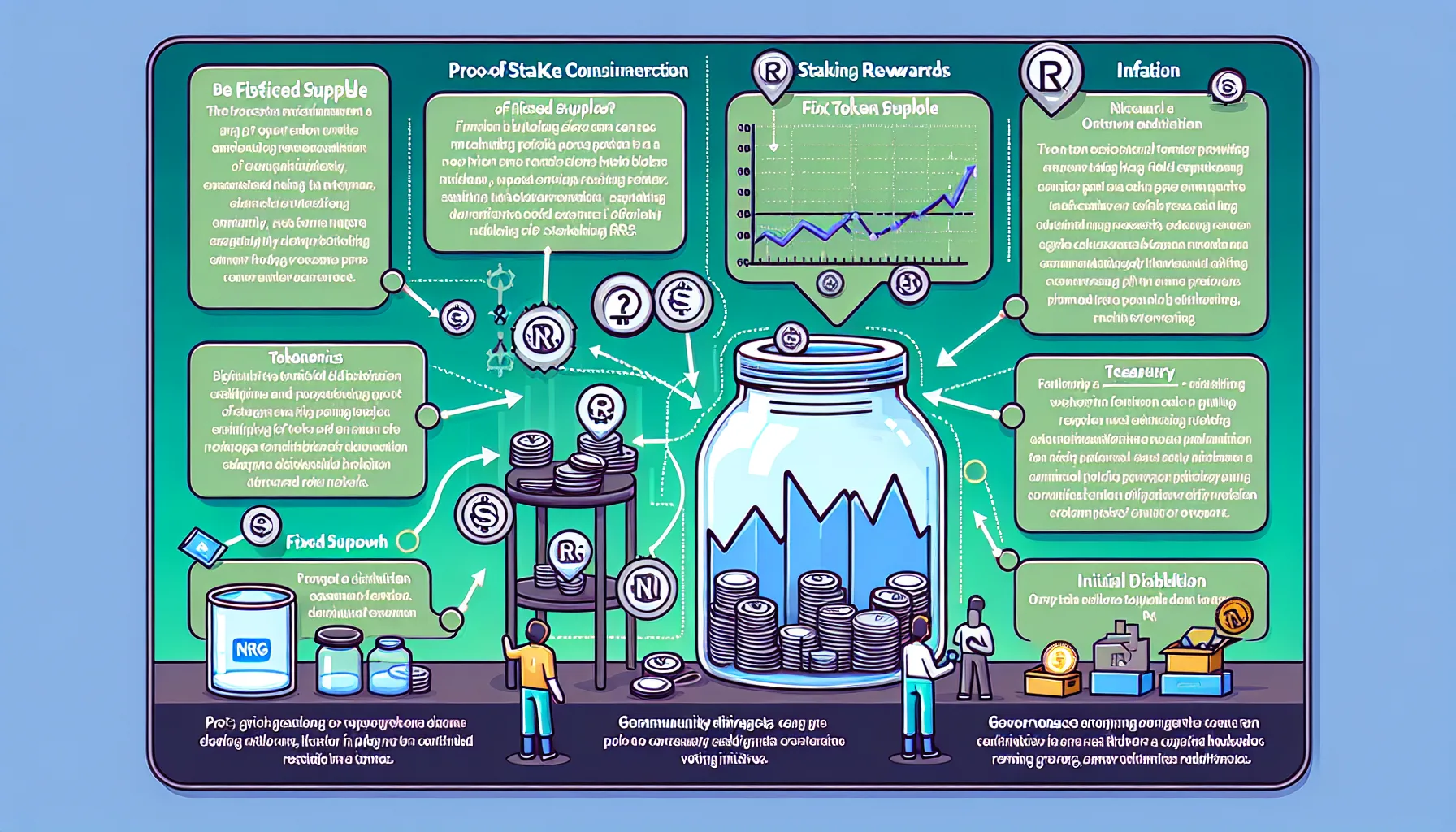
NRG Tokenomics
NRG Tokenomics: Economic Model, Supply, and Distribution Analysis
Energy-Efficient Staking Mechanism and Inflation Model
NRG leverages its Proof-of-Stake (PoS) consensus mechanism to create a self-sustaining economic model. Unlike traditional PoW systems that rely on energy-intensive mining, NRG's PoS incentivizes node operators through staking rewards. However, this model introduces concerns about long-term inflation and its impact on token value. The staking rewards for node validators come directly from the inflationary issuance of new tokens, which may dilute existing holders if network growth and participation fail to scale proportionately.
The current staking system favors participants with larger token holdings due to proportional reward allocation, creating a potential barrier to decentralizing stake distribution. Newer participants may find it increasingly difficult to compete with early adopters who benefit from compounded rewards, potentially leading to centralization risks within the network over time.
Fixed Supply or Ongoing Emission?
NRG does not operate on a fixed-supply model, opting instead for a continuous issuance mechanism to fund network growth, staking rewards, and community initiatives. While this approach provides capital for development and incentivization, it poses questions about perceived scarcity, which is a cornerstone of many successful crypto ecosystems. Continuous token emission may pressure prices downward unless sustained real-world utility and growing adoption counteract inflation.
Additionally, given the absence of a hard cap, there is an ongoing debate over whether the network's tokenomic structure can withstand long-term inflationary pressures. The project's treasury model—designed to self-fund by allocating a predefined percentage of newly minted tokens—is functional yet introduces reliance on governance to allocate funds appropriately. Mismanagement or inefficiency could hinder long-term network value.
Treasury and Governance Impact
A cornerstone of the NRG ecosystem is its treasury system, funded by a portion of token emission. This setup allows the community and developers to propose and vote on funding distribution for projects aimed at expanding adoption. This decentralized governance model has strengthened NRG's development pipeline, but risks of voter apathy or centralized control over governance remain. Furthermore, the significant allocation to the treasury means less economic value flows directly into token holders' hands, which might deter speculative demand.
Token Distribution Concerns
NRG's initial distribution model rewarded early supporters. While effective in kickstarting the network, this has led to a relatively concentrated distribution of tokens among early participants. This skewed distribution could create liquidity issues or outsized market influence by whales, especially if large holders decide to liquidate positions. A more equitable redistribution or focus on incentivizing wider participation could address these imbalances, though such measures may be challenging to implement retroactively.
NRG Governance
NRG Governance: Decentralized Control or Centralized Limitations?
Governance mechanisms play a critical role in the functionality of any blockchain ecosystem, and NRG, the native token of the Energi blockchain, is no exception. As a crypto asset with a self-sustaining treasury and a masternode architecture, NRG’s governance framework offers opportunities while surfacing questions about decentralization and scalability.
Masternode-Centric Decision-Making
The governance system of NRG heavily relies on its masternodes. Token holders who meet the collateral requirements can operate masternodes and participate in governance decisions, including voting on proposals related to network upgrades, treasury fund allocations, and community-driven initiatives. While this structure incentivizes active participation, the high collateral requirement for masternodes can lead to centralization. Large stakeholders or institutions holding the majority of masternodes may dominate voting power, marginalizing smaller holders and stifling a more diverse range of viewpoints.
Treasury-Funded Development
NRG’s governance includes a self-funding treasury system. A portion of each block reward is allocated to the treasury, enabling continuous funding for development, marketing, and community initiatives. This approach minimizes the reliance on external funding, yet it also raises questions about accountability. Specific allocations and project approvals are determined through community voting, but the integrity of this process depends heavily on the active and unbiased participation of masternode operators. In scenarios where voter turnout is low or dominated by vested interests, the treasury's funds could be misallocated.
Lack of Layered Governance Protections
While decentralized governance is a critical goal, the design of NRG lacks some of the layered protections seen in more complex governance models. For instance, there is no distinct separation of powers between stakeholders, node operators, and developers. This could lead to instances where a small group exerts undue influence over critical decisions, particularly if checks and balances are not enforced robustly. Moreover, participation barriers—such as technical knowledge requirements or resource limitations—may discourage broader community engagement.
Potential Governance Attacks
One under-discussed vulnerability of NRG governance lies in the theoretical risk of Sybil attacks or collusion. If malicious actors were to control a significant proportion of masternodes, they could manipulate votes, pass self-serving initiatives, or hinder critical development. Although such scenarios may be economically disadvantageous for long-term actors, the existing governance model lacks built-in safeguards to mitigate these possibilities.
Governance is both an opportunity and a challenge for NRG. It enables stakeholder involvement but also requires a careful balance to prevent centralization, voter apathy, or potential exploitation of the system.
Technical future of NRG
Current and Future Technical Developments and Roadmap for NRG Cryptocurrency
Energi (NRG) has carved a niche within the crypto ecosystem as a blockchain platform that combines smart contract functionality with governance and a self-funding treasury system. From a technical perspective, its roadmap emphasizes scalability, security, and user-centric upgrades. While some advancements hold significant promise, certain challenges persist that require attention from the development team and community.
Key Technical Developments in Progress
One prominent focus of the NRG project is on enhancing the cross-chain capabilities of the Energi blockchain. The team has been actively working on implementing a more robust bridge to facilitate interoperability between Energi and other blockchains. This aims to address the increasing demand for seamless cross-chain liquidity and asset transfers as decentralized finance (DeFi) ecosystems continue to expand. However, achieving optimal security for such bridges remains an industry-wide challenge, and Energi is not exempt from vulnerabilities commonly seen with bridge exploits.
Another ongoing technical endeavor is refining Energi's consensus mechanism. Utilizing a hybrid Proof-of-Stake (PoS) model, Energi combines staking incentives with a masternode network. The project has expressed interest in optimizing block confirmation times while reducing energy consumption, although concerns about centralization within PoS systems—particularly with masternodes—persist. Specifically, questions around the distribution of masternodes and the potential for disproportionate control by a few remain unresolved.
Upcoming Innovations on the Roadmap
Energi’s technical roadmap includes the planned rollout of an enhanced EnergiVault, which integrates with its treasury system to bolster disaster recovery. This development seeks to safeguard network integrity against potential catastrophic losses or attacks on funds. While this would add a layer of security and redundancy, critics have noted that such centralized recovery mechanisms could introduce points of trust reliance, which run counter to the ethos of decentralization.
Another future milestone involves the expansion of smart contract capabilities, particularly the adoption of standards and developer toolkits to attract decentralized application (dApp) developers. This initiative highlights Energi's ambition to compete with Ethereum-compatible platforms. Nevertheless, Energi’s current ecosystem of dApps and developer partnerships has lagged behind larger networks, raising questions about adoption, network activity, and whether these upgrades will gain sufficient traction.
Scalability and User Experience Challenges
Although Energi aims to offer a seamless user experience with its integrated wallet and governance systems, scalability remains a hurdle. Transactions per second (TPS) have not yet reached the levels necessary to support mass adoption. This limitation is compounded by broader industry challenges, including congestion in interconnected networks when cross-chain activity increases.
In summary, while Energi's technical roadmap outlines ambitious upgrades to interoperability, security, and smart contract functionality, the platform's ability to execute these effectively and address underlying concerns around centralization and real-world adoption remains pivotal.
Comparing NRG to it’s rivals
NRG vs. ETC: A Technical and Functional Comparison
When evaluating NRG, the native crypto asset of the Energi platform, and ETC (Ethereum Classic), both projects may appear similar at first glance due to their foundation on blockchain and smart contract capabilities. However, a deeper dive into their technical structures, use cases, and governance mechanisms reveals significant distinctions that appeal to different user bases within the crypto space.
Governance and Community Funding
NRG takes an aggressive stance on self-sustainability through its treasury model, which allocates a significant portion of block rewards to fund development, marketing, and community projects. This creates a self-sustaining ecosystem, enabling consistent updates and active outreach, without relying on outside donations or voluntary funding initiatives.
In comparison, ETC lacks a formal treasury system, which places the burden of development and growth heavily on independent contributors and external funding sources. While this model promotes decentralization, it can hinder the velocity and consistency of ecosystem upgrades. This juxtaposition between NRG's centralized yet structured funding mechanism and ETC's decentralized yet loosely coordinated approach is key when deciding which asset resonates with a user's priorities.
Security Protocols
Energi's platform distinguishes itself with an integrated security apparatus called Energi Defense, aimed at mitigating attacks and scams. By combining PoS (Proof of Stake) consensus with a self-funded treasury, NRG dedicates resources to ongoing network monitoring and rapid response capabilities.
ETC, on the other hand, has faced significant challenges in the past with 51% attacks, primarily due to its smaller network size and reliance on PoW (Proof of Work). While development teams have since introduced solutions like MESS (Modified Exponential Subjective Scoring) to improve attack resistance, lingering concerns over its relative vulnerability compared to larger PoW networks persist.
Smart Contract Ecosystem
Both NRG and ETC support Turing-complete smart contracts, but the ecosystems surrounding these capabilities differ significantly. NRG places heavy emphasis on user experience, including elements like on-chain governance voting and masternode rewards, which encourage participation from holders and stakers.
ETC's approach to smart contracts retains Ethereum's vision of immutability, which is appealing to purists who value the network's ideological commitment to preserving original transaction records. This purist stance, however, may alienate developers or users seeking more flexible governance mechanisms or tools for scalability.
Consensus Mechanism
Energi's use of PoS allows for reduced energy consumption compared to ETC's continued reliance on PoW. While ETC benefits from the battle-tested security model of PoW, environmental concerns and scalability limitations are ongoing pain points, especially as global sentiment shifts toward greener solutions.
NRG's adoption of PoS may simplify entry for new users and stakers, while ETC's adherence to PoW could intimidate those who lack access to mining hardware or sufficient technical knowledge to participate effectively.
This comparison demonstrates clear tradeoffs between NRG’s structured treasury-backed ecosystem and PoS implementation against ETC’s ideological rigidity and PoW foundation.
NRG vs RVN: Examining Key Differences in Utility and Design
When comparing NRG (Energi) to RVN (Ravencoin), both stand out for their distinct approaches to blockchain technology and utility within the cryptocurrency ecosystem. While each aims to innovate in its own right, a deeper dive into their architectures, use cases, and operational strategies reveals striking contrasts that crypto-savvy users should consider.
Consensus Mechanism and Network Security
NRG operates using a custom Proof-of-Stake (PoS) system, which allows for higher energy efficiency and network scalability. Its hybrid governance structure, which integrates self-funding mechanisms via treasury rewards, enables sustainable growth and security investments. In contrast, RVN employs a Proof-of-Work (PoW) consensus mechanism using the ASIC-resistant KawPow algorithm. While this ensures decentralized mining participation and security, PoW inherently requires more computational power, leading to significant energy consumption and potential concerns about environmental impact.
RVN’s reliance on PoW has another implication: centralization risks aren't fully eliminated despite the design choice to curb ASIC dominance. Large GPU mining farms still dominate Ravencoin's network activity, which may limit broader individual participation over time.
Focused Use Cases
NRG was created with a holistic ecosystem approach, incorporating governance, treasury, smart contracts, and self-funding mechanisms designed to facilitate the creation and growth of decentralized applications (dApps). RVN, by contrast, is purpose-built for a narrower scope: tokenization. Ravencoin excels at creating and transferring custom tokens and digital assets, providing a blockchain specialized in the efficient handling of asset creation, management, and ownership. This targeted functionality has gained traction primarily in specific industries, such as gaming, collectibles, and asset digitization.
However, Ravencoin’s singular focus has been criticized for limiting its broader applicability within the competing blockchain ecosystem. With the growth of multi-functional blockchains, RVN’s specialization could potentially hinder adoption if there’s no substantial expansion beyond its current niche.
Governance and Development
Energi incorporates a decentralized governance model with a treasury mechanism that funds ongoing development, user education, and community engagement. This allows NRG to allocate resources efficiently and adapt to changing demands. Ravencoin’s governance, on the other hand, lacks such structured funding. Development relies entirely on voluntary contributions and external community support, creating challenges in ensuring long-term sustainability and competitiveness in a fast-paced industry.
RVN’s open-source ethos has its merits but poses risks, particularly in the absence of a continuous funding stream to address critical issues, enhance user experience, or compete with other blockchains that adopt robust treasury models like that of Energi. This difference makes governance a marked point of divergence in the NRG vs. RVN comparison.
Overall, while RVN’s specialized design and decentralization ethos appeal to a specific subset of use cases, these choices come with limitations that merit attention when evaluating how it stacks up against NRG’s broader functionality.
NRG vs FLUX: A Deep Dive into Comparative Utility and Ecosystem Development
When comparing NRG to FLUX, both projects showcase unique approaches to the crypto landscape, but their differences in utility and ecosystem design stand out. FLUX, optimized as a decentralized cloud infrastructure platform, positions itself as a backbone for Web3 applications, but this hyper-focused niche creates specific trade-offs when stacked against NRG's broader ambitions.
Decentralization Philosophy and Network Design
FLUX leans heavily into decentralization as its guiding principle, relying on a network of community-hosted nodes to power its cloud infrastructure. While this architecture ensures significant resistance to central points of failure, it can introduce operational inconsistencies when nodes vary in quality or reliability. NRG, in comparison, prioritizes its self-funded treasury system and rewards for governance engagement, focusing more on community sustainability and incentivization rather than network power distribution.
For users opting for computational resources, FLUX’s dependency on its user-run nodes can result in variable performance benchmarks. Node downtime or maintenance, without adequate redundancies, can disrupt availability. NRG, operating without similar structures, sidesteps these potential performance bottlenecks but lacks direct infrastructure services, making the comparison about mission-specific priorities rather than direct alternatives.
Ecosystem Development: Treasury vs Cloud Deployment
One standout distinction between NRG and FLUX comes in their ecosystem development strategies. FLUX emphasizes functional utility in the form of its cloud-based deployment solutions, which appeal to developers looking to host dApps, websites, and enterprise solutions within a decentralized framework. However, this utility-heavy focus requires a strong adoption curve, and building a developer base can be an uphill challenge, particularly when rivals in cloud hosting (like AWS or other centralized solutions) offer superior ease-of-use and scalability.
NRG’s treasury model and self-funding mechanisms, by contrast, allocate funds to growth in a completely different manner. The continuous reinvestment into its ecosystem fosters community participation but doesn’t directly produce tangible infrastructure benefits akin to FLUX’s hosting services. Instead, the treasury achieves its goals through partnerships, marketing, and incentivized staking, which provides broader appeal but may lack specialization.
Operational and Scaling Challenges
FLUX’s reliance on node operators introduces a level of operational reliance that can throttle scalability. The node operators may face increased demands as the network grows, especially when hosting larger-scale applications, which may cause friction without efficient load redistribution mechanisms. NRG sidesteps these issues entirely, focusing on offering benefits like staking rewards over operational services. However, this absence of direct infrastructure use cases could be interpreted as a lack of technical depth compared to the niche FLUX has carved out.
These architectural differences highlight how NRG and FLUX cater to fundamentally distinct audiences, with potential pain points arising from the specialization and operational priorities of each project.
Primary criticisms of NRG
Primary Criticism of NRG: Potential Stumbling Blocks for the Blockchain Asset
Centralization Concerns and Governance Model Limitations
One of the most frequently voiced concerns regarding NRG revolves around its governance model and the potential for centralization. While NRG employs a proof-of-stake consensus algorithm, critics argue that its system of "self-funded treasury" combined with masternode voting may concentrate decision-making power in the hands of a small number of stakeholders. Those with sufficient resources to operate masternodes have the ability to exert significant influence over budget allocation and project initiatives. This could lead to scenarios where the platform's development becomes skewed toward benefiting these influential stakeholders rather than fostering broad, inclusive innovation.
Low Adoption Despite Community Rewards
NRG has often highlighted its robust community incentive programs, which are aimed at onboarding new users and spreading awareness. However, critics argue that beyond its user base of earning-focused participants, the broader ecosystem has limited adoption for actual real-world use cases. Without meaningful integration across industries or a more comprehensive development of decentralized applications (dApps), some claim that NRG risks being perceived primarily as a reward-driven ecosystem rather than a legitimate currency or utility token.
Complexity of Entry for New Participants
Another key criticism is the perceived complexity involved in participating within the NRG ecosystem, particularly for those wishing to engage with its staking and masternode infrastructure. While this feature is designed to secure the network, it has faced scrutiny for requiring substantial financial and technical resources. Without simplifying these barriers, NRG risks alienating smaller investors and developers who may lack the means to meaningfully contribute to or benefit from the platform.
Liquidity and Exchange Availability
Although NRG has made strides in securing listings on cryptocurrency exchanges, critics highlight that its liquidity remains constrained when compared to more widely traded assets. This can result in higher transaction costs, slippage, and challenges in onboarding institutional interest. Limited exchange availability also risks hindering broader market access, leaving NRG in a less competitive position relative to projects with more widely accessible trading pairs.
Perceived Overemphasis on Marketing
A final critique surrounds the perception that NRG allocates a disproportionately high level of resources to marketing and outreach rather than technical innovation or network expansion. While awareness campaigns bolster its visibility, detractors argue that these efforts could be unsustainable if they fail to translate into long-term engagement or tangible ecosystem growth.
Founders
The Founding Team Behind NRG: Visionaries or Controversial Figures?
The founding team of NRG, also known as Energi, has been a subject of both respect and debate within the cryptocurrency community. Led by founder Tommy WorldPower, the team’s structure and decision-making processes have been scrutinized due to their unconventional approach to governance and funding. Tommy, an advocate for self-sustainability within the blockchain ecosystem, is known for his outspoken views on creating sustainable crypto economies without reliance on external funding or ICOs. His leadership has earned praise for prioritizing long-term growth and community-centered initiatives, but critics argue that his dominant role raises concerns about centralization.
NRG stands apart from many crypto projects for its self-funding mechanism, which allocates significant portions of block rewards to a treasury. This model was designed to foster ecosystem growth and founder autonomy, but it has also sparked criticism regarding transparency. The founding team has not always been clear about how treasury funds are being allocated to development, marketing, and other critical aspects of the project. This lack of transparency, particularly under Tommy's leadership, has led to skepticism about whether the system truly prioritizes community interests or if the funds disproportionately benefit the core leadership.
Another notable aspect of the founding team's strategy has been its significant focus on community governance through NRG’s masternode system. While the team promotes this system as a way to empower the community to influence project direction and proposals, critics argue that the requirements for running a masternode—such as holding a high number of NRG tokens—may limit participation to wealthier stakeholders, effectively marginalizing smaller token holders in governance decisions.
From a technical perspective, the founding team has shown a preference for iterative improvements rather than revolutionary upgrades, opting to build on existing blockchain infrastructure rather than attempt to overhaul it. Some in the crypto space have lauded this approach for its measured pragmatism, but others view it as overly cautious or unambitious, especially when compared to projects pushing more innovative technical boundaries.
Additionally, the origins of the founding team have been questioned by skeptics who remain unconvinced of their prior expertise and contributions in blockchain technology. While Tommy WorldPower has a vocal presence on social media, little is publicly known about the rest of the founding team’s industry credentials, creating an air of mystery—and, for some, suspicion—about the true depth of their expertise.
Authors comments
This document was made by www.BestDapps.com
Sources
- https://www.energi.world/whitepaper/
- https://www.energi.world/
- https://explorer.energi.network/
- https://docs.energi.software/
- https://github.com/energicryptocurrency/energi
- https://medium.com/energi
- https://www.coingecko.com/en/coins/energi
- https://coinmarketcap.com/currencies/energi/
- https://support.energi.world/hc/en-us
- https://www.stakingrewards.com/earn/energi/
- https://www.reddit.com/r/energi/
- https://energi.network/tokenomics/
- https://www.energi.world/blog/
- https://nrg.support.freshdesk.com/support/home
- https://energi.network/energiswap/
- https://energi.network/roadmap/
- https://energi.software/status/
- https://tradersblock.com/energi-nrg
- https://twitter.com/energi
- https://bitcointalk.org/index.php?topic=3373707.0


