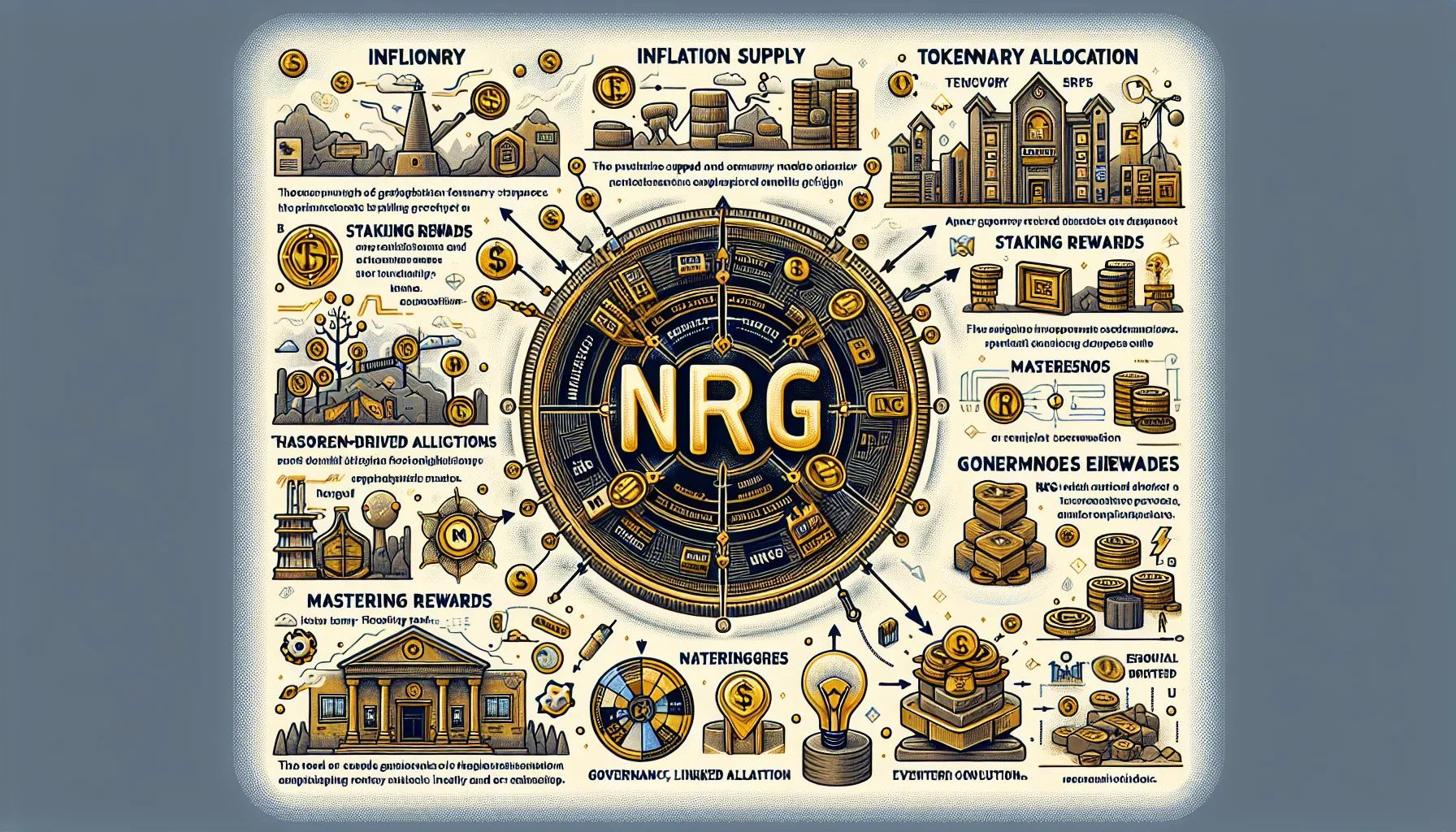
History of NRG
The History of Energi (NRG): A Journey Rooted in Governance and Sustainability
Energi (NRG), launched in 2018, distinguishes itself from many other projects in the crowded crypto landscape by prioritizing self-sustainability through innovative funding mechanisms and governance structures. Founded by Tommy World Power, Energi was conceived as a cryptocurrency that addresses critical shortcomings in existing blockchain ecosystems, particularly in governance, funding for development, and scalability. The idea was to build a robust, self-funding ecosystem that could grow independently without constant reliance on outside investments or fundraising.
From its inception, Energi adopted a unique regenerative funding model through its allocation of block rewards. Instead of focusing on mining incentives alone, the project introduced a 60-20-20 allocation split: with 40% of rewards destined for its Treasury, 40% for stakers (after Energi transitioned to proof-of-stake), and the remaining 20% for masternodes. This design has been pivotal in creating a self-sufficient ecosystem, enabling project developers to focus on long-term growth and ongoing advancements.
Energi’s early days benefitted from its decision not to hold an ICO (initial coin offering) or engage in pre-mining. By diverging from speculation-driven token distribution models, Energi aimed to mitigate centralization risks and discourage the short-term profiteering often observed in the crypto market. However, critics have pointed out that such a structure makes the platform heavily dependent on the maturity and efficiency of its Treasury allocation. Mismanagement or inefficiency in fund utilization could pose threats to project sustainability, an issue Energi continues to navigate.
Energi introduced its “Smart Contracts” in 2020, enabling developers to build decentralized applications (dApps) natively on its blockchain. While seen as a significant milestone, this move also brought the project into competition with more established smart contract platforms like Ethereum and Binance Smart Chain. Achieving wider adoption in a saturated market remains an ongoing struggle for Energi.
Another point of differentiation in Energi’s approach has been its commitment to governance. With regular voting mechanisms incorporated into the network, all stakeholders theoretically share input in the ecosystem's direction. While this has been praised as democratizing the platform, some have questioned how effectively governance decisions are implemented and whether they align with token holders’ best interests.
Energi’s history is intertwined with its philosophy of self-sustainability and governance, though the execution of these ideals continues to evolve under the scrutiny of its community and critics.
How NRG Works
How NRG Crypto Asset Works: A Deep Dive Into Its Mechanics
The NRG cryptocurrency operates on its proprietary blockchain, leveraging a combination of Proof of Stake (PoS) and self-funding treasury models to enable decentralized governance, incentivized staking, and community engagement. Designed as a self-sustaining ecosystem, its structure balances economic incentives, network security, and long-term utility. Here is an in-depth look at how the mechanics of NRG function.
Proof of Stake and Staking Rewards
NRG implements a PoS consensus mechanism, where validators, known as stakers, lock their NRG tokens to validate transactions and secure the network. Unlike Proof of Work (PoW) blockchains, PoS removes the need for energy-intensive mining, giving NRG a more sustainable operational model. Stakers on the NRG network are rewarded with newly minted tokens as incentives, creating an emissions model that contributes to overall liquidity. However, the distribution of staking rewards has raised concerns of accumulation risks, where wealthier participants holding larger stakes potentially contribute to centralization over time.
Treasury-Funded Ecosystem
The NRG blockchain incorporates a self-funded treasury model, allocating a fixed portion of block rewards to fund development, marketing, and other initiatives aimed at growth. This model ensures that the project does not rely on external funding sources for maintenance or innovation. While it provides autonomy, critics have pointed out the opacity of allocation methods, as the decision-making process concerning treasury use is not always transparent. Furthermore, the centralized control over treasury disbursements may create governance risks if mismanaged.
Masternodes and Governance
NRG integrates masternodes, participants who take on elevated roles in the network by locking a higher minimum number of tokens. These masternodes enable governance voting, transaction verification, and protocol-level decision-making. Governance involves community voting on proposals relating to the network’s future, which, in theory, democratizes decision-making. However, the high barrier to entry for running a masternode, both in terms of token requirement and technical expertise, could discourage wider participation, leaving governance in the hands of a relatively small subset of stakeholders.
Transaction Efficiency and Scalability
NRG provides fast transaction confirmation times coupled with low fees, making it an attractive option for users prioritizing efficiency. However, scalability remains a concern as with many blockchain networks. Without further enhancements in throughput capacity, the network might face congestion problems as adoption increases.
Security and Codebase
NRG’s blockchain places a strong emphasis on security, employing robust cryptographic techniques. Additionally, the codebase undergoes regular reviews to prevent vulnerabilities. Still, as with any blockchain, it is not immune to potential exploits or flaws, particularly in cases where the network topology might enable targeted attacks on a small validator pool.
Use Cases
Exploring the Use Cases of NRG: Energy Web Chain's Native Cryptocurrency
NRG is the native cryptocurrency of the Energy Web Chain, a blockchain designed to revolutionize the energy sector. Beyond being a typical token, NRG serves distinct roles that cater to specialized use cases aligned with the evolving decentralized energy ecosystem. Here’s a breakdown of where and how the token finds application, as well as potential challenges tied to its utility.
1. Grid Decentralization and Peer-to-Peer Energy Markets
One of the core use cases of NRG revolves around enabling peer-to-peer (P2P) energy trading frameworks. On the Energy Web Chain, NRG is typically used as a medium of exchange within these markets, facilitating transactions between energy producers and consumers without intermediaries. For example, private households generating surplus solar energy can "sell" their excess power directly to neighbors or businesses, with payments settled using NRG.
However, scalability concerns linger. P2P energy trading can lead to network congestion due to a high transaction volume, potentially impacting transaction speeds and fees for participants.
2. Staking to Secure the Network
NRG plays a critical role in the Energy Web Chain's Proof-of-Authority (PoA) consensus mechanism. Trusted validators are required to stake NRG to participate in securing the network and processing transactions. This incentivizes long-term engagement and helps align validators with the network's operational integrity.
Yet, concerns stem from the centralization risks inherent in PoA systems. Since validator nodes are pre-selected, critics argue this could reduce competition, leaving the network open to governance-related vulnerabilities.
3. Smart Contract Execution for Energy Efficiencies
NRG powers smart contracts that optimize energy distribution, pricing, and grid management. These contracts aim to improve efficiency in large-scale applications, such as utility grids or renewable energy certificates, which rely on automating interactions between numerous parties.
The downside here is tied to technical barriers. Complex smart contract designs require expertise and resources, which could limit adoption by smaller players in the energy sector who might lack the means to engage with programmable energy markets.
4. Incentives for Decarbonization Initiatives
Various projects leveraging the Energy Web Chain use NRG to reward participants in decarbonization efforts. For instance, corporations looking to meet sustainability targets can use the token to incentivize clean energy production or reward users for reducing energy consumption.
A looming question here is whether such incentives are sustainable over time. As the adoption scales, demand-side pressures might inflate NRG's utility costs, potentially diminishing participation rates.
Conclusion
NRG's suite of use cases ties closely to its mission of enabling a decentralized and efficient energy future. While powerful, these applications are not without their limitations, particularly in relation to scalability, governance concerns, and adoption barriers.
NRG Tokenomics
NRG Tokenomics: A Deep Dive into Supply Dynamics and Incentive Structures
The tokenomics of NRG, the native cryptocurrency of the Energi platform, exhibits a unique structure distinct from typical blockchain models. This section explores the intricacies of its supply distribution, governance-driven allocation mechanisms, and potential challenges stemming from its economic design.
Inflationary Supply Model
NRG utilizes an inflationary model as opposed to a fixed token supply. New tokens are generated through staking rewards, which are distributed block by block. This mechanism ensures continuous incentivization for validators participating in the Energi ecosystem but raises concerns about long-term inflationary pressure. Active governance has a critical role in calibrating the staking reward rate to prevent dilution of value for token holders. For cautious investors, the capacity for ongoing community oversight is both an advantage and an area requiring vigilant management.
Treasury-Driven Allocation
One of the standout features of NRG tokenomics is the allocation of its treasury. A substantial percentage of each block reward is funneled into the self-funding treasury system, designed to support development, marketing, and ecosystem growth initiatives. This decentralized funding mechanism aligns incentives by empowering governance participants to vote on treasury utilization. While this structure fosters adaptability and self-sufficiency, it introduces potential risks in the form of governance centralization. Concentrated voting power among major token holders could result in biased allocation of resources, potentially prioritizing short-term returns over long-term project sustainability.
Staking Rewards and Masternode Incentives
NRG tokenomics heavily rely on staking rewards and masternode operation incentives. A large portion of newly minted tokens is allocated to masternode operators, who are critical to securing the Energi network and facilitating transactions. While this structure strengthens network security, the high entry barrier for masternode operation—due to the sizable NRG collateral required—creates a system where wealthier participants disproportionately benefit. This dynamic may hinder broader decentralization and participation, posing additional centralization risks.
Governance-Linked Allocation Dynamics
Governance within the NRG ecosystem is tightly woven into its tokenomics, as stakeholders vote on treasury decisions and protocol updates. However, the "one token, one vote" framework raises concerns about disproportionately amplifying the influence of high-value stakeholders. This model presents an inherent challenge: aligning network growth with fair representation. Without strategic safeguards, the risk of plutocratic governance could alienate smaller token holders, potentially hampering community engagement.
In summary, NRG's tokenomics stand out for their emphasis on governance-driven funding and incentivization mechanisms. However, the elements of inflation and potential centralization risks warrant close scrutiny for participants navigating this ecosystem.
NRG Governance
NRG Governance: Decentralization and Voting Mechanisms in Focus
The governance framework of NRG is one of its most defining elements, structured around a decentralized, community-driven model that gives token holders direct influence over network decisions. Built on the principle of ensuring democratic participation, NRG governance employs a voting mechanism to manage protocol upgrades, treasury fund allocations, and community proposals. While the framework emphasizes inclusivity, several nuances and challenges emerge when assessed critically.
At the core of NRG's governance is the staking process. Token holders lock their NRG to participate in on-chain voting, a mechanism designed to align incentives with the network's long-term vision. However, this model may unintentionally favor participants with substantial token holdings, creating a potential centralization of influence. Smaller stakeholders often find it challenging to have meaningful sway over critical decisions due to their limited voting power. This dynamic, while not unique to NRG, remains a notable trade-off in its governance structure.
Another pivotal element of NRG governance is the treasury system. The protocol allocates a portion of block rewards to the treasury, which is then distributed to fund ecosystem development, marketing, and community initiatives. While this approach bolsters transparency, disputes over fund utilization have occasionally surfaced. Without rigorous oversight, there's a risk of misaligned priorities or inefficient allocation, particularly when proposals lack clear accountability or measurable outcomes.
Furthermore, NRG’s emphasis on community engagement presents logistical hurdles. Achieving high voter turnout often proves difficult, mirroring a broader challenge in decentralized systems. Although staking incentives partly mitigate voter apathy, participation rates may still lag during less contentious or highly technical decision-making processes. When turnout is low, the risk of governance capture by well-coordinated interest groups grows, potentially leading to decisions that do not reflect the broader community's will.
Additionally, proposal creation within the NRG network demonstrates both strengths and vulnerabilities. While allowing any stakeholder to submit a proposal fosters inclusivity, it also opens the door to an influx of poorly vetted or redundant proposals. This can dilute attention and resources, impeding actionable governance outcomes. Effective filtering mechanisms are essential to prevent governance inefficiencies and fatigue among voters.
In summary, NRG’s governance design embodies many of the ideals associated with decentralized decision-making but faces the inherent challenges of balancing equitable participation, transparency, and efficiency. Its ongoing evolution will likely determine the system's ability to scale and adapt over time.
Technical future of NRG
NRG Crypto Asset: Current and Future Technical Developments
NRG, the native cryptocurrency of the Energi blockchain, continues to position itself as a platform aiming to balance scalability, security, and user empowerment. On a technical level, the project is currently focused on a range of developments, both in its core architecture and auxiliary features, to remain competitive in the rapidly evolving blockchain ecosystem.
Current Technical Developments
One key technical innovation within the Energi ecosystem is its adoption of masternode governance and Proof-of-Stake consensus. While these mechanisms offer increased scalability and energy efficiency compared to Proof-of-Work systems, they are not without challenges. Sustaining a decentralized network of masternodes requires active participation, which could be bottlenecked if staking incentives fail to keep up with network maintenance demands. Additionally, questions remain about the potential centralization of governance if masternode control consolidates in the hands of a few.
NRG emphasizes its self-funding treasury model, where a share of block rewards goes to a treasury for ecosystem development. Technically, such a system is an appealing feature to ensure ongoing innovation, but its sustainability will depend on the governance framework and how efficiently those funds are allocated. Critics have pointed out that treasury systems in blockchain projects may incur opacity issues or potential mismanagement without robust auditing mechanisms in place.
The recently upgraded Energi Defense and Security systems aim to tackle threats like phishing scams and wallet exploits, common plagues in the crypto industry. However, blockchain-wide security enhancements must coexist with user-side education and awareness—an area that Energi cannot fully control.
Future Roadmap and Direction
Energi’s roadmap highlights plans to enhance its smart contract capabilities, a crucial step in competing with Ethereum and other programmable blockchains. However, building a scalable and developer-friendly environment poses significant hurdles. The ecosystem must establish a more competitive development toolkit and developer onboarding process to attract dApp builders. Without a high adoption rate by developers, these efforts risk stagnation.
Furthermore, the integration of cross-chain interoperability is on the horizon. While this development carries the promise of expanding liquidity and use cases for NRG, successful implementation hinges on Energi’s ability to construct seamless bridges to other blockchain networks. Missteps in bridge development, such as poorly audited smart contracts or mishandled token swaps, could lead to exploit risks.
Scalability also looms as a future challenge. While the current infrastructure appears capable of handling the network's present transaction load, it must evolve to withstand increased demand should adoption grow. Proactive scaling strategies, possibly exploring rollups or sharding solutions, will be critical for mitigating future bottlenecks.
In summary, while NRG showcases an ambitious technical framework and ongoing developments, real-world implementation and adaptation will ultimately dictate its sustainability in a competitive crypto market.
Comparing NRG to it’s rivals
NRG vs. FLUX: A Detailed Comparison of Energy Efficiency and Decentralized Functionality
When evaluating NRG and FLUX, it's essential to focus on how both crypto assets handle scalability, decentralization, and network efficiency. NRG boasts a unique Proof-of-Stake (PoS) consensus design that prioritizes energy efficiency while maintaining strong security parameters. In contrast, FLUX operates on a hybrid model of Proof-of-Work (PoW) and customized consensus mechanisms, which raises questions around energy usage and eco-friendliness compared to NRG’s streamlined PoS.
Governance and Community Involvement
NRG is notable for its decentralized governance system, which allows the community to vote on developmental changes and ecosystem upgrades. This model has often been praised for fostering active stakeholder involvement. However, some critics argue that its governance structure can trend toward centralization due to the requirements for node participation. FLUX offers a more layered governance model through its tiered node system, enabling varying degrees of participation and influence. This system provides additional flexibility but may create barriers for new entrants with limited resources.
Incentive Structures and Rewards
The financial incentives for supporting each network showcase a divergence in philosophy. NRG’s staking model rewards long-term holders who actively participate in governance. While this rewards loyalty and engagement, some critics point to the higher entry barriers for new users without sufficient stakeable holdings. FLUX, on the other hand, leans toward incentivizing infrastructure contributors by rewarding node operators who provide computational resources for decentralized applications. This model appeals to developers and technical users but could alienate non-technical investors seeking simpler earning opportunities.
Decentralized Ecosystems
NRG and FLUX are both committed to decentralization but emphasize it in different ways. NRG has built an ecosystem primarily focused on transaction efficiency and governance, where all nodes have equal weight in maintaining the network’s health. Critics, however, suggest that this hyper-focus on governance has left certain developer tools and integrative features underprioritized. FLUX, conversely, caters heavily to Web3 and decentralized application (dApp) hosting, offering comprehensive tools for developers. While this approach positions FLUX as more robust for complex applications, it risks overextending resources and creating centralization risks through reliance on its infrastructure providers.
Scalability Concerns
While NRG enjoys high transaction throughput and minimal operational costs due to its PoS framework, some users have voiced concerns over potential congestion if its user base expands dramatically. FLUX’s hybrid architecture allows it to handle heavy computational tasks seamlessly, yet its reliance on resource-intensive nodes makes efficient scaling an ongoing challenge.
NRG vs SYS: A Technical and Functional Comparison of Blockchain Ecosystems
When analyzing NRG in comparison to SYS, both crypto assets showcase distinct approaches to their respective ecosystems—each catering to unique use cases and priorities. NRG focuses heavily on sustainability and decentralized governance, while SYS offers a broader toolkit for blockchain development, with its eye on scalability and innovation for enterprise-level apps.
Consensus and Governance: A Divergence in Approach
NRG prioritizes a self-funding treasury mechanism and uses a Proof-of-Stake (PoS) consensus algorithm designed to incentivize network participants while maintaining energy efficiency. While SYS also leverages PoS in conjunction with masternodes, it incorporates an additional layer called "Z-DAG" (Zero Confirmation Directed Acyclic Graph) technology to enhance transaction throughput. This dual-layer approach does improve SYS's transactional performance but can complicate the network's overall structure, potentially leading to centralization risks within the masternode system. NRG, by comparison, avoids such additional layers, focusing on simplicity and balancing decentralization while maintaining an energy-efficient design.
Smart Contracts and Token Ecosystems: A Gap in Capabilities
SYS excels in fostering adoption through its strong interoperability framework and tokenization tools, such as the Syscoin Token Platform. With Ethereum Virtual Machine (EVM) compatibility, SYS enables developers to deploy scalable smart contracts more seamlessly—particularly useful for decentralized applications (dApps) that demand flexibility and cross-chain operability. NRG, on the other hand, does not prioritize smart contracts at the same level and instead focuses resources on its energy-efficient staking protocols and treasury-funded growth initiatives. This narrower functionality of NRG may limit its appeal in some scenarios when compared to SYS’s expansive capabilities in tokenization and DeFi integrations.
Decentralization and Network Security
A key differentiator lies in SYS’s ability to appeal to enterprise-scale use cases while operating at a larger validator scale. However, given SYS’s reliance on masternodes for certain functions, critics argue this model can lead to the consolidation of power among wealthier participants, potentially compromising its decentralization factor. In contrast, NRG applies a flatter network design using PoS to maintain a more evenly distributed staking model. Although this aids NRG in enforcing its ideals of decentralization, it also means it cannot compete with SYS’s high-performance innovations like Z-DAG in speed-centric applications.
Developer and Enterprise Adoption: A Mixed Landscape
SYS overtly markets itself as a blockchain tailored for adoption by enterprises and developers through its hybrid architecture, making it a prime candidate for supply chain management and real-world dApps. NRG, while focusing more on governance and sustainability, has yet to develop the extensive enterprise-facing tools or ecosystem breadth seen in SYS. This gap showcases clear distinctions in target audiences, with SYS being aimed at innovation-led enterprises and NRG carving a niche for governance-centric advocates.
NRG vs. RSR: Assessing Differences in Utility and Execution
When comparing NRG to RSR (Reserve Rights), both crypto assets target unique market segments, but their core functionalities and execution models diverge significantly. Understanding these differences sheds light on how NRG positions itself in comparison to decentralized stablecoin solutions like RSR.
Use Case: Treasury-Focused Governance vs. Stablecoin Backing
NRG operates with a strong emphasis on decentralized governance, its self-funding treasury system, and a proof-of-stake model aimed at sustaining the project long-term. On the other hand, RSR aims to support the Reserve Protocol by acting as a governance token and a mechanism for maintaining the peg stability of Reserve stablecoins (RSV). The primary differentiation lies in their target applications—NRG is optimized for self-reinforcing ecosystem growth and incentivized network participation, while RSR is designed to mitigate the volatility of stablecoins used in real-world economic scenarios.
Tokenomics and Incentives
NRG boasts a treasury model funded by transaction fees, which is designed to incentivize staking and governance participation. With this structure, NRG ensures a constant reinvestment in project growth and community-building initiatives. By contrast, RSR operates as a deflationary token with a burn mechanism tied to its role in rebalancing RSV stablecoins during periods of high volatility. While RSR's utility as a stabilization tool is more narrowly defined compared to NRG's multifaceted governance model, this focus aligns with its specific objective within the stablecoin ecosystem.
Decentralization and Network Design
NRG champions full decentralization with a community-focused governance system. The project’s treasury is a pivotal element here, driving proposals, funding development, and community-driven initiatives. RSR's decentralization narrative conversely hinges on its ability to function as a governance and arbitrage token for the Reserve Protocol. However, RSR’s practical utility is dependent on the adoption and success of Reserve stablecoins in global markets, which could make its value proposition contingent on external factors beyond protocol governance—a dependency NRG does not face directly.
Challenges
NRG's reliance on its treasury model and governance system has raised questions about scalability, especially if treasury allocations and rewards fail to increase alongside network adoption. RSR, while offering a very specific and arguably innovative solution to stablecoin volatility, faces the challenge of limited scope; its value is intricately linked to the success of RSV, offering little flexibility for broader crypto use cases.
By examining their contrasting focuses, NRG and RSR present fundamentally different approaches to blockchain infrastructure, each with its own strengths and limitations.
Primary criticisms of NRG
Key Criticisms of NRG: Challenges and Controversies
Centralized Governance Concerns
One of the most commonly voiced criticisms of NRG stems from its governance model, which some argue leans toward centralization. While NRG promotes itself as a self-funding and self-governing blockchain, detractors highlight that its decision-making process relies heavily on a core team and pre-selected validators. This centralized influence raises questions about whether it aligns with the decentralized ethos that underpins the broader cryptocurrency ecosystem. Critics worry that such a structure introduces single points of failure and could lead to potential conflicts of interest.
Transparency Issues Around Treasury Allocation
NRG’s treasury system, designed to fund development, marketing, and community incentives, has faced scrutiny. Holders and participants have voiced concerns about the lack of granular transparency regarding how these funds are utilized. Critics argue that the allocation process appears opaque, making it difficult to assess whether resources are being deployed effectively or if they disproportionately benefit the core team or select contributors. This has raised calls for more detailed public disclosures and community-driven oversight mechanisms.
Stagnation in Network Growth
Another area of criticism is the perception of stagnant or limited adoption of NRG. Despite its feature set and ambitious goals, some in the community suggest that the platform has struggled to attract a significant developer or user base. This perceived underutilization leads to questions about the project's scalability, long-term relevance, and ability to compete with more established networks in the blockchain space.
Claims of Over-Promotion
NRG’s aggressive marketing strategies have been met with mixed reactions. While promotion is an integral part of growing any network, detractors argue that the emphasis on promotional campaigns sometimes overshadows tangible technological innovation. This has led some observers to label NRG as being driven by hype rather than intrinsic value, creating friction within the community regarding its priorities.
Token Distribution Inequity
The tokenomics of NRG have also drawn criticism, particularly around early distribution mechanisms. Observers suggest that a disproportionate amount of the token supply may be controlled by a small group of early participants, potentially leading to wealth concentration and network dominance by a few players. This structure arguably disincentivizes wider community participation and raises concerns about the network’s ability to ensure equitable governance moving forward.
Founders
Energi (NRG): Founding Team and Core Leadership
Energi (NRG), a blockchain project emphasizing self-funding and sustainability through its treasury model, was founded in 2017 by Tommy World Power. Known for his background in cryptocurrency investment and blockchain entrepreneurship, Tommy World Power envisioned Energi as a platform that could address some of the prevalent issues in the crypto space, such as sustainability, governance deficiencies, and insufficient funding for development. While his contributions to the project have been pivotal, critics have debated the concentration of decision-making power within the founding entity early in the project’s lifecycle.
The founding team established Energi with the expressed goal of ongoing improvements to core blockchain functionalities, governance frameworks, and security standards. Early hiring patterns demonstrated a strong emphasis on maintaining a lean, yet strategically skilled team, spanning expertise in blockchain tech, cryptography, business strategy, and community engagement. Notably, Energi’s initial team was self-funded rather than driven by an ICO or token presale, a decision that has been both praised for reducing the risk of regulatory complications and critiqued for limiting transparency regarding early financial allocation.
Energi employs a self-funded treasury system, designed to redirect a portion of block rewards back into development, operations, and marketing. As such, much of the leadership team revolves around roles that focus on sustainable treasury management and fostering ecosystem growth. Despite its forward-thinking funding structure, some in the community have raised concerns about whether treasury allocations are sufficiently decentralized or remain overly controlled by a small group of individuals.
Over time, the core leadership expanded to include experienced blockchain developers and cybersecurity specialists who oversee Energi’s advanced security protocols. However, detractors have noted occasional perceived lapses in communication transparency between the founding team and the Energi community, particularly around roadmap progress and project pivots. Such issues have sometimes resulted in community members questioning the motives and decision-making processes of the leadership.
Given Energi’s unique developmental trajectory and the discretionary control its treasury model affords the founding team, there’s consistent scrutiny from the crypto-savvy regarding the balance between innovation and governance centralization. While the decision to prioritize a strong funding model over decentralization may appeal to some, it’s clear that this remains an area of contention for others engaging with the project at a deeper level.
Authors comments
This document was made by www.BestDapps.com
Sources
- https://www.energi.world/whitepaper/
- https://www.energi.world/roadmap/
- https://explorer.energi.network/
- https://medium.com/energi
- https://github.com/energicryptocurrency
- https://energi.network/about/
- https://support.energi.world/
- https://www.coingecko.com/en/coins/energi
- https://coinmarketcap.com/currencies/energi/
- https://www.energi.world/security/
- https://www.energi.world/energi-impact/
- https://blockchain.energi.network/
- https://www.energi.world/new-to-crypto/
- https://energi.world/technology/
- https://docs.energi.software/
- https://twitter.com/energitoken
- https://t.me/energichat
- https://www.linkedin.com/company/energi/
- https://www.youtube.com/c/EnergiBlockchain
- https://www.reddit.com/r/energi/


