History of NIM
The History of NIM: From Nimiq's Inception to Present
NIM is the native token of Nimiq, a blockchain project that set out to create a highly accessible and browser-native payment system. The origins of NIM trace back to Nimiq’s mainnet launch, which followed a successful ICO. The project prioritized ease of use, with an in-browser blockchain that didn't require users to download extensive software. This design choice set it apart from traditional proof-of-work chains at the time.
The Transition from NET to NIM
Before NIM's mainnet launch, early participants received NET (Nimiq Exchange Token), an ERC-20 token issued on Ethereum. NET served as a placeholder before the native blockchain was ready. Upon the mainnet launch, holders of NET were able to swap them for NIM at a 1:1 ratio. This transition marked Nimiq’s shift from Ethereum dependency to operating its independent blockchain.
Mining and Supply Dynamics
Initially, Nimiq utilized a unique PoW algorithm called Argon2d, aimed at ASIC resistance and fairness in mining. However, over time GPU mining gained dominance, impacting decentralization among smaller miners using CPU hardware. The fixed supply of NIM is governed by its emission schedule, with block rewards decreasing over time.
Technological Challenges and Upgrades
Nimiq’s approach of having an in-browser blockchain, while innovative, introduced technical challenges. Browser execution constraints meant optimizations were necessary to maintain performance. Furthermore, adoption barriers arose due to reliance on web technologies, where support for persistent connections and efficient synchronization varied across different browsers.
Addressing these issues, the development team iterated on optimizations and introduced support for native implementations where necessary. Over time, the focus shifted towards expanding real-world payment use cases and simplifying onboarding for non-technical users.
Exchange and Liquidity Challenges
Since its inception, NIM has faced liquidity challenges, in part due to limited initial exchange support and low trading volume compared to more established cryptocurrencies. The project made efforts to improve accessibility by integrating atomic swaps and non-custodial exchange mechanisms, reducing reliance on centralized platforms. However, despite these advancements, liquidity remained an ongoing concern, impacting trade efficiency and broader adoption.
Evolution Towards Usability
Nimiq has continuously refined NIM’s ecosystem, addressing accessibility barriers with wallet improvements and merchant adoption efforts. The overarching goal has remained enabling seamless, low-friction payments without sacrificing decentralization. However, real-world adoption has been an ongoing hurdle, especially in competition with more established payment-focused crypto assets.
How NIM Works
How NIM Works: Consensus, Transactions, and Network Mechanics
NIM’s Underlying Consensus Mechanism
NIM operates on the underlying infrastructure of the Nimiq blockchain, which employs a unique consensus mechanism known as Albatross. This is a proof-of-stake (PoS)-inspired protocol intended to deliver high throughput and near-instant finality while minimizing the common security issues found in traditional PoS systems. Unlike conventional PoS networks that rely on long bonding periods or slashing penalties, Albatross utilizes a leader-based block production model where validators take turns proposing and validating blocks.
Transaction Processing and Settlement
Transactions within the NIM ecosystem are settled directly on the Nimiq blockchain. Given its browser-native approach, users can initiate transactions without running a full node, enabling quick access to the blockchain with minimal setup. NIM transactions typically confirm within a few seconds due to Albatross' block time adjustments, but finality is contingent upon network conditions and validator participation.
Accounts use an extended UTXO model combined with ed25519 cryptographic signatures, allowing for lightweight transactions and enhanced security. Additionally, the Nimiq network integrates off-chain signature aggregation to help reduce blockchain bloat, improving efficiency compared to traditional PoS implementations.
Network and Smart Contracts Limitations
While NIM’s efficiency makes it a viable medium of exchange, the network does not natively support Turing-complete smart contracts like Ethereum or Solana. Instead, it emphasizes ease of integration for payments and fast settlements. This design choice speeds up transactions and reduces complexity, but it limits the types of decentralized applications that can be built.
Nimiq’s contract functionality is intentionally simplified, focused predominantly on payment channels and atomic swaps rather than full-fledged decentralized finance (DeFi) applications. This trade-off means NIM is well-suited for everyday crypto payments but lacks the versatility required for complex financial instruments, lending protocols, or large-scale dApp ecosystems.
Cross-Chain Functionality and Limitations
NIM’s interoperability efforts include Hashed Timelock Contracts (HTLCs) for atomic swaps, allowing interaction with other blockchains. However, without native bridges or full cross-chain protocol implementations, its ability to participate in broader blockchain ecosystems remains constrained.
Additionally, staking in Albatross is still relatively centralized compared to more decentralized PoS networks. Validator participation is essential for security, and a lower validator count can introduce risks related to collusion or censorship resistance.
Overall, NIM’s design makes transaction execution smooth and lightweight, but its trade-offs in smart contract flexibility and blockchain interoperability define its niche within the crypto landscape.
Use Cases
NIM Crypto Asset Use Cases
Peer-to-Peer Transactions with Fast Finality
NIM is designed for efficient peer-to-peer transactions, offering low fees and fast finality. With a lightweight architecture, the network supports high throughput, making microtransactions viable. However, adoption remains a hurdle, as merchant acceptance and user demand are still developing.
Staking and Network Participation
NIM holders can stake their tokens to support network security and functionality. Unlike traditional staking models that require large capital lockups, NIM's approach aims for accessibility. However, the staking rewards and overall incentives must be weighed against inflation mechanics and potential dilution effects.
On-Chain Applications and Smart Transactions
NIM enables smart transactions, allowing users to create and execute conditional payments or programmable logic directly on the chain. While this functionality expands potential use cases, the ecosystem’s development is still in progress, and widespread adoption of these smart transactions remains limited.
Payment Integration and Merchant Solutions
Some businesses explore NIM as a payment method due to its transaction speed and low cost. However, competition from larger cryptocurrencies with established payment integrations limits its reach. Ensuring sufficient liquidity and stable network infrastructure remains a challenge for widespread adoption in commerce.
Bridge to Fiat and Other Digital Assets
NIM can act as a bridge between traditional fiat transactions and decentralized payment systems. However, liquidity constraints and exchange support impact its effectiveness. Compared to more liquid assets, NIM users may encounter barriers when converting to other currencies or trading in large volumes.
Community-Driven Ecosystem and Experimental Use Cases
The open nature of NIM’s ecosystem allows for experimental use cases, including alternative digital economies, tipping systems, and incentivized engagement models. Despite this flexibility, the long-term utility depends on continued developer interest and ecosystem growth, which are not guaranteed.
Limitations and Adoption Barriers
While NIM presents multiple use cases, network effects and broad adoption remain key challenges. Integration hurdles, low recognition outside niche communities, and competition from established blockchain platforms impact its usability. Additionally, decentralized application (dApp) development on the network is not as extensive as on major smart contract blockchains, which restricts the scope of potential integrations.
Regulatory and Compliance Considerations
Like many crypto assets, NIM faces evolving regulatory landscapes that could affect adoption. Its utility depends on jurisdictional recognition and the ability to remain compliant with financial regulations, which could impact how individuals and businesses choose to use it.
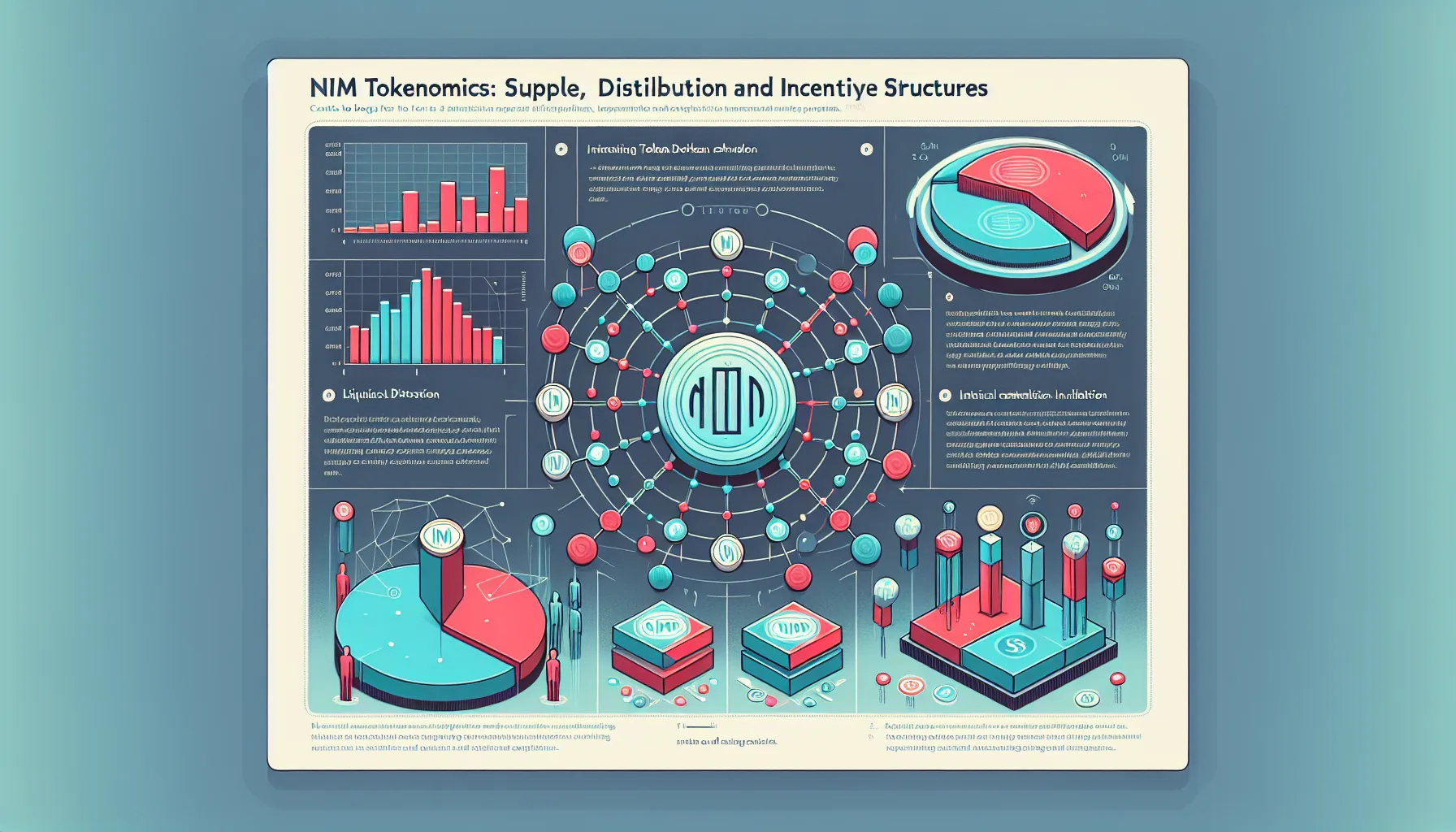
NIM Tokenomics
NIM Tokenomics: Supply, Distribution, and Incentive Structures
Fixed Supply and Emission Model
NIM operates with a predefined total supply, ensuring no arbitrary inflation beyond the protocol's original design. The structured emission model governs the release of tokens, influencing both liquidity and long-term sustainability. Early distribution mechanics and emission schedules have played a critical role in shaping current circulating supply dynamics, impacting both market availability and ecosystem incentives.
Staking and Incentive Mechanisms
NIM’s consensus model incorporates staking elements, rewarding participants who secure the network. The staking incentives are designed to balance inflationary pressures with network participation, but the rate of return is subject to shifts in network-wide staking engagement. High participation can dilute rewards, while low participation may offer outsized incentives but compromise security. The economic model aims to create a self-regulating balance, but fluctuations in network staking levels can impact actual returns.
Liquidity and Exchange Considerations
NIM’s liquidity is distributed across various markets, with centralized and decentralized exchanges playing key roles. Market depth and order book resilience fluctuate based on trading activity, and external market conditions can influence token velocity. One challenge associated with liquidity is the potential for slippage, particularly when large trades occur in lower-volume markets. Additionally, listing accessibility and exchange support impact overall adoption and usability.
Utility and Transaction Model
The utility of NIM is structured around network functions, transaction fees, and staking incentives. Transaction fees are designed to prevent spam while maintaining economic efficiency. However, fee structures must adapt to maintain competitiveness against alternative blockchain solutions that prioritize low-cost transactions. If fee markets fluctuate significantly, this could impact network usage patterns.
Token Distribution and Market Effects
Initial token distribution models significantly impact decentralization and market behavior. Early token holders may retain a disproportionate share of supply, leading to potential centralization risks. Vesting schedules and distribution mechanics shape long-term liquidity and price stability. In cases where concentrated holdings exist, market movements may be subject to higher-than-average volatility when large holders decide to liquidate or move their assets.
Inflationary and Deflationary Pressures
While NIM follows a controlled emission schedule, market dynamics introduce inflationary and deflationary pressures. The pace at which new tokens enter circulation relative to ecosystem demand affects overall valuation. If staking rewards or other token sinks fail to counterbalance new emissions, dilution effects may occur. Conversely, mechanisms that reduce active supply, such as transaction burns or locked staking, can create deflationary pressures, influencing scarcity.
NIM Governance
Governance in NIM: Decentralization and Decision-Making
On-Chain vs. Off-Chain Governance in NIM
NIM governance operates with a mix of on-chain and off-chain mechanisms. While certain aspects of network consensus and protocol upgrades are executed through blockchain-based rules, broader governance decisions often rely on community and foundation-led discussions. This division creates both flexibility and challenges: on-chain governance ensures deterministic execution, but off-chain coordination can introduce inefficiencies and centralization risks.
Role of the Nimiq Foundation in Governance
A notable aspect of NIM’s governance is the role of the Nimiq Foundation. While the foundation contributes to protocol development and decision-making, its level of influence raises concerns about decentralization. Governance structures that involve foundation-led initiatives can create efficiency but also introduce questions about central control over network updates, funding allocation, and development priorities.
Community Participation and Voting Mechanisms
NIM governance includes community input mechanisms, though the extent to which they influence major decisions can be debated. Unlike crypto assets with formalized DAO structures, NIM governance lacks a fully decentralized voting system directly encoded on-chain. Instead, stakeholder influence is exerted through forums, proposals, and general consensus-building efforts. This approach can lead to a slower decision-making process, as changes often require soft consensus rather than a strict, predefined voting system.
Governance Risks and Centralization Concerns
One of the main governance risks within NIM is the potential centralization of decision-making among a small group of developers and early adopters. While open discussion channels exist, major protocol developments often stem from a limited set of contributors. This structure creates a trade-off between efficiency and decentralized consensus, where rapid development can conflict with widely distributed decision-making power.
Upgrade Coordination and Governance Challenges
NIM’s governance model also affects how network upgrades and protocol changes are introduced. Without a fully decentralized on-chain governance system, implementing core changes requires social coordination, developer buy-in, and community support. This process can increase stability by preventing abrupt or contentious changes, but it also limits the agility of governance compared to blockchain ecosystems with automatic, proposal-driven execution.
Future Governance Considerations for NIM
For NIM to enhance governance decentralization, further steps could include more structured decision-making frameworks, enhanced transparency about roadmap decisions, and community-driven funding allocation. The balance between foundation-led direction and decentralized community participation remains a critical factor in shaping NIM’s governance model.
Technical future of NIM
Nimiq (NIM) Technical Roadmap and Upcoming Developments
Albatross Consensus and Scalability Enhancements
Nimiq has been progressing towards implementing the Albatross consensus algorithm, a high-performance Proof-of-Stake (PoS) mechanism designed to maximize blockchain throughput. This protocol aims to achieve near-theoretical maximum efficiency for a single-chain system by optimizing block propagation and leader election. However, challenges remain in fully testing and deploying the protocol while maintaining network security and decentralization.
Smart Contracts and Layer 2 Solutions
While Nimiq was originally designed as a lightweight payments-focused blockchain, there have been discussions around incorporating smart contract functionality through Layer 2 solutions. The primary obstacle is ensuring that such an implementation maintains Nimiq’s lightweight architecture while still enabling interoperability with widely-used DeFi standards. Research is ongoing into WebAssembly (WASM)-based execution environments and how these could be integrated without overloading the network.
Browser-Based Staking and User Accessibility
With Nimiq’s commitment to a browser-native experience, the development of seamless in-browser staking remains a priority. The challenge here is maintaining security while allowing users to stake directly through a web interface without relying on third-party extensions or downloads. Ongoing efforts focus on removing unnecessary complexity in the staking process while ensuring robustness against potential exploits.
Nimiq OASIS and Banking Integrations
Nimiq’s Open Asset Swap Interaction Scheme (OASIS) enables fiat-to-crypto atomic swaps, allowing users to exchange NIM directly with traditional banking systems. Further refinements are being made to increase the reliability and accessibility of these instant bank-to-crypto transactions. However, regulatory shifts present potential hurdles, especially concerning partnerships with financial institutions that may be resistant to direct crypto integration.
Quantum Resistance and Cryptographic Security
With post-quantum security becoming a growing concern in blockchain development, Nimiq has been exploring quantum-resistant cryptographic methods. Although no immediate upgrade is planned, research into lattice-based cryptographic solutions and their compatibility with Nimiq’s architecture remains ongoing. The challenge will be ensuring that any transition or hybrid integration does not compromise performance or compatibility with existing wallets and infrastructure.
Developer Tooling and Ecosystem Growth
While Nimiq’s infrastructure is designed for simplicity, developer tools for third-party applications are still evolving. The current focus is on improving SDKs and APIs that facilitate integration into external platforms. However, limited adoption by developers outside of the core Nimiq ecosystem remains a potential barrier to wider growth.
Final Considerations
The roadmap for Nimiq presents a balance between maintaining its lightweight architecture and expanding functionality. While ambitious technical developments are in progress, execution and external adoption remain key variables that will determine long-term success.
Comparing NIM to it’s rivals
NIM vs. NIM: Understanding the Key Differences
Consensus Mechanism and Network Architecture
NIM operates on a unique consensus mechanism tailored for high efficiency and scalability. However, when compared to itself, it's important to analyze the evolution of its protocol design, efficiency, and real-world application. Variants of NIM may differ in their block validation methods, fees, or optimization techniques, leading to variations in throughput and decentralization.
Transaction Speed and Scalability
NIM emphasizes fast transactions with minimal fees, but implementation differences can impact actual network performance. Depending on specific deployments or forks, variations in consensus tuning may introduce block propagation delays or require additional network resources. These differences can influence usability, especially under high load conditions.
Security and Network Decentralization
Security mechanisms within NIM must continually adapt to potential attack vectors. Certain implementations may prioritize ease of use over decentralization, potentially introducing vulnerabilities if validator incentives are not properly aligned. Additionally, staking or other participation mechanisms can differ, affecting how resistant the network is to Sybil attacks or centralization risks.
Ecosystem and Developer Support
NIM's ecosystem strength relies on developer adoption and available tooling. Differences in SDKs, smart contract capabilities, or cross-chain integrations significantly affect its utility in real-world applications. Fragmentation across different implementations of NIM could limit interoperability, creating challenges for developers looking for consistency across integrations.
Use Case Differentiation
Certain versions or adaptations of NIM tailor themselves to specific industries or applications. While baseline functionality may remain the same, variations in governance models, fee structures, or consensus adjustments can make one implementation more suited for microtransactions while another focuses on enterprise-level settlement.
Potential Challenges and Trade-Offs
As NIM evolves, compatibility issues between implementations could hinder broader adoption. If different approaches diverge too much in terms of security assumptions or consensus optimizations, it may create friction in the broader ecosystem. Managing interoperability while maintaining security and decentralization remains a challenge as multiple NIM variants coexist.
NIM vs. XNO: Comparing Technology, Use Cases, and Adoption
Consensus Mechanisms: PoS vs. Block Lattice
NIM employs a proof-of-stake (PoS) consensus model, which allows for energy efficiency and decentralized validation. In contrast, XNO utilizes a block-lattice architecture, which eliminates the need for conventional mining and enables feeless transactions. While XNO’s approach dramatically improves transaction speeds and cost efficiency, it relies on open representative voting (ORV), which can raise concerns about centralization due to the influence of large voting nodes.
Transaction Speed and Scalability
XNO’s block-lattice structure ensures transactions are processed asynchronously, leading to near-instant settlement. This scalability model makes it highly efficient for micropayments. However, because every account maintains its own blockchain, managing network-wide synchronization can pose technical challenges, particularly under high transaction loads. NIM, with its PoS network, may not match XNO’s raw speed but offers a more conventional blockchain structure, which some developers prefer for compatibility with existing blockchain-based applications.
Feeless Transactions vs. Network Sustainability
A core feature of XNO is its feeless transaction model, which is attractive for users and businesses looking to avoid network fees. However, this approach has raised long-term concerns about sustainability, given that node operators must support the network without earning transaction fees. Incentives are instead based on ecosystem growth, which could become problematic if adoption slows or network demands increase. NIM, by operating on PoS, ensures validators receive staking rewards, creating a more traditional and economically sustainable system.
Smart Contract Capabilities
Unlike NIM, XNO does not natively support smart contracts. While there are workarounds for integrating smart contract functionality through third-party solutions, the absence of native programmability limits its use cases in DeFi and decentralized applications. NIM, in contrast, provides built-in mechanisms for smart contract execution, making it more versatile for developers looking to build decentralized services.
Network Security Considerations
The security models of both networks differ significantly. XNO’s ORV system is energy-efficient but has been criticized for potential centralization risks if voting power is concentrated among a few representatives. Additionally, because nodes are incentivized through network adoption rather than direct financial rewards, long-term security viability remains a topic of debate. NIM’s PoS model provides economic incentives for validators, contributing to a more predictable security framework.
Community and Ecosystem Growth
While XNO boasts a dedicated community that strongly advocates for its feeless design, its ecosystem remains somewhat niche, primarily centered around fast, lightweight transactions. NIM, with its broader use case possibilities, attracts a different segment of developers and users who require both transaction efficiency and additional blockchain functionalities.
Comparing NIM to Stellar (XLM)
Consensus Mechanism and Network Efficiency
Nimiq (NIM) and Stellar (XLM) take different approaches to consensus. Stellar operates on the Stellar Consensus Protocol (SCP), a federated Byzantine agreement (FBA) system that offers fast finality but requires a predefined validator structure. This means that while Stellar transactions are quick, network decentralization is somewhat limited since trust is placed on a set of known validators.
Nimiq, in contrast, employs a browser-first Proof-of-Stake (PoS) mechanism, enabling direct blockchain interactions without the need for third-party software. This fully web-native approach enhances accessibility but introduces its own trade-offs in terms of validator incentives and network robustness when compared to Stellar's SCP.
Smart Contracts and Tokenization
Stellar has positioned itself as a strong competitor in the tokenization and payments space, facilitating asset issuance and cross-border transactions. However, its scripting functionality is relatively limited, lacking full-fledged smart contract support. Recent upgrades have improved programmability, but Stellar still lags behind other ecosystems where complex decentralized applications (dApps) are a priority.
Nimiq, on the other hand, was initially designed as a simple and efficient payment solution with a focus on browser integration rather than token issuance or contract execution. This makes it more lightweight, but it also places restrictions on its ability to expand into sectors like DeFi, an area where Stellar has seen some traction despite its limitations.
Transaction Fees and On-Chain Costs
Stellar boasts extremely low transaction fees, often measured in fractions of a cent, making it a strong choice for micropayments and financial inclusion projects. These low fees, coupled with fast finality, have made Stellar a preferred network for international remittances and payments between institutions.
Nimiq also offers minimal transaction costs due to its efficient PoS design, but its reliance on browser-based interactions means transaction propagation and node connectivity can sometimes be affected by user device architecture and network stability. While both networks maintain low-cost operations, Stellar benefits from its more established infrastructure and widespread exchange support—factors that contribute to its liquidity advantage.
Decentralization and Adoption Challenges
Despite its efficiency, Stellar's reliance on predefined validators has raised concerns about centralization risks. Network governance is largely influenced by the Stellar Development Foundation (SDF), which holds a significant portion of the token supply. This has sparked debates over network autonomy and validator influence.
Nimiq takes a more decentralized approach in terms of accessibility, as anyone with a web browser can participate in the network. However, its adoption has faced difficulties due to the niche focus on browser-first blockchain interactions, which, while innovative, has not yet translated to mainstream institutional interest comparable to Stellar’s partnerships with payment processors and fintech companies.
Primary criticisms of NIM
Primary Criticism of NIM
Lack of Widespread Adoption
One of the most frequent criticisms of NIM is its limited adoption compared to other blockchain networks. While the technology behind it may be efficient, the number of real-world integrations and merchant adoptions remains relatively small. Without strong network effects, the utility of NIM as a daily-use cryptocurrency is constrained, making it harder to compete with larger and more established digital assets.
Market Liquidity Concerns
Liquidity is a persistent issue for NIM, with many traders and investors pointing out that order book depth on exchanges can be shallow. This lack of liquidity can lead to higher slippage when executing large trades and can discourage institutional participation. The challenge of managing low liquidity also increases the risk of market manipulation, where a small number of players can significantly influence price movements.
Centralization vs. Decentralization Debate
While NIM positions itself as a decentralized crypto asset, some critics argue that key aspects of its ecosystem show signs of centralization. Concerns often revolve around the distribution of tokens, the role of core developers, and governance structures that may favor early adopters or specific stakeholders. A perceived centralized control can be a point of contention for users who prioritize decentralization as a core principle of blockchain technology.
Competition from Established Platforms
NIM operates in a highly competitive crypto landscape dominated by well-established networks that already provide similar or superior features. Critics argue that without a significant differentiating factor, NIM struggles to justify its existence against larger ecosystems with higher development activity, better tooling support, and more extensive third-party integrations. Competing blockchains often offer broader smart contract capabilities, scalable solutions, and a more diverse developer community, making it difficult for NIM to gain a strong foothold.
Development and Roadmap Uncertainty
Questions surrounding the project's long-term development roadmap have been raised by both users and developers. Some critics highlight that the pace of innovation and updates can be unpredictable, leading to uncertainty about the asset’s future direction. Without a clear and consistent development trajectory, confidence from both retail users and businesses may wane over time.
Tokenomics and Incentive Structures
Another major criticism of NIM revolves around its tokenomics. Some argue that the incentive structures in place may not be sustainable or sufficiently attractive to drive long-term participation. If inflation, staking rewards, or transaction fees are not balanced effectively, they can either dilute existing holdings or fail to secure long-term network engagement.
Founders
Founding Team Behind NIM: Background, Vision, and Challenges
Origins and Key Figures
NIM was created by the team behind the Nimiq project, a browser-first blockchain designed for simplicity and high accessibility. The founding team consists of individuals with backgrounds in cryptography, software engineering, and finance. Among them, Elion Chin played a significant role in shaping the project's early vision and direction, while Philipp von Styp-Rekowsky contributed key technical expertise in protocol development. Other core contributors brought experience in web development, decentralized systems, and business strategy.
The emphasis from the start was on making blockchain technology more user-friendly, particularly by enabling in-browser interactions without requiring third-party software installations. This approach influenced how the team structured Nimiq’s consensus mechanisms and native crypto asset, NIM.
Technical Leadership and Development Approach
From the beginning, the project’s leadership positioned Nimiq as a unique blockchain implementation based on WebAssembly (WASM). This technical choice came from the team's goal to lower the technical entry barrier for users and developers adopting the network. However, working with WASM as a primary runtime environment introduced its own set of challenges, both from a performance perspective and in terms of developer adoption compared to more established environments.
Another technical challenge stemmed from the team's effort to implement an off-chain/on-chain financial bridge, particularly their Albatross consensus upgrade aimed at increasing transaction speed and efficiency. The ambition to achieve high-speed transaction finality with Albatross reflects the team's deep focus on usability, but it also put them in competition with established Layer 1 networks that were pursuing similar optimizations with larger development ecosystems.
Communication and Transparency Issues
While the team has demonstrated strong technical capabilities, community communication has been inconsistent at times. Development progress, roadmap updates, and strategic shifts have not always been clearly conveyed, leading to uncertainty among stakeholders. Some users in the ecosystem have expressed concerns about the transparency of decisions, particularly regarding protocol upgrades and tokenomics adjustments.
Furthermore, the team has had to navigate the challenge of balancing decentralization with usability—a core dilemma for many blockchain projects. Some of their early design choices sacrificed decentralization in favor of accessibility, which drew both praise and criticism from the broader crypto community.
Challenges in Adoption and Ecosystem Growth
Despite strong founding principles, the team has faced difficulties in expanding adoption beyond their initial user base. The decision to target browser-based blockchain interactions meant betting on a niche approach in an industry where the majority of decentralized applications and wallets rely on standalone clients. While innovative, this strategy created additional hurdles for integrations and partnerships with third-party service providers who prioritize compatibility with more widely-established architectures.
The founding team’s technical expertise remains evident, but their ability to drive broader adoption and ecosystem development has been constrained by competition from other more liquid and widely adopted crypto networks.
Authors comments
This document was made by www.BestDapps.com
Sources
- https://nimiq.com/whitepaper.pdf
- https://nimiq.com/
- https://github.com/nimiq/core
- https://github.com/nimiq/nips
- https://explorer.nimiq.com/
- https://nimiq-network-status.com/
- https://nimdex.io/
- https://blog.nimiq.com/
- https://www.coingecko.com/en/coins/nimiq
- https://coinmarketcap.com/currencies/nimiq/
- https://github.com/nimiq/safe
- https://www.reddit.com/r/Nimiq/
- https://discord.com/invite/nimiq
- https://developer.nimiq.com/
- https://safe.nimiq.com/
- https://wallet.nimiq.com/
- https://miner.nimiq.com/
- https://stats.nimiq-network.com/
- https://www.stakingrewards.com/earn/nimiq/
- https://www.nimiq.community/


