History of NEAR
The History of NEAR Protocol: Origins and Early Development
NEAR Protocol, a Layer 1 blockchain, emerged as a solution aimed at addressing scalability and usability challenges that plagued earlier blockchains like Ethereum. Its history is deeply rooted in technical innovation, community collaboration, and iterative development. However, like any ambitious blockchain project, NEAR's inception and growth faced technical and strategic hurdles along the way.
The journey began in 2018, when developers Illia Polosukhin and Alexander Skidanov co-founded NEAR. Both co-founders brought significant technical expertise, with Polosukhin having a background in machine learning at Google and Skidanov contributing extensively to distributed systems at Microsoft and MemSQL. Importantly, the project initially started as a machine learning platform for program synthesis, but it pivoted toward blockchain development upon recognizing the potential to build infrastructure that could address critical limitations of existing protocols.
NEAR's architectural design was heavily influenced by the need to optimize scalability while maintaining developer-friendly infrastructure. Early on, the team prioritized sharding—a scalability solution designed to partition blockchain networks into smaller pieces called “shards” to handle more transactions in parallel. NEAR’s specific implementation, known as Nightshade, became a focal point in its early technical roadmap. Although promising, the adaptation to sharding required notable trade-offs, including the complexity of maintaining protocol security under high fragmentation.
The protocol underwent several development phases, kicking off with testnets in 2019. These testnets were instrumental in revealing bugs, ensuring stability, and achieving performance benchmarks. Challenges emerged during this phase, particularly around fine-tuning the consensus mechanism called "Doomslug," a design focused on balancing the speed and finality of transactions. Early critiques pointed out the risks of adopting relatively novel consensus mechanisms that hadn’t yet been battle-tested on large-scale production networks.
In April 2020, NEAR launched its mainnet in a phased rollout. Interestingly, the initial phase did not allow token transfers, highlighting the team’s cautious approach to mitigating risks during the network's formation. This periodic release model attempted to balance decentralization with control, an approach that some in the crypto community viewed as too centralized for a protocol marketing itself as community-centric.
From the outset, NEAR cultivated its ecosystem with the aim of attracting developers through tools like its WebAssembly-based smart contract capabilities and a user-friendly SDK. Critics initially questioned how competitive NEAR’s developer onboarding process truly was compared to dominant platforms. Furthermore, the team's focus on building bridges to enhance interoperability became an essential part of its ecosystem strategy, though maintaining secure cross-chain connections remains a constant challenge for the entire blockchain industry.
NEAR’s history is marked by iterative decision-making and responses to technical limitations. While its founders and community have celebrated significant milestones, the project's early history is also indicative of broader challenges faced by emerging Layer 1 blockchains striving to differentiate themselves in a crowded landscape.
How NEAR Works
How NEAR Protocol Works: Under the Hood of a Sharded Blockchain
NEAR Protocol is built with scalability, developer accessibility, and decentralized application performance in mind. Its design leans heavily on sharding, innovative consensus mechanisms, and robust tooling to offer a unique infrastructure for powering decentralized applications. While effective in addressing blockchain bottlenecks, some core trade-offs and operational complexities persist.
Nightshade: The Core Sharding Mechanism
At the heart of NEAR Protocol is its sharding architecture, called Nightshade. Unlike other blockchain designs, where full nodes store and validate all data, Nightshade breaks the chain into smaller partitions—or "shards." Each shard processes a portion of transactions, vastly improving throughput and reducing overhead. Unique to Nightshade is the approach to block creation: instead of producing independent blocks for each shard, all shard data is aggregated into a single block on the main chain.
This efficient design ensures that validators are only responsible for the shard they operate on while benefiting from the security of the entire network. However, this introduces complexity in cross-shard communication. NEAR addresses this partly through a mechanism that allows messages to be passed between shards in a single block cycle—but developers utilizing cross-shard interactions still need to optimize their applications for performance bottlenecks.
The Doomslug Consensus Mechanism
NEAR employs a two-part consensus system spearheaded by Doomslug to finalize blocks quickly. Doomslug’s lightweight design enables NEAR to achieve near-instant block finality by requiring only a single round of communication between validators. This is supplemented by a separate economic mechanism that ensures secure chain continuity.
However, the lower latency of Doomslug comes with its own challenges: its design assumes honest participation from validators in normal circumstances. While Byzantine Fault Tolerance (BFT) mechanisms back-stop security in adversarial scenarios, a dishonest majority could theoretically exploit faster block production without triggering slashing penalties.
Gas Fees and Usability Optimization
NEAR Protocol minimizes friction for end users by implementing dynamic gas fee structures and human-readable account names (e.g., username.near instead of alphanumeric wallet addresses). Additionally, the protocol allows developers to subsidize user gas fees, creating a smoother on-boarding experience for non-crypto-savvy users. However, this approach raises questions about long-term fee sustainability and potential developer cost burdens as the network scales.
Storage Staking and Validator Design
To manage on-chain data, NEAR requires users and applications to pay for storage through storage staking—a mechanism that locks NEAR tokens proportional to the amount of state stored. While innovative, this introduces fragmentation risks for smaller developers or dApps constrained by higher state requirements. Validator architecture ensures decentralization but may penalize smaller operators due to high hardware demands and stake requirements for participation.
Use Cases
Use Cases of NEAR Protocol: Applications and Opportunities
The NEAR Protocol, as a layer-1 blockchain, provides a foundation for a range of decentralized use cases designed to leverage its unique architecture, including its sharding mechanism and user-oriented design. Below, we explore the prominent use cases built on NEAR and the challenges that come with its adoption.
Decentralized Application Development
NEAR is tailored toward developers looking to build decentralized applications (dApps). Its sharding-focused scalability allows applications to handle significant user loads without the prohibitive transaction fees common on other blockchains. Additionally, NEAR’s developer tools, such as its Rust and AssemblyScript frameworks, make smart contract development accessible. However, onboarding developers into Rust rather than more ubiquitous languages like Solidity can serve as an entry barrier. While the protocol markets itself as "developer-friendly," the limited experience pool available for these languages poses a hurdle for rapid growth in the ecosystem.
NFT Platforms and Digital Ownership
Non-fungible tokens (NFTs) have emerged as a critical use case for NEAR. Projects on NEAR take advantage of its low gas fees and environmentally-conscious Proof-of-Stake consensus. Digital artists and content creators can mint and sell NFTs without the friction or high transaction costs typical of other platforms. However, a notable limitation is NEAR's visibility within the broader NFT ecosystem. Ethereum-based platforms still dominate market share, and bridging assets from Ethereum or other NFT-heavy protocols can feel cumbersome, even with NEAR’s bridging solutions (e.g., Rainbow Bridge).
Decentralized Finance (DeFi)
The DeFi ecosystem on NEAR is growing, encompassing lending platforms, decentralized exchanges (DEXs), and yield farming protocols. With its scalability and fast transactions, NEAR has the technical underpinnings to compete with established DeFi networks. The Aurora EVM allows Ethereum-compatible smart contracts to run on NEAR, expanding DeFi accessibility. However, liquidity fragmentation remains a concern as projects compete for limited resources across competing chains. Additionally, users and developers alike can face difficulty when integrating EVM-based solutions with the native NEAR ecosystem, highlighting potential friction points.
Gaming and Metaverse Projects
The gaming and virtual world sectors are a natural fit for NEAR due to its low cost, high throughput, and focus on user experience. Blockchain-based games and metaverse projects increasingly prioritize performance, and NEAR’s infrastructure supports seamless in-game transactions and blockchain interoperability. However, competition within blockchain gaming is fierce, and NEAR must overcome the challenge of developer acquisition and community engagement to solidify itself as a go-to platform.
Challenges to Scaling Beyond Niche Use Cases
While NEAR holds technical advantages, its broader adoption faces ongoing challenges. Public awareness, ecosystem funding, and competition from more established chains like Ethereum and Solana raise questions about its ability to scale use cases beyond its current niches. Additionally, reliance on bridges for interoperability creates potential vulnerabilities and added user friction, particularly for users unfamiliar with cross-chain tools.
These factors continue to shape the adoption and utility of NEAR, leaving room for growth while also highlighting the hurdles the protocol must address to expand its footprint in an increasingly crowded blockchain landscape.
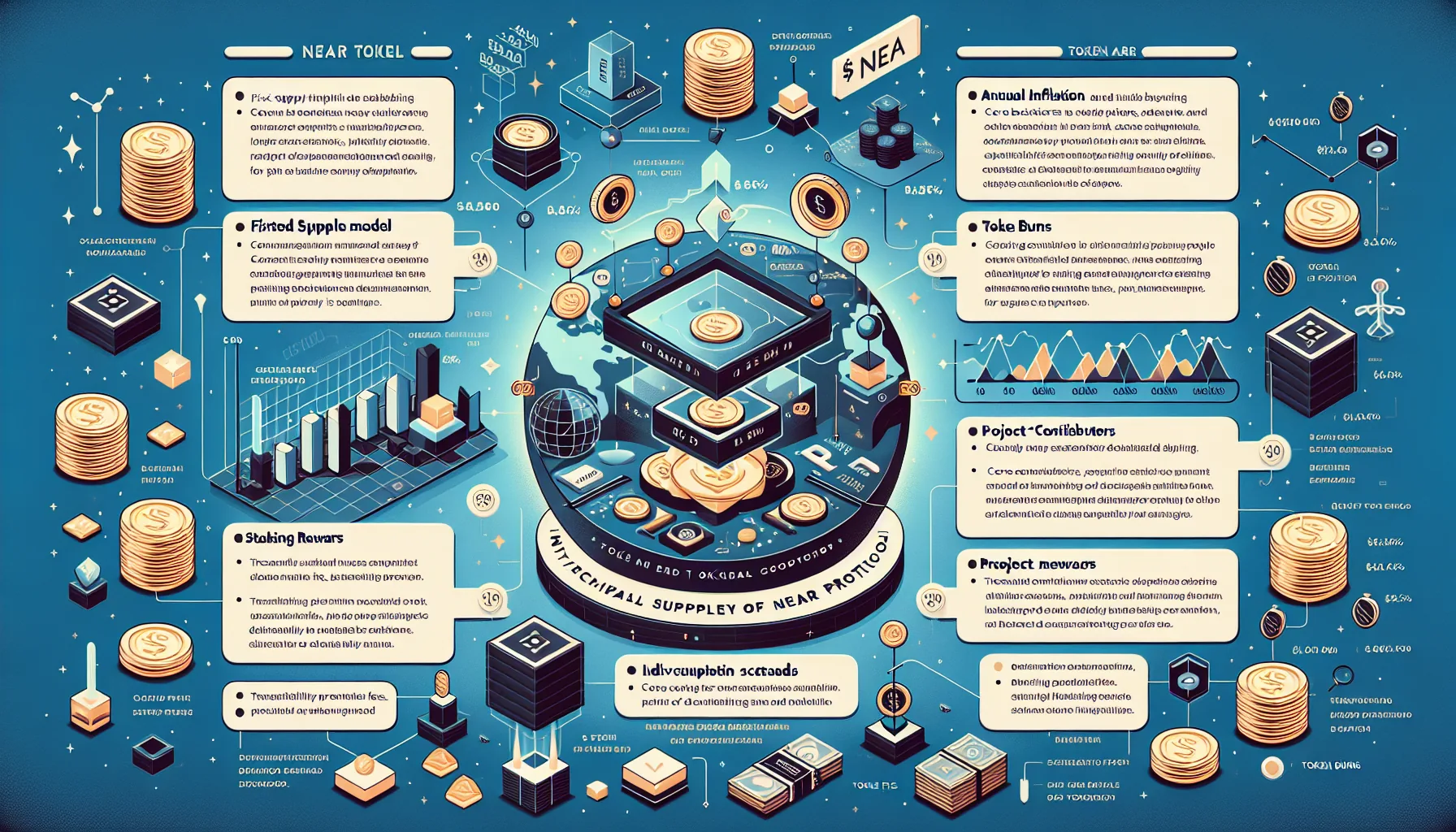
NEAR Tokenomics
NEAR Tokenomics: Exploring Supply Dynamics and Utility
The tokenomics of NEAR Protocol revolves around its native cryptocurrency, $NEAR, which functions as the backbone for the platform’s decentralized ecosystem. Key considerations in $NEAR’s design include supply mechanisms, distribution strategy, and utility models—all of which are pivotal for sustaining the ecosystem’s growth while incentivizing active participation.
Fixed Supply with Inflationary Rewards
NEAR operates on a fixed token supply model with an inflationary component. The total token issuance rate is currently set at an annual inflation of 5%, primarily allocated toward staking rewards for validators. These rewards are essential to securing the proof-of-stake (PoS) blockchain, ensuring validators and delegators are incentivized to maintain the network. However, this inflationary model is counterbalanced by token burns tied directly to transaction fees. With 70% of fees burned, this mechanism introduces a deflationary pressure that aligns neatly with usage growth, but it also raises questions about potential misalignments if transaction volumes stagnate.
Distribution and Vesting Challenges
A closer look at NEAR’s token allocation reveals a multi-tiered approach, dividing tokens between core contributors, project backers, initial investors, and community funds. The allocation heavily leans toward early participants, such as seed investors and private rounds, which involved a substantial percentage of initial distribution. While this incentivizes early-stage investors, it also raises concerns about centralization risks and potential sell-off events as vesting schedules expire. For a network focused on decentralization, this distribution asymmetry might be viewed critically by some in the crypto community.
Utility-Driven Demand
$NEAR’s utility within the protocol adds another dimension to its tokenomics. Beyond staking, the token serves as a medium for transaction fees, smart contract execution, and ecosystem governance. This multi-functionality positions $NEAR as critical for network operations, but questions around demand scalability remain, particularly in scenarios where broader Web3 adoption wanes. The ability of the protocol to continuously onboard builders and sustain user activity directly impacts the token's demand curve.
Liquidity and Circulating Supply Dynamics
NEAR's approach to liquidity provisioning and release schedules has played a significant role in tokenomics discussions. With a gradual model for unlocking pre-allocated tokens, the circulating supply expands over time, potentially suppressing upward price movements in periods of high token release. This creates a delicate balance—ensuring liquidity without overwhelming the market. Community-driven mechanisms to address these concerns remain limited, leaving some governance gaps unresolved.
Ultimately, the tokenomics of NEAR Protocol reflect a well-thought-out balance of incentives, but execution remains heavily dependent on network growth, decentralization efforts, and sustained demand for $NEAR’s utility.
NEAR Governance
NEAR Protocol Governance: Decentralization and Challenges
NEAR Protocol's governance structure plays a central role in maintaining its decentralized ethos while facilitating decision-making for protocol upgrades, funding distribution, and ecosystem development. Unlike traditional centralized models, NEAR emphasizes community-driven governance. However, its system comes with nuances and challenges that are crucial for understanding its operational landscape.
Staked Governance and Validator Influence
The NEAR Protocol utilizes a PoS (Proof-of-Stake) consensus mechanism, inherently linking governance power to staking. Validators, who secure the network, accumulate influence based on the amount of NEAR tokens staked on their nodes by individual participants or delegators. This creates a dynamic wherein governance participation heavily favors entities with significant token holdings.
While staking ensures alignment between network health and governance incentives, it can also centralize decision-making. Large validators, or staking pools with substantial delegator backing, hold disproportionate sway in protocol votes. This disparity raises concerns about the concentration of governance power, an issue common across PoS systems, but one that NEAR must continuously address.
Role of the NEAR Foundation
The NEAR Foundation, a Switzerland-based non-profit, currently plays a pivotal role in coordinating governance. It operates as a funding body, allocating grants and resources to projects building on the network, while also acting as a steward for protocol development. Though the Foundation's leadership has helped fast-track innovation and resolve disputes, its prominent role occasionally sparks debates about centralization risks.
Critics highlight that reliance on a central institution—even in early-stage protocol development—can conflict with long-term decentralization goals. The Foundation’s decision to gradually transition responsibilities to the community has alleviated some concerns, but implementation hurdles remain.
Decentralized Governance Mechanisms
NEAR has introduced formal mechanisms like the Sputnik DAO framework to promote decentralized decision-making within its ecosystem. These decentralized autonomous organizations (DAOs) allow token holders to directly influence initiatives ranging from developer grants to marketing proposals. Although Sputnik DAOs enhance inclusivity, challenges persist in achieving widespread adoption and meaningful participation. Low voter turnout and accessibility issues among non-technical stakeholders often undermine the democratic intent of these structures.
Smart Contract Governance Risks
Further decentralization efforts on NEAR rely on smart contract-based governance systems. While these are pivotal for minimizing human intervention and ensuring code-driven fairness, they are not without risks. Governance logic encoded in smart contracts is susceptible to potential bugs or exploits. Misaligned incentives in the contract's design could inadvertently magnify governance flaws rather than resolve them.
In summary, NEAR Protocol’s governance framework demonstrates a sophisticated blend of on-chain mechanisms, validator participation, and foundation oversight. However, as the protocol evolves, it must constantly evaluate and address the tension between decentralization and efficiency to maintain trust within its community of stakeholders.
Technical future of NEAR
NEAR Protocol: Current and Future Technical Developments
NEAR Protocol, a Layer 1 blockchain, has been steadily evolving with a focus on advancing scalability, usability, and interoperability. Its novel approach to decentralized development is supported by several technical upgrades in progress and on the roadmap. However, the ecosystem also faces notable challenges, especially in the realm of competition with other blockchains targeting similar objectives.
Technical Upgrades to Scalability Through Sharding
At the core of NEAR's scalability efforts lies its unique approach to sharding, formalized as “Nightshade.” Unlike traditional sharding implementations that silo shards as independent mini-chains, Nightshade divides the blockchain's state into smaller chunks (logical shards), enabling each node to process only a portion of the transactions. This dynamic enables NEAR Protocol to maintain a single unified chain with concurrent processing of data.
Moving forward, the roadmap aims to adopt fully dynamic resharding capabilities. This development would implement mechanisms to increase or reduce the number of shards based on network activity, ensuring resource efficiency during periods of varying demand. While theoretically enabling seamless scalability, dynamic sharding adds an extra layer of complexity and is yet to be proven robust against edge-case scenarios or sudden spikes in throughput.
Enhanced Cross-Chain Interoperability with Layer 2 Solutions
NEAR's technical development is increasingly focused on interoperability, targeting composability with Ethereum assets and beyond. Aurora, NEAR’s Ethereum Virtual Machine (EVM)-compatible Layer 2 environment, allows developers to deploy Solidity-based smart contracts on the protocol. This bridges Ethereum dApps to the NEAR ecosystem but remains constrained by performance bottlenecks during cross-chain activity.
Further down the roadmap, NEAR intends to bolster trustless bridges to other ecosystems. This includes direct advancements in technologies like Zero-Knowledge Proof bridges, which could optimize security and reduce reliance on centralized validators often seen in existing bridge models. However, implementation hurdles—especially related to the cryptographic stack’s computational overhead—may delay aggressive deployments and undermine the immediate ability to compete with leading interoperability protocols.
Focus on Developer Experience and Usability
A critical differentiator for NEAR has been its focus on developer-centric tooling. Key upgrades include continued evolution of its JavaScript Software Development Kit (SDK) to lower the barrier to entry for less-experienced developers. The roadmap also spotlights enhanced capabilities for its “Contract in Contract” feature, designed to enable composability of complex smart contracts.
While NEAR’s usability pushes are commendable, trade-offs exist. Prioritizing simplicity risks alienating advanced developers who prefer more robust tooling offered by other Layer 1 solutions. Additionally, consistent communication and support for onboarded developers remain a challenge as the ecosystem scales.
Governance and Decentralization Challenges
On a governance front, NEAR’s roadmap envisions improved decentralization of validator nodes to avoid centralization risks tied to the protocol’s limited validator set. However, addressing decentralization is inherently complex, with potential resistance from early token holders or validators who may lose influence as governance expands. Algorithms optimizing staking incentives and delegation mechanics will play a critical role but may introduce additional trade-offs in user-ecosystem dynamics.
Comparing NEAR to it’s rivals
NEAR Protocol vs Solana: A Detailed Comparison
When analyzing how NEAR Protocol stacks up against Solana (SOL), it becomes evident that both blockchains cater to high-performance decentralized applications (dApps) but operate with different approaches to scalability, architecture, and developer experience. Each has its merits, but also notable trade-offs depending on priorities and use cases.
Scalability and Consensus Mechanisms
NEAR employs a unique approach to sharding called Nightshade, which dynamically splits its blockchain into "chunks," allowing for parallel transaction processing. This design is horizontal in nature, aimed at scaling with increased demand without compromising decentralization. Solana, on the other hand, relies on its Proof of History (PoH) mechanism paired with Proof of Stake (PoS) to optimize block time and throughput. While Solana’s vertical scaling approach achieves higher theoretical transaction throughput (over 65,000 TPS), critics often highlight that this comes at the cost of higher hardware requirements, potentially reducing network decentralization compared to NEAR’s lightweight node requirements.
Developer Experience and Ecosystem Growth
NEAR Protocol has prioritized ease of use for developers through its focus on a human-readable account model and support for high-level programming languages like Rust and AssemblyScript. Solana, however, places a greater emphasis on performance over accessibility, requiring developers to use Rust or C, which may present a steeper learning curve. Despite this, Solana has managed to foster an active developer community, often due to its focus on high-frequency applications such as DeFi and GameFi. NEAR’s ecosystem is still growing but pivots more toward user-friendly dApps, onboarding Web2 users, and lower entry barriers for developers.
Network Reliability and Performance
Solana's high throughput has occasionally come at the cost of network reliability. The network has experienced notable instances of downtime and congestion under heavy loads, which have raised concerns about its ability to handle extreme surges in activity. In contrast, NEAR's architecture—while not reaching Solana’s peak transaction speeds—has demonstrated more consistent uptime and resilience under stress. For projects prioritizing reliability, these differences can weigh heavily in decision-making.
Tokenomics and User Costs
Both NEAR and Solana emphasize low transaction fees, critical for mainstream adoption. NEAR's sharded design helps maintain predictably low fees, even as usage scales. Solana also offers negligible transaction costs but faces scrutiny for token distribution disparities, with critics pointing at higher centralization risks. NEAR’s tokenomics are often perceived as slightly more inclusive due to broader staking participation and a capped total supply.
Ultimately, the NEAR-vs-Solana debate centers on scalability trade-offs, developer accessibility, and network resilience, which may influence adoption depending on specific project needs.
NEAR vs. DOT: A Technical and Ecosystem Comparison
When comparing NEAR Protocol to Polkadot (DOT), key differences emerge in architecture, interoperability, scalability, and developer experience. Both are next-generation blockchain platforms focusing on solving scalability and usability challenges, but they approach these goals in fundamentally distinct ways.
Interoperability and Governance
Polkadot’s standout feature is its focus on interoperability through its Relay Chain, which enables parachains—independent blockchains—each optimized for specific use cases. By design, DOT thrives on its ability to connect heterogeneous chains, creating a vast multi-chain ecosystem. While this model is ideal for cross-chain collaboration, it introduces complexities, such as auctioning slots for parachain access, which could be cost-intensive and competitive, potentially alienating smaller teams or startups seeking access to the DOT ecosystem.
NEAR, on the other hand, achieves interoperability through its Aurora Layer 2 and Rainbow Bridge, offering compatibility with Ethereum. While these make NEAR an attractive option for developers migrating from Ethereum, its interoperability capabilities are narrower in scope compared to Polkadot’s multi-chain ambitions. NEAR focuses more on ensuring seamless interaction with Ethereum assets and dApps rather than building an expansive network of purpose-specific chains.
Architecture and Scalability
NEAR’s sharding approach, termed Nightshade, enables dynamic scalability, where computational loads are divided across multiple validator groups via shards. This offers linear scalability without disrupting network performance, making NEAR an ideal choice for applications that require high throughput. In contrast, Polkadot’s approach relies less on sharding directly within its architecture, instead leveraging parachains to distribute workloads. This unique setup potentially limits the overall scalability of Polkadot’s Relay Chain itself, relying heavily on the efficiency and design of individual parachains.
Developer Ecosystem and Complexity
NEAR takes pride in being developer-friendly, offering tools like NEAR SDKs, support for Rust and JavaScript/TypeScript, and an account model familiar to Web2 developers. Additionally, its onboarding process for developers is streamlined, encouraging rapid deployment of dApps. Polkadot, though robust, demands a steeper learning curve owing to its need for in-depth understanding of Substrate—a blockchain-building framework used to create parachains. The added complexity may deter developers unfamiliar with blockchain fundamentals, a gap that NEAR addresses more effectively.
Economic Feasibility
Polkadot’s parachain slot auctions introduce a barrier to entry, as they generally require significant financial resources or community backing to secure network access. NEAR instead uses a simpler, pay-as-you-go staking model, which may appear more inclusive for smaller teams or independent developers. However, some argue that NEAR’s model could lead to centralization concerns, as well-capitalized validators may dominate staking pools.
Both NEAR and DOT present compelling use cases in the Web3 landscape, but their differences in technical design and ecosystem structure reveal trade-offs tailored to distinct developer and user needs.
NEAR Protocol vs. Avalanche (AVAX): Key Differences in Technology and Ecosystem
When comparing NEAR Protocol to Avalanche (AVAX), the distinctions between their architecture, consensus mechanisms, and ecosystem strategies reveal important contrasts for developers and investors. Both blockchains focus on scalability, low transaction fees, and environmental efficiency, but they achieve these goals in markedly different ways.
Consensus Mechanisms: Nightshade vs. Avalanche Consensus
NEAR Protocol utilizes a sharded Proof-of-Stake model called Nightshade. This system divides the network into shards, each processing transactions and smart contracts in parallel, which enables linear scalability as the network grows. Avalanche, on the other hand, employs its Avalanche Consensus—a probabilistic consensus mechanism optimized for rapid finality and high throughput. While NEAR’s Nightshade aims to simplify developer experience via abstracting shards from end-users, Avalanche’s consensus is designed to ensure sub-second finality, making it particularly suited for latency-sensitive use cases like decentralized exchanges.
One potential drawback for NEAR is the ongoing need to refine its sharding model, especially as new applications stress-test its capacity. In contrast, Avalanche’s architecture faces challenges around node resource requirements—a critical issue for its Subnet implementation, which enables customizable blockchains but at the cost of higher operating expenses for validators.
Developer Tools and Ecosystem Growth
NEAR distinguishes itself with a strong focus on usability, providing streamlined onboarding for developers through features like human-readable account names and native support for WebAssembly (WASM). This makes NEAR particularly attractive for developers transitioning from traditional programming environments. Avalanche aggressively markets its Subnets—specialized, app-specific blockchains tailored to meet precise enterprise or project needs. However, while Subnets provide flexibility, the fragmentation of liquidity and user base across multiple Subnets can hinder broader network effects.
For developers, the tradeoff between NEAR’s unified environment versus Avalanche’s Subnet customization largely depends on project requirements. NEAR simplifies multi-chain deployments through seamless composability across its shards. Avalanche’s approach, while modular, requires developers and communities to manage economic and technical complexities tied to Subnet operation, including validator incentivization.
Bridging and Interoperability
Both chains prioritize interoperability but take different paths. NEAR leverages its Rainbow Bridge for seamless asset transfers between NEAR and Ethereum. While the bridge has been applauded for its non-custodial security, its reliance on Ethereum’s congestion can lead to delays during peak periods. Avalanche uses its native bridging solution, which boasts speed and low costs. However, concerns around long-term security implications tied to Avalanche's trust-assumptions for cross-chain bridges remain a subject of debate.
Ecosystem Maturity
Avalanche has arguably gained faster adoption in DeFi due to early incentives and aggressive liquidity mining campaigns, but this has led to occasional criticisms about sustainability. NEAR, meanwhile, has adopted a more organic growth model, focusing on fostering a developer-friendly ecosystem without over-reliance on token subsidies. While this approach is viewed as more sustainable, it may result in a slower pace of adoption compared to aggressively incentivized ecosystems like Avalanche’s.
Primary criticisms of NEAR
Primary Criticisms of NEAR Protocol: Examining Its Challenges
NEAR Protocol, while often recognized for its innovative take on blockchain scalability and user experience, is not without its share of criticism. As the ecosystem continues to grow, several pain points have emerged that warrant deeper examination. Here are the primary issues that have consistently drawn scrutiny from the crypto-savvy community:
Limited Decentralization Concerns
A notable critique leveled at NEAR revolves around its perceived centralization. While NEAR employs a Proof-of-Stake (PoS) consensus mechanism with validators, the network currently relies on a relatively small pool of participants to secure the blockchain. This validator pool size, coupled with delegation dynamics, has led to concerns around the influence large token holders may exert. For those deeply invested in the principles of decentralization, this structure raises potential vulnerabilities, particularly around collusion risks or censorship resistance.
Competition and Overlap in the Layer-1 Landscape
NEAR operates within an increasingly saturated market of smart contract platforms, and some detractors claim that NEAR lacks truly unique differentiators compared to dominant players such as Ethereum, Solana, and Avalanche. Developers and users may view NEAR's innovations, like its sharding solution (“Nightshade”), as iterative rather than revolutionary. This intense competition can potentially limit adoption, especially as bridging protocols between chains continue to improve.
Complexity of the Sharding Model
NEAR's sharding infrastructure, while touted as a long-term scaling solution, has raised doubts about its implementation, particularly in terms of usability and security. Critics argue that sharding is inherently complex and can introduce risks of cross-shard communication failures. Additionally, for developers building on NEAR, the specifics of sharding might complicate app design compared to simpler monolithic chains, potentially deterring less experienced teams.
Onboarding Friction Despite User-Focused Features
NEAR has been lauded for its emphasis on user-friendly features, such as human-readable wallet addresses and meta-transactions, but not all users see a seamless onboarding experience. Critics point to gaps in wallet support across broader crypto ecosystems, or difficulties in bridging NEAR assets to other chains via existing interoperability solutions. Such hurdles can impair accessibility, despite the platform’s stated intent to lower barriers for new users.
Token Distribution and Incentive Mechanisms
Another area of critique is NEAR’s token distribution model. Similar to many PoS networks, questions persist about whether the initial token allocations overly favored early investors and insiders, potentially creating centralization risks within governance structures. Moreover, critics have expressed skepticism about the sustainability of staking rewards over time, particularly as inflation rates adjust. If these incentives fail to sustain validator participation in the long run, the protocol’s security could be undermined.
These challenges serve as a reality check for NEAR enthusiasts and demonstrate the complexities of balancing innovation with practical adoption.
Founders
The Founding Team Behind NEAR Protocol: Visionaries and Challenges
The NEAR Protocol was brought to life by an accomplished team of developers and entrepreneurs with a focus on scalability, usability, and developer experience. Co-founders Illia Polosukhin and Alexander Skidanov are central to NEAR's formation, leveraging deep technical expertise and prior experience to craft an ambitious decentralized platform. Despite their credentials, the team has not been without scrutiny, particularly in terms of transparency and alignment with decentralization values.
Background of the Co-Founders
Illia Polosukhin, with over a decade of engineering experience, came from a strong background in artificial intelligence and machine learning. Before co-founding NEAR, he worked at Google Research, contributing to critical projects like TensorFlow and natural language processing advancements. Polosukhin’s focus on technical innovation has driven NEAR's approach to solving fragmentation and inefficiencies in Layer 1 protocols.
Alexander Skidanov, NEAR's other co-founder, brings specialized knowledge in software engineering, particularly in distributed systems. Skidanov previously worked at industry-leading organizations like Microsoft and co-founded MemSQL (now SingleStore) before transitioning to the blockchain space. His strengths in systems design shaped NEAR's sharding infrastructure, enhancing its scalability and transaction throughput.
Contributions of Key Team Members
In addition to the co-founders, NEAR has been supported by a robust team of developers, researchers, and community managers. The core team includes individuals with an array of expertise in cryptography, distributed computing, and blockchain architecture. Many team members had impressive pedigrees, working on impactful projects in tech giants and blockchain startups alike. This level of technical depth has been integral in ensuring NEAR's proof-of-stake system is both efficient and developer-friendly.
Challenges and Criticisms
While the founding team has undeniable technical acumen, there have been critiques regarding their journey. One prominent issue voiced by sections of the crypto community relates to the distribution and decision-making processes of the core team early in NEAR's development. Questions surrounding the initial token allocations and their potential implications for centralization have lingered, even as the team worked to decentralize governance through community-driven structures.
Another challenge stems from the high-level ambitions articulated by the founders. Some have criticized the team for targeting numerous objectives simultaneously—ranging from sharding and user-friendly interfaces to developer onboarding—which has led to delays and perceptions of overextension. As the protocol matured, balancing these goals with execution remains a point of debate among supporters and critics alike.
Authors comments
This document was made by www.BestDapps.com
Sources
- https://near.org/papers/nightshade
- https://near.org/papers/near_whitepaper.pdf
- https://github.com/nearprotocol/nearcore
- https://near.org/developers
- https://explorer.near.org
- https://docs.near.org
- https://gov.near.org
- https://aurora.dev
- https://github.com/aurora-is-near
- https://near.org/ecosystem
- https://github.com/near
- https://wiki.near.org
- https://ref.finance
- https://stakewars.near.org
- https://blog.near.org
- https://coinmarketcap.com/currencies/near-protocol/
- https://nearsocial.io
- https://near.foundation
- https://github.com/near/stakewars
- https://docs.aurora.dev


