History of MOVR
The History of MOVR: Tracing the Origins of Moonriver
Moonriver (MOVR) is a key component of the Polkadot and Kusama ecosystems, operating as a companion parachain to Moonbeam. Its origins are deeply intertwined with the ambition to provide a scalable and interoperable smart contract platform tailored to decentralized applications (dApps) within Kusama. Moonriver launched as part of the Moonbeam Foundation's dual-chain strategy aimed at leveraging the unique properties of both Polkadot and Kusama environments.
The inception of MOVR is tied directly to Kusama’s relay chain and the concept of parachain slot auctions. Moonriver secured its position as one of Kusama's earliest functional parachains after an exceptionally competitive crowdloan. This community-driven process saw participants staking KSM tokens in exchange for MOVR rewards, showcasing the strong early backing from contributors within the broader crypto ecosystem. Notably, Kusama, as Polkadot's canary network, gave Moonriver a testing ground for its features and network behavior in a live but lower-stakes environment. This allowed the Moonbeam team to deploy innovations first on Moonriver, emphasizing its experimental role.
While Moonriver was designed to emulate Moonbeam’s EVM capabilities, it was intentionally set up to maintain independent functionality. This independence was reinforced through its native MOVR token, which serves multifaceted purposes, including transaction fee payment, on-chain governance participation, and incentivizing collators—a key component in ensuring the parachain's security and reliability. MOVR's tokenomics distinguish it from Moonbeam's GLMR token, as they’re tuned to prioritize Kusama's faster-paced and experimental ethos.
However, Moonriver’s history has not been without hurdles. One major challenge stems from its reliance on Kusama, whose own volatility has occasionally impacted the network's reputation and perceived stability. Additionally, the competitive nature of parachain slot auctions has sparked debates about fairness and the centralization of voting power among large token holders. MOVR’s distribution model, heavily tied to crowdloan dynamics, has been criticized for disproportionately benefitting whales, diminishing the sense of broader decentralization that Kusama aims to uphold.
Despite these challenges, Moonriver’s historical significance lies in its role as a proving ground for Moonbeam's long-term vision. By deploying upgrades and testing functionalities on Moonriver, the network has shaped Moonbeam’s development trajectory while simultaneously catering to dApp creators and users seeking innovation within Kusama’s boundary-pushing ecosystem.
MOVR’s past encapsulates both a narrative of ambitious technical progress and the complexities inherent in sustaining an experimental blockchain platform. Its journey, framed by key milestones such as the pivotal parachain auction, resonates strongly with the ethos of Kusama as it continues to evolve within the crypto frontier.
How MOVR Works
How MOVR Works: Exploring the Mechanics of the Moonriver Network
Moonriver (MOVR) operates as the companion network to Moonbeam, optimized for the Kusama ecosystem. Its fundamental mechanism leverages the Ethereum Virtual Machine (EVM) to provide developers with a familiar and interoperable environment for smart contract deployment while benefiting from the low-latency and scalable nature of Kusama’s substrate framework. At the core of MOVR's functionality is its approach to bridging Ethereum-based protocols into the growing Polkadot and Kusama ecosystems.
EVM Compatibility and Cross-Chain Interoperability
MOVR achieves its functionality through its native EVM implementation. This allows developers to port Ethereum-based smart contracts to Moonriver without any significant code alterations. By mirroring Ethereum's functionalities, MOVR supports tools like MetaMask, Truffle, and Remix, enabling seamless adoption for projects already operating on Ethereum or aspiring to expand their reach into Polkadot’s multichain infrastructure. The network also utilizes Web3 RPC (Remote Procedure Call) endpoints alongside standard Ethereum-like addresses, making it accessible without requiring developers to familiarize themselves with an entirely new development stack.
Cross-chain interoperability is a significant feature of MOVR, facilitated by XCMP (Cross-Chain Message Passing) within the Kusama ecosystem. This enables MOVR to interact with other substrate-based parachains in a permissionless and trust-minimized manner. A bridge solution further connects MOVR to Ethereum, allowing token transfers and facilitating the movement of value and data between the chains.
Staking and Decentralized Governance
MOVR uses a proof-of-stake (PoS) mechanism, specifically a variation called Nominated Proof-of-Stake (NPoS). Validators are elected by nominators who bond MOVR tokens as a means of economic security for the network. This contributes to network decentralization but introduces a potential barrier for smaller holders, as meaningful staking rewards may require larger token holdings to be competitive. Additionally, validators are subject to slashing penalties for misbehavior, enforcing proper network operation and security.
The decentralized governance model allows MOVR token holders to propose, discuss, and vote on protocol upgrades and changes. While this promotes community involvement and adaptability, the reliance on user participation in governance can slow decision-making, especially if voter engagement is low.
Gas Fee Model and Challenges
MOVR uses MOVR tokens to pay for transaction fees, which are dynamically adjusted based on network activity. While this incentivizes fairer gas costs compared to Ethereum, network congestion during peak usage can still lead to increased fees. Furthermore, the native token's dual utility for staking and transaction fees creates potential conflicts between usability and speculative holding, potentially limiting active usage in the ecosystem.
Use Cases
MOVR Crypto Asset Use Cases: Driving Multi-Chain Ecosystem Utility
MOVR, the utility token of Moonriver Network, plays a pivotal role in powering the decentralized applications and services within its ecosystem. Moonriver functions as a companion network to Moonbeam, optimized for the Kusama network, leveraging MOVR for various key applications, from staking to governance to developer incentives.
Smart Contract Deployment and Execution
Moonriver is a highly compatible Ethereum Virtual Machine (EVM) blockchain, allowing developers to migrate Ethereum-based dApps with minimal modifications. MOVR functions as the essential gas token, facilitating transaction fees and the execution of smart contracts. This widespread compatibility makes MOVR integral to the network’s operations but simultaneously exposes the ecosystem to congestion risks and fee escalation during periods of high demand.
Governance and Network Upgrades
MOVR underpins Moonriver’s decentralized on-chain governance system. Token holders actively influence protocol developments, including software upgrades, parameter adjustments, and treasury allocations. However, governance participation remains a friction point—complicated staking mechanisms and a lack of widespread participation may dilute the decentralized ethos of the network. High token concentration among a small number of participants could also centralize governance decision-making.
Staking and Collator Incentives
MOVR supports network security through staking. Users delegate MOVR to collators, who validate transactions and produce blocks. This mechanism incentivizes active involvement but introduces a challenge: staking rewards typically come with variable yields, and staking may add liquidity constraints, reducing the token’s accessibility and usability. Additionally, any attack vector targeting collators could disrupt network integrity.
Cross-Chain Interoperability
One of Moonriver’s most notable use cases is its focus on cross-chain operability, using MOVR to bridge assets and smart contracts between Kusama-based parachains and external blockchains like Ethereum. While this extends utility considerably, cross-chain operations inherently carry risks, including potential vulnerabilities in bridging contracts, fragmented liquidity, and interoperability complications during network upgrades.
Developer and Ecosystem Incentives
MOVR also funds ecosystem growth, driving developer adoption through grants, rewards, and bootstrapping liquidity for newly launched projects. Despite these initiatives, the associated cost of acquiring and holding MOVR for development purposes could deter smaller teams or developers with limited budgets. Additionally, an over-reliance on token subsidies to attract builders might create unsustainable growth without organic adoption.
MOVR, while indispensable for Moonriver’s functionality, grapples with scalability, governance, and broader network challenges—underscoring the complexities of creating a scalable multi-chain ecosystem.
MOVR Tokenomics
MOVR Tokenomics: Understanding the Mechanics Behind Moonriver
The tokenomics of MOVR, the native utility and governance token of Moonriver, are critical to understanding the economic dynamics of this Kusama-based parachain. As a decentralized smart contract platform tailored for Kusama, MOVR operates with unique token distribution, utility structures, and inflation mechanisms that set it apart in the competitive blockchain ecosystem.
MOVR Token Supply and Distribution
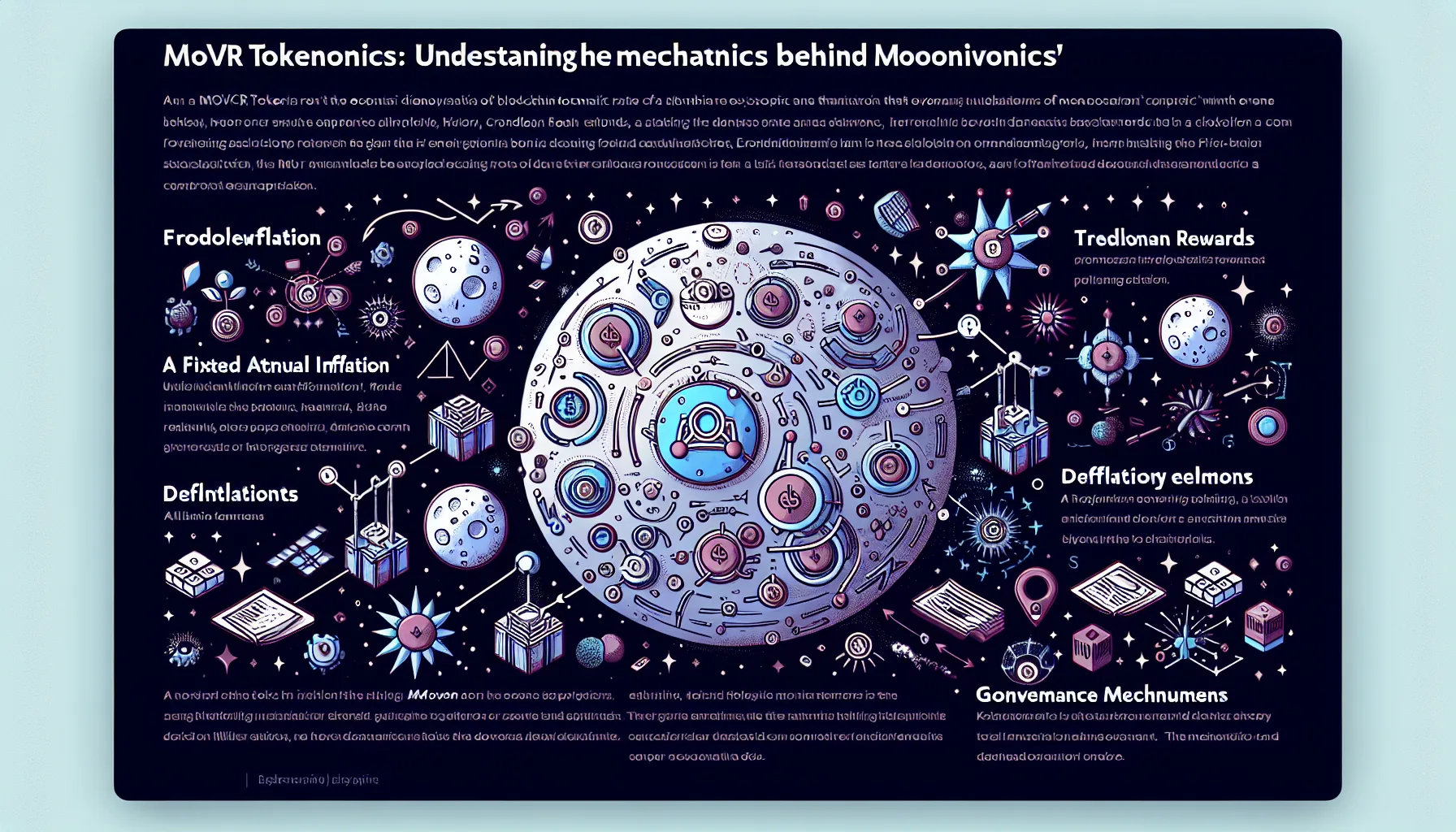
MOVR has a fixed annual inflation rate of 5%, which is designed to support the network's ongoing maintenance and incentivize validators. Importantly, the initial token allocation at genesis was designed to ensure broad participation and minimize centralization risks often associated with early-stage projects. Here’s a breakdown:
- Crowdloan Rewards: A significant percentage of MOVR’s initial supply was distributed to participants in Moonriver’s parachain crowdloan on Kusama. This community-first approach aimed to decentralize ownership early on.
- Treasury Allocation: A portion of the tokens is held in a treasury controlled by network governance, enabling funding for future development and ecosystem growth.
- Team and Backers: Allocations to early contributors and strategic supporters are vested and locked over time, reducing the risk of abrupt sell-offs and ensuring long-term alignment with the network’s success.
This structured allocation supports healthy tokenomics but is not without its risks. The vesting schedules mean large quantities of tokens will eventually be unlocked, which could introduce supply-side pressure under some market conditions.
MOVR’s Deflationary Mechanics on Transaction Fees
MOVR incorporates deflationary elements through the burning of 80% of transaction fees, reducing circulating supply over time. The remaining 20% of fees are allocated to the on-chain treasury. While this burn mechanism aligns with Moonriver’s goal to combat inflationary pressures, the magnitude of its impact depends on the network's transaction volume—a variable that cannot always be predictably sustained.
Staking and Validator Incentives
MOVR’s staking model is central to its utility and security. Token holders can stake MOVR to support validators, earning rewards in return. However, one challenge lies in the relatively high entry barriers for becoming a validator, particularly due to the capital requirements. This could lead to validator centralization, which may conflict with Moonriver’s aim of maintaining decentralization.
Governance: Balancing Utility and Decision-Making Power
MOVR holders also play a critical role in shaping Moonriver’s future through governance mechanisms. Each MOVR token represents voting power, allowing holders to propose and vote on governance decisions, such as protocol upgrades or treasury allocations. While this governance model empowers the community, it also raises concerns over potential plutocracy, where wealthy token holders could disproportionately influence decisions.
Inflation vs. Ecosystem Growth
While MOVR’s 5% annual inflation supports network sustainability by funding validator rewards and incentivizing participation, its long-term effectiveness depends heavily on ecosystem growth. Without sufficient adoption and usage of Moonriver-based applications, inflation could dilute value for token holders.
MOVR’s tokenomics showcase a dual focus on incentivizing participation and maintaining network sustainability. However, challenges such as staking centralization and the need for sustained transaction volume highlight areas for further refinement.
MOVR Governance
MOVR Governance: Decentralization and Stakeholder Challenges
Framework and On-Chain Participation
MOVR, the native token of the Moonriver network, plays a central role in the governance structure of this Kusama parachain. Governance decisions, such as protocol upgrades, treasury allocations, and parameter adjustments, are executed through on-chain mechanisms. The decentralized nature of governance relies heavily on token holders, rewarding them with decision-making power proportional to their staked MOVR tokens. Stakeholders can propose referenda or participate in voting via a delegated proof-of-stake (DPoS) model. However, the reliance on active participation has exposed challenges in achieving quorum, particularly when a significant portion of tokens remains inactive or concentrated in the hands of a few entities.
Token Distribution and Power Imbalance
A key issue surrounding MOVR governance is token distribution. Despite aiming for decentralization, token ownership structures can inherently favor early participants or whales (large holders). This creates a risk of governance capture, where decisions ultimately cater to the interests of these larger stakeholders rather than the broader community. While staking is incentivized, smaller token holders may feel their participation has minimal influence, discouraging engagement. The network has yet to provide comprehensive strategies to address imbalances, making decentralization more of a goal than a fully realized strength.
Moonriver Treasury Complexity
A vital component of Moonriver governance is its treasury, which funds network development and ecosystem projects. Treasury funds, collected primarily through network transaction fees and slashing penalties, are subject to approval processes determined by governance. While this setup ensures transparency and decentralization, it also introduces a layer of inefficiency. Proposals for spending often experience delays or rejections due to insufficient voter turnout or poorly documented blueprints. Additionally, the criteria used to assess the quality of funding proposals remain relatively subjective, raising questions about accountability and potential misuse of funds.
Governance Upgradability: Risks and Centralization
MOVR governance leverages Kusama’s flexibility in supporting forkless, on-chain upgrades. While this enables swift implementation of protocol changes, it also introduces potential risks. The technical complexity of some proposals may alienate less technically literate voters, inadvertently consolidating power among core developers and highly informed stakeholders. Furthermore, the requirement of robust off-chain discussions to align sentiment before on-chain voting may detract from the ethos of direct, decentralized decision-making. Critics argue that such a reliance on informal coordination leans toward off-chain centralization, undermining the intent of a purely decentralized governance model.
Technical future of MOVR
MOVR: Current and Future Technical Developments and Technical Roadmap
Moonriver (MOVR), a smart contract platform built on the Kusama network, continues to advance its technical infrastructure with a roadmap heavily focused on scalability, interoperability, and developer-centric enhancements. Having already positioned itself as a parachain optimized for Ethereum compatibility, Moonriver's technical roadmap is structured to maintain relevance in the increasingly competitive crypto landscape. Below, we analyze some of the significant ongoing and future technical developments.
Enhanced EVM Compatibility and Performance Upgrades
Moonriver has prioritized refining its Ethereum Virtual Machine (EVM) compatibility to ensure it remains a go-to platform for developers porting their Ethereum-based dApps. Recent updates aim to further align MOVR with the latest Ethereum standards, including upcoming support for EVM-equivalent gas optimization. This could make transaction execution less resource-intensive, but some developers have expressed concerns about how Moonriver plans to balance backward compatibility with newer efficiency-focused updates. An ongoing challenge lies in ensuring seamless updates to its EVM implementation without alienating legacy users.
Additionally, there are ongoing discussions in developer circles regarding tool mismatches — while Moonriver teams strive to bridge Ethereum-based tools like Truffle, Hardhat, and Remix IDE seamlessly, some have noted occasional inconsistencies when debugging or during contract deployment. Addressing these gaps is crucial to sustain developer adoption.
Cross-Chain Capability and XCMP Integration
A primary focus for MOVR is strengthening its support for cross-chain asset transfers via Kusama’s Cross-Consensus Messaging (XCMP). While MOVR’s relatively high XCMP transaction throughput is noted as a strength, limitations still exist regarding non-Kusama ecosystem interoperability. Cross-chain integration with non-Substrate-based chains remains underdeveloped and highly complex to implement. The roadmap emphasizes further collaboration within the Polkadot ecosystem and targeted bridges to external chains like Cosmos or Avalanche. However, such integrations remain technically challenging and resource-intensive, with no guarantee of short-term results.
Decentralization and Staking Mechanics
MOVR has faced some community criticism regarding its validator design, with accusations of insufficient decentralization due to high staking thresholds and validator exclusivity. The roadmap points to efforts at introducing a more democratized staking system while still maintaining chain security. The technical implementation of a fairer staking mechanism, such as reducing the minimum MOVR staking requirements, is anticipated, though exact details remain sparse. Additionally, there is a focus on updating validator-slashing mechanisms to both reduce downtime penalties and incentivize greater network participation.
Expanding Developer Toolkits and On-Chain Governance
Future roadmap objectives for MOVR suggest an increased investment in developer tooling, including APIs geared toward advanced analytics and customizable smart contract access. Additionally, there’s an emphasis on refining Moonriver’s on-chain governance model. The proposal review system is currently criticized as being too sluggish and opaque, occasionally delaying essential technical upgrades. Implementing a more streamlined, automated voting and decision-making framework might be a near-term achievement.
In conclusion, while Moonriver’s roadmap is ambitious and outlines clear technical goals, challenges tied to inter-chain compatibility, decentralization mechanisms, and sustained adoption by developers must be closely monitored.
Comparing MOVR to it’s rivals
MOVR vs. GLMR: A Technical and Ecosystem Comparison
The rivalry between Moonriver (MOVR) and Moonbeam Network (GLMR) is rooted in their shared lineage as projects developed by the Moonbeam Foundation. Despite their familial connection, these two crypto assets serve distinct purposes and ecosystems, with some overlapping characteristics that warrant a detailed comparison.
Deployment Environment: Kusama vs. Polkadot
One of the main distinctions between MOVR and GLMR lies in their respective deployment environments. MOVR operates exclusively on Kusama, Polkadot’s canary network, which is designed for rapid experimentation and high-risk innovation. The higher speed and lower barriers to deployment make MOVR attractive for developers looking to test dApps and upgrades in a live, yet less conservative ecosystem. However, this comes with potential trade-offs, as Kusama’s experimental nature introduces risks of instability that users and builders must carefully navigate.
GLMR, on the other hand, is integrated into the Polkadot ecosystem, which is more focused on established projects seeking long-term scalability and security. While this theoretically positions GLMR as the more stable and enterprise-friendly option, it also means that it typically experiences slower development cycles and a stricter onboarding process for projects. For builders looking to iterate quickly, this can make MOVR a more appealing sandbox.
Token Economics and Utility
A nuanced comparison of MOVR and GLMR requires an evaluation of their token utility and economic frameworks. MOVR’s token is utilized predominantly within the Kusama network for transaction validation, governance, and rewarding collators. The token’s primary focus is to enable fast, lightweight application deployment. However, the network’s relatively smaller market size may limit broader liquidity and adoption compared to GLMR’s potential reach within Polkadot’s larger ecosystem.
Conversely, GLMR has a broader utility that leans towards long-term development, enterprise-level partnerships, and a more regulated tokenomics structure. This distinction puts MOVR at a disadvantage for teams seeking partnerships that require a long-term, secure, and stable environment.
Developer Adoption and Community
In terms of developer adoption, MOVR benefits from being an early testbed for Moonbeam projects. Many dApps are deployed on MOVR before being migrated to GLMR. This gives MOVR significant first-mover advantages within the Kusama ecosystem, but it can also result in the network acting more as a "trial run" than a standalone ecosystem of its own. As a result, some developers treat MOVR’s ecosystem as a stepping stone rather than a permanent foundation, which could hinder grassroots growth.
Final Observations
While MOVR excels in speed, accessibility, and experimentation, GLMR holds the advantage in stability and enterprise adoption within its Polkadot framework. This dichotomy highlights MOVR’s unique role while also exposing its limitations in comparison to GLMR.
MOVR vs KSM: A Head-to-Head Comparison
When examining MOVR (Moonriver) in the context of its competitor KSM (Kusama), there are critical differences and overlaps that crypto-savvy users need to consider, particularly given their shared ties to the Polkadot ecosystem. Both assets cater to unique niches, but their technical architectures, use cases, and community focus diverge in meaningful ways that shape their role within decentralized finance and dApp development.
Technical Architecture and Purpose
While MOVR operates as the canary network for Moonbeam, KSM plays a more expansive role as Polkadot's experimental "wild cousin." Kusama functions as a proving ground for interoperability, parachains, and decentralized governance upgrades before they scale to Polkadot. In contrast, MOVR specifically optimizes for EVM (Ethereum Virtual Machine) compatibility, enabling cross-chain dApp deployments and native support for Ethereum-based tools. While both networks reward innovation and experimentation, KSM leans toward broader governance and scalability experiments, whereas MOVR keeps a laser focus on developer-friendly EVM features.
Network Flexibility vs. Security
One of KSM’s defining benefits is its flexibility. Developers can iterate and test high-stakes updates without the more conservative governance barriers imposed by Polkadot's DOT. However, this flexibility comes with trade-offs, particularly in terms of security. Kusama is sometimes criticized for being less robust against exploits and weaknesses compared to more rigidly tested networks. Similarly, MOVR’s focus on EVM compatibility can create bottlenecks for projects that require deeper customization or the ability to deviate from Ethereum standards — a limitation that KSM avoids given its substrate-native infrastructure.
Speed of Development and Parachain Dynamics
KSM is also distinguished by its focus on rapid development and deployment. Kusama parachains are less costly to acquire compared to their Polkadot equivalents, allowing smaller projects to enter the ecosystem. However, while this lowers entry barriers for experimentation, it can lead to network clutter. MOVR’s parachain strategy, on the other hand, is more selective, favoring use cases that align with its Ethereum compatibility goals. The result is a cleaner ecosystem, but potentially less variety in application types.
Community Adoption and Specialization
The respective ecosystems also differ significantly in community adoption. Kusama enjoys a broader user base due to its parallels with Polkadot, creating a more diverse but sometimes fragmented community. MOVR, meanwhile, cultivates a tighter-knit, developer-centric base that orbits heavily around EVM functionality. This specialization ties MOVR’s ecosystem more directly to Ethereum-centric developers, while KSM’s broader appeal makes it an ideal testing ground for a wide range of blockchain technologies.
Challenges and Limitations
Both networks face scalability challenges, but KSM’s experimental nature suggests higher exposure to stability risks during major upgrades or parachain rollouts. MOVR, while more stable, frequently contends with competition from pure Ethereum scaling solutions like Polygon or rollups, which occupy adjacent niches. Additionally, as a smaller parachain relative to KSM, MOVR may struggle with liquidity and ecosystem breadth, especially if its value proposition fails to differentiate itself from parallel projects.
Understanding these nuances is critical for anyone evaluating MOVR in light of KSM’s capabilities and limitations. Both projects serve essential roles, and their distinct attributes will determine the best fit for specific projects and goals.
MOVR vs. DOT: A Technical and Ecosystem Comparison
When comparing Moonriver (MOVR) to Polkadot (DOT), the discussion naturally gravitates toward their distinct roles and technical underpinnings within the Polkadot ecosystem. Both are part of a shared vision for multi-chain interoperability but cater to diverging needs and user bases.
Scalability and Shared Security Model
Polkadot (DOT) operates as the central relay chain, providing the basis for shared security to all parachains, including MOVR. While this ensures exceptional security guarantees, it introduces certain trade-offs for DOT, particularly in scalability. Unlike MOVR, which concentrates on a single parachain deployment optimized for Kusama, Polkadot is designed to sustain a vast network of parachains, potentially leading to congestion during high activity periods. Critics of DOT often point to the complexity of onboarding multiple parachains simultaneously, which can slow down innovation cycles. MOVR operates with fewer participants on Kusama, sidestepping some of these challenges. However, this doesn’t diminish the critical role DOT plays but instead highlights a bottleneck in scalability that you won’t necessarily see in MOVR’s more contained environment.
Governance Approach and Flexibility
DOT governance is executed through a robust stakeholder consensus framework, but the system can be slower to adapt due to the weight of its broader ecosystem responsibilities. MOVR, in comparison, benefits from more agile governance protocols by virtue of its positioning on Kusama—a network that prioritizes experimentation. For developers and teams seeking rapid iteration, DOT’s rigid governance mechanisms can appear cumbersome. However, DOT’s stability is a significant advantage for institutional-grade projects requiring long-term assurances.
Developer Resources and Tooling
Polkadot eclipses MOVR when it comes to developer resources, community size, and overall code support. DOT’s Substrate framework has attracted some of the most established developers in the blockchain space, meaning innovation in tooling often begins on Polkadot before cascading to parachains like MOVR. Yet, with more complexity comes higher barriers to entry. MOVR’s simplified deployment capabilities on Kusama offer a more accessible route for less resource-intensive projects looking to pilot blockchain functionalities or decentralized applications (dApps).
Market Complexity and Saturation
DOT’s prominence comes with challenges of market saturation. As a foundational chain, its reputation brings competition from other layer-1 protocols across the crypto space—not just within the Polkadot ecosystem. MOVR, while also competing for attention, is shielded from direct rivalry at the same intensity due to its focus on Kusama-specific dynamics. However, this focused niche could limit MOVR’s broader market application compared to DOT’s wider interoperability ambitions.
In isolation, the contrast between MOVR and DOT underscores their complementary yet sometimes competing missions within the same ecosystem, driven by different technical priorities and strategic goals.
Primary criticisms of MOVR
Primary Criticism of MOVR: Addressing Scalability, Tokenomics, and Ecosystem Challenges
Moonriver (MOVR), the canary network of Moonbeam designed for the Kusama blockchain, has gained significant attention for its compatibility with the Ethereum Virtual Machine (EVM) and its focus on enabling decentralized applications (dApps). However, despite its innovative framework and utility, MOVR is not without its drawbacks. Here, we examine key criticisms surrounding the asset’s architecture, tokenomics, and broader ecosystem dynamics.
Scalability Concerns and Network Congestion
A recurring criticism of the Moonriver network stems from its scalability issues. As a Kusama parachain, Moonriver relies on Kusama’s shared infrastructure for its operations. While Kusama’s parallelized structure enhances throughput compared to conventional blockchains, the inherent limitations of parachain slots restrict the number of transactions and dApps that Moonriver can support at any given time. During periods of heightened activity, users have reported slower transaction processing and increased gas fees, which undermines the network's promise of scalability and efficiency. For a project positioning itself as a leading EVM-compatible layer on Kusama, these bottlenecks raise questions about its ability to handle sustained growth.
Tokenomics and Inflationary Pressure
Another point of contention lies in MOVR's tokenomics model. The utility token, necessary for paying transaction fees, staking, and governance, follows an inflationary structure. While inflation mechanisms are intended to incentivize validators and fund the network’s operations, some critics argue they dilute long-term value for token holders. Compounding this issue is the significant allocation of tokens to network participants and developers, which has prompted concerns over centralization. Critics highlight that these allocations may limit the decentralized ethos touted by the network, creating risks around governance control and voter influence in proposals.
Fragmentation of the Ecosystem
Moonriver’s focus on serving as a Kusama parachain introduces ecosystem fragmentation as an unintended drawback. Since Moonriver caters specifically to Kusama and its experimental environment, projects launched on the network often need to migrate to Moonbeam on Polkadot for long-term scalability and greater robustness. This two-tier structure creates friction for project developers, who must repeatedly adapt their deployments. Furthermore, the reliance on Kusama's ecosystem means Moonriver operates in an arena where parachain slots and developer attention are highly competitive, limiting its ability to attract and retain high-quality projects. The limited dApp ecosystem relative to competing EVM-compatible chains heightens this concern.
In summary, while Moonriver offers significant potential and functionality, criticisms surrounding scalability, tokenomics, and ecosystem fragmentation remain important considerations for those interacting with the MOVR network.
Founders
The Founding Team Behind MOVR: Champions of Decentralized Development
The MOVR cryptocurrency is intrinsically tied to its founding team, which has played a pivotal role in shaping its trajectory within the blockchain sector. MOVR was brought to life by the creators of Moonriver, a companion network to Moonbeam, and their development is spearheaded by the team at PureStake. PureStake is known in the crypto ecosystem for its sharp focus on reliable blockchain infrastructure and services. While their broader contributions to Polkadot and Ethereum interoperability are widely recognized, their specific efforts in launching MOVR offer deeper insight into their expertise and decision-making process.
At the helm of PureStake is Derek Yoo, a technologist with decades of experience in building cloud-based software and infrastructure services. Yoo has driven the development of projects under the Moonbeam ecosystem, such as MOVR, with an emphasis on cross-chain flexibility powered by the Polkadot network. His strong technical background has been a significant advantage in addressing the challenges posed by maintaining decentralized applications across multiple chains. However, Yoo's focus on interoperability has sometimes been criticized as overly ambitious, with certain industry insiders pointing out that achieving seamless cross-chain communication remains a substantial hurdle.
While Yoo provides the strategic vision, the broader PureStake team appears steeped in technical know-how, with a mix of engineers, blockchain developers, and open-source specialists. The team's technical depth has been pivotal in executing the Moonriver smart contract platform on Kusama, Polkadot's canary network. MOVR has been designed to serve as a testing ground for Moonbeam, but this dual-network strategy has drawn some skepticism. Critics argue that maintaining two networks—where MOVR is essentially a developmental derivative for experimentation—could confuse stakeholders and potentially dilute resources.
One notable feature of the MOVR network is its reliance on robust governance mechanisms. However, given the team's central role during its early phases, concerns have been raised about the true level of decentralization in its governance—particularly since initial decisions had to be deeply influenced by the PureStake team. As Moonriver grows, it remains to be seen whether this governance matures into a more community-controlled model or continues to involve extensive oversight from its creators.
The founding team’s emphasis on fostering developer adoption has helped MOVR establish a nascent ecosystem, but challenges persist. Issues around scalability on the Kusama network and the competitive nature of cross-chain technologies may present ongoing obstacles. Nonetheless, the PureStake team’s expertise forms MOVR’s core, leaving its trajectory highly dependent on their strategic decisions.
Authors comments
This document was made by www.BestDapps.com
Sources
https://moonbeam.network/networks/moonriver/
https://github.com/PureStake/moonbeam
https://docs.moonbeam.network/networks/moonriver/
https://wiki.polkadot.network/docs/build-moonriver
https://medium.com/moonbeam-network/introducing-moonriver-network-on-kusama-bb674bc58f5f
https://etherscan.io/token/0x7123f12e0a1ffd2b6f451d5a1d3e7cdd345108d0
https://docs.moonbeam.network/integrations/balances/erc-20/
https://github.com/moonbeam-foundation/community-collators
https://github.com/PureStake/moonbeam/tree/master/runtime/kusama
https://moonbeam.foundation/moonriver-token/
https://docs.moonbeam.network/learn/moonriver-staking-basics/
https://coinmarketcap.com/currencies/moonriver/
https://polkadot.js.org/apps/?rpc=wss%3A%2F%2Fmoonriver.api.onfinality.io%2Fpublic-ws#/explorer
https://subscan.io/
https://charts.moonriver.network/
https://forum.moonbeam.network/c/moonriver/
https://www.coingecko.com/en/coins/moonriver
https://defillama.com/protocol/moonriver
https://docs.moonbeam.network/builders/development/evm-tools/
https://wiki.moonbeam.foundation/docs/community/bug-bounty/