History of MDT
The History of Measurable Data Token (MDT)
Measurable Data Token (MDT) was introduced as a blockchain-based solution aimed at decentralizing data exchange. The project emerged during a period when data privacy concerns were becoming increasingly prominent, positioning itself as a response to centralized entities monetizing user data without direct compensation to the contributors. MDT's framework was designed to facilitate transparent and consensual data sharing, offering tokenized incentives to users while maintaining privacy protection.
Initial Development and Token Launch
The MDT token was launched as an ERC-20 token on the Ethereum blockchain. Its initial release coincided with a wave of data-related blockchain projects seeking to establish new privacy-preserving monetization mechanisms. From the outset, MDT aimed to integrate with real-world data applications, particularly in financial services and consumer analytics. Unlike purely theoretical blockchain concepts, the MDT ecosystem sought to embed itself into existing data flows through partnerships and application-layer integrations.
Early Adoption and Strategic Integrations
MDT's adoption strategy revolved around integrating with existing applications that generated valuable user data. Its primary implementation was within the MailTime email app, where users could opt-in to share anonymized email transactional data in exchange for MDT rewards. This model demonstrated a working use case but faced challenges in achieving large-scale adoption beyond its initial ecosystem.
Over time, MDT sought additional integrations in the fintech and market research sectors. However, like many blockchain projects dependent on network effects, sustained user acquisition and data provider participation posed challenges. Balancing data privacy with verifiable insights remained a key technical and regulatory hurdle.
Challenges and Ecosystem Limitations
MDT's approach of incentivized data sharing was innovative but faced obstacles, including scalability concerns and compliance with evolving data protection regulations. The increasing scrutiny on data privacy laws, such as GDPR and other regional frameworks, introduced additional complexities in utilizable data.
Additionally, the viability of token-based data exchanges depended on maintaining a consistent demand for the incentivized data. The challenge was not just in attracting users willing to share information but also in sustaining a market where third parties found the acquired data valuable enough to justify ongoing transactions.
Despite these challenges, MDT continued its attempts at expanding its ecosystem, emphasizing real-world integrations to sustain utility. However, achieving mainstream traction remained a persistent test for the project.
How MDT Works
How MDT Works: A Deep Dive into Its Data Monetization Model
MDT (Measurable Data Token) is designed to facilitate decentralized data exchange by connecting data providers, consumers, and users in a blockchain-driven ecosystem. At its core, MDT leverages smart contracts to process transactions transparently while ensuring that users retain control over their data contributions.
Data Sourcing and Contribution
MDT’s framework operates through data contributors who voluntarily share anonymized consumer data. This data can originate from various sources such as email receipts, transaction records, or other verifiable digital interactions. Users opt into this ecosystem through partnered applications that integrate MDT’s protocol, enabling seamless data sharing without exposing personally identifiable information.
Smart Contract Execution
Transactions within the MDT network are executed via Ethereum-based smart contracts. These contracts govern data submission, validation, and reward distribution. When a data consumer—such as a business or analytics provider—requests data, smart contracts ensure that only relevant datasets are provided while enforcing predefined payment terms.
A key challenge in this system is maintaining the balance between meaningful data aggregation and user privacy. While MDT employs cryptographic techniques and anonymization protocols, concerns around potential data deanonymization remain a focal point of discussion, particularly as demand for higher granularity increases.
Tokenized Incentive Model
MDT functions as the primary utility token within its ecosystem. Users who contribute data receive MDT tokens in return, while businesses pay for access using the same token. This tokenomics model aims to create a circular economy where data value is exchanged efficiently. However, the reliance on a singular token introduces potential liquidity risks, as fluctuations in token demand may impact participation incentives.
Decentralization vs. Centralized Dependencies
While MDT promotes a decentralized approach to data exchange, several aspects of its operations rely on centralized components. Partnered applications act as gatekeepers for data collection, creating dependency risks that could undermine the trustless nature of the network. Additionally, regulatory scrutiny over data marketplaces remains an ongoing challenge, which could affect the project’s long-term adoption.
Scalability and Network Efficiency
Given that MDT operates on Ethereum, transaction fees and network congestion can impact its efficiency. While layer-2 solutions or alternative blockchain scaling strategies could mitigate these concerns, the protocol’s reliance on Ethereum exposes it to inherent limitations in throughput and cost variability.
Use Cases
Use Cases of Measurable Data Token (MDT)
Data Monetization for Users
MDT enables individuals to monetize their anonymized data while maintaining privacy. Users can connect data sources—such as transactional records—and receive compensation when their data is accessed by businesses or research institutions. Unlike traditional data brokerage models that operate without transparency, MDT allows users to retain control over their data and participate in revenue generation directly. However, adoption challenges remain, as mainstream users may hesitate to share personal data, even with privacy assurances.
Reward Systems in Data Exchanges
MDT is used as a reward mechanism in various data-sharing ecosystems. Businesses and platforms can incentivize users to share specific datasets, creating a decentralized data exchange. Given the demand for consumer insights, brands and market researchers can leverage MDT to acquire data legally and transparently. One issue, however, is ensuring quality control. Since users are directly rewarded, there is a risk of fabricated or manipulated data being introduced into the ecosystem.
Integration with Decentralized Finance (DeFi)
With financial data being one of the most valuable datasets, MDT has potential integrations within DeFi applications. Users who contribute financial behaviors or spending trends could be rewarded with MDT, enabling new financial data-driven models. Some DeFi protocols could utilize such datasets for risk assessment, credit scoring, or predictive analytics. The primary challenge here is adoption within major DeFi platforms and ensuring a balance between privacy and data utility.
Application in Smart Contracts
MDT can be incorporated into smart contracts for automated data transactions. Organizations seeking specific data sets can enter into smart contracts that trigger payment upon verification of data quality and compliance. This capability minimizes reliance on intermediaries in data markets, enhancing efficiency. However, scalability remains a concern, as processing large data sets on blockchain infrastructure may be expensive and slow.
Use in Research and Analytics
MDT’s framework enables direct collaboration between data providers and researchers. Academic institutions, fintech firms, and analysts can access anonymized datasets from consenting users, creating a transparent model for data-driven studies. However, the challenge lies in ensuring regulatory compliance regarding data privacy, particularly with differing standards across jurisdictions.
Challenges in Adoption
While MDT provides a decentralized approach to data exchange, challenges include user adoption barriers, regulatory scrutiny, and ensuring data authenticity. Without widespread use, liquidity and practical utility may remain limited. The sustainability of incentivized data models also depends on maintaining a balance between demand from data buyers and supply from users.
MDT Tokenomics
MDT Tokenomics: Supply, Distribution, and Utility
Fixed Supply and Allocation
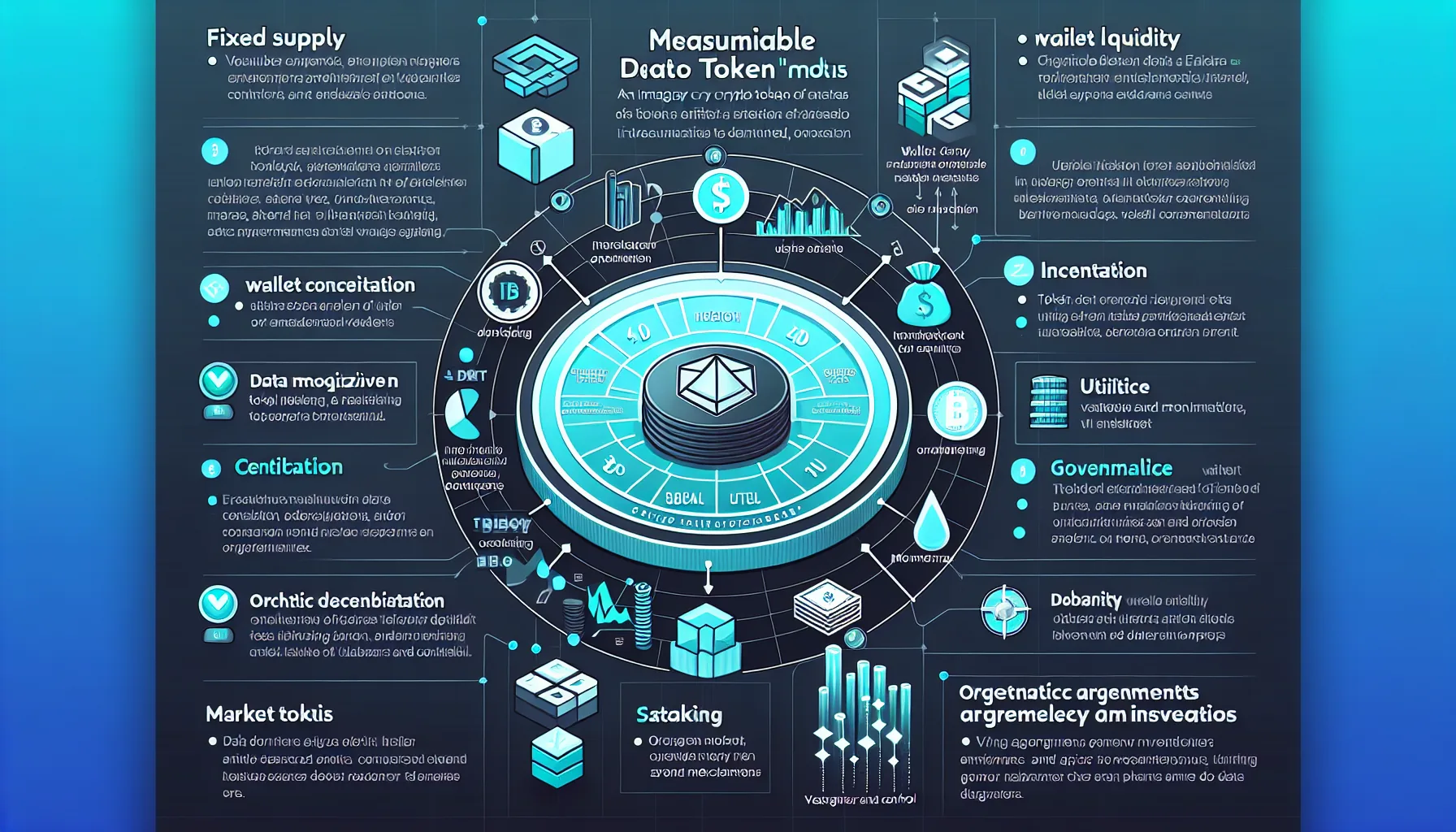
Measurable Data Token (MDT) operates with a fixed total supply, ensuring no further minting or inflationary mechanics. This finite supply is a critical factor for scarcity-driven valuation but also places constraints on future network incentives. The distribution structure plays a fundamental role, with allocations spread across ecosystem development, team incentives, and market circulation. A significant portion of the supply is reserved for incentivizing participants in data-sharing ecosystems, which directly ties utility to adoption. However, centralization concerns arise due to wallet concentration, where a few addresses hold substantial portions of the supply, potentially impacting liquidity and price stability.
Incentives and Circulation
MDT’s primary function revolves around data monetization, where users are rewarded for sharing anonymized data. The continuous issuance of tokens as rewards raises sustainability questions—if user growth stagnates, reward dilution could reduce long-term demand. Token velocity is another consideration, as rapid circulation without consistent lock-up mechanisms may contribute to price instability. MDT relies on organic demand from data buyers, but if data purchaser engagement lags, token utility could face significant pressure.
Staking, Utility, and Token Sink Mechanisms
Unlike some crypto assets that integrate staking for passive yield generation, MDT focuses on active utility within its ecosystem. However, a lack of traditional staking reduces incentives for long-term holding. Token sink mechanisms, such as transaction fees or buybacks, can help regulate supply dynamics, but MDT’s model does not emphasize aggressive token-burning strategies. Without strong deflationary forces, the long-term balance between supply and demand remains a factor requiring monitoring.
Exchange Liquidity and Market Dynamics
MDT is supported on multiple exchanges, but liquidity concentration can vary across platforms. While broad exchange availability enhances accessibility, low liquidity on certain pairs may contribute to volatile price movements. Moreover, the presence of wash trading or artificial volume inflation on smaller exchanges could provide misleading liquidity signals, affecting traders relying on market depth analysis.
Governance and Control
Unlike governance tokens that empower holders with protocol decision-making, MDT does not incorporate decentralized governance mechanisms. Centralized decision-making over ecosystem development may streamline growth but reduces community influence. Additionally, token unlock schedules and vesting arrangements for early investors and team members can impact circulating supply dynamics, with large unlock events potentially influencing price action.
MDT Governance
MDT Governance: Decentralization, Control, and Challenges
Governance Mechanism of MDT
The governance structure of Measurable Data Token (MDT) primarily revolves around its smart contract framework and ecosystem participation. Unlike some fully decentralized protocols that utilize DAO models, MDT's governance is influenced by its development team and strategic partners. Token holders have limited direct governance powers, with no on-chain voting mechanism widely implemented for protocol upgrades or ecosystem changes.
This centralized decision-making structure raises concerns regarding transparency and community influence. While the team has control over key protocol decisions, there is little insight into how governance choices are made or whether decentralization will increase over time.
Lack of a DAO-Led Governance Model
Many modern crypto projects incorporate decentralized autonomous organization (DAO) frameworks to allow token holders to shape protocol direction. MDT currently does not have a DAO-based governance model, meaning token holders lack formal decision-making mechanisms such as voting on proposals, modifying fee structures, or influencing partnerships.
This governance limitation can lead to central points of failure or slow adaptability to user demands. Since MDT operates within the data monetization sector, governance centralization may pose risks, particularly regarding user data policies and revenue-sharing mechanisms.
Decision-Making and Smart Contract Authority
The MDT smart contracts control token transfers, staking functions, and transaction settlements within the ecosystem. However, the ability to execute upgrades or modify smart contract logic remains largely under the control of the founding team or designated administrators. There is no publicly available documentation detailing whether governance upgrades require multi-signature approvals or other decentralized security measures.
For token holders, this means that core modifications, such as changes in reward distribution or transaction fees, are not directly influenced by community consensus. This contrasts with governance models where token-weighted voting dictates protocol evolution.
Risks Associated with Centralized Governance
The centralized governance of MDT introduces key risks:
- Lack of Transparency: Without a clear governance roadmap or voting structure, token holders have no direct say in protocol enhancements or ecosystem modifications.
- Smart Contract Control: If contract upgrades are not subject to community governance, there is potential for unilateral modifications that may not align with token holder interests.
- Regulatory Considerations: Centralized governance can make the protocol easier to regulate, but it also concentrates decision-making power, which could impact decentralization principles over time.
While MDT facilitates data monetization, its governance structure remains largely centralized, with few participatory mechanisms for token holders to influence protocol direction. This governance approach may evolve, but as of now, decision-making remains controlled by core team members rather than a decentralized community.
Technical future of MDT
MDT Technical Roadmap and Upcoming Developments
On-Chain Infrastructure Enhancements
MDT is continuously refining its blockchain infrastructure to improve scalability and reduce transaction latency. Efforts are being directed towards optimizing smart contracts for gas efficiency, enabling more cost-effective interactions on the network. Additionally, research into Layer 2 scaling solutions, such as rollups or state channels, is underway to mitigate congestion and enhance throughput without compromising decentralization.
Privacy and Data Anonymization Innovations
MDT's core proposition revolves around data monetization, necessitating robust privacy mechanisms. Enhancements in zero-knowledge proofs (ZKPs) and other cryptographic techniques are being explored to allow users to share data without exposing personally identifiable information. However, implementing such solutions at scale poses technical challenges in computational efficiency and blockchain compatibility.
Cross-Chain Compatibility and Interoperability
To extend its ecosystem beyond a single network, MDT is actively pursuing interoperability with other blockchains. The integration of cross-chain bridges and token standards like ERC-677 or ERC-5164 will help facilitate seamless asset transfers and data integration across multiple networks. However, security remains a pressing concern, as cross-chain bridge vulnerabilities have been historically exploited in the broader crypto ecosystem.
Decentralized Storage and Data Management
A critical focus is on decentralizing data storage to reduce reliance on centralized servers. Implementing IPFS or similar decentralized storage solutions has been proposed to ensure greater resilience and censorship resistance. While decentralized storage improves security, it also introduces challenges in retrieval speeds and cost efficiency, which need to be addressed for seamless user experience.
Smart Contract Upgrades and Governance Evolution
A structured governance model is essential for sustaining protocol evolution. MDT is expected to introduce more sophisticated on-chain governance mechanisms to decentralize decision-making further. Potential integration with governance frameworks like quadratic voting or delegated staking is being explored. However, governance participation rates remain an issue across many blockchain projects, raising concerns about centralization due to voter apathy.
Integration with Emerging DeFi and Web3 Protocols
MDT’s use cases naturally intersect with decentralized finance (DeFi) and broader Web3 applications. Expanding partnerships and integrations with lending protocols, decentralized exchanges (DEXs), and NFT projects could enhance utility. However, aligning with fast-evolving DeFi standards requires continuous adaptation and security audits—both of which demand substantial development resources.
Challenges and Bottlenecks in Development
Despite ongoing advancements, several technical hurdles remain. Scalability improvements must balance trade-offs between decentralization and efficiency. Privacy implementations require continuous refinement to comply with regulatory standards. Additionally, maintaining a secure and robust cross-chain infrastructure demands constant security assessments to prevent potential exploits.
Comparing MDT to it’s rivals
Comparing MDT to OCEAN: Key Differences in Data Monetization
Approach to Data Sharing
MDT and OCEAN both focus on data monetization, but they take fundamentally different approaches. MDT operates within a closed-loop ecosystem where users voluntarily share anonymized data via partnerships with applications like email and financial services. The data is aggregated and providers are rewarded in MDT tokens.
OCEAN, on the other hand, is designed as an open marketplace where users and enterprises can tokenize and trade datasets using the Ocean Protocol. This model allows for more flexibility but also introduces complexities related to data discoverability, pricing, and privacy enforcement. MDT’s approach is more streamlined, whereas OCEAN’s open exchange caters to a broader range of industries, including AI and enterprise-level data solutions.
Smart Contract Functionality
OCEAN utilizes Ethereum-based smart contracts to facilitate the automated exchange of data assets using its native token. It also implements data NFTs and Compute-to-Data to allow AI models to be trained on private datasets without exposing the raw data. MDT, in contrast, employs a reward-based mechanism where user data contributions are incentivized through its ecosystem, though it does not support Compute-to-Data functionality.
This presents a tradeoff—while MDT focuses on bridging the gap between users and data buyers efficiently, OCEAN provides greater programmability and customization for more complex data utilization scenarios.
Privacy and Data Control
Privacy and ownership are critical concerns for both projects. MDT emphasizes user-first privacy by ensuring that data is anonymized before being shared with data consumers. While this minimizes third-party tracking concerns, it also limits the granularity of data available to buyers compared to OCEAN’s offerings.
OCEAN’s framework allows data owners to maintain control over their datasets through fine-grained access control, including compute-only usage. This potentially gives data providers more confidence in licensing valuable datasets while still maintaining privacy, a flexibility that MDT does not currently match.
Market Adoption and Adoption Barriers
MDT has a narrower focus on consumer-driven data, particularly in the financial sector. This targeted approach makes integration simpler for applications but limits its appeal to enterprises looking for more diverse datasets. OCEAN, with its broader scope, has traction in industries that require large-scale data exchanges such as AI, healthcare, and enterprise analytics. However, its complexity can be a barrier for casual users, whereas MDT’s ecosystem is designed for seamless adoption via integrated apps.
Comparing MDT to NMR: Key Differences in Data Economy Approach
Core Use Case and Data Utilization
MDT and NMR both operate in the data economy, but their approaches differ significantly. MDT focuses on user-generated data, rewarding individuals for contributing anonymized behavioral insights. In contrast, NMR is centered on financial predictions, leveraging crowdsourced machine learning models to refine hedge fund strategies. This fundamental difference influences their token utility: MDT emphasizes data monetization for consumers, while NMR is built around staking to improve predictive accuracy in financial markets.
Token Model and Economic Incentives
The NMR token operates in a staking-based system where participants risk their holdings based on the accuracy of their financial models. Poor performance results in token burns, while strong predictions yield rewards. This mechanism creates a competitive, meritocratic environment that directly impacts token supply. MDT, on the other hand, does not involve staking mechanics in the same way but instead distributes rewards based on data contributions, which can lead to different token velocity and demand dynamics.
Decentralization and Governance
Governance structures between the two projects exhibit differences. NMR leans toward a decentralized approach with participation from data scientists who contribute models without direct central oversight. MDT's ecosystem relies more on partnerships with applications that gather and distribute data from users, giving companies a larger role in its adoption and expansion. This contrast affects how decisions are made regarding network upgrades, token economics, and platform changes.
Adoption and Market Niche
NMR has carved out a niche within quantitative finance, attracting hedge funds and data scientists looking to improve algorithmic trading through decentralized intelligence. Its narrow focus means adoption is largely constrained to this sphere. MDT, in contrast, aims for broader consumer participation, targeting everyday users who generate data through online behaviors and transactions. The scalability of MDT’s approach depends on partnerships and application integrations, while NMR's success ties more directly to the performance of its staked models.
Challenges and Limitations
Both projects face distinct challenges. NMR’s dependency on predictive modeling means that token ecosystem sustainability is closely linked to ongoing participation by data scientists. If engagement declines, the staking and burn incentives could create volatility in supply. MDT, meanwhile, must overcome adoption barriers in convincing users to actively share their data amidst growing concerns over privacy and data ownership. Additionally, MDT’s reliance on third-party applications for data collection introduces risks related to platform dependency and integration bottlenecks.
MDT vs. DIMO: A Comparative Analysis
Data Monetization Focus
MDT and DIMO both operate in the data economy but serve fundamentally different sectors. MDT is focused on general consumer data aggregation, leveraging blockchain for decentralized data transactions. In contrast, DIMO is specifically built for vehicle data, allowing users to collect and monetize telemetry from their cars. This narrow focus sets DIMO apart but also limits its overall applicability compared to MDT’s broader consumer data model.
Decentralization and Control
MDT operates with a decentralized data exchange model, working to remove intermediaries while ensuring data buyers and sellers transact transparently. DIMO follows a similar blockchain-based architecture but enforces stricter control over data sources by requiring specific hardware (DIMO devices or connected car integrations). This hardware requirement creates a higher barrier to entry for users compared to MDT’s more open system, which primarily relies on existing digital data streams.
Token Utility and Incentive Structures
The MDT token serves as a medium of exchange for data transactions, with buyers compensating data providers for insights. DIMO’s token model also rewards users for contributing vehicle data but has additional complexities due to hardware logistics and integration costs. One concern with DIMO’s model is that its dependency on specific hardware could slow adoption, creating a bottleneck that MDT bypasses with its data-agnostic approach.
Adoption Challenges
While both projects aim to disrupt traditional data economies, adoption remains a key challenge. MDT has the advantage of integrating with existing digital services, allowing users to sell data collected passively. DIMO, on the other hand, faces hurdles due to the requirement for compatible vehicles and hardware installations, which could limit the number of participants. However, DIMO’s focus on automotive data may attract users interested in monetizing a high-value niche, whereas MDT competes in a broader, more fragmented market.
Regulatory Considerations
Both MDT and DIMO navigate complex regulatory environments related to data privacy. MDT deals with traditional consumer data regulations, which vary by region. DIMO, due to its vehicle focus, may encounter additional regulatory scrutiny concerning car manufacturers, telematics data laws, and data sharing between vehicle owners and third-party services. These added complications could present long-term challenges for DIMO’s scalability compared to MDT’s more software-centric approach.
Primary criticisms of MDT
Primary Criticism of MDT (Measurable Data Token)
Data Privacy and Centralization Concerns
One of the most significant criticisms of MDT revolves around its handling of data privacy. While the project promotes itself as a decentralized data marketplace, skeptics argue that true decentralization is questionable given the reliance on centralized entities to collect, process, and monetize user data. Since data providers and consumers must interact through designated platforms, the risk of central entities retaining control persists, raising concerns about whether users genuinely own their data or are merely participants in another intermediary-driven system.
Utility and Adoption Challenges
The actual utility of MDT remains a contentious issue within the crypto space. While the concept of compensating users for their data is appealing, adoption has been slow, limiting the token's real-world use cases. Many platforms struggle to integrate a tokenized data economy seamlessly, and data buyers may not see enough incentives to adopt an alternative to traditional data brokerage models. Without widespread participation from both data providers and buyers, MDT could struggle to maintain long-term viability in an increasingly competitive landscape.
Regulatory Risks for Tokenized Data
The regulatory landscape surrounding personal data monetization presents another challenge for MDT. Governments worldwide continue to introduce stricter data privacy laws, such as GDPR and other consumer protection regulations. Since MDT operates in a field where user data is being commoditized, any changes in data protection laws could directly impact the project’s legality and operational feasibility. Additionally, the classification of data-related tokens under financial regulations remains a gray area, increasing uncertainty about potential compliance risks.
Competition from Established Data Markets
Traditional data marketplaces operated by tech giants already dominate data monetization, posing a significant hurdle for MDT. Large-scale companies have deeply entrenched relationships with advertisers and data buyers, making it difficult for a blockchain-based alternative to gain traction. Even within the crypto ecosystem, similar data-sharing projects compete for adoption, raising skepticism about MDT’s ability to differentiate itself effectively.
Tokenomics and Incentive Model Issues
MDT's tokenomics have been criticized for their long-term sustainability. Questions persist about whether incentives are attractive enough to ensure continued platform participation. If data providers receive minimal rewards, they may not engage long-term, leading to liquidity and ecosystem stagnation. Additionally, without robust demand from data buyers, the value proposition for holding MDT remains uncertain, further complicating adoption and market growth.
Founders
The Founding Team Behind Measurable Data Token (MDT)
Measurable Data Token (MDT) was founded by a team with deep experience in data trading, enterprise solutions, and blockchain technology. The key figures behind the project have backgrounds that span across fintech, big data analytics, and decentralized applications, positioning them to create a crypto asset focused on data monetization.
Background of the Core Team
The founding team is composed of individuals who previously worked in established tech firms, primarily in the data and analytics space. Their prior ventures involved building platforms for data exchange, which laid the groundwork for MDT’s blockchain-based approach. Some team members have experience in both traditional finance and emerging Web3 sectors, providing a crossover skill set essential for bridging centralized data markets with decentralized solutions.
MDT’s leadership has been involved in privacy-driven innovations for data sharing but has faced scrutiny over the balance between decentralization and platform control. While the token itself is designed to facilitate data transactions without direct third-party intermediaries, concerns have been raised about whether the founding team’s existing business interests create conflicts with the principles of full decentralization.
Previous Ventures and Experience
Before launching MDT, the founders were responsible for building product-focused companies that dealt with anonymized user data aggregation. Their expertise helped shape MDT’s core value proposition: offering compensation for data while maintaining privacy protections.
While their industry experience provides credibility, some critics argue that MDT mirrors traditional data brokerage models, except with blockchain-layered incentives. This has led to skepticism within the crypto community, particularly from decentralization advocates who question the team's ability to maintain a trustless data ecosystem.
Challenges in Leadership Transparency
Despite their technical and business acumen, the MDT founding team has been criticized for limited transparency in governance and roadmap execution. While some projects in the data-sharing blockchain space prioritize community involvement, MDT’s development trajectory has often been tightly controlled by its original team. This has fueled discussions about the level of decentralization and the role of token holders in project decision-making.
Additionally, there have been questions about the lack of high-profile investors or partnerships backing the founding team. Unlike some blockchain projects that attract significant institutional interest, MDT’s adoption relies heavily on the team’s ability to execute without external financial backing from major crypto funds.
These factors have shaped the perception of MDT’s founders within the broader crypto ecosystem, influencing ongoing discussions about the project’s direction and governance model.
Authors comments
This document was made by www.BestDapps.com
Sources
https://www.mdt.co/whitepaper.pdf
https://www.mdt.co/
https://etherscan.io/token/0x81c9151de0c8bafcd325a57e3db5a5df1cebf79c
https://coinmarketcap.com/currencies/measurable-data-token/
https://www.coingecko.com/en/coins/measurable-data-token
https://defillama.com/token/ethereum/0x81c9151de0c8bafcd325a57e3db5a5df1cebf79c
https://mdt.co/docs/MDT_Technical_Documentation.pdf
https://twitter.com/mdt_official
https://medium.com/@MeasurableDataToken
https://github.com/MeasurableDataToken
https://www.binance.com/en/trade/MDT_USDT
https://www.huobi.com/en-us/exchange/mdt_usdt/
https://www.gate.io/trade/MDT_USDT
https://support.mdt.co/hc/en-us
https://dappradar.com/ethereum/data/measurable-data-token
https://decrypt.co/resources/what-is-measurable-data-token-mdt
https://messari.io/asset/measurable-data-token
https://nomics.com/assets/mdt-measurable-data-token
https://cryptoslate.com/coins/measurable-data-token/


