History of MATIC
The History of MATIC: From Plasma Chains to Polygon Rebranding
MATIC, now widely recognized under the Polygon brand, initially emerged in 2017 as an ambitious solution to Ethereum's well-documented scalability challenges. The project was co-founded by Jaynti Kanani, Sandeep Nailwal, Anurag Arjun, and Mihailo Bjelic, making its debut as the Matic Network. Its early development focused on implementing Plasma chains, a Layer 2 scaling solution proposed by Ethereum co-founder Vitalik Buterin and Joseph Poon, allowing for faster transactions and reduced fees by offloading computations from Ethereum's main chain.
The MATIC token itself was first introduced through an initial exchange offering (IEO) on Binance Launchpad in April 2019. This event marked a critical moment in the project’s timeline, securing the capital needed for further development while also aligning it with Binance’s broader ecosystem, a significant advantage for visibility and adoption.
Following its initial IEO, the Matic Network released its Alpha-mainnet in 2019. Despite promising features, initial adoption faced hurdles, primarily due to the limited interoperability of Plasma technology and the complexity it introduced for developers. This inefficiency made it evident that improvements or new strategies were necessary for the project to achieve its stated goals of scaling Ethereum.
In February 2021, a major turning point occurred when Matic Network rebranded itself as Polygon. With this rebrand came a strategic shift to a broader framework for scaling Ethereum, moving beyond Plasma chains to incorporate multiple solutions, including sidechains, rollups (both optimistic and zero-knowledge), and a software development kit (SDK) enabling developers to build their own custom scaling solutions. This paradigm shift positioned Polygon as a multi-faceted scaling platform rather than a single-purpose Layer 2 network.
Notably, the transition was not without its challenges. Critics argued that adding support for multiple scaling solutions diluted the project’s focus, introducing unnecessary complexity. Moreover, attempts to decentralize governance through the Polygon DAO spurred debates around token distribution and voting power, as these dynamics sometimes appeared to favor insiders over broader community input.
The history of MATIC also highlights notable upgrades to its infrastructure. However, periods of network congestion and fragmentation in developer tools stirred dissatisfaction among users and builders. Despite this, Polygon's evolution to support Ethereum Virtual Machine (EVM) compatibility broadened developer adoption, intertwining its fate more closely with Ethereum's ecosystem.
MATIC’s journey from a nascent Plasma-focused project to Polygon’s comprehensive scaling platform underscores its adaptability and ambition, though not without leaving contentious decisions and inefficiencies in its wake.
How MATIC Works
How MATIC Works: A Deep Dive into the Polygon Network's Utility and Mechanics
MATIC is the native utility token that powers the Polygon network, a Layer 2 scaling solution for Ethereum designed to improve transaction speed and reduce costs. To fully understand how MATIC functions, it’s critical to examine the underlying architecture, token utility, and potential trade-offs integrated into the protocol’s mechanics.
Polygon’s Architecture and MATIC’s Role
Polygon utilizes a modular architecture composed of its Proof-of-Stake (PoS) blockchain and Plasma sidechains, secured by Ethereum at its base layer. Validators run the PoS consensus mechanism to aggregate transactions and secure the network. These validators are required to stake MATIC tokens, ensuring economic alignment and deterring malicious activity. Delegators, on the other hand, can delegate their MATIC stake to validators, engaging in token-based governance while also earning staking rewards.
Transactions on Polygon sidechains are periodically checkpointed to Ethereum, leveraging its security and immutability. This hybrid approach enables scalability while anchoring trust in Ethereum’s mainnet. However, challenges such as reliance on validator honesty and potential breakdowns in cross-chain communication remain areas to monitor within this model, as they may impact Polygon's robustness under high-stress scenarios.
Utility of MATIC in Network Operations
MATIC serves three primary functions within the Polygon ecosystem:
-
Transaction Fees: The token is used to pay for gas fees on Polygon’s network, and these fees are significantly cheaper than those on Ethereum. However, while this makes the network attractive to developers and users, it has faced scrutiny over fee consistency during periods of network congestion. Lack of predictability, even at reduced costs, may partially deter onboarding for high-frequency dApps.
-
Staking and Security Incentives: To maintain its PoS consensus, validators receive MATIC rewards proportional to their staked amounts and delegation. This aligns incentives to maintain the network but also introduces the risk of centralization, as larger whales or institutional players may dominate the staking pool over time.
-
Governance: Holders of the token participate in governance proposals, influencing the future of the protocol. Yet criticism persists on whether Polygon’s governance system is decentralized enough, especially since decision-making power often consolidates around a select few validators with high stakes.
Limitations in Cross-Chain Interoperability
MATIC’s functionality relies heavily on efficient bridging between Ethereum and Polygon, handled by smart contracts. Yet, bridging assets or liquidity has risks tied to smart contract vulnerabilities, which, if exploited, could result in significant losses for participants. Additionally, the user experience during asset transfer can still pose friction, making seamless interoperability between chains an ongoing challenge for adoption at scale.
In summary, MATIC functions at the core of Polygon as its operational and economic backbone, addressing Ethereum’s scalability concerns through Layer 2 innovation. However, inherent trade-offs, such as reliance on validator dynamics and cross-chain vulnerabilities, underline areas that require further refinement for sustained long-term success.
Use Cases
Use Cases of MATIC: Scaling Ethereum and Beyond
MATIC, the native token of the Polygon network, underpins a diverse range of use cases primarily focused on addressing Ethereum’s scalability challenges while supporting decentralized applications (dApps) and broader blockchain utility. Below, we explore these use cases and their implications.
1. Layer 2 Scaling Solutions and dApp Ecosystem
One of the core use cases for MATIC lies in its role within Polygon's Layer 2 architecture. As Ethereum struggles with high gas fees and congestion during peak demand, developers and users flock to Polygon to leverage lower transaction costs and faster processing. MATIC is used as the gas token for transactions on the network, enabling smooth operation within Polygon’s proof-of-stake (PoS) chain. Numerous dApps, including DeFi protocols, NFT marketplaces, and blockchain games, rely on Polygon for seamless user experiences. However, fragmentation between Polygon and Ethereum's mainnet can sometimes pose challenges for interoperability, despite bridge solutions.
2. Governance Mechanism
MATIC is integral to governance within the ecosystem. Token holders can propose and vote on key protocol upgrades, contributing to a decentralized decision-making process. However, governance via token-weighted voting raises concerns about centralization risks, as whales or large entities can exert outsized influence over the network's future. This compromises the ideal of fully equitable participation.
3. Staking and Network Security
MATIC is used in securing the Polygon network through staking. Validators and delegators lock up MATIC tokens to validate transactions and produce blocks while earning staking rewards. This incentivizes network participation and contributes to overall security. Still, the reliance on PoS introduces vulnerabilities inherent to the model, such as potential economic centralization among high-capital validators. Additionally, slashing mechanisms for dishonest validators, while effective in theory, can present risks due to implementation errors or unforeseen protocol updates.
4. Cross-Chain Compatibility and Asset Bridging
Polygon markets itself as an interoperable blockchain: users can migrate assets seamlessly between Ethereum and Polygon using bridges, with MATIC playing a role in bridging fees. This interoperability expands utility; however, bridges are often targets for high-profile hacking incidents, creating concerns about asset security. Moreover, the bridging process for users remains clunky and non-intuitive, limiting mass adoption.
5. Payments and Micropayments
Beyond its ecosystem, MATIC is gaining traction as a payment token, particularly for micropayments or recurring transactions that demand low fees and speedy settlement. Use cases include subscription services, tipping mechanisms, and cross-border transactions within dApps. Nevertheless, the volatility of cryptocurrency values can complicate payment use, as pricing adjustments become necessary to account for fluctuation.
6. Enterprise Use Cases
Polygon positions itself as a blockchain solution for enterprise adoption, with MATIC providing the fuel for contract execution and data management. Use cases include supply chain tracking, identity verification, and loyalty programs. However, the complexity of integrating traditional systems with Polygon’s blockchain—not to mention security audits—slows enterprise adoption, often requiring specialized consulting, thereby increasing costs.
MATIC’s varied applications showcase its functionality in tackling scalability, interoperability, and payment issues across decentralized ecosystems. However, challenges like governance centralization, bridge security, and complexities in user experience warrant careful consideration for developers and users alike.
MATIC Tokenomics
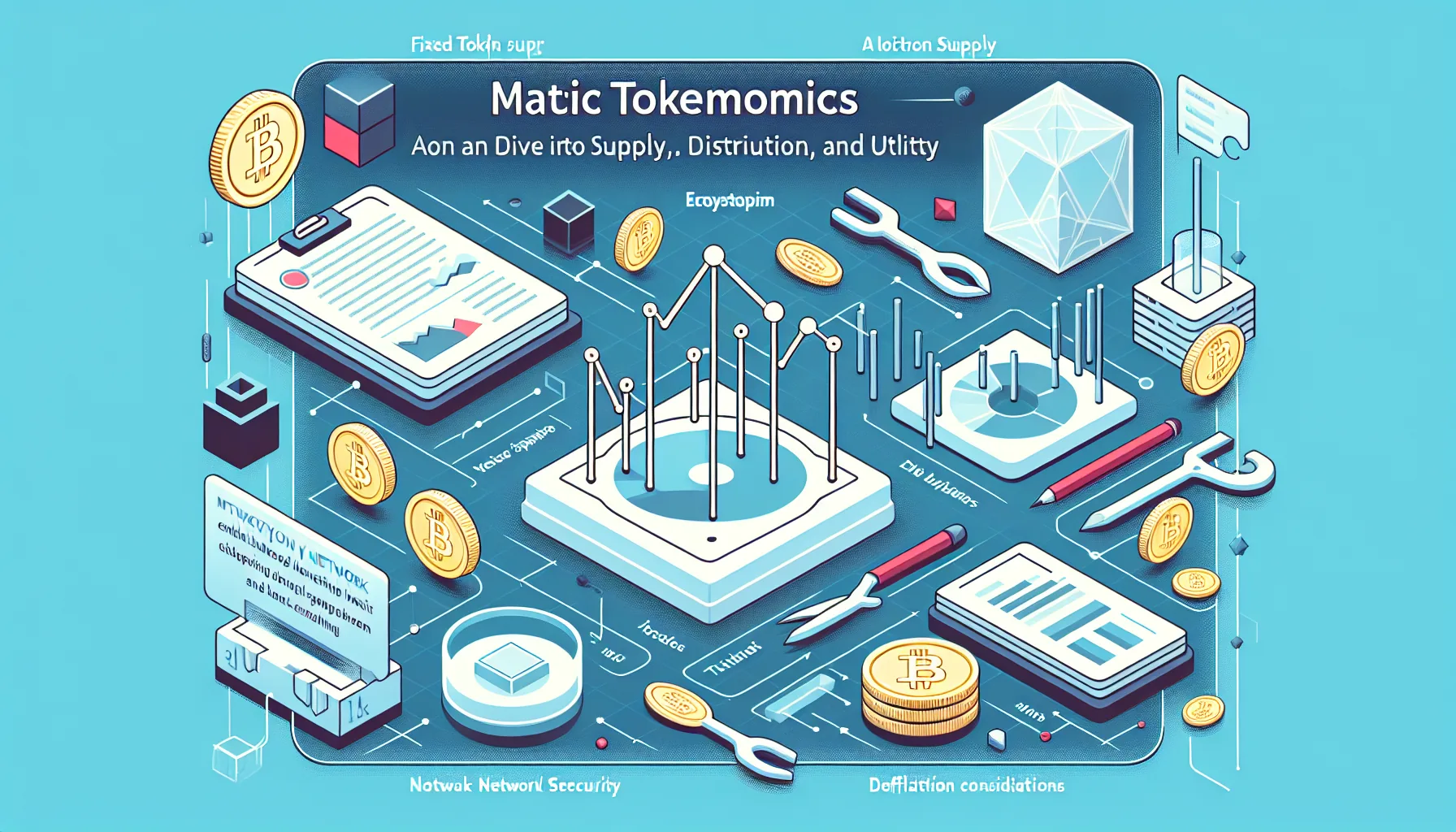
MATIC Tokenomics: A Deep Dive into Supply, Distribution, and Utility
MATIC, the native cryptocurrency of the Polygon network, plays a central role in the ecosystem’s tokenomics. Designed to support network security, fuel transactions, and incentivize its participants, the structure and distribution of MATIC raise several technical and economic considerations.
Fixed Supply and Circulating Dynamics
MATIC has a fixed token supply capped at 10 billion, which establishes a hard ceiling for inflation. As of now, a significant portion of the total supply is already in circulation, creating a predictable supply curve. This finite cap aligns with Polygon's goal of long-term token sustainability. However, questions around supply dynamics remain, especially when considering vesting schedules and how temporarily locked tokens may impact liquid market conditions when released.
The structured token allocation supports a diverse range of stakeholders, including ecosystem funds, initial project supporters, validators, and the Polygon Foundation itself. For instance, a substantial portion is earmarked for staking rewards, incentivizing validator participation and ensuring the network’s security. Critics, however, note that early investors received a favorable price point during initial funding rounds, and their allocated tokens could wield outsized influence when unlocked or liquidated.
Utility Across Network Layers
MATIC has clear utility within the ecosystem. It is used for paying transaction fees, one of its primary functions, as Polygon is a Layer-2 scaling solution that aims to lower costs compared to Ethereum's higher gas fees. MATIC is also foundational for staking operations, with validators required to stake significant amounts to participate in securing the network. The dual role as both a staking mechanism and transactional token underscores its utility but also concentrates its importance, which could be a potential risk if transaction volumes diminish in low-utilization periods.
Deflationary Pressures and Burn Mechanisms
MATIC incorporates deflationary mechanics, such as periodic token burning through Ethereum network EIP-1559-inspired mechanisms. A portion of the transaction fees paid in MATIC is burned, leading to a gradual reduction in circulating supply. While this provides value accrual for long-term holders and is designed to counterbalance the capped supply dynamics, it also means that continual network usage is required to sustain these deflationary pressures. Low network activity could diminish the intended deflationary effects, leaving concerns over balancing supply and demand in the long run.
Governance Implications
Unlike some other projects, MATIC still lacks robust on-chain governance mechanisms tied directly to token holders. This creates a debate about centralization within the Polygon ecosystem, as critical decisions are often executed by the core team and the foundation rather than through community-led initiatives. While this approach has so far enabled faster decision-making, it highlights a potential weakness in aligning incentives between token holders and the core decision-makers.
By breaking down these tokenomics components—supply, utility, and governance—a clear picture emerges of both the opportunities and challenges that MATIC faces within its ecosystem.
MATIC Governance
Governance of MATIC: Understanding the Role and Limitations
MATIC, the native token of the Polygon network, plays a pivotal role in governance, offering token holders a say in shaping the protocol's evolution. Governance on Polygon is rooted in a hybrid approach that merges on-chain and off-chain mechanisms, aimed at decentralizing decision-making. However, the current governance structure presents both opportunities and challenges, which are crucial for stakeholders to understand.
Governance Token Utility
MATIC holders are empowered to participate in proposals and vote on various matters, including network upgrades, parameter adjustments, and treasury management. By staking tokens, users gain eligibility to cast votes proportional to their holdings, incentivizing meaningful participation from a broad spectrum of stakeholders. This mechanism ensures that those with vested interests in Polygon’s long-term stability can influence its direction. However, the alignment of economic incentive with governance power can raise concerns about centralization, as large holders inherently wield disproportionate influence.
Off-Chain Governance and Its Implications
Polygon’s governance process incorporates off-chain elements, including discussions held in forums and social platforms before decisions enter the formal proposal stage. While off-chain deliberations facilitate broader community engagement and pave the way for more nuanced proposals, they also introduce an ambiguity layer. Informal conversations in off-chain channels might lack transparency or accessibility, potentially limiting the inclusion of stakeholders unfamiliar with or unable to track such discussions. This could result in disjointed representation and inconsistent participation across network governance.
Challenges in Decentralization
Despite positioning itself as a decentralized network, Polygon’s governance mechanisms currently lean on centralized points of coordination, particularly at the development and decision-facilitation levels. Core teams and key individuals often play a disproportionate role in shaping the initial direction of governance proposals. While this streamlines the decision-making process, it risks diminishing the community's influence if checks and balances aren't maintained. Addressing voter apathy and incentivizing smaller holders to participate are ongoing concerns, especially in preserving true decentralization.
Potential Arbitration and Evolution
MATIC governance continues to evolve, but it faces unresolved dilemmas such as managing competing priorities between developers, validators, and regular token holders. Questions regarding how conflicts are arbitrated within proposals remain pertinent. A lack of clarity around formal disagreement resolution mechanisms could impact the network’s ability to address community disputes effectively. Additionally, as more functionality is added, layered complexity in governance processes may make it harder for average participants to navigate decision-making structures.
Technical future of MATIC
Current and Future Technical Developments of MATIC: An In-Depth Analysis of Polygon’s Roadmap
Polygon (MATIC) has solidified itself as a critical scaling solution for the Ethereum network, and its technical roadmap reflects ongoing innovation coupled with notable challenges. This section explores the latest advancements and anticipated developments in MATIC’s ecosystem, highlighting both progress and potential hurdles.
ZK-Rollups and zkEVM Deployment
One of the forefront developments in the Polygon ecosystem is its focus on Zero-Knowledge Rollups (ZK-Rollups) and the introduction of its zkEVM (Zero-Knowledge Ethereum Virtual Machine). This implementation is designed to provide high-security, low-cost transactions with native compatibility with Ethereum smart contracts. Unlike optimistic rollups, which rely on fraud proofs with latency for finality, ZK-Rollups offer instant state proofs. However, critics argue the computational intensity required for zk-SNARK generation may still pose scalability bottlenecks, particularly for high-volume dApps.
Polygon has deployed zkEVM to address compatibility issues, intending to power seamless migration of projects from Ethereum. However, critics caution about centralization risks tied to off-chain sequencers utilized in ZK-Rollup architectures. Ensuring robust decentralization—while maintaining performance—remains an unresolved technical challenge.
Polygon Avail and Modular Blockchain Design
Polygon is also pivoting towards modular blockchain solutions with its proposed Polygon Avail, a data availability layer designed to optimize scalability for rollup-centric applications. Avail works by separating data availability processes from execution, enabling developers to launch lightweight chains that rely on shared data layers. Though promising, the adoption of Avail hinges on resolving coordination challenges between rollup nodes and underlying data-sharing protocols. Additionally, this adds another layer of complexity to security audits and implementation for developers.
Transition to Polygon 2.0 and Multi-Chain Architecture
Polygon has signaled a significant shift with its transition to Polygon 2.0—a vision that aims to create a multi-chain ecosystem relying on a "shared liquidity" approach. Through the establishment of interconnected Layer 2 chains, Polygon hopes to cater to an expanding range of decentralized applications. While this multi-chain outlook could bring unparalleled scalability, skeptics warn of potential fragmentation risks and bridging vulnerabilities, which remain persistent attack vectors in the broader blockchain ecosystem.
Technical Roadblocks
Despite these advancements, concerns around MATIC’s token utility within this evolving architecture raise valid questions. Will MATIC’s value accrue across multi-chain implementations, or might its function become diluted among parallel chains? Furthermore, interoperability concerns between Polygon’s ecosystem and external blockchains like Cosmos or Polkadot could limit its reach despite technical promise.
In conclusion, MATIC’s technical roadmap underscores its ambition to lead Ethereum scaling, yet it faces hurdles related to decentralization, interoperability, and streamlined developer adoption.
Comparing MATIC to it’s rivals
MATIC vs SOL: A Technical and Ecosystem Comparison
When evaluating MATIC (Polygon) against SOL (Solana), the differences stem from their core architecture, scaling strategies, and ecosystem approaches. Both aim to solve blockchain scalability challenges, but their technological foundations and trade-offs highlight distinct priorities.
Consensus Mechanism and Throughput
Solana’s defining feature is its Proof-of-History (PoH) combined with Proof-of-Stake (PoS), allowing it to achieve extremely high transaction throughput and low latency. By layering PoH to timestamp transactions, Solana avoids the bottlenecks seen in traditional block validation processes. This has led to claims of handling thousands of transactions per second (TPS) with near-instant finality.
MATIC, on the other hand, operates as a Layer 2 solution for Ethereum, employing a modified Proof-of-Stake mechanism and Plasma Framework to scale the Ethereum ecosystem. While it can handle significant throughput, it inherently relies on Ethereum's base layer for security and decentralization, trading off some of the independent scalability benefits seen in Solana.
The trade-off here is critical: while Solana achieves impressive TPS, it has historically faced centralization challenges due to its high hardware requirements and node distribution. MATIC, while not offering Solana's raw speed, retains closer ties to Ethereum’s robust decentralized infrastructure, leading to differences in trust assumptions for developers and users.
Ecosystem Growth and Developer Activity
SOL’s ecosystem has rapidly expanded due to its appeal in areas like DeFi, NFTs, and gaming. Its high TPS and low transaction costs make it attractive for latency-sensitive applications. However, frequent downtime and network interruptions have sparked criticism, especially given how reliability is paramount for blockchain adoption.
Polygon’s ecosystem, integrated deeply within Ethereum, benefits from Ethereum-compatible tooling and widespread adoption of the EVM. This allows developers to seamlessly migrate projects from Ethereum while enjoying lower fees and faster transactions on MATIC. However, MATIC’s chain is somewhat dependent on Ethereum’s success, which may limit its appeal to projects seeking full independence from Ethereum’s congestion.
Decentralization vs. Centralization Concerns
Solana’s high-performance blockchain relies on validator nodes with substantial hardware demands, narrowing participation and network decentralization. Critics argue this increases potential points of failure and consolidates influence in fewer hands.
Polygon’s Layer 2 solution, by design, leverages Ethereum’s decentralization model, sidestepping some of these centralization concerns. However, as a sidechain, MATIC introduces additional layers of trust for bridging assets, potentially increasing attack surfaces.
Without prescribing superiority, these distinctions define the trade-offs between MATIC and SOL, shaping how they cater to developers and projects seeking scalability.
MATIC vs. AVAX: A Detailed Comparison of Layer 2 and Layer 1 Innovation
When comparing MATIC (Polygon) to AVAX (Avalanche), the most evident distinction lies in their underlying design philosophies and technological approaches within the blockchain ecosystem. MATIC operates as a Layer 2 scaling solution for Ethereum, prioritizing interoperability and enhancing Ethereum’s scalability. AVAX, on the other hand, is a Layer 1 blockchain with its own consensus mechanism, designed to compete directly with Ethereum by solving similar scalability challenges via native architecture. Here’s how these two projects stack up across critical technical and functional dimensions.
Consensus Mechanism and Speed
MATIC leverages various scaling technologies like Plasma, zk-rollups, and optimistic rollups to offload computational and transactional loads from Ethereum’s mainnet. By relying on Ethereum's security layer, MATIC optimizes for efficiency without requiring a new consensus model.
AVAX, however, introduces its Snowman consensus mechanism. This protocol allows for sub-second finality and high throughput. While Snowman provides decentralized consensus on AVAX's dedicated subnet architecture, questions about real-world scalability in heavily trafficked scenarios have been raised, as performance degradation can occur under sustained, intensive network activity. MATIC's reliance on Ethereum offers a more battle-tested security architecture but could inherit Ethereum’s congestion issues during extremely high demand.
Network Architecture
AVAX offers developers access to customizable subnets, allowing dApps and enterprise use cases to operate on isolated chains. This modularity gives AVAX an edge in flexibility but comes with increased complexity in execution and potential onboarding challenges for less experienced developers.
MATIC instead builds directly on Ethereum’s robust developer base, leaning heavily on EVM compatibility to attract projects. While this makes MATIC a natural choice for projects already in the Ethereum ecosystem, it creates dependency on Ethereum’s limitations, which some rivals aim to bypass entirely.
Token Utility
AVAX’s token utility stretches across three main functions: staking for securing the network, paying transaction fees, and acting as collateral in subnet creation. While this multi-use design offers versatility, it can also complicate the network’s tokenomics depending on adoption rates of different subnet-based projects.
MATIC’s token functions include transaction fee payments, staking rewards, and governance, but it demonstrates a narrower utility scope compared to AVAX. By focusing primarily on Ethereum scaling, MATIC’s token utility mirrors its overarching value proposition without the multi-chain ambitions of AVAX.
Development Ecosystem
AVAX has worked to grow its ecosystem by marketing itself as "Ethereum-competitive," attracting developers with the promise of low fees and high speeds. Still, adoption has been uneven, partially due to technical learning curves and competition from other Layer 1 platforms.
MATIC, by aligning itself more closely with Ethereum developers and tooling, avoids much of this friction. However, its reliance on Ethereum compatibility could limit its ability to innovate beyond Ethereum’s ecosystem constraints.
Security Considerations
By relying on its own Layer 1 architecture, AVAX has full control over its security parameters through its consensus mechanism. Yet this independence also comes with responsibility; any significant vulnerabilities are the sole responsibility of the AVAX ecosystem. MATIC, as a Layer 2 solution that inherits Ethereum’s security, may avoid some of these pitfalls but remains tethered to Ethereum’s network-wide risks.
MATIC vs ADA: A Battle of Layer 2 Scaling and Layer 1 Innovation
When comparing MATIC (Polygon) to ADA (Cardano), it’s essential to differentiate the core purposes and design philosophies of these blockchain platforms. MATIC emerges as a Layer 2 scaling solution on Ethereum, addressing the blockchain trilemma by providing faster transactions and reduced fees. ADA, on the other hand, is a Layer 1 blockchain emphasizing security, scalability, and formal verification using a proof-of-stake system. Despite operating in the same broader ecosystem, their value propositions are distinct yet overlap in certain competitive areas, creating natural friction.
One prominent differentiator lies in development architectures. MATIC leverages the Ethereum ecosystem and provides developers access to a wide array of tools such as Solidity and the Ethereum Virtual Machine (EVM). This compatibility accelerates adoption, making it easier for dApps on Ethereum to migrate or scale using Polygon. ADA counters this with its homegrown Plutus smart contract language, based on Haskell. While Plutus promotes functional programming and increased security through mathematical proofs, the steeper learning curve and limited developer familiarity create friction for onboarding.
A key point of comparison is transaction throughput and fees. MATIC’s architecture, particularly with its implementation of plasma chains and sidechains, allows it to process thousands of transactions per second (TPS) at minimal cost. ADA addresses scalability through its Ouroboros consensus algorithm, recently enhanced by the integration of features like Hydra for Layer 2 scaling. While each shows promising performance under stress tests, ADA frequently faces criticism for its extended development timelines. Updates to increase scalability often take longer than anticipated, potentially slowing its competitive edge compared to the agile development seen in the Polygon ecosystem.
Another critical area is ecosystem strength. MATIC’s foundation rests on Ethereum, which it effectively enhances, giving it direct access to Ethereum’s vast network effects. ADA pursues a more isolated approach, building its ecosystem from scratch. While ADA has seen notable projects launched on its blockchain, including DeFi and NFTs, a frequent critique is the relatively smaller pool of active projects when measured against Ethereum’s hyper-dense web of developers and usage, into which MATIC taps seamlessly.
Finally, governance models diverge in influence. ADA prides itself on decentralization and a heavy emphasis on formal research-led development, funded by its treasury. Critics argue that this academic focus occasionally comes at the expense of execution speed. MATIC, staying closer to Ethereum’s governance ethos, has prioritized usability and adaptability, though this has stirred debates about the value of complete decentralization versus pragmatic scaling.
Primary criticisms of MATIC
Primary Criticism of MATIC: Examining the Concerns Surrounding Polygon's Ecosystem
Centralization Concerns
One of the most significant criticisms leveled at MATIC is related to its perceived centralization. While Polygon’s architecture enhances Ethereum’s scalability, skeptics argue that it sacrifices decentralization in the process. The network relies heavily on a limited number of validators, which raises questions about its resilience against censorship or coordinated attacks. Critics note that this validator set is largely governed by Polygon's foundation and core team, sparking worries about the potential for undue influence on governance and operations.
Overreliance on Ethereum
Despite being marketed as a Layer-2 scaling solution, Polygon’s architecture does not fully conform to the technical definition of Layer-2. Instead, it operates more as a sidechain, with its own consensus mechanism, independent validator network, and bridge for interaction with Ethereum. This introduces a layer of risk tied to Ethereum’s long-term performance and security. Some argue that if Ethereum scales well enough natively—be it through sharding or Layer-2 rollups—Polygon’s utility may diminish or become redundant, potentially eroding confidence in MATIC’s future use cases.
Smart Contract Vulnerabilities
Polygon’s network has faced scrutiny regarding potential vulnerabilities in its smart contracts and bridges. The complex mechanisms enabling cross-chain interactions with Ethereum are particularly subject to exploits. Critics point out that decentralized finance (DeFi) protocols built on Polygon are interconnected with Ethereum through these bridges, which have historically proven to be a weak link in terms of security and remain an attractive target for hackers. Concerns over systemic risk in a worst-case exploit scenario contribute to ongoing skepticism about Polygon’s operational robustness.
Tokenomics and Inflation
MATIC’s tokenomics model has been another area of contention. While the total supply is capped, some argue that the release schedule and allocation raise questions about long-term sustainability. In particular, early-stage investors and team allocations have led to criticism over potential sell pressure once vesting schedules complete. This could dilute the value of tokens held by retail investors, a concern often highlighted in discussions of wealth centralization within crypto ecosystems.
Ecosystem Fragmentation
As Polygon expands its ecosystem with Supernets and custom blockchain solutions, concerns over fragmentation have emerged. Critics argue that dividing resources and community focus across multiple chains and products could dilute the core mission, stretching developer and user engagement thin. This potential fragmentation might also hurt interoperability between projects, creating isolated silos rather than a cohesive, scalable scaling solution for Ethereum.
Energy Efficiency Debate
Despite lower energy requirements compared to Ethereum’s pre-Merge proof-of-work system, Polygon still relies on a proof-of-stake (PoS) mechanism, which attracts critique from blockchain purists. While PoS is generally considered energy-efficient, some question whether it compromises on security compared to more robust consensus algorithms such as Ethereum’s current proof-of-stake implementation or Bitcoin’s proof-of-work.
Founders
MATIC Founding Team: Origins and Controversies
The team behind MATIC (formerly known as Polygon) was formed in 2017, spearheading its development as a scaling solution for Ethereum. Co-founded by Jaynti Kanani, Sandeep Nailwal, Anurag Arjun, and later joined by Mihailo Bjelic, the founding team brought together diverse expertise in blockchain technology, engineering, and business development. While their collective vision to address Ethereum’s scalability challenges gained substantial recognition, the team’s path has not been without critique or contention.
Jaynti Kanani: The Technical Backbone
Jaynti Kanani, also known as JD, is widely recognized as the technical architect of the network. With a deep background in data science, machine learning, and blockchain, Kanani played a pivotal role in implementing Plasma, Polygon’s original Layer-2 scaling model. However, critics have pointed out that Plasma technology did not maintain the traction it initially promised, as the ecosystem shifted focus toward more advanced solutions like zk-rollups. Kanani’s ability to evolve the technical roadmap has been praised, but some skeptics argue that the delays in Polygon’s transition to newer technology underline broader strategic gaps in leadership.
Sandeep Nailwal: The Public Voice
Sandeep Nailwal, a co-founder who often acts as the face of Polygon, is credited with securing partnerships and leading community engagement. His vision for polygonizing Ethereum has been central to the project’s strategic messaging. However, his highly active public presence has occasionally drawn criticism, particularly from those who interpret it as overly promotional or lacking transparency in addressing criticisms of centralization in the network. While Nailwal’s communication style resonates with many in the DeFi space, others have highlighted the need for more focus on addressing hard technical questions instead of marketing narratives.
Anurag Arjun: The Silent Contributor
Anurag Arjun, the only non-technical co-founder, has remained relatively behind the scenes, driving product development and operational efficiency. While his contributions in ensuring structured team operations are acknowledged, his lower-profile presence has sometimes been interpreted as a lack of accountability in pressing public matters. Arjun has also faced questions surrounding his role during pivotal shifts in Polygon’s roadmap.
Mihailo Bjelic: The New Strategist
Mihailo Bjelic joined the team later to bring fresh perspectives as the project expanded its ambitions beyond just being a Plasma implementation. Bjelic’s expertise in blockchain and cryptography has been instrumental in pivoting Polygon toward zk-proof technology — a strategic shift that some argue should have been prioritized earlier. While Bjelic filled critical gaps in the team, critics have noted that his late addition highlighted earlier deficiencies in both technical insight and forward-planning dynamics.
Each founding member has contributed uniquely to building the MATIC ecosystem, but their journey reflects both innovation and critical challenges, including questions about technological prioritization, centralization concerns, and strategic continuity.
Authors comments
This document was made by www.BestDapps.com
Sources
https://polygon.technology/
https://github.com/maticnetwork/whitepaper
https://docs.polygon.technology/docs/faq/technical-faq/
https://github.com/maticnetwork/contracts
https://polygonscan.com/
https://forum.polygon.technology/
https://wiki.polygon.technology/
https://matic.network/blog/
https://polygon.technology/papers/Polygon-Whitepaper.pdf
https://docs.polygon.technology/docs/develop/network-details/network
https://matic.network/foundation-disclosures
https://coinmarketcap.com/currencies/polygon/
https://messari.io/asset/matic/profile
https://defillama.com/chain/Polygon
https://polygon.foundation/
https://reddit.com/r/0xPolygon
https://staking.polygon.technology/
https://twitter.com/0xPolygon
https://www.alchemy.com/polygon
https://chainlist.org/chain/137