History of MATIC
The History of MATIC: From Inception to Evolution
MATIC, the native token of the Polygon network, was introduced as the backbone of a project aiming to tackle Ethereum’s scalability challenges. Originally launched in 2017 by a team of Indian developers—Jaynti Kanani, Sandeep Nailwal, and Anurag Arjun—the project was conceived as the "Matic Network" with a mission to create a framework that brings fast and secure off-chain computation to blockchain networks, starting with Ethereum.
Built initially as a Layer 2 scaling solution using Plasma, Matic was designed to provide sidechains capable of executing faster transactions while ensuring security through the Ethereum mainnet. After its rebranding to Polygon in early 2021, the project broadened its scope beyond Plasma, evolving into a comprehensive framework for building Ethereum-compatible blockchain networks. However, while integrating the broader multi-chain vision, the project's core token retained the name "MATIC."
The initial coin offering (ICO) took place in April 2019 on Binance Launchpad, which has been pivotal in giving MATIC early exposure to the global crypto community. Amid the successful fundraising, questions arose about scalability tradeoffs and whether the Plasma architecture would fulfill its promise in practice. As Ethereum advanced its own scaling strategies, some critics suggested that Matic's reliance on Plasma might soon be obsolete.
Despite concerns, the team demonstrated flexibility post-rebranding by integrating additional Layer 2 technologies. The introduction of Optimistic Rollups, zk-Rollups, and other Polygon scaling solutions showed the team’s pivot from Plasma dependency. However, critics noted that this shift had its challenges, such as heightened competition and uncertainties regarding interoperability amid the emergence of other multi-chain ecosystems like Avalanche and Polkadot.
MATIC's adoption grew significantly due to Polygon's strategic partnerships, developer incentives, and growing utility within DeFi, NFTs, and gaming applications. Yet not everything has been without criticism. Centralization concerns still linger, with the network relying on a limited validator set, raising questions about the security and decentralization tradeoff. Furthermore, the tokenomics of MATIC, including its supply issuance and future stake-based participation, frequently spark discussions in forums about potential inflationary risks.
The history of MATIC incorporates both its technical milestones and debates surrounding its methodology, making it a project that embodies Ethereum's shift towards a truly scalable ecosystem while navigating its unique challenges within the competitive blockchain space.
How MATIC Works
How MATIC Works: Unpacking Polygon's Core Mechanisms
MATIC serves as the native token powering the Polygon network, a Layer 2 scaling solution designed to enhance the performance, efficiency, and affordability of Ethereum. At its core, MATIC facilitates transactions, staking, and governance within Polygon’s ecosystem. Understanding how MATIC operates requires delving into its role across three key mechanisms: scaling, staking, and network security.
Scaling Ethereum with MATIC-Backed Infrastructure
MATIC plays a crucial role in enabling Polygon's core function: scaling Ethereum. Polygon achieves scalability using a variety of approaches, including Plasma chains, zk-rollups, optimistic rollups, and its flagship Proof-of-Stake (PoS) sidechain. The Polygon PoS chain is the most widely adopted solution, where transactions are validated off-chain and subsequently batched before being submitted to the Ethereum mainnet. By minimizing the computational load on the Ethereum base layer, this scaling mechanism reduces congestion and gas fees.
Within this context, MATIC is central to the payment of transaction fees within the Polygon ecosystem. While fees on the PoS chain are significantly lower than those on Ethereum, they are denominated and paid in MATIC tokens. This positions MATIC as the fuel that drives the network’s broad array of decentralized applications (dApps) and services.
Staking: Securing the Polygon Ecosystem With MATIC
Polygon’s Proof-of-Stake architecture depends heavily on MATIC for network security and validator incentives. Validators on the Polygon chain stake MATIC tokens as collateral to participate in transaction validation. This staking mechanism not only secures the network but is also key to maintaining decentralization. Validators are rewarded with newly issued MATIC and transaction fees, creating a financial incentive to act honestly.
However, the staking economy introduces certain challenges. One notable issue is centralization risk. A concentration of MATIC in the hands of a few large token holders—whether due to extensive staking requirements or whale accumulation—could potentially undermine Polygon’s efforts to maintain a trustless and decentralized network.
Governance: MATIC’s Role in On-Chain Decision-Making
MATIC token holders also participate in governance decisions, influencing protocol upgrades and other on-chain parameters. However, on-chain governance for Polygon is not as mature as other blockchain protocols, with much of the decision-making still relying on off-chain coordination. Critics argue this reliance could hinder scalability and transparency as Polygon grows.
Limitations and Risks
While MATIC is engineered to optimize efficiency and scalability, it is not immune to risks. Smart contract bugs or exploits on the Polygon network’s bridges could undermine the integrity of assets bridged to and from Ethereum. Given that Polygon relies on Ethereum’s security guarantees, systemic issues in Ethereum can cascade into the functioning of MATIC’s ecosystem. Additionally, reliance on MATIC for gas fees means token volatility could affect user experience.
Use Cases
Exploring MATIC's Use Cases: Powering Layer-2 Scaling and Beyond
MATIC, the native token of the Polygon network, plays a pivotal role in enabling a wide range of blockchain applications. Its utility is fundamentally tied to Polygon's layer-2 scaling solutions, which aim to resolve Ethereum’s traditional limitations, such as high gas fees and slow transaction speeds.
Transaction Fees and Network Security
One of MATIC’s primary use cases revolves around covering transaction fees on the Polygon network, often cited as a cost-effective alternative to Ethereum. MATIC is effectively gas for all the transactions occurring on Polygon-powered dApps, including token swaps, NFT trades, and gaming interactions. Additionally, the token supports network security through staking, allowing validators to help maintain the network while earning rewards. However, as the network grows, concerns about centralization emerge; a limited set of validators might jeopardize decentralization, raising questions about long-term network resilience.
Bridging Assets Across Chains
MATIC also facilitates interoperability via the Polygon Bridge, enabling users to seamlessly transfer assets between Ethereum and Polygon. This cross-chain capability reduces congestion on Ethereum and empowers users to take advantage of Polygon’s low-cost environment. Nonetheless, the bridge architecture has been subject to community scrutiny surrounding potential vulnerabilities. A single point of failure in the bridge mechanism could expose users' funds to risks, drawing attention to the broader issue of cross-chain security.
DeFi Integration and Staking Protocols
MATIC's presence in the Decentralized Finance (DeFi) space is substantial. Many lending platforms, decentralized exchanges, and yield farming projects on Polygon rely on MATIC as collateral or a reward token. This dual functionality—both as a utility asset and a store of value—has expanded its adoption. That said, critics argue that the abundance of MATIC-based incentives has led to unsustainable reward models, contributing to yield dilution and over-reliance on token emissions rather than organic growth.
Boosting NFT and Gaming Applications
The surge in play-to-earn gaming and NFT projects on Polygon has highlighted another critical use case for MATIC. Projects like NFT marketplaces utilize MATIC for listing fees or earning royalties, while blockchain-based games leverage it for in-game economies. This has positioned MATIC as an integral token for these burgeoning sectors. However, scalability improvements achieved through Polygon may not suffice as user adoption scales exponentially, potentially posing future scalability bottlenecks.
Governance and Ecosystem Participation
Finally, MATIC serves governance-related use cases within the Polygon ecosystem. Token holders have a say in critical protocol upgrades and community proposals. Yet, governance participation rates remain relatively low, mirroring a broader trend in blockchain projects where governance often concentrates in the hands of whales or well-funded entities.
MATIC Tokenomics
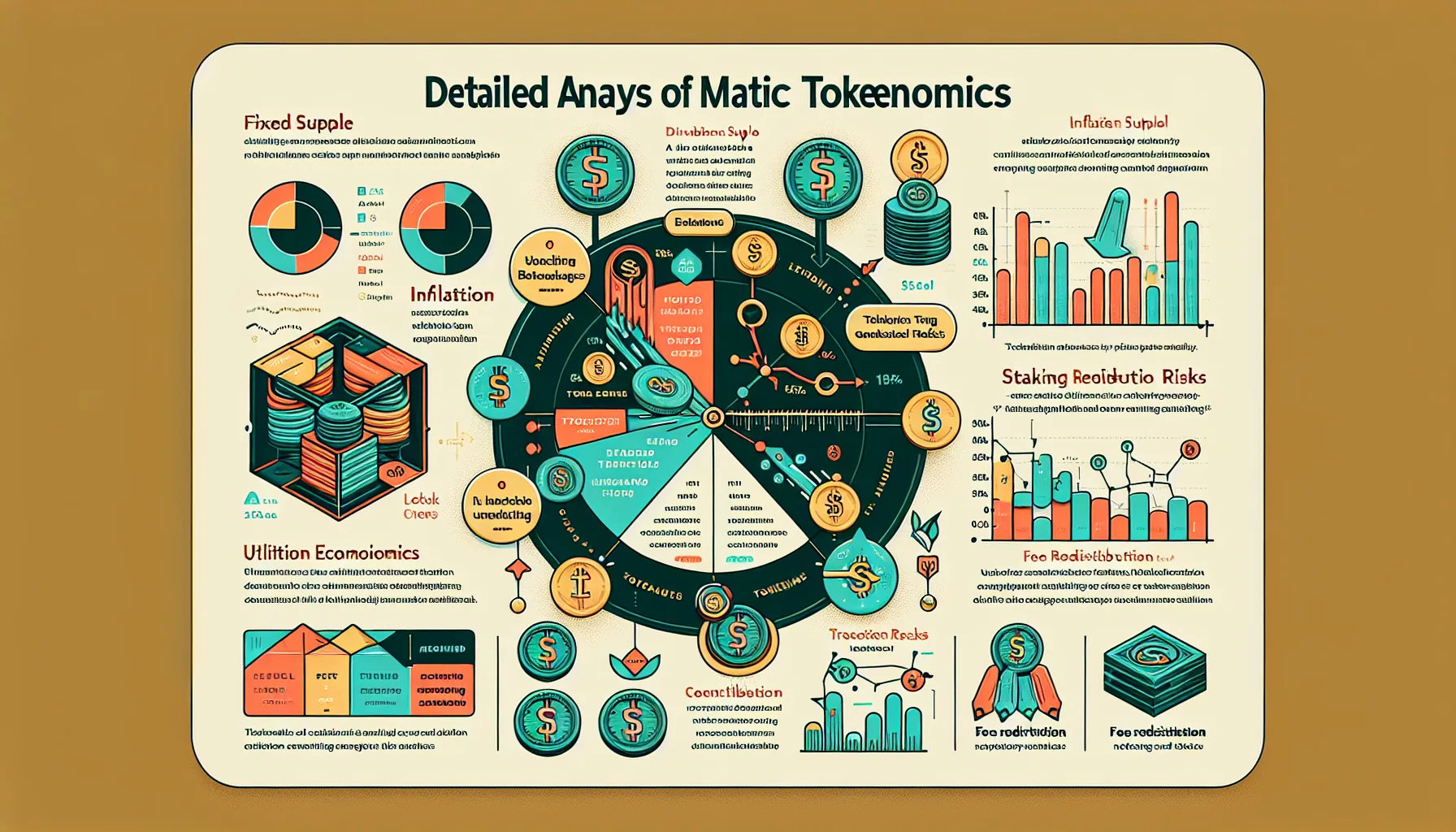
Detailed Analysis of MATIC Tokenomics
Fixed Supply and Distribution Breakdown
MATIC, the native token of the Polygon network, operates under a capped total supply of 10 billion tokens. This fixed supply introduces a fundamental scarcity mechanism, but the way these tokens are distributed plays a critical role in understanding their tokenomics. The initial token allocation designated 19% for the early seed round, 16% for the founding team, and an additional 4% for advisors, meaning nearly 40% of the total supply was allocated to entities closely tied to the project before public participation. A further 23.33% was set aside for ecosystem growth and another 12% as staking rewards, underscoring the importance placed on incentivizing participation within the network. While these allocations are common in the crypto space, critics might raise concerns about potential centralization risks due to the significant share held by insiders early on.
Inflation Mitigation via Gradual Unlocking
MATIC's release schedule employs a slow unlocking mechanism to manage circulating supply over time. While this design aims to mitigate dilution risks and control inflationary pressure, the unlock schedule could still exert periodic downward pressure on price due to increased token supply entering circulation. This dynamic could impact token holders and market dynamics, especially given the significant amount of tokens allocated to foundation reserves (21.86%). Periodic unlocking events might clash with broader market sentiment, raising liquidity concerns among traders and long-term holders.
Utility in the Ecosystem
MATIC's primary utility lies in its role as the staking and gas token for the Polygon network. Validators are required to lock up MATIC to participate in network consensus, and transaction fees are also paid in the token. This dual utility creates consistent demand for MATIC, particularly as user adoption grows. However, lower transaction fees compared to Ethereum, while attractive to users, could potentially limit the token burn rate and its deflationary impact, raising questions about how effectively the tokenomics can maintain long-term value sustainability.
Staking Economics and Concentration Risks
Staking is central to MATIC’s ecosystem, yet the staking ecosystem reveals challenges. Currently, a majority of staking activity is concentrated among a small number of validators, a factor that could amplify centralization risks. This concentration poses potential vulnerabilities to governance dynamics and network security, especially in scenarios where validator collusion becomes feasible. Such issues underscore the importance of monitoring validator distribution on an ongoing basis.
Fee Redistribution and Network Sustainability
Transaction fees paid in MATIC are allocated between the network and validators, creating a cyclical redistribution of value within the ecosystem. However, questions remain about whether the current fee structure is sufficient to support network sustainability in the long term, particularly in scenarios with stagnant or declining transaction volumes. Additionally, if the token’s price experiences prolonged downward trends, validator incentives may weaken, further compounding centralization risks.
MATIC Governance
Governance Mechanisms of MATIC: Exploring Decentralized Control
The governance structure of MATIC, the native token of Polygon, plays a pivotal role within its ecosystem, enabling decentralized decision-making while balancing community influence and protocol efficiency. Polygon's governance model ensures that changes to the network, such as protocol upgrades, parameter adjustments, or allocation of treasury funds, are executed with stakeholder input. However, the model is not without its challenges, and questions remain about the degree of decentralization in decision-making processes.
Hybrid Governance Approach
Polygon adopts a hybrid approach to governance, involving both on-chain and off-chain mechanisms. Core protocol upgrades and foundational decisions often occur through off-chain deliberations led by the Polygon Foundation, alongside input from developers and community members. While this ensures rapid and strategic decision-making, critics argue that off-chain governance introduces a level of centralization, particularly when the foundation holds significant influence over key decisions.
Conversely, on-chain governance mechanisms allow MATIC token holders to participate directly in ecosystem-related proposals, including staking governance and treasury allocations. Still, as with many proof-of-stake systems, the concentration of tokens among a small group of holders, including early investors and whales, raises concerns about governance power distribution.
Treasury and Resource Allocation
The governance process extends to managing the ecosystem's treasury. This treasury, funded through transaction fees and MATIC token reserves, supports development initiatives, strategic partnerships, and ecosystem growth. Governance votes determine how these funds are deployed, offering the community a voice in the financial direction of Polygon. Transparency is a critical factor here, but critics note that without regular audits or stringent accountability measures, the process could be prone to misuse or inefficiencies.
Scalability vs. Decentralization Debate
One key tension within MATIC's governance is navigating the trade-off between scalability and decentralization. Polygon’s rapid growth necessitates quick decision-making, which can sometimes favor smaller, centralized groups. On the other hand, fully decentralized governance increases the potential for slower, fragmented decision-making processes. Ensuring a balance between these priorities is essential for long-term network sustainability but remains an ongoing challenge.
Smart Contract Governance Risks
As with any ecosystem relying heavily on smart contracts, Polygon’s governance mechanisms are subject to potential vulnerabilities. Exploits targeting governance-related smart contracts could lead to protocol disruptions or misuse of funds. While audits and security measures are integral to mitigating these risks, governance remains a potential attack vector for malicious actors.
Lack of Full On-Chain Governance
Finally, it is worth noting that a fully on-chain governance model has yet to be implemented for the Polygon ecosystem. This absence raises questions about the project’s commitment to broader decentralization and whether this could limit user participation. As MATIC holders push for increased transparency and control, the evolution of governance mechanisms will likely remain a contentious topic within the community.
Technical future of MATIC
MATIC: Current and Future Technical Developments and Roadmap
Polygon zkEVM: Scaling for Layer 2 Growth
One of the most prominent technical developments in Polygon’s ecosystem is the deployment of Polygon zkEVM (Zero-Knowledge Ethereum Virtual Machine). zkEVM is an advanced layer-2 scaling solution designed to offer high transaction throughput and reduced gas fees while maintaining Ethereum’s security. zkEVM significantly enhances scalability by employing zero-knowledge proofs to validate large batches of transactions off-chain before submitting them to the Ethereum mainnet.
This development allows full compatibility with existing Ethereum-based smart contracts, streamlining the migration process for dApps. However, zkEVM faces challenges related to transaction finality, as its zero-knowledge proof generation and validation processes occasionally lead to latency issues when compared to competing technologies. Ensuring minimal latency while maintaining robustness is an ongoing hurdle for its technical developers.
Polygon Avail: Modular Blockchain for Data Availability
Polygon is actively working on Avail, a modular blockchain designed to solve data availability and scalability issues for chains without sacrificing decentralization. Avail introduces the ability for blockchain networks to decouple consensus from data availability, which helps reduce data demands on validators. This approach minimizes overhead for rapidly-growing networks like rollups and application-specific chains.
Future iterations of Avail are focused on optimizing validator efficiency and bridging protocols, but concerns around its complexity—especially for new developers—could hinder adoption. Coordination between Link nodes and rollups remains a technical bottleneck that developers need to address effectively.
Improved Bridge Protocols and Interoperability
Polygon’s team is implementing advanced bridge protocols aimed at improving cross-chain interoperability. This includes integrating newer standards for secure bridging while adhering to Ethereum Improvement Proposals (EIPs). As bridging mechanisms between Polygon and external chains improve, risks related to bridge exploits have come to light. Ensuring bridge infrastructure security will remain a critical technical priority to mitigate exploits affecting user assets.
Transition to PoS 2.0: Enhancing Polygon’s Core Infrastructure
Polygon’s Proof-of-Stake (PoS) mechanism is undergoing major revisions dubbed “PoS 2.0.” Aimed at boosting decentralization, PoS 2.0 will enhance validator incentives and optimize resource usage. Despite these improvements, scalability challenges—especially during surges in network activity—remain a pain point. Balancing decentralization with reduced validator costs is a key focus for this roadmap milestone.
MEV and Fee Optimizations
Polygon developers are also exploring strategies to mitigate Miner Extractable Value (MEV) through updated fee mechanisms. This includes reducing opportunities for front-running and sandwich attacks inherent in high-frequency trading environments. Adaptations of Ethereum’s EIP-1559 are already partially implemented but face constraints in high-demand scenarios where gas spikes remain an issue.
Comparing MATIC to it’s rivals
MATIC vs ARB: A Detailed Comparison of Layer 2 Scalability Approaches
When evaluating MATIC (Polygon) against ARB (Arbitrum), the comparison centers around their positioning as Ethereum Layer 2 solutions aimed at scalability. Both projects leverage Ethereum’s security while reducing transaction costs and enhancing throughput. However, their fundamental architectures and approaches introduce distinct trade-offs in terms of decentralization, development ecosystems, and technological advances.
Differentiating Technologies: Plasma, PoS, and Optimistic Rollups
Polygon utilizes a hybrid architecture that combines Plasma chains and Proof-of-Stake (PoS) validators to process transactions off-chain. While this multi-faceted approach has proven effective for high throughput and flexible use cases, it often raises questions regarding how tightly it adheres to Ethereum’s core decentralization principles. Arbitrum, on the other hand, uses Optimistic Rollups—an approach designed to bring scalability while maintaining closer adherence to Ethereum’s infrastructure. Rollups inherently trust but verify, with fraud-proof mechanisms periodically reconciling with Ethereum.
This divergence introduces philosophical and technical contrasts. Polygon’s model sacrifices some decentralization in favor of speed and compatibility, which may appeal to users seeking fast execution for high-volume applications. Conversely, Arbitrum’s rollups emphasize Ethereum-alike decentralization but may suffer from higher latency due to the fraud-proof dispute periods.
Ecosystem and Developer Experience
MATIC has aggressively positioned itself in the blockchain space with strong developer outreach and broad support for existing tools and frameworks. With its compatibility for Ethereum Virtual Machine (EVM) and deeper integrations through custom SDKs, Polygon has successfully attracted a diverse array of decentralized applications (dApps). In contrast, Arbitrum, while also EVM-compatible, takes a more focused approach by catering specifically to developers looking for scalable Ethereum-based solutions without significant architectural changes.
Developers often cite MATIC’s flexibility as both an advantage and a challenge. While Polygon’s sidechains provide opportunities for innovative chain customization, this comes at the cost of possible fragmentation, where the user experience between sidechains might diverge. Arbitrum’s ecosystem prioritizes simplifying the development transition from Ethereum, which can foster cohesion but potentially limit experimentation.
Validator Networks and Operational Scale
Polygon’s PoS model relies on a network of global validators, whose size and diversity continue to grow. However, achieving robust decentralization remains an ongoing challenge due to possible validator concentration. Arbitrum operates differently, requiring validators primarily for fraud-proof resolutions, which reduces overhead but places significant responsibility on the optimistic assumption that fraud is rare. This inherently creates different attack vectors for each system.
Both platforms aim to address Ethereum's performance bottlenecks, but the choice between MATIC and ARB revolves around balancing speed, decentralization, and flexibility—a trade-off that deeply influences user adoption and community sentiment.
MATIC vs. Optimism (OP): A Technical and Ecosystem Comparison
When evaluating MATIC (Polygon) against Optimism (OP), both projects aim to address the scalability challenges of Ethereum, yet they diverge significantly in their technical frameworks, ecosystem structure, and developer incentives.
Key Technical Differences
MATIC operates as a sidechain network that runs parallel to Ethereum, utilizing its Proof-of-Stake (PoS) consensus mechanism. This architecture allows it to handle a high volume of transactions with low fees while offering compatibility with Ethereum through its Polygon Bridge. However, its design as a sidechain introduces certain trade-offs, particularly in terms of security. Transaction finality on MATIC is dependent on its own validator set, which—while decentralized—is separate from Ethereum’s core security apparatus. This can introduce vulnerabilities in contrast to solutions that directly inherit Ethereum's base-layer security.
Optimism, by contrast, leverages Optimistic Rollups to scale Ethereum. This approach executes transactions off-chain while batching and submitting data back to Ethereum for consensus validation. Rollups are inherently more reliant on the base layer's security, making OP tightly coupled with Ethereum for its trust model. However, Optimistic Rollups also bring latency challenges; the one-week dispute period for fraud proofs can hinder user experience, especially in use cases where instant finality is crucial.
Developer and Ecosystem Dynamics
Polygon has placed significant emphasis on offering an all-in-one, multi-chain scaling solution. While MATIC initially gained traction for its EVM-compatible PoS chain, its ecosystem has since expanded to support custom-built zk-rollups and enterprise-facing solutions like Polygon Supernets. This breadth of options has made MATIC a more versatile platform, at the cost of ecosystem complexity, potentially diluting developer focus.
OP, in contrast, has honed in on becoming a minimalist Ethereum scaling solution. Its narrower purpose allows OP developers to build within Ethereum’s ecosystem while keeping technical implementation aligned with the Ethereum roadmap (e.g., EIP-4844 "proto-danksharding" compatibility). Despite this focus, OP has faced criticism for its centralized sequencer design, which could pose bottlenecks to censorship resistance.
Incentive Structures
Polygon has aggressively incentivized developers with token grants, liquidity programs, and ecosystem funds, enabling a fast ramp-up of dApps and DeFi protocols. However, some critics argue this approach fosters short-term adoption tied to rewards rather than organic growth. OP, meanwhile, has leaned heavily into its concept of the “Optimism Collective,” distributing retroactive public goods funding to projects that benefit the greater Ethereum ecosystem. While this aligns with Ethereum’s ethos, its impact remains niche and may lack the immediate financial appeal for newer developers.
By juxtaposing Polygon’s multi-pronged, sidechain-first approach against OP’s Ethereum-native, rollup-centric path, the comparison highlights philosophical and technical trade-offs in tackling Ethereum’s scalability issues. Both solutions face limitations tied to their chosen architectures, influencing their adoption among developers and users.
MATIC vs. SOL: A Technical Comparison of Layer 2 and Layer 1 Approaches
When comparing MATIC with SOL, the most notable distinction lies in their architectural approach to blockchain scalability. MATIC operates as a Layer 2 solution on Ethereum, leveraging sidechains and zk-rollups to address Ethereum’s congestion and high transaction fees. In contrast, SOL (Solana) is a standalone Layer 1 blockchain that emphasizes high throughput and low latency by implementing a unique Proof-of-History (PoH) consensus mechanism, layered with Proof-of-Stake (PoS).
This architectural difference fundamentally defines how these platforms tackle scalability and decentralization. MATIC’s reliance on Ethereum enhances its security, leveraging Ethereum's robust validator network. However, this also means MATIC inherits Ethereum's limitations, such as reliance on its mainnet's security updates or potential systemic scalability bottlenecks as adoption grows.
Solana, by being its own Layer 1, boasts extremely high transaction speeds (reportedly up to 65,000 TPS), made possible by PoH’s sequential timestamp mechanism. However, SOL’s critics often argue that this speed comes at the expense of decentralization. Solana’s network has, in the past, faced outages during periods of high traffic, raising concerns about its reliability for enterprise-grade applications. Additionally, Solana requires higher hardware specifications for validators, which can limit participation and concentrate control to wealthier stakeholders.
Another key point of differentiation is the developer ecosystem and tooling. MATIC, benefiting from Ethereum’s dominance, offers seamless integration with Ethereum-based development tools like Remix, Truffle, and MetaMask. This makes it attractive to developers already building on Ethereum. Solana, on the other hand, utilizes the Rust programming language for its smart contracts, which is known for its performance but has a steeper learning curve compared to Ethereum’s Solidity.
Tokenomics further separates the two networks. MATIC employs a capped token supply model, aligning with Ethereum’s shift toward deflationary economics post-EIP-1559. SOL, meanwhile, has an inflationary token issuance structure that supplies rewards to its stakers, which creates long-term questions around supply dilution and its impact on price stability.
While both MATIC and SOL have robust ecosystems, Solana’s repeated outages and higher validator costs have sparked debates around its sustainability, especially when weighed against MATIC’s alignment with the broader Ethereum ecosystem. Yet, Solana’s unmatched speed and scalability for high-frequency applications make it a strong contender in scenarios where performance outpaces decentralization as a priority. The decision between the two often comes down to use case, with developers facing trade-offs between Ethereum's security guarantees and the raw performance of a Layer 1 like Solana.
Primary criticisms of MATIC
Key Criticisms of MATIC: Challenges Facing Polygon’s Ecosystem
Centralization Concerns Within the Network
One of the primary criticisms frequently directed at MATIC, the native token of the Polygon ecosystem, revolves around concerns regarding centralization. While Polygon is often touted as a Layer 2 scaling solution for Ethereum striving for decentralization, critics argue that its validator set and governance structure exhibit significant centralization. A limited number of validators control the network, which raises questions about the robustness and security of the protocol against malicious actors. Additionally, governance decisions are largely dominated by Polygon’s core team and key stakeholders, leading to doubts about the ability of the broader community to influence long-term protocol direction.
Dependency on Ethereum's Ecosystem
Another issue tied to MATIC is its over-reliance on Ethereum’s infrastructure. Polygon markets itself as a scaling solution for Ethereum, but skeptics point out that this dependence could also be a liability. If Ethereum successfully implements more effective Layer 2 scaling solutions directly within its own ecosystem or upgrades Layer 1 capabilities such as through sharding, it could diminish the necessity of Polygon's architecture. This puts MATIC in a precarious position, where its value proposition is tightly intertwined with the evolving landscape and technical roadmap of Ethereum.
Token Utility vs. Value Dynamics
The utility of MATIC within the Polygon ecosystem primarily revolves around transaction fees, staking, and governance. However, critics argue that this token utility model could fail to sustain long-term demand and price support, as the broader ecosystem continues to focus on interoperability. With competing platforms offering similar scaling solutions that do not demand an intermediary token, such as Optimistic Rollups or zk-Rollups relying solely on ETH, there’s concern that MATIC's utility might become redundant in certain scenarios.
Scalability Trade-Offs and Security Risks
Polygon’s commit chain model, while effective at increasing scalability, introduces trade-offs that opponents are quick to highlight. For example, the design significantly increases throughput but at the cost of potentially diminished security when compared to Ethereum’s main chain. Critics also express doubts about the long-term ability of MATIC’s architecture to manage congestion or prevent exploits, especially if the popularity of DeFi applications and NFT activity on Polygon continues to grow.
Inflationary Token Supply
The tokenomics of MATIC also receive skepticism, particularly due to concerns about its inflationary supply mechanism. Even with burned tokens and periodic staking incentives, critics argue that inflation could outpace adoption, leading to dilution of existing users’ holdings. This presents an ongoing challenge for maintaining investor confidence and ensuring adequate returns for stakers over time.
Founders
The Founding Team Behind MATIC: Visionaries Driving Polygon's Development
The founding team behind MATIC, now widely recognized as Polygon, comprises three Indian software engineers and entrepreneurs: Jaynti Kanani, Sandeep Nailwal, and Anurag Arjun. Each brought distinct expertise to the project, collectively shaping the Layer 2 scaling solution that has grown to be a significant player in the blockchain and cryptocurrency space.
Jaynti Kanani: The Technical Backbone
Jaynti Kanani, also known as JD, holds a deep background in software development and blockchain technology. Before co-founding MATIC, he worked as a data scientist and had significant exposure to decentralized applications (dApps). Kanani’s contribution to the Ethereum ecosystem, particularly his work on Plasma (a scaling solution) and the WalletConnect protocol, showcased his technical acumen early on. His efforts in spearheading the technical architecture of MATIC have been integral. However, some in the crypto space have criticized the lack of extensive technical documentation regarding Polygon's consensus mechanisms during its early phases, which could have been more transparent under Kanani's leadership.
Sandeep Nailwal: Scaling Evangelist with Entrepreneurial Drive
Sandeep Nailwal, a blockchain developer and entrepreneur, brought an operations-driven mindset to the team. He has an MBA in Technology Management, offering a blend of technical and managerial skills that helped the project address both scalability and usability concerns for Ethereum. Nailwal has been a vocal advocate for addressing Ethereum’s congestion issues and championing developer-friendly solutions. Nevertheless, some critiques allege that Nailwal’s public-facing focus could detract from resolving long-standing onboarding challenges for developers. Additionally, skeptics question whether his rapid deployment strategies occasionally favored speed over rigorous testing.
Anurag Arjun: Product Visionary With Strategic Oversight
Anurag Arjun, the only non-developer among the co-founders, brought a product-oriented perspective to the team. With experience in product management from roles in large multinational corporations, Arjun played a pivotal role in shaping MATIC's user-centric approach. His ability to translate technical innovations into actionable business strategies was critical in positioning Polygon as more than just a technology but as a scalable ecosystem. However, Arjun’s corporate background sometimes drew skepticism from crypto purists who viewed his traditional approach to product strategy as potentially misaligned with decentralized ideals.
The founding team of MATIC demonstrated a combination of technical rigor, strategic foresight, and operational efficiency, but also faced criticism over issues of transparency and trade-offs in their development approach. How the team’s leadership evolved during the transition from MATIC to Polygon remains a point of analysis within the ecosystem.
Authors comments
This document was made by www.BestDapps.com
Sources
https://polygon.technology/
https://github.com/maticnetwork/whitepaper
https://github.com/maticnetwork/
https://docs.polygon.technology/docs/home/
https://wiki.polygon.technology/docs/faq/general-faq/
https://polygonscan.com/
https://maticfoundation.medium.com/
https://blog.polygon.technology/
https://research.polygon.technology/
https://forum.polygon.technology/
https://snapshot.org/#/polygon-dao.eth
https://polygon.technology/developer-resources/
https://docs.polygon.technology/docs/category/deployment-guides
https://chainlist.org/chain/137
https://etherscan.io/token/0x7d1afa7b718fb893db30a3abc0cfc608aacfebb0
https://defillama.com/chain/Polygon
https://tokenomicsdao.xyz/polygon-matic/
https://www.coingecko.com/en/coins/polygon
https://coinmarketcap.com/currencies/polygon/


