History of MATIC
The History of MATIC: From Inception to Adoption
MATIC, the native token of the Polygon network, has undergone a significant evolution since its inception, shaped by a series of strategic developments and challenges. Originally launched as the Matic Network in 2017 by co-founders Jaynti Kanani, Sandeep Nailwal, and Anurag Arjun, the project aimed to tackle the scalability issues that plagued Ethereum, such as high transaction fees and slow processing times. Using a Plasma-based sidechain architecture proposed by Ethereum’s co-founder Vitalik Buterin, Matic set out to deliver faster and cheaper transactions while leveraging Ethereum’s robust decentralization and security.
In 2019, the team conducted an Initial Exchange Offering (IEO) on Binance Launchpad, raising approximately $5 million. The IEO not only secured funding for development but also provided early visibility in one of the world’s largest crypto ecosystems. This launch marked the start of MATIC's listing on major exchanges and its journey into becoming a highly liquid asset.
The development phase that followed focused on refining the network’s Ethereum Layer-2 solution, implementing significant updates to ensure compatibility with the broad spectrum of dApps (decentralized applications). However, issues with accessibility and developer onboarding became apparent, necessitating better documentation and tooling to attract projects and developers.
Rebranding in early 2021 from "Matic Network" to "Polygon" was a pivotal moment. The rebrand signaled the network's expansion from a single Layer-2 scaling solution to a multi-chain ecosystem. Polygon set its sights on becoming the “Internet of Blockchains,” introducing interoperability with Ethereum-compatible blockchains. While this ambitious shift diversified its use cases, some criticized the project for spreading resources thin and diluting its strategic focus.
Another historical milestone was the integration of zk-Rollups and the acquisition of Hermez in 2021, anchoring the project’s commitment to exploring zero-knowledge proof technology. Although widely praised, concerns emerged over its decentralized governance, with critics pointing to the disproportionate control held by the Polygon team and a lack of clarity on its roadmap for scaling governance participation.
MATIC tokens played a critical role throughout Polygon’s history, functioning as the network's lifeblood for staking, transaction fees, and governance. However, Polygon’s reliance on Ethereum for security metrics has also been a point of vulnerability, highlighting a persistent trade-off in Layer-2 scaling solutions. Despite these challenges, MATIC's historical trajectory remains a testament to rapid innovation in the ever-evolving blockchain space.
How MATIC Works
How MATIC Works: Unpacking Polygon's Architecture and Mechanics
MATIC, the native token of the Polygon network, plays a key role in powering the platform's Layer 2 scaling infrastructure. Polygon is designed to mitigate Ethereum’s inherent limitations, such as high gas fees and network congestion, by offering faster and cost-effective solutions via sidechains. Here's a detailed look at how MATIC operates within this ecosystem.
Layer 2 Scaling and the Role of POS Validators
Polygon functions as a Layer 2 scaling solution by utilizing sidechains to offload transactions from Ethereum’s mainnet. These sidechains rely on a network of Proof-of-Stake (POS) validators. MATIC is staked by validators to secure the network, verify transactions, and produce blocks. In return, validators earn rewards in the form of MATIC tokens. This dual purpose of staking and incentivization ensures the Polygon network maintains its speed and security while remaining decentralized.
To participate as a validator, individuals must run full nodes and stake MATIC. However, this entry point can be cost prohibitive, creating a potential issue of centralization as staked amounts trend higher. For users without the resources to operate a validator node, delegation is an alternative. Delegators secure the network by delegating their MATIC to validators, though delegators implicitly trust validators to act honestly.
Plasma Chains and EVM Compatibility
Polygon uses a Plasma implementation that allows for fast and secure off-chain transactions by leveraging Ethereum as the base settlement layer. Plasma enables the bundling of multiple transactions into a single batch before submitting them to Ethereum. This batch processing model keeps costs low and throughput high.
Polygon's full compatibility with the Ethereum Virtual Machine (EVM) sets it apart from other Layer 2 solutions. Developers can seamlessly port existing decentralized applications (dApps) onto Polygon with minimal changes to their codebases. However, this compatibility comes with trade-offs, such as periodic dependency on Ethereum, affecting overall autonomy.
MATIC as Gas and Governance
The MATIC token also serves as the medium for transaction fees on Polygon. Users must hold MATIC to pay for gas, even for interactions happening purely on Polygon chains. While fees are drastically lower compared to Ethereum, the reliance on MATIC for all activities creates exposure to token-specific volatility risks.
Additionally, MATIC plays a role in governance. Polygon intends to gradually evolve into a more community-driven ecosystem. However, the current governance mechanism has faced scrutiny regarding voter engagement levels and participation distribution, raising questions about its practical decentralization.
By focusing on modularity and interoperability, Polygon positions itself as a key player in Ethereum's broader ecosystem, yet its reliance on Ethereum raises concerns about external dependencies, particularly during network congestion on Ethereum’s mainnet. This structural dynamic could be viewed both as a strength and potential weakness.
Use Cases
MATIC Use Cases: Scaling Solutions and Beyond for Layer 2
The MATIC token is integral to the Polygon ecosystem, a Layer 2 scaling solution aimed at reducing congestion and transaction costs on Ethereum. Its use cases are diverse, touching on areas like network security, transaction validation, decentralized applications (dApps), and governance. However, each use case comes with its own set of opportunities and challenges, making it critical for crypto-savvy users to evaluate their involvement in the network.
Transaction Fees and Scalability
One of the most immediate and practical applications of MATIC is its role in paying transaction fees within the Polygon ecosystem. With Polygon’s architecture enabling faster and cheaper transactions compared to Ethereum’s L1 network, MATIC serves as the utility token for seamless operations. Yet, this reliance on MATIC raises questions about its vulnerability to fluctuating gas fees and network congestion during high usage. A spike in activity may lead to increased demand for MATIC tokens, which could introduce volatility not only for users but also for dApps operating on the platform.
Staking and Network Security
MATIC holders can participate in the network’s Proof-of-Stake (PoS) consensus mechanism by staking tokens to validate transactions and secure the network. In return, stakers are rewarded with additional MATIC. This system incentivizes long-term token holding and network participation, which theoretically enhances security. However, centralization concerns arise due to the uneven distribution of stake among validators. A handful of dominant validators may gain outsized influence, potentially compromising decentralization, a core principle of blockchain technology.
DeFi and dApps Ecosystem
MATIC powers a growing ecosystem of decentralized finance (DeFi) protocols and dApps built on Polygon’s Layer 2. From liquidity pools to yield farming and NFT marketplaces, developers have integrated MATIC as the backbone of their platforms. While this growth underscores its utility, it also introduces complexity regarding interoperability. Not all dApps interact seamlessly across multiple chains, and users may encounter technical barriers or fragmented liquidity when moving assets between Polygon and other networks.
Governance and Decision-Making
An additional, if underutilized, use case for MATIC is its role in governance. Token holders have the ability to vote on proposals that affect the Polygon protocol’s development and upgrades. The decentralized governance model appears strong in principle; however, low voter turnout and apathy from token holders have occasionally limited its efficacy. This raises doubts about how effectively the community can address critical challenges or implement large-scale improvements.
In summary, while MATIC serves as a multifaceted utility token for the Polygon ecosystem, its use cases are accompanied by challenges such as validator centralization, interoperability hurdles, and governance inefficiencies. Users engaging with MATIC should weigh these factors carefully as they navigate the evolving crypto landscape.
MATIC Tokenomics
MATIC Tokenomics: A Deep Dive into Supply, Distribution, and Utility
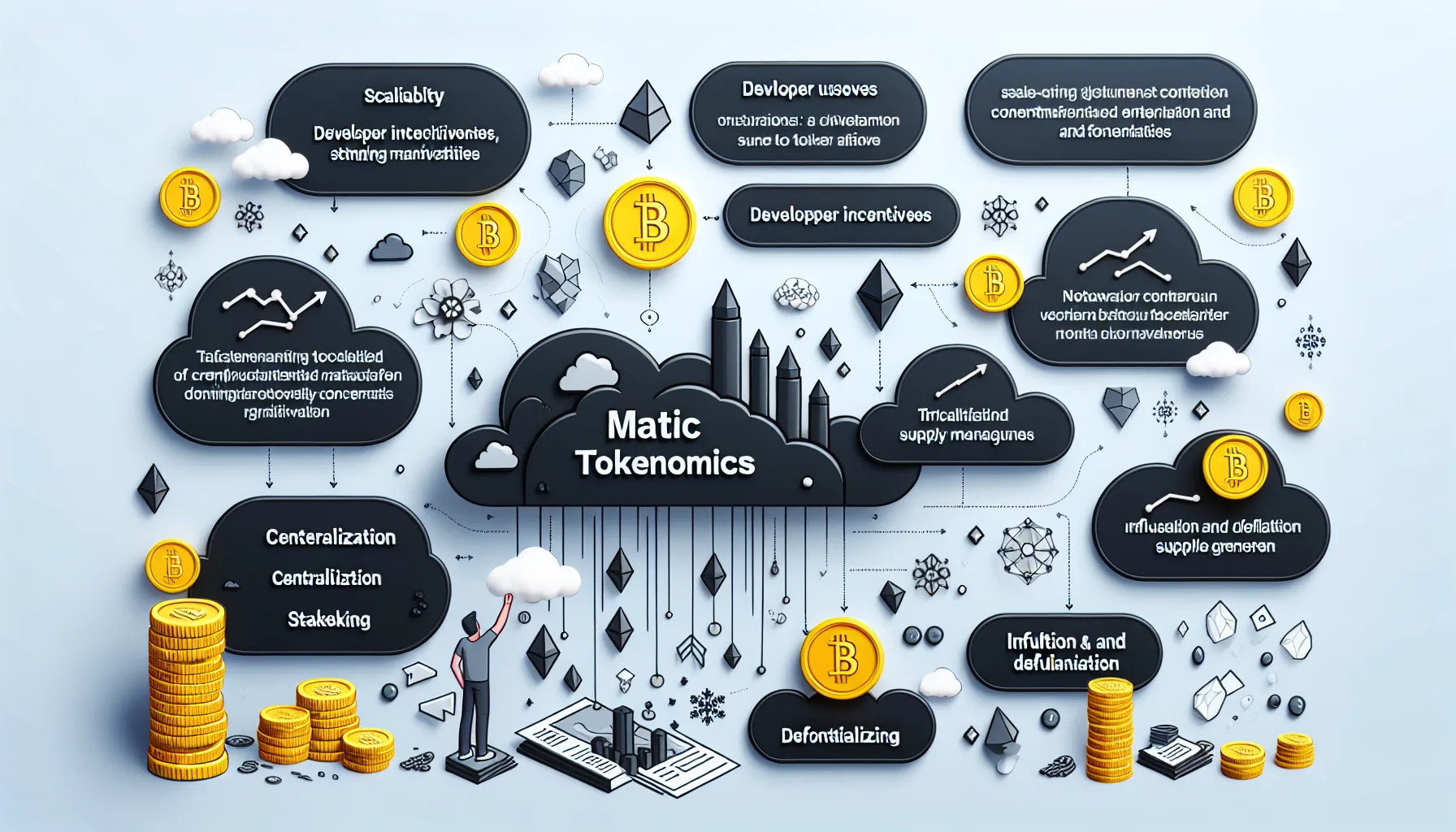
The tokenomics of MATIC, the native cryptocurrency of the Polygon network, play a critical role in its ecosystem. Designed with scalability and developer incentives in mind, the tokenomics of MATIC are structured to support both network functionality and sustained adoption while raising important concerns about centralization and supply management.
Fixed Supply and Distribution Mechanism
MATIC has a capped total supply of 10 billion tokens, a model that aligns with the deflationary principles often favored in the crypto space. The token distribution was pre-defined during the initial token sale and subsequent allocations, which divided the supply across several categories: team (16%), advisors (4%), foundation (21.86%), ecosystem (23.33%), staking rewards (12%), and the public token sale (19%). This breakdown concentrates a significant percentage of tokens in the hands of the team, foundation, and ecosystem initiatives, leading to potential concerns about centralized influence. While such allocations are intended to bootstrap network development, they also create a concentration of power that investors and developers should monitor.
Another key consideration around MATIC’s tokenomics relates to the vesting schedules. Tokens earmarked for team members and advisors have a specific release schedule, mitigating the immediate risk of large sell-offs. However, the eventual release of these tokens into the circulating supply could impact price dynamics and create liquidity challenges if not carefully managed.
Utility within the Ecosystem
MATIC is integral to the Polygon network’s functionality. The token serves three primary purposes: transaction fees, staking, and governance. Users pay MATIC for transaction and gas fees within the network, which keeps costs low and the system efficient due to Polygon’s Layer 2 architecture. Additionally, MATIC staking secures the network's Proof-of-Stake (PoS) mechanism, incentivizing validators and delegators through staking rewards. Over 12% of MATIC's total supply has been allocated to encourage active participation in this PoS framework.
However, governance remains a relatively underdeveloped area for MATIC compared to other crypto assets. While token holders have some input into governance, decision-making tends to remain concentrated among the Polygon team and foundation. This limits decentralization in governance—a potential drawback for those emphasizing trustless systems.
Inflation Considerations and Deflationary Pressure
Although MATIC has a fixed supply, ongoing staking rewards and token unlocks have the potential to inflate the circulating supply before full vesting is completed. To counteract this, Polygon’s mechanism for burning MATIC tokens through EIP-1559 implementations adds a deflationary element. Still, concerns linger over whether this deflationary pressure will balance the token emissions from staking rewards and unlock schedules over the long term.
MATIC's carefully planned tokenomics come with inherent trade-offs, including balancing centralization versus decentralization and inflationary versus deflationary pressures. Understanding how these elements interact is critical for anyone engaging with the Polygon network or investing in MATIC.
MATIC Governance
Governance Structure of MATIC: Decentralization and Control
Polygon’s native token, MATIC, plays an integral role in the governance framework of the Polygon ecosystem. Unlike some other blockchain platforms that rely on fully on-chain governance systems, Polygon currently adopts a more hybrid approach, marrying decentralization principles with off-chain decision-making processes. This system has implications both for decision-making efficiency and the broader community's ability to influence the protocol's development.
On-Chain Governance Limitations
While MATIC is a utility token and critical for staking and securing the network, its role in on-chain governance is comparatively limited. Polygon doesn’t yet operate under a fully fleshed-out decentralized autonomous organization (DAO) where token holders exercise direct, binding voting power on protocol upgrades or treasury allocations. This lack of fully on-chain participatory mechanisms may be viewed as a drawback for crypto users accustomed to projects emphasizing token-holder governance.
Decision-Making: Council and Core Teams
A significant portion of Polygon’s governance is executed by its core development teams and the Polygon Council, a body that comprises protocol contributors and ecosystem stakeholders. While this allows for high levels of coordination and rapid decision-making, it presents challenges for maintaining transparency and accountability. Critics often argue that such a concentration of decision-making might sideline the broader MATIC token-holder community, raising questions about how decentralized the governance model truly is.
Governance Token Dynamics
Although MATIC holders have indirect ways to influence the ecosystem, such as participating in community discussions and proposals, binding governance votes for critical decisions like protocol upgrades are largely absent. Some members of the crypto community view this as a missed opportunity to incentivize wider ecosystem engagement and align development choices more closely with community desires.
Additionally, the absence of token-weighted binding votes can create disparities in power, where large token holders or key developers effectively exercise outsized influence without formalized systems ensuring greater accountability.
Potential Trade-Offs and Risks
One of the most significant challenges Polygon faces revolves around balancing governance efficiency with decentralization. While centralized decision-making may expedite technological evolution, it arguably introduces single points of failure and could alienate users who prioritize open, permissionless systems.
Moreover, as the ecosystem expands, the existing governance framework may encounter scaling challenges in terms of incorporating a growing number of stakeholders. The lack of a robust, token-driven governance model might lead to governance inefficiencies or disputes in the future.
Technical future of MATIC
Polygon (MATIC): Current and Future Technical Developments and Roadmap
Polygon (formerly Matic Network) continues to evolve as a leading Layer 2 scaling solution for Ethereum, offering a mix of Proof of Stake (PoS) sidechains, zk-rollups, and optimistic rollups. Its technical roadmap provides a detailed window into the platform’s ongoing improvements and future goals, though not without its challenges.
zkEVM: Advancing Ethereum Scaling
One of Polygon’s most prominent technical developments is its zkEVM (zero-knowledge Ethereum Virtual Machine). By enabling the execution of Ethereum-compatible smart contracts through zero-knowledge proofs, zkEVM introduces scalability while ensuring security and maintaining Ethereum compatibility. This implementation is a major leap for scaling Ethereum, as zk-rollups significantly reduce transaction costs and enhance processing speeds while preserving the network’s decentralization.
While zkEVM technology is promising, the cryptographic processes required are computationally intensive, leading to concerns about latency issues and high operational costs for validators during early deployments. The push for broader zkEVM adoption may require ongoing optimizations to address these bottlenecks without compromising the user experience.
Supernets: Customized Blockchain Solutions
Polygon’s introduction of Supernets represents a focused effort to provide customizable blockchain-as-a-service solutions. Built atop the Polygon infrastructure, Supernets allow enterprises and developers to deploy bespoke networks tailored to their use cases, offering modularity and flexibility.
Despite offering diverse options, the complexity and steep learning curve for deploying and maintaining a Supernet could deter smaller developer teams. Additionally, questions surrounding interoperability between fully isolated Supernets versus the broader Ethereum ecosystem persist, presenting challenges in maintaining seamless cross-chain communication.
Energy Efficiency Upgrades
The platform has emphasized implementing energy-efficient mechanisms as part of its evolution. Polygon's move towards zk-based technologies aligns with the crypto industry's push for sustainable solutions. However, as the network scales further, energy demands need continual attention, particularly as zk-tech becomes more computationally demanding.
Future Focus: Polygon 2.0 and Beyond
The ongoing transition to "Polygon 2.0" aims to integrate various interconnected Layer 2 scaling solutions under a unified architecture. Core advancements include cross-layer communication protocols, enhanced decentralization of validators, and a transition to a blockchain-based data availability layer. While these represent significant technical ambitions, implementation risks, particularly related to decentralization tradeoffs and potential congestion across shared environments, remain hot topics among the community.
Polygon’s roadmap suggests a commitment to becoming Ethereum’s ultimate scalability hub. Nevertheless, recurring debates about complexity, execution risks, and decentralization challenges ensure that its journey ahead is closely watched by the crypto ecosystem.
Comparing MATIC to it’s rivals
MATIC vs. ETH: A Detailed Comparison
When evaluating MATIC and ETH, it becomes clear that while both projects bring unique value propositions to the blockchain landscape, they cater to overlapping segments of the market with distinctive approaches to scalability, cost, and adoption.
Scalability: Layer-1 vs. Layer-2 Debate
Ethereum (ETH) operates as a Layer-1 protocol, meaning it serves as the foundational blockchain layer for decentralized applications (dApps). However, this foundation has long struggled with scalability bottlenecks due to its Proof-of-Work (PoW) legacy—gradually phased out by the ongoing adoption of Proof-of-Stake (PoS)—and high gas fees under heavy network demand.
MATIC, on the other hand, functions predominantly as a Layer-2 scaling solution for Ethereum, although it has expanded its ecosystem to include its own Polygon Supernets, enabling interoperable independent blockchains. This foundational difference gives MATIC a technological edge in transaction throughput (TPS) and cost efficiency over Ethereum's mainnet, which remains limited by its base-layer constraints. While Ethereum's rollup-centric roadmap, including zk-rollups and optimistic rollups, shows promise, it also hints at future challenges for MATIC's Layer-2 dominance as Ethereum's scaling solutions evolve.
Cost-Efficiency: Gas Fees Showdown
Ethereum's gas fees have a notoriously well-documented volatility, driven by its auction-style mechanism. This pricing inefficiency has often priced out smaller developers and retail users, leaving room for alternatives like MATIC to cater to those audiences with significantly lower transaction costs. With MATIC, users can settle transactions for fractions of a cent, a stark contrast to Ethereum, whose fees often balloon during network congestion. However, it is worth noting that MATIC’s lower fees come with a level of dependency on Ethereum's base layer, which may indirectly inherit Ethereum's scalability challenges as the two ecosystems become more intertwined.
Security and Decentralization Trade-Offs
Ethereum's decentralized architecture, backed by thousands of validators, is a major reason for its wide adoption. MATIC, while leveraging Ethereum’s security through its Layer-2 integration, relies on a smaller validator set for its Polygon PoS chain. This more centralized architecture can lead to faster processing times but poses questions regarding resistance to censorship and greater systemic risks tied to validator misbehavior. These trade-offs are particularly relevant for users prioritizing decentralization and censorship resistance.
Developer Ecosystems and Adoption
Ethereum commands the largest developer ecosystem in the blockchain world. While MATIC benefits from Ethereum compatibility and has successfully attracted a wave of dApps looking for reduced transaction costs, it still faces challenges differentiating itself from being just a cheaper, faster "bolt-on" to Ethereum. Developers looking for unique infrastructure features often weigh building directly on Ethereum versus integrating MATIC, a dynamic that can sometimes limit MATIC’s originality in comparison to Ethereum's ecosystem.
In summary, ETH and MATIC represent fundamentally different trade-offs and target use cases, rooted in their respective approaches to overcoming scalability and network congestion.
MATIC vs. SOL: A Comparison of Layer-2 Scaling and Layer-1 Performance
When comparing MATIC (Polygon) to SOL (Solana), it becomes clear that these are fundamentally different approaches to blockchain scalability and infrastructure. While MATIC operates as a Layer-2 scaling solution that enhances Ethereum's ecosystem, SOL represents a high-performance Layer-1 blockchain designed to handle massive transaction throughput on its independent framework. Both projects are influential within the crypto space, but their distinct architectures highlight unique points of comparison.
Transaction Throughput: Layer-1 Power vs. Layer-2 Optimization
Solana's claim to fame lies in its staggering transaction processing capacity, with the blockchain capable of handling thousands of transactions per second (TPS) owing to its Proof-of-History (PoH) consensus mechanism. This native Layer-1 design allows SOL to achieve quick finality with lower fees, making it appealing for performance-intensive applications such as DeFi and NFT marketplaces.
MATIC, on the other hand, scales Ethereum by leveraging sidechains and layer-2 technologies like Plasma, zk-rollups, and optimistic rollups. While its TPS cannot independently match SOL's Layer-1 capacity, MATIC’s architecture enables Ethereum to offload transaction congestion and lower costs without compromising its decentralized security. Yet, since MATIC depends on Ethereum for its base-layer security and decentralization guarantees, its throughput is indirectly influenced by the limitations of Ethereum's network.
Decentralization and Trade-offs: Security vs. Speed
While Solana's streamlined architecture allows it to process transactions quickly, this efficiency comes at a cost. Critics argue that SOL sacrifices some degree of decentralization, with relatively high hardware requirements for validators significantly limiting how accessible the validation process is for smaller participants. This has raised concerns in the crypto community about centralization risks and network robustness during outages.
MATIC, by contrast, is firmly anchored within Ethereum's decentralized ecosystem, benefiting from its proven security model at the cost of greater complexity in its two-layer design. However, Polygon's dependence on Ethereum also means it inherits potential vulnerabilities from the Ethereum chain, particularly when Layer-1 congestion becomes severe or when Ethereum upgrades are delayed.
Ecosystem Development & User Base
Solana boasts a rapidly expanding ecosystem, particularly in domains like high-frequency DeFi applications and NFT platforms where speed and low-cost transactions are critical. However, frequent network outages and downtime have intermittently shaken confidence in its reliability, raising questions about its long-term viability for mission-critical use cases.
MATIC, by virtue of its position as Ethereum's primary scaling solution, enjoys widespread adoption, especially among developers already anchored in Ethereum's ecosystem. While it does not suffer from the same systemic outages as Solana, it faces challenges when accommodating the rapid expansion of Ethereum’s user base. High demand can test its scalability under heavy strain, especially as new Ethereum-based solutions emerge to compete.
In this head-to-head, the choice between MATIC and SOL ultimately depends on whether a project's priorities lean more toward raw speed or leveraging Ethereum's established, decentralized infrastructure.
MATIC vs AVAX: A Focused Comparison in Layer-1 and Layer-2 Dynamics
When analyzing MATIC (Polygon) and AVAX (Avalanche), it’s crucial to recognize the distinct roles they play within the blockchain ecosystem. While MATIC operates as a Layer-2 scaling solution primarily supporting Ethereum, AVAX functions as a full Layer-1 blockchain that emphasizes high-speed performance and interoperability. This divergence in purpose informs key differences in architecture, adoption, and use cases that highlight their competition.
Architecture and Scaling Efficiency
AVAX’s architecture is anchored on its unique approach of operating multiple blockchains within its ecosystem—specifically the C-Chain (Contract Chain), X-Chain (Exchange Chain), and P-Chain (Platform Chain). This design allows it to segment functionality, optimizing performance and ensuring scalability without bottlenecks. In contrast, MATIC leverages Layer-2 sidechains, such as its Plasma Chains or the increasingly utilized Polygon PoS chain, to handle Ethereum’s transaction overflow. While MATIC’s reliance on Ethereum for security aligns with its interoperability goals, AVAX’s Layer-1 independence provides it with greater control but also higher complexity for developers managing multiple chains.
Transaction Finality and Throughput
One point of stark comparison lies in transaction speeds and finality. AVAX uses the Avalanche consensus mechanism to achieve near-instant finality with sub-second transaction completion times. For applications requiring extremely low latency, this is a significant advantage. MATIC, while still fast, often introduces added latency because transactions on its secondary network must ultimately settle on Ethereum for finality. This dependency can create occasional congestion during high activity periods on Ethereum’s mainnet, slowing the bridging process.
DeFi and dApp Ecosystem Strength
Both networks have attracted a wealth of decentralized applications (dApps), especially in DeFi. However, AVAX’s “Subnet” functionality—a feature enabling developers to create application-specific blockchains—offers an unparalleled degree of customization for larger-scale projects. This is something MATIC does not yet match, as its focus remains on scaling Ethereum rather than standalone custom solutions. That said, MATIC excels in Ethereum-native integrations, making it the go-to option for developers already entrenched in Ethereum’s environment who require scaling without major adjustments to their tech stack.
Challenges with Network Congestion
AVAX has experienced periodic issues with network congestion, particularly as its ecosystem grows. Users have reported high spikes in gas fees during peak usage periods, challenging its claims of cost efficiency. MATIC, while generally more cost-effective due to its Layer-2 positioning, occasionally struggles with interoperability between its multiple scaling solutions, such as the PoS chain and zk-rollups, leading to friction for developers managing cross-solution integrations.
Security Paradigms and Perceived Risks
AVAX’s security is inherently tied to its multi-chain approach, which, while innovative, could widen its attack surface—particularly in the context of Subnets. Each Subnet requires a separate validator set, raising questions about decentralization and potential centralization risks for small or niche Subnets. MATIC, grounded in Ethereum’s security model, is more reliant on Ethereum’s health and security challenges, inheriting both its strengths and vulnerabilities.
This head-to-head showcases how deeply different goals and design philosophies set MATIC and AVAX apart, catering to developers and users with varying needs and preferences.
Primary criticisms of MATIC
Key Criticisms and Challenges Facing MATIC
Centralization Concerns
One of the prevailing criticisms aimed at MATIC, the native token of the Polygon network, revolves around centralization issues. While Polygon markets itself as a decentralized Layer 2 solution for Ethereum, critics point out that a significant portion of the network’s governance and operations is controlled by a relatively small number of validators and developers. This has sparked debates within the crypto community regarding whether Polygon truly meets the decentralization standards expected of blockchain networks. Additionally, the network’s Proof-of-Stake (PoS) consensus mechanism inherently concentrates control among larger stakeholders, raising concerns over oligopolistic tendencies where a few entities wield disproportionate influence.
Validator and Network Security Risks
MATIC's security model also draws scrutiny, particularly around the quality and robustness of its validator ecosystem. While Polygon boasts a growing network of validators securing its chain, skeptics argue that the comparatively lower staking requirements, when compared to Ethereum’s mainnet, incentivize suboptimal participation. This could lead to a lack of high-quality validators, increasing the risk of network downtime or other issues. Compounding this, security experts sometimes question whether the network has sufficient safeguards to protect against coordinated attacks by malicious actors in its validator community. Such vulnerabilities could undermine trust, especially in the context of Polygon’s widespread use for DeFi projects and NFT marketplaces.
Token Supply and Inflation Worries
Concerns related to MATIC's tokenomics and supply structure further add to its criticisms. Despite its capped token supply of 10 billion MATIC, questions linger over the allocation strategy and the potential impact of unlocked tokens over time. Critics have expressed apprehension about the distribution favoring early investors and the team, thereby creating potential for dumps or massive sell-offs that disproportionately affect small holders. Moreover, some argue that the network’s incentivization strategy risks over-reliance on token rewards, creating inflationary pressures on the token that may not be adequately offset by organic demand increases from network adoption.
Competition in the Layer 2 Landscape
Although Polygon is widely recognized within the Ethereum scalability space, it faces increasing competition from other Layer 2 solutions. Critics highlight that alternative networks, such as zk-rollup and optimistic rollup solutions, may offer technical advantages in terms of scalability, lower transaction fees, or enhanced security mechanisms. This intensifying competition raises concerns about MATIC’s ability to maintain its dominance in a rapidly evolving landscape. In particular, the perception that Polygon heavily prioritizes marketing and partnerships over deep technical innovation has caused some technologists to critique its long-term sustainability.
Environmental Impact Debate
Polygon’s PoS mechanism is often touted as energy-efficient, but critics counter that it still contributes to the broader blockchain industry’s environmental footprint. This criticism arises because a significant portion of Polygon's activity bridges with Ethereum, whose network has historically faced accusations of high energy consumption. While this criticism may weigh less heavily when compared to older proof-of-work models, it's a narrative that has not been entirely eliminated in public discourse.
Founders
MATIC Founding Team: The Visionaries Behind Polygon's Creation
The foundation of MATIC (now widely recognized as Polygon) traces back to a dedicated team of blockchain engineers and entrepreneurs who aimed to address Ethereum's scalability challenges. The founding team comprises three core members: Jaynti Kanani, Sandeep Nailwal, and Anurag Arjun. Each brought distinct skillsets to the project, playing a pivotal role in shaping Polygon’s development. Their collaborative efforts laid the groundwork for what has become one of the most comprehensive Layer 2 scaling solutions in the cryptocurrency ecosystem.
Jaynti Kanani: The Technological Backbone
Jaynti Kanani, often referred to as the technical architect of MATIC, comes from a background in technology and software development. Prior to his role at Polygon, Kanani worked as a data scientist and contributed to several blockchain-based projects. Crucially, he played a central role in implementing the Plasma framework and the WalletConnect protocol into the Ethereum ecosystem, both of which have had a lasting impact. His technical expertise allowed MATIC to establish itself with a solid foundation, but some critics have pointed out that Kanani’s focus on scaling technology has occasionally come at the expense of network decentralization. This tradeoff remains a point of contention in discussions around Polygon's architecture.
Sandeep Nailwal: The Operational Strategist
Sandeep Nailwal’s contributions are primarily tied to operational strategy and community development. With a background in management and entrepreneurship, Nailwal has been highly effective in marketing Polygon’s vision to a global audience. His involvement ensured that MATIC gained significant traction in the developer community, particularly during the network’s early adoption phase. However, some skeptics argue that Nailwal’s rapid approach to scaling may have prioritized network adoption over building an inherently trustless system, a claim the team has rebutted with continuous updates to the protocol.
Anurag Arjun: The Product and Business Specialist
As the only non-coder among the three co-founders, Anurag Arjun brought a business mindset to the MATIC project. His focus on product design and user experience has played a key role in making Polygon developer-friendly. Arjun’s emphasis on streamlined onboarding facilitated partnerships with significant blockchain projects. That said, critics have occasionally questioned whether the protocol’s alignment with large-scale businesses diverges from the decentralized ethos of blockchain ideals, sparking debates about its long-term implications.
Challenges and Internal Dynamics
While the founding team’s combined expertise has undeniably fueled Polygon’s rise, their centralized roles during the project’s early stages raised concerns within the crypto community about governance and power distribution. Although efforts have since been made to decentralize the network through community-driven initiatives, questions regarding the concentration of decision-making authority continue to linger.
Authors comments
This document was made by www.BestDapps.com
Sources
- https://polygon.technology/
- https://polygon.technology/lightpaper-polygon.pdf
- https://github.com/maticnetwork
- https://polygonscan.com/
- https://ethereum.org/en/developers/docs/scaling/polygon/
- https://wiki.polygon.technology/
- https://eips.ethereum.org/EIPS/eip-1559
- https://matic.network/blog
- https://research.binance.com/en/projects/polygon
- https://messari.io/asset/polygon/profile
- https://chain.link/solutions/scaling-blockchain-with-polygon
- https://debank.com/projects/polygon
- https://opensea.io/blog/announcements/polygon-on-opensea/
- https://www.stakingrewards.com/earn/polygon/
- https://cryptofees.info/
- https://polygon.researchhub.org/
- https://bridges.poly.network/
- https://www.theblock.co/data/protocols/polygon
- https://docs.matic.network/
- https://dappradar.com/rankings/protocol/polygon