History of MANA
The History of MANA: Decentraland's Foundational Asset
MANA, the native crypto asset of Decentraland, has its roots intertwined with the creation and evolution of one of the earliest blockchain-based virtual worlds. The project was initiated in 2015, with a whitepaper officially unveiled in 2017. Developed by Ari Meilich and Esteban Ordano, Decentraland aimed to create a decentralized, user-owned digital experience, and MANA was designed as its economic cornerstone.
MANA was launched as part of an Ethereum-based ERC-20 token model during Decentraland’s Initial Coin Offering (ICO) in 2017, which raised approximately $24 million in funding. The ICO positioned MANA as an integral part of the Decentraland ecosystem, enabling participants to purchase, trade, and monetize virtual land parcels (LAND) represented by NFTs, also on the Ethereum blockchain. During this period, MANA tokens were burned as users acquired LAND, introducing a deflationary mechanism designed to reduce token supply over time and theoretically increase its scarcity.
The early implementation of MANA was not without challenges. Scalability and transaction fees on Ethereum became a recurring bottleneck for users as the popularity of Decentraland expanded. Since MANA transactions are processed on the Ethereum network, rising gas fees and network congestion affected the practicality of small-scale transactions within the ecosystem. These limitations fueled critiques of MANA as a friction-heavy in-game currency, with adoption hindered by Ethereum's inherent constraints.
Another critical decision concerning MANA’s development was its dual-purpose functionality. Beyond functioning as a purchase and trade medium within Decentraland, it also serves as a governance token under the Decentralized Autonomous Organization (DAO) governing structure. Over time, this governance model granted MANA holders voting power on key issues, such as future platform upgrades and allocation of Decentraland's community treasury. Despite its innovative intent, some have criticized this governance structure for being susceptible to power centralization, as larger stakeholders with substantial MANA holdings inherently wield disproportionate influence.
MANA’s historical trajectory also involves a consistent effort to align its utility with broader industry trends. For example, periodic updates have included bridging mechanisms to Layer 2 solutions in an effort to counteract Ethereum's scalability issues. However, transitioning users from the established ecosystem to these solutions has presented adoption hurdles, as many participants resist migration due to perceived complexity or lack of immediate benefits.
How MANA Works
How MANA Works: The Mechanics Behind Decentraland’s Native Token
MANA is the native utility token powering Decentraland, a decentralized virtual reality platform built on Ethereum. It is an ERC-20 token, and its primary function lies in enabling transactions within the Decentraland ecosystem. Through its mechanics, MANA facilitates land purchases, interactions with decentralized applications (dApps), and governance participation. However, its underlying design also introduces complexities that savvy crypto users should understand when engaging with the ecosystem.
Token Utility and Burn Mechanism
MANA operates as the medium of exchange for virtual goods, services, and LAND parcels in Decentraland. LAND, the ERC-721 non-fungible tokens (NFTs) representing virtual real estate, can only be acquired using MANA. When LAND is purchased, the spent MANA tokens are burned—effectively removed from circulation. This burn mechanism theoretically decreases supply over time, an attribute that proponents argue adds deflationary pressure on the token.
However, this is not without limitations. The fixed LAND grid size within Decentraland constrains the number of transactions tied to MANA's burn mechanism. Once the grid is fully claimed, the direct correlation between MANA's utility and its supply reduction diminishes, potentially impacting the token’s long-term utility narrative.
Staking and Governance within the DAO
MANA’s governance role allows holders to participate in Decentraland DAO (decentralized autonomous organization) decision-making. Stakers lock MANA into the DAO’s smart contracts to vote on proposals involving platform upgrades, content moderation, and treasury allocations. The more MANA staked, the greater the voting power.
Yet, a critical challenge here is the centralization risk. Larger MANA holders inherently wield disproportionate influence on governance decisions, a common issue across token-weighted voting systems. This could lead to outcomes that favor whales (large token holders) over smaller participants, undermining the principles of decentralization.
Technical and Economic Constraints
As an ERC-20 token reliant on Ethereum, MANA is subject to the performance and scalability issues of the Ethereum network. High gas fees during periods of congestion can make small transactions uneconomical and deter participation from retail users. This is particularly problematic for microtransactions required for accessing experiences or purchasing minor items within Decentraland.
Additionally, MANA’s reliance on external cryptocurrency markets for liquidity introduces volatility. While the project has a usable token model within its ecosystem, the token's speculative nature in secondary markets often overshadows its intended utility. This split identity—both as a utility and speculative asset—can distort its core functionality within the Decentraland framework.
Smart Contract Risks
As with any ERC-20 token, MANA’s functionality relies on smart contracts, which inherently carry risks of coding errors or exploits. While Decentraland’s contracts have undergone audits, vulnerabilities in the broader ecosystem, such as vulnerabilities in third-party dApps or bridges involving MANA, create additional security concerns. For users operating in this ecosystem, understanding these risks is essential.
Use Cases
Use Cases of MANA: Powering the Decentraland Ecosystem
MANA is the native cryptocurrency of Decentraland, a blockchain-based virtual platform where users can create, explore, and monetize content and applications. Primarily an ERC-20 token, MANA enables a variety of functions within the Decentraland metaverse, particularly around the ownership and interaction with virtual parcels of land and digital assets. Here are the primary use cases of MANA, including its potential limitations and challenges:
1. Purchasing Virtual Land (LAND NFTs)
The most notable use case of MANA is its role in acquiring LAND, the non-fungible ERC-721 tokens that represent virtual real estate within Decentraland. Users burn MANA to purchase these parcels, effectively removing the tokens from circulation. This burning mechanism introduces a deflationary aspect to the token’s supply. However, the high cost of premium LAND parcels in prime locations can price out smaller investors, raising concerns about accessibility and wealth concentration within the ecosystem.
2. In-World Purchases and Transactions
MANA functions as a medium of exchange for buying virtual goods, services, and experiences within Decentraland. Users can trade digital wearables, avatars, accessories, and other custom assets built by creators. The design of its economy encourages user participation but also faces challenges such as player retention and the longevity of demand for in-world items, especially during bear markets or periods of metaverse skepticism.
3. Decentralized Governance and Voting Power
MANA token holders can participate in Decentraland’s decentralized autonomous organization (DAO), using their tokens to vote on proposals related to platform development, policy changes, and allocation of treasury funds. Notably, MANA can be wrapped as "wMANA" to enable governance functionalities. Despite these democratic principles, governance risks include inequalities in voting power, as users with more MANA can exert outsized influence on key decisions.
4. Developer Tools and Monetization
MANA empowers developers to create and monetize custom experiences through Decentraland’s SDK and builder tools. Creators can establish virtual casinos, live event venues, art galleries, and games that generate income via MANA-based transactions. Nonetheless, entry barriers such as technical expertise and upfront costs for LAND ownership remain significant hurdles for independent developers.
5. Bridging Physical and Digital Economies
MANA’s integration with external services allows bridging real-world and virtual economic activities. Some businesses use Decentraland to host virtual storefronts and events that accept MANA payments. The broader adoption of such use cases is, however, heavily contingent on establishing broader interoperability standards and cross-platform utility for MANA.
MANA’s use cases span virtual land ownership, e-commerce, creator monetization, and governance. Still, concerns around accessibility, scalability, and ongoing utility highlight the challenges its ecosystem must address.
MANA Tokenomics
Tokenomics of MANA: A Deep Dive into the Ecosystem's Economic Blueprint
MANA, the native utility token of the Decentraland ecosystem, operates on a deflationary model designed to balance its dual utility and governance roles within a virtual metaverse economy. Built on the Ethereum blockchain, MANA adheres to the ERC-20 standard and is crucial to facilitating peer-to-peer transactions, purchasing virtual assets, and participating in Decentraland's DAO governance model. Its tokenomics framework introduces key dynamics that influence its circulating supply, demand, and user participation.
Supply Dynamics and Burn Mechanisms
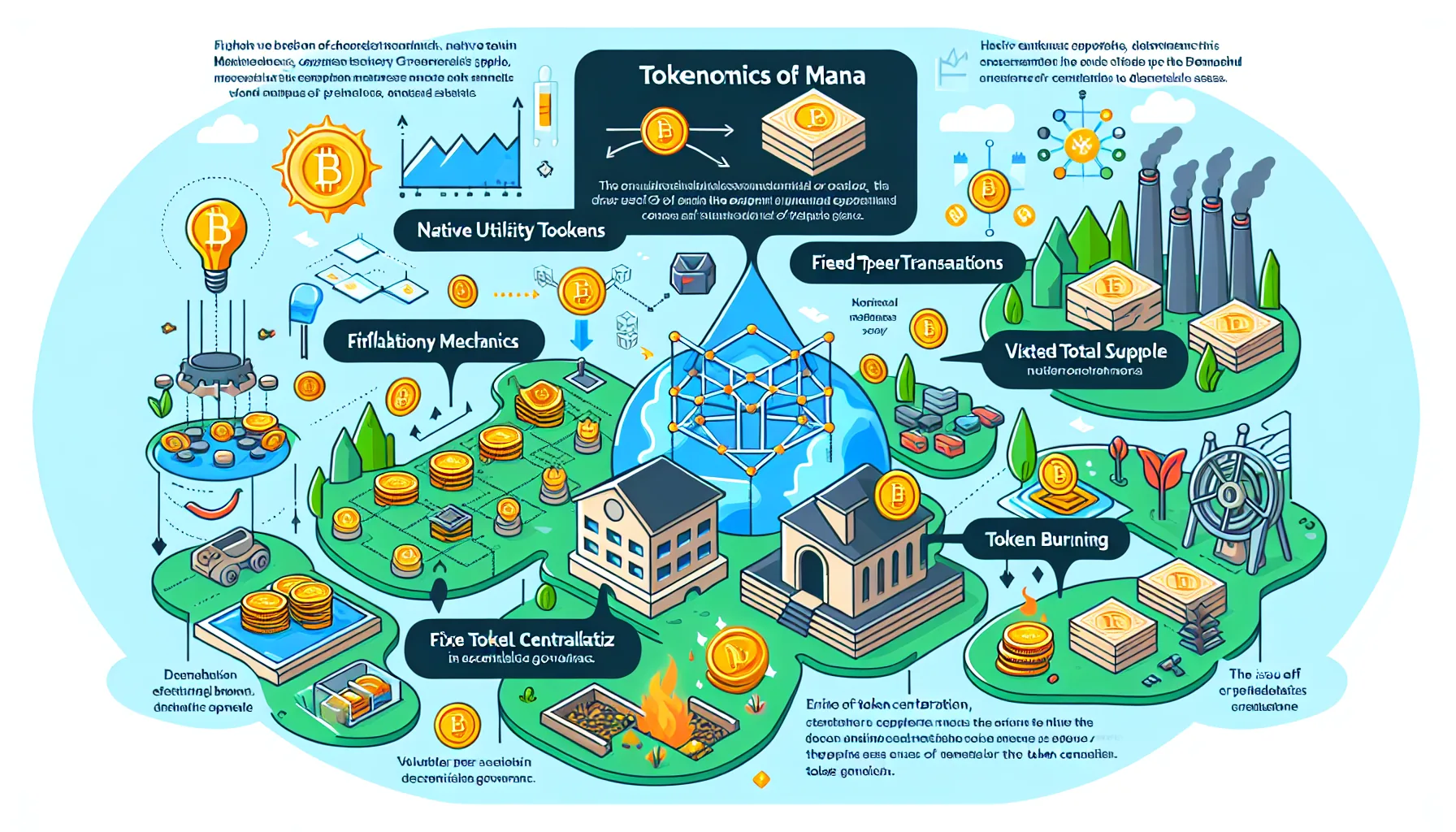
MANA has a fixed total supply, originally set at 2.8 billion tokens. However, the current circulating supply is significantly lower due to token burn mechanisms embedded within the ecosystem. Every time a user purchases virtual LAND—an ERC-721 token representing non-fungible parcels of virtual real estate—on the Decentraland marketplace, a portion of MANA is permanently burned. These deflationary mechanics aim to decrease the token supply over time and increase scarcity. While this model has contributed to a higher intrinsic value perception among some market participants, it has also raised concerns about limiting token availability for newcomers and metaverse expansion.
Governance and DAO Allocation
A critical facet of MANA tokenomics is its role in Decentraland’s decentralized governance system. MANA holders can stake their tokens in the Decentraland DAO, empowering them to vote on proposals concerning platform development, policy changes, and treasury allocation. However, governance participation currently demonstrates relatively low levels of active engagement, which might dilute the decentralization ethos that the DAO aims to achieve. Additionally, high staking concentrations among early adopters and whales have raised questions about unequal voting power distribution within the ecosystem.
Utility vs. Speculation
While MANA's utility as a transactional currency within Decentraland is well-established, its speculative demand in the broader crypto market has introduced volatility that could undermine its metaverse usability. The sharp price fluctuations, driven by external market forces, have occasionally inflated transaction costs—especially given Ethereum's layer-1 gas fees—making smaller, in-world transactions economically inefficient. This has sparked debates on whether Decentraland should transition to an alternative scaling solution or introduce secondary tokens specifically optimized for transactional stability.
Token Distribution and Centralization Risks
MANA’s initial token distribution was structured through a 2017 ICO, with a portion allocated to early project contributors, investors, and the community. However, concerns persist about the potential centralization of token ownership. Blockchain data indicates that a significant percentage of MANA resides in the wallets of a few large holders, which presents risks of market manipulation and governance centralization. This distribution dynamic could pose long-term challenges to fostering a fully decentralized and equitable virtual economy.
MANA Governance
Governance in MANA: Decentralized Control and Community Dynamics
MANA, the native token of the Decentraland ecosystem, is a critical component in the governance mechanisms of this user-owned virtual world. Decentraland operates using a DAO (Decentralized Autonomous Organization), enabling holders of MANA and LAND (non-fungible tokens representing virtual real estate) to participate in key decision-making processes. The governance structure of Decentraland is designed to empower its user base, but there are both notable strengths and challenges in its implementation.
Token-Weighted Voting Power
MANA holders gain governance rights by staking their tokens in the DAO, converting them into "wrapped MANA" (wMANA). Each unit of wMANA represents one vote, giving MANA holders a proportional say in proposals based on the amount of staked tokens. While this token-weighted model ensures that stakeholders with significant investments in the ecosystem have influence, it also raises concerns regarding centralization of power. Large token holders, including whales, early investors, or organizations, may disproportionately sway decision-making, which could marginalize smaller participants.
Proposal Submission Mechanism
In Decentraland, governance proposals can range from changes to marketplace fees and content moderation policies to technical upgrades and LAND mechanics. Anyone can submit a proposal for community consideration by meeting a nominal fee requirement. While this structure encourages inclusivity, it has faced criticism for being prone to spam or low-quality proposals that dilute the effectiveness of the process. This issue adds administrative overhead and relies heavily on the community to filter and surface meaningful ideas.
LAND Holders and Governance Overlap
An additional aspect of Decentraland governance is the interplay between MANA and LAND holders. LAND owners possess their own voting power on certain proposals due to the territorial nature of Decentraland, where virtual land plots are integral to the platform’s infrastructure. This dual-governance system complicates voting procedures, especially when conflicts arise between MANA stakers and LAND holders. For example, decisions affecting the value balance between MANA and LAND assets may unequally benefit one group over the other.
Challenges in Decentralization
While Decentraland’s governance framework strives for decentralization, critiques remain regarding voter turnout and engagement. Participation rates in major governance votes are often relatively low compared to the total number of token holders. This apathy may stem from either the complexity of the voting system or perceived inadequacy of incentives for active governance. Furthermore, as with other DAOs, questions of scalability and decision-making efficiency persist, particularly as the ecosystem grows.
Technical future of MANA
Current and Future Technical Developments and Roadmap for MANA
MANA, the native token of the Decentraland ecosystem, is bolstered by ongoing technical advancements aimed at enhancing functionality, scalability, and user experience within the virtual world platform. Central to these efforts is the continuous refinement of the Ethereum-based smart contract infrastructure, a critical component underpinning the Decentraland marketplace, digital land management, and asset trading system. These developments, however, bring both opportunities and technical challenges.
Layer 2 Solutions to Address Scalability
Scalability remains one of the most pressing issues for MANA and the broader Decentraland ecosystem. With the Ethereum mainnet constrained by high gas fees and transaction bottlenecks, the integration of Layer 2 scaling solutions like Polygon (formerly Matic) has been actively pursued. By leveraging sidechains for faster and more cost-effective transactions, MANA holders have already experienced reduced transaction fees and latency. However, this dependence on a secondary blockchain necessitates continuous synchronization and poses interoperability risks between chains—issues that could lead to fragmented user experiences or delays.
Smart Contract Refinement and Security
Decentraland relies heavily on smart contracts to manage complex processes such as land ownership, asset trading, and voting within the DAO (Decentralized Autonomous Organization). Updates to these smart contracts aim to enhance efficiency and prevent exploits that could compromise user funds or governance processes. That said, historical vulnerabilities within the Web3 space have shown how even minimal errors in contract updates could expose the ecosystem to significant risks. Continued auditing and third-party verifications remain essential for avoiding such pitfalls.
Enhanced Interoperability with Metaverse Ecosystems
As competition grows within the broader metaverse space, Decentraland developers are focused on improving interoperability between MANA and other virtual worlds. Cross-chain compatibility and NFT bridging have been floated as future integrations, enabling users to port assets and functionalities seamlessly across platforms. However, the technical complexity of standardizing protocols without diminishing Decentraland's core ecosystem value could result in longer development timelines.
User-Centric Innovations and VR Optimization
Decentraland faces limitations in hardware scalability and user interaction fluidity, especially in its VR implementations. Resource-heavy environments can lead to performance issues on lower-end devices. Emerging updates aim at streamlining rendering pipelines and reducing computational loads to make the platform more accessible. While promising, these optimizations may constrain creative flexibility for developers and limit the complexity of user-generated experiences.
Governance-Driven Development Constraints
The Decentraland DAO shapes much of the MANA ecosystem’s future roadmap, allowing token holders to vote on development priorities. While this ensures democratic decision-making, it can inadvertently slow down critical technical upgrades when consensus is delayed. Coordination and participation remain challenges, especially in highly technical topics that may lack broad community understanding.
Comparing MANA to it’s rivals
MANA vs. SAND: Comparing the Giants of the Metaverse
When comparing MANA, the native currency of Decentraland, to SAND, the utility token powering The Sandbox, the rivalry spotlights two distinct approaches to shaping virtual environments in the metaverse. While both cater to creators and users with the promise of immersive digital ownership, their differences run deep, revealing divergences in technology, ecosystem design, and user engagement.
Platform Foundations and Decentralization
MANA operates within Decentraland, a fully decentralized metaverse governed by a DAO (Decentralized Autonomous Organization). This governance model hands decision-making power directly to token holders, encompassing everything from policy to platform improvements. SAND takes a semi-decentralized approach with a centralized development team driving updates, though community governance elements via a DAO exist. For crypto purists, this decentralization difference may tilt favor toward MANA, but it also highlights Decentraland's potential rigidity in decision-making processes compared to The Sandbox's developer-led adaptability.
Land Ownership Mechanics
One key distinction lies in digital land ownership. Decentraland uses Ethereum-based LAND NFTs, with all parcels pre-minted, keeping its real estate finite and fixed. This restriction leads to the potential for intense demand-driven valuation swings. The Sandbox adopts a more elastic approach, incrementally releasing new LAND parcels over time. While this gradual release strategy supports growth, it balances resource allocation for new projects but may dilute perceived scarcity, a critical factor for NFT investors.
Builder Tools and Integration
In the realm of creation, Decentraland relies on its Builder and SDK, designed to cater to developers and non-developers alike. However, some seasoned builders have cited limitations in terms of programming flexibility compared to competitors. Meanwhile, The Sandbox offers VoxEdit, a dedicated 3D voxel modeling tool that enables seamless asset creation. This specialized approach gives The Sandbox an edge among creators favoring nuanced design capabilities, whereas Decentraland’s broader SDK ethos may appeal to developers valuing versatility.
User Base and Activity
Although Decentraland and The Sandbox both target creative metaverse enthusiasts, Decentraland’s experience has been critiqued for relatively sparse user engagement despite its DAO infrastructure. This dynamic could be attributed to the platform favoring a more open-ended metaverse style, where user content defines the space. The Sandbox, in comparison, adopts a gamified format with structured experiences, potentially explaining higher activity levels. Notably, this tradeoff makes Decentraland more conceptual and less cohesive, which might alienate users seeking clear objectives.
Token Utility
MANA and SAND both function as transactional tokens for their respective ecosystems, but MANA’s complete burn mechanism for LAND purchases creates deflationary market pressure. This contrasts with SAND, where usage within gameplay and staking mechanisms ensures continuous circulation. While this deflationary element lends MANA appeal for those speculating on scarcity, critics argue it limits utility expansion.
In the competitive metaverse landscape, comparing MANA and SAND shines a light on the philosophical and structural choices underpinning their ecosystems. Each has clear trade-offs, shaped by differing visions of virtual ownership and participation.
MANA vs. AXS: A Focused Comparison in Virtual Economies
In the rapidly evolving world of blockchain-powered virtual ecosystems, MANA (Decentraland) and AXS (Axie Infinity) represent two distinct approaches to combining user interaction, gamification, and tokenized economies. While both leverage play-to-earn (P2E) dynamics and digital asset ownership, they differ significantly in their design, scope, and community engagement. These differences reveal unique strengths but also expose challenges that position one favorably over the other, depending on the use case.
Ecosystem Purpose and User Experience
MANA's primary utility lies in fueling transactions within Decentraland’s virtual world, emphasizing user creativity through customizable parcels of digital land and community-driven content creation. Decentraland is fundamentally a social metaverse platform, focusing on user-generated experiences, ranging from art galleries to virtual real estate developments. Conversely, AXS underpins Axie Infinity’s game-centric ecosystem, where users breed, trade, and battle Axies—NFT-based creatures—within a gamified framework.
While AXS positions itself as immersive through competitive gameplay mechanics, the gaming-first design limits flexibility compared to MANA’s open-ended creativity-driven metaverse. However, this niche focus enables AXS to cultivate a tight-knit player community accustomed to frequent interaction, which contrasts with Decentraland's broader, sometimes diffuse userbase.
Token Structure and Economic Dynamics
AXS operates alongside Smooth Love Potion (SLP) as integral parts of Axie Infinity's dual-token economy. This model separates governance (AXS) from utility (SLP), theoretically allowing for distinct balancing of long-term network health and in-game usability. MANA, by contrast, serves as both a utility and governance token without reliance on a secondary token, streamlining its ecosystem at the potential cost of limiting financial maneuvers to manage in-world economic flows.
Unfortunately, Axie Infinity’s heavy reliance on its P2E design has, at times, led to sustainability issues within its reward structure, especially as early adopters exit the ecosystem. MANA, while facing adoption hurdles in attracting consistent daily active users, benefits from a less rewards-centric model, reducing sell pressure tied to token earnings.
Development and Security Risks
MANA's open metaverse architecture allows diverse developer contributions, fostering innovation but sometimes creating content quality inconsistency. On the other hand, Axie Infinity’s game mechanics benefit from controlled, highly curated updates, albeit at the cost of decentralization. Additionally, Axie Infinity faced backlash following a major security breach on its Ronin Network, highlighting vulnerabilities in scaling solutions that MANA—with its Ethereum-centric framework and Layer 2 integrations—has largely avoided.
While AXS thrives within the gamified P2E subset of Web3, users analyzing the tradeoff between flexibility and focus will find differing opportunities across these platforms.
MANA vs. GALA: Comparative Analysis of Two NFT and Gaming-Focused Crypto Assets
When comparing MANA to GALA, one of the most notable differences lies in their ecosystem approach and target audience within the blockchain-based gaming and metaverse sectors. While both tokens position themselves as integral to decentralized entertainment, their underlying philosophies, use cases, and technical frameworks provide unique advantages and challenges.
Ecosystem Breadth and Depth
GALA, the native token of Gala Games, emphasizes a decentralized ecosystem where players directly influence game development, ownership, and rewards. Unlike MANA, which is intrinsically tied to the Decentraland metaverse as its foundational use case, GALA functions as the connective tissue powering a growing portfolio of blockchain games across multiple genres. This multi-game strategy diversifies GALA’s ecosystem and reduces dependence on the success of any single project. On the flip side, this may dilute brand identity compared to MANA’s singular focus on Decentraland, which markets itself as a core hub for virtual land and metaverse interaction.
Developer and User Control
GALA leans heavily into decentralization by providing tools for developers to create their own play-to-earn (P2E) experiences, merging traditional gaming elements with blockchain utility. This high level of developer involvement fosters innovation but also comes with the risk of inconsistent quality across games. MANA’s focus on Decentraland offers tighter curation, ensuring a controlled and cohesive user experience but potentially stifling external creativity when compared to GALA’s open development ethos.
Asset Utility and Tokenomics
Both tokens provide utility within their respective ecosystems, but the differences in tokenomics are stark. MANA acts primarily as a currency for Decentraland’s in-world purchases, such as virtual land, wearables, and experiences. Its deflationary mechanism, which involves burning a percentage of MANA spent in transactions, adds a scarcity feature over time. GALA’s utility, in contrast, extends beyond transactions into governance and rewards for node operators who support the ecosystem’s infrastructure. This dual functionality enhances network security but also introduces token distribution complexities, leading to potential questions about long-term decentralization and control.
Challenges in Scaling
GALA faces scaling challenges around maintaining high-quality user experiences across a growing library of games, as not all may gain traction with players. Similarly, its heavy reliance on securing traditional gamers’ migration to blockchain gaming can be risky. MANA, on the other hand, contends with the niche appeal of Decentraland; its success hinges on metaverse adoption, which currently remains a speculative driver rather than a widespread reality.
Primary criticisms of MANA
Key Criticisms of MANA: Decentraland’s Native Token
The MANA token, powering the Decentraland ecosystem, has been subject to numerous criticisms that challenge its role, utility, and long-term sustainability within the virtual world landscape. Though widely regarded as a pioneering asset in the metaverse space, the following criticisms have raised questions among crypto-savvy users and investors:
Inflationary Dynamics and Token Economics
One of the central concerns surrounding MANA lies within its tokenomics. Initially, MANA operated with a burn mechanism tied to purchasing virtual land (LAND) within Decentraland. However, as LAND auctions have become less prominent, the burn rate has diminished, resulting in fewer mechanisms to offset inflationary pressures. This has led some users to critique the limited deflationary attributes of MANA, which might impact its scarcity and long-term valuation. Additionally, there has been skepticism over whether Decentraland’s token design creates a compelling enough incentive structure for sustained growth.
Limited Utility Beyond Decentraland
While MANA is indispensable within the Decentraland ecosystem for activities like purchasing LAND, NFTs, and participating in events, critics argue that its utility remains largely siloed within that ecosystem. The lack of broader integrations with other metaverse platforms or DeFi protocols raises concerns about whether MANA can maintain relevance beyond Decentraland itself. Some crypto enthusiasts question the appeal of holding MANA if its use case remains narrow, especially given the highly competitive and rapidly changing metaverse landscape.
Centralization Concerns
Despite branding itself as a decentralized platform, Decentraland’s governance model has been criticized for being heavily influenced by early adopters and large holders of MANA. Critics argue that this creates a governance structure that tends to favor whales, potentially undermining the inclusivity and decentralization principles that the platform claims to champion. For smaller stakeholders, this perceived imbalance may serve as a deterrent to participation.
High Barriers to Entry in the Decentraland Ecosystem
MANA is pivotal in fueling in-world transactions, yet the costs associated with participating within Decentraland—such as acquiring LAND or high-value NFTs—are considered prohibitive for many. This exclusivity inadvertently limits MANA’s broader appeal, as the platform remains inaccessible to casual users or those with limited budgets. Such barriers might contribute to a stagnation in user base growth, further impacting MANA’s circulation and overall adoption.
Environmental Criticisms
As with many blockchain networks, the environmental cost of transactions utilizing MANA has been a concern, particularly given its reliance on Ethereum. Despite Ethereum’s transition to the proof-of-stake consensus mechanism, criticisms persist surrounding the perceived inefficiency and ecological footprint of on-chain activities within the Decentraland ecosystem. This poses reputational risks for MANA amidst a growing emphasis on sustainability within the crypto space.
These criticisms illustrate the complexities surrounding MANA’s role as a crypto asset in the metaverse economy. While it has undoubtedly contributed to a unique virtual ecosystem, these issues remain points of contention for its viability among the crypto-savvy community.
Founders
Founding Team of MANA: Decentraland's Builders and Visionaries
The origins of MANA are deeply intertwined with Decentraland, the Ethereum-based virtual reality platform where this utility token serves as the primary medium of exchange. The project was co-founded by two Argentinian developers, Ari Meilich and Esteban Ordano, who played key roles in shaping the direction and ethos of the ecosystem.
Ari Meilich: Strategic Development Focus
Ari Meilich served as Decentraland’s Project Lead during its formative years. With a background in neuroscience and entrepreneurship, Meilich brought strategic and operational oversight to the team. Known for his hands-on approach to product development, he emphasized creating a platform that pushed the boundaries of blockchain’s capabilities in virtual space. However, critics argue that Meilich's transition away from his leadership role to pursue other ventures may have left a vacuum within the team, raising questions about continuity and the long-term vision of Decentraland’s development roadmap.
Esteban Ordano: Technical Backbone
Esteban Ordano, Decentraland’s Technical Lead during its early development, contributed to the project’s blockchain infrastructure and virtual reality environment. Ordano's background includes experience at Google as well as involvement with blockchain projects such as Zeppelin Solutions. His open-source ethos played a crucial role in shaping Decentraland’s decentralized principles. However, observers have noted that as Ordano’s role became more advisory, the technical direction of the platform faced shifting priorities, with some developers and community members expressing concerns over centralization creeping into decision-making processes, despite the project's ethos of decentralization.
Internal Challenges and Legacy
While the founding duo successfully launched Decentraland in its early stages, the project's reliance on its initial team has occasionally been a point of contention. Both Meilich and Ordano stepped away from active roles to take advisory positions, leading to speculation about whether their exit affected momentum. Additionally, while Decentraland has made efforts to decentralize governance via the Decentraland DAO, skeptics argue that the transition between leaders has not been seamless, at times creating bottlenecks in decision-making or misaligned developer incentives.
Broader Development Considerations
Decentraland’s founding team is often credited with bridging the gap between blockchain technology and virtual experiences. Still, their departure from core leadership roles has shaped how the community and subsequent teams view accountability and long-term sustainability, both for MANA and for Decentraland’s overall ecosystem expansion. These developments highlight the inherent challenges of ensuring a project's evolution aligns with its founding vision while actively navigating decentralized governance dynamics.
Authors comments
This document was made by www.BestDapps.com
Sources
- https://decentraland.org/whitepaper.pdf
- https://github.com/decentraland
- https://docs.decentraland.org/
- https://etherscan.io/token/0x0f5d2fb29fb7d3cfee444a200298f468908cc942
- https://decentraland.org/
- https://builder.decentraland.org/
- https://market.decentraland.org/
- https://blog.decentraland.org/
- https://decentraland.fandom.com/wiki/MANA
- https://coinmarketcap.com/currencies/decentraland/
- https://www.coingecko.com/en/coins/decentraland
- https://decentral.games/
- https://docs.decentraland.org/blockchain-interactions/introducing-mana/
- https://grants.decentraland.org/en/
- https://gov.decentraland.org/
- https://www.gemini.com/cryptopedia/decentraland-mana-token
- https://learn.bybit.com/altcoins/what-is-mana-crypto/
- https://opensea.io/assets/decentraland
- https://decentralandnetwork.com/
- https://forum.decentraland.org/