History of LEND
The History of LEND: Evolution of a DeFi Pioneer
LEND, the native token of the Aave protocol, has an origin story that predates its widely recognized DeFi dominance. Starting life in 2017 under the name ETHLend, it emerged during the ICO boom as a decentralized platform designed to facilitate peer-to-peer crypto-backed loans. The broader concept of ETHLend was innovative for its time, offering users the ability to post loan requests and offers directly on the Ethereum blockchain without relying on centralized intermediaries. At its core was a vision of creating a decentralized credit system by leveraging smart contract technology.
However, ETHLend encountered several challenges in its early days. The platform faced significant headwinds due to the complexities associated with peer-to-peer lending in its original form. The lack of liquidity, borrower defaults, and an overall cumbersome user experience limited the platform's adoption. Moreover, fierce competition and rapid market evolution within the crypto space posed additional hurdles. Despite these obstacles, the team at ETHLend recognized the need for adaptation and executed a major pivot, one that would set the foundation for its future success.
In 2018, ETHLend rebranded to Aave—derived from the Finnish word for "ghost"—signaling its rebirth and a broader expansion of its ecosystem. Alongside the rebranding came a fundamental shift in its use case and technical approach. Rather than limiting operations to peer-to-peer loans, Aave introduced liquidity pools, giving rise to a more flexible and scalable borrowing and lending model. This change allowed users to deposit assets into shared pools, which borrowers could draw from without the need for direct matching between lenders and borrowers.
As part of this evolution, LEND remained a central component of the ecosystem, serving as the governance and utility token. Despite these advancements, the token faced criticism for its limited governance functionality in the early stages of Aave's development, as decision-making power remained concentrated among the core team.
The transition from ETHLend to Aave marked a turning point for LEND, but it also brought about regulatory scrutiny surrounding DeFi protocols. Questions about the compliance of such systems arose, with LEND's role in governance and staking sometimes drawing attention to potential vulnerabilities.
This historical journey of LEND—rising from a niche ICO project to becoming a key part of one of DeFi's most prominent protocols—highlights the dynamic and sometimes tumultuous path of innovation in the crypto space. While its resilience is commendable, early liquidity issues and the challenges of evolving in a rapidly changing landscape remain significant aspects of its history.
How LEND Works
How LEND Works: Exploring the Mechanics of Aave’s Governance Token
LEND operates as the governance token of the Aave Protocol, a decentralized finance (DeFi) platform enabling users to lend, borrow, and earn interest on crypto assets without intermediaries. The token plays a central role in maintaining the ecosystem's functionality, empowering holders to propose and vote on protocol upgrades, features, and parameters.
Governance Utility
At the core of LEND’s utility is its role in decentralized governance. Token holders can submit and vote on Aave Improvement Proposals (AIPs) to influence critical aspects of the protocol. These include modifying fee structures, adjusting risk parameters, or introducing new collateral types. Proposals with sufficient community support are implemented, ensuring Aave evolves in a decentralized and user-driven manner. This governance mechanism promotes collective decision-making but can occasionally suffer from low voter participation, a common issue in many token-based governance systems.
Protocol Contribution and Fee Discounts
LEND can also contribute directly to the Aave ecosystem through fee-related mechanisms. By staking LEND within the Safety Module, holders can earn staking rewards while simultaneously exposing their tokens to potential slashing events during adverse protocol conditions—for instance, covering shortfalls during systemic failures. Additionally, LEND holders may benefit from reduced protocol fees, incentivizing active participation within the ecosystem.
Tokenomics and Burn Mechanics
LEND integrates a deflationary mechanism designed to align supply with demand. A portion of protocol fees collected is directed toward purchasing LEND from the open market, which is then burned, reducing overall token supply. While this strategy theoretically supports long-term price appreciation and ensures scarcity, its real-world impact hinges on the platform's growth and sustained fee generation. Additionally, as large protocol upgrades (such as token migrations) occur, LEND’s utility and functionality can shift, potentially impacting its perceived value.
Potential Risks and Centralization Concerns
Despite its decentralized ethos, LEND governance may face centralization risks, particularly if a small number of large token holders dominate voting processes. Concentrated governance can undermine decentralization and leave protocol decisions in the hands of a minority. Furthermore, significant fluctuations in LEND’s staking volumes could expose the Safety Module to liquidity constraints during market shocks, reducing its effectiveness as an insurance mechanism.
LEND exemplifies a versatile governance token with multiple use cases, but its efficacy relies heavily on active community engagement, robust participation in governance, and secure staking practices. Understanding its intricacies is essential for participants aiming to contribute meaningfully to Aave’s ongoing development.
Use Cases
Use Cases of the LEND Crypto Asset
Decentralized Lending and Borrowing
The primary use case of the LEND crypto asset is its utility in decentralized lending and borrowing protocols. LEND was designed to operate within its ecosystem to facilitate seamless peer-to-peer borrowing without intermediaries. Users can deposit funds to earn yield or use their holdings as collateral for loans. By leveraging smart contracts, LEND eliminates the need for traditional banks, reducing time delays, fees, and the requirement for centralized trust.
Governance Participation
LEND often plays a critical role in governance within its native ecosystem. Token holders can propose, vote on, and influence key protocol changes, including interest rates, collateral parameters, or the launch of new features. While governance fosters community involvement and decentralization, it's not without flaws. Unequal token distribution can lead to governance power being concentrated in the hands of a few large holders, undermining the ethos of decentralization.
Liquidity Provision and Incentives
LEND also serves as an incentive mechanism for liquidity providers on decentralized platforms. Users who stake or supply LEND to liquidity pools are rewarded with additional tokens, often receiving high APYs for their contributions. However, this functionality is not risk-free. Impermanent loss, token devaluation, and smart contract vulnerabilities present ongoing challenges, particularly for those less experienced in DeFi mechanics.
Collateralization in DeFi Protocols
In many decentralized finance ecosystems, LEND can be used as collateral to borrow other assets. This increases its utility for advanced crypto users seeking to leverage their holdings. The secured loans can amplify both gains and losses, introducing significant risks. Additionally, the need for over-collateralization could be a deterrent for some users, especially during heavy market fluctuations that can trigger rapid liquidations.
Staking Mechanisms for Network Security
In some implementations of LEND-related protocols, staking the asset can serve as a mechanism to secure the system or support protocol upgrades. In exchange for staking, users are often rewarded with fixed or variable token yields. While attractive to some, the staking process can lock up liquidity, and associated rewards may not always compensate for the opportunity cost or the risks tied to token volatility.
Limitations of LEND Use Cases
Despite its versatility, the use cases of LEND are bounded by the broader DeFi ecosystem's scalability and regulatory uncertainty. As with many crypto assets, its utility heavily depends on smart contracts, which are not immune to bugs or hacks. Moreover, jurisdictional compliance and evolving laws can impact LEND's usability, with some regions potentially banning its associated operations. This creates an added layer of uncertainty for token holders and ecosystem participants.
LEND Tokenomics
LEND Tokenomics: A Deep Dive into Supply Dynamics and Utility
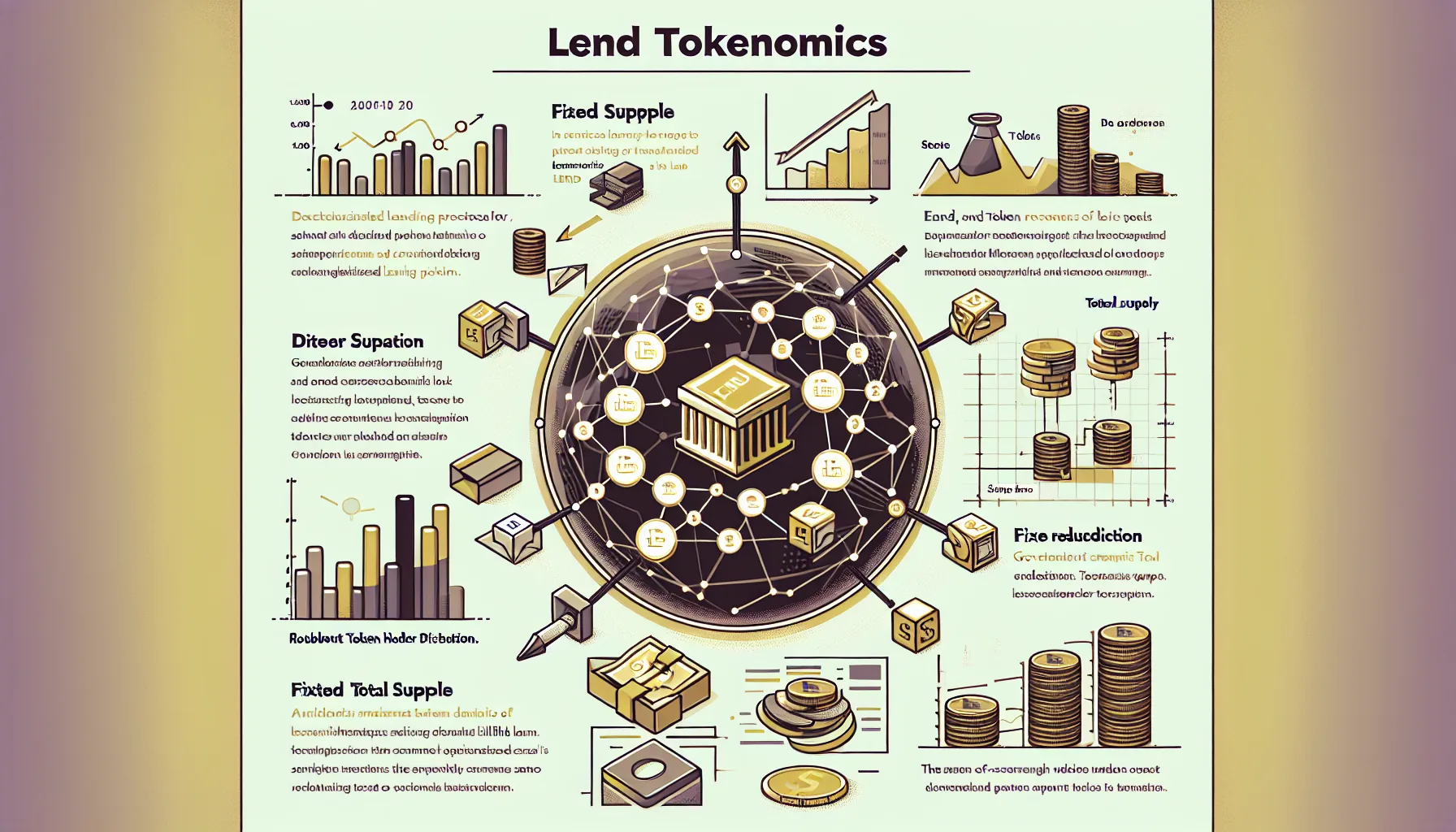
LEND, the utility token associated with the decentralized lending protocol Aave, features a tokenomics model that reflects both its historical evolution and its role within the ecosystem. Originally launched as an ERC-20 token, LEND played a central role in governance and fee reduction, though its tokenomics shifted significantly with its migration to AAVE tokens during the protocol upgrade. The analysis here pertains to its specific mechanics prior to and within this transitional framework.
Supply Structure and Circulation
LEND was initially released with a fixed total supply of 1.3 billion tokens. Notably, there were no mechanisms for ongoing inflation or mining, meaning the circulating supply corresponded closely to the total supply over time, barring instances of token burns. This static supply mechanism contributed to LEND being regarded as deflationary, contingent on its usage within Aave protocol activities. However, critics have pointed out that the absence of a dynamic supply adjustment feature might limit its adaptability to changing ecosystem demands or market conditions.
Token distribution at inception leaned heavily toward public participants via its 2017 token sale. However, some concerns within the community arose from allocations to the project team and early investors, which could potentially skew incentives or affect decentralization depending on the utilization of vested tokens.
Token Utility and Use Cases
In practice, LEND's utility was primarily based on governance and protocol fee value capture. LEND holders could leverage their tokens for decision-making in Aave Improvement Proposals (AIPs). Additionally, LEND offered fee discounts for users participating in lending and borrowing activities within the protocol. A proportion of fees collected in the system were directed to fund development or burned via a buyback model, directly linking LEND's usage to its supply deflation. However, some observers suggest that LEND’s original utility model was relatively limited compared to other DeFi tokens offering multi-dimensional use cases, such as staking or cross-chain functionalities.
Liquidity and Token Holder Distribution
Liquidity for LEND was generally robust, facilitated by a wide array of listings across both centralized and decentralized exchanges. Nonetheless, disparities in token holder distribution became a point of contention, with some claiming that a concentration of tokens among a few high-balance wallets presented potential risks for governance centralization and protocol manipulation.
In summary, the tokenomics of LEND laid the groundwork for its evolution into the Aave ecosystem but was not without its critiques. From fixed supply mechanics to specific utility constraints, LEND’s economic design prompted both praise for its simplicity and calls for greater innovation before its transition to AAVE.
LEND Governance
Governance in LEND: A Deep Dive into Its Framework and Challenges
The governance structure of the LEND crypto asset plays a pivotal role in shaping its ecosystem, prioritizing decentralization and user participation. As the native token originally associated with the Aave Protocol, LEND holders were given an avenue to influence decisions related to development, upgrades, and overall protocol management. However, alongside its benefits, certain limitations and challenges have emerged within its governance model.
Decentralized Decision-Making Mechanisms
LEND's governance empowers token holders to propose and vote on critical protocol decisions, including parameter adjustments, protocol upgrades, and treasury fund distributions. This decentralized structure theoretically ensures that the community, rather than a central authority, steers the protocol's evolution. Such a framework aligns with the ethos of decentralized finance (DeFi) by granting power to its users.
Governance Token Distribution Challenges
One fundamental issue related to LEND governance lies in its token distribution. The concentration of LEND tokens among a small group of whales or early adopters can skew voting power disproportionately, reducing the influence of smaller stakeholders. This raises concerns about centralization risks within the governance process, contrary to the protocol's intended decentralization. These power dynamics can lead to potential scenarios where decisions primarily benefit large holders, sidelining the wider community.
Proposal Submission Process
Submitting a proposal within the LEND governance ecosystem generally involves meeting a threshold of token holdings to ensure only serious and impactful suggestions are brought forward. While this mechanism aims to avoid governance spamming, it can alienate smaller holders from active participation. Additionally, without clear incentives to participate or vote, the problem of governance apathy can arise, where even token holders with substantial stakes may abstain from engagement.
Security and Vulnerability Considerations
On-chain governance, while transparent, is not devoid of risks. Protocols like LEND often face the challenge of balancing swift decision-making with thorough deliberation. Governance models relying on time-locked periods before enacting proposals aim to address potential exploit risks. Yet, this delay can also restrict the protocol's ability to respond quickly to emergencies, such as vulnerabilities or unforeseen market conditions.
Conclusion
LEND's governance framework underscores the broader complexities faced by decentralized systems striving for balance between inclusivity, security, and efficiency. While LEND has laid the foundation for community-driven protocol management, issues like disproportionate influence and participation barriers highlight areas where evolution is needed. As with any governance system, continuous iteration will likely remain critical for its sustainable success.
Technical future of LEND
Technical Developments and Roadmap for LEND: Innovations and Challenges
LEND, initially known as the utility token driving the Aave platform, has undergone substantial technical transformations since its inception. One of the cornerstone developments was the migration of LEND to AAVE as part of the tokenomics upgrade. This was aimed at enhancing governance potential and reinforcing the network’s resource allocation mechanism. While the migration is widely regarded as a pivotal improvement, the associated technical complexities underscored scalability issues tied to legacy infrastructures.
Transition to Layer 2 Solutions
LEND’s evolution has increasingly focused on addressing Ethereum's high gas fees and congestion issues by transitioning to Layer 2 solutions like Optimistic Rollups and zk-Rollups. These scalable protocols are designed to enhance transaction throughput and reduce operational costs. However, there are ongoing concerns about interoperability with smart contracts native to Layer 1 Ethereum, making seamless integration an unfinished challenge.
Smart Contract Audits and Risk Mitigation
The development team has prioritized security in its smart contract architecture, with multiple audits performed by independent firms. Despite these measures, the network has encountered critiques regarding the complexity and potential vulnerabilities of its permissionless liquidity pools. Flash loans—a prominent feature of Aave’s ecosystem—while innovative, have occasionally been exploited, raising questions on whether the existing safeguards against malicious activity are sufficient. Future updates are expected to direct significant attention toward fortifying these areas without compromising usability.
Governance and DAO Transition
One of LEND’s celebrated advancements is its integration into Aave’s decentralized autonomous organization (DAO) governance model. While this enables token holders to vote on critical protocol updates, the consolidation of voting power among large stakeholders has sparked decentralization concerns. Proposed enhancements to governance mechanisms are under discussion, focusing on incentivizing broader participation and resolving existing power imbalances.
NFT Collateralization and Cross-Chain Functionality
Future iterations of the protocol are exploring the inclusion of NFT collateralization within the lending ecosystem, allowing users to leverage NFTs as loan assets. Additionally, cross-chain functionality is a priority, with the aim of extending LEND’s usability across multiple blockchain networks beyond Ethereum. However, cross-chain compatibility introduces complexities tied to bridging mechanics and security risks, both of which remain unresolved hurdles. These elements are anticipated to be key focal points in upcoming roadmap updates.
Final Notes on Emerging Challenges
As LEND continues to evolve within the Aave ecosystem, its technical roadmap reflects a commitment to scalability, security, and inclusivity. However, unresolved challenges—ranging from governance centralization to technical integration risks—highlight important areas for continued improvement.
Comparing LEND to it’s rivals
LEND vs. AAVE: Key Differences in the Crypto Lending Space
In the highly competitive decentralized finance (DeFi) ecosystem, the relationship between LEND and AAVE presents an interesting case study. Though AAVE ultimately emerged as the protocol’s official brand following a migration process, it's vital to evaluate specific differences between the LEND token and its evolved rival, AAVE, in terms of functionality, governance, and adoption.
Governance and Token Dynamics
While both LEND and AAVE are tied to the same underlying protocol, their governance frameworks highlight distinct design choices. LEND tokens were originally used to fuel the protocol's early stages of growth, particularly by providing liquidity incentives and allowing for staking mechanisms to secure the protocol. However, AAVE’s governance utility incorporates a broader range of functionality via AAVE Improvement Proposals (AIPs), which allow token holders to vote on protocol upgrades and risk framework adjustments.
The key limitation of LEND compared to AAVE lies in its relative inflexibility within governance processes. LEND functioned primarily as a utility token, without the deeply integrated governance rights evident in AAVE. This relegated LEND holders to a more passive role relative to the later framework designed around the AAVE token.
Liquidity Support and Ecosystem Participation
LEND's utility in fostering early-stage adoption is notable but lacks the more structured mechanisms seen in its counterpart. Most significantly, liquidity incentives associated with LEND were primarily foundational, offering less multimodal usability compared to the robust staking and yield-generation options that developed later. This constraint limited LEND’s capacity to attract steady capital inflows outside speculative interest or early ecosystem builders.
Further, while LEND enabled participation in interest-bearing deposits and stable borrowing frameworks, the absence of risk mitigation features such as AAVE’s “Safety Module” (a staking mechanism designed to backstop losses in the protocol) positions LEND as less robust in addressing systemic risk scenarios.
Smart Contract Infrastructure
AAVE’s introduction brought substantial upgrades to the protocol’s backend, including more advanced rate-switching mechanisms (stable vs. variable interest) and improvements in borrower protections via collateral ratios. While LEND did allow for fundamental lending and borrowing interactions, it lacked these refined tools, which are critical for DeFi protocols aiming to scale to mainstream DeFi use cases. As a result, LEND is often viewed as an early-stage iteration, with limitations in smart contract extensibility compared to AAVE.
Ultimately, the LEND token, while integral to the protocol's origins, reveals multiple disparities when juxtaposed with its successor, AAVE, particularly in governance reach, ecosystem integration, and technical sophistication. These aspects underscore the evolutionary trajectory of the platform rather than equivalence between the two tokens.
LEND vs COMP: A Critical Comparison of Lending Protocols
When comparing LEND to COMP, it's essential to focus on their structural differences in governance, market positioning, and the underlying technology that drives user adoption. Both projects operate in the decentralized finance (DeFi) ecosystem, prioritizing lending and borrowing services. However, COMP presents a distinctly different approach to decentralized lending compared to LEND.
Governance Structure and Token Utility
One of the most notable differences between LEND and COMP is their governance model. COMP, as the governance token for Compound, plays a crucial role in decision-making mechanisms. It gives token holders the ability to vote directly on protocol changes, interest rate adjustments, and other system parameters. While LEND’s utility extends beyond mere governance into fee reductions and staking incentives, COMP has leaned heavily into decentralization. This reliance on token-holder voting, however, has led to questions regarding its susceptibility to governance capture by large COMP holders, potentially centralizing influence in the hands of a few.
Reward Systems and Liquidity Mining
COMP gained significant traction through its liquidity mining program, which rewards users with COMP tokens based on protocol activity. This strategy’s gamified incentives spurred robust initial adoption and liquidity inflow. Comparatively, LEND has been less reliant on liquidity mining, arguably fostering a more organic user growth model. However, COMP’s heavy reward mechanisms have drawn criticism for encouraging mercenary capital—liquidity that leaves the protocol as soon as rewards decrease—leading to potential instability in its total value locked (TVL).
Risk Factors in Protocol Design
From a risk perspective, COMP’s algorithmic interest rate model presents both its strength and vulnerability. While it efficiently adjusts rates based on supply and demand, extreme dependence on this model can result in sharp liquidation events during high market volatility. LEND’s focus on a safety module and risk-backed assets reduces liquidation risks but comes at the cost of slightly less APY competitiveness in certain scenarios. For high-APY hunters, COMP might seem more attractive, but it also carries elevated systemic risks that skilled users will recognize.
Market Position and Borrower Profiles
COMP heavily emphasizes governance token-driven innovation, appealing to developers and institutional users seeking sophisticated tooling. In contrast, LEND caters to a broader retail market, emphasizing accessibility. Thus, COMP may suffer from an overly institutional focus, alienating smaller market participants. This narrower user base, while profitable in the short term, could pose long-term scalability challenges as it competes for dominance with retail-driven platforms.
Comparing LEND to MKR: A Deep Dive into Utility and Governance
When evaluating the differences between LEND and MKR, the contrast lies in their roles within the DeFi ecosystem, as well as their underlying approaches to governance, utility, and protocol mechanics. Both operate within the broader framework of decentralized finance, but their fundamental objectives and implementations diverge significantly. Below, we explore the specific distinctions.
Protocol Functionality and Asset Utility
LEND originates from an ecosystem designed predominantly to facilitate lending and borrowing services, functioning as a utility token to drive the behavior of its user base. MKR, by contrast, plays a pivotal role in the Maker protocol’s operations and stability mechanisms. While LEND focuses on incentivizing liquidity providers and earning fees, MKR operates with a governance-and-collateral sustainability model at its core.
One of MKR’s defining differences lies in its dual utility: not only is it a governance token, but it's also directly linked to the system's solvency. MKR holders bear the responsibility of recapitalizing the protocol during insolvency events. This is crucial because it introduces risk to MKR holders—not something mirrored in LEND’s structure—which can dissuade casual investors or governance participants unwilling to take on systemic liability.
In contrast, LEND leans heavily toward rewarding usage-based behaviors rather than putting its token holders at systemic risk. It does, however, lack the same level of integration with protocol-level financial mechanisms.
Governance Dynamics
Governance models further separate the two. MKR governance operates with an on-chain voting model directly tasked with maintaining the Dai stablecoin peg, risk parameters, and collateral types. This places MKR holders in a direct decision-making role for critical protocol operations such as approving new collateral or adjusting stability fees. It’s a system steeped in responsibility, where governance missteps can result in direct monetary consequences for stakeholders.
LEND, however, primarily abstains from this high-stakes governance structure, instead prioritizing its use for participating in system upgrades and fee benefits. This lightweight governance model might appear less burdensome for token holders but also raises questions surrounding decentralization and long-term involvement.
Liquidity Supply Versus Collateral
LEND operates in a straightforward liquidity provision system where rewards and incentives attract users to the platform. MKR’s approach, tied to the MakerDAO vaults system, revolves around ensuring adequate overcollateralization of the Dai stablecoin. This distinction impacts risk factors: MKR holders indirectly shoulder the responsibility for collateral shortfalls, making participation more nuanced and risk-sensitive.
With these sharp contrasts, LEND’s strengths may reside in its simpler, less risk-bearing utility, but this simplicity might fail to address the level of systemic importance that tokens like MKR bring to their respective ecosystems.
Primary criticisms of LEND
Primary Criticism of LEND: Examining Potential Weaknesses
While LEND has garnered significant attention in the decentralized finance (DeFi) ecosystem, it is not without its share of criticism. Below, we explore the primary concerns raised by the crypto community regarding the asset and its associated protocol.
Centralization Concerns
One of the most frequently cited criticisms of LEND revolves around the protocol's governance structure. Although it operates within the framework of decentralized finance, skeptics point out that governance may not be as decentralized as intended. Entities holding substantial amounts of tokens can disproportionately influence protocol decisions, leading to questions about the equitable distribution of power. Critics argue that this can create an uneven playing field where the interests of large stakeholders potentially outweigh those of smaller participants.
Smart Contract Vulnerabilities
Like many DeFi assets, LEND is not immune to the broader risks inherent in smart contract-based platforms. The reliance on complex code introduces potential vulnerabilities that, if exploited, could lead to significant financial losses for its users. While extensive audits and security reviews mitigate some concerns, the fast-moving nature of DeFi means that even well-reviewed contracts may harbor undiscovered flaws. Critics assert that confidence in the asset is contingent on its exposure to ever-evolving security risks.
Liquidity Risks
A significant point of contention with the LEND ecosystem is its perceived susceptibility to liquidity challenges during periods of market stress. Critics highlight that the over-collateralization requirement—an integral feature of the lending system—can lead to rapid spikes in liquidation events during volatile market conditions. These events often trigger cascading sell-offs, amplifying price instability and straining liquidity pools, which many argue undermines the protocol’s long-term resilience.
Regulatory Uncertainty
The decentralized nature of LEND might shield it from immediate centralized regulatory scrutiny, but the project is not free from legal risk. Regulatory ambiguity surrounding DeFi lending platforms can pose existential threats, as governments worldwide are increasingly setting their sights on unregulated financial products. Critics warn that prolonged uncertainty in regulatory alignment may hinder the protocol’s adoption in more risk-averse jurisdictions.
Tokenomics Critiques
Concerns about the tokenomics of LEND have also surfaced in discussions. While the system incentivizes early adopters, some argue that this creates a model where incentives diminish over time, reducing the motivation for new participants to engage. Additionally, critics question whether the token’s utility is sufficient to sustain its demand, particularly in the face of increasing competition in the DeFi space.
In examining these issues, it becomes evident that LEND, like many emerging technologies, must address significant challenges to maintain trust and relevance.
Founders
Founding Team Behind LEND: Origins and Expertise
The crypto asset LEND, initially launched by the ETHLend project, owes much of its inception and development to the vision and expertise of its founding team. ETHLend was created in 2017 with the goal of building a decentralized peer-to-peer lending platform, and the individuals driving this initiative played a significant role in shaping the trajectory of both the platform and its native token, LEND.
The project was spearheaded by Stani Kulechov, a lawyer by training who took a keen interest in blockchain technology and the emerging realm of decentralized finance (DeFi). Kulechov’s legal background provided a unique perspective, enabling him to identify inefficiencies in traditional financial systems and envision how blockchain could address them. While his leadership and ability to anticipate market needs have been widely acknowledged, critics have pointed out that his relatively young age at the time of ETHLend’s inception may have initially contributed to skepticism within conservative financial circles.
Supporting Kulechov was a small but technically proficient team of developers and advisors, many of whom were instrumental in building the smart contract infrastructure that powered the ETHLend platform. However, some analysts noted that, in its early stages, the team appeared to lack substantial experience in large-scale financial systems—an issue that was flagged as a potential risk given the complex and highly regulated nature of lending markets.
Another point of contention stems from the decentralized ethos of the project versus the practical need for centralized leadership during its formative stages. Critics have argued that ETHLend's initial decision-making process was overly dependent on Kulechov and a select group of core contributors. While this streamlined development, it also raised questions about governance, transparency, and community input during the early stages of LEND's existence. These concerns eventually led to further decentralization measures in subsequent iterations of the project.
Overall, the founding team brought innovative ideas and technical prowess to the table but faced challenges related to perceived youth, lack of traditional finance experience, and early-stage governance structures. These factors, while not unique to LEND, are important to consider when evaluating the foundation upon which the asset and its ecosystem were built.
Authors comments
This document was made by www.BestDapps.com
Sources
- https://aave.com/
- https://github.com/aave/protocol-v1
- https://whitepaper.io/document/586/aave-whitepaper
- https://ethereum.org/en/developers/docs/erc-20/
- https://medium.com/aave/ethlend-becomes-aave-ded695116112
- https://coinmarketcap.com/currencies/aave/
- https://crypto-comparison.com/coins/aave/
- https://etherscan.io/token/0x80fB784B7eD66730e8b1DBd9820aFD29931aab03
- https://defillama.com/protocol/aave
- https://docs.aave.com/
- https://www.coingecko.com/en/coins/aave
- https://decrypt.co/resources/what-is-aave
- https://blog.aave.com/
- https://tokeninsight.com/en/coins/aave
- https://consensys.net/defi-token-overview/aave/
- https://tokensniffer.com/token/ethereum/0x80fB784B7eD66730e8b1DBd9820aFD29931aab03
- https://docs.ethlend.io/
- https://defipulse.com/aave
- https://aave.arc.radicle.network/
- https://research.binance.com/en/projects/aave


