History of KSM
A Deep Dive Into the History of KSM: Kusama’s Origins and Evolution
Kusama (KSM), often referred to as Polkadot’s canary network, was introduced by Parity Technologies during the development of the broader Polkadot ecosystem. Its creation aimed to serve as a testbed for innovations, allowing developers to experiment freely without jeopardizing the stability of Polkadot. However, Kusama quickly evolved beyond its initial purpose, becoming a standalone blockchain network that caters to developers seeking both flexibility and reduced oversight for rapid deployment.
Kusama was launched in 2019, with its roots deeply tied to Polkadot, given they share the same underlying codebase. Both projects are the brainchild of Dr. Gavin Wood, co-founder of Ethereum and the creator of Substrate, the blockchain framework on which Kusama operates. What differentiates Kusama isn’t just its ethos of fostering innovation through chaos but also its unique operational choices, such as shorter governance timelines and faster updates. These differences positioned KSM not merely as a “test network,” but as an independent space for use cases demanding high-speed iterations.
The initial KSM token distribution was conducted via a lockdrop system. Users who participated by locking their DOT tokens received KSM in return. This novel approach ensured that early users of Polkadot became stakeholders in Kusama, creating a symbiotic relationship between the two ecosystems. However, this distribution model wasn’t without challenges. Some critics pointed out that the airdrop-style lockdrop model inherently favored early adopters and whales, potentially leaving out smaller investors or newcomers to the ecosystem.
Kusama gained recognition for its aggressive timeline, which led to a variety of technical successes but also periodic criticisms. Due to its rapid governance cycles, some significant decisions and network upgrades were made with limited time for community-wide deliberations. While this allowed for cutting-edge experimentation, it occasionally led to fragmented opinions and concerns about centralization within specific decision-making processes.
The history of Kusama is also inseparable from its role in pioneering parachain auctions. These auctions began as a mechanism to secure slots for projects aiming to operate within Kusama’s shared relay chain. Although the auctions have incentivized innovation and participation, the fierce competition among projects, coupled with the high KSM bond requirements, often sparked debates regarding accessibility and fairness for smaller decentralized applications.
As Kusama continues to evolve, its unique history encapsulates a dual narrative of innovation and controversy, shaping it into a network that thrives on pushing boundaries, often through trial by fire.
How KSM Works
How Kusama (KSM) Works: Diving into Its Technical Backbone
Kusama (KSM) operates as an experimental blockchain platform designed to provide developers with a sandbox environment to test their projects in a live yet adaptable network architecture. As the "canary network" for Polkadot, Kusama shares the same underlying codebase and concepts, but it's tailored for faster innovation cycles and a higher tolerance for risk.
Substrate Framework at Its Core
Kusama is built on Substrate, a framework that facilitates the development of custom blockchains. Substrate enables developers to build optimized, application-specific chains without starting from scratch. Kusama leverages Substrate’s modularity, which allows parachains deployed on its network to customize runtime logic while still being interoperable with the main Relay Chain. This reliance on Substrate means scalability and parallel transaction processing are inherent to the design.
Nominated Proof-of-Stake (NPoS) Governance
Kusama utilizes Nominated Proof-of-Stake, a variant of Proof-of-Stake, to secure the network and validate transactions. The process involves nominators electing validators by staking their KSM tokens. Validators, in turn, stake KSM and are responsible for producing new blocks, participating in consensus processes, and validating parachain blocks. However, NPoS governance introduces a potential risk of centralization due to top nominators consolidating influence.
Relay Chain and Parachains Interaction
The network’s architecture revolves around a central Relay Chain that serves as the backbone, ensuring network security and cross-chain compatibility. Parachains, which are independent blockchains running parallel to the Relay Chain, are connected to Kusama via parachain slots. These slots are limited in number, and their allocation is managed via auction processes, which can create a barrier to entry for smaller projects due to high costs.
On-Chain Governance and Rapid Updates
Kusama’s governance model is uniquely aggressive. The voting system for upgrades and decision-making is fully on-chain and facilitated by mechanisms like council votes, public referenda, and motions. This results in faster decision-making and network updates compared to Polkadot. However, the same flexibility translates to a higher risk of introducing untested changes that could destabilize the ecosystem.
Staking and Inflation Mechanics
Staking plays a critical role on Kusama. By staking KSM, users can earn rewards while participating in securing the network. However, KSM also has an inflationary supply model, which continually increases the token supply. This design incentivizes active participation but dilutes holdings for those not staking.
As Kusama enables developers to push the boundaries of blockchain experimentation, its always-evolving infrastructure serves as both an advantage and a challenge. Balancing innovation with stability remains key to its functionality.
Use Cases
Use Cases of KSM: Unlocking the Full Potential of Kusama's Native Token
KSM, the native token of the Kusama network, powers a variety of specific and high-value use cases within the ecosystem. Known as the "canary network" for Polkadot, Kusama promotes rapid experimentation and innovation, and KSM is at the core of driving this functionality. Its use cases are multifaceted, yet they are not without limitations that sophisticated users should consider.
Staking and Network Security
One of the primary use cases for KSM is staking to secure the Kusama network. Validators stake KSM to participate in the consensus mechanism, while nominators delegate KSM to trusted validators to earn staking rewards. This staking ensures network security and maintains decentralization. However, Kusama's faster-paced development cycle introduces more frequent runtime upgrades and potential vulnerabilities compared to Polkadot, making staking slightly riskier in terms of operational stability. For active participants, this tradeoff between innovation and risk factors requires careful evaluation.
Crowdloans for Parachain Auctions
KSM is extensively used in the crowdloan mechanism to participate in parachain slot auctions. Developers launching parachains on Kusama depend on KSM contributions from the community to secure a slot. In return for their contributions, participants often receive unique parachain tokens or other project-specific rewards. While this mechanism democratizes parachain launches, it ties up KSM during the lease period, which can last for several months to over a year. This creates an illiquidity challenge for contributors, impacting their ability to capitalize on other opportunities.
Governance and On-Chain Decision-Making
KSM plays a central role in Kusama's on-chain governance. Holders can propose or vote on referenda, elect members of the Kusama Council, and participate in Treasury funding proposals. This governance structure ensures a holder-driven decision-making framework, but it also demands active engagement and expertise. Additionally, the majority-based voting system can sometimes disproportionately favor larger KSM holders, raising concerns about centralization of influence.
Transaction Fees and Smart Contract Deployment
KSM is used to pay for transaction fees, including transferring assets or interacting with parachains via the network's relay chain. Developers deploying decentralized applications and smart contracts on Kusama also utilize KSM for fees. However, the inherently experimental nature of Kusama can lead to higher per-transaction network instability compared to more mature blockchains.
Final Thoughts on Use Cases
KSM's utility in securing the network, enabling parachain auctions, participating in governance, and facilitating transactions defines its indispensable role in the Kusama ecosystem. However, the design tradeoffs inherent to Kusama’s experimental ethos affect aspects like risk, liquidity, and accessibility, demanding diligence from all stakeholders.
KSM Tokenomics
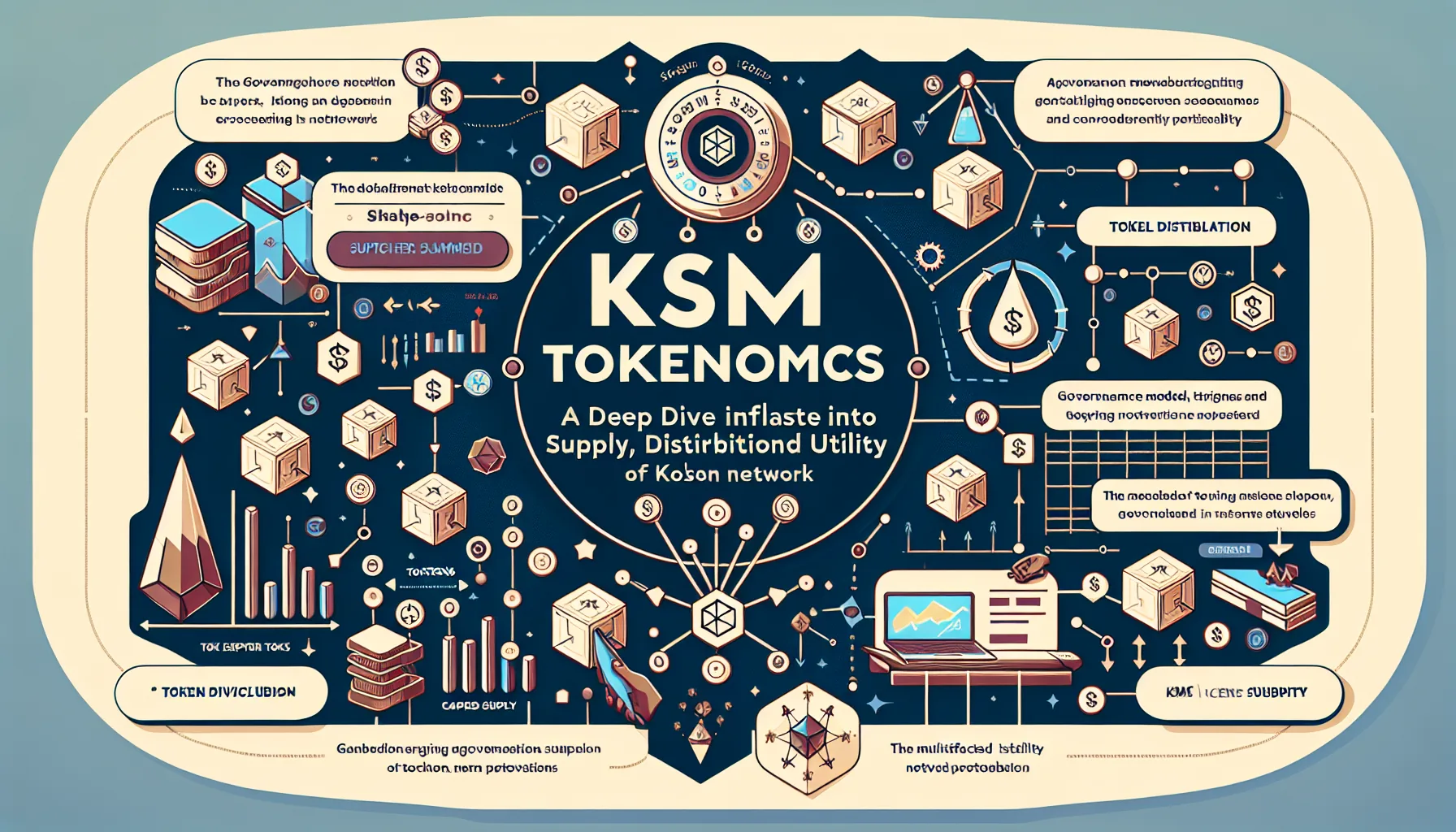
KSM Tokenomics: A Deep Dive into Supply, Distribution, and Utility
KSM, the native cryptocurrency of the Kusama network, underpins its decentralized ecosystem via a meticulously designed tokenomic structure. As a canary network for Polkadot, Kusama serves as an experimental platform, and the tokenomics of KSM reflect this utility-focused and innovation-centric orientation.
Token Supply and Emission Model
KSM has a unique token supply mechanism, driven by inflation rather than a capped supply. Unlike deflationary tokens, KSM's intrinsic model incentivizes network participation by rewarding validators and nominators who secure the network. The annual inflation rate is governed by the staking participation rate: if fewer than 50% of KSM tokens are staked, inflation increases to encourage more staking, and if more are staked, it decreases. This dynamic adjustment helps to balance network security with circulating liquidity, though some criticize this scheme, arguing it may deter long-term holders concerned about dilution.
Distribution and Governance
Initial KSM distribution was achieved through a token split for DOT holders during the network’s launch phase. This introduced a non-token-sale allocation model, successfully decentralizing its ownership from inception. However, concerns remain about early concentration of tokens among initial holders, especially given Kusama's governance model, which directly ties voting power to token ownership. This governance system allows token holders to vote on proposals or even launch public referenda, but it raises questions about oligarchic control, as large stakeholders can exert disproportionate influence.
Utility of KSM Tokens
KSM's utility within the Kusama network is multifaceted. It acts as the stake for validators and nominators securing the network, as collateral for parachain slot auctions, and as the fuel for transaction fees. The parachain auction mechanism, in particular, ties the value of KSM directly to real network utility, as projects seeking access to Kusama’s relay chain must bond KSM. However, the high demand for bonding has created liquidity challenges for smaller stakeholders, sparking debate about whether the system inherently benefits larger participants.
Challenges in Tokenomic Sustainability
Critics argue that Kusama’s inflationary model and the network's experimental focus may eventually compound the issue of token over-supply. In addition, the requirement to stake KSM in parachain auctions removes significant portions of tokens from circulation, potentially creating artificial scarcity that could lead to volatility and reduced usability. Furthermore, while KSM’s multi-purpose utility suggests broad demand across use cases, this complexity can alienate non-technical participants, limiting broader adoption.
KSM Governance
KSM Governance: Decentralized Decision-Making at Scale
Kusama's native crypto asset, KSM, plays a pivotal role in its decentralized governance framework, offering token holders direct control over network upgrades, parameter adjustments, and the overall direction of the protocol. Governance within Kusama is dynamic, permissionless, and designed to encourage active participation, but it’s not without its complexities and challenges.
The Role of KSM in Governance
KSM token holders have significant influence over the Kusama network through on-chain governance mechanisms. They can propose referenda, vote on proposals, and elect members of the Kusama Council and Technical Committee. This system prioritizes decentralization by ensuring that decision-making rests within the community, rather than being dictated by a small group of developers or external entities.
Voting in Kusama's governance system is weighted by the amount of KSM staked and the duration of staking (referred to as conviction). While this incentivizes long-term commitment, it raises concerns about the concentration of decision-making power among large KSM holders or whales, potentially diluting the voices of smaller participants. The system also demands close attention to governance updates, which may be intimidating for casual or non-technical token holders.
Kusama Council and Technical Committees
The governance structure taps elected representatives through the Kusama Council, which acts as an intermediary to propose referenda on behalf of the community while providing a layer of refinement. Additionally, the Technical Committee, composed of members from reputable teams within the ecosystem, has the authority to fast-track referendum proposals in critical scenarios.
While these committees aim to streamline governance and secure network stability, they bring into question the extent to which centralization is tolerated in a system designed to be fully decentralized. There is ongoing debate about how representative the Council is of the broader Kusama community, as well as the transparency of decision-making within the Technical Committee.
Referendum Process and Challenges
The referendum mechanism is a cornerstone feature of Kusama governance. Any KSM holder can submit a proposal by bonding a portion of their tokens, which serves as a deterrent against frivolous or spam submissions. However, the bonding requirement might unintentionally create barriers for smaller participants, effectively marginalizing less wealthy community members. Moreover, the system’s reliance on active voting and engagement can result in voter fatigue, where lower participation rates skew outcomes.
Another issue lies in the practicality of interpreting governance outcomes. While the concept of “adaptive quorum biasing” improves the likelihood of passing legitimate upgrades, the parameters can appear overly complex to newcomers, limiting accessibility to only highly experienced participants.
With all these dynamics at play, KSM governance stands as both an innovation in decentralized decision-making and a subject of continuous refinement to balance inclusivity, transparency, and efficiency.
Technical future of KSM
Kusama (KSM) Technical Developments and Roadmap: Advancing Innovation on Polkadot's Canary Network
Kusama (KSM), known as Polkadot's experimental "canary network," has cemented its place as a proving ground for cutting-edge blockchain innovations. Its technical roadmap and ongoing developments highlight its commitment to fostering experimentation while maintaining a functional ecosystem. Below, we delve into key technical advancements and challenges shaping Kusama's trajectory.
Cross-Chain Interoperability Expansion
Kusama actively leads the way in refining Polkadot's interoperability model. By leveraging the XCM (Cross-Consensus Messaging) format, Kusama facilitates seamless communication between parachains, allowing applications to exchange assets and data without intermediaries. Technical refinements within XCM focus on scalability and security, ensuring communication remains efficient as the number of parachains grows. However, challenges remain in maintaining performance as the ecosystem expands, especially given the experimental nature of the platform.
Parachain Slot Auctions and Governance Upgrades
The parachain auction mechanism remains integral to Kusama's technical ecosystem, with new participant projects regularly vying for limited slots. The auctions are fine-tuned through runtime upgrades, incorporating decentralized governance mechanisms to ensure fair resource allocation. Kusama's governance system, particularly its staking and voting processes, has undergone numerous upgrades aimed at reducing centralization risks. Nevertheless, onboarding newer users while maintaining governance efficiency remains a balancing act.
Runtime Upgrades and Forkless Evolution
Kusama’s forkless upgrade capability is a cornerstone of its technical innovation, enabling the network to implement runtime upgrades without requiring disruptive hard forks. This process relies heavily on Substrate, the blockchain framework underpinning Kusama. Current developments focus on improving runtime efficiency and developer tools. Still, as runtime upgrades increase in complexity, ensuring backward compatibility and mitigating risks associated with failed upgrades is a critical area for improvement.
Scalability and Decentralization Challenges
Efforts are underway to further decentralize Kusama's validator ecosystem, increasing resilience against malicious actors. Technologies such as asynchronous backing and candidate batching are being explored to enhance both scalability and block production efficiency. However, these upgrades introduce higher technical complexity, often requiring extensive testing before implementation—a process sometimes slowed by Kusama’s experimental mandate.
Emphasis on Innovation with Risks
As an experimental network, Kusama evolves rapidly, often pushing the boundaries of blockchain technology. While this promotes innovation, it can also result in the deployment of features with insufficient testing. Issues such as smart contract vulnerabilities or suboptimal parachain designs occasionally surface, reflecting the inherent risks of its testing-oriented approach. Projects deploying on Kusama need to weigh the benefits of rapid deployment against these potential pitfalls.
Comparing KSM to it’s rivals
KSM vs DOT: Key Differences in Utility and Ecosystem Dynamics
Kusama (KSM) and Polkadot (DOT) share a unique relationship, often referred to as “cousin networks” due to their shared foundational infrastructure and governance design under the Substrate framework. However, despite their similarities, there are distinct differences between these two blockchain ecosystems that appeal to different use cases and audiences. Understanding these differences is critical for those navigating the Polkadot ecosystem and determining where KSM stands relative to DOT.
Experimental vs Established Ecosystems
The most immediate distinction between KSM and DOT lies in their respective roles. Kusama serves as a canary network, meaning it is designed as a live environment where developers can test new projects and ideas with real economic conditions but lower stakes than Polkadot. This “move fast and break things” ethos gives Kusama an edge for projects prioritizing rapid deployment and experimentation. Developers can iterate quickly on Kusama without the stringent governance and longer development cycles seen on Polkadot, thanks to Kusama’s shorter referendum and voting periods.
However, this high-speed governance comes with challenges. The experimental nature of Kusama means that it is inherently riskier than Polkadot. Network participants may encounter incomplete features, bugs, or potential vulnerabilities in Kusama projects due to its beta-like functionality. By contrast, Polkadot offers a more conservative and secure environment, which appeals to institutions and long-term investors.
Parachain Slot Competition
Both Kusama and Polkadot utilize parachains, but the way projects approach parachain auctions differs significantly. Kusama’s parachain slots are more accessible due to lower overall competition and reduced economic barriers. This has allowed Kusama to attract a more diverse mix of projects, particularly early-stage applications or those in heavily experimental fields that may struggle to gather the resources needed to win Polkadot’s auctions.
However, this accessibility can result in a lack of parity for development resources. Some parachains may treat Kusama as a stepping stone to secure funding and attention before eventually migrating to Polkadot, raising concerns about long-term commitment to the Kusama ecosystem.
Token Utility and Valuation
KSM’s utility is another area of divergence. While both KSM and DOT are essential for staking, governance, and parachain bonding, KSM’s value proposition hinges heavily on its role as the first-mover platform for innovation. This provides significant advantages for early adopters at the cost of potential adversities such as volatility in staking rewards during high periods of network congestion.
Additionally, the lack of parity between DOT and KSM in market influence and liquidity poses a challenge for Kusama’s ability to compete in broader adoption outside experimental use cases.
Verdict on Comparison
Kusama isn’t simply a “testnet” as some newcomers suggest; it is a fully functioning network with its own thriving ecosystem. However, the relationship between KSM and DOT introduces inherent complexities that potential users and stakeholders must weigh when selecting which network aligns with their goals. This comparative relationship highlights the unique synergies and trade-offs that define Kusama in contrast to its relative, Polkadot.
KSM vs MOVR: A Detailed Comparison of Features and Use-Cases
Kusama (KSM) and Moonriver (MOVR) occupy unique roles within the Polkadot ecosystem but also often draw comparisons due to their interconnected functionality and shared focus on interoperability. While KSM serves as Polkadot’s canary network, providing a proving ground for new technologies and projects, MOVR is Moonbeam’s companion network on Kusama, specifically designed to bring smart contract functionality to the Kusama parachain environment.
Core Differentiators: Focus on Purpose
One of the most significant differentiators between KSM and MOVR is their overarching purpose. KSM functions as a hub for experimentation, mainly targeting developers and entities looking to stress-test their applications in a real economic environment before migrating to Polkadot’s mainnet. MOVR, on the other hand, is tightly focused on facilitating decentralized application (dApp) deployment with Ethereum Virtual Machine (EVM) compatibility. In essence, MOVR's design is dApp-centric, which contrasts with KSM’s broader experimental ethos.
Although both assets benefit from Kusama’s high-throughput, low-latency infrastructure, MOVR emphasizes ease of use for Solidity developers by providing Ethereum-compatible accounts, tools, and APIs. This can make MOVR more approachable for projects porting from existing Ethereum systems, while KSM’s broad scope might appeal more to those building entirely new blockchain-based frameworks.
Tokenomics and Usability Challenges
KSM and MOVR also differ considerably in token utility and economic models. While KSM is heavily utilized for staking, governance, and securing parachain slots via its native parachain lease auction system, MOVR prioritizes facilitating network transactions, gas fees, and staking within its more targeted ecosystem. However, MOVR’s relatively high rate of token emission has drawn criticism from some analysts who argue it could impact long-term value retention compared to KSM’s more constrained supply dynamics.
For users and validators, MOVR’s dual focus on gas fee affordability and EVM compatibility has presented a double-edged sword. While these features address developer needs, they have led to somewhat fragmented user demand compared to KSM’s broader role in the ecosystem. Furthermore, despite its EVM compatibility advantages, some dApp developers express concerns about MOVR’s tooling and ecosystem maturity compared to other EVM-focused networks.
Interoperability and Ecosystem Integration
Interoperability remains a strong suit for both KSM and MOVR, but the way each achieves this goal diverges. MOVR’s standout feature is its seamless bridging for Ethereum-native dApps and assets, providing a critical gateway for Solidity-based developers transitioning to the Kusama ecosystem. KSM, in contrast, serves as the backbone for infrastructure-level innovations, enabling cross-chain communication and experimentation through its parachain and relay chain systems.
While MOVR’s interoperability prowess lies in application development, it lacks the foundational role played by KSM in securing and evolving the network. This divergence reinforces MOVR’s specialization as an application-layer project rather than a network-layer protocol, which limits its applicability compared to KSM’s broader range of use cases.
KSM vs. ASTR: A Deep-Dive into Ecosystem Specialization and Interoperability
Kusama (KSM) and Astar (ASTR) represent two notable platforms in the Polkadot ecosystem, but their functionalities, target audiences, and architectural choices set them apart in distinct ways. While KSM serves as the wild, experimental environment designed for rapid development and testing of parachains, Astar positions itself as a multichain smart contract platform optimized for interoperability. This difference creates unique synergies and tensions between the two assets, which each serve contrasting use cases within the broader ecosystem.
Development Focus
Astar excels at being a hub for multichain decentralized applications (dApps), focusing on supporting both Ethereum Virtual Machine (EVM) and WebAssembly (WASM) environments. This dual-compatibility enables developers to build and deploy cross-chain dApps without excessive reliance on any single runtime. By contrast, KSM emphasizes providing a live, experimental playground for developers to test and launch new parachains and decentralized innovations. While KSM rewards those willing to prioritize agility and creativity, Astar’s technical emphasis on multi-environment deployment favors developers aiming for cross-chain scalability and stable long-term implementation.
However, Astar’s complexity comes with trade-offs. Unlike Kusama’s agile "move-fast-and-break-things" ethos, Astar’s need to accommodate different runtime environments and achieve seamless connectivity introduces additional layers of technical overhead. For developers less experienced in cross-chain architectures, Kusama’s stripped-down experimentation period can feel more accessible.
Scalability and Security Challenges
One critical distinction lies in how scalability and security are approached. Astar, reliant on its multichain connections, faces hurdles when ensuring smooth interoperation across heterogeneous blockchains. The introduction of bridges and relays increases network vulnerability to security exploits. This complexity can make Astar's dApps more susceptible to attack vectors if not maintained with precise engineering.
Ksm, even with its experimental nature, benefits inherently from its close integration with the Polkadot's substrate framework.
Further Insight?
Primary criticisms of KSM
Primary Criticism of KSM: Examining Its Challenges and Controversies
Kusama (KSM), often referred to as Polkadot’s "wild cousin," has carved out its role in the blockchain ecosystem as a platform for scalability and experimentation. However, despite its innovative design and substantial community support, KSM is not without its criticisms. Below, we delve into the key challenges and issues that have sparked debate among crypto-enthusiasts and developers.
Scalability: A Double-Edged Sword
While Kusama is lauded for its scalability enhancements compared to traditional blockchain networks, critics point out that its scaling capabilities may result in a potential tradeoff with decentralization. The platform's reliance on parachains to handle parallel transactions is innovative, but the finite number of parachains available at any moment could limit scalability over the long term. This limitation raises concerns about how the network might handle growing adoption without overloading its resource capacity.
Overlapping Use Cases with Polkadot
One recurring criticism is the overlap between Kusama and Polkadot. Because Kusama serves as a "canary network" for Polkadot, critics argue that its identity and purpose can feel diluted. For some, Kusama lacks a clear distinction beyond being the experimental counterpart to Polkadot. This fosters questions about whether KSM will always remain secondary or if its ecosystem and functionalities can sustainably stand on their own.
High Barriers to Entry for Parachain Auctions
Although parachain auctions are a cornerstone of Kusama's ecosystem, their implementation has drawn criticism due to the high cost associated with participating. Smaller projects looking to secure a parachain slot often struggle to compete against more well-funded entities, leading to concerns about the network favoring larger, wealthier players. Furthermore, the complexity of the bonding process and the significant amounts of KSM required can deter projects with limited resources.
Governance Risks
Kusama's on-chain governance model, which allows token holders to vote on proposals, has been both praised and criticized. While the model enables community-driven decision-making, critics highlight the potential for governance centralization. Wealthy token holders or influential validators can exert disproportionate influence over network proposals, creating a risk of plutocratic decision-making rather than truly decentralized governance.
Inflation Model Concerns
Kusama utilizes an inflationary token model, designed to encourage staking and participation in the network. However, critics argue that this model could dilute long-term token value for holders, especially for those who choose not to stake. The allocation system also emphasizes rewards for validators and stakers, which some interpret as potentially discouraging broader token use in real-world applications.
Security Tradeoffs
Given that Kusama is explicitly positioned as an experimental network, its emphasis on faster deployment cycles can raise security concerns. Rapid iterations and updates may leave the network more exposed to vulnerabilities compared to more conservatively developed platforms. This approach, while suitable for testing groundbreaking ideas, may feel overly risky to institutional stakeholders or projects with stringent security requirements.
KSM’s role as a bleeding-edge blockchain platform invites both admiration and skepticism. Its unique position as an experimental network enables innovation, but it also amplifies the scrutiny of its trade-offs, leaving room for debate within the crypto space.
Founders
Founding Team of Kusama (KSM): Visionaries Behind the Experimentation Network
Kusama (KSM), often referred to as the “canary network” for Polkadot, is the brainchild of a renowned and technically proficient team with deep roots in blockchain development. At the core of KSM’s founding is Dr. Gavin Wood, a well-known figure in the crypto space who co-founded Ethereum and later went on to establish Polkadot and Kusama under the umbrella of Parity Technologies. Wood’s contributions to blockchain technology stretch far beyond conceptual visions; his technical work, particularly in designing the Solidity programming language and approach to blockchain consensus and scalability, has positioned him as one of the leading decentralization pioneers.
Kusama wasn’t built in isolation but came to fruition through the collaborative efforts of a broader team working within Parity Technologies. Parity serves as the driving force behind the network's engineering prowess. Their expertise provided Kusama with its Substrate foundation, a modular blockchain-building framework that enables Kusama's agility and adaptability. The tight coupling between Substrate's development and Kusama’s initial success underscores the team’s technical competence.
However, while the founding team’s accomplishments are undeniable, their dual focus on Polkadot and Kusama has raised some concerns. Kusama operates as Polkadot's experimental ground, a platform designed to push boundaries and test upgrades before deployment on the main network. While this relationship fosters innovation, it brings occasional tensions. Members of the broader crypto community have at times questioned whether Kusama receives sufficient resources and attention, given Polkadot’s priority status. Critics argue that being positioned as a "canary" network slightly diminishes Kusama’s independent identity and long-term credibility despite its utility and achievements.
Another challenge noted by analysts is the complexity of the network’s governance model which was largely architected by the founding team. Though intended to decentralize decision-making, the intricacies of Kusama’s governance process sometimes deter participation, even among its savvy user base. The team’s transparency about governance mechanics is appreciated, but there’s room for clearer documentation and better user accessibility.
Nonetheless, the founding team’s drive for experimentation and decentralization aligns intricately with Kusama's ethos. This creates room for unpredictable and rapid innovation, which can be viewed as both an opportunity and a risk. The long-term evolution of Kusama depends on how the founding team continues to balance its role as an independent network versus a testing ground tied to Polkadot’s ecosystem ambitions.
Authors comments
This document was made by www.BestDapps.com
Sources
- https://kusama.network/
- https://kusama.network/faq/
- https://polkadot.network/PolkaDotPaper.pdf
- https://github.com/paritytech/polkadot
- https://wiki.polkadot.network/docs/en/build-kusama
- https://github.com/paritytech/substrate
- https://kusama.network/guide/
- https://etherscan.io/token/0xd43869c434ee4ec7746567ffde02e03fcef980f7
- https://coingecko.com/en/coins/kusama
- https://docs.substrate.io/
- https://research.web3.foundation/en/latest/
- https://medium.com/kusama-network
- https://parachains.info/details/kusama
- https://github.com/w3f
- https://polkadot.subscan.io/
- https://kusama.subscan.io/
- https://docs.google.com/document/d/1Me7QnXtFi9Z63k7M2JmOMtVDaQ6wV4-9xnzjMv1YkP8/edit?usp=sharing