History of KAVA
The History of KAVA: Evolution of Cross-Chain DeFi
Kava, a blockchain platform specializing in cross-chain decentralized finance (DeFi), emerged with a vision of creating a unified ecosystem that bridges assets and liquidity across disparate networks. Its journey began in 2019, spearheaded by Kava Labs, with the objective of solving critical inefficiencies in the DeFi landscape, particularly surrounding interoperability and accessibility for non-Ethereum assets. The history of Kava is underscored by both innovation and the inherent challenges of building on a multi-chain infrastructure.
The project gained prominence through its launch on Cosmos, leveraging the Cosmos SDK and Tendermint consensus mechanism to enable scalability and modularity. Unlike Ethereum-based DeFi solutions confined to its own ecosystem, Kava’s architecture was built to act as a decentralized hub accommodating assets like Bitcoin, XRP, Binance Coin, and others. This strategic focus on interoperability attracted attention within the crypto space, distinguishing Kava from single-chain DeFi protocols. However, critics noted early on that this approach came at the cost of complexity, with bridging mechanisms and interoperability layers introducing security risks and operational inefficiencies.
One of the earliest milestones in Kava’s history was the launch of its mainnet in 2019, which included support for multi-collateralized loans. Kava’s decentralized lending platform allowed users to lock supported assets as collateral to borrow its native stablecoin, USDX, marking its entry into the growing DeFi lending space. Early adoption was driven in part by partnerships with Binance, as Kava became one of the first projects to integrate staking rewards through Binance Launchpad. Although this provided significant visibility and initial liquidity, it also raised questions about the project's long-term independence and the centralization concerns tied to such an external reliance.
Throughout its evolution, Kava expanded its ecosystem by introducing additional features, such as staking mechanisms for the KAVA token, governance frameworks for decentralized decision-making, and integrations with other protocols. However, like many cross-chain projects, Kava faced challenges with liquidity fragmentation and onboarding developers in an increasingly competitive DeFi market. Another issue in its trajectory has been the tempo of development and upgrades—a recurring point of critique from some community members who expect faster iteration.
Kava’s history is marked by an effort to balance ambition with execution in a competitive and experimental DeFi space. Its journey reflects both the opportunities and hurdles inherent in pioneering cross-chain solutions.
How KAVA Works
How KAVA Works: Exploring the Mechanisms Behind the Blockchain
KAVA operates as a decentralized finance (DeFi) platform built on Cosmos, leveraging the Tendermint consensus algorithm to offer users a high-performance, scalable blockchain infrastructure. The platform integrates a multi-asset collateralized debt position (CDP) system and a lending hub to enable decentralized borrowing, lending, and stablecoin issuance. Here's a detailed look at its inner workings:
Core Infrastructure
KAVA’s blockchain utilizes the Cosmos SDK, offering cross-chain compatibility through the Inter-Blockchain Communication (IBC) protocol. This design allows KAVA to interact with other blockchains within the Cosmos ecosystem while maintaining interoperability with assets from networks like Bitcoin, Ethereum, and Binance Smart Chain through the use of bridge modules. These bridges facilitate seamless token transfers, enabling asset diversification within the platform’s ecosystem.
Validators play a key role in the network, securing it via the Tendermint delegated proof-of-stake (DPoS) mechanism. KAVA token holders can stake their assets directly or delegate them to validators, earning rewards while participating in network governance. However, this validator system isn't immune to centralization risks; a concentrated number of top validators could potentially affect the network's neutrality.
CDP System and Stablecoin Issuance
The KAVA platform allows users to lock up collateral, such as Bitcoin or Ethereum, into smart contracts to mint its native USDX stablecoin. This collateralized debt position (CDP) mechanism ensures USDX is over-collateralized, reducing the risk of under-collateralization even in volatile market conditions. However, liquidation penalties, stability fees, and minimum collateralization ratios are predefined, which may discourage participation from those who aren't willing to actively monitor their positions.
The CDP model also depends heavily on the reliability of price oracles. While KAVA uses a multi-aggregator oracle system, a failure or manipulation within the oracle network could compromise the platform’s stability, directly affecting the determination of collateral values.
Automated Money Market (Kava Lend)
Kava Lend enables users to earn interest or borrow assets by depositing crypto into liquidity pools. Interest rates are determined algorithmically based on demand and supply dynamics within the pool. While this model incentivizes liquidity provision, the system can face liquidity crunches if a significant portion of funds are withdrawn simultaneously, creating vulnerabilities during extreme market events. Smart contract risks are also inherent in these systems, especially for users who deposit large amounts of collateral.
Governance and Network Incentives
KAVA holders shape the ecosystem’s development through decentralized governance. They can propose and vote on protocol changes, such as parameter adjustments or integrations with new assets. While governance enables decentralized decision-making, low voter participation and possible dominance by large token holders could centralize decision-making power, limiting the diversity of input on critical upgrades.
Use Cases
Exploring the Use Cases of KAVA in the Crypto Ecosystem
KAVA, a prominent player in the decentralized finance (DeFi) sphere, offers a unique multi-chain architecture designed to bridge the gap between isolated blockchain ecosystems. Its versatility has enabled a range of notable use cases, although not without some challenges.
Lending and Borrowing via the Kava Protocol
At its core, KAVA powers the Kava Protocol, a decentralized lending platform. Users can deposit supported crypto assets as collateral and borrow the platform's native stablecoin, USDX. The flexibility to collateralize a wide variety of assets, coupled with cross-chain functionalities, is a competitive advantage for KAVA. However, its reliance on over-collateralization—a typical feature in DeFi—requires users to lock up more value than they borrow, which may limit accessibility for smaller participants or create inefficiencies during market downturns.
Cross-Chain Asset Interoperability
One of KAVA's standout use cases is its ability to facilitate cross-chain interactions. Built on the Cosmos SDK, the protocol leverages the Inter-Blockchain Communication (IBC) protocol to connect with other blockchains seamlessly. This interoperability is crucial for enabling the flow of assets and liquidity between traditionally siloed networks. However, being reliant on IBC means adoption hurdles in ecosystems that have yet to implement or fully embrace cross-chain compatibility, which could constrain its growth.
Stablecoin Creation
Users of the Kava Protocol can mint the platform’s native algorithmic stablecoin, USDX, by locking up collateral. USDX is particularly appealing due to its aim to maintain value stability while leveraging decentralized principles. While this use case demonstrates innovation, maintaining a stable peg for USDX can pose risks, particularly during periods of extreme volatility. The DeFi space has seen struggles with algorithmic stablecoins in general, a factor that could impact user trust.
Staking and Governance
KAVA offers robust staking opportunities, where holders of its native token can participate in the network's consensus mechanism while earning rewards. Furthermore, token holders have the ability to vote on key network upgrades and proposals, allowing them to shape the protocol’s evolution. However, a potential risk with token-based governance is centralization of voting power—should large holders (whales) dominate decision-making, smaller participants may feel disenfranchised.
Leveraging Institutional-Grade DeFi Infrastructure
KAVA's infrastructure is designed to appeal not only to retail DeFi users but also to institutional participants. Its high scalability and security focus position it as a viable option for enterprise use cases. That said, achieving institutional adoption will likely depend on external factors, such as regulatory clarity and ecosystem maturity, which KAVA cannot directly control.
While KAVA presents a range of compelling use cases, each comes with inherent complexities and trade-offs that users should carefully consider.
KAVA Tokenomics
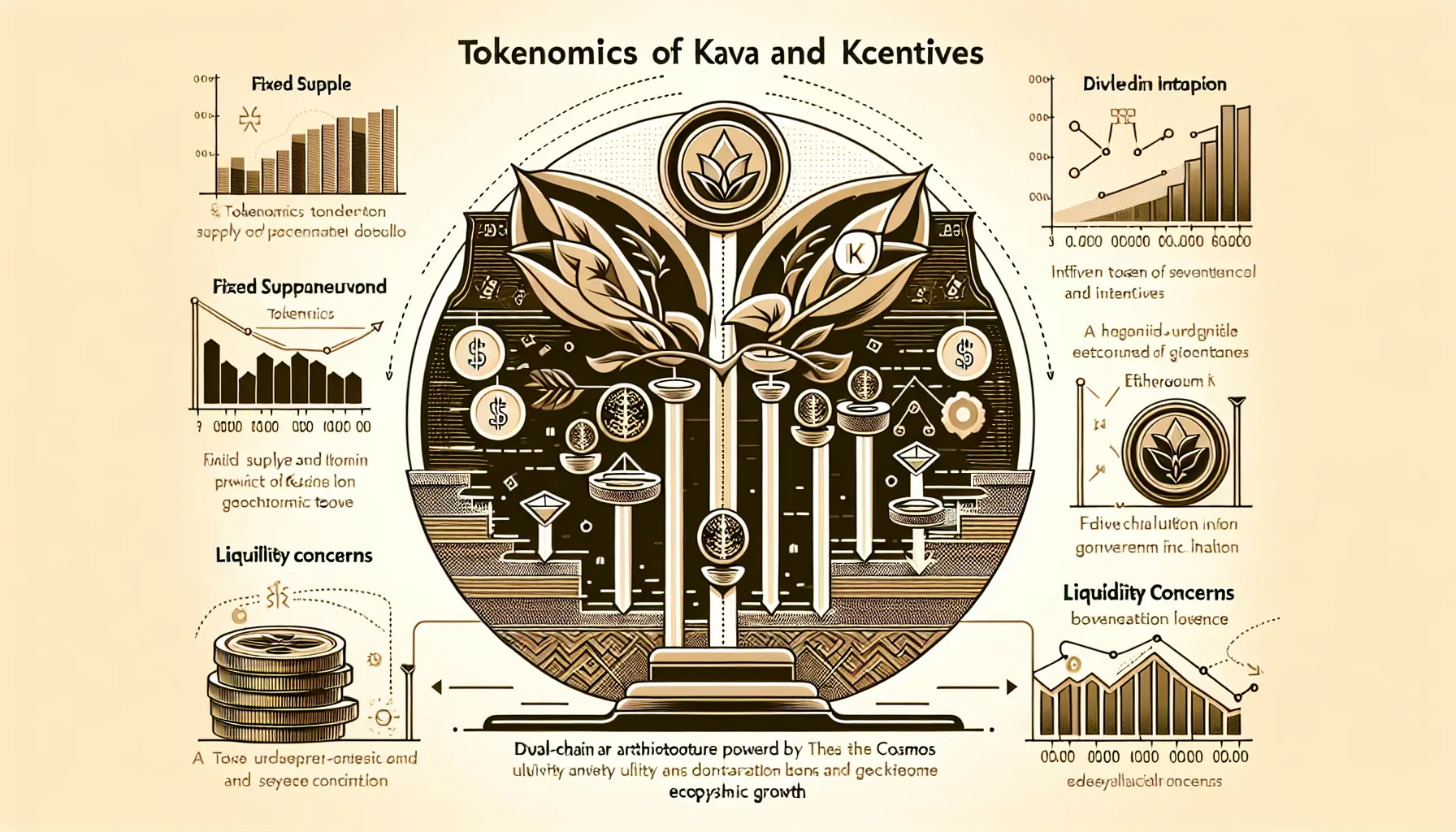
Tokenomics of KAVA: A Deep Dive into Supply Dynamics and Incentives
KAVA operates as the native utility and governance token of the Kava ecosystem, supporting the platform’s dual-chain architecture powered by the Cosmos SDK and Ethereum Virtual Machine (EVM). KAVA’s tokenomics are structured to incentivize security, drive network growth, and empower decentralized governance. However, these mechanisms are not without challenges, particularly when balancing issuance rates, staking incentives, and on-chain utility.
Fixed Supply and Inflation Model
KAVA has a capped total supply defined by its emission curve, with newly minted tokens allocated primarily to staking rewards. While the capped supply model can mitigate long-term inflationary pressures, the network’s reliance on staking rewards introduces complexities. Larger token holders or validators with significant stakes may benefit disproportionately, potentially leading to centralization of staking power. Additionally, as the staking reward emission rate gradually decreases over time, questions arise about whether KAVA’s designed token incentives are sufficient to sustain validator engagement and security in the long run.
Dual-Chain Utility: Governance and Decentralized Finance
A core utility of KAVA lies in governance, where token holders can propose and vote on critical network upgrades, fee structures, or reward distribution changes. However, voter participation and governance decentralization can vary, as seen in many token-based ecosystems. Low voter turnout or governance capture by large stakeholders could hinder the protocol's adaptability and decentralization.
KAVA also serves as collateral in decentralized finance (DeFi) applications within the ecosystem. Users lock KAVA to mint or borrow stablecoins or other assets, creating utility-driven demand. However, this use case is sensitive to fluctuations in the token’s perceived value and liquidity. Any sharp decrease in token value could expose borrowers to higher risks of liquidation, potentially destabilizing the system.
Liquidity Concerns and Token Velocity
While token liquidity is bolstered by the presence of KAVA on several prominent decentralized and centralized exchanges, liquidity fragmentation across multiple trading platforms could pose issues. Moreover, KAVA’s velocity within the ecosystem remains a point of interest. High velocity may indicate utility but also speculative tendencies, while low velocity might imply underutilization or hoarding, which limits the token's economic movement.
Balancing Inflation and Ecosystem Growth
Another consideration is the delicate balance between incentivizing early adopters through rewards and preventing excessive inflation that dilutes token value. While KAVA employs mechanisms to reduce annualized rewards over time, the sustainability of these reductions vis-à-vis network activity and transaction fees will be critical in determining long-term economic health.
KAVA Governance
Governance in KAVA: Decentralization, Voting Mechanics, and Challenges
The governance of KAVA operates as a critical element of its unique decentralized ecosystem, enabling stakeholders to participate in key decisions that influence the protocol's development, upgrades, and overall direction. Governed by KAVA token holders, the system utilizes an on-chain governance model, where proposals are submitted, voted upon, and executed based on collective consensus. While this structure aligns with decentralized finance (DeFi) principles, it is not without its complexities and potential shortcomings.
Governance Voting: The Role of KAVA Holders
KAVA token holders serve as the primary decision-makers within the protocol's governance process. Through staking, they acquire the ability to vote on proposals concerning various network parameters, such as protocol upgrades, reward distributions, or modifications to collateralization requirements. Governance proposals are submitted on-chain, followed by a designated voting period during which stakeholders can either approve, reject, or abstain from voting.
The governance process places significant power in the hands of validators and high-stake token holders. Stakes are weighted, meaning those with more KAVA tokens staked inherently have greater influence on the outcome of proposals. This setup efficiently incentivizes active participation but raises inevitable concerns regarding token distribution and the potential for governance centralization by a small number of well-capitalized entities.
Proposal Submission and Lifecycle
For a proposal to progress, it must pass through several stages: proposal creation, deposit collection, voting, and implementation. Proposals typically require a deposit of KAVA tokens to discourage frivolous submissions. If the community rejects a proposal, the deposit is forfeited. When sizable community alignment occurs, the approved proposals are automatically enforced through the protocol’s code.
While this process ensures transparency and reduces human bottlenecks common in traditional corporate governance, there is an inherent complexity in submitting effective proposals. Proposers must not only deeply understand the protocol and its economic impact but also navigate DeFi-focused technicalities and present clearly to ensure community buy-in.
Challenges in KAVA Governance
One of the notable challenges in KAVA governance lies in voter apathy. As with many DeFi projects, a significant portion of KAVA holders delegate their tokens to validators and abstain from directly participating. Engagement disparities between individual token holders versus large-scale validators exacerbate concerns of governance concentration, where power disproportionately resides with a limited number of entities.
Additionally, the system faces scalability challenges. As KAVA's ecosystem expands, the increased complexity of governance discussions and the technical details of proposals may deter participation. This dynamic risks alienating smaller stakeholders, potentially undermining the foundational ethos of decentralization.
Governance in KAVA simultaneously embodies the potential and pitfalls of decentralized systems, offering token holders both power and responsibility within its ecosystem. How this model evolves hinges on the community's ability to address current limitations and maintain balanced participation.
Technical future of KAVA
KAVA: Current and Upcoming Technical Developments and Roadmap Insights
KAVA, a decentralized blockchain platform built on the Cosmos SDK, continues to evolve with a focus on enabling interoperability, scalability, and cross-chain functionality. As it competes within the increasingly crowded landscape of decentralized finance (DeFi), the project’s technical trajectory showcases both promising innovations and challenges that could impact adoption and performance.
Interoperability and Cross-Chain Enhancements
One of KAVA’s core strengths lies in its functionality as a Layer-1 protocol that can interact with a variety of blockchain ecosystems. With the integration of the Inter-Blockchain Communication (IBC) protocol, KAVA has widened its ability to facilitate seamless asset transfers across IBC-compatible chains within the Cosmos ecosystem. To further extend these capabilities, the platform’s roadmap includes developments geared toward enhanced Ethereum Virtual Machine (EVM) compatibility. This aims to attract dApp developers from Ethereum while also enabling users to bridge assets like ERC-20 tokens more efficiently between networks.
However, while these upgrades promise increased usability, the reliance on IBC and bridging introduces potential vulnerabilities. Cross-chain technologies remain a frequent target of exploits in crypto, and ensuring that newly implemented EVM compatibility layers do not compromise security is pivotal. Any lapses in these areas could deter institutional partners or DeFi projects from heavily relying on KAVA.
Scalability Improvements Through Validator Optimization
KAVA employs a Tendermint-based consensus mechanism to deliver high transaction throughput, a cornerstone of its performance-focused architecture. A notable upcoming development involves the optimization of validator incentives, aiming to enhance network decentralization and efficiency. Efforts to revise the economic model for validators—such as optimizing staking parameters or implementing precision slashing mechanisms to penalize downtime—are on the roadmap to ensure stability as the network scales.
However, these upgrades place increased pressure on existing validator infrastructure, raising concerns about the network's sustainability during periods of rapid growth. Additionally, the pivot towards fostering decentralization could conflict with the onboarding of smaller validators due to high staking requirements and operational costs.
Advanced Module Integrations
KAVA has been rolling out new modules to expand its DeFi utility. For instance, the CDP (Collateralized Debt Position) system allows users to mint stablecoins like USDX against deposited collateral. Future plans aim to develop additional lending and liquid staking capabilities, among others. These will likely leverage further improvements to smart contract execution and integration layers. Yet, increasing technical complexity in these modules could lead to execution bottlenecks or expose the platform to unforeseen risks associated with multi-layered chain interactions.
Technical debt may also arise as new features are added more rapidly to compete within the fast-evolving DeFi ecosystem. Managing this balance effectively will be critical to maintaining overall network integrity.
Conclusion Considerations
Understanding both the progress and the potential risks in KAVA’s technical roadmap is key for stakeholders. Scalability and interoperability developments could significantly boost usability, but trade-offs in security and decentralization require careful monitoring.
Comparing KAVA to it’s rivals
KAVA vs ATOM: A Comparative Analysis
When examining KAVA in contrast to ATOM, one immediately notices core differences in their focus, architecture, and design philosophy despite their shared anchoring in the Cosmos ecosystem. Both leverage the Cosmos SDK, but their purposes diverge significantly, offering unique trade-offs for developers and users.
Focus and Use Case
KAVA positions itself as a decentralized, multi-chain lending platform that facilitates seamless borrowing and lending across numerous blockchain networks. Its specialty lies in its lending module and its on-chain stablecoins, such as USDX. In contrast, ATOM's role is deeply intertwined with the foundational layer of the Cosmos ecosystem. ATOM's primary purpose is to secure and govern the Cosmos Hub, which acts as the central interchain communication hub for numerous blockchains. While KAVA offers a DeFi-specific utility, ATOM functions more as an infrastructure layer, steering on-chain governance and interchain connectivity through IBC (Inter-Blockchain Communication).
KAVA has successfully carved out a niche in DeFi, but ATOM's value proposition is arguably broader, appealing to networks aiming to integrate into the Cosmos ecosystem. However, this lack of specialization for ATOM can dilute its utility appeal compared to KAVA's more defined DeFi role.
Token Utility
The utility of each token reflects their distinct goals. KAVA’s token is heavily utilized within its lending protocol to back loans, mint USDX stablecoins, and serve as collateral. It supports DeFi activity directly, which ties its performance and adoption to the growth of lending on its platform. On the other hand, ATOM functions primarily within the Cosmos Hub, securing the network via staking, participating in governance, and facilitating exchange fees for the Interchain.
ATOM’s broader scope is advantageous for interchain transactions, but KAVA’s tighter utility focus provides clearer alignment with DeFi-native growth. However, KAVA’s dependency on DeFi adoption could leave it more vulnerable to platform-specific risks, while ATOM benefits from a systemic position in the Cosmos ecosystem.
Interoperability Approach
Both KAVA and ATOM tout interoperability as key components of their ecosystems, but the implementations differ. ATOM relies heavily on the IBC protocol, which has become the backbone of its interchain strategy to connect multiple sovereign blockchains. KAVA, while also rooted in Cosmos SDK, takes interoperability further by integrating external networks like Ethereum and Binance Chain through its KAVA Network.
This strategic divergence presents trade-offs. KAVA’s cross-chain focus broadens its appeal, yet it introduces complexities in maintaining consistency and scalability across these external chains. ATOM’s narrower, IBC-specific strategy ensures tighter security and consistency within the Cosmos ecosystem but limits its reach to networks outside the Cosmos framework without additional integrations.
Challenges
While both projects bring innovation to the table, they are not without their issues. KAVA has faced criticism for its relatively centralized governance model compared to ATOM, where validator participation in its governance is robust and well-distributed. This could raise questions about the decentralization claims of KAVA over time. Conversely, ATOM struggles with tokenomics concerns due to its inflationary nature and lack of a clearly defined cap, which can potentially impact its long-term value proposition.
KAVA vs. AVAX: A Detailed Comparison of Blockchain Architecture and Ecosystem Strategy
When comparing KAVA and Avalanche (AVAX), the defining difference lies in their approach to blockchain design and ecosystem development. Both projects operate in the DeFi space, but their technical architectures and strategic emphases diverge significantly.
Technical Architecture: Consensus Mechanism and Network Design
KAVA employs the Cosmos SDK and Tendermint-based consensus to deliver a high-throughput, low-latency blockchain ideal for cross-chain DeFi applications. Avalanche, by contrast, operates on a novel consensus protocol known as Avalanche consensus, which enables sub-second transaction finality across its multi-chain architecture.
The Avalanche network is built on three primary chains — the Exchange Chain (X-Chain), Contract Chain (C-Chain), and Platform Chain (P-Chain) — each optimized for specific functionalities. This separation aids in scalability and modular development but comes with added complexity. In comparison, KAVA’s architecture is simpler, relying on a single blockchain but expanding its interoperable capabilities through the Inter-Blockchain Communication (IBC) protocol. Critics of Avalanche’s design argue that the segmented structure, while powerful, introduces a steeper learning curve for developers transitioning to its ecosystem.
Ecosystem Strategy: Breadth vs. Specialization
Avalanche has aggressively pursued a strategy of broad-based ecosystem growth. With the support of its "Subnets" — customizable blockchain environments — it has positioned itself as a platform for developers seeking high customization for tailored use cases. These Subnets, while a key differentiator, require validators to stake AVAX, which has faced some scrutiny for potential centralization risks as wealthier entities dominate validation.
KAVA, on the other hand, has focused on specialized DeFi services, including borrowing, lending, and yield farming. Its unique role as a hub for multiple crypto assets through its support of cross-chain applications demonstrates targeted utility. However, skeptics argue that this singular focus risks limiting broader adoption when compared to AVAX's multi-purpose ecosystem, which includes NFTs, enterprise applications, and tokenized assets.
Developer Adoption and Tooling
AVAX has leveraged robust developer tools such as an Ethereum-compatible C-Chain, which supports Solidity-based smart contracts. This EVM compatibility enables rapid onboarding of Ethereum-based projects, thus fostering a diverse range of dApps. While KAVA has enhanced interoperability through IBC and recently integrated EVM compatibility as well, it remains an area where Avalanche retains a significant advantage in terms of developer attention and migration.
That said, a recurring critique from the community involves Avalanche's tokenomics. With high staking requirements and emissions-related inflation, debates about sustainability persist. KAVA’s tokenomic model, being inflationary but focusing rewards on liquidity providers and stakers, faces fewer of these critiques yet raises questions about long-term competitiveness.
Final Thoughts on Differentiation
By examining KAVA alongside Avalanche, it becomes clear how these projects cater to varying market needs: KAVA targets interoperability within DeFi, while Avalanche pushes boundaries in modular blockchain development. Each comes with trade-offs in complexity, adoption, and scalability that warrant close scrutiny for any investor or participant in the space.
KAVA vs. FTM: Comparing Architectures and Ecosystem Strength
When analyzing KAVA in relation to Fantom (FTM), key differences emerge in their underlying architectures and ecosystem dynamics, each impacting their suitability for different use cases within the DeFi space.
Consensus Mechanism and Network Efficiency
Fantom leverages the Lachesis consensus algorithm, a DAG-based aBFT protocol that emphasizes high throughput and near-instant finality. This approach enables FTM to process transactions in under a second with minimal energy consumption, which has been a draw for projects demanding scalability without sacrificing decentralization. In comparison, KAVA utilizes a more traditional Tendermint-based consensus, which, while robust and offering deterministic finality, is generally perceived as slower in transaction throughput. This discrepancy potentially limits KAVA's ability to compete in high-frequency trading or Layer-2 scaling solutions, where latency is critical.
Ecosystem Scope and Developer Adoption
Another differentiator lies in ecosystem breadth. Fantom has emphasized developer-friendly tools, leading to significant adoption by smart contract developers and DeFi protocols looking to leverage its fast and inexpensive network. FTM's provision of the Ethereum Virtual Machine (EVM) compatibility has made porting projects from Ethereum seamless, creating a broader dApp landscape.
KAVA, in contrast, has traditionally focused on being a high-performance Layer-1 blockchain specializing in DeFi-specific use cases. While this focus has enabled unique product development, like the network's cross-chain liquidity hub, it has also constrained its ecosystem compared to FTM's more general-purpose application environment. Developers may view this narrow DeFi orientation as either an advantage or a limitation based on their specific requirements.
Interoperability and Cross-Chain Capabilities
Cross-chain operability is another critical metric. While FTM has recently made efforts to integrate with cross-chain ecosystems such as bridging solutions and multi-chain swaps, these capabilities have not been its defining strength. KAVA, on the other hand, was designed from the ground up for cross-chain DeFi—leveraging the Inter Blockchain Communication protocol (IBC) to seamlessly connect to other blockchain networks. This native focus on interoperability gives KAVA an edge in contexts requiring fluid integration across disparate chains, but it remains to be seen if this will be enough to keep pace with ecosystems like Fantom's which rapidly expand.
Challenges and Trade-offs
Despite its advantages in speed and scalability, Fantom has faced criticism over its network's security following high-profile exploits in its DeFi ecosystem. This raises concerns regarding whether FTM's speed-first approach has compromised its ability to sustain robust smart contract security. While KAVA appears more conservative in its development approach, prioritizing proven security and liquidity mechanisms, this prudence could also mean slower innovation compared to FTM's fast-evolving ecosystem.
Ultimately, comparing KAVA to Fantom crystallizes a trade-off between performance-driven scalability and interoperability-focused specialization, making user and developer choices highly context-dependent.
Primary criticisms of KAVA
Primary Criticism of KAVA: Addressing Core Concerns
Limited Differentiation in a Saturated Space
One of the key criticisms of KAVA lies in its struggle to differentiate itself within the competitive landscape of DeFi protocols. While KAVA positions itself as a cross-chain decentralized finance platform, critics argue that many of its features overlap with similar projects such as Cosmos-based platforms or multi-chain lending solutions. The market already hosts a variety of DeFi ecosystems capable of enabling cross-chain interoperability, leading some to question whether KAVA truly offers unique value or is simply an incremental innovation.
Centralization Concerns and Validator Distribution
Despite branding itself as decentralized, KAVA has faced scrutiny over its validator network's level of decentralization. The governance of the Kava blockchain relies heavily on a relatively small selection of validators. Critics argue that such concentration may leave the network vulnerable to governance manipulation or increased levels of trust dependency. Furthermore, this centralization raises questions about long-term security and resistance to censorship, two tenets that crypto purists value intensely. These concerns may intimidate prospective users who prioritize decentralization in their DeFi investments.
Governance Participation Challenges
The governance mechanism within KAVA allows token holders to vote on key protocol decisions. However, low rates of voter participation have been highlighted as a recurring challenge. Critics point out that this weak engagement can create inefficiencies in decision-making and delays in protocol upgrades, as well as allowing large token holders to exert outsized influence. Poor participation norms also raise doubts about whether the ecosystem has achieved the ideal balance of democratization and inclusiveness needed for a thriving decentralized community.
Token Utility and Economic Design Questions
While the KAVA token serves multiple purposes, including staking, governance, and platform rewards, skeptics argue that its economic design could be improved. Some point to the inflationary token model—driven by staking rewards—as potentially unsustainable over the long term, particularly if networking growth rates plateau. Additionally, the separation of KAVA from HARD tokens for lending adds complexity that may deter broader adoption. These issues contribute to ongoing debates about whether the token mechanics are optimally designed to create lasting value for its ecosystem participants.
Smart Contract Risks and Security
As with any DeFi protocol, KAVA’s reliance on smart contracts introduces inherent security risks. While the platform has taken steps to audit its codebase, critics note that no system is immune to vulnerabilities or exploits. Given the significant funds locked within KAVA’s ecosystem, any breach could have catastrophic effects, both financially and reputationally. Some argue that users are still exposed to undue risk, particularly as smart contract technology continues to mature.
Founders
Founding Team Behind KAVA: The Architects of a Decentralized Ecosystem
The Kava blockchain, renowned for its cross-chain DeFi platform, was developed by a team of seasoned experts with diverse backgrounds in blockchain infrastructure, software engineering, and business strategy. This multidisciplinary founding team has been pivotal in shaping Kava’s vision of creating a scalable and interoperable DeFi ecosystem. However, like many crypto ventures, their journey has not been without challenges and controversies.
The Kava project was spearheaded by Brian Kerr, a tech entrepreneur with a history of CEO roles in venture-backed technology startups. Kerr's leadership in Kava leveraged his business acumen to drive partnerships and raise capital for development. Prior to Kava, Kerr gained experience in fields like esports and fintech, but his Blockchain-specific expertise has been met with some scrutiny by industry critics who question the depth of his technical background relative to other blockchain founders.
On the technical side, Ruaridh O’Donnell, a former engineer and Ph.D. level physicist, brought crucial expertise to the Kava team. His role in the project centered on ensuring the robustness of Kava’s blockchain architecture and its implementation. O’Donnell’s contributions have been integral to the project's ability to handle cross-chain transactions securely. However, observers often cite the increasing complexity of cross-chain environments as an area where further innovations and enhancements will be necessary.
Another technical lead, Scott Stuart, co-founded Kava and provided insights into product strategy, focusing on user experience and functionality. Stuart's prior experience as an investment analyst brought a market-driven approach to user interface design and liquidity management within Kava. Nonetheless, some members of the crypto community have raised questions about whether this dual focus on both user adoption and interoperability has slowed down certain developmental milestones, particularly amid rising competition in the DeFi space.
The founding team of Kava also put a strong emphasis on integrating into the Cosmos ecosystem, leveraging the Tendermint consensus protocol. While this decision reinforced Kava’s interoperability goals, it tied the project’s fate closely to the success and adoption of Cosmos SDK, which remains a potential dependency risk.
Despite their collective strengths, the Kava team has faced criticism over certain opacity in their decision-making and partnership processes. This was particularly evident during early token allocations, which sparked debate over centralization concerns. Transparency and governance remain areas where the founding team is expected to focus in order to maintain trust within the Kava community.
Authors comments
This document was made by www.BestDapps.com
Sources
- https://www.kava.io/
- https://docs.kava.io/
- https://whitepaper.kava.io/
- https://kava-platform.medium.com/
- https://github.com/Kava-Labs/kava
- https://explorer.kava.io/
- https://defillama.com/protocol/kava
- https://www.coingecko.com/en/coins/kava
- https://coinmarketcap.com/currencies/kava/
- https://cryptoslate.com/coins/kava/
- https://messari.io/asset/kava
- https://www.stakingrewards.com/earn/kava/
- https://app.diadata.org/general/data/KAVA
- https://www.binance.com/en/kava
- https://www.blockchain.com/explorer/assets/kava
- https://www.reddit.com/r/KavaTrader/
- https://cosmos.network/ecosystem/apps/kava
- https://forum.kava.io/
- https://validator.kava.io/
- https://twitter.com/kava_platform