History of KAVA
The History of KAVA: From Inception to Blockchain Evolution
KAVA originated as a decentralized cross-chain DeFi platform designed to provide accessible financial services through the use of its native cryptocurrency. Launched by Kava Labs, the project was founded with the vision of addressing interoperability issues in the decentralized finance space, utilizing blockchain technology to create a network that supports multiple assets and protocols. Initially, KAVA gained traction due to its proposition of enabling collateralized loans, particularly with cryptocurrencies that were not typically supported on other DeFi lending platforms.
The project's development can be traced back to its early roots on the Cosmos blockchain. By leveraging Cosmos’s Tendermint-based consensus mechanism, KAVA set out to establish itself as a scalable, secure, and cross-chain-compatible protocol. The integration of Cosmos SDK played a significant role in KAVA’s ability to facilitate transactions and interactions across multiple blockchain networks, something that has remained at the core of its utility. Early ambitions of the platform centered on enabling users to collateralize major cryptocurrencies like BTC, BNB, and XRP for obtaining stablecoins (initially USDX, a Kava-issued stable token).
KAVA’s growth strategy included a key token generation event and its subsequent transition to becoming a governance and utility token within its ecosystem. However, its reliance on Cosmos introduced both strengths and limitations. While compatibility and interoperability stood out as competitive advantages, Kava’s ecosystem was initially dependent on the technological improvements and progress of Cosmos itself. Delays in Cosmos upgrades and broader issues with inter-blockchain communication (IBC) posed challenges to KAVA’s development timeline early on.
Security has also been a focal point in KAVA’s history, with the platform facing scrutiny over its governance mechanisms and the centralization of validator nodes. Critics have pointed out that early in its lifecycle, the validator network on Kava was relatively small, leading to concerns over decentralization and voting power disparities.
Moreover, the platform’s reliance on algorithmically pegged stablecoins faced skepticism, particularly amid market periods when algorithmic models faced systemic instability industry-wide. This sparked ongoing debates about how KAVA’s stablecoin, USDX, could maintain resilience during volatile conditions without the adoption of overcollateralization.
In summary, KAVA's history reflects its ambitions to differentiate itself through cross-chain functionality, its strategic alignment with the Cosmos ecosystem, and a measured approach toward DeFi innovation. However, as with many crypto assets, its trajectory has not been without hurdles, including critiques around governance, scaling, and market risk dependencies.
How KAVA Works
How KAVA Works: A Deep Dive into Its Underlying Mechanisms
KAVA operates as a decentralized finance (DeFi) platform designed to facilitate cross-chain decentralized applications (dApps) and financial transactions. At its core, KAVA leverages the Cosmos SDK and Tendermint consensus algorithm, enabling it to function as a highly interoperable network within the broader Cosmos ecosystem. This multi-asset platform is engineered to provide services like lending, borrowing, and staking while utilizing its native governance and utility token, KAVA, and USDX, its algorithmically-backed stablecoin.
The Core Architecture: Cosmos SDK and Tendermint
KAVA's modular blockchain architecture is powered by the Cosmos SDK, which ensures scalability and interoperability through the Inter-Blockchain Communication (IBC) protocol. The incorporation of Tendermint consensus ensures fast, secure, and deterministic transaction finality, offering a throughput that supports high-volume DeFi use cases. This foundational design enables KAVA to interface with other blockchains, making it a versatile hub for cross-chain liquidity.
Collateral Debt Positions (CDPs)
One of KAVA’s primary mechanisms for stablecoin generation is its CDP system. Users lock supported collateral assets, such as BTC or ATOM, in exchange for USDX, the platform's stablecoin. Each CDP is over-collateralized to mitigate price volatility risks, with specific collateralization ratios enforced to ensure system stability. However, while this approach offers robustness, users face risks of liquidation during unfavorable market conditions when ratios are breached. The liquidator module automatically sells collateral to maintain solvency, an algorithmic process that some users may find harsh in rapid downturns.
Staking and Incentives
KAVA employs a delegated proof-of-stake (dPoS) consensus mechanism. Token holders can delegate KAVA tokens to validators responsible for securing the network, earning rewards in return. The staking system incentivizes network participation but introduces the typical risks of dPoS systems, such as validator centralization and slashing penalties for validator misbehavior.
Governance and Protocol Upgrades
The KAVA token also acts as a governance tool, enabling stakeholders to propose and vote on protocol upgrades or parameter changes. While this governance framework aims to decentralize decision-making, voter participation rates have occasionally been low, which can lead to decisions being influenced by a concentrated minority of token holders.
Risks of Cross-Chain Operations
KAVA's interoperability introduces unique challenges. By facilitating the bridging of assets from external chains, the system inherits vulnerabilities from those ecosystems. Cross-chain bridges remain a frequent target of exploits in the crypto space, posing potential risks to KAVA’s liquidity and stability modules if not adequately secured.
Use Cases
KAVA Use Cases: Unlocking Cross-Chain DeFi Potential
KAVA is a decentralized blockchain platform recognized for its role in bridging the gap between siloed blockchain ecosystems and DeFi (Decentralized Finance) services. Its primary use cases are deeply embedded in its ability to facilitate cross-chain interoperability, offer collateralized lending, provide staking incentives, and power a secure decentralized stablecoin ecosystem. However, its utility isn’t without caveats; certain aspects still face adoption challenges and technical bottlenecks.
Cross-Chain Lending and Borrowing
One of KAVA's most prominent use cases is enabling users to borrow against their crypto assets without liquidating them. By acting as a multi-collateral lending platform, KAVA allows diverse cryptocurrencies, including BTC, ETH, and ATOM, to be locked as collateral. Borrowers receive USDX, KAVA’s native decentralized stablecoin, in return. This capability is particularly advantageous for those who wish to maintain their long-term holdings while accessing liquidity. However, the effectiveness of this functionality is constrained by the network’s current collateralization ratio requirements, which some DeFi users view as overly conservative. This can limit capital efficiency compared to platforms offering more dynamic collateral management systems.
Yield Opportunities Through Liquidity Mining
KAVA encourages participation in its ecosystem by rewarding users with staking and liquidity mining incentives. Liquidity providers can earn yields by supplying assets to its lending protocols or staking KAVA tokens for governance and securing the network. These rewards are a compelling use case for crypto investors seeking to maximize returns on idle assets. However, the reliance on incentives raises sustainability concerns, as many projects within DeFi ecosystems struggle to retain participation when rewards decrease over time due to emissions adjustments.
Stablecoin Issuance with USDX
KAVA’s native stablecoin, USDX, plays a pivotal role in its ecosystem. Users can mint USDX by locking up their crypto assets as collateral, effectively creating a decentralized borrowing mechanism. This design reduces dependency on centralized stablecoins like USDT or USDC. However, the reliance on over-collateralization may dissuade some users accustomed to capital-efficient alternatives found on competitive platforms.
Cross-Chain Interoperability
KAVA’s support for multi-chain infrastructure allows assets from various blockchains to interact seamlessly on its platform. This cross-chain capability is underpinned by the Inter-Blockchain Communication (IBC) protocol, which forms a key component of the Cosmos ecosystem. While this interoperability makes KAVA a powerful hub for DeFi, its reliance on Cosmos-specific standards poses a potential entry barrier for users and developers more familiar with Ethereum Virtual Machine (EVM)-based ecosystems.
Governance and Decentralization
KAVA token holders are empowered to participate in governance decisions, including setting system parameters, protocol upgrades, and emission schedules. This democratic framework aligns with decentralized principles but comes with risks; low voter engagement or the concentration of voting power among a few prominent holders could compromise the platform’s decentralization ethos.
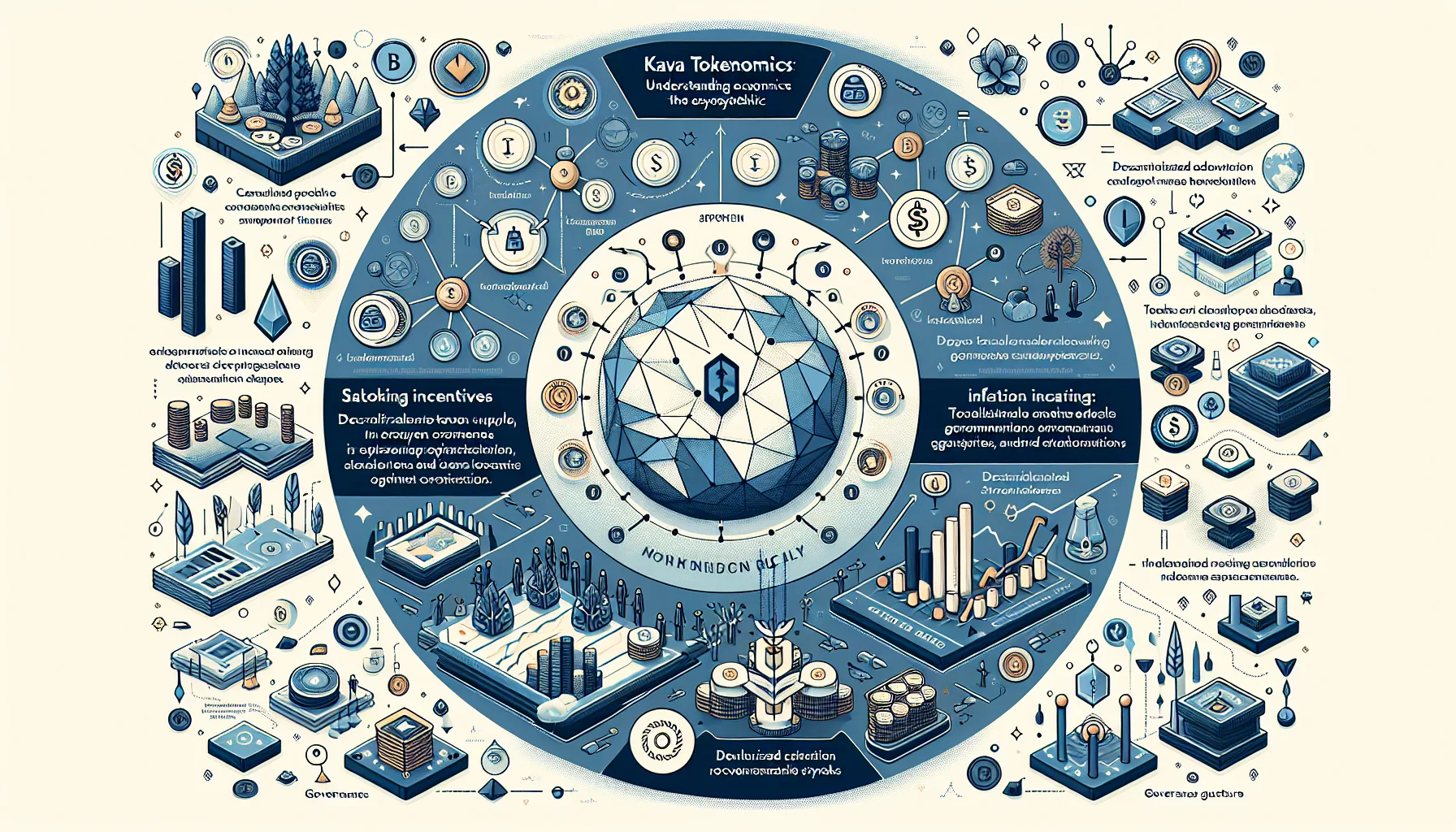
KAVA Tokenomics
KAVA Tokenomics: Understanding the Economics of the Ecosystem
KAVA operates as the native utility and governance token within the Kava blockchain ecosystem, designed to support decentralized finance (DeFi) applications and interoperable functionality. Central to its tokenomics is its role in securing the network, facilitating governance, and incentivizing ecosystem participation. However, the tokenomics structure presents both opportunities and challenges for users and developers alike.
Supply Dynamics and Inflationary Model
KAVA employs an inflationary supply model, with a capped maximum supply of 250 million tokens. New KAVA tokens are minted through staking rewards, with an adjustable inflation rate dependent on the total percentage of KAVA actively staked. This model is intended to encourage high network security by rewarding token holders for participating in staking. However, the variable inflation rate can introduce complexity and unpredictability. Users seeking long-term value accumulation must consider how inflation impacts the token's scarcity dynamics.
Staking Incentives and Distribution Structure
Holders of KAVA can delegate their tokens to validators, earning staking rewards while contributing to the network’s security. Validators process transactions and propose new blocks, forming the foundation of network operations. A significant portion of newly minted tokens is allocated to staking rewards. While this incentivizes participation, it creates a potentially high staking yield that could dilute token value over time, especially if network adoption or utility demand does not offset inflationary pressures.
Additionally, KAVA tokenomics allocate rewards in part to developers building on the Kava platform. While this aligns incentives for ecosystem growth, it can result in a steady release of tokens into the circulating supply, which may weigh on market dynamics and liquidity.
Governance and Decentralized Control
KAVA holders play an essential role in network governance, voting on proposals that shape the blockchain's future. Proposals often involve critical aspects such as protocol upgrades or collateral integrations for supported DeFi applications. However, tokenomics-driven governance models inherently face challenges related to token distribution. Concentrated holdings among large investors or validators could diminish decentralization and amplify governance power imbalance.
Utility and Ecosystem Challenges
KAVA’s utility extends beyond staking and governance, serving as collateral within the Kava ecosystem for lending and borrowing operations. Although this utility enhances token demand within the protocol, broader adoption may depend on how well the ecosystem attracts users and supports cross-chain asset integrations. A highly specific use case tied to the Kava network may limit the asset’s appeal as a broader store of value or currency, creating potential bottlenecks in utility-driven demand.
Tokenomics-focused investors should remain aware of how these economic dynamics interplay with network growth, inflation, and governance structures over time.
KAVA Governance
KAVA Governance: Decentralized Decision-Making and Challenges
The governance system of KAVA plays a pivotal role in shaping the protocol’s evolution, as it empowers token holders to directly influence decisions regarding the platform's features, parameters, and upgrades. KAVA operates as a Proof-of-Stake (PoS) blockchain, with governance mechanisms deeply embedded into its infrastructure, relying primarily on the KAVA token as the governance token. While the structure is built to reflect decentralized values, there are several intricate details and potential concerns worth examining.
On-Chain Governance: Mechanisms and Participation
KAVA’s governance revolves around on-chain proposals, which allow users to suggest and vote on changes to the network. This can include updates to core protocol parameters (such as collateralization ratios for CDPs or interest rate changes), budget allocations for development, or even the inclusion of new assets within the ecosystem. Each KAVA token represents voting power, reinforcing a proportional system where stakeholders with larger holdings have greater influence.
However, this design leads to notable concerns around centralization. The concentration of KAVA tokens among a few large holders (such as early participants, validators, or institutional backers) may skew the governance process toward their interests, potentially sidelining smaller retail investors. This raises questions about how genuinely “decentralized” the decision-making process is.
Validator Influence and Delegator Dynamics
Validators and their delegators carry significant weight in KAVA governance because they control substantial token holdings via delegated stakes. Delegators can entrust their voting power to validators, which enhances participation for individuals less directly involved but also means that validator decisions can disproportionately shape governance outcomes.
Critically, the alignment between validators and delegators is not always perfect. Validators may vote in ways that do not reflect the preferences of their delegators, leading to a disconnect in representation. Moreover, reliance on a limited pool of active participants in governance votes can reduce overall voter turnout, making the system vulnerable to manipulation or apathy among stakeholders.
Governance Challenges
One key challenge for KAVA governance lies in balancing inclusivity with efficiency. While the open proposal process allows for innovation, the absence of systematic safeguards against spam or ill-thought-out proposals may burden participants with reviewing a high volume of irrelevant suggestions. Additionally, contentious proposals can fracture the community, especially if powerful stakeholders unilaterally enforce changes that other parts of the network disagree with.
Another area of criticism often directed at KAVA governance is the lack of robust mechanisms to incentivize active participation. While the voting structure functions adequately for critical proposals, there is a noticeable trend of low voter engagement on non-controversial or technical initiatives, potentially hampering the protocol’s long-term adaptability.
Technical future of KAVA
KAVA: Current and Future Technical Developments and Roadmap
Cross-Chain Compatibility Enhancements
Kava’s technical roadmap continues to prioritize interoperability within the blockchain ecosystem. The launch of Kava Network’s compatibility with Ethereum’s EVM (Ethereum Virtual Machine) has broadened its appeal to developers, allowing them to deploy Ethereum-based dApps directly on the Kava platform. This dual-chain architecture is being refined further to enable even more seamless interaction between its Cosmos-based network and the EVM environment. However, the challenge of maintaining performance and security across these integrated chains remains unresolved, with some developers reporting friction in bridging tokens and assets effectively.
Looking ahead, the roadmap includes further enhancements to the EVM bridge, focusing on reducing latency and optimizing gas fees for cross-chain operations. While promising, this development hinges on overcoming persistent scalability bottlenecks—an area where Kava's reliance on Tendermint consensus still faces limits during high transaction loads.
Liquid Staking and Yield Mechanisms
Kava is set to expand its liquid staking capabilities, a key feature for unlocking capital efficiency. Upcoming upgrades will allow users to collateralize staked KAVA tokens in decentralized finance (DeFi) applications without unstaking them, a significant improvement to liquidity options on the platform. This development is expected to attract more DeFi builders, though concerns about smart contract vulnerabilities in staking mechanisms remain a technical risk.
In conjunction with this, the developer team is building out additional yield-generation modules in its native Kava App. These modules aim to provide diverse streams of passive income for token holders but could complicate the network’s governance model. The balance between rapid technical development and governance consensus could be challenging to maintain as the platform expands its tooling.
Integration of Permissionless Infrastructure
To attract enterprise-level solutions, Kava plans to implement permissionless node infrastructure, enabling validators to operate independently while managing their own staking economics. This approach is intended to decentralize the network further, but some industry experts have noted potential centralization risks during the transition phase. Any imbalance in the distribution of validator nodes could lead to reduced network security.
Future Scalability Initiatives
The roadmap highlights a pivot towards Layer-2 scaling solutions and zk-rollups to support higher throughput and increased dApp activity. While experimental for Kava at this stage, successful implementation of these technologies could be a game-changer. However, the associated technical complexity might slow progress, and questions remain about whether Kava can maintain developer interest as other Layer-1 competitors aggressively pursue the same advancements.
Comparing KAVA to it’s rivals
KAVA vs ATOM: Comparing Cross-Chain Capabilities
When analyzing KAVA in comparison to ATOM, the most notable distinction lies in how each crypto asset and its ecosystem approach cross-chain interoperability. Both projects have established themselves as key players in facilitating blockchain connectivity, but their technical implementations reveal significant differences.
Consensus Mechanism and Network Architecture
ATOM, as part of the Cosmos ecosystem, uses the Tendermint consensus algorithm alongside the Inter-Blockchain Communication Protocol (IBC). This makes ATOM a cornerstone for connecting various independent blockchains in the Cosmos network. Its modular framework allows developers to create customized blockchains that interoperate seamlessly within the broader Cosmos network.
KAVA, while also leveraging the Tendermint consensus mechanism, takes a more vertically integrated approach. KAVA’s infrastructure is more tightly focused on bridging decentralized finance (DeFi) with its lending protocols and liquidity hubs. However, this specialization can be seen as both an advantage and a limitation. Unlike ATOM, KAVA's cross-chain functionality is more narrowly centered on financial dApps and interoperability with specific assets. This presents potential scalability constraints for projects that might require a broader array of interconnections beyond DeFi-centric use cases.
Adoption and Ecosystem Development
One area where ATOM holds a clear advantage is developer adoption. Cosmos SDK, which underpins ATOM, has been widely embraced as a go-to framework for building interoperable blockchains. KAVA’s ecosystem, by comparison, is smaller and more niche. The latter may reduce competition within its ecosystem but could also limit its appeal for developers seeking broader opportunities or diverse blockchain integrations.
Furthermore, the scale of ATOM's ecosystem creates a network effect that KAVA has yet to reach. With a multitude of chains connecting through ATOM, its ecosystem benefits from enhanced liquidity, decentralization, and collaboration. KAVA’s strategy, while focused and deliberate, has faced challenges in growing a similarly robust network effect.
Governance and Decentralization Challenges
Both projects have implemented decentralized governance, but there are nuances in how this plays out. ATOM’s governance structure allows for a more distributed decision-making process, especially given its broader ecosystem participation. KAVA, on the other hand, has faced criticism for having a more concentrated developer influence due to its narrower ecosystem. While KAVA continues to move toward more robust decentralization, it currently lags behind ATOM in terms of governance diversity.
In summary, while KAVA provides a focused and performance-driven solution for DeFi interconnectivity, its narrower scope contrasts sharply with ATOM’s broader ecosystem goals and developer adoption. These distinctions highlight the trade-offs inherent in choosing one over the other depending on use case priorities.
KAVA vs. AVAX: A Closer Look at Layer-1 DeFi Protocols
When examining how KAVA compares to AVAX, both platforms bring unique capabilities to the DeFi space, but their underlying architectures, consensus models, and ecosystem strategies reveal distinct trade-offs that appeal to different segments of the crypto community.
Consensus Mechanism and Network Design
AVAX, Avalanche’s native blockchain platform, leverages its novel "Avalanche Consensus" protocol, which is built for high throughput and near-instant transaction finality. This contrasts sharply with KAVA’s Tendermint-based consensus mechanism, a component rooted in the Cosmos SDK ecosystem. While Avalanche’s DAG-like consensus often results in scalable performance and strong decentralization properties, its complexity makes it more computationally intensive, which could deter smaller validators from participating.
KAVA takes a leaner approach by marrying the simplicity of Tendermint with optimized interoperability. Although this simplicity means KAVA sacrifices some of the speed advantages of AVAX, it positions itself as a more accessible option for validators of varying resource capabilities. However, AVAX gains an edge in empowering subnets: dedicated, customizable blockchains that enable developers to shape tokenomics, consensus, and policies. KAVA, despite promoting cross-chain capabilities, lacks a similar feature set, making it less appealing for projects requiring custom blockchain infrastructure.
Ecosystem Growth and Use Case Differentiation
Avalanche boasts an expansive ecosystem with strong adoption for smart contract development, especially in the NFT and gaming sectors. It has successfully cultivated partnerships and deployed decentralized applications (dApps) on its C-Chain (contract chain) with EVM compatibility. KAVA, on the other hand, focuses on bridging DeFi across multiple chains via its "co-chain" architecture, combining Cosmos SDK's interchain capabilities with Ethereum smart contracts. While KAVA’s dual architecture is innovative, it remains a work in progress and trails AVAX in terms of smart contract deployment volume and total value locked (TVL).
This disparity can be partially attributed to developer incentives. Avalanche’s robust subnet architecture attracts developers seeking customizable frameworks, while KAVA’s growth has been hindered by slower adoption of its cross-chain infrastructure. Additionally, AVAX’s developer documentation and tooling are perceived to be more extensive, giving it a competitive advantage among builders accustomed to EVM environments.
Challenges and Trade-offs
KAVA’s focus on interoperability gives it a niche advantage, but it struggles against Avalanche’s scalability and broader ecosystem traction. Furthermore, AVAX benefits from a more mature staking model, while KAVA's validator set is comparatively concentrated, which might pose centralization risks over time. For technically adept users, managing and securing Avalanche nodes can be more demanding given its DAG structure—but for those seeking brute ecosystem adoption and transaction volume, AVAX holds the upper hand.
As both evolve, the divergence in approach highlights trade-offs between simplicity and scalability, making the choice between KAVA and AVAX highly context-dependent for developers, investors, and users alike.
Comparing KAVA to Solana (SOL): Differentiators and Challenges
When examining KAVA in the context of Solana (SOL), key distinctions in architecture, use cases, and adoption strategies come to light. Both ecosystems target scalability and decentralized finance (DeFi) use cases, but they carve out their niches through contrasting approaches to consensus models, performance benchmarks, and ecosystem growth.
Consensus Mechanisms: Modular vs. Monolithic
Solana operates on a high-performance architecture built around the unique Proof of History (PoH) mechanism, integrated with Proof of Stake (PoS). This monolithic design enables Solana to achieve high throughput and ultra-low latency. By comparison, KAVA employs a more modular approach, utilizing the robust Tendermint consensus engine within its Cosmos-SDK-based framework. This modularity gives KAVA flexibility with cross-chain interoperability, but it cannot match the sheer transaction speed or block finality offered by Solana.
A drawback of Solana's monolithic efficiency is its trade-off in decentralization. The demanding hardware requirements for validators create barriers to entry, leading to concerns over centralization. KAVA sidesteps this issue with lower infrastructure demands for its validators, ensuring a more decentralized validator set. However, this comes at the expense of raw performance, as KAVA's transaction throughput is by no means on par with SOL's capabilities.
Ecosystem Development: DeFi-Centric vs. Broad Application
Solana’s strategy has been rooted in developing a broad ecosystem, catering to NFTs, gaming, and DeFi simultaneously. This multifaceted expansion has attracted highly active developers and institutional backing. KAVA, in contrast, has concentrated primarily on DeFi, with initiatives like its Hard Protocol for lending and borrowing and KAVA Swap for decentralized trading. While this focus establishes KAVA as a DeFi-specialized platform, it limits the audience and market opportunities compared to Solana’s wide-ranging appeal.
That said, Solana’s expansive ecosystem growth hasn’t come without issues. The network has faced multiple high-profile outages due to stress from its ambitious scaling model. This has raised questions about its reliability under heavy workloads. KAVA, albeit slower-growing, has avoided similar stability concerns largely due to its more conservative scaling ambitions. Yet, this can also be interpreted as a lack of innovation, where scalability plays second fiddle to cross-chain compatibility.
Target Market Disparities: Institutional vs. Interoperability
Solana has positioned itself as a home for institutions and venture-backed mega-projects, with high liquidity and large-scale user engagement. In contrast, KAVA’s heavy emphasis on bridging assets across multiple chains highlights its target market: users and developers navigating multiple blockchain ecosystems. While this aligns with the growing multi-chain vision of the crypto industry, it also means KAVA faces stiff competition from other interoperability-focused projects, which may overshadow KAVA’s efforts in the absence of standout solutions Solana-like ecosystems bring to the table.
Ultimately, KAVA and Solana attract different segments of the crypto ecosystem, but Solana’s speed-centric approach often outshines KAVA’s interoperability-first focus among high-performance applications. However, this dichotomy also defines the limitations and tradeoffs faced by each platform.
Primary criticisms of KAVA
Primary Criticisms of KAVA: Challenges Facing the Ecosystem
Governance Centralization Concerns
One of the recurring criticisms leveled against the KAVA ecosystem is its perceived governance centralization. While KAVA claims that its governance is decentralized, skeptics point out that a significant portion of KAVA tokens is concentrated in the hands of a small number of early backers, investors, and validators. This raises concerns about voting power and how effectively the broader community can influence protocol decisions. Critics suggest that this token distribution structure could lead to potential conflicts of interest, where major stakeholders prioritize their own benefits over the long-term health of the ecosystem.
Dependence on Cross-Chain Architecture
KAVA’s focus on interoperability and cross-chain lending, while innovative, introduces critical vulnerabilities. Any technical failure, congestion, or security breach within the supported external blockchains (such as Cosmos or Ethereum) could have a cascading effect on the KAVA ecosystem. Additionally, the reliance on bridges and smart contracts to facilitate cross-chain operations surfaces risks of exploits, hacks, and other attack vectors. Critics argue that this dependence creates a fragile ecosystem, where issues on external chains could negatively impact user confidence and platform performance.
Collateral Efficiency Limitations
KAVA’s lending platform has faced scrutiny for offering limited collateral efficiency. Some users have voiced concerns about high collateral requirements when compared to other DeFi platforms. These high thresholds can deter smaller participants, reducing accessibility and participation. Furthermore, the scope of supported collateral types has been critiqued for being insufficiently diverse, limiting the flexibility and appeal of the platform to a broader user base within the DeFi community.
Overemphasis on MakerDAO Comparison
KAVA has often been compared to MakerDAO due to similarities in its lending and stablecoin mechanisms. Critics argue that positioning itself as a “multi-chain MakerDAO” is problematic, as it creates unrealistic benchmarks while disregarding key differentiators in both ecosystems. This narrative risks alienating users who expect KAVA to match or exceed MakerDAO’s maturity and liquidity without taking into account the technical and market challenges involved in operating across multiple blockchains. The resulting gap between expectations and execution has left some users disappointed.
Limited Marketing and Ecosystem Awareness
Despite its robust infrastructure, KAVA has struggled with building visible traction in the broader DeFi space. Critics highlight its lack of effective marketing and developer outreach, which has hindered the onboarding of new projects and liquidity providers. This has led to slower ecosystem growth compared to competitors who have succeeded in scaling developer participation and community engagement. Some argue that KAVA's technical focus has come at the expense of fostering a strong broader community.
Founders
The Founding Team Behind KAVA: Leadership and Expertise Driving the Platform
Kava’s founding team has been pivotal in establishing the blockchain as a key player within the decentralized finance (DeFi) ecosystem. However, while their backgrounds and accomplishments have contributed to the early success of the project, there are nuanced perspectives to consider about their approach and structure.
At its core, Kava was founded by Brian Kerr, Ruaridh O’Donnell, and Scott Stuart, all of whom bring diverse skill sets from different industries. Brian Kerr, serving as Kava’s CEO, has a background in business development and product design. Before Kava, he worked with companies in gaming and e-sports, including roles at firms like Fnatic and other tech-focused startups. While his leadership has helped craft the business vision for Kava, some critics within the crypto industry have pointed out that his experience is not deeply rooted in blockchain development or cryptography, which could give pause to purists looking for technical-first leadership.
Ruaridh O’Donnell, Kava’s co-founder and former CTO, brings a more technical expertise to the project. A graduate in Physics, O’Donnell transitioned into software development, contributing to the foundational architecture of the Kava blockchain. Although his technical acumen undeniably played a critical role in the project’s early infrastructure design, O'Donnell has since taken more of a backseat, and some observers within the community argue that this shift raised questions about the long-term continuity of the founding team’s technical oversight.
Scott Stuart, Kava’s Chief Product Officer, had a background as a professional poker player before pivoting to tech entrepreneurship. While his unique perspective on risk management and strategy has influenced Kava’s product development, the lack of institutional experience in DeFi among the founders has occasionally led to skepticism from portions of the crypto-savvy audience.
It's also worth noting the overall critique regarding centralized decision-making within Kava Labs, the entity responsible for Kava's development. Despite branding itself as decentralized, questions have been raised about how much control remains with the founding team versus the broader community of token holders. Transparency and decentralization are ongoing concerns for some in the project’s ecosystem.
In sum, while the Kava founding team has demonstrated adaptability and innovation, the reliance on relatively non-traditional blockchain backgrounds paired with concerns about governance mechanics provides a dual-edged perspective on their leadership.
Authors comments
This document was made by www.BestDapps.com
Sources
- https://www.kava.io/
- https://whitepaper.kava.io/
- https://explorer.kava.io/
- https://github.com/Kava-Labs/kava
- https://blog.kava.io/
- https://docs.kava.io/
- https://medium.com/kava-labs
- https://kavachain.statuspage.io/
- https://defillama.com/protocol/kava
- https://stakingrewards.com/earn/kava
- https://developer.kava.io/
- https://coinmarketcap.com/currencies/kava/
- https://messari.io/asset/kava
- https://www.coingecko.com/en/coins/kava
- https://rekt.news/kava-research/
- https://twitter.com/kava_platform
- https://research.binance.com/en/projects/kava
- https://cryptoslate.com/coins/kava/
- https://icodrops.com/kava/
- https://nomics.com/assets/kava-kava


