History of ICX
The History of ICX: The Development of ICON Network
ICON (ICX) debuted in 2017 as a product of the blockchain-focused company ICONLOOP, headquartered in South Korea. The project aimed to create a platform that fosters interoperability between various blockchain networks. Its history traces back to an ambitious vision: to build a decentralized network connecting independent blockchains, enterprises, and government institutions. The team sought to establish ICON as the "blockchain of blockchains," a network capable of supporting diverse use cases while adhering to decentralization principles.
The project officially burst onto the scene with its successful ICO (Initial Coin Offering) in September 2017. It raised approximately 150,000 ETH, making it one of the more notable token launches during the ICO boom. ICX served as the network's native token, with utilities spanning transaction fees, staking, and governance. However, like many other projects from the 2017 ICO era, its early development was met with skepticism, particularly concerning regulatory risks and scalability challenges.
ICON's initial roadmap included the development of its own consensus algorithm called Loop Fault Tolerance (LFT). LFT, a delegated Byzantine Fault Tolerance (dBFT) adaptation, was introduced to handle a high volume of transactions while preserving security. The launch of ICON’s mainnet in January 2018 was a significant milestone, transitioning ICX from ERC-20 token status to its proprietary blockchain infrastructure. Despite community excitement, the mainnet launch faced criticism due to delays and a lack of immediate functionality upon release, which caused some friction with early adopters.
A notable element in ICON's history is its focus on partnerships within South Korea. The technology was marketed for adoption in fields such as healthcare, education, and financial services, as well as for public sector use like smart cities. While government affiliations boosted market confidence, reliance on localized adoption raised questions about the global applicability and relevance of ICON’s ecosystems.
Interoperability efforts materialized in the form of the Blockchain Transmission Protocol (BTP), a critical component allowing communication across separate blockchain systems. While BTP’s conceptual foundation propelled ICON's reputation as a pioneer among interoperable networks, development hurdles and implementation delays bogged down momentum.
Technological updates like ICON 2.0 showcase the project's intent to evolve. However, the migration to ICON 2.0 brought challenges, including community concerns over centralization due to its governance structure and node validator ecosystem. The perceived dependency on South Korea's market also left ICON facing criticism about its ability to scale globally.
How ICX Works
How ICX Works: A Technical Overview of Icon’s Blockchain Protocol
At the core of ICX is the Icon blockchain, a decentralized network designed to enable interoperability between various independent blockchains through Icon's proprietary technology, known as the Blockchain Transmission Protocol (BTP). ICX functions as the primary utility token within this ecosystem, facilitating transactions, governance, and network operations. Here's an in-depth look at how ICX operates within the Icon ecosystem.
Blockchain Transmission Protocol (BTP)
BTP is the innovative mechanism that allows Icon to connect disparate blockchains. By utilizing smart contracts and relayers, BTP enables the transfer of data and assets across different blockchain systems without requiring intermediaries. Each connected blockchain maintains its sovereignty while still being able to interact with others. The process involves the use of validators to ensure security and integrity—however, like other interoperability solutions, the potential centralization of these validators could present vulnerabilities.
Delegated Proof-of-Stake (DPoS) and ICX Staking
Icon operates on a Delegated Proof-of-Stake (DPoS) consensus mechanism, where ICX holders can delegate their tokens to validators called Public Representatives (P-Reps). P-Reps are responsible for validating blocks and securing the network. In return, ICX stakeholders can earn staking rewards, which are distributed proportionately based on delegation. It’s noteworthy that DPoS introduces competition among P-Reps, but critics highlight the risk of centralization inherent in voting-based systems, as wealthier participants can exert significant influence over governance.
Governance and Decentralized Autonomous Organizations (DAOs)
ICX holders play a crucial role in Icon’s governance. They can vote on governance proposals that are submitted by P-Reps or community members. This emphasizes decentralization; however, the effective power of smaller stakeholders is often diluted unless there is broad alignment across the community. Icon has also expanded into decentralized autonomous organizations (DAOs) through its Contribution Proposal System (CPS), enabling specific projects within the ecosystem to be funded via community-led initiatives.
Smart Contract and dApp Ecosystem
The Icon blockchain supports smart contract functionality using its loopchain technology. Developers can build decentralized applications (dApps) on Icon’s infrastructure, leveraging its scalability and interoperability features. While this adds significant utility to the ecosystem, the ecosystem of dApps and developers faces challenges in achieving adoption rates comparable to Ethereum or other established networks.
Token Utility and Transaction Costs
The ICX token is central to executing all operations within the network, including transactions, voting, staking, and participating in governance. Transaction fees are paid in ICX, and they dynamically adjust based on network demand. Although this elastic model helps maintain efficiency, high traffic spikes may lead to increased costs, which could limit usability for smaller-scale participants.
Limitations and Technical Considerations
While Icon’s interoperability-focused mission is ambitious, challenges persist. BTP, though innovative, is still in its relative infancy, and its adoption by other blockchains remains uneven. Furthermore, DPoS governance models, despite their speed, introduce trade-offs between efficiency and decentralization. Icon also still contends with the broader issue of developer acquisition and user adoption, which requires sustained growth in its ecosystem to remain viable.
Use Cases
Use Cases of ICX: Bridging Blockchain Ecosystems with Real-World Applications
ICX, the native token of the ICON Network, plays a pivotal role in enabling seamless connectivity across independent blockchains. Positioned as an interoperability-focused asset, ICX serves several distinct use cases within the broader ICON ecosystem and beyond.
Interoperability and Cross-Chain Communication
The ICON Network is built around facilitating cross-chain communication and interoperability through its Blockchain Transmission Protocol (BTP). ICX acts as the foundational utility asset, enabling transactions and facilitating value transfer across otherwise isolated blockchain networks. This positions ICX as a key enabler for decentralized finance (DeFi) projects that rely on integrating assets and services from multiple platforms. However, scalability and adoption of the BTP protocol remain challenges, with ongoing concerns about the speed and efficiency of cross-chain operations under high activity levels.
Decentralized Finance (DeFi) on ICON
ICX has become crucial to the DeFi infrastructure built on ICON. It is used as collateral in lending platforms, liquidity pools, and staking protocols within the network. For instance, in liquidity pools, ICX pairs with other assets to facilitate token swaps while simultaneously earning fees for liquidity providers. A core benefit here is the relatively low transaction fees within the ICON ecosystem compared to competing blockchains. That said, competition from alternative DeFi ecosystems with more extensive development and user bases could limit ICX's growth in this space.
Governance and Staking
ICX holders actively participate in the network's on-chain governance by staking ICX to support Public Representatives (P-Reps). These P-Reps serve as validators for the network and are essential to maintaining its decentralized architecture. By staking ICX, users earn rewards in return, aligning incentives between token holders and the network's performance. Nonetheless, concentration of voting power among a small number of P-Reps has raised concerns about centralization risks, which could undermine the ICON network's credibility as a truly decentralized platform.
Enterprise Integration and Digital Identity Solutions
The ICON Network is designed to support enterprise-grade blockchain applications, such as digital identity verification, supply chain management, and healthcare systems. ICX serves as the medium of exchange and transactional fuel for these implementations. A notable use case is ICON's contribution to decentralized identity (DID) systems, where ICX powers the network transactions required for identity claims. Adoption in enterprise settings remains slow, however, as organizations often face regulatory and technical hurdles when implementing blockchain-based solutions.
ICX in NFT Ecosystems
The ICON blockchain has also ventured into the NFT space, leveraging ICX for NFT minting, purchasing, and trading. ICON's relatively low transaction costs provide a competitive edge in this arena. However, the platform has yet to achieve widespread attention in the NFT market compared to leading chains like Ethereum, which host entrenched NFT marketplaces.
ICX Tokenomics
ICX Tokenomics: A Deep Dive into Supply Dynamics and Utility
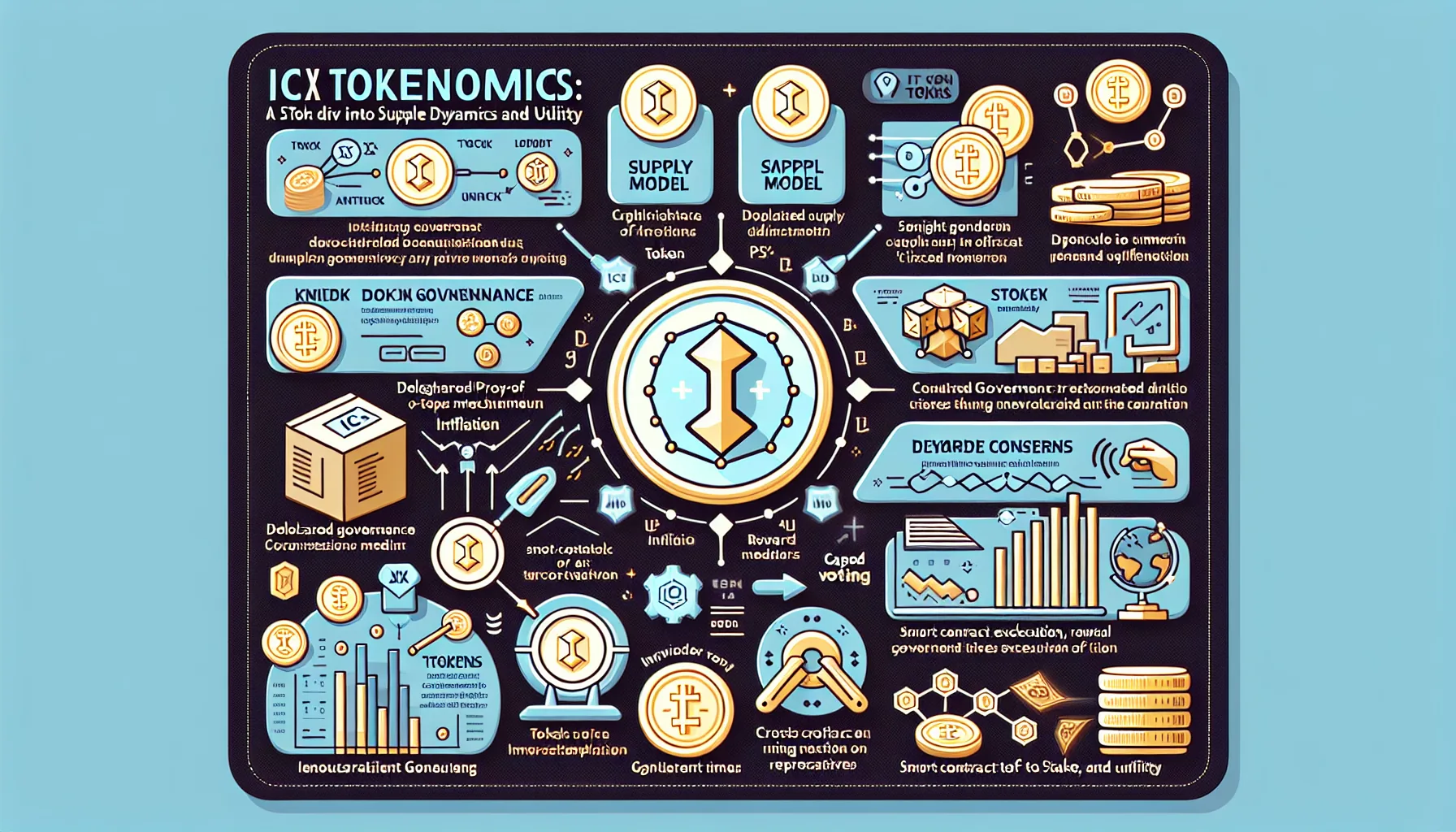
ICX, the native cryptocurrency of the ICON ecosystem, underpins the platform’s tokenomics by facilitating interoperability, decentralized governance, and smart contract execution. The tokenomics of ICX encompasses its supply model, distribution mechanics, staking incentives, and potential concerns tied to inflation and utility.
Supply Model and Token Distribution
ICX utilizes a capped supply model, with an initial total supply set during its ICO phase. While no additional coins are minted into circulation outside of governance-approved updates, ICX is inflationary in nature, as new tokens are created to reward validators, delegates, and stakeholders participating in network consensus. This inflation rate is dynamic and governed by community decisions, which ensures adaptability to changing network demands. However, critics argue that inflation mechanisms can dilute the holdings of long-term investors if the additional supply isn’t matched by proportional growth in network utility.
The allocation of ICX also reflects both its early funding strategy and ongoing ecosystem development. A significant portion was reserved for the ICON Foundation to fund operations and development. However, skeptics have raised concerns about centralization risks, as the Foundation’s allocation offers it substantial influence over the ecosystem’s economic direction.
Staking and Reward Mechanics
ICX plays a pivotal role in ICON's Delegated Proof-of-Stake (DPoS) consensus mechanism. Token holders can delegate their ICX to representatives (P-Reps) who validate transactions and participate in governance. Stakers receive ICX rewards proportional to their delegation, subject to network inflation mechanics. This incentivizes participation in securing the network while encouraging more extensive token holding.
One challenge, however, lies in the accessibility of staking rewards. High staking rates by large ICX holders could lead to economic stratification, where wealthier participants disproportionately benefit from staking incentives. This creates a potential barrier for smaller holders to gain meaningful rewards, impacting broader network participation.
Utility and Market Depth
ICX's primary utility is derived from its use within ICON’s ecosystem. It acts as a transactional medium for cross-chain interactions, smart contract gas fees, and governance voting. Furthermore, ICX facilitates interoperability across different blockchain networks via ICON’s Blockchain Transmission Protocol (BTP), enhancing its utility in multi-chain environments.
Nonetheless, the utility of ICX could face constraints if adoption of the broader ICON ecosystem stagnates. Critics point to potential over-reliance on speculative demand rather than sustained organic utility growth, which could affect long-term token economics. Robust adoption of BTP and decentralized applications (dApps) remains crucial to sustaining ICX’s relevance in its competitive landscape.
ICX Governance
Governance in ICX: Decentralization and Network Decision-Making
ICON (ICX) utilizes a hybrid governance model designed to balance decentralization with scalability and efficiency. At its core, the ICX governance framework is underpinned by delegated proof-of-stake (DPoS), where voting power is concentrated among a set of elected delegates known as Public Representatives (P-Reps). This structure enables ICX stakeholders to participate in critical network decisions, while also centralizing authority to specific actors, which can have both advantages and drawbacks.
The Role of P-Reps
P-Reps are central to ICX’s governance system. They are responsible for validating transactions, creating blocks, and making protocol-level decisions. The election process for P-Reps involves staking ICX tokens, allowing token holders to vote for their preferred representatives. This system incentivizes community participation, but it also creates the potential for power imbalances as larger token holders can exert disproportionate influence. Concentrated voting stakes raise concerns about the resilience of the network to collusion or centralization within the ranks of the top-performing P-Reps.
Decentralization Challenges
While the ICX protocol is designed to promote decentralization, the reliance on a fixed set of P-Reps introduces a significant point of failure. If a majority of P-Reps act in bad faith or are compromised, the integrity of the network could be at risk. In addition, smaller token holders may feel disenfranchised in the voting process, as their stakes are unlikely to wield significant influence in electing or challenging P-Reps. This dynamic has raised questions over whether the network’s governance truly represents the broader community or primarily serves the interests of its largest stakeholders.
The Proposal System
ICON offers a formalized proposal system where P-Reps and token holders can initiate or vote on proposals that influence the network’s future. These proposals may address protocol upgrades, fund allocations, or policy changes. While this system provides a structured mechanism for community input, the decision-making process can be bottlenecked by P-Reps, whose approval is often required for implementation. This hierarchy can slow down innovation or lead to the prioritization of self-serving proposals over those that benefit the ecosystem as a whole.
Economic Incentives in Governance
Governance in ICX is intrinsically linked to its tokenomics. Both Main P-Reps (top-ranked representatives) and Sub P-Reps receive staking rewards, which encourage competition and incentivize network reliability. However, the rewards structure has sparked debates regarding its fairness, with critics arguing that an overemphasis on economic incentives detracts from principles of equitable participation and decentralization.
Technical future of ICX
ICX: Current and Future Technical Developments in Detail
The ICON blockchain ecosystem, powered by the ICX token, has undergone several iterations of technical innovation aimed at establishing a decentralized interoperability layer. Below, we explore its current technical state and future roadmap, examining both advancements and unresolved challenges.
Current Technical Developments
1. ICON 2.0 Transition
ICON 2.0 brought a shift away from its original loopchain infrastructure to a more modular architecture developed with Golang. The aim is to enhance performance, scalability, and developer accessibility. This upgrade allows faster transaction processing, better error handling, and improved network governance functionalities. By introducing optimized block validation and reduced latency, ICON 2.0 sets the foundation for future enhancements.
2. Blockchain Transmission Protocol (BTP)
One of the flagship technical developments is the Blockchain Transmission Protocol. BTP provides next-level interoperability by allowing trustless communication among diverse blockchains. Its interoperability does not rely on centralized bridges, which eliminates potential single points of failure. While promising, challenges such as scalability under heavy cross-chain activity and ensuring robust security for node operators have been points of ongoing refinement.
3. SCORE (Smart Contract on Reliable Environment)
ICON’s smart contract system, SCORE, adds an additional layer of programmability but is distinct in its focus on governance. While highly efficient for predefined applications and DAO frameworks, critics argue that SCORE’s coding constraints might limit developer flexibility compared to Ethereum’s Turing-complete virtual machine. However, the team is actively working on expanding tools and libraries to mitigate these limitations.
Future Technical Roadmap
1. Decentralized Identity (DID) Integration
ICON has plans to expand its implementation of decentralized identity solutions, leveraging its existing collaboration with public institutions to enable secure, blockchain-based identity systems. While integration with real-world applications offers significant potential, widespread adoption may face hurdles in terms of privacy and regulatory compliance.
2. Governance Enhancements via Public Representative (P-Reps) Model
ICON has prioritized governance by leveraging its P-Reps model. Future updates aim to further decentralize decision-making, giving community members greater input over network upgrades. This could, however, introduce the risk of governance gridlock, particularly if competing interests among P-Reps result in voting stalemates.
3. Enhanced BTP Development
ICON’s roadmap includes further scaling of BTP’s scalability and user experience. New iterations may feature slashing mechanisms to penalize bad actors in cross-chain interactions and include streamlined onboarding processes for partner blockchains. Actualizing these goals will require concerted technical effort and maintaining open collaboration across blockchain communities.
Technical Challenges and Criticism
ICON faces several technical headwinds, primarily revolving around its ambitious claim to become an interoperability standard while competing in an increasingly crowded cross-chain landscape. BTP’s complexity, though innovative, necessitates a level of security scrutiny and operational optimization that continues to evolve. Additionally, developer onboarding remains a pain point, with some citing insufficient documentation and limited existing tooling compared to mature ecosystems like Ethereum and Polkadot.
Despite these hurdles, ICX remains technically intriguing, driven by its engineering-focused approach and roadmap for long-term protocol improvements.
Comparing ICX to it’s rivals
ICX vs. DOT: Comparing Vision, Use Cases, and Infrastructure
When examining ICX (ICON) against DOT (Polkadot), the core contrasts arise from their approaches to blockchain interoperability, network structure, and overarching ecosystem goals. Both projects aim to solve the problem of siloed blockchain networks, yet their methodologies differ significantly, resulting in unique advantages as well as complications for both.
Interoperability Architecture: Different Paths to the Same Goal
ICON’s interoperability is primarily centered on its Blockchain Transmission Protocol (BTP), which enables cross-chain communication by allowing independent blockchain networks to interact without relying on intermediaries. ICON takes an integration-heavy stance, emphasizing collaboration between disparate chains, including public and private networks.
Polkadot, in contrast, leverages a more controlled approach through the use of parachains, which are customized blockchains interoperable through Polkadot’s relay chain. While ICX emphasizes direct integration and modular scaling with minimal dependencies, DOT’s reliance on the relay chain, while robust, creates a more centralized bottleneck. This could limit scalability to some extent, as the relay chain's throughput is finite. On the other hand, critics of ICX argue that its BTP model is overly reliant on external network participation, which exposes potential vulnerabilities if large stakeholders fail to cooperate or if adoption stagnates.
Governance: Decentralization vs. Complexity
ICON employs a decentralized governance model, where Public Representatives (P-Reps) play a major role in decision-making. This design fosters permissionless participation while potentially exposing governance to centralization risks if power consolidates within a few influential P-Reps.
Polkadot employs a more structured governance framework, featuring stakeholder voting and decisions coordinated through its on-chain governance system. While this may appear more organized, it is often questioned for being overly complicated, leaving participants behind due to its high barrier of entry for understanding and engaging in governance. DOT’s governance design also leans more toward decisions flowing through specific predefined structures, reducing flexibility compared to ICON’s more open-ended approach.
Network Vision and Adoption Challenges
Both ICX and DOT place emphasis on creating interconnected blockchains, but ICON’s strategy extends more aggressively into real-world use cases, particularly with private enterprise and public sector partnerships. However, some argue that ICON’s broader ambitions have diluted focus, making execution slower than anticipated. DOT, on the other hand, has focused more narrowly on technical innovation, sometimes at the expense of practical, real-world adoption.
In summary, while DOT’s deeply structured framework provides strong security and interoperability for custom-built chains, ICX’s decentralized approach and BTP design aim for a more inclusive integration. However, this comes with potential risks related to coordination and adoption hurdles, where stability and efficiency remain key challenges.
ICX vs ATOM: A Detailed Comparison of Interoperability Solutions
When examining ICX and ATOM, both projects prioritize interoperability within the blockchain ecosystem, but their approaches—and resultant implications—diverge significantly. For crypto-savvy investors and developers, understanding these differences is critical to appreciating how ICX stacks up against one of its notable rivals.
Interoperability Architectures: ICON vs. Cosmos Hub
ICX operates through its Blockchain Transmission Protocol (BTP), which aims to establish seamless, trustless interoperability across heterogeneous blockchains. This allows individual blockchains, regardless of consensus mechanisms or architecture, to communicate directly with one another while maintaining their unique governance structures. BTP's design eliminates the reliance on intermediaries, offering a trustless, decentralized bridge for cross-chain transactions.
Similarly, ATOM’s Cosmos ecosystem employs the Inter-Blockchain Communication (IBC) protocol. Like BTP, IBC facilitates interoperability between independent blockchains. However, Cosmos takes a more siloed approach, requiring networks to integrate into its "Internet of Blockchains" using the Cosmos SDK or Tendermint consensus, meaning any new chain opts into specific design constraints and dependencies imposed by Cosmos’ framework. Critics of this approach note reduced flexibility for projects that don't align well with the Cosmos ecosystem tools.
Scalability and Performance
ICX emphasizes scalable connections across domains by leveraging its native architecture and enterprise integrations. However, critics have noted speed limitations when operating through BTP, given the need to verify transaction proofs on independent blockchains.
Conversely, Cosmos touts high throughput across its hubs but faces challenges with broader scalability as networks with large volumes create bottlenecks in relaying excessive messages over IBC channels. For example, the heavier reliance on relayers introduces risks of dependency and inefficiencies if not properly incentivized.
Decentralization Degree and Security Focus
While both projects aim for decentralization, ICX differs by focusing on connecting permissionless and permissioned chains, effectively carving out space for enterprise adoption. But this dual approach raises questions about how ICX balances decentralization with control in business integrations.
ATOM tackles security with its "shared security" model, where chains tap the Cosmos Hub's validator set for protection—potentially introducing concerns about over-centralization of security reliant on a core hub. ICX doesn’t currently share security across participating blockchains, segmenting risks but also potentially increasing vulnerabilities for smaller networks.
Token Utility and Adoption
ICX's native token supports governance, transaction fees, and staking for rewards. However, adoption remains a bottleneck, particularly in ecosystems outside ICON’s immediate scope.
ATOM’s utility mechanism is slightly more narrow, being largely focused on staking for governance and cross-chain validation. While it has fostered stronger recognition within certain DeFi and dApp niches, those outside its ecosystem may find the token’s utility limited.
Comparing ICX to ETH: Smart Contract Ecosystems and Bridging Ambitions
When evaluating ICX (ICON) in comparison to Ethereum (ETH), it's impossible to ignore Ethereum's established dominance in the blockchain ecosystem. Ethereum, as the pioneer of smart contract functionality and decentralized applications (dApps), serves as a crucial benchmark for any blockchain network aiming to carve its niche. While ICX distinguishes itself with its interoperability focus and efforts to connect disparate blockchains, its approach contrasts sharply with Ethereum’s well-entrenched infrastructure, introducing both opportunities and challenges.
One of the most notable distinctions lies in Ethereum's overwhelmingly large developer base and mature tooling ecosystem. Ethereum's dominance in smart contract standards, particularly the ERC-20 and ERC-721 token protocols, has propelled its adoption across DeFi, NFTs, and beyond. In comparison, ICX still finds itself in a position where it needs to compete for developer mindshare. ICON's semi-decentralized governance model, while designed for scalable interoperability, can come across as less flexible for these developers who may be accustomed to Ethereum’s fully decentralized ethos—even with its occasional congestion and scalability trade-offs.
On the topic of network scalability, Ethereum's ongoing evolution from proof-of-work (PoW) to proof-of-stake (PoS)—via Ethereum 2.0—addresses long-standing concerns about throughput and cost efficiency. While this transformation introduces complexities and periods of transition, Ethereum still benefits from its first-mover advantage and massive ecosystem funding. ICX, meanwhile, claims to offer a high-performance alternative to Ethereum by leveraging its unique delegation structure through its Loopchain protocol. However, questions remain about whether ICX's implementation can scale comparably to Ethereum’s robust Layer 2 rollups. Ethereum's expansive rollup ecosystem, extending to solutions like optimistic rollups and zk-rollups, further cements it as the go-to platform for dApp builders in comparison.
Interoperability is another critical point of divergence. While Ethereum has opted for projects like the Ethereum Virtual Machine (EVM) and cross-chain solutions (e.g., bridges to external ecosystems), ICX tightly focuses on its Blockchain Transmission Protocol (BTP). Though BTP holds promise in offering seamless interactions, Ethereum’s expansive integrations frequently overshadow ICON’s adoption efforts. ICX faces the challenge of proving its value in this area, especially when Ethereum alternatives and bridge-enabled compatibility already dominate the landscape. Furthermore, concerns over the security of ICX’s bridging mechanisms—particularly in light of recent industry-wide bridge vulnerabilities—may give developers pause.
Both ICX and Ethereum are tackling monumental blockchain challenges, but ICX must contend with Ethereum's unmatched developer ecosystem and deeply ingrained network effects, which remain significant hurdles.
Primary criticisms of ICX
Primary Criticism of ICX: Key Challenges Facing the Icon Blockchain
Interoperability Concerns and Limited Adoption
While ICX and the Icon blockchain are often touted for their goal of enabling interoperability between disparate blockchains, one key criticism lies in its limited adoption within the broader crypto landscape. Despite marketing itself as a "blockchain of blockchains," the actual number of networks successfully integrated and actively leveraging Icon’s interoperability framework remains underwhelming. Many competing projects, such as Polkadot and Cosmos, have managed to capture larger developer ecosystems and institutional interest, raising questions about whether Icon’s technology and network effects are strong enough to stand out in an increasingly competitive niche.
Governance and Centralization Risks
Another concern consistently raised is the centralization of governance within the Icon network. The project uses Delegated Proof-of-Stake (DPoS) through its Public Representative (P-Rep) system, where a small set of validators plays a dominant role in network decision-making. Critics argue that this leads to potential governance bottlenecks and risks of collusion. There is also skepticism regarding the level of decentralization, as a significant portion of voting power tends to be concentrated among a few wealthy stakeholders, diminishing the participatory power of smaller ICX holders. This undermines the fundamental principle of distributed blockchain governance and raises questions about long-term scalability and inclusivity.
Development and Ecosystem Growth Challenges
Icon Network’s pace of development has also been a source of criticism. Observers often point to delays in implementing roadmap milestones or launching major updates, which can erode community trust and developer confidence. Furthermore, the overall ecosystem of decentralized applications (dApps) on Icon has struggled to gain meaningful traction compared to other competing platforms. This lack of robust dApp development and user adoption has fueled concerns about the project’s capacity to sustain continued growth or attract new developers.
Tokenomics and Incentive Structures
The ICX tokenomics model has raised eyebrows within the crypto community. Some individuals argue that the inflationary nature of ICX may not sufficiently incentivize long-term holders, given that staking yields can decline over time as inflation and network reward dynamics mature. Additionally, there are concerns that the allocation and distribution of tokens from the early days might have overly benefited insiders, creating skepticism about the fairness of the token’s economic design.
Limited Market Penetration
Lastly, critics highlight Icon’s limited ability to penetrate key institutional areas with its blockchain solutions. Although Icon targets use cases in industries like finance, healthcare, and government, the lack of highly visible, high-impact partnerships or flagship implementations has hampered its ability to stand out as a dominant player. This has led to questions about whether Icon can successfully execute its vision in a rapidly evolving blockchain environment.
Founders
ICX Founding Team: Origins and Organizational Structure
The founding team behind ICX (ICON) is notable for its efforts to bridge the gap between blockchain ecosystems through the creation of a decentralized network. The project was initially developed by the South Korean blockchain startup ICONLOOP, previously known as theloop. This company played a pivotal role in establishing ICON’s infrastructure, leveraging its expertise in both blockchain technology and building enterprise solutions.
One of the key figures in the creation of ICX is Min Kim, who served as the Foundation Council Member for the ICON Foundation. With a background in business development and venture investment, Kim’s leadership shaped ICON’s early vision of interconnecting independent blockchains. Another integral team member is Jeonghyun Kim, co-founder of ICONLOOP, who has deep experience in blockchain architecture and was instrumental in designing the infrastructure of the ICON network.
While the founding team demonstrated technical expertise and a robust entry into the crowded blockchain space, some aspects have drawn scrutiny. Questions have been raised regarding the transparency of ICONLOOP’s relationship with the ICON Foundation — the entity that governs the ICX network. ICONLOOP operates as a for-profit organization while the ICON Foundation ostensibly functions as a nonprofit. The lines between the two have occasionally appeared blurred, sparking debates around the allocation of resources and token distribution, especially during the early phases of the project.
Although the ICON ecosystem aimed for decentralization, critics argue that the founding team maintained significant centralized control during the initial rollout. For example, the Foundation retained a large portion of ICX tokens post-ICO, raising concerns about potential centralization risks. The team has made moves toward decentralizing governance over time, but observers continue to evaluate how much influence the founding team still wields within the network.
Additionally, ICON’s leadership has faced challenges in effectively engaging with its community. Despite its high-profile goals of achieving interoperability, limited updates and perceived communication gaps have at times contributed to skepticism about progress. This disconnect between technical aspirations and delivery has put increased pressure on the founding team to meet its ambitious roadmap while demonstrating technical transparency.
The ICX founding team has undeniably laid a solid foundation for the project, with ICONLOOP’s expertise providing strong technical underpinnings. However, the legacy of centralized control, resource allocation concerns, and occasional lapses in community engagement leave open questions about the long-term dynamics of its leadership.
Authors comments
This document was made by www.BestDapps.com
Sources
- https://icon.community/resources/whitepapers
- https://github.com/icon-project/icon-sdk-java
- https://medium.com/helloiconworld
- https://icon.foundation/resources/whitepaper
- https://tracker.icon.community/
- https://docs.icon.foundation/
- https://icon.foundation/
- https://github.com/icon-project
- https://wiki.icon.foundation/
- https://www.icondev.io/
- https://www.coingecko.com/en/coins/icon
- https://coinmarketcap.com/currencies/icon/
- https://iconrepublic.org/
- https://icon.community/
- https://icon.foundation/resources/yellowpaper
- https://docs.icon.community/core-concepts/
- https://iconosphere.io/
- https://staking.icon.community/
- https://github.com/icon-project/icon2
- https://twitter.com/helloiconworld


