History of ICP
The History of Internet Computer (ICP): A Deep Dive into Its Origins and Development
The history of Internet Computer (ICP) is deeply intertwined with the mission of the DFINITY Foundation, the organization behind its creation. Founded in 2016 by Dominic Williams, DFINITY set out with an ambitious goal: to reimagine the internet by building a decentralized “world computer” that would eliminate the need for traditional IT infrastructure, cloud services, and centralized control. This revolutionary vision positioned the Internet Computer protocol at the intersection of blockchain technology and internet innovation.
The Internet Computer itself was officially unveiled in May 2021, marking the culmination of five years of research and development. During this time, extensive cryptographic breakthroughs were achieved, including the implementation of Chain Key Technology. This core innovation enables the Internet Computer to operate at web speed and scale, something that posed significant challenges to other blockchains. Chain Key Technology also allows the protocol to update seamlessly without hard forks, an issue often plaguing competitor networks.
Pre-launch, DFINITY raised hundreds of millions of dollars from prominent venture capital firms, such as Polychain Capital and Andreessen Horowitz, as well as contributions from independent investors within the crypto community. However, the token’s debut quickly met controversy, specifically criticisms surrounding the ecosystem's initial decentralization claims. While marketed as decentralized, critics argued that the network's governance mechanism—dominated by the Network Nervous System (NNS)—gave disproportionate control to early participants and the foundation itself. This sparked debates about whether ICP truly aligned with the core principles of permissionless and decentralized innovation.
The overwhelming hype that accompanied its public launch also fed into the narrative of ICP being one of the most highly-anticipated crypto projects ever. However, its sharp decline in market capitalization post-launch drew scrutiny. Skeptics pointed to delays in ecosystem development, uncertainty over developer activity, and skepticism around tokenomics—particularly regarding the sudden unlocking of tokens allocated to early investors. These issues raised questions about transparency and whether retail participants bore the brunt of the speculative frenzy.
Despite these challenges, the Internet Computer has achieved some notable milestones over time. Its developer-focused tools, such as Motoko, a custom programming language, have garnered interest. Additionally, it demonstrated its ability to host full-fledged decentralized applications (dApps) natively on-chain. However, questions remain about its ability to realize its long-term vision while addressing early criticisms, particularly around governance and centralization.
How ICP Works
How ICP Works: Understanding the Internet Computer Protocol's Core Mechanisms
The Internet Computer Protocol (ICP) operates as a decentralized computing platform aimed at extending the functionality of the public internet, allowing it to host software and services natively. Unlike traditional blockchain networks, ICP introduces novel mechanisms to scale computation, reduce latency, and enhance user access directly via the web.
Chain Key Cryptography and Consensus Model
At the heart of ICP's functionality is its chain key cryptography—a breakthrough mechanism that enables the Internet Computer to operate with efficiency and interoperability. This cryptographic framework simplifies the process of updating smart contracts and allows the protocol to perform a single public key operation instead of requiring constant blockchain node coordination. While this design enhances fast finality and improves scalability, it centralizes certain cryptographic dependencies, which raises concerns about validator diversity and resilience against targeted attacks.
The consensus protocol within ICP utilizes a layered approach: combining Probabilistic Slot Consensus (PSC) for block production with advanced notary mechanisms to finalize blocks. This approach ensures high throughput while maintaining decentralization for governance purposes. However, critics argue that this structure introduces considerable complexity to protocol operations, potentially limiting transparency for participants familiar with simpler consensus strategies like Proof-of-Work or Proof-of-Stake.
Canister Smart Contracts
ICP leverages “canisters” as its version of smart contracts—autonomous units that bundle code and state. Canisters are designed to run WebAssembly (WASM) bytecode, giving developers flexibility in programming languages compatible with this standard. Canisters are critical to ICP’s ability to manage stateful computations efficiently, which distinguishes it from other blockchain ecosystems reliant on stateless models.
However, storing and executing smart contract data on ICP can become cost-prohibitive depending on the use case. The protocol taxes developers primarily based on their canisters’ memory usage. While this incentivizes lean development, it may limit opportunities for small projects to scale within the network.
Network Nervous System (NNS)
Governance within ICP is orchestrated through the Network Nervous System (NNS), a programmatic system that automatically executes decisions based on community voting. Token holders lock their ICP in “neurons” to submit and vote on proposals, with rewards proportionate to staking duration and voting participation.
But the NNS's design raises centralization concerns. The voting power of long-term stakers potentially concentrates decision-making in the hands of early adopters, leaving late entrants with diminished influence. While this may incentivize early engagement, it risks disproportionately amplifying the voices of a minority at the expense of network-wide consensus-building.
Limitations in Decentralization
While ICP champions a vision of a decentralized global computer, skeptics point to significant reliance on the DFINITY Foundation and affiliated data centers. This perceived choke point in the infrastructure undermines claims of full decentralization, leading to debates about whether ICP can sustain its ecosystem if dominance by centralized entities persists.
Use Cases
Use Cases of ICP: Powering the Internet Computer Ecosystem
The Internet Computer Protocol (ICP) is a distinctive crypto asset underpinning the operations of the Internet Computer, a decentralized platform designed to extend the capabilities of the public internet. Its primary use cases revolve around enabling dApp development, governance, and network economics. However, the practical application of ICP raises critical points for consideration.
1. Smart Contract Execution through Cycles
ICP is pivotal in powering decentralized applications (dApps) deployed on the Internet Computer. Developers convert their ICP tokens into "cycles," which fuel the computational resources required to execute smart contracts, known as "canisters." Unlike other blockchain ecosystems, cycles are specifically designed to ensure predictable cost structures, insulating developers from erratic token price fluctuations. This utility is appealing but also exposes a challenge: the mandatory conversion of ICP to cycles introduces an extra operational layer, potentially alienating projects accustomed to more straightforward models.
2. Governance via the Network Nervous System (NNS)
One of ICP’s core functionalities lies in governance. Token holders can stake their ICP as neurons within the NNS, the protocol’s on-chain governance mechanism. Participants can vote on proposals such as protocol upgrades, system parameters, or network fixes. In return, governance participants receive staking rewards. While this decentralized structure aligns with crypto ideals, its complexity can deter less experienced token holders. Furthermore, criticism has been directed at the NNS, citing centralization risks due to unequal participation rates and the strong influence of early adopters.
3. Storage and Hosting for Decentralized Web Applications
ICP supports data storage and hosting capabilities directly on the blockchain, which aims to replace traditional cloud service providers. This function eliminates reliance on centralized entities, empowering dApp developers with censorship-resilient hosting options. Still, skeptics question its scalability—for instance, storing and managing high-volume data can become prohibitively expensive when compared to centralized solutions. This raises crucial concerns about whether such use cases can achieve parity with existing technologies.
4. Token Incentives and Ecosystem Sustainability
ICP also plays a role in incentivizing participants and securing the network. Rewards are distributed to data centers contributing computational power and to users participating in governance. Despite this incentive mechanism, the network's long-term economic sustainability remains an open question; large-scale adoption is necessary to maintain sufficient rewards and uphold token utility.
In summary, ICP’s use cases demonstrate a combination of innovation and friction, making it essential for the crypto-savvy audience to assess its architecture with a keen eye toward these opportunities and limitations.
ICP Tokenomics
Tokenomics of ICP: Deep Dive into the Internet Computer Protocol's Economic Framework
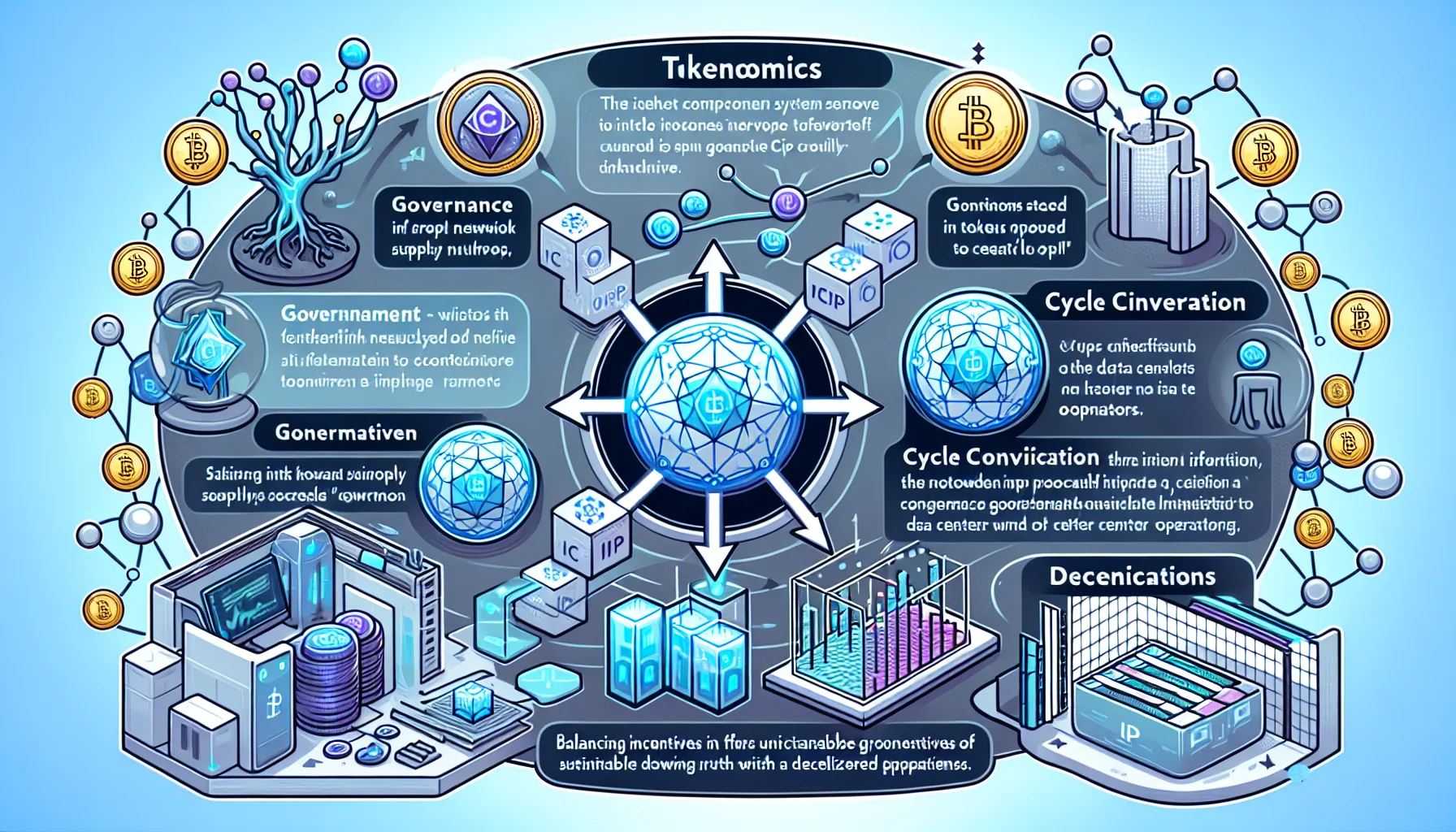
ICP (Internet Computer Protocol) employs a nuanced and multifaceted tokenomics structure designed to balance network participation, decentralized governance, and resource consumption. Unlike many crypto assets, ICP tokens serve multiple interdependent roles within the protocol, including governance, computational resource allocation, and creating economic incentives. However, this complexity introduces unique challenges and trade-offs that warrant critical examination.
Utility of ICP Tokens
At its core, ICP is a utility token that plays three key functions:
-
Governance: ICP holders can stake their tokens in the Network Nervous System (NNS), a decentralized governance system, to create "neurons." These neurons enable holders to propose, accept, or reject protocol upgrades and earn rewards for active participation. However, staking requires locking up tokens for a chosen period, potentially reducing liquidity.
-
Cycle Conversion: ICP can be converted into cycles, which are used to power decentralized applications (dApps) running on the Internet Computer. This conversion introduces a unique deflationary mechanism tied to network usage. However, critics point out that the dual-token model (ICP and cycles) could introduce user experience friction, especially for those unfamiliar with the conversion process.
-
Incentive Mechanisms: Beyond governance and cycles, ICP incentivizes data center operators (called "node providers") to maintain and expand the infrastructure. This aligns compensation with the protocol's long-term viability but also makes reward allocations a point of scrutiny, as they must continuously balance incentives with inflationary effects.
Inflation Dynamics and Supply Model
ICP employs an inflationary supply model to fund governance rewards, node provider incentives, and overall ecosystem growth. Inflation is dynamic and designed to decrease as the network scales. While this mechanism ensures token distribution for active contributors, critics argue that the inflation rate may dilute long-term holders if network adoption does not grow in tandem. Furthermore, the precise calculation of rewards remains subject to centralized decision-making through the NNS, which some participants perceive as a risk to decentralized principles.
Challenges in Decentralized Governance
While the NNS enables governance token holders to steer the protocol's direction, the system has been criticized for its complexity and reliance on hyperactive participation. To earn rewards, neurons must vote on nearly all proposals, which can overwhelm casual holders or lead to disproportionate influence by automated or professionally managed neurons. This raises concerns about decentralization and whether true democratic governance can be sustained as the network matures.
Balancing Incentives and Sustainable Growth
The tokenomics of ICP ultimately hinge on achieving equilibrium between incentivizing contributors and maintaining a healthy, sustainable economy. Changes to token issuance, cycle conversion rates, or staking requirements are all subject to governance proposals, but rapid decision-making risks alienating stakeholders or introducing volatility into the ecosystem. As a result, ICP's tokenomics reflect both its ambition to create a Web3-native infrastructure and the inherent challenges of aligning diverse economic incentives in a decentralized framework.
ICP Governance
Governance in Internet Computer (ICP): Frameworks, Challenges, and Decentralization
The governance model of Internet Computer (ICP) hinges on its Network Nervous System (NNS), a sophisticated, algorithmic mechanism designed to manage the protocol and ensure decentralized decision-making. The NNS operates as the central brain of the network, enabling stakeholders to propose, discuss, and vote on critical upgrades, parameter changes, and wider development activities. On paper, this system exemplifies the ambition for decentralized governance, but in practice, it introduces notable complexities and areas of contention within the community.
The Role of Neurons and Voting Power
ICP governance centers around active participation through staking tokens, which generates "neurons." These neurons provide voting power and a degree of control over the network’s trajectory. Staking duration directly correlates to the weight of voting power—longer lock-in periods result in greater influence on proposals. While this incentivizes long-term commitment, critics argue that high entry barriers disproportionately benefit institutional stakeholders or wealthy participants, potentially skewing the governance model in favor of centralized power structures.
Moreover, the "follow neuron" mechanism, which allows users to delegate their vote to other trusted neurons, adds another layer of practicality but highlights a double-edged challenge: efficient decision-making versus passive participation. Users relying too heavily on follow neurons may undermine the ideal of engaged, decentralized governance by clustering influence into a limited subset of trusted entities.
Proposal Processes and Controversy in Decision-Making
The governance proposals handled by the NNS extend broadly—ranging from technical upgrades to setting protocol-level fees. However, one area of recurring contention revolves around proposal spam. Given the open nature of submitting proposals, the network has periodically been subjected to low-quality or spammy submissions, diluting governance discussions and increasing operational costs. While initiatives have aimed to mitigate this issue, it remains an Achilles’ heel, forcing the community to balance openness with the efficiency of the governance process.
Tokenomics Influence on Voting Dynamics
The inflationary nature of staking rewards within ICP complicates governance further. Vaulting ICP into neurons not only grants voting power but creates a reward stream tied to network participation. However, this monetary design incentivizes voting behavior that may prioritize reward maximization over network sustainability. Short-term, self-serving decisions risk undermining the collective health of the protocol unless carefully managed by both participants and the NNS itself.
Decentralization Trade-Offs
Despite the NNS’s ambition to deliver robust, decentralized governance that scales with the protocol, critics question whether the design fully achieves this ethos. The reliance on large token holders and delegation mechanics often provokes discussions about effective decentralization versus economic centralization. As the network grows, its ability to maintain equitable governance while fostering active engagement remains a crucial metric by which ICP's governance framework will ultimately be judged.
Technical future of ICP
Technical Developments and Road Map for Internet Computer (ICP)
Advances in Chain Key Cryptography
Internet Computer (ICP) leverages a unique cryptographic framework known as Chain Key Cryptography, which facilitates the network's ability to scale securely and decentralize control over its infrastructure. Recent progress includes enhanced capabilities for securely rotating cryptographic keys without halting the system—significantly improving both efficiency and resistance to potential exploits. However, the complexity of maintaining such cryptographic innovations has raised concerns among critics about potential vulnerabilities from poorly understood attack vectors, as formal, large-scale security audits remain relatively limited.
Canister Smart Contracts: Expanding Utility
ICP is innovating with its canister-based smart contracts, designed to offer greater scalability compared to traditional Ethereum-style smart contracts. Improvements in storage efficiency and computation isolation within canisters are also advancing deployment for Web3 interfaces and enterprise-grade applications. Despite these optimizations, some developers report constraints tied to memory limits, requiring frequent refactoring of applications to fit within the technical confines.
Integration of Threshold ECDSA
The integration of Threshold ECDSA enables ICP to natively support Bitcoin and Ethereum wallets without requiring third-party bridges. This development enhances interoperability and opens direct pathways for cross-chain functionalities. However, the computational intensity of Threshold ECDSA has drawn critiques regarding its sustainability and network-wide resource optimization. Continued refinement will be necessary to minimize overhead as adoption scales.
Decentralized Compute Standardization
A notable focus of the ICP technical roadmap includes pushing towards de facto standards for decentralized compute. Through initiatives like boundary node diversification and autonomous subnet creation, the network is targeting better control distribution and reduced collusion risks. That said, the adoption of wider standards has been slow, and questions remain regarding whether existing governance mechanisms can adequately drive community-wide consensus for such technical steps.
Scalability and Subnet Architecture
ICP’s novel subnet architecture allows for network scaling by splitting workload across independent subnet blockchain groups. Recent updates have increased the subnet-to-subnet messaging efficiency, but scaling has exposed challenges in maintaining homogeneous security levels across all subnets. Optimizing for scalability without sacrificing decentralization or uniform reliability remains a fundamental hurdle.
Developer Tooling and Ecosystem Growth
Developer tooling for ICP has seen progress, including improved SDKs for Rust and Motoko, ICP’s native programming language. While such advancements ease onboarding for developers, adoption remains hindered by limited documentation and learning resources compared to more established ecosystems like Ethereum or Solana.
Comparing ICP to it’s rivals
Comparing Internet Computer (ICP) to Ethereum (ETH): Key Differences and Considerations
When comparing Internet Computer (ICP) to Ethereum (ETH), it’s essential to evaluate core distinctions in architecture, design goals, and technical implementations that define their respective approaches to blockchain technology.
Architecture and Smart Contract Execution
Ethereum operates as a general-purpose blockchain designed around its Ethereum Virtual Machine (EVM), which supports Turing-complete smart contracts written in languages like Solidity and Vyper. This architecture is well-established and benefits from a vast ecosystem of developers, tools, and documentation. However, its reliance on Layer 2 scaling solutions to address network congestion and throughput challenges is often seen as a trade-off, introducing increased complexity and potential fragmentation.
In contrast, ICP’s architecture is built on the concept of "canisters," which extend the smart contract concept by integrating computation and state into a single, scalable model. This allows canisters to process high volumes of transactions directly on the protocol without requiring external Layer 2 solutions. While this approach may provide enhanced scalability, some critics highlight that canisters are more complex to develop and debug compared to traditional EVM-based smart contracts. Developers must use Motoko or Rust, less familiar programming languages compared to Solidity, which could deter adoption.
Scalability and Decentralization Trade-Offs
Ethereum’s roadmap emphasizes modularity and progressive decentralization, notably via its transition to the proof-of-stake consensus model with the Ethereum 2.0 upgrade. Despite offering significant energy efficiency improvements, Ethereum still grapples with scalability issues. While transaction bottlenecks are alleviated through rollups and sharding, they create a bifurcation between the base layer and rollup-processed data, raising key questions about cost predictability and user experience across different layers.
ICP, on the other hand, positions itself as an all-in-one solution for web-scale applications. Its unique consensus mechanism, the Threshold Relay, aims to combine scalability with decentralization. However, its heavy reliance on the Network Nervous System (NNS) governance model has raised concerns in the crypto community about centralization risks. Critics argue this high level of governance hierarchy could undermine one of blockchain’s core tenets: trust minimization.
Development Ecosystem and Adoption
Ethereum has a clear first-mover advantage with a rich ecosystem of DeFi, NFTs, and dApps, alongside robust tooling and community support. This stands in contrast to ICP, which, despite its innovative claims, is relatively nascent in comparison. Skeptics point out that ICP’s ecosystem has yet to achieve comparable traction, with fewer high-profile applications and frameworks available for developers to build upon, limiting wider adoption and experimentation.
Consensus and Storage Costs
Ethereum’s storage costs remain a challenge for many developers due to its high on-chain resource fees, driven by demand and competition for gas. ICP differentiates itself by integrating Web3-style hosting functionality, offering scalable and cost-effective storage aimed at driving down application hosting costs. Critics, however, note that this advantage depends on ICP’s long-term ability to sustain such economics at scale, a question skeptical observers find critical yet currently unanswered.
ICP vs. SOL: A Detailed Comparison
In the world of blockchain innovation, Internet Computer (ICP) and Solana (SOL) are two distinct players that often draw comparisons due to their focus on scalability, developer ecosystems, and infrastructure. However, their differences in architecture, use cases, and design philosophies create clear distinctions, especially for developers and crypto investors seeking unique value propositions.
Scalability and Transaction Speed
Solana is widely recognized for its ultra-fast transaction speeds, facilitated by its Proof of History (PoH) consensus mechanism combined with Proof of Stake (PoS). This hybrid model allows Solana to process up to 65,000 transactions per second (TPS) under ideal conditions, positioning it as one of the fastest blockchains currently in operation. By contrast, ICP focuses on scaling computational power through its novel Chain Key Technology, enabling smart contracts to run at web speed and allowing for scalability across dApps on the network. While ICP takes a broader aim at decentralizing the web infrastructure itself, Solana's lead in raw transaction throughput makes it an attractive choice for projects requiring ultrafast execution, such as DeFi protocols.
That said, Solana's high TPS has occasionally come at the cost of network reliability. Outages and downtime have plagued its network multiple times, raising concerns among developers and businesses about long-term stability. ICP's use of independent computation subnets may not match Solana’s speed but offers potentially stronger reliability through its distributed structure, albeit with some trade-offs in complexity.
Decentralization and Architecture
One of the principal differences between ICP and Solana lies in their approach to decentralization. Solana has faced ongoing criticism regarding its validator node distribution, as a significant concentration of nodes appears to be controlled by a few entities. While this setup enables better performance, it introduces centralization risks that deviate from core blockchain principles.
ICP, on the other hand, builds its network using Network Nervous System (NNS), a decentralized governance system designed to oversee its protocol. Though ICP's approach prioritizes decentralization, its technical complexity and hardware requirements for node operators may hinder faster adoption compared to Solana's more accessible validator setup.
Ecosystem Focus
Both blockchains have thriving ecosystems; however, Solana has attracted a significant number of NFT projects, DeFi protocols, and gaming applications partly due to its cost-efficiency and low transaction fees. ICP, while competitive on costs, stands out for aiming to replace traditional cloud infrastructure, a goal that diverges from Solana's niche focus. Whether ICP's ambitious strategy pays off remains a topic of debate, but Solana’s dedicated approach to high-speed dApp development has cultivated rapid community growth.
Development Challenges
Solana’s high-performance network requires substantial hardware investment for validators, which has deterred smaller participants and contributed to centralization concerns. Additionally, its frequent network interruptions have sowed unease regarding operational reliability. Meanwhile, ICP developers may face challenges integrating Chain Key Technology and adapting to its unconventional model, which diverges significantly from the traditional smart contract frameworks many developers are accustomed to.
While Solana boasts an edge in speed and dApp adoption, its challenges with decentralization and reliability stand in stark contrast to ICP’s focus on foundational decentralization, albeit with steeper learning curves for developers.
ICP vs. ADA: A Technical Perspective on Layer 1 Competitors
When comparing Internet Computer (ICP) with Cardano (ADA), the fundamental distinction emerges in how each blockchain approaches scalability, smart contract functionality, and decentralization. Both projects position themselves as next-generation layer 1 solutions, yet their architectures reflect vastly different philosophies.
Cardano employs a research-driven, heavily peer-reviewed methodology with a multistage development roadmap (e.g., Byron, Shelley, Goguen). Its consensus mechanism, Ouroboros, is a proof-of-stake (PoS) protocol that prioritizes energy efficiency and security while implementing delegation as a key feature for decentralization. In contrast, ICP utilizes its unique Chain Key Cryptography to enable Web3 applications to run directly on the internet at speeds comparable to traditional web services, integrating high-speed consensus and scalability into a single, seamless protocol. While this approach allows ICP to target traditional web developers and onboard those unfamiliar with blockchain intricacies, some find its cryptographic innovations challenging to audit and understand compared to ADA's rigorously scrutinized PoS methods.
From a smart contract perspective, ADA operates with Plutus, Cardano’s dedicated smart contract framework built on Haskell. This framework allows for functional programming paradigms that appeal to developers seeking formal verification and reduced susceptibility to vulnerabilities. However, Plutus requires developers to have specialized knowledge in Haskell, which can limit its adoption. ICP, on the other hand, supports smart contracts through its Motoko programming language, alongside support for mainstream languages like Rust. While more accessible in some respects, ICP’s ecosystem is newer, and developer tooling, onboarding, and ecosystem support are still growing when compared to ADA's established developer communities.
Scalability is another core area of comparison. Cardano's scalability largely depends on Hydra, its layer 2 solution, which leverages state channel technology to process transactions off-chain. This achieves significant transaction throughput without compromising network security. However, Hydra's impact still hinges on its adoption and implementation. ICP, conversely, operates entirely within its Layer 1 protocol, boasting scalable performance through its subnet model. Subnets act as independent blockchains within the ICP network that interoperate seamlessly, enabling horizontal scaling. Critics, however, raise concerns over the network’s dependency on the Internet Identity system for access, which introduces complexities around privacy and user control.
Ultimately, the ideological split between a rigorously peer-reviewed blockchain like ADA versus the high-performance, cryptographic innovation of ICP highlights the diversity of approaches in layer 1 development. Each comes with trade-offs in usability, decentralization, and adoption pathways, fulfilling different needs within the blockchain ecosystem.
Primary criticisms of ICP
Primary Criticism of Internet Computer Protocol (ICP)
The Internet Computer Protocol (ICP) has garnered significant attention within the crypto community, but this exposure has also highlighted several key criticisms of the project. Despite its ambitious goal of decentralizing the internet, many skeptics point to structural, technical, and governance-related issues that undermine its potential.
Governance Centralization Concerns
A recurring criticism of ICP is the centralized nature of its governance. While the project is marketed as a decentralized network, the Network Nervous System (NNS)—the algorithmic governance system—places substantial control in the hands of its founding organization, the Dfinity Foundation, and entities closely affiliated with them. Critics argue that this concentration of power undermines the ethos of decentralization, which is a foundational principle for blockchain and Web3 projects. The perceived lack of transparency in NNS decision-making processes has further fueled skepticism.
Poorly Managed Tokenomics
ICP's tokenomics have also been a point of contention. Market participants have criticized the initial token distribution, suggesting that a large portion was allocated to insiders, such as early investors, developers, and Dfinity itself. This uneven distribution has drawn allegations of unfairness and questions about the project's commitment to community-driven development. Furthermore, the high initial circulating supply created significant downward price pressure aside from any speculative demand, which some see as an indicator of poor design in its economic model.
Overly Complex Architecture
ICP’s design architecture is often criticized for being unnecessarily complicated. Its use of "canisters" as an alternative to smart contracts adds a layer of complexity that some developers find off-putting. Critics argue that this added complexity limits adoption, as it requires developers to upskill significantly to build on the platform. This steep learning curve has, thus far, hindered broader engagement from the developer community compared to other blockchain ecosystems like Ethereum or Solana.
Community Frustration with Developer Experience
ICP's focus on building a decentralized internet is bold, but its developer tooling and documentation have left much to be desired. Developers frequently highlight a lack of clear, accessible resources, as well as the relative immaturity of its developer ecosystem. This has created friction in attracting broader talent to build on the platform, particularly when compared to more mature ecosystems with pre-existing infrastructure.
Resource-Intensive Consensus Mechanism
Another technical criticism revolves around ICP’s consensus mechanism. While it delivers high throughput, it is resource-intensive, raising questions about scalability and sustainability over time. Detractors have compared this to more energy-efficient alternatives, arguing that ICP's design sacrifices environmental responsibility to achieve performance gains.
These points of criticism highlight persistent concerns that could impact ICP's adoption and position within the highly competitive blockchain ecosystem.
Founders
Exploring the Founding Team Behind ICP (Internet Computer Protocol)
The Internet Computer Protocol (ICP) was developed by DFINITY, a Swiss-based nonprofit foundation. The founding team behind this ambitious blockchain project is composed of a diverse group of technologists, cryptographers, and computer scientists, led by Dominic Williams, who serves as the project's founder and Chief Scientist.
Dominic Williams brings significant visibility to the project due to his robust background in distributed computing and cryptocurrency. Prior to DFINITY, Williams contributed to several blockchain startups and created concepts like Threshold Relay and Probabilistic Slot Consensus, which underpin the Internet Computer’s unique consensus mechanism. However, his approach to explaining the technical aspects of ICP, coupled with the project’s ambitious goal to “decentralize the internet,” has drawn both praise and skepticism from the wider crypto community. Some critics consider elements of his vision overly grandiose, raising concerns about whether such goals are achievable within a realistic timeframe.
Beyond Williams, there are several key contributors to ICP, including cryptography experts like Timo Hanke, a former Bitcoin miner who developed AsicBoost, an efficiency optimization for BTC mining. While Hanke’s expertise has been instrumental in creating the secure foundations of the Internet Computer, his association with controversial aspects of Bitcoin’s mining ecosystem has occasionally drawn scrutiny.
The team also includes prominent researchers such as Andreas Rossberg, who is notable for co-designing WebAssembly (Wasm), a critical technology leveraged by the Internet Computer for smart contract execution. By integrating Wasm, ICP has built itself on cutting-edge technology, though critics argue that such a heavy reliance on a relatively new standard could create bottlenecks if key adoption or performance improvements fail to materialize.
DFINITY’s hiring strategy has often focused on attracting talent from academia and leading tech companies, including Google, Microsoft, and IBM. While this approach has resulted in a technically elite team, some in the crypto community question whether the group prioritizes academic idealism over practical implementation and user adoption. Moreover, the team’s insistence on maintaining considerable control over the Internet Computer project has caused some to raise concerns about how decentralized the governance actually is.
One of the most controversial topics surrounding the founding team has been their handling of ICP's initial token distribution. With significant allocations reportedly retained for early contributors and insiders, skeptics have questioned whether this aligns with the decentralized ethos the project aims to champion. This aspect continues to fuel debate, particularly among proponents of more egalitarian tokenomics in the crypto space.
Authors comments
This document was made by www.BestDapps.com
Sources
- https://dfinity.org/whitepaper/
- https://dfinity.org/faq/
- https://internetcomputer.org/docs/current/introduction/what-is-icp/
- https://medium.com/dfinity
- https://sdk.dfinity.org/docs/developers-guide/
- https://github.com/dfinity
- https://wiki.internetcomputer.org/wiki/Internet_Computer
- https://internetcomputer.org/tokenomics/
- https://internetcomputer.org/developers/motoko/
- https://forum.dfinity.org/
- https://docs.internetcomputer.org/
- https://dashboard.internetcomputer.org/
- https://internetcomputer.org/developers/rust/
- https://nns.ic0.app/
- https://internetcomputer.org/roadmap/
- https://ic.assist.tools/
- https://medium.com/dfinity/architecture-overview-internet-computer-separates-computation-and-storage-6f4503b8d032
- https://medium.com/dfinity/exploring-internet-computer-governance-how-the-neuron-economics-work-in-the-nns-3c6eeb007bea
- https://sdk.dfinity.org/docs/language-guide/motoko.html


