History of ICP
The History of Internet Computer (ICP): Pioneering Decentralized Cloud Computing
The origins of Internet Computer (ICP) can be traced back to 2016, when the DFINITY Foundation, led by founder Dominic Williams, began conceptualizing a decentralized protocol to overcome the limitations of traditional blockchain ecosystems. The project aimed to create a “blockchain that runs at web speed” with the ability to host scalable decentralized applications and smart contracts. From its inception, ICP set ambitious goals: to decentralize the internet by replacing traditional IT infrastructure with blockchain-based solutions. This bold vision attracted significant attention from both venture capital and the broader crypto community.
The early stages of ICP’s development were marked by groundbreaking cryptographic advancements. The team introduced Chain Key Technology, which enables the Internet Computer to run efficiently, execute updates in milliseconds, and manage nodes seamlessly across its decentralized network. Such innovations positioned ICP as a potentially disruptive force in the blockchain space, and its promise of unprecedented scalability led to a surge in funding. High-profile backers included Andreessen Horowitz and Polychain Capital. However, much of this early momentum created sky-high expectations that later became a point of contention among critics.
ICP’s public debut came in May 2021, following an extended period of internal testing and development. Its launch was met with enthusiasm due to its claims of transforming how the internet operates, but the rollout wasn’t without challenges. Many in the crypto-savvy audience noted issues surrounding its network architecture, including centralized control concerns stemming from the DFINITY Foundation's role in managing network governance through its Network Nervous System (NNS). This led to debates about whether ICP could fully adhere to the principles of decentralization, a core tenet of blockchain innovation.
Another significant historical point was the post-launch token distribution model. Critics highlighted problems stemming from the allocation of ICP tokens, which were heavily concentrated among early investors and team members. This sparked accusations of inequitable distribution and questions about potential price manipulation. Additionally, concerns over the complexity of operating on the Internet Computer network created barriers to adoption. Skeptics pointed out that while the technology itself seemed promising, its steep learning curve could hinder widespread developer engagement.
Despite these hurdles, ICP rapidly cemented itself as a major player in the crypto space. By tying its history to a bold, albeit controversial, vision of decentralizing the web, it remains a project steeped in both potential and debate.
How ICP Works
How Internet Computer (ICP) Works: Understanding Its Core Technology
Internet Computer (ICP) operates as a decentralized network designed to extend the functionality of the internet through smart contracts and decentralized applications (dApps). Unlike traditional blockchain networks, it introduces a unique architecture that integrates cutting-edge cryptography, novel consensus mechanisms, and on-chain governance. Here's a closer look at the foundational elements driving ICP's operation:
Chain Key Technology and Canister Smart Contracts
At the heart of ICP lies its Chain Key Technology, a cryptographic innovation that allows for seamless and scalable system operations. This technology enables the Internet Computer to manage a singular, unified chain instead of multiple shards or layers. The system splits computations across nodes while enabling fast, low-latency contract execution.
These computations are processed within canister smart contracts, which are far more flexible than standard smart contracts seen on other platforms. Canisters bundle both software code and state, allowing them to handle persistent data directly. They auto-scale and upgrade without disruption, making them ideal for hosting complex applications such as DeFi protocols, social media platforms, and enterprise software.
Autonomous Governance Through NNS
ICP’s decentralized governance is managed via the Network Nervous System (NNS), an on-chain mechanism that oversees protocol upgrades, node operations, and economic adjustments. Users stake ICP tokens in the NNS to create neuron-like structures, enabling them to vote on governance proposals. While this system allows decentralized control, it also consolidates significant power into the hands of major token holders, raising potential concerns about wealth concentration and governance centralization.
Consensus and Decentralized Network Framework
The protocol employs a unique consensus mechanism optimized for speed and scalability. Its Threshold Relay consensus enables nodes to produce randomized signatures, ensuring fast block finality. However, the downside is its reliance on trusted hardware and cryptographic techniques, which increase the barrier to entry for node operators. This raises questions about true decentralization, as dependence on specialized equipment and proprietary designs may limit broader participation in the network.
Motoko Language for Development
ICP supports application development through Motoko, its native programming language designed specifically for blockchain. While Motoko is tailored to the Internet Computer, it lacks widespread adoption compared to other well-known languages like Solidity or Rust. This introduces a potentially steep learning curve for developers accustomed to more popular ecosystems.
By leveraging this multi-faceted architecture, ICP aims to address the scalability challenges and performance bottlenecks of traditional blockchain networks. However, its reliance on complex cryptographic techniques, proprietary elements, and centralized governance at higher levels could hinder its broader adoption and raise concerns over its ability to remain truly decentralized.
Use Cases
Use Cases for Internet Computer Protocol (ICP)
The Internet Computer Protocol (ICP) is designed to address critical shortcomings in current blockchain ecosystems, and its use cases reflect that ambition. These include decentralized application (dApp) deployment, Web3 services, interoperability between blockchains, and scalable cloud-like solutions. While promising in scope, real-world adoption of these use cases has raised questions around feasibility, complexity, and ecosystem maturity.
1. Building Decentralized Applications (dApps)
ICP positions itself as a platform for developers to create fully decentralized applications without relying on traditional Web2 infrastructure such as AWS, Google Cloud, or Azure. By running smart contracts, called "canisters," directly on its decentralized network, ICP aims for complete autonomy from centralized intermediaries. This is particularly useful for building dApps like social media platforms, gaming ecosystems, and DeFi protocols. However, developers must navigate ICP's unique programming environment, leveraging Motoko or Rust. This can be limiting, as existing dApp creators in other ecosystems may face a steep learning curve transitioning to these languages.
2. Open Internet Services
One of ICP’s stated goals is enabling "open internet services," which are decentralized alternatives to traditional SaaS products. These services aim to be permissionless, censor-resistant, and solely governed by token holders. For example, decentralized social networks or enterprise tools hosted on ICP could theoretically offer greater user data privacy and transparency. Yet, achieving this vision has practical hurdles. User adoption can be uncertain, and scaling these services may be complex due to network architecture challenges and higher gas fees during high traffic periods.
3. Scalable Storage and Computation
ICP presents itself as an alternative to traditional cloud computing platforms, offering scalable storage and computation. This use case appeals directly to organizations looking for decentralized solutions for hosting websites, managing large data sets, or even running AI algorithms. However, while ICP offers unique cryptographic scalability built through its Chain Key Technology, questions remain regarding the cost-effectiveness and efficiency of long-term data storage when compared to conventional cloud providers. Additionally, critics highlight reliability as a potential issue, as decentralized hosting still depends on consensus and network participation.
4. Cross-Blockchain Interoperability
ICP is designed with interoperability in mind, striving to integrate seamlessly with other blockchain networks. This use case is crucial as the crypto ecosystem becomes increasingly multi-chain. For example, ICP has been working on connecting with Ethereum and Bitcoin networks to facilitate cross-chain smart contract operations without additional bridging layers. Nonetheless, achieving seamless interoperability is notoriously difficult. Integration bottlenecks and reliance on external protocols can slow adoption and raise security concerns.
5. Tokenized Governance and Decentralization
Using ICP tokens for decentralized governance is another major use case. Token holders can participate in network decision-making, such as upgrading protocol features or adjusting economic parameters. While this model empowers community-owned governance, it’s not without issues. Critics argue that token distribution heavily impacts decision-making fairness, and whales can potentially dominate governance processes, compromising decentralization.
Challenges With Real-World Adoption
For all its ambitious use cases, adoption of ICP faces significant challenges. While its broader vision aligns with the ideals of Web3, questions remain about scalability, cost metrics, accessibility for developers, and achieving adoption in a market saturated with competing blockchain platforms.
ICP Tokenomics
Detailed Analysis of ICP Tokenomics for Advanced Crypto Enthusiasts
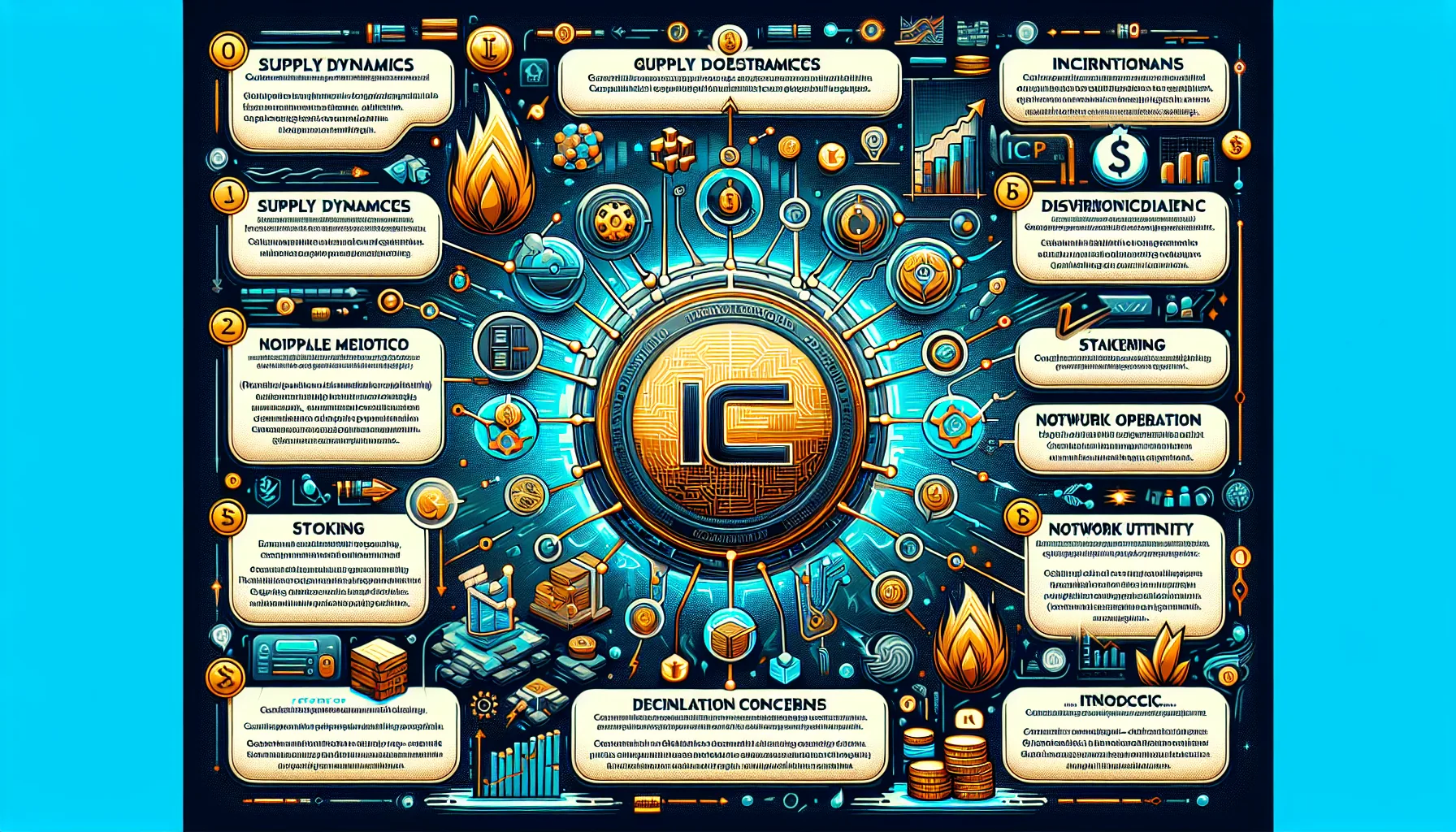
The tokenomics of Internet Computer Protocol (ICP) plays a critical role in its ecosystem, enabling governance, network operation, and incentivization. The intricacies of its design reveal both strengths and challenges for participants and investors engaged with this crypto asset.
Supply Dynamics and Distribution Mechanics
One of the standout aspects of ICP tokenomics is its supply management mechanism. At genesis, ICP tokens were distributed across multiple stakeholders, including developers, early contributors, Node Providers, and the Internet Computer Association (ICA). A significant portion is held in the Network Nervous System (NNS), the protocol’s algorithmic governance mechanism. However, the concentration of tokens in large institutional hands has drawn criticism from decentralized governance purists, as it potentially centralizes voting power on critical decisions.
The continuously evolving circulating supply is another critical feature. ICP tokens regularly cycle between locking (in neurons for staking and governance purposes) and unlocking (returning to liquid supply). This mechanism incentivizes long-term participation but may contribute to uncertainty in calculating actual inflation rates and supply metrics.
Staking and Governance Through the NNS
Holders can lock their ICP tokens into neurons, which are vehicles for staking and voting in the NNS. The reward structure for staking promotes longer lock-up durations—potentially up to eight years—for higher yields, which theoretically aligns participants with the network’s success. While this creates strong incentives for long-term engagement, it also raises questions about liquidity access for stakeholders who might reconsider their position amidst unexpected events.
Critics argue that the lengthy lock-up periods expose investors to potential opportunity costs and invite speculation about the actual return on investment compared to other blockchain staking models. Furthermore, since neuron rewards come in the form of new ICP tokens, the tokenomics introduces an inflationary component that could impact purchasing power unless offset by consistent demand growth or token lock-in.
Network Utility and Token Burning
ICP tokens are required to convert into “cycles,” the fuel for computation and resource usage on the Internet Computer. This conversion introduces a natural deflationary pressure by removing tokens from circulation. However, the trajectory of this burn mechanism depends heavily on the network’s adoption. Should demand for computational cycles falter, the deflationary aspect of ICP tokenomics might be insufficient to counter inflationary pressures from staking rewards.
Additionally, the conversion rate of ICP to cycles is algorithmically determined and subject to fluctuations, which could create unpredictability for developers and enterprises building on the Internet Computer. This potential volatility in operational costs might affect the network's wider adoption in competitive DeFi and Web3 environments.
Tokenomics Challenges and Decentralization Concerns
Despite its innovative framework, ICP’s tokenomics does face scrutiny, particularly regarding its initial distribution and governance centralization. The NNS, while a powerful tool for decisions, consolidates control among a small subset of stakeholders, which may deter those favoring more equitable governance systems.
Token inflation due to staking rewards also poses long-term sustainability questions. Unless network adoption accelerates to offset inflationary forces, participants could experience reduced value per token over time. This dynamic makes understanding the economic model’s risks and trade-offs crucial for anyone interacting with the ICP ecosystem.
ICP Governance
ICP Governance: Exploring Decentralized Decision-Making and Challenges
The Internet Computer Protocol (ICP) employs a unique governance model built around the Network Nervous System (NNS), a decentralized platform that enables token holders to shape the future of the protocol. This layer of governance ensures that decisions impacting the ecosystem are driven by stakeholders rather than centralized entities. However, while the system is robust, it brings its own complexities and challenges to the table.
The Role of ICP in Governance
ICP tokens are not just the currency of the Internet Computer but also the backbone of its governance framework. Token holders can lock their ICP into "neurons," which empower them to actively participate in decision-making. These neurons act as voting units, allowing stakeholders to vote on proposals or set up configurations to vote automatically through "follow neurons." While this creates a layer of inclusivity and decentralization, it requires participants to dedicate resources and attention to actively engage with the ecosystem.
Proposal and Voting Mechanics
The NNS governs a wide array of network operations, from protocol upgrades and economic adjustments to node rewards and software updates. Proposals submitted to the system are open for community voting, and decisions are executed automatically if they are approved. Voting power is determined by the number of ICP tokens staked and the length of time they are locked, emphasizing the influence of "long-term" participants. While this incentivizes commitment, it can also marginalize smaller or newer stakeholders who lack considerable token holdings.
Power Dynamics and Centralization Risks
Despite its decentralized ethos, ICP governance has drawn criticism for potential centralization risks. Larger token holders or entities controlling significant neurons wield disproportionate influence over decision outcomes. Additionally, the "follow" feature—while convenient for those who do not wish to manually vote—can lead to vote concentration, as many participants align their voting preferences with prominent neurons or developers. This risks creating a governance environment that may skew towards centralized decision-making under the guise of decentralization.
Complexity and Barriers to Participation
Another challenge of ICP governance lies in its technical and conceptual complexity. For less-experienced participants, engaging with the NNS can feel overwhelming due to the need for direct involvement, sustained commitment, and understanding of advanced staking mechanisms. This raises concerns about participation inequities, as the model inherently favors stakeholders with high technical competency and extensive resources.
The Ever-Evolving Governance Landscape
As a protocol aimed at disrupting the centralized web, ICP governance reflects a tension between decentralization goals and the practical implementation of such a system. Dynamic by design, the Internet Computer Protocol continues to refine its governance mechanisms to address inequities and maintain the integrity of its decentralized mission. Nonetheless, navigating these challenges remains crucial for the system's continued growth and credibility.
Technical future of ICP
Internet Computer (ICP): Technical Developments and Roadmap
Expansion of the Internet Computer Protocol
The Internet Computer (ICP) network has continued to implement advancements aimed at reshaping the blockchain ecosystem. One of its key ongoing technical focuses involves optimizing the scalability of its network without sacrificing security or decentralization. This is being achieved through improvements to its “chain key cryptography,” enabling subnets (or independent blockchain shards) to process transactions in parallel. This architectural model reduces bottlenecks, allowing the network to accommodate an increasing number of applications and users.
Efforts are also underway to enhance the network's ability to support general-purpose smart contracts — known as “canisters” on ICP. Best-in-class tooling for canister development using Motoko and Rust is being prioritized, with upgrades to developer frameworks to improve accessibility and efficiency. However, there have been concerns within the developer community regarding the steep learning curve associated with Motoko, ICP’s domain-specific programming language, which could limit adoption.
Integration of Bitcoin and Other Networks
ICP’s integration of Bitcoin through a cryptographic method known as “Chain Key Signing” deserves specific attention. Unlike traditional bridge mechanisms, this technique avoids the need for wrapping tokens, providing a trustless means for interacting with Bitcoin directly within ICP’s ecosystem. This development not only reinforces cross-chain interoperability but also uniquely positions ICP for decentralized finance (DeFi) use cases involving the Bitcoin network. The roadmap indicates further ambitions to extend this integration model to other major blockchain ecosystems. However, scaling such integrations without introducing centralization risks remains a challenge for developers.
Decentralized Storage and Web2 Disruption
ICP’s primary innovation surrounds decentralized data storage directly on its blockchain architecture, enabling “true” on-chain applications without reliance on external storage solutions like Amazon Web Services or IPFS. Recent enhancements focus on storage efficiency, reducing network overheads while ensuring redundancy and fault tolerance via network-wide replication. Developers building on ICP face limitations, however, as high costs for larger-scale storage requirements could undermine the economic viability of sizable projects.
Governance and Decentralization Improvements
ICP’s Network Nervous System (NNS), its algorithmic governance protocol, is continuing to evolve. Enhancements targeting voting scalability and preventing voter fatigue are a key priority. Critics of ICP’s governance have noted centralization concerns, as decisions can be heavily influenced by large stakeholders, exposing governance mechanisms to potential collusion. Addressing these issues remains a long-term concern to ensure the network's decentralization goals align with its technical development roadmap.
Developer Ecosystem and SDK Enhancements
Finally, expansions to ICP’s SDKs and APIs have been announced. These upgrades aim to reduce development friction by allowing for more seamless integration of off-chain and on-chain components. Debugging tools, deployment pipelines, and middleware compatibility are also actively being improved. Despite such advancements, the current developer ecosystem lags behind those of Ethereum and Solana in terms of tooling maturity and community size, underscoring a gap that may slow adoption.
Comparing ICP to it’s rivals
ICP vs. FIL: A Deep-Dive into Protocol Strengths and Differences
When comparing Internet Computer (ICP) and Filecoin (FIL), the most striking difference lies in their core use cases. ICP positions itself as a decentralized cloud computing platform capable of hosting applications, websites, and even enterprise systems directly on a blockchain-based infrastructure. In contrast, FIL focuses on creating a decentralized storage network for efficient data retrieval and secure file storage. While both aim to revolutionize Web3 infrastructure, their approaches cater to vastly distinct needs in the crypto ecosystem.
Infrastructure Focus: Computation vs. Storage
ICP’s architecture integrates computational capabilities directly into its blockchain protocol. This allows developers to build applications that operate natively on the blockchain without traditional intermediaries like hosting services or centralized cloud systems. Filecoin does not support computation; its focus is instead on incentivized data storage and retrieval using an open marketplace. ICP’s Internet Identity system and smart contract model (known as canisters) build a foundation for seamless application development. FIL, however, is tailored for individuals and enterprises needing decentralized storage solutions, with retrieval times and cost efficiency being its primary objectives. Simply put, ICP facilitates running applications, whereas FIL optimizes decentralized storage.
Scalability: Trade-Offs and Bottlenecks
ICP has been criticized for its high complexity and resource dependence, particularly when it comes to reproducing its computational model across subnets (its version of sharding). Network governance is also considered relatively centralized due to the role of the Network Nervous System (NNS). For FIL, scalability is inherently tied to its storage providers' capacity. However, achieving high retrieval speeds for everyday use remains challenging, as network latency can become a bottleneck depending on the geographic dispersion of its nodes. The reliance on Proof-of-Replication and Proof-of-Spacetime occasionally introduces inefficiencies compared to legacy storage systems.
Token Model Differences
The economics of ICP and FIL further delineate their purposes. ICP’s token powers the operation of canisters and network governance, effectively fueling computational costs. Yet its tokenomics have faced scrutiny over their complex inflation schedule and utility dilution. FIL’s token model, on the other hand, revolves around incentivizing storage providers and penalizing them for failing to maintain data integrity. Critics of FIL argue that the upfront costs for storage providers—such as hardware investment and staking requirements—create entry barriers, potentially limiting decentralization.
Adoption Challenges
While ICP and FIL both target the Web3 space, adoption barriers differ markedly. ICP struggles with convincing developers and enterprises to migrate from established cloud infrastructures like AWS. FIL’s challenge lies in educating users on its decentralized storage benefits compared to solutions like IPFS or traditional cloud equivalents. Users often question whether FIL’s economic incentives justify its latency trade-offs for cold storage use cases.
By breaking down the specific approaches of each, it becomes clear that ICP and FIL are building complementary but fundamentally different functionalities for Web3 users.
Comparing ICP and AR: A Deep Dive into Decentralized Storage vs Web3 Infrastructure
When analyzing Internet Computer (ICP) alongside Arweave (AR), a key distinction emerges in their design philosophies and primary applications. While ICP is famously positioned as a general-purpose Web3 infrastructure that facilitates the building of decentralized applications (dApps) at scale, AR anchors itself as a permanent, decentralized storage layer. This difference in focus influences not only their technological architecture but also their target user bases and use cases.
Architectural Divergence: Smart Contracts vs Permaweb
ICP employs a unique architecture centered on its "canister" smart contracts, which are designed to enable end-to-end decentralized applications. These canisters encapsulate logic, data, and storage while running on ICP’s highly optimized blockchain. In contrast, Arweave’s value proposition hinges on its "blockweave" architecture, which builds a permanent, tamper-resistant ledger optimized for data storage. AR allows users to upload files or web pages (what it calls the "Permaweb"), storing them indefinitely through a distributed network of nodes.
The functionality gap is apparent when developers evaluate potential integrations. ICP caters to a broader range of decentralized computational tasks like hosting fully on-chain dApps, while AR shines as a niche player specialized in long-term, immutable storage needs such as archival use cases. This can lead to complementary use in some instances, but it also makes each less versatile in the other’s domain.
Consensus Models: Innovative, But Different Trade-offs
Arweave uses a novel Proof of Access (PoA) model, which incentivizes miners not just to validate transactions but also to replicate historical data, ensuring its "permanent" aspect. While this model is efficient for its purpose, its dependence on economical storage scaling remains a point of debate. ICP’s decentralized infrastructure, on the other hand, leverages its bespoke Network Nervous System (NNS) to govern consensus and system upgrades, but critics argue the NNS introduces governance centralization risks compared to more traditional consensus mechanisms.
Scalability vs Storage Economics
A key challenge for both networks stems from their growth trajectories. For ICP, scaling its usage to attract developers while maintaining its groundbreaking speed and accessibility is a major hurdle. On the flip side, AR is heavily reliant on the declining cost curve of physical storage to maintain economically sustainable "forever" guarantees—an assumption that may not hold universally. This could pose barriers for long-term adoption, especially if users require highly dynamic data or corrections to stored information.
In conclusion, ICP and AR operate in vastly different ecosystems within the broader crypto space, each with trade-offs arising from their technical and ideological frameworks. This makes head-to-head comparisons both complex and critical for informed stakeholders.
ICP vs SOL: Decentralization and Network Efficiency Compared
When comparing Internet Computer (ICP) to Solana (SOL), fundamental differences in their architecture, performance metrics, and decentralization approaches become immediately apparent. Both are often discussed in the context of building highly scalable, decentralized ecosystems, but their execution paths reveal contrasting strengths and weaknesses.
Scalability and Throughput: Contrasting Approaches
Solana has established itself as one of the fastest blockchains in the industry, utilizing its Proof of History (PoH) consensus mechanism. This allows for sub-second block finality and extremely high transaction throughput, well into the tens of thousands per second. In contrast, ICP employs Chain Key Technology, which facilitates seamless computation and scaling across nodes, though its performance in high-load scenarios often doesn't match Solana’s raw speed. However, Solana’s high-speed architecture comes at the cost of significant hardware requirements, favoring centralization due to the technical and financial barriers for running a validator node.
ICP, with its design prioritizing modularity and web-like scalability, demands fewer computational resources for node operators. This lowers the threshold for participation, aiming to keep the network more decentralized in intent. Yet, critics note ICP's decentralization model still raises questions, particularly around the control exerted by the Network Nervous System (NNS), which governs the ecosystem.
Cost Efficiency and Resource Dynamics
One of Solana’s most touted features is its low transaction costs. Despite handling immense data throughput, the transaction fees remain near negligible. ICP, on the other hand, leverages its novel "cycles" economy for resource consumption. While ICP's approach to computational scaling is innovative, it introduces complexity for developers, as they must adapt to an entirely new economic model that some argue can create friction when onboarding dApps.
Moreover, Solana’s low fees have at times worked against it, enabling spam attacks and overwhelming network resources. ICP mitigates this issue by pegging the cost of cycles to deterministic computations, making it harder to exploit its fee structure but potentially resulting in higher operational costs for more complex applications.
Resiliency and Network Downtime
Solana has faced notable incidents of network outages, drawing criticism regarding its resilience under stress. These outages often stem from its high-speed infrastructure's tendency to buckle under extreme congestion or malicious activity. ICP's intentionally decentralized computing focus sidesteps the specific bottlenecks experienced by Solana, but not without introducing its own concerns. Issues such as complexities surrounding governance decisions via the NNS create points of contention, as the central decision-making body arguably could undermine trust in the network’s autonomy.
In the end, while Solana and ICP both aim to solve the blockchain scaling trilemma, their differing approaches highlight trade-offs between decentralization, performance, and governance. Ultimately, this contrast is a focal point for developers deciding which ecosystem aligns best with their applications' needs.
Primary criticisms of ICP
Primary Criticism of ICP: Challenges Facing the Internet Computer Protocol
The Internet Computer Protocol (ICP) has garnered significant attention within the crypto ecosystem for its ambitious goal of decentralizing the internet. However, scrutiny reveals several critical issues that have sparked debate among seasoned industry participants. These points of criticism raise questions about its long-term viability and adoption within the broader blockchain community.
Centralization Concerns
One of the primary criticisms of ICP lies in its perceived centralization. While the project heavily markets itself as a decentralized network, much of the control resides with the DFINITY Foundation, the organization that oversees the protocol's development. The Network Nervous System (NNS), tasked with governance, has been criticized for being opaque and potentially allowing disproportionate influence by those holding significant ICP stakes. This raises doubts about whether ICP truly embodies the decentralized ethos central to blockchain technology.
Complexity of the Protocol
ICP's architecture is notably complex, and this has presented challenges for developers seeking to build upon the platform. The unique design, which involves a hierarchy of canisters rather than traditional smart contracts, requires developers to adopt an entirely new paradigm. Critics argue that this steep learning curve deters adoption and limits community contributions, which are vital for sustaining the growth and vitality of any blockchain ecosystem.
Tokenomics and Initial Distribution
ICP's initial token distribution is another contentious point, with claims of inequity during the early allocation. Critics highlight the extent of central ownership among insiders, including the DFINITY Foundation and venture capital backers. A significant concentration of tokens in the hands of a few parties raises concerns over market manipulation and undermines the decentralized narrative. Such dynamics can potentially deter retail and institutional participants wary of high-risk asset structures.
Scalability Trade-Offs
While ICP positions itself as a high-speed network capable of web-scale performance, detractors argue that this comes at the cost of decentralization and security. The reliance on proprietary technologies like "Chain Key Cryptography" has not been universally embraced, and some suggest it creates barriers to open-source collaboration. For many in the crypto community, the trade-offs ICP has made to achieve speed and scalability are seen as a deviation from blockchain's founding principles of trust and transparency.
Regulatory and Oversight Risks
Lastly, ICP has been scrutinized for its potential vulnerability to regulatory oversight, given its emphasis on re-imagining the internet. The ambition to challenge traditional cloud computing giants may attract unfavorable scrutiny from governments or regulators. In particular, its governance structure and partnerships could place it under the same legal framework as centralized tech firms, further muddying its decentralized claims.
Critiques of ICP remain a central focus for the wider community, shaping discussions on its standing in the competitive blockchain landscape.
Founders
Understanding the Founding Team Behind Internet Computer (ICP)
The Internet Computer (ICP) was brought to life by the DFINITY Foundation, a nonprofit organization based in Zurich, Switzerland. This ambitious project was led by founder Dominic Williams, an entrepreneur and cryptographic researcher with a history in building innovative technologies. While Williams’ reputation as a visionary in blockchain development is well-recognized, some in the crypto community have critiqued the foundation’s transparency, governance, and handling of the project’s roadmap.
Dominic Williams is known for his strong focus on theoretical computer science and blockchain scalability, which became the cornerstone of DFINITY’s objectives. However, his hands-on management style and dominance in decision-making have sparked debates about the centralization of authority. Critics often highlight the potential risks in having a single key figure shape the trajectory of a project purporting to champion decentralization.
The DFINITY Foundation's team consists of over 250 members, including cryptographers, theoretical computer scientists, and engineers from prestigious institutions such as MIT, Stanford, and ETH Zürich. Positively, this multidisciplinary team has propelled ICP’s technological innovations, like Chain Key Technology and WebAssembly integrations. Yet, despite the ambitious talent pool, skepticism has been raised over the prioritization of research outputs versus practical ecosystem development. For instance, persistent concerns linger about DFINITY's perceived lack of focus on fostering a robust developer community around ICP to sustain its ecosystem in the long term.
Another contention stems from how the funding and token distribution were handled during the foundation’s early stages. The majority of ICP tokens are allocated to team members, early contributors, and the DFINITY Foundation, leading to criticism about wealth centralization. Many in the crypto-savvy audience see this as misaligned with blockchain’s ethos of equitable distribution and permissionless innovation.
Though some applaud the grand vision of the ICP project, others question whether the founding team’s ambitions for a “world computer” could inadvertently limit engagement from grassroots contributors. Trust remains a recurring issue, particularly regarding how the team communicates updates and addresses delays in delivering key promises.
In summary, the founding team of ICP represents both a significant strength in technical expertise and a continued source of scrutiny within the blockchain community due to governance, centralization, and communication challenges.
Authors comments
This document was made by www.BestDapps.com
Sources
- https://dfinity.org/whitepaper.pdf
- https://internetcomputer.org/
- https://wiki.internetcomputer.org/wiki/Internet_Computer_Protocol_(ICP)
- https://github.com/dfinity/ic
- https://internetcomputer.org/tokenomics/
- https://docs.internetcomputer.org/
- https://sdk.dfinity.org/docs/tokenomics/governance.html
- https://medium.com/dfinity/
- https://forum.dfinity.org/
- https://twitter.com/dfinity
- https://github.com/dfinity/examples
- https://www.coindesk.com/learn/what-is-internet-computer-icp/
- https://www.icpexplained.org/
- https://internetcomputer.org/features/
- https://chainstack.com/internet-computer-tutorials-and-resources/
- https://www.lucidchart.com/pages/internet-computer-architecture
- https://nns.ic0.app/
- https://medium.com/dfinity/understanding-network-nervous-system-governance-7e0051b67e53
- https://www.anvil.works/blog/internet-computer-vs-traditional-cloud