History of HIVE
The History of HIVE Blockchain and Its Ecosystem
HIVE emerged as a decentralized blockchain network from the contentious hard fork of the Steem blockchain in March 2020. The rift in the Steem community was triggered by concerns about centralization and governance after the acquisition of Steemit Inc.—the company overseeing the Steem blockchain—by TRON founder Justin Sun. This acquisition led to the utilization of a large, pre-mined stake ("ninja-mined stake") in Steem to influence governance decisions, igniting a backlash from long-time community members.
In response, a faction of developers and community contributors decided to fork the blockchain, giving rise to HIVE. Unlike Steem, the HIVE network set out to distill a more explicitly decentralized model from the genesis of its fork. The inherited "ninja-mined stake" from Steem was excluded, ensuring that all entities in the ecosystem started without undue financial or governance influence. This decision was seen as a commitment to building a community-driven blockchain that prioritized decentralized consensus.
The launch was notably controversial and faced technical challenges. A "snapshot" of account balances from the Steem blockchain was used to initialize the HIVE ledger, but certain accounts associated with Steemit Inc. and others perceived as unfavorable to the HIVE community by its core developers were excluded. Critics argued that this intentional exclusion reflected centralization tendencies within the new network itself. Supporters, however, maintained that this was a strategic necessity to preserve the ethos of decentralization and community control that the blockchain set out to embody.
Despite its rapid launch, HIVE needed to address several development hurdles. Early on, some users raised concerns about its governance model, which relies on Delegated Proof of Stake (DPoS) and empowers a limited number of top "witnesses" to approve network changes. DPoS, by design, has often been critiqued for its potential to concentrate power within the hands of a few. For HIVE, ensuring that this governance model remains resistant to centralization pressures continues to be a key challenge.
Furthermore, the ecosystem inherited technical debt from Steem. Early updates to HIVE refocused on addressing performance inefficiencies and expanding feature sets, but the blockchain's reliance on DPoS meant maintaining consistent community participation was critical. Over time, the HIVE blockchain has diversified, expanding its use cases and operational ecosystem, though scalability, onboarding of non-savvy users, and long-term governance stability remain areas of ongoing discussion.
How HIVE Works
How HIVE Blockchain Works: A Deep Dive into Its Mechanisms
HIVE is a crypto ecosystem built on the Hive blockchain, a decentralized network designed to facilitate fast, fee-less transactions and scalable Web3 applications. At its core, HIVE operates on a delegated proof-of-stake (DPoS) consensus mechanism, a variant of proof-of-stake (PoS) systems. Here's an in-depth exploration of its functionality, strengths, and limitations.
The Delegated Proof-of-Stake Mechanism
At the heart of HIVE is its DPoS setup, where governance and block validation are managed by 20 active block producers, called “witnesses,” and a series of backup producers. Hive token holders participate in the ecosystem by staking their tokens (HIVE Power) and voting for witnesses. These votes are weighted by the staked amount, granting more voting power to those who hold more HIVE Power. This structure enables the blockchain to achieve block times of approximately 3 seconds. However, the system has raised concerns regarding centralization risks, as concentrated voting power among whales or exchanges could potentially influence network governance disproportionately.
Dual-Token Structure: HIVE and HBD
HIVE operates with a dual-token economy: HIVE and Hive Backed Dollars (HBD).
- HIVE: This is the native token of the network, used for governance, staking, and liquidity in exchanges. HIVE can be converted to HIVE Power, which determines voting influence.
- HBD: Designed as a stablecoin, HBD is pegged to the U.S. dollar and targets a 1:1 value ratio. Its main use case is to provide stability for transactions and payments in the ecosystem. However, maintaining this peg has been problematic during periods of extreme volatility, leading to criticisms of its design.
Fee-Less Transactions and Resource Credits
One of HIVE’s stand-out features is its fee-less transaction model. Instead of transaction fees, the platform utilizes “Resource Credits” (RCs), an allocation derived from a user's HIVE Power. This design eliminates the need for traditional gas fees seen in networks like Ethereum. However, it introduces complexity; users who exhaust their RCs must wait for them to regenerate or acquire more HIVE Power, which could create friction for new users or smaller participants with limited staking capacity.
Decentralized Application (dApp) Ecosystem
HIVE's infrastructure supports a growing ecosystem of decentralized applications, including social media, blogging platforms, and games. Developers building on HIVE benefit from its scalable and feeless environment. But the ecosystem faces challenges from competition. Other ecosystems with larger development budgets or more mature infrastructures are vying for dominance in similar niches, making HIVE's long-term positioning uncertain.
Overall, HIVE's mechanics reflect a blend of innovation and potential limitations rooted in its design principles. This layered functionality presents both opportunities and risks for participants.
Use Cases
HIVE Crypto Asset: Diverse Use Cases in Decentralized Ecosystems
The HIVE blockchain has carved out a unique niche in the Web3 space with its focus on decentralized content, social applications, and community governance. Here’s an in-depth look at the specific use cases this blockchain and its native HIVE token enable, paired with challenges it faces in fulfilling those applications.
1. Decentralized Content Creation and Monetization
One of the standout use cases for HIVE is its role in powering decentralized content platforms. Applications such as social media hubs built on the blockchain allow users to publish, share, and monetize their content without intermediaries. HIVE and HBD (Hive Backed Dollars, the ecosystem's stablecoin) are used to reward content creators directly through upvotes and community engagement mechanisms.
However, scalability remains a concern. While the fee-less transaction system supports microtransactions integral to peer-to-peer value exchange, it raises questions about network sustainability under high demand. Content creators may also face challenges with value assessment, as token rewards are directly influenced by community voting power rather than universal valuation standards.
2. Web3 Social Media Applications
Building alternatives to traditional, centralized social media is a major focus for HIVE-based projects. Users can interact, vote, and post in a censorship-resistant environment—removing barriers posed by centralized algorithms or moderation policies. This approach empowers freedom of expression but can lead to challenges with content moderation. Without centralized oversight, the ecosystem relies heavily on grassroots governance, which may struggle to maintain quality or curb spam and abusive content effectively.
Additionally, the user onboarding process for Web3 social media remains a barrier to entry for some non-crypto-savvy users. Handling private keys and extra steps for account creation may limit broader adoption.
3. DAO Governance and Community Projects
HIVE allows for decentralized autonomous organizations (DAOs) to operate through proposals funded by the blockchain. This governance structure is transparent and inclusive, letting users directly participate in decisions related to ecosystem development. Funding mechanisms naturally tie back to HIVE token staking, incentivizing long-term holding and aligning interests of stakeholders. That said, governance participation typically skews toward larger stakeholders with higher voting power, raising concerns about decentralization.
4. Layer 2 Innovation and Fast Microtransactions
HIVE's focus on fast, scalable transactions positions it as a solid infrastructure for Layer 2 solutions, including gaming and micropayment-driven applications. The blockchain architecture, designed for high throughput, helps streamline these use cases. Still, the absence of transaction fees makes it crucial for the ecosystem to find alternative avenues for sustainable economic incentives for node operators.
HIVE showcases an array of potential applications, but its adoption and longevity depend on addressing these obstacles in parallel with user base expansion.
HIVE Tokenomics
Analyzing HIVE Tokenomics: Distribution, Supply Dynamics, and Incentive Structure
HIVE’s tokenomics revolves around its dual role as both a token for governance and transactional utility within the Hive blockchain ecosystem. This section dissects the underlying mechanics governing its supply, distribution, and ecosystem incentives, critically examining their implications for the crypto-savvy user.
Token Supply: Inflationary Design with Weighted Adjustments
HIVE operates on a dynamic inflation model where new tokens are continuously minted to reward stakeholders and maintain network operations. The inflation rate follows a diminishing curve, reducing annually. While this addresses long-term inflation concerns, it raises questions about the incentives provided to early adopters versus new entrants. Unlike fixed-supply assets, the inflationary design promotes activity within the ecosystem but potentially dilutes token value for holders if utility adoption fails to match token issuance.
Additionally, HIVE is complemented by the secondary asset, Hive Backed Dollars (HBD), a dollar-pegged stablecoin. The interplay between HIVE and HBD tokenomics introduces complexity, particularly around the conversion mechanisms, which can impact HIVE’s circulating supply depending on market conditions and arbitrage opportunities.
Distribution Mechanics and Stakeholder Allocation
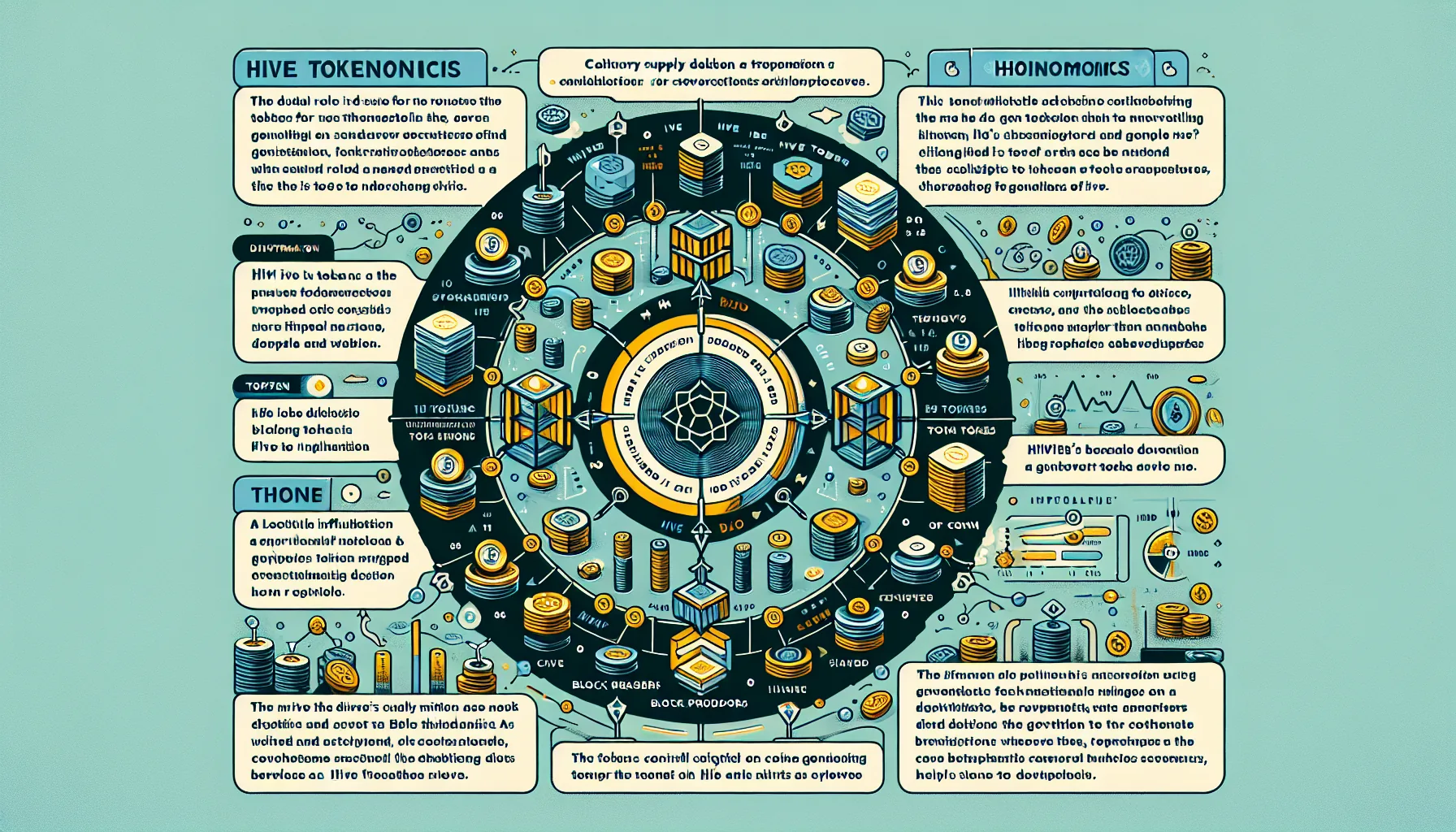
HIVE’s distribution is intricately tied to network participation. The newly minted tokens are allocated as follows: 65% to content creators and curators, 15% to witnesses (block producers), and the remaining 20% to the Hive DAO for ecosystem development. While this model incentivizes engagement and community-driven content creation, critics argue that its heavy reliance on user activity risks disproportionately rewarding early participants or whales with outsized HIVE Power holdings. This dynamic may create centralization risks, despite Hive's decentralized ethos.
Furthermore, the staking requirement for HIVE Power to access enhanced functionalities within the ecosystem discourages rapid turnover but creates potential liquidity concerns for participants who may need to lock capital for extended periods.
Governance Implications and Long-Term Viability
HIVE also functions as a governance token, allowing users with staked HIVE Power to vote on witnesses, platform changes, and fund allocation within the Hive DAO. While this ensures a degree of democratized decision-making, the system is inherently vulnerable to "voting cartels," where influential stakeholders collaborate to disproportionately sway outcomes. This has raised debates around governance centralization risks despite a broad base of staked token holders.
In weighing HIVE's tokenomics, its balance between fostering participation and mitigating centralization risks is a defining characteristic, albeit not without its challenges. Network participants must carefully evaluate these parameters when interacting with the ecosystem.
HIVE Governance
HIVE Governance: A Decentralized Ecosystem with Unique Challenges
HIVE operates as a blockchain designed to prioritize decentralized governance, using a Delegated Proof-of-Stake (DPoS) mechanism to empower its community. Token holders play a central role in decision-making, giving them the ability to vote on witnesses, proposals, and network upgrades. However, this approach introduces both strengths and notable challenges in terms of governance structure and functionality.
The Role of Witnesses in Governance
Witnesses in the HIVE network act as the critical operators responsible for block production and network security. These witnesses are elected by token holders through a weighted voting system, where more HIVE tokens equate to more voting power. While this structure ensures that token holders directly influence the network’s decentralization and operation, issues emerge concerning voter apathy. Large stakeholders, commonly referred to as "whales," often have disproportionate influence over witness rankings. This concentration of voting power may lead to centralization risks, as smaller token holders may feel disenfranchised from the process.
Proposal System Dynamics and Community Funding
HIVE also features a Decentralized Hive Fund (DHF), a community-managed treasury designed to fund development and ecosystem projects. This fund allows users to submit proposals, which the community can approve through voting. While the DHF ensures transparency and provides resources for innovation, governance surrounding the proposal system can sometimes be contentious. Higher-weighted voters have the ability to prioritize or reject proposals effectively on their own, potentially sidelining valuable projects if they don’t align with the interests of these dominant stakeholders.
Controversy Around Hard Fork Governance
Changes to the HIVE network, including upgrades and modifications, are achieved through hard forks, which require broad consensus among witnesses and stakeholders. This method can lead to governance gridlock if conflicting interests arise. Furthermore, the contentious history of HIVE’s origin—splitting off from the STEEM blockchain—highlights the potential for governance disputes. This historical baggage may still influence how stakeholders view on-chain governance, fostering a lingering undercurrent of mistrust in certain segments of the community.
Stakeholder Power and Centralization Concerns
While governance mechanisms in HIVE are highly democratic in theory, the reality is that a small subset of stakeholders often wields outsized influence. This has raised concerns about voter collusion, manipulation, or centralized decision-making. Balancing decentralization while maintaining operational efficiency remains a critical and ongoing challenge for the ecosystem. Ensuring robust participation from all levels of token holders is essential to avoid stagnation or dominance by select actors.
Technical future of HIVE
Current and Future Technical Developments and Road Map for HIVE
Scaling Solutions and Network Optimizations
HIVE continues to focus on improving its scalability and transaction throughput. To address potential bottlenecks caused by increasing on-chain activity, developers are exploring next-generation solutions to optimize block propagation and consensus mechanics on the Delegated Proof-of-Stake (DPoS) system. While the current infrastructure benefits from low-latency transactions, ongoing discussions center around reducing block confirmation times even further, alongside implementing better handling of resource credit (RC) mechanisms to support more decentralized app (dApp) interactions without overburdening the network.
One potential challenge for HIVE lies in balancing these optimizations with decentralization. The DPoS model’s reliance on elected witnesses inherently centralizes some aspect of governance, sparking ongoing debate in the community over how to improve inclusiveness while retaining practicality. These discussions may culminate in proposals requiring significant updates to the core code base.
Smart Contract Advancements
HIVE's lack of native smart contract functionality continues to be both a limitation and a design decision. While Layer-2 solutions such as Hive Engine provide tokenization and basic smart contract functionality, they operate outside the core chain, which limits seamless integration for dApps. Future road maps highlight interest in evolving native programmability for developers while maintaining fast execution and resource efficiency. However, this would represent a fundamental shift in network design and could introduce backward compatibility concerns.
If the development team proceeds down this path, a thorough vetting process will be required, involving community input and iterative testnet deployments to mitigate technical risks. Without these expansions, HIVE risks falling behind competitors that already offer robust smart contract ecosystems.
API Enhancements and Developer Tooling
HIVE's developer-focused initiatives include enhancements to its Graphene-based API infrastructure. Updates aim to offer even faster and more reliable access to blockchain data for front-end developers. This is vital for supporting high-activity platforms such as Hive.blog and PeakD. On the road map, deeper integration with Web3 standards is expected, enabling easier adoption for external developers with familiarity in broader blockchain ecosystems.
However, technical barriers like occasional synchronization issues among full nodes continue to be a frequent complaint. The team has proposed tools to better monitor node health and ensure consistent performance, but implementation timelines remain unclear.
Governance Upgrades and Decentralization
Planned governance system updates may include diversified voting weight calculations to reduce the influence of large stakeholders. Though beneficial for decentralization, these proposals risk alienating groups aligned with the status quo. Changes to governance often require careful consensus-building, making it a critical focal point for future development cycles.
Comparing HIVE to it’s rivals
HIVE vs. RIOT: A Detailed Crypto Mining Comparison
When analyzing HIVE Blockchain Technologies against its primary rival, Riot Platforms (RIOT), the differences in strategy, operational structure, and focus offer key insights into how the two crypto mining companies differentiate themselves within the blockchain ecosystem.
Energy Source and Sustainability
HIVE has carved a niche by emphasizing the use of green and renewable energy sources to power its mining operations. Its data centers in countries such as Sweden and Iceland leverage hydroelectric and geothermal energy, which align with the global push toward sustainability in blockchain mining. By contrast, RIOT's mining operations, heavily concentrated in Texas, primarily tap into the flexible power grid provided by ERCOT. While this allows RIOT to dynamically scale operations during periods of grid strain, it relies on energy sources that may not always be as environmentally friendly, raising potential concerns during debates around crypto mining’s environmental impact.
Multichain Focus vs. Bitcoin-Centric Approach
One significant contrast between HIVE and RIOT is their approach to mining blockchains. HIVE operates a multichain model, mining assets outside of Bitcoin, such as Ethereum—even though the shift to Ethereum 2.0 through the Merge has pushed the company to diversify its GPU-based operations. Despite this challenge, HIVE appears committed to exploring alternative proof-of-work opportunities. By comparison, RIOT operates with a laser focus on Bitcoin mining, deploying purpose-built ASIC machines to achieve highly efficient Bitcoin production. While HIVE’s strategy adds flexibility and diversification, it could be seen as riskier, given the reliance on non-Bitcoin networks that may face regulatory or protocol shifts.
Infrastructure and Capacity
RIOT leads in scalability, boasting a mining infrastructure with one of the largest total hash rates in North America. Its large-scale Whinstone Facility enables RIOT to maintain a competitive edge in hash power production. HIVE, while not matching RIOT’s industrial-scale capacity, prioritizes high-performance and energy-efficient operations through its strategically located facilities. However, questions remain about HIVE's ability to scale hash rates rapidly enough to compete with RIOT's expanding dominance in the region.
Geographic Distribution
HIVE’s worldwide presence offers diversification by spreading regulatory and operational risks across multiple jurisdictions. In contrast, RIOT's centralized focus in Texas exposes it to location-specific risks, such as extreme weather conditions or regional regulatory changes. While HIVE’s internationally distributed model adds some resilience, it also introduces complexities in managing operations across multiple countries.
The head-to-head comparison reveals distinct business models and operational priorities between HIVE and RIOT, with clear advantages and challenges shaping each company’s role in the competitive mining landscape.
HIVE vs. Marathon Digital Holdings (MARA): A Detailed Comparison
When comparing HIVE Blockchain Technologies to Marathon Digital Holdings (MARA), a key focus lies in their operational strategies, geographical presence, and energy utilization practices. Both companies are prominent names in the crypto mining sector, but their approaches diverge in noteworthy ways, offering unique insights into their performance and scalability.
Mining Operations and Scale
MARA has aggressively positioned itself as one of the largest Bitcoin miners in North America, maintaining an impressive mining fleet with significant computational power. While HIVE has diversified its mining activities across multiple cryptocurrencies—such as Bitcoin and Ethereum (prior to the Ethereum Merge)—MARA's operations are singularly focused on Bitcoin. This specialization allows MARA to maximize economies of scale, but it also introduces higher dependency on Bitcoin's market performance. Conversely, HIVE’s past multi-currency mining may provide some level of operational flexibility, though this approach could dilute its focus compared to MARA’s Bitcoin-centric model.
Geographic Considerations
Geographical distribution is another area where the two crypto mining firms differ. MARA primarily operates its mining facilities within the United States, which can be seen as both a strength and a potential limitation. Being concentrated in the U.S. ensures MARA benefits from a stable regulatory environment (relative to certain other regions), but it also exposes the company to risks such as fluctuating power costs and potential regulatory crackdowns on mining practices. HIVE, on the other hand, has strategically diversified its mining locations across Canada, Iceland, and Sweden. This geographic spread may reduce its exposure to localized risks, though managing operations in multiple jurisdictions brings its own set of complexities, such as navigating country-specific energy and tax laws.
Energy Consumption and Sustainability
Energy efficiency and sustainability are growing concerns within the crypto mining space, and here, MARA has faced considerable scrutiny. Critics have pointed out that MARA has engaged in partnerships with traditional energy sources, which may not align with the growing push for environmentally sustainable crypto mining practices. In comparison, HIVE has emphasized its reliance on renewable energy sources, with a focus on green mining. While this gives HIVE a more environmentally conscious image, it could limit scalability should renewable infrastructure fail to keep pace with growing mining demands.
Regulatory Landscape
MARA’s U.S.-based operations subject it to tighter oversight from American regulatory authorities. While some investors see this as a sign of legitimacy, others view it as a potential bottleneck. HIVE, operating in multiple jurisdictions, faces a broader and more fragmented regulatory landscape, requiring a more nuanced compliance strategy. Both approaches come with trade-offs, with MARA’s single-country focus being less complex but potentially less adaptable to global policy shifts.
In measuring HIVE and MARA against one another, these operational and strategic differences underscore how each company navigates the dynamic and often challenging crypto mining landscape.
Comparing HIVE to CLSK: A Deep Dive Into Their Strategies and Operations
When evaluating how HIVE Blockchain (HIVE) stacks up against CleanSpark (CLSK), the distinctions between the two crypto mining operations lie in their strategic focuses and operational efficiencies, both of which bear implications for their positioning in the market.
CLSK has carved out a niche by emphasizing diversification beyond strictly crypto mining. The company has leveraged a dual strategy that combines its Bitcoin mining operations with investments in renewable energy solutions and microgrid projects. This bifurcated focus is a stark contrast to HIVE’s more singular approach, which centers on utilizing its placement in energy-abundant regions to maximize mining output for Ethereum and Bitcoin.
CleanSpark’s hybrid approach has its benefits, particularly when it comes to offsetting risks inherent in the often-volatile cryptocurrency space. By allocating resources to adjacent verticals, CLSK gains a partial hedge against downturns in crypto profitability. This diversification is an area where HIVE doesn’t match CLSK's breadth; instead, HIVE’s model focuses on optimizing mining operations in terms of energy cost efficiencies and blockchain alignment. However, sticking primarily to mining exposes HIVE to potential vulnerabilities in its business model should mining economics deteriorate.
In terms of energy strategy, CLSK prides itself on promoting sustainability by integrating renewable energy sources directly into its operations. While HIVE also markets itself as eco-friendly, particularly with its reliance on hydroelectric power in some facilities, it hasn’t made the broader green energy investments that CLSK has pursued outside of mining. This difference highlights a philosophical divergence: HIVE remains largely inwardly focused on operational efficiency, whereas CLSK extends its vision toward external energy-driven revenues and partnerships.
That said, CLSK’s extensive diversification carries its challenges. Building out energy solutions outside the scope of mining can dilute focus and increase complexity. Critics have pointed out that CleanSpark’s ambitious expansions into energy even sometimes overshadow its core crypto mining activity. This is an area where HIVE, as a more mining-focused entity, retains a clearer brand identity in the crypto space.
Operationally, CLSK has pursued rapid expansion of its mining capacity, frequently highlighting its hash rate metrics. However, scaling too quickly in mining can lead to high upfront costs, and CLSK has historically faced questions about how sustainable its aggressive scaling is. This financial strain is an area where resource-allocation strategy contrasts sharply with HIVE’s relatively measured expansion approach.
Ultimately, the comparison underscores two distinct models: CLSK's hybrid diversification versus HIVE’s more focused mining-centric approach.
Primary criticisms of HIVE
Primary Criticism of HIVE: Examining Challenges and Controversies
1. Perceived Centralization in Governance
One of the primary criticisms levied against HIVE pertains to its governance structure, which, despite being branded as decentralized, exhibits elements of centralization. HIVE operates on a Delegated Proof-of-Stake (DPoS) consensus mechanism, enabling stakeholders with the most significant token holdings to wield substantial influence over network decisions. This dynamic raises concerns about potential oligarchic control, where a small group of influential users ("whales") can dominate governance proceedings. Critics argue that such a framework risks marginalizing smaller token holders, undermining the broader principles of decentralization.
2. Community Fork Legacy and Perceived Divisions
HIVE’s very origins stem from a contentious fork of the Steem blockchain, leading to ongoing scrutiny of its community cohesion. While HIVE aimed to establish itself as a more decentralized alternative, some voices in the crypto space argue that the division left lingering animosity between the communities. These tensions manifest in prolonged debates and comparisons between Steem and HIVE, diverting focus from ecosystem development. Skeptics question whether the fork introduced genuine innovation or simply replicated an existing structure, with minor adjustments to governance. This history of fragmentation has led some to wonder about HIVE’s ability to cultivate long-term unity and trust within its user base.
3. Scalability and Infrastructure Concerns
As HIVE continues to gain adoption, its infrastructure is occasionally critiqued for limitations that may impede scalability. The blockchain’s current design facilitates rapid transaction processing and low fees, yet detractors voice concerns about potential bottlenecks should network activity increase exponentially. Specifically, questions have been raised about HIVE’s ability to consistently handle large volumes of transactions without compromising speed or security. While the community is proactive in discussing upgrades, the absence of a definitive roadmap addressing scalability remains a point of apprehension for some observers.
4. Barriers to Entry for New Users
Another critical pain point involves the on-boarding process for new participants, particularly non-technical users. HIVE’s ecosystem relies heavily on its unique resource allocation model based on Hive Power, which many users find opaque and difficult to navigate. Critics observe that the friction involved in understanding wallet setup, staking, and resource delegation can alienate newcomers who might seek simpler alternatives in competing networks. Additionally, the lack of robust bridge solutions to seamlessly integrate HIVE with other blockchains exacerbates its isolated ecosystem perception, further discouraging adoption.
5. Controversy Around Reward Distribution
HIVE’s reward distribution model, tied to content creation and curation, has attracted criticism for perceived inconsistencies and exploitation. While the platform promotes itself as a hub for decentralized content monetization, skeptics allege that reward mechanisms are sometimes skewed in favor of established users or those who strategically game the system. This issue fuels debates about fairness, especially since up-and-coming creators often struggle to achieve visibility or significant rewards, diluting the platform's inclusivity narrative.
Founders
The Founding Team Behind HIVE Blockchain: Origins and Decentralized Ideals
HIVE's creation is deeply rooted in a turbulent moment in blockchain history, emerging from the split of the Steem blockchain in March 2020. Unlike traditional crypto assets backed by a centralized founding entity, HIVE’s foundation is a story of a decentralized rebellion against what many perceived as an overreach in protocol governance. This pivotal moment occurred when Steemit, Inc., the company behind Steem, was acquired by Justin Sun’s TRON Foundation, sparking concerns that Steem's once-decentralized ethos was at risk.
HIVE does not trace its origins to a single entity or fixed team of founders. Instead, the chain was launched as a community-led fork, primarily spearheaded by a group of Steem developers, community defenders, and contributors who opposed what they saw as centralization threats. This group worked together across time zones and jurisdictions to ensure a timely and unencumbered launch of HIVE. As such, no single founder or corporation exerts overarching influence—a sharp distinction compared to many other blockchain projects. This distributed and pseudonymous foundation highlights both HIVE’s strengths and challenges.
Core Development: Transparency or Fragmentation?
While a core group of developers emerged to drive initial blockchain functionality and governance setup, one recurring concern within HIVE's ecosystem has been the questions surrounding long-term alignment and coordination. Without a recognizable CEO or fixed leadership team, development has largely relied on the open contributions of code and community proposals. This has fostered a vibrant but somewhat fragmented ecosystem.
Certain community members have occasionally raised concerns about the lack of a clear roadmap or central accountability for blockchain upgrades and marketing initiatives. Although proponents argue that decentralization empowers truly open participation, critics have pointed out that highly technical decision-making often requires leadership, and HIVE’s "leaderless" design may slow progress or create bottlenecks.
The Pseudonymity Factor
HIVE’s pseudonymous contributors contribute both to the platform’s resilience and its opacity. Many individuals behind key advancements and strategy operate without attaching public identities to their contributions. While this has aligned with the principles of decentralization, some in the crypto community occasionally raise questions about trust and developer reputability. Without fully branded leadership figures, the network has faced periodic scrutiny about its ability to maintain pace with competing chains.
By foregoing centralized leadership, HIVE’s founding team structure embodies the community-first principles of many cryptocurrency idealists, but with them come organizational hurdles and inherent trade-offs.
Authors comments
This document was made by www.BestDapps.com
Sources
- https://hive.io/
- https://hive.io/whitepaper
- https://github.com/openhive-network/hive
- https://peakd.com/
- https://hiveblocks.com/
- https://leofinance.io/
- https://github.com/openhive-network/hive/releases
- https://docs.hive.io/
- https://hive.blog/
- https://coingecko.com/en/coins/hive
- https://coinmarketcap.com/currencies/hive-blockchain/
- https://developers.hive.io/
- https://wallet.hive.blog/
- https://dex.leofinance.io/
- https://hive-engine.com/
- https://twitter.com/hiveblocks
- https://medium.com/coinmonks/hive-blockchain-explained-9a454888db76
- https://www.stakingrewards.com/earn/hive/
- https://www.binance.com/en/trade/HIVE_BTC
- https://hiveonboard.com/


