History of HBTC
The History of HBTC: From Concept to Controversy
HBTC, or Huobi Bitcoin, is an ERC-20 token created by Huobi, one of the major crypto exchanges, with the goal of bringing Bitcoin's liquidity to the Ethereum blockchain. HBTC launched as a wrapped Bitcoin token, designed to maintain a 1:1 ratio with Bitcoin by requiring a corresponding amount of BTC to be securely held in custody. This custodial model, however, has not been without scrutiny.
The introduction of HBTC was tied closely to the growing interest in decentralized finance (DeFi). By launching HBTC, Huobi aimed to enable Bitcoin holders to access Ethereum’s DeFi ecosystem without selling their BTC. The token rapidly gained attention from developers and liquidity providers for its potential to bridge the gap between Bitcoin maximalists and the Ethereum ecosystem, which at the time was expanding rapidly. However, this focus on DeFi adoption also underscored several challenges—some technical, others tied to infrastructure trust.
HBTC's centralized custodial model is one of the most debated aspects of its history. Huobi’s system requires users to trust that the exchange holds reserves equivalent to the circulating supply of HBTC. While Huobi has issued assurances and provided transparency reports to verify this backing, skepticism remains prevalent among parts of the cryptocurrency community who advocate for trustless, decentralized solutions. This custodial reliance has, over time, raised questions about systemic risks, especially in light of high-profile exchange failures and incidents of fund mismanagement elsewhere in the industry.
Another notable issue was HBTC's initial adoption traction. While a few early supporters integrated HBTC into DeFi platforms, its adoption rate faced challenges competing with similarly positioned wrapped Bitcoin tokens, such as WBTC. Critics argue that the market liquidity of HBTC has historically been limited compared to its competitors, limiting its utility beyond Huobi’s ecosystem.
Technologically, HBTC employs a relatively straightforward wrapping mechanism, but its reliance on Ethereum invites critiques related to scalability and high transaction fees, particularly in times of network congestion. These concerns have, at times, made it less attractive to cost-conscious Bitcoin holders.
In essence, the history of HBTC is as much a reflection of the promise of tokenized Bitcoin as it is a case study in the challenges that emerge when trust and centralization intersect within decentralized ecosystems. While the token achieved a notable milestone by creating interoperability between Bitcoin and Ethereum, it remains a subject of debate among the crypto-savvy.
How HBTC Works
How HBTC Works: The Mechanics Behind the Tokenized Bitcoin
HBTC, or Huobi BTC, operates as a fully-backed, tokenized representation of Bitcoin on the Ethereum blockchain. Leveraging the ERC-20 token standard, HBTC functions to bridge liquidity between the Bitcoin and Ethereum ecosystems, enabling users to utilize BTC’s value within decentralized finance (DeFi) applications while retaining a 1:1 peg to Bitcoin through a custody mechanism.
Issuance and Redemption Process
The core of HBTC’s functionality lies in its issuance and redemption mechanism. Each unit of HBTC corresponds to one Bitcoin held in reserve by Huobi Global. When a user deposits Bitcoin through Huobi’s custodial services, an equivalent amount of HBTC is minted. These tokens can then be issued to the depositor’s Ethereum wallet. Conversely, holders of HBTC can redeem their tokens for the underlying BTC by following a withdrawal process through Huobi. This requires centralized custody from a known entity, which introduces a layer of trust dependency, unlike decentralized Bitcoin-pegged assets like renBTC or tBTC.
Smart Contract Implementation
HBTC is implemented as an ERC-20 token, utilizing Ethereum’s smart contracts for its operations. This allows it to integrate seamlessly with the Ethereum ecosystem, including decentralized exchanges (DEXs), lending/borrowing platforms, and staking protocols. The ERC-20 standardization ensures compatibility and enables fast transfers and token management through Ethereum-compatible wallets, but it also means HBTC inherits Ethereum's scalability challenges, such as high gas fees and network congestion during periods of heavy activity.
Custodial Transparency and Risk
Huobi provides transparency regarding HBTC’s Bitcoin reserves through monthly audits, publishing the address of the custodian wallet holding the Bitcoin collateral. However, the reliance on Huobi as the central authority raises questions around counterparty risk, regulatory exposure, and operational reliability. The centralized custody model makes HBTC susceptible to risks such as custodial fund seizures, insolvency, or compromise via external attacks. This reliance on trust-based backing deviates from the ethos of decentralized cryptocurrency, potentially dissuading users who prioritize trustless systems.
Cross-Chain Utility
HBTC primarily serves as a bridge asset for Bitcoin within Ethereum’s DeFi ecosystem. By tokenizing BTC, it allows liquidity to flow into Ethereum-native platforms, enabling functionalities like liquidity provision, yield farming, and collateralized borrowing. However, this cross-chain utility is limited by HBTC’s centralized nature, which differentiates it from decentralized alternatives that rely on cryptographic proofs for Bitcoin collateralization.
Limitations of Centralization
While HBTC facilitates increased usability for Bitcoin within Ethereum's DeFi infrastructure, its centralized structure undermines its censorship resistance. This makes transactions and custody susceptible to potential freezes or compliance interventions. Additionally, its existence in a single jurisdiction—tied to Huobi—adds further vulnerabilities in cases of legal or regulatory action.
HBTC demonstrates a practical approach for bridging major blockchains but also exposes critical trade-offs between convenience, decentralization, and security.
Use Cases
HBTC Use Cases: Exploring Utility and Challenges in Wrapped Bitcoin
HBTC (Huobi BTC) is a widely recognized wrapped Bitcoin token operating on the Ethereum blockchain, leveraging the ERC-20 standard to facilitate BTC’s integration into the DeFi ecosystem. Primarily used as a bridge between Bitcoin’s robust liquidity and Ethereum’s smart contract functionality, HBTC addresses multiple use cases, while also presenting considerations around its centralized nature and network dependency.
Cross-Chain Liquidity in Decentralized Finance (DeFi)
HBTC enables Bitcoin holders to participate in the Ethereum-based DeFi ecosystem without liquidating their BTC holdings. Users can lock their Bitcoin in a custodial service, mint HBTC, and interact with decentralized applications (dApps) such as lending protocols, decentralized exchanges (DEXs), and yield farming platforms. By doing so, HBTC acts as a liquidity layer for Bitcoin, allowing participation in lending pools like Aave and trading pairs on Uniswap.
However, reliance on a centralized custodian for Bitcoin locking and HBTC minting introduces counterparty risk. This dependence expands the trust vector that traditional Bitcoin lacks, making HBTC less appealing to users prioritizing decentralization.
Collateral for Ethereum-Based Protocols
HBTC functions as collateral in decentralized financial mechanisms, enabling the creation of stablecoins or leveraged positions. Applications like MakerDAO may permit HBTC to back the issuance of decentralized stablecoins such as DAI. Similarly, platforms offering margin or leveraged trading often list HBTC as a deposit option due to its pegged 1:1 ratio with Bitcoin.
The challenge, however, lies in maintaining the absolute peg between HBTC and BTC. Factors like custodial mismanagement, blockchain congestion, or arbitrage inefficiencies can create price discrepancies, leading to issues like discounted HBTC in trading markets.
Bridging Custodial and Non-Custodial Environments
HBTC helps bridge the gap between custodial Bitcoin holdings (locked with Huobi) and Ethereum’s non-custodial financial landscape. By using HBTC, Bitcoin holders can transition from centralized services into decentralized environments, unlocking multi-use opportunities while retaining exposure to Bitcoin’s price movements.
Yet, the centralized issuance model of HBTC raises concerns for Ethereum purists focused on censorship resistance. The minting and redemption of HBTC rely on the Huobi platform, which means potential vulnerabilities arise from regulatory actions or platform-specific outages.
Mitigating Transaction Inefficiencies
Beyond DeFi integration, HBTC addresses Bitcoin’s slow transaction times and high fees by leveraging Ethereum’s faster network for value transfers. HBTC offers swift, inexpensive transactions compared to Bitcoin’s mainnet, making it popular for arbitrage and high-frequency operations across Ethereum.
Nonetheless, this use case depends heavily on Ethereum's network conditions. In periods of high gas prices or network congestion, HBTC transfers lose cost-efficiency compared to layer-2 Bitcoin solutions, diminishing its comparative advantage.
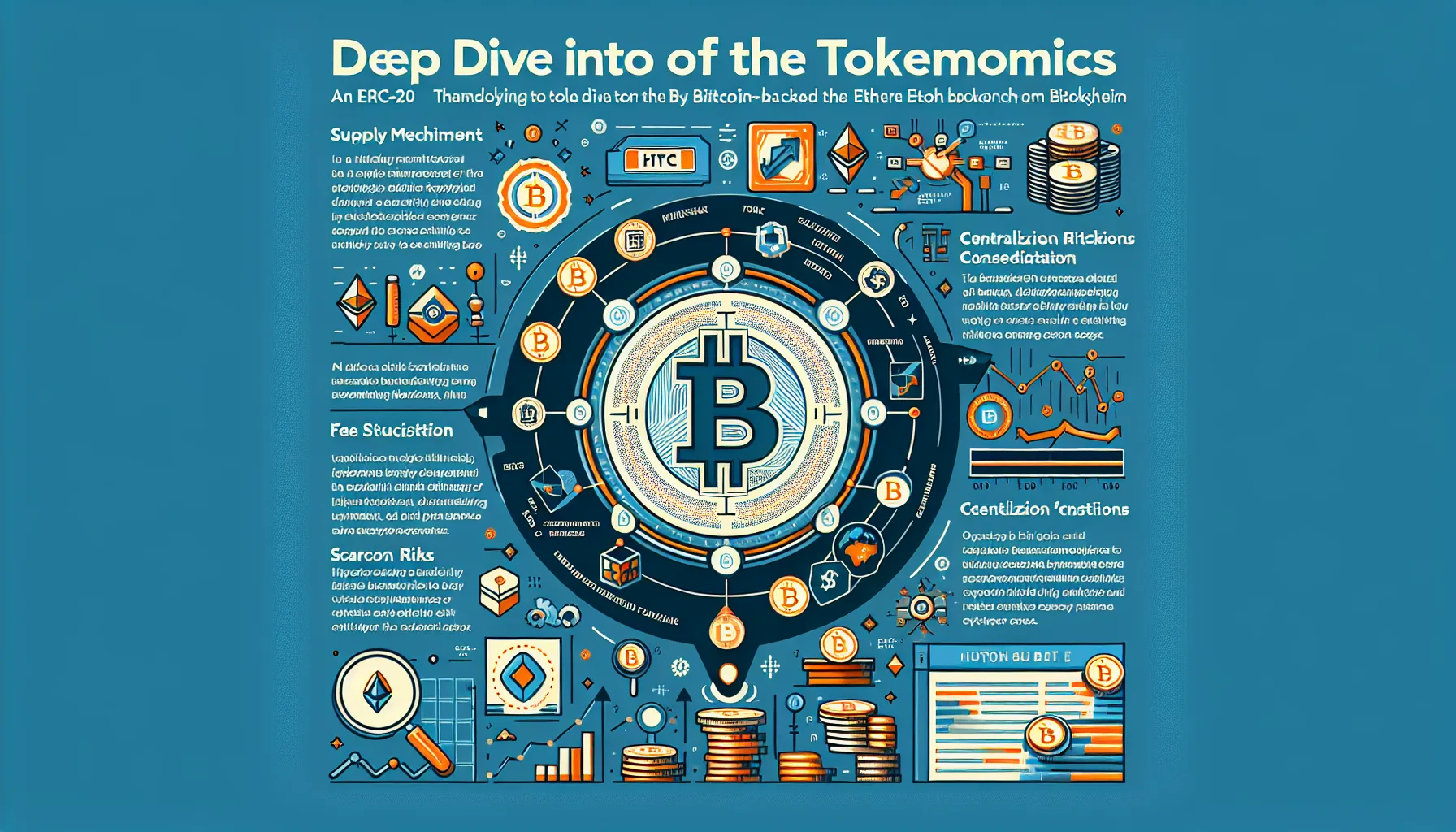
HBTC Tokenomics
HBTC Tokenomics: A Deep Dive into the Mechanics
Understanding HBTC’s tokenomics requires a granular look at its structure and functionality as a crypto asset. HBTC (Huobi Bitcoin) is an ERC-20 token that operates as a Bitcoin-backed asset on the Ethereum blockchain, promising a 1:1 peg with BTC. Its tokenomics framework hinges on several critical elements, each influencing its position in the broader crypto ecosystem.
Supply Mechanism and Minting Process
HBTC’s supply dynamic is solely governed by its custodial model. For every HBTC minted, an equivalent BTC must be deposited into reserves managed by Huobi or its custody partners. This hard peg ensures that the total supply of HBTC always mirrors the amount of BTC locked in reserve. However, this introduces a level of centralization uncommon in decentralized ecosystems. The reliance on Huobi to maintain the peg introduces custodial risk, as the asset’s integrity rests heavily on the transparency and reliability of reserve auditing. Failure in this area—whether through lapses in collateralization or lack of real-time proof-of-reserves updates—could undermine market confidence.
Fee Structure and Usability Considerations
On-chain transactions involving HBTC benefit from Ethereum’s efficiency compared to the BTC network, particularly concerning speed and costs. Yet, users incur Ethereum gas fees which, during network congestion, can make the token less compelling as a medium of exchange. Additionally, there is no native staking or yield-generation mechanism directly tied to HBTC, diminishing its appeal for long-term hodlers seeking passive income opportunities. This makes one question its value proposition beyond basic Bitcoin replication for liquidity purposes on Ethereum.
Scarcity and Circulation
Unlike native BTC, HBTC doesn’t benefit from Bitcoin’s halving cycles or algorithmically defined issuance cap, as its total supply is purely reliant on demand dynamics within Ethereum-based ecosystems. Wrapped Bitcoin (WBTC) and other bridged assets often compete with HBTC for dominance in decentralized exchanges (DEXs) and DeFi projects. HBTC’s market share here depends on factors such as liquidity depth and sustained user adoption. A fragmented ecosystem of Bitcoin-backed tokens dilutes liquidity pools, potentially impacting price stability and slippage for HBTC traders.
Centralization Risks and Ecosystem Limitations
The centralized custodial approach in HBTC's tokenomics stands in stark contrast to Bitcoin's decentralized philosophy. Huobi and its validators hold considerable power, creating potential vulnerabilities to regulatory action or operational failures. Moreover, its utility is primarily constrained to Ethereum, leaving it less versatile compared to cross-chain interoperable alternatives. As the space evolves, questions may arise regarding HBTC’s role in an increasingly multi-chain environment where users demand greater flexibility and decentralization.
HBTC Governance
HBTC Governance: Understanding the Framework and Challenges
The governance mechanisms surrounding HBTC (Huobi BTC) represent a critical factor in its utility and operational functionality within the crypto ecosystem. As a tokenized representation of Bitcoin on the Ethereum blockchain, one of its core governance considerations stems from its centralized issuance model, which is managed by Huobi Global. This structure introduces distinct advantages and challenges for participants, especially as decentralization becomes an integral value for many in the cryptocurrency sector.
Centralized Issuance and Control
Unlike purely decentralized projects, HBTC’s governance heavily relies on the custodial trust of Huobi. The issuance and redemption of HBTC tokens are contingent on Huobi holding the equivalent BTC reserves on a 1:1 ratio. While this provides transparency through regular proof-of-reserves reporting, it places significant trust in Huobi’s ability to maintain proper custodial practices. Critics of this model argue that such centralization exposes HBTC holders to single points of failure, including regulatory action, mismanagement, or custodial risks.
Smart Contract Administration
HBTC operates through smart contracts on the Ethereum blockchain, allowing it to integrate with DeFi platforms such as decentralized exchanges, lending protocols, and liquidity pools. However, the administration of these contracts is not decentralized, as changes or upgrades to the HBTC system remain subject to the decisions of Huobi’s internal team. This lack of DAO (decentralized autonomous organization) governance eliminates token-holder participation in protocol-level decisions, potentially alienating crypto purists who prioritize community-driven control.
Transparency and Auditing Practices
Huobi mitigates governance concerns by maintaining regular audits of on-chain BTC reserves to ensure the 1:1 backing of HBTC. However, these audits are not conducted through fully permissionless or third-party mechanisms, which some critics argue undermines the trustless ethos of blockchain technology. The reliance on centralized reporting mechanisms leaves room for skepticism regarding data accuracy without completely independent verification processes.
Implications for DeFi Integration
While HBTC benefits from high liquidity and seamless integration with major DeFi protocols due to its Bitcoin backing, centralized governance structures present risks for long-term sustainability in decentralized ecosystems. A potential failure or breach in Huobi’s governance could ripple across DeFi platforms that have integrated HBTC as collateral or trading pairs, exacerbating systemic risks in an already volatile landscape.
Community Governance Gap
Finally, the absence of community involvement in HBTC’s governance model stands in stark contrast to emerging trends within the crypto space. Competitors with more decentralized frameworks might appeal more strongly to users who desire governance models that empower individual stakeholders over centralized authorities.
Technical future of HBTC
HBTC: Current and Future Technical Developments
HBTC (Huobi Bitcoin) stands out as a 1:1 Bitcoin-backed token issued on Ethereum, aiming to bridge the gap between Bitcoin's liquidity and the advantages of decentralized finance (DeFi). However, despite its innovative concept, several challenges and developments define HBTC's technical trajectory.
Current Technical Developments
One of the critical features of HBTC is its reliance on Ethereum's ERC-20 standard, which ensures interoperability with the vast ecosystem of Ethereum-based decentralized applications. This compatibility simplifies the process of integrating HBTC into DeFi platforms, such as decentralized exchanges (DEXs) and lending protocols. Notably, HBTC operates through a custodian model, where reserves of Bitcoin are held transparently to ensure complete peg security between the token and underlying asset.
An ongoing area of technical focus is the streamlining of on-chain collateral verification. Huobi, as the issuer of HBTC, publishes wallet addresses for the BTC reserves to enhance transparency and accountability. However, this centralized custody model introduces technical risks relating to trust and security. Should the custodian's infrastructure encounter vulnerabilities or mismanagement, the fundamental 1:1 peg promise could falter.
Another emphasis in HBTC’s current development is gas efficiency. Transacting ERC-20 tokens on Ethereum often incurs significant gas costs due to network congestion. HBTC smart contracts have seen optimizations to mitigate these costs, but the inherent scalability issues of Ethereum still pose challenges for seamless high-volume transfer or usage at peak times.
Future Technical Road Map
Future developments for HBTC strongly hinge on extending its usability across a growing multichain ecosystem. With the rise of non-Ethereum blockchains, such as Binance Smart Chain and Avalanche, there's notable demand for cross-chain operability. HBTC's roadmap includes potential integrations with cross-chain bridges or Layer 2 solutions to reduce transaction costs and enable transfers across different blockchain ecosystems without compromising security.
Decentralization remains a prominent theme. While HBTC is a custodial token, there are exploratory efforts to introduce trust-minimized mechanisms, such as multi-signature wallets or decentralized custody frameworks. These advancements aim to reduce reliance on a single centralized entity while preserving the transparency integral to its on-chain model.
Another challenge lies in scalability and network upgrades. The Ethereum merge and further protocol updates, such as sharding, could improve gas efficiency and overall transaction throughput for HBTC. However, dependency on Ethereum’s roadmap introduces uncertainties that HBTC remains vulnerable to, should delays or unforeseen complications arise.
Ultimately, HBTC’s technical future lies at the intersection of transparency, scalability, and decentralization advancements—focusing on technical refinement and adaptation to maintain competitiveness in the rapidly evolving DeFi landscape.
Comparing HBTC to it’s rivals
HBTC vs. BTC: Key Differences in Functionality and Utility
HBTC (Huobi Bitcoin) and BTC (Bitcoin) share a critical architectural link: both represent the same underlying asset—Bitcoin. However, their design and utility diverge fundamentally when considering their purpose within the crypto ecosystem. HBTC is an ERC-20 token pegged 1:1 to Bitcoin on the Ethereum network, while BTC is the native cryptocurrency operating on its own Bitcoin blockchain. This difference introduces distinct advantages and trade-offs for users and developers engaging with either asset.
Network Design and Integration
BTC operates on the Bitcoin blockchain, emphasizing decentralization, immutability, and unparalleled security. However, this comes with limitations, such as slower transaction speeds and higher fees during peak network activity. On the other hand, HBTC inherits the scalability and composability advantages of the Ethereum blockchain. By leveraging Ethereum, HBTC offers access to decentralized finance (DeFi) protocols, smart contracts, and decentralized exchanges (DEXs). This integration makes HBTC particularly attractive to users seeking utility beyond BTC's primary function as a store of value.
Custody and Counterparty Risk
BTC’s decentralized nature ensures that holders rely solely on the Bitcoin protocol to maintain ownership of their keys and assets. In contrast, HBTC is a custodied token issued by Huobi. This means that for every HBTC in circulation, an equivalent BTC is held in reserve by the custodian. While HBTC’s design ensures transparency through regular audits, it introduces counterparty risk—a concern for crypto purists who prioritize trustlessness. Should the issuing institution fail to secure reserves or maintain operational integrity, the value of HBTC could decouple from BTC.
Interoperability Trade-offs
HBTC’s ERC-20 standard enables frictionless integration with Ethereum-native tools and protocols, making it a versatile asset within the ecosystem. Users can easily supply liquidity, engage in yield farming, or collateralize HBTC in lending platforms. However, this convenience comes at a cost to decentralization—HBTC remains dependent on Huobi’s operations and compliance. BTC, while lacking these interoperability benefits, maintains a level of independence and censorship resistance unmatched by any wrapped token.
Liquidity and Adoption
BTC is the most widely adopted and liquid asset in the cryptocurrency market, providing unmatched access across centralized and decentralized exchanges. HBTC, though supported on Ethereum-based platforms, primarily appeals to DeFi participants and may not achieve the same universal acceptance. This discrepancy in adoption can lead to liquidity fragmentation, affecting users depending on the platform or use case.
Ultimately, understanding the distinctions between HBTC and BTC is crucial for evaluating which asset aligns best with a specific use case. While HBTC expands Bitcoin’s utility in the DeFi space, it inherently sacrifices certain principles to do so.
HBTC vs. WBTC: A Detailed Comparison
HBTC and Wrapped Bitcoin (WBTC) are two crypto assets aiming to provide tokenized Bitcoin functionality within the broader decentralized finance (DeFi) ecosystem. While both serve as solutions to bridge Bitcoin’s liquidity into Ethereum’s ecosystem, there are nuanced differences in their design, operational mechanisms, and use cases that make them distinct offerings.
Custodial Model and Trust Structures
The backbone of WBTC's operation lies in a consortium model, overseen by a network of trusted merchants and custodians. Minting and burning WBTC operate through a semi-decentralized process where users must rely on these entities to verify Bitcoin deposits and issue corresponding WBTC tokens. On the other hand, HBTC adopts a fully custodial approach under the governance of Huobi Global. While this arrangement offers a more streamlined and efficient issuance structure, it introduces a significant centralization concern, as users are dependent on the integrity of a single entity.
Crypto-savvy audiences often question HBTC's single custodial model, citing risks such as opaque processes, reliance on one organization, and potential vulnerabilities to regulatory scrutiny. WBTC, while not immune to criticisms, leverages its distributed approval process among consortium members as an additional layer of trust.
Liquidity and DeFi Integration
WBTC commands a larger share of the DeFi landscape, with deep liquidity pools across multiple decentralized exchanges (DEXs). It benefits from widespread acceptance within DeFi protocols, making it the dominant token for investors seeking Bitcoin exposure in Ethereum-based ecosystems. HBTC, while gaining traction, struggles to achieve the same level of penetration or trading volume. Limited liquidity can lead to slippage concerns for large trades, impacting its usability.
Additionally, WBTC’s broad adoption has established it as a standard for cross-chain tokenized Bitcoin solutions. This extensive integration with lending platforms, yield farms, and collateralized debt systems underscores WBTC’s advantage in terms of utility. Comparatively, HBTC suffers from narrower protocol alignment, which restricts its versatility.
Transparency and Auditing
One strength WBTC brings to the table is the frequent publication of proof-of-reserve audits, ensuring a 1:1 backing of Bitcoin to Wrapped Bitcoin tokens. Users can independently verify asset backing through on-chain data tied to custodial wallets. While HBTC also claims to maintain full reserves backed by Bitcoin, it lacks the same level of transparency and independently verified reporting, which can raise red flags for risk-averse users.
Network Risks
HBTC’s reliance on the Huobi ecosystem introduces concentration risks directly tied to the exchange’s operational health and reputational standing. Any compromise to Huobi’s security, compliance, or liquidity could ripple outward to HBTC users. In contrast, WBTC spreads its operational risk among numerous participants, reducing reliance on any single point of failure, although its consortium model poses distinct trust concerns within semi-centralized systems.
HBTC vs. ETH: Bridging Bitcoin’s Security and Ethereum’s Utility
When examining HBTC in relation to Ethereum (ETH), a critical distinction emerges: HBTC was designed to bring Bitcoin’s security model into tokenized form, while ETH represents the backbone of an entirely different ecosystem rooted in smart contract capabilities and decentralized application (dApp) development. While both assets operate in the larger landscape of blockchain, they are tailored to serve fundamentally different purposes, and the comparison reveals both strengths and limitations.
HBTC’s primary objective as a Bitcoin-pegged token is to maintain a 1:1 representation of BTC on the Ethereum blockchain, which allows users to leverage Bitcoin’s liquidity directly within Ethereum’s decentralized finance (DeFi) ecosystem. ETH, on the other hand, is not collateralized but serves as the native token for the Ethereum network, enabling diverse use cases such as network fees (gas), staking, and as a base layer currency for dApps. This key difference means that HBTC lacks intrinsic utility on Ethereum outside of being a wrapped version of BTC, whereas ETH benefits from native design advantages, including its role as gas for executing smart contracts.
ETH’s programmability provides substantial flexibility, attracting a gigantic ecosystem of developers and projects. However, it also introduces complexities such as higher gas fees during periods of network congestion. For HBTC users, the reliance on Ethereum’s infrastructure means inheriting these same issues. Every transaction involving HBTC incurs gas fees in ETH, often creating inefficiencies for users simply seeking exposure to Bitcoin without the intention of leveraging Ethereum’s broader ecosystem. This dependency underscores a potential limitation for HBTC compared to ETH, as it is always tethered to Ethereum by design.
Another area of divergence is security. While Ethereum itself is secured by its proof-of-stake (PoS) consensus mechanism, HBTC’s security is effectively outsourced—not only to the Bitcoin network but also to the custodial party managing the Bitcoin reserves backing the token. This centralization risk is non-existent with ETH, which is a native and non-custodial asset. Purists in the crypto community may view custodial risks tied to HBTC as a disadvantage, particularly in comparison to ETH’s decentralization ethos.
Ultimately, HBTC’s positioning as a bridge for Bitcoin liquidity inevitably pales in versatility against ETH’s deep integration within its own ecosystem. Its reliance on both custodians and Ethereum infrastructure limits its autonomy, whereas ETH thrives as a native utility within a self-contained system. These differences frame the interplay between the two assets and shape their adoption within overlapping yet distinct crypto contexts.
Primary criticisms of HBTC
Primary Criticism of HBTC: Examining Trust and Centralization Concerns
HBTC, while designed to bridge Bitcoin with Ethereum's DeFi ecosystem, faces notable criticism primarily surrounding trust and centralization. As a token backed 1:1 by Bitcoin and minted on Ethereum, HBTC attempts to provide liquidity and utility for Bitcoin holders in decentralized applications. However, its reliance on a custodial model raises significant concerns for crypto enthusiasts advocating for decentralization and censorship resistance.
One of the most prominent criticisms of HBTC revolves around the custodial mechanism underpinning it. Unlike trustless wrapped tokens implemented through decentralized smart contracts and multi-signature systems, HBTC’s issuance depends on a centralized entity to manage the underlying Bitcoin reserves. This custody model requires users to trust that the custodian is accurately maintaining reserves and is acting in good faith. Critics argue that such centralization contradicts the ethos of decentralization that cryptocurrencies like Bitcoin aim to uphold. In the event of mismanagement, hacking incidents, or regulatory intervention, users holding HBTC could be exposed to significant risk.
Transparency, though claimed to be a feature, is another contested aspect of HBTC. While the custodian may publish audits of its Bitcoin reserves, many crypto stakeholders question the frequency and reliability of these audits. The lack of a fully decentralized, verifiable mechanism for proof of reserves leaves room for skepticism and creates potential vulnerabilities. This limitation has given rise to a heated debate about whether HBTC should be categorized as a truly decentralized financial instrument.
Another sticking point for critics is HBTC’s interoperability trade-offs. By operating on Ethereum, HBTC binds Bitcoin liquidity to the constraints of Ethereum’s network. Fees, congestion, and potential forks on Ethereum all become risks that impact HBTC users—risks that would not directly affect Bitcoin itself. These concerns are particularly pressing for Bitcoin maximalists, who argue that any divergence from Bitcoin’s native network and architecture erodes the principles of sound money.
Lastly, the reliance on third parties in the HBTC minting and redeeming process introduces friction that can alienate privacy-conscious users. Providing identifying documentation and undergoing centralized verification processes to redeem HBTC for Bitcoin can clash with the preferences of individuals who value pseudonymity and permissionless access.
HBTC’s utility within the DeFi ecosystem is clear, yet these criticisms highlight the contentious balancing act between trust, decentralization, and usability that continues to fuel debate within the cryptocurrency community.
Founders
The Founding Team Behind HBTC: A Complex History
HBTC, a tokenized version of Bitcoin backed 1:1 by BTC on the Ethereum blockchain, owes its existence to a founding team that stands as both a testament to innovation and a lightning rod for scrutiny. The team hails from Huobi Global, a heavyweight in the crypto exchange landscape, renowned for its early commitment to blockchain adoption. However, the connection to Huobi comes with both operational expertise and lingering industry skepticism.
The project launched under the governance of Huobi’s infrastructure, supported by their extensive resources and technological framework. This gave HBTC a notable credibility boost in its infancy, rooted in Huobi’s established position as a trusted exchange. The development team leveraged their deep technical acumen, focusing on constructing a mechanism that bridges Bitcoin with the Ethereum ecosystem via an ERC-20 token standard. Their goal was both strategic and specific: unlocking Bitcoin’s liquidity to serve the rapidly growing DeFi market.
Despite the technical competency of the founding team, questions surrounding transparency and decentralization persist. Critics argue that HBTC’s initial custodial model effectively centralizes control, as Huobi functions as the primary custodian of the BTC backing HBTC tokens. Concerns have been raised regarding proof-of-reserve mechanisms, prompting calls for more robust, real-time audits and independent oversight. While steps have been introduced to address transparency—such as publishing periodic reports—many in the crypto community remain wary of centralized control points, viewing them as a contrast to the decentralization ethos central to blockchain technology.
Moreover, the influence of regulatory uncertainty surrounding Huobi creates an additional layer of tension for HBTC. Huobi’s historical entanglements with regulators in various jurisdictions make its role in HBTC’s custodial framework a potential risk factor for users, as shifting regulatory stances could theoretically impact operational stability. While the founding team continues to iterate on improving the transparency and scalability of HBTC, these unresolved concerns dampen the sense of full trust among crypto purists.
Ultimately, the founding team behind HBTC represents a duality: a technically proficient group with the means to innovate, yet one tied to a centralized entity struggling to convince its audience of long-term security and trustworthiness. Understanding this dynamic is key to evaluating HBTC’s position in the broader crypto landscape.
Authors comments
This document was made by www.BestDapps.com
Sources
- https://www.hbtc.finance/
- https://www.hbtc.finance/assets/HBTC_Whitepaper.pdf
- https://etherscan.io/token/0x0316eb71485b0ab14103307bf65a021042c6d380
- https://coinmarketcap.com/currencies/huobi-btc/
- https://defillama.com/protocol/hbtc
- https://www.coingecko.com/en/coins/huobi-btc
- https://medium.com/@HBTC
- https://www.huobi.com/en-us/education/intro-to-hbtc/
- https://github.com/euclid1990/hbtc-token
- https://nomics.com/assets/hbtc-hbtc
- https://blog.huobi.com/hbtc-bridging-bitcoin-on-blockchains/
- https://www.reddit.com/r/HBTC/
- https://cryptoslate.com/coins/huobi-btc/
- https://hbtcscan.io/
- https://www.binance.com/en/price/huobi-btc
- https://support.huobi.com/hc/en-us/articles/900003064463-HBTC-Token
- https://dappradar.com/token/eth/0x0316eb71485b0ab14103307bf65a021042c6d380
- https://tokenterminal.com/terminal/projects/hbtc
- https://btc.huobichain.com/
- https://explorer.huobichain.com/token/0x0316eb71485b0ab14103307bf65a021042c6d380


