History of GLMR
The History of GLMR: Moonbeam's Evolution in the Crypto Ecosystem
GLMR (Glimmer) is the native utility token of the Moonbeam Network, a project that emerged to address critical gaps in blockchain interoperability and user-friendly decentralized application (dApp) development. Moonbeam was conceptualized to serve as a parachain within the Polkadot ecosystem, leveraging Polkadot's shared security, scalability, and cross-chain interoperability.
The genesis of Moonbeam can be traced to the strategic vision of its developer, PureStake, a well-known entity in providing blockchain infrastructure and tools. Following months of development and alpha phases, Moonbeam launched its first major functional testnet, Moonbase Alpha, in late 2020. Moonbase Alpha attracted considerable attention from developers, offering an environment to experiment with Ethereum-compatible smart contracts directly within Polkadot's architecture. This early testnet gradually expanded to include thousands of projects and developers, laying the groundwork for Moonbeam’s eventual mainnet launch.
By integrating compatibility with Ethereum’s technology stack, including EVM (Ethereum Virtual Machine), Solidity smart contracts, and Ethereum's widely-used tooling like Truffle and Hardhat, Moonbeam made a direct appeal to existing Ethereum developers. However, this focus on Ethereum compatibility also led to some criticisms. Critics argued that Moonbeam’s reliance on Ethereum tooling could make it overly dependent on Ethereum’s technological constraints, potentially limiting innovation beyond replicating Ethereum functionality.
The transition from testnets to Moonbeam’s eventual parachain deployment on Polkadot was marked by its participation in Polkadot's competitive parachain slot auctions. These auctions function via a crowdloan mechanism, where supporters lock DOT tokens (Polkadot's native asset) to back their chosen project. Moonbeam’s crowdloan campaign drew extensive interest, securing one of the initial parachain slots. This success validated Moonbeam’s positioning as a highly anticipated project within the Polkadot ecosystem.
GLMR’s role as the native token was established to support essential network functionalities, including transaction gas fees, staking, and governance. Upon mainnet launch, GLMR tokens were distributed to crowdloan contributors, PureStake founders, early backers, and ecosystem development funds. However, some in the community criticized the tokenomics structure, pointing out concerns about token inflation and the initial allocation skewed heavily in favor of insider stakeholders and institutional investors. These concerns remain a contentious topic in discussing GLMR’s history.
Moonbeam has also faced challenges in achieving its vision of seamless cross-chain operability. Some users have noted that despite its Ethereum-compatible framework, bridging assets and liquidity across chains remains an arduous process, with fee structures and bridge infrastructure that sometimes lead to friction and inefficiencies.
How GLMR Works
Understanding How GLMR Works: A Deep Dive into Moonbeam's Core Mechanics
GLMR, the native token of the Moonbeam network, operates as a foundational element in enabling decentralized applications (dApps) within the Polkadot ecosystem. Moonbeam itself is a smart contract platform designed to provide Ethereum compatibility while leveraging Polkadot's multi-chain infrastructure. This dual design makes GLMR critical to the network's function and interoperability. Let’s break down key aspects of its architecture and role:
Ethereum Compatibility via EVM Support
At its core, Moonbeam provides full support for Ethereum Virtual Machine (EVM). This means developers can deploy Solidity-based smart contracts on the Moonbeam network without requiring extensive code migration. GLMR functions as the operational token required to execute these contracts, covering transaction fees and smart contract computations. While this approach lowers entry barriers for Ethereum developers, one limitation arises: High gas fees on GLMR transactions during peak network congestion, although typically lower than Ethereum, can deter smaller-scale applications.
Shared Security through Polkadot
Moonbeam benefits from the Polkadot Layer-0 architecture, meaning it inherits Polkadot's relay chain security. GLMR is integral here because it enables staking by both validators and nominators within Moonbeam’s parachain consensus mechanism. Stakers contribute to securing the network, but the risk of slashing – the loss of a portion of staked tokens due to malicious or negligent behavior – can potentially disincentivize participation by less-experienced users.
Governance through Decentralization
GLMR holders gain the ability to vote on governance proposals influencing Moonbeam's future direction, such as protocol upgrades and fee adjustments. This feature empowers decentralization, but it also places control in the hands of token holders with large stakes, leading to potential centralization of influence. This is a common issue across token-based governance models and something the Moonbeam ecosystem actively contends with.
Cross-Chain Integration
GLMR supports interoperability between blockchains via Polkadot’s cross-consensus messaging format (XCM). Developers can connect Moonbeam dApps to external chains, broadening functionality and liquidity. However, cross-chain interactions come with risks. Bridge mechanisms, which often rely on third-party solutions, can become points of vulnerability for hacks or exploits.
Native Utility and Inflationary Supply
GLMR is used for multiple purposes: paying gas fees, staking, and funding protocol-level operations. Tokenomics-wise, GLMR employs an inflationary model to sustain network operations and reward participants. Yet this inflation can dilute long-term holders absent sufficient growth and use-case adoption.
By blending Ethereum compatibility with Polkadot's scalability, Moonbeam positions GLMR as a multi-purpose token. However, network scalability challenges, governance centralization risks, and the inflationary supply model present noteworthy concerns for potential users and developers who rely on robust network efficiency.
Use Cases
Use Cases of GLMR (Moonbeam)
Moonbeam’s native token, GLMR, plays a critical role within its multi-purpose blockchain framework, designed specifically to provide a full Ethereum-compatible environment on the Polkadot network. By leveraging Ethereum’s extensive developer tools and combining them with the scalability and interoperability of Polkadot, GLMR facilitates several use cases, each addressing key blockchain industry needs.
Key Functionalities Within the Moonbeam Ecosystem
GLMR’s primary function is to power the Moonbeam ecosystem as its utility token. It is used for gas fees required to execute smart contracts and process transactions. Developers porting Ethereum-based dApps to Moonbeam or building native decentralized applications (dApps) on its platform can benefit from lower costs compared to Ethereum, while maintaining a seamless user interaction experience. This allows GLMR to directly enable cost-effective dApp deployment and scaling.
The token also acts as a vehicle for governance within Moonbeam's ecosystem. Token holders can propose changes, vote on protocol upgrades, and participate in council elections, making it a participatory governance mechanism. This decentralized governance infrastructure empowers users but can sometimes limit its efficiency due to voter apathy or low participation in decision-making processes—a common issue in decentralized networks.
Interoperability Use Cases
GLMR supports Moonbeam’s unique interoperability model. Moonbeam acts as a cross-chain smart contract platform, enabling secure communication between different blockchains. This allows GLMR to be used in cross-chain scenarios, such as integrating with other Polkadot parachains or transferring assets between Ethereum and Moonbeam, broadening its utility beyond a single ecosystem. However, these cross-chain functionalities introduce vulnerabilities, as any exploits in bridge technologies could pose security risks to the broader network.
Incentivizing Network Participation
GLMR is also deployed as a staking token, incentivizing active network participation. Users can delegate their tokens to collators to secure the network and validate transactions while earning rewards in return. Token holders willing to commit their GLMR to staking pools are integral to Moonbeam's proof-of-stake consensus mechanism. Yet, this design can create centralization concerns if staking rewards disproportionately favor large holders or if collator nodes emerge as dominant entities.
Challenges in Real-World Adoption
Though GLMR’s use cases address technical pain points in blockchain technology, adoption barriers remain. The platform’s reliance on Polkadot’s success could narrow its appeal, as developers gravitating solely toward Ethereum Layer 2 solutions might overlook Moonbeam entirely. Additionally, the need for users to learn another chain’s mechanics may create friction, even with Ethereum compatibility. These hurdles highlight the importance of positioning GLMR’s use within broader blockchain standards while refining user experience.
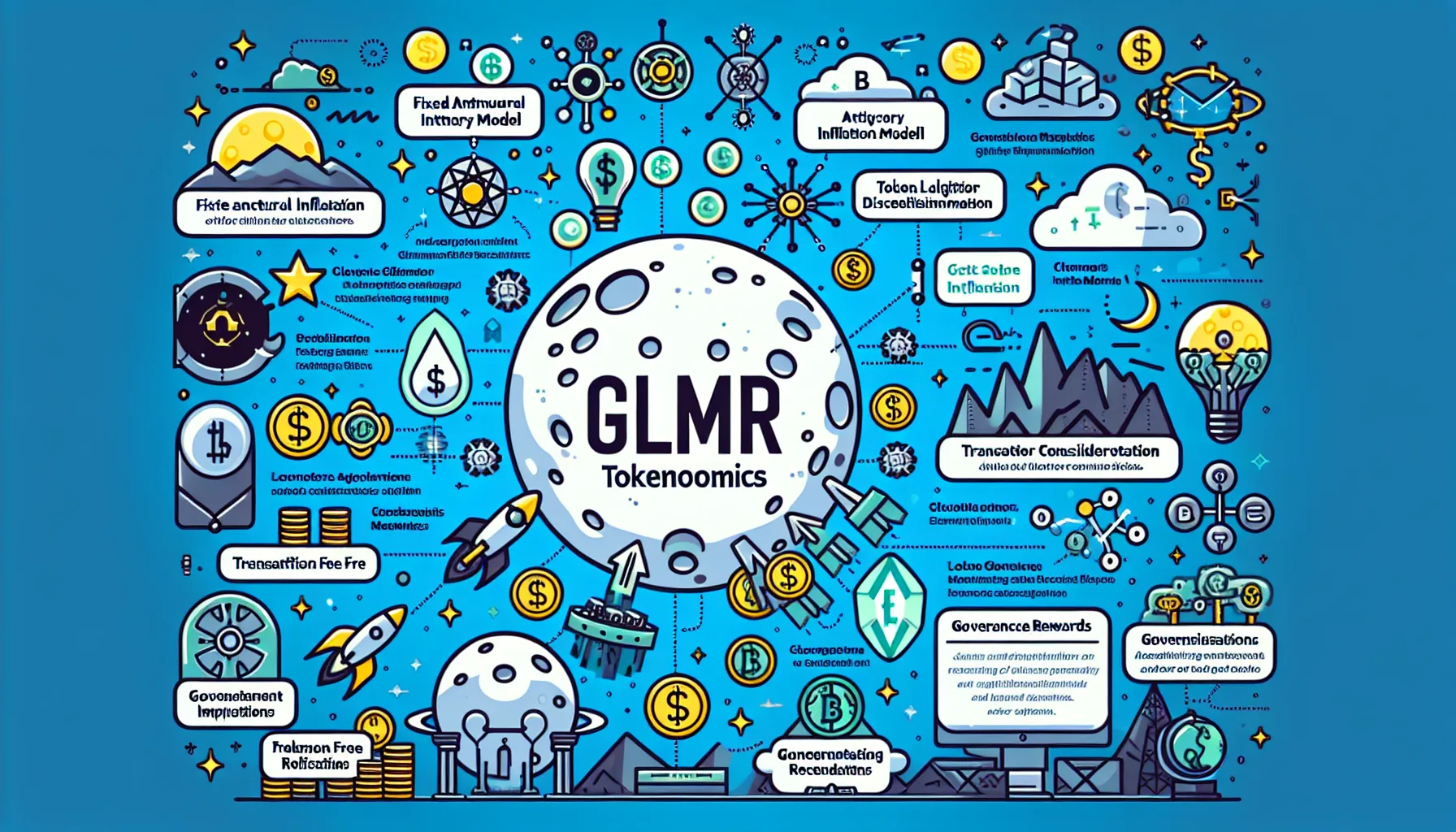
GLMR Tokenomics
GLMR Tokenomics: A Deep Dive into Supply, Utility, and Distribution
The tokenomics model of GLMR, the native cryptocurrency of the Moonbeam network, plays a pivotal role in defining its utility, incentives, and economic structure. Designed to function as a core utility token within the Moonbeam ecosystem, GLMR serves governance, staking, and transaction fee purposes. However, like many blockchain-based projects, the tokenomics design comes with nuances that need scrutiny.
GLMR Token Supply Structure
GLMR follows a fixed annual inflationary model, diverging from fully capped supply models commonly seen in other tokens. The total supply expands at a predetermined rate per year, catering to rewards for validators and fueling ecosystem growth. While inflationary mechanisms can promote network participation, they also introduce an inherent risk of diluting value for token holders who do not participate in staking or yield-generating activities. This presents an implicit trade-off: incentivizing long-term participation at the cost of potential sell pressure.
Initial Distribution Dynamics
At inception, GLMR underwent a token allocation process designed to balance community allocation, contributors, and backers. A significant portion was allocated to seed investors, private sales, and strategic backers, with vesting schedules to mitigate immediate sell-offs. However, such allocations are often critiqued for creating potential centralization risks or disproportionate influence in governance. The balance between ensuring network development funding and maintaining decentralization is a recurring challenge to watch within the GLMR ecosystem.
Transaction Fee Implications
As Moonbeam facilitates cross-chain compatibility and DeFi activities, GLMR is integral for paying transaction fees. The model adopts a “burn-and-redistribute” mechanism, wherein a portion of the fees is burned, reducing the circulating supply, while another portion is redistributed to validators. While this mechanism theoretically supports long-term value, transaction volume changes could impact its effectiveness. Lower adoption or reduced activity could limit the burn rate and redistribution benefits, leading to questions about the sustainability of this mechanism.
Governance and Decentralization Considerations
GLMR enables token holders to participate in Moonbeam's on-chain governance structure. While this theoretically democratizes protocol upgrades and decisions, concerns about voter turnout, delegation centralization, and potential whale dominance persist. A small number of influential participants could stall or monopolize consensus, raising questions about the practical inclusivity of the governance model.
Staking Rewards and Validator Economics
Staking is a key feature driving GLMR’s intrinsic utility. Token holders can delegate their GLMR tokens to validators and earn rewards. However, inflation-based staking rewards come with trade-offs. Non-stakers face dilution over time, potentially reducing the attractiveness of GLMR for passive holders. Additionally, validator node economics depend on maintaining competitive staking rates, which could inadvertently lead to centralization pressures if smaller validators struggle to stay viable.
GLMR Governance
Governance Mechanisms of GLMR: A Deep Dive into Decision-Making
The governance model of GLMR (Moonbeam's native crypto asset) operates as a key component of the Moonbeam ecosystem, designed to align with the platform's decentralized ethos while enabling efficient decision-making. Built on the Substrate framework, GLMR inherits Polkadot’s on-chain governance system, but with specific features tailored to the needs of the Moonbeam community.
Token Holder Voting
GLMR holders play a central role in governance, as token ownership enables participation in decision-making processes, such as protocol upgrades, parameter adjustments, and changes to the economic model. Token-weighted voting creates a system where users have as much influence as the amount of GLMR they stake or hold. Though effective in incentivizing participation, this model has a well-known drawback: it risks favoring whales—large token holders—with disproportionate influence, which can result in centralization of governance power.
Proposal and Referendum System
Moonbeam’s governance relies on an open and transparent process for submitting proposals. Any community member can suggest changes to the protocol, but not all proposals automatically make it to the voting stage. A proposal must first achieve sufficient backing through a deposit (measured in GLMR) to prevent spam and ensure only serious initiatives gain traction. If a proposal is approved via referendum, it proceeds to implementation via Moonbeam’s forkless upgrade mechanism.
However, a challenge here lies in accessibility. Less experienced community members or smaller token holders may struggle to achieve the visibility or deposit thresholds required to advance their proposals, effectively creating a barrier to entry in the governance system.
Council and Technical Committees
Moonbeam governance incorporates a council body designed to streamline decision-making and act as a check against poorly conceived or malicious proposals. Council members are elected by token holders through an open process, with their role being to represent the community and prioritize initiatives that align with Moonbeam's long-term vision. Additionally, Moonbeam features a technical committee composed of core developers who can fast-track emergency upgrades or fixes. While these bodies improve governance efficiency, their existence introduces a degree of centralization, which has elicited criticism from those advocating for purely decentralized governance systems.
Stake Delegation and the Role of Nominations
GLMR governance allows token holders to delegate their voting power to representatives via a nomination mechanism. By nominating trusted individuals or entities, less active members can still align their stake with governance outcomes. However, this system also mirrors the risks of traditional representative models, such as voter apathy, lack of transparency among delegates, or misalignment of interests between nominators and their representatives.
Challenges in Balancing Decentralization and Efficiency
While GLMR governance is technically robust, it highlights the inherent tension in blockchain governance: achieving full decentralization while maintaining operational efficiency. The reliance on councils and technical committees is practical but can alienate portions of the user base who expect maximal decentralization. Furthermore, the token-weighted voting structure exacerbates wealth and influence disparities, a reality that remains unresolved in GLMR and many other crypto ecosystems leveraging similar models.
Technical future of GLMR
GLMR Technical Developments and Roadmap: Key Innovations and Challenges
Moonbeam (GLMR), a smart contract platform built on Polkadot, continues to refine its technical infrastructure with a focus on interoperability and scalability. This section explores the current and future technical developments on GLMR, addressing both strengths and potential challenges.
EVM Compatibility and Advancements
GLMR's Ethereum Virtual Machine (EVM) compatibility remains one of its standout features, enabling seamless integration with Ethereum-based tools and projects. Recently, efforts have been directed toward optimizing gas efficiency, with the goal of reducing transaction costs for developers and users. Enhancements in EVM implementation have also aimed to strengthen compatibility with complex Ethereum DApps, enabling improved functionality across chains. However, there remains an ongoing concern about the fragmented developer experience when bridging between Moonbeam and Ethereum, particularly in debugging and tooling discrepancies.
Cross-Chain Interoperability
Leveraging Polkadot's relay chain, Moonbeam has made significant strides in cross-chain communication through XCMP (Cross-Chain Message Passing). This functionality allows GLMR to interact with other parachains, facilitating token transfers and data-sharing. A prominent focus of the roadmap involves expanding support for non-Polkadot chains, thereby improving interoperability with ecosystems like Cosmos and Solana through Cosmos IBC (Inter-Blockchain Communication) and future bridging frameworks. Nonetheless, reliance on third-party bridges for non-Polkadot chains introduces risks related to security vulnerabilities and centralization, which will need to be addressed as the blockchain ecosystem matures.
Focus on Decentralization and Governance
Technical upgrades on Moonbeam also extend to its decentralized governance system. Efforts are underway to introduce more robust on-chain governance mechanisms, empowering token holders to shape network upgrades directly. The governance process aims to reduce latency in proposal approvals while making the system more inclusive for smaller stakeholders. However, there are challenges in ensuring participatory governance remains efficient and resistant to potential voter apathy and manipulation by whales.
Scalability Improvements via Layer 2 Solutions
Scalability continues to be an area of exploration. While GLMR benefits from Polkadot's shared security model, the project has laid out plans to explore Layer 2 solutions, such as rollups, to mitigate congestion risks as the ecosystem grows. Proposals for ZK-rollups and optimistic rollups have been hinted at, offering potential reductions in latency and transaction costs. However, integrating such solutions poses technical hurdles in maintaining EVM compatibility and seamless user experience, which the team will need to navigate in the coming development cycles.
Developer-Focused Tools and Improvements
Moonbeam’s roadmap places a strong emphasis on enhancing its developer toolkit. Innovations like unified APIs, optimized block explorer interfaces, and advanced debugging tools cater to developers building natively on GLMR. The goal is to reduce the learning curve and attract contributors from other ecosystems. However, despite progress, GLMR faces competition from more mature developer stacks on Ethereum and other major chains, making tool adoption a continuous uphill battle.
Security Enhancements and Auditing
The Moonbeam network consistently prioritizes security, with multiple audits and bug bounty programs to safeguard assets. Yet, as more applications deploy on the network, the risk of smart contract vulnerabilities and exploits increases. Future technical developments aim to implement proactive threat detection tools and automated vulnerability scanning. However, addressing these risks remains a moving target given the constantly evolving nature of attacks in the blockchain space.
Comparing GLMR to it’s rivals
GLMR vs. MATIC: A Technical and Ecosystem Comparison
When comparing Moonbeam (GLMR) to Polygon (MATIC), one of the most critical distinctions lies in their underlying architecture and the approach each takes toward scalability and interoperability. While both projects aim to optimize the blockchain user experience, they employ fundamentally different strategies and have unique strengths and limitations.
Moonbeam (GLMR), built on the Polkadot ecosystem, leverages Substrate technology to act as an Ethereum-compatible smart contract parachain. This means it benefits from Polkadot’s shared security model and cross-chain capabilities that allow seamless communication across various blockchains within the Polkadot network. By focusing heavily on developer tools, Moonbeam supports Solidity-based smart contracts, enabling Ethereum-native projects to transition with minimal changes to their codebase. However, its reliance on the Polkadot ecosystem can be seen as a limitation when compared to Polygon's broader market penetration and adoption.
Polygon (MATIC), on the other hand, is often referred to as a Layer 2 scaling solution that enhances Ethereum's existing infrastructure. Unlike Moonbeam, which operates as a parachain, MATIC employs sidechains and Layer 2 rollup technologies to significantly reduce network congestion and gas fees on Ethereum. Its ecosystem is bolstered by established partnerships and deployments, making it a go-to platform for decentralized applications seeking immediate scalability. That said, some critics argue that Polygon’s approach sacrifices a degree of decentralization due to its validator model and reliance on the Ethereum mainnet for security.
For developers, one notable difference is how each platform integrates with Ethereum. Moonbeam provides a nearly identical development environment to Ethereum, with added compatibility for Polkadot-specific features like XCMP (Cross-Chain Message Passing). This makes it particularly appealing for projects seeking to explore multi-chain operability. Polygon's focus, meanwhile, centers on cost-effectiveness and transaction speed, making it the preferred choice for high-volume dApps but potentially less flexible for cross-chain scenarios.
A significant challenge Moonbeam faces in competing with Polygon is its ecosystem maturity. Polygon's vast array of tools, libraries, and developer resources has been battle-tested by a larger share of projects, while GLMR is still in the process of carving a unique niche. This disparity has implications for network effects and project onboarding processes.
In summary, while Moonbeam excels in interoperability and Ethereum compatibility within Polkadot's framework, it struggles to match the extensive tooling, adoption, and liquidity found in MATIC’s ecosystem. Developers and users need to weigh these trade-offs when choosing between the two platforms.
Comparing GLMR to DOT: A Detailed Look at the Competitive Edge
When comparing GLMR, the native token of the Moonbeam Network, to DOT, the utility token powering Polkadot’s ecosystem, the relationship between the two is inherently significant given Moonbeam’s role as a Polkadot parachain. However, distinct characteristics and areas of overlap are worth exploring in order to understand their competitive dynamics within the Web3 and blockchain infrastructure ecosystem.
1. Core Value Proposition
DOT functions as the backbone of Polkadot, providing staking, governance, and bonding capabilities for its parachains. In contrast, GLMR serves as the operational fuel for Moonbeam, with a focus on facilitating seamless decentralized application (dApp) deployment and multi-chain interoperability through its Ethereum-compatible smart contract platform. Essentially, GLMR inherits security and consensus from Polkadot while differentiating itself with its developer-friendly, Ethereum Virtual Machine (EVM) environment. The rivalry here is more indirect, stemming from overlapping use cases rather than conflicting token designs.
2. EVM vs. Substrate Exclusivity
One critical contrast is GLMR’s strong reliance on EVM compatibility to attract developers. While this approach lowers entry barriers for Ethereum developers, it does come at a cost: it tethers Moonbeam’s ecosystem to Ethereum’s design limitations, such as gas inefficiencies and centralized tooling dependencies. DOT, on the other hand, operates at the Polkadot protocol layer and leverages Substrate’s modular framework to allow parachains to tailor blockchain architectures. Developers building with DOT’s infrastructure can bypass many of the design constraints introduced by Ethereum-centric environments. This variance in developer tooling creates a strategic tension, as GLMR targets ease of adoption, while DOT enables deeper blockchain customization.
3. Token Economics
DOT boasts a well-established staking mechanism, enabling robust security for its relay chain while incentivizing widespread participation. GLMR, while offering an inflationary staking model for network validators and delegators, operates under a more niche framework as an application-layer token. This distinction impacts token demand; DOT's use case extends beyond Moonbeam to the entire Polkadot ecosystem, whereas GLMR’s utility has a narrower focus tied to Moonbeam adoption. That narrower scope is a vulnerability GLMR faces when compared to DOT’s broader ecosystem-wide utility.
4. Ecosystem Growth
GLMR benefits greatly from its integration with DOT, but it also faces a scalability challenge due to its reliance on Polkadot for shared security and interoperability. DOT, by contrast, positions itself as the enabler of an entire multi-chain system, making it inherently less dependent on any single parachain’s success. This ecosystem-wide advantage can limit GLMR’s ability to independently carve out market share, particularly in high-throughput or custom blockchain use cases where Moonbeam’s generalized EVM compatibility might not suffice.
Understanding GLMR’s place alongside DOT highlights both synergies and competitive frictions, especially as Web3 ecosystems evolve.
GLMR vs. AVAX: A Comparative Analysis of Layer-1 Protocols
The rivalry between GLMR (Moonbeam) and AVAX (Avalanche) highlights significant contrasts in the architectural design, ecosystem scope, and approach to decentralization within the competitive Layer-1 blockchain landscape.
Technical Architecture: Substrate vs. Avalanche Consensus
GLMR is built on Polkadot's Substrate framework, allowing it to function as a Polkadot parachain. This integration facilitates interoperability and shared security through Polkadot's relay chain. AVAX, on the other hand, operates as a standalone network, leveraging its Avalanche Consensus mechanism. This consensus is divided across multiple "subnets," which enable customizable blockchain deployments. While AVAX benefits from its modular consensus design for scalability, this independence also creates potential challenges around interoperability with external ecosystems, compared to GLMR’s seamless access to Polkadot's multichain network.
However, GLMR’s reliance on Polkadot introduces a dependency concern. The performance and adoption of GLMR are tightly coupled to Polkadot’s success, while AVAX's autonomous nature provides more flexibility in pursuing its own roadmap. For developers looking for a vast interoperable network, GLMR might be appealing, but AVAX’s unique consensus mechanism offers high throughput and low latency, which are attractive for use cases like DeFi and gaming.
Developer Ecosystem: EVM Compatibility
Both GLMR and AVAX prioritize Ethereum Virtual Machine (EVM) compatibility, making them appealing to developers familiar with Ethereum tools. For GLMR, EVM compatibility is one of its core functionalities, enabling Ethereum-based smart contracts to execute seamlessly on its platform. This is further bolstered by GLMR’s integration into the Polkadot ecosystem, where developers can access cross-chain functionality.
AVAX, while also EVM-compatible, extends this capability through its multi-chain structure: the C-Chain, which is specifically optimized for EVM integration; and the X-Chain, designed for asset creation and transfer. While this architecture offers versatility, it can also complicate the developer experience. The need to navigate multiple chains for specific operations might be perceived as less straightforward compared to GLMR's all-in-one EVM compatibility on a parachain.
Ecosystem Size and Security
AVAX boasts a broader ecosystem with a higher number of dApps and total value locked (TVL), reflecting its adoption and maturity. This contrasts with GLMR, which is still in its growth phase. Additionally, AVAX benefits from a more distributed validator set, enhancing its network security against potential attacks. By contrast, GLMR inherits Polkadot's relay chain validators, which, while secure, may be viewed as an indirect reliance on Polkadot’s infrastructure.
Limitations in Governance
Another consideration is governance. AVAX employs its native governance model, while GLMR’s governance is deeply connected to Polkadot. For projects or users prioritizing independence in decision-making, AVAX may be preferable, while GLMR’s governance model ties it to the broader Polkadot community, which some might view as a limitation.
Primary criticisms of GLMR
Primary Criticism of GLMR: Challenges Facing Moonbeam's Ecosystem
One of the central criticisms levied against GLMR, the native token of Moonbeam, revolves around its scalability within the Polkadot ecosystem. While Moonbeam benefits from Polkadot's shared security and interoperability, detractors argue that it inherits performance bottlenecks related to the Polkadot relay chain. For applications that demand high throughput and near-instant finality, this reliance on the shared relay chain can present limitations. For example, network congestion on Polkadot can indirectly affect Moonbeam’s efficiency, impacting transaction speeds and developer experience, especially during periods of heightened activity across the ecosystem.
Tokenomics is another concern often raised. Critics point to the inflationary model of GLMR, which includes a substantial annual issuance to incentivize collators and maintain the parachain. While this model supports network sustainability, it creates ongoing dilution for token holders. This aspect has drawn attention from those skeptical of its long-term value proposition, particularly in comparison with deflationary or capped supply tokens that dominate the broader crypto space. Combined with the utility-focused scope of GLMR, some investors express skepticism about its potential as an attractive store of value.
The dense competition in the smart contract layer-1 and layer-2 space further compounds criticisms of GLMR. Moonbeam's positioning as an Ethereum-compatible parachain may distinguish it within the Polkadot ecosystem, but it also places it directly against high-profile rivals like Ethereum itself, as well as EVM-compatible chains like Polygon, Avalanche, and Binance Smart Chain. Critics argue that Moonbeam has yet to sufficiently differentiate itself or attract a substantial share of decentralized applications (dApps) relative to these well-established alternatives. The result is a perception that GLMR’s adoption has room to grow but currently lags behind its competitors.
Lastly, protocol centralization concerns persist in the early stages of Moonbeam’s lifecycle. Despite the network’s intention to decentralize over time, critics point to the initial allocations of GLMR as a potential issue. Ecosystem funds, early backers, and team allocations collectively represent a significant portion of the token supply. This concentration of holdings raises questions about governance centralization and the ability of retail participants to meaningfully influence protocol decisions, particularly as the network grows.
These criticisms spotlight the challenges Moonbeam and GLMR face in a highly competitive and rapidly evolving crypto environment.
Founders
The Founding Team Behind GLMR: Visionaries and Challenges
The genesis of GLMR, the native token of Moonbeam, traces its roots to a focused group of pioneers in blockchain infrastructure development. Moonbeam, regarded primarily as an Ethereum-compatible smart contract parachain on Polkadot, was spearheaded by the team at PureStake, led by Derek Yoo, its CEO, an experienced entrepreneur with a background in creating scalable cloud-based software. Yoo's strategic leadership played a critical role in shaping Moonbeam’s technical architecture and its corresponding crypto asset, GLMR, enabling it to carve a niche in the multi-chain ecosystem.
However, while Yoo has received recognition for his methodical approach to blockchain deployment, criticisms have emerged regarding the centralized development focus. The PureStake team, while technically proficient and rooted in years of practical expertise, has drawn scrutiny for the relatively insular nature of its decision-making across critical protocol developments. Some within the crypto community have raised concerns about whether the foundational team has sufficiently prioritized decentralization in its governance structure—a key tenet that many expect from platforms aiming to empower developers within the decentralized finance (DeFi) and Web3 space.
Adding to this, Moonbeam’s reliance on grants and funding from external stakeholders, such as Web3 Foundation initiatives and Polkadot ecosystem contributors, has sparked concerns about possible oversight or undue influence from these supporting entities. While funding relationships remain common in blockchain development, these dynamics highlight the complexities faced by the founding team in balancing innovation, neutrality, and autonomy.
On the technical front, the founding team stands out for its depth in building Layer 1 parachains, and reportedly, they’ve also leaned heavily on key hires with expertise in Solidity, Ethereum toolchains, and Substrate development. Nonetheless, some analysts have questioned whether the broader team is sufficiently staffed to support and scale the ambitious roadmap for Moonbeam’s full-featured multi-chain implementations. Resource allocation and finding the perfect balance between supporting GLMR’s adoption and scaling effectively remain chief challenges under the PureStake management.
The Moonbeam founding team’s achievements place them among the more competent in navigating the complexities of blockchain interoperability. That said, ongoing scrutiny from a highly vocal and discerning crypto community emphasizes that GLMR’s ultimate adoption and sustainability may hinge on how the founding team matures its governance strategy, decentralization efforts, and operational scalability moving forward.
Authors comments
This document was made by www.BestDapps.com
Sources
- https://docs.moonbeam.network/
- https://moonbeam.network/
- https://github.com/PureStake/moonbeam
- https://moonbeam.network/technical-whitepapers/
- https://forum.moonbeam.network/
- https://medium.com/moonbeam-network
- https://etherscan.io/token/0xAcc15dC74880C9944775448304B263D191c6077F
- https://polkadot.network/technology/
- https://subscan.io/chain/moonbeam
- https://github.com/PureStake/moonbeam/tree/master/docs
- https://wiki.polkadot.network/docs/learn-parachains#moonbeam
- https://docs.moonbeam.network/networks/moonbeam/
- https://explorer.moonbeam.network/
- https://substrate.io/
- https://github.com/paritytech/substrate
- https://developers.moonbeam.network/


