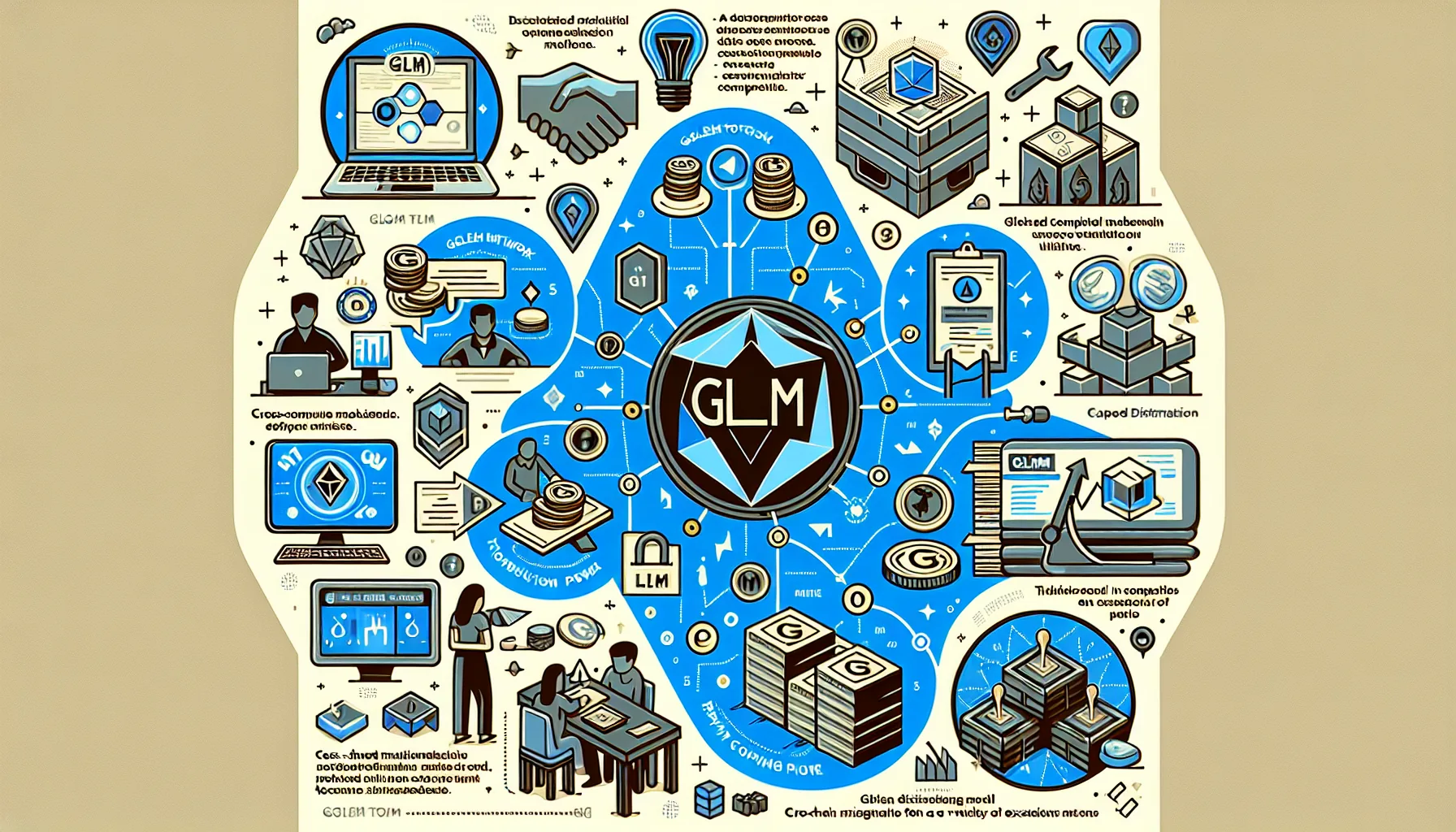
History of GLM
The History of GLM: From Golem to Token Redenomination
GLM, the token powering the Golem Network, has an intricate and evolving history tightly linked to the development of decentralized computing marketplaces. Originally introduced in 2016, GLM began its journey under the ticker GNT (Golem Network Token). GNT was launched as part of one of the earliest Initial Coin Offerings (ICOs) in the crypto space, raising approximately 820,000 ETH. This made it one of the most prominent token sales of its era, contributing to its initial visibility and adoption.
Golem’s primary vision was to create a peer-to-peer decentralized computing network, enabling users to rent their unused computing power or tap into others' resources to perform complex computations. Initially, the GNT token acted as the main utility within this ecosystem, enabling economic interactions between providers and requesters of computation. However, as time went on, GNT faced increasing criticism for its outdated technical infrastructure, such as its reliance on the Ethereum ERC-20 standard without upgrades that reflected the rapid developments in token standards.
In late 2020, the Golem Network initiated the redenomination of GNT to GLM to address these shortcomings. The transition to GLM introduced the migration to a more modern and flexible ERC-20-compliant token framework. The process required users to swap GNT for GLM at a 1:1 ratio, though participation wasn’t mandated, resulting in some fragmentation. This left portions of GNT frozen in wallets due to user inactivity or neglect, raising concerns regarding lost or inaccessible tokens. The redenomination also sparked debates within the community over the centralization of decision-making during the migration process.
Another challenge during GLM’s history was tied to the slow pace of technical implementation on the Golem Network. While the concept of decentralized computing held strong theoretical appeal, the practical realities posed hurdles. Critics pointed out that adoption of Golem’s network remained limited, largely due to competing platforms and questions surrounding whether such decentralized solutions could perform economically and technically at scale. Similar concerns extended to the utility of GLM within the ecosystem, as its demand correlated directly with user engagement on the Golem Network, which experienced periods of stagnation.
Despite these hurdles, GLM’s redenomination marked a pivotal point in its evolution. It reflected efforts by the Golem team to adapt to the rapidly changing crypto landscape, even as skepticism persisted regarding the project’s maturity and real-world integration challenges.
How GLM Works
How GLM Works: A Decentralized Computing Marketplace
GLM, the native token of the Golem Network, powers an open-source, decentralized platform designed to facilitate global access to unused computational resources. The protocol operates by linking requestors—users needing computational power—with providers—those offering idle processing resources—from personal devices to robust data centers. The result is a distributed computing ecosystem where GLM is integral for payments within this peer-to-peer network.
The Core Mechanism of GLM Transactions
GLM serves as the medium of exchange that fuels the Golem Network’s ecosystem. Computational requestors propose tasks, specifying parameters such as price, runtime, and resource requirements. Providers, on the other hand, evaluate these proposals, typically operating the Golem client to offer their computational power. Smart contracts embedded in the Ethereum blockchain facilitate automated payment and ensure security by eliminating intermediaries during transactions.
The protocol leverages a staking mechanism to mitigate risks. Both requestors and providers lock a portion of their GLM tokens in smart contracts to discourage malicious behavior. Once the computation task is successfully completed and verified, locked GLM tokens are released while payment is processed accordingly.
Task Splitting and Resource Utilization
A significant feature of the Golem Network is its ability to split large computational workloads into smaller subtasks. This parallelization allows requestors to benefit from a distributed node network, which optimizes computational efficiency. Examples of supported workloads range from CGI rendering and artificial intelligence training to complex simulations.
Providers participate by dedicating unused CPU cycles, memory, and GPU power for performing these computations. However, this arrangement assumes a level of trust in the network. While verification mechanisms help guarantee result accuracy, computational requestors must still consider the risk of incomplete or defective work from inexperienced providers.
Limitations and Bottlenecks
While the system enables a democratic use of global computational resources, it’s not without its challenges. Latency can be an issue when dealing with geographically dispersed nodes, particularly for real-time or latency-sensitive workloads. Additionally, as the Golem Network relies on Ethereum for its foundational infrastructure, transaction speeds and costs may fluctuate depending on Ethereum’s network congestion. This dependency also subjects GLM users to risks associated with Ethereum-related updates or vulnerabilities.
Furthermore, the level of decentralization claimed by Golem has sparked some debate. Critics argue that the reliance on a centralized protocol design for matchmaking tasks challenges the ideal of full decentralization. As the network grows, scaling and maintaining efficient node discovery mechanisms remain critical challenges for GLM adoption.
Use Cases
Exploring GLM Use Cases: Powering Decentralized Compute with Golem
GLM, the native ERC-20 token of the Golem Network, is designed to facilitate access to decentralized computing resources. The Golem platform, functioning as a marketplace for idle computing power, leverages GLM as the settlement medium between requestors and providers of computational tasks. This section delves into the specific and technical use cases of GLM within the ecosystem, while addressing potential challenges associated with its utility.
Facilitating Access to Computational Resources
GLM is central to Golem’s decentralized compute marketplace, allowing users to purchase the computing power necessary for resource-intensive tasks such as rendering, scientific simulations, machine learning model training, or data analysis. Requestors post tasks on the Golem network, and providers—who can range from individual users to enterprises—bid for these tasks, offering their unused computational resources. All transactions within this framework are settled in GLM. This model enables cost efficiency by utilizing underused hardware, which would otherwise remain idle.
Empowering Web3 Applications
GLM supports Web3’s push toward decentralization by offering projects an alternative to traditional cloud computing services. Applications built within the blockchain ecosystem can leverage the Golem Network for backend operations, ensuring higher levels of decentralization compared to centralized providers like AWS or Google Cloud. Through GLM payments, developers can tap into global computing power without relying on intermediaries that might introduce single points of failure or censorship risks.
Micropayments for Granular Billing
One of GLM’s standout features is its ability to facilitate micropayments, allowing requestors to pay providers on a granular, per-task or even per-second basis. This enables a pay-as-you-go billing model, reducing upfront costs for individuals or startups who may not require long-term commitments to compute resources. However, these micropayments require high-frequency transaction support, which may lead to high gas fees in periods of Ethereum network congestion, potentially offsetting the cost-effectiveness of the system.
Barriers to Widespread Adoption
Despite its potential, GLM faces hurdles that limit its appeal. A noticeable issue is the complexity of onboarding non-technical users who may struggle with understanding decentralized computing workflows and the associated token mechanics. Additionally, while Ethereum's robust security bolsters GLM's integrity, scalability remains a bottleneck, especially as network demand grows. The future integration with Layer 2 solutions or other scaling technologies may alleviate some of these challenges, though these solutions bring trade-offs in terms of centralization and interoperability.
Incentivizing Providers and Mitigating Idle Resource Risks
GLM incentivizes users to act as providers by monetizing idle hardware resources. However, network reliability can become an issue if providers fail to maintain consistent uptime or if computational tasks are misallocated due to insufficient vetting or task validation mechanisms. Misaligned incentives or provider withdrawal during high-demand periods can result in uneven task completion rates, reducing the overall efficiency of the system.
GLM Tokenomics
Golem (GLM) Tokenomics: An In-Depth Breakdown
The tokenomics of Golem Network Token (GLM) are designed to facilitate its decentralized computational marketplace, where users can trade computing power. However, like most crypto assets, GLM's structure introduces key considerations and potential challenges for participants.
Fixed Supply and Distribution Model
GLM operates with a fixed total supply of 1 billion tokens, which were created during its initial token generation event. Unlike inflationary tokens, GLM relies on a capped supply model, eliminating concerns about dilution from future token minting. However, this also means that demand-driven value appreciation is heavily reliant on active network adoption and usage rather than mechanisms like staking rewards or token burning.
The initial token allocation distributed the majority of the supply to investors and the public, with a reserve for team development and ecosystem growth. Over time, this fixed distribution has reduced potential centralization concerns, though questions about the long-term liquidity of GLM remain relevant, especially during periods of low trading volumes across exchanges.
Utility and Incentives
GLM's primary utility lies in its role as a medium of exchange within the Golem Network. Users pay in GLM to rent computational resources, while providers earn GLM for hosting their idle hardware power. This creates a natural sink for the token, ideally driving its demand through network adoption. Nonetheless, one drawback is the dependency on steady network participants. If user interest in paid computations wanes, the demand for GLM tokens could stagnate.
Furthermore, GLM lacks direct staking mechanisms or governance functionality, which are features often touted by other utility or DeFi-enabled tokens to enhance user involvement. While this simplicity aligns with Golem's narrower focus, it also limits the pathways for token holders to be actively engaged.
Cross-Chain Migration: GNT to GLM Swap
In a critical development for its tokenomics, the Golem project transitioned from its original GNT token (an ERC-20) to the current GLM token. GLM retains an ERC-20 structure but improves smart contract efficiency. Despite the smooth migration, challenges persist as some holders have not completed the swap, leaving portions of the previous token supply inactive. This incomplete migration underscores an ongoing inefficiency in circulating supply calculations and market cap analysis.
Liquidity and Exchange Accessibility
GLM's usage is supported by listings on a range of popular decentralized and centralized exchanges, ensuring widespread accessibility. However, liquidity fragmentation across these platforms can result in occasional pricing inefficiencies. Slippage and trading bottlenecks are more pronounced on less active exchanges, a factor to consider for high-volume traders or significant token holders looking to exit or enter the market without impacting the price.
Lastly, while the Golem Network has fostered a niche use case for its token, broader adoption faces stiff competition from projects introducing more complex incentives or hybrid models across DeFi, NFTs, and governance layers. For GLM to optimize its tokenomics strategy, bridging these gaps could prove vital for its long-term sustenance.
GLM Governance
Understanding GLM Governance: Decision-Making Framework and Challenges
Governance in the GLM ecosystem is a critical component that defines how the network evolves, adapts, and manages decision-making processes. As a decentralized crypto project, GLM (formerly Golem) aims to give stakeholders fair involvement in shaping the protocol, but its governance model presents both strengths and challenges.
Decentralized Governance Model
GLM operates with a governance model that prioritizes community input over centralized control. Token holders act as stakeholders, with the power to propose, vote, and implement changes to the protocol. These governance mechanisms are often implemented through smart contracts, ensuring transparency and immutability in decision-making. This approach aligns with the ethos of decentralization, but the reliance on token-weighted voting introduces potential issues of power imbalance, as larger token holders naturally exert influence disproportionate to other participants.
Proposal Process and Transparency
The GLM ecosystem employs a proposal system designed to enable community members to suggest modifications or enhancements. These proposals typically follow a structured process, moving from discussion to formal on-chain voting. While this theoretically provides a democratic avenue for decision-making, accessibility can be an issue. Participation in governance discussions often requires a deep technical understanding and familiarity with the project’s roadmap, potentially alienating less sophisticated stakeholders.
Transparency is generally a strong feature of the project’s governance as voting results and proposal details are published on-chain for public verification. However, criticism arises regarding engagement and the concentration of governance participation among a limited subset of the community.
Governance Tokenomics
Token-weighted governance, where decisions are influenced proportionally by the number of governance tokens held, imposes a potential risk of centralization. Whales or large token holders may sway decisions in their favor, often leading to suspicion about whether decisions align with the broader interests of the community or only benefit those with significant capital investment.
Additionally, voter participation metrics sometimes reveal low turnout in critical proposals. This raises concerns about voter apathy and whether important governance changes are truly reflective of the community's collective will.
Off-Chain Influence
Despite its decentralized nature, off-chain factors can still heavily impact GLM governance. Decisions are frequently shaped by core development teams, influential individuals, and larger entities within the ecosystem, which may dilute the intent of allowing token holder autonomy. Users have also reported difficulties in navigating governance off-chain discussions on platforms like forums or community calls, further adding to barriers in embracing fully decentralized governance.
In conclusion, GLM governance is a work-in-progress, balancing decentralized principles with practical challenges surrounding influence, participation, and technical education among stakeholders.
Technical future of GLM
Current and Future Technical Developments of GLM: Examining the Technical Roadmap
The GLM (Golem) project has taken strides in redefining decentralized computation, leveraging its protocol to offer a marketplace for computing power. The core development focuses on enabling developers and enterprises to outsource computationally intensive workloads to a network of globally distributed nodes. While functional, GLM faces challenges and opportunities as it progresses through its technical roadmap.
Enhancements to the Golem Network Protocol
One of the critical areas of technical development for GLM is the enhancement of the Golem Network Protocol. The current architecture is based on peer-to-peer (P2P) interactions, leveraging Web3 and smart contracts for payment mechanisms. However, scalability and network efficiency remain areas requiring continuous iteration. Efforts are being directed toward improving the matchmaking algorithms, which pair providers with requestors more efficiently. Current solutions occasionally suffer from latency issues when matching task providers with suitable computational nodes, a limitation that impacts user experience and overall throughput.
To mitigate these challenges, developers are exploring decentralized proof-of-concept systems for more optimized load balancing. These systems aim to reduce data silos, improve node resource utilization, and streamline execution times. However, it's worth noting that while this could enhance overall speed and fairness in task allocation, further implementation complexities may arise, and achieving true decentralization while significantly boosting performance remains technically challenging.
WASM Integration and SDK Improvements
An area of focus is the tighter integration with WebAssembly (WASM). This is aimed at expanding the supported workloads beyond traditional computational tasks to include more diverse use cases like machine learning inference and distributed rendering pipelines. The development of streamlined software development kits (SDKs) and APIs for external developers is also being prioritized. While the introduction of a robust SDK empowers a broader range of developers to leverage GLM, concerns exist around onboarding third-party developers into a still-evolving ecosystem lacking widespread documentation and standardization.
Layer 2 Solutions for Scalability
GLM's shift towards incorporating Layer 2 (L2) solutions, such as rollups, forms another cornerstone of its technical roadmap. These efforts are aimed at decongesting the Ethereum network, where GLM predominantly resides, by offloading computational proofing to L2 chains while ensuring predicates and state updates maintain integrity. Although this initiative reduces transaction costs and increases throughput, compatibility issues with existing L2 platforms and smart contracts pose integration challenges.
Future Roadmap Challenges
Future development plans largely center on improving fault tolerance and redundancy systems for task computations, an area currently requiring more robust implementation. Additionally, ensuring the self-sustainability of distributed computing nodes remains a significant challenge, especially as demand for low-cost computational power scales. The risk of centralization—caused by disproportionately powerful nodes dominating tasks—requires proactive governance solutions, which are currently at risk of lagging behind technical improvements.
Comparing GLM to it’s rivals
Comparing GLM to BAT: Decentralized Use Cases in Focus
When evaluating GLM against BAT, one of the core differentiators lies in their respective use cases within decentralized ecosystems. While both assets are built with blockchain technology to enable distributed functionality, their target industries are fundamentally different, leading to significant disparities in how they operate, their token utility, and the size of their potential markets.
GLM powers the Golem Network, a decentralized marketplace for computing power. It enables users to either rent out underutilized computational resources or pay for access to them. This utility positions GLM as a niche asset focused on decentralized computing. In contrast, BAT is foundational to the Brave browser and its associated ad tech ecosystem, designed to decentralize digital advertising by empowering users to earn rewards for consuming content while giving advertisers more transparent engagement metrics.
One major advantage GLM holds over BAT is its broader functional use case in industries that demand intensive computation. Applications such as rendering, scientific simulations, and machine learning workloads make GLM particularly appealing to technical users and developers in enterprise-grade fields. BAT, on the other hand, remains confined to a more narrow consumer-facing scope, largely incentivizing browser activity but lacking a direct entry into the broader field of decentralized services.
However, GLM's focus on computational power also exposes challenges that BAT does not face. The usability of GLM is highly contingent on the successful adoption of its network by developers and enterprises. Its model depends on a balanced supply-and-demand dynamic between "providers" (those renting out resources) and "requestors" of computing power. This balance can struggle in periods of low adoption or when similar centralized solutions are perceived as more convenient. BAT, by contrast, benefits from an ad-supported adoption mechanism built into the Brave browser, which consistently drives user engagement due to its baked-in ecosystem.
Another point of divergence is in the maturity of their respective platforms. BAT has a strong emphasis on usability for non-technical end users, bolstered by a streamlined entry point through the Brave browser. GLM, while powerful for its target users, is inherently more complex and demands a higher level of familiarity with decentralized networks and technical infrastructure from both resource providers and developers.
Finally, both tokens are heavily reliant on user bases for success, but GLM faces competition not just from the crypto space but also from centralized cloud providers, whose solutions are well-entrenched and more familiar to many potential users.
GLM vs RLC: A Detailed Comparison in Decentralized Computing
When comparing GLM (Golem) to RLC (iExec), two of the most prominent decentralized computing platforms in the blockchain space, it becomes evident that while they operate within the same broad sector, their technological implementations, use cases, and community engagement strategies differ significantly. These distinctions highlight both the rivalry and the niche specializations that exist between them.
Core Use Case Differentiation
GLM focuses on providing a marketplace for general-purpose distributed computing, allowing users to rent unused computational power for a wide array of tasks such as CGI rendering, AI training, and large-scale data processing. In contrast, RLC positions itself as a more enterprise-focused solution, enabling businesses to access off-chain computational resources for applications that often require higher levels of privacy and compliance, such as confidential computing and TEE-based (Trusted Execution Environment) workloads. This difference in target demographics — individuals and small developers for GLM versus institutional users for RLC — significantly influences the adoption patterns and development priorities of both networks.
Network Architecture
An important technical distinction lies in their architectural design. GLM relies on a network where providers contribute computational power without a stringent need for specialized hardware. RLC, on the other hand, often emphasizes high-performance computing nodes and secure enclaves via its integration with Intel SGX technology. While this provides a layer of additional security for RLC users, particularly for sensitive business operations, it also introduces a more complex setup process and dependency on specific hardware configurations. Critics argue that this reliance on proprietary hardware limits the decentralization claims of RLC compared to GLM’s more hardware-agnostic model.
Ecosystem Integration
RLC has carved out a niche by actively integrating with enterprise-level solutions and promoting partnerships, such as those involving oracle services and cloud providers like Microsoft Azure. However, this focus on institutional partnerships places RLC at risk of becoming overly centralized in practice, as heavyweight enterprises tend to exert greater influence over the network’s roadmap. GLM, conversely, has largely leaned on grassroots efforts to nurture a developer-driven ecosystem, which resonates with decentralization purists in the blockchain community but arguably limits large-scale adoption in corporate environments.
Token Utility and Adoption Challenges
Both platforms tie their native tokens tightly to their ecosystems, but GLM’s focus on microtransactions for individual computing tasks can pose scalability challenges during periods of intense network activity, especially if gas fees surge on Ethereum. RLC, being built on Ethereum as well, faces similar issues but mitigates some of this by targeting fewer, higher-value transactions rather than frequent micropayments. Nevertheless, RLC has faced criticism for its relatively steep barrier to entry for providers, with token staking requirements creating friction in onboarding new contributors to its network.
Through this lens, RLC emerges as a platform with distinct advantages in enterprise adoption but also certain trade-offs around decentralization and accessibility, especially when juxtaposed with GLM’s more community-centric approach.
GLM vs OCEAN: A Focused Comparison in Decentralized Ecosystems
When contrasting GLM (the native utility token of the Golem Network) to OCEAN (the token powering Ocean Protocol), the underlying difference lies in their value propositions and operational focus within the decentralized ecosystem. Both projects leverage blockchain technology to enhance decentralization, but their technical priorities and infrastructure diverge significantly.
Core Use Cases: Computation vs Data Markets
GLM is designed to fuel a decentralized computational power-sharing network. Users can rent or provide computing resources in an open, peer-to-peer marketplace. Its primary appeal lies in enabling distributed rendering, data analysis, AI model training, and other resource-intensive tasks without relying on centralized cloud providers.
In stark contrast, Ocean Protocol, driven by OCEAN tokens, focuses on decentralizing data markets. It empowers users to monetize datasets while retaining control over who accesses the data. Ocean Protocol incentivizes AI and data-driven solutions but lacks the computational angle that defines Golem. Instead, its forte lies in organizing and sharing fragmented datasets.
Here, the rivalry narrows to use-case overlap: GLM often indirectly competes with OCEAN in fields like AI, where both computation and data ownership are critical. Depending on project integrations, this overlapping territory can create friction as collaborators decide between GLM's execution layer or OCEAN’s data infrastructure.
Technological Depth: Security vs Interoperability
GLM relies on a core Ethereum implementation but has undergone significant updates, including Layer-2 enhancements through zkSync, which optimize transactions and reduce fees. While these updates strengthen Golem as a computation network, interoperability with indexing massive datasets, something inherently tied to OCEAN’s data-tokenization model, is limited.
On the other hand, Ocean Protocol emphasizes Web3 interoperability and enables data tokenization through the ERC-20 standard. Yet users often encounter issues related to privacy guarantees when dealing with sensitive or proprietary datasets. In these scenarios, GLM’s strict focus on anonymous computation-as-a-service gains relevance, bypassing data-specific risks associated with storage and sharing.
Pain Points and Ecosystem Limitations
A notable limitation for GLM in this competitive context is its more narrow utility scope. While democratizing computing power is ambitious, it does little to address the growing need for integrated data solutions that projects like OCEAN target. Conversely, OCEAN’s struggles with adoption and fragmentation in dataset availability expose gaps that GLM's community, being smaller and more focused, typically avoids.
The key competitive factor lies in their potential integrations. Notably, Golem’s computation power could complement Ocean Protocol’s data marketplaces, but competing incentives and ecosystem growth trajectories create hurdles in fostering organic collaboration.
Primary criticisms of GLM
Primary Criticism of GLM: Unpacking the Limitations of the Golem Network Token
Centralization Concerns in a Decentralized Framework
One recurring criticism of GLM revolves around the broader structure of the Golem Network itself. While its mission is to create a decentralized marketplace for computing power, skeptics argue that significant aspects of the network still rely on centralized decision-making. The Golem Factory, the primary development team behind the project, wields substantial influence over the platform’s evolution, sparking concerns about governance centralization. Critics have raised questions about whether this level of oversight contradicts the ethos of decentralization that is foundational to blockchain ecosystems. For those seeking truly trustless systems, this aspect of GLM may be seen as a misalignment with the industry’s principles.
Barriers to Resource Provider Adoption
Another oft-cited issue with GLM has to do with onboarding new resource providers—individuals or entities that offer computational power to the network. The process of becoming a provider demands not only technical understanding but also hardware that meets specific requirements. This creates friction that could potentially deter participation and reduce the network’s ability to scale. Without a wider base of providers, the actual utility of the network as a viable decentralized alternative may remain hampered.
Interoperability Limitations
The technical architecture of the Golem Network has also been the subject of scrutiny, particularly regarding interoperability. While the platform focuses on creating its own decentralized infrastructure, some critics point out that its lack of seamless integration with other blockchain ecosystems could limit its appeal. Competitors that prioritize cross-platform functionality may have an edge in attracting developers or businesses looking for fluid, multi-chain solutions.
Profitability and Token Utility Challenges
The distribution of rewards in the Golem Network, facilitated by GLM, has prompted debate over its sustainability. For resource providers, the cost of contributing computing power—including electricity, hardware maintenance, and network fees—may outweigh the rewards received. This could potentially disincentivize participation long-term. Additionally, GLM’s core utility is heavily tied to its role as a payment tool within the network. Critics argue this singular focus may be too narrow for it to drive widespread adoption compared to multi-functional crypto assets.
Sparse Use Cases Beyond Core Functionality
Finally, GLM’s reliance on its parent platform has led to concerns about its lack of broader use cases. Unlike some crypto assets that diversify utility—offering governance rights, staking, or collateralization—GLM remains tightly coupled to the computational marketplace. This limits its appeal for broader investor pools or DeFi integration, narrowing its usability to a more niche audience.
Founders
The Founding Team Behind GLM: A Closer Look
One of the most intriguing aspects of GLM (Golem) is its founding team, a group of individuals who set out to establish a decentralized marketplace for computing power. Spearheaded by Golem Factory GmbH, the Warsaw-based organization behind the project, GLM’s roots date back to early blockchain development initiatives. The composition of the team has drawn both praise and scrutiny, given the ambitious scope of their vision.
The foundational leadership includes Piotr Janiuk, Julian Zawistowski, and Andrzej Regulski, who remain notable figures in the blockchain space. Piotr Janiuk, serving as the CTO, has steered the technical backbone of GLM with significant expertise in system architecture and software development. With a background that includes working on complex projects outside of blockchain, his role has been pivotal in addressing critical issues like scalability and security. However, despite his technical contributions, some in the crypto community argue that the pace of development under his technical guidance has been slower than anticipated.
Julian Zawistowski, often perceived as the face of the project during its formative years, brought a strategic approach to GLM’s development while also emphasizing decentralization as a core principle. While his leadership resonated with the ethos of Web3, questions have arisen regarding the ability to deliver on the project's roadmap in a timely manner. Criticism has been leveled at the governance approach during his tenure, with some arguing that the team’s execution lacked clarity in communicating milestones to the community.
Andrzej Regulski, as the COO during the early phases, played a vital role in operations and project management, particularly in fostering partnerships and advocating for the Golem Network's adoption. While his operational acumen contributed to the project’s presence in developer circles, there have been concerns over missed opportunities with major institutional allies that could have accelerated adoption.
Over time, there have been shifts in the team's structure and external contributors have increasingly taken on roles within the project. Although this aligns with the decentralization philosophy, it has also introduced a layer of complexity in accountability and decision-making. This evolution has led to varying opinions on whether the project benefits from such an open approach or if it risks losing cohesion in long-term strategic execution.
Overall, the founding team’s technical competence and passion for decentralization have been clear since GLM’s inception. Still, community critiques surrounding delays, execution, and communication present significant areas for improvement.
Authors comments
This document was made by www.BestDapps.com
Sources
- https://golem.network/
- https://docs.golem.network/
- https://github.com/golemfactory/yagna
- https://www.coingecko.com/en/coins/golem
- https://etherscan.io/token/0x7dd9c5cba05e151c895fde1cf355c9a1d5da6429
- https://medium.com/golem-project
- https://github.com/golemfactory/golem-smart-contracts
- https://golem.foundation/
- https://twitter.com/golemproject
- https://www.golem.network/blog
- https://whitepaper.golem.network/
- https://defillama.com/protocol/golem-network
- https://docs.golem.network/docs/creators-tutorials/quick-start/
- https://github.com/golemfactory/
- https://cryptoslate.com/coins/golem/
- https://coinmarketcap.com/currencies/golem/
- https://www.stakingrewards.com/earn/golem/
- https://blog.golemproject.net/schedule/
- https://thegraph.com/explorer/subgraph?id=golem_data
- https://discord.com/invite/golem


