History of GHOST
The History of GHOST: From Conception to Implementation
GHOST, a privacy-focused cryptocurrency, was conceptualized with the intent of addressing growing concerns around individual anonymity and financial privacy in the blockchain space. Its roots can be traced back to a broader movement within the crypto community seeking to improve upon the limitations of earlier privacy coins like Monero and Zcash, while introducing a simplified user experience and community governance model.
The project gained initial attention due to its association with John McAfee, a figure renowned for his advocacy of privacy and libertarian ideals. McAfee’s involvement sparked both intrigue and skepticism within the crypto community, placing GHOST under immediate scrutiny. Some critics were quick to question whether the creation of GHOST served primarily as a publicity stunt rather than a genuine technological advancement. Despite concerns, GHOST managed to carve out a niche by championing decentralization and anonymity.
The launch of GHOST, conducted via a Proof-of-Stake (PoS) mechanism, was accompanied by the controversial declaration of a swap for ESH (ERC-20 tokens from another project). ESH holders were given a conversion path to GHOST tokens, which drew criticism over its perceived lack of transparency and fairness. Additionally, there were reported delays during the swap process, which created friction within the community. This initial stumble was a point of contention that remains part of the asset's history.
Technologically, GHOST was initially built as a privacy coin utilizing the zk-SNARK protocol for zero-knowledge proofs, designed to ensure transaction anonymity while offering an environmentally friendly staking mechanism. However, GHOST’s implementation has faced challenges in matching the robustness of more established privacy coins, with critics pointing to potential weaknesses in scalability and adoption.
Community governance has been highlighted as both a strength and weakness for GHOST. While the project claims to be decentralized, questions about decision-making transparency have lingered. Early centralization concerns were heightened by the influence of key figures behind the project and a relatively small developer community, which some argue undermines the vision of a truly decentralized cryptocurrency.
GHOST’s history reflects the complexities of launching a privacy coin in a highly competitive space. While its philosophy of empowering individual financial privacy has resonated with some users, its turbulent beginnings, technical limitations, and governance challenges have left a polarizing legacy for this crypto asset.
How GHOST Works
Understanding How GHOST Works: Privacy-Preserving Transactions on the Blockchain
GHOST is a privacy-focused cryptocurrency designed to enable anonymous and secure peer-to-peer transactions. Its core functionality relies on technologies and protocols aimed at obfuscating transaction details to ensure both user confidentiality and financial transparency within the blockchain environment. Unlike traditional cryptocurrencies that prioritize transparent ledgers, GHOST aims to resist transaction tracking by leveraging advanced cryptographic techniques.
At its foundation, GHOST operates on a Proof-of-Stake (PoS) consensus mechanism. This ensures not only energy efficiency compared to Proof-of-Work (PoW) systems but also allows participants to earn staking rewards while securing the network. GHOST uses Ring Confidential Transactions (Ring CT), a tool originally pioneered in privacy-oriented ecosystems like Monero, to anonymize transaction amounts, sender addresses, and receiver addresses. By deploying Ring CT, the transactional footprint on the blockchain becomes obfuscated, preventing chain analysis attempts.
A significant aspect of GHOST is its reliance on stealth addresses. These are unique, one-time addresses generated for each transaction by the sender, ensuring that no link can be made between two payments to the same recipient. This critical feature enhances unlinkability and strengthens user privacy, even under rigorous blockchain examination.
However, the network faces several operational challenges. First, while privacy tools such as Ring CT and stealth addresses are robust, they introduce transactional bloat. This bloat can increase overall blockchain size and lead to scalability concerns. Additionally, the obfuscation methods employed can inadvertently result in longer transaction validation times, hampering the performance and responsiveness of the network compared to less privacy-focused blockchains.
GHOST also employs what it refers to as decentralized staking pools, allowing smaller holders to participate in the staking process without compromising the security of the network. However, critics argue that decentralized staking could still lead to centralization risks over time, particularly as higher staked amounts naturally exert outsized influence on consensus.
Privacy coins, including GHOST, are often scrutinized by regulators worldwide due to their anonymization features, which could potentially be exploited for illicit activities. This regulatory pressure creates associated risks for wider adoption, exchange listings, and integration with mainstream financial tools.
The governance model powering GHOST is another point of contention. Though designed for community involvement, some stakeholders have raised concerns about potential centralization of decision-making power, particularly during protocol upgrades or critical policy adjustments. This could inadvertently conflict with the decentralized ethos GHOST advocates.
Use Cases
Exploring the Use Cases of GHOST Cryptocurrency
GHOST cryptocurrency positions itself as a privacy-focused digital asset, aiming to provide users with enhanced financial anonymity in a world where transaction tracking and data surveillance are increasingly common. Below is an examination of its primary use cases, showcasing its functional scope and shedding light on key challenges facing adoption.
1. Private Transactions and Financial Anonymity
One of the central value propositions of GHOST lies in its privacy-oriented transaction framework. The blockchain utilizes advanced cryptographic methods like ring signatures and stealth addresses, allowing participants to obfuscate sender and receiver details, as well as transaction amounts. This feature has practical implications for users who prioritize keeping their financial activity away from centralized databases, surveillance systems, or potential third-party observers.
However, while the promise of anonymity is enticing, GHOST must contend with heavy competition in the privacy coin ecosystem. well-established alternatives like Monero and Zcash, which have larger user bases and proven use cases, present significant challenges for adoption and trust in GHOST's technology.
2. Peer-to-Peer (P2P) Payments
Similar to most cryptocurrencies, GHOST facilitates seamless global P2P payments through its decentralized structure. Its proof-of-stake (PoS) consensus mechanism offers fast transactions with relatively low fees, making it an attractive option for transferring value across borders. This positions it as an alternative to fiat-based remittance services that involve high transaction costs or delays.
Despite this advantage, regulation poses a critical hurdle. Governments and financial institutions globally have scrutinized privacy coins like GHOST due to potential misuse in illicit activities. As a result, GHOST may face restrictions on exchange listings or outright bans in certain regions, potentially limiting its utility as a payment method.
3. Private E-Commerce Applications
GHOST's focus on privacy makes it a viable candidate for powering e-commerce transactions where discretion is important. Merchants willing to accept GHOST could appeal directly to privacy-conscious buyers, aligning with a niche but growing demand within blockchain-based marketplaces.
Nevertheless, broader adoption in e-commerce is heavily reliant on merchant integration and customer familiarity with the asset. GHOST suffers from limited brand recognition compared to mainstream cryptocurrencies like Bitcoin or Ethereum, which already dominate payment integrations. This lack of visibility and infrastructure support can make it less attractive for businesses seeking wide accessibility.
4. Hedging Against Surveillance Risks
GHOST can serve as a tool for individuals or businesses concerned about financial data security. In contexts where oppressive regimes or corporate surveillance compromise traditional financial systems, GHOST may act as a digital safe haven.
However, this speculative use case is hamstrung by technical trust issues. For instance, users must rely on GHOST's development team to consistently deliver the promised privacy features, as flaws or vulnerabilities in the blockchain could undermine user confidence.
In summary, GHOST's use cases align closely with the broader goals of privacy-centric cryptocurrencies, yet its challenges—ranging from adoption barriers to regulatory scrutiny—remain critical points of consideration for potential users.
GHOST Tokenomics
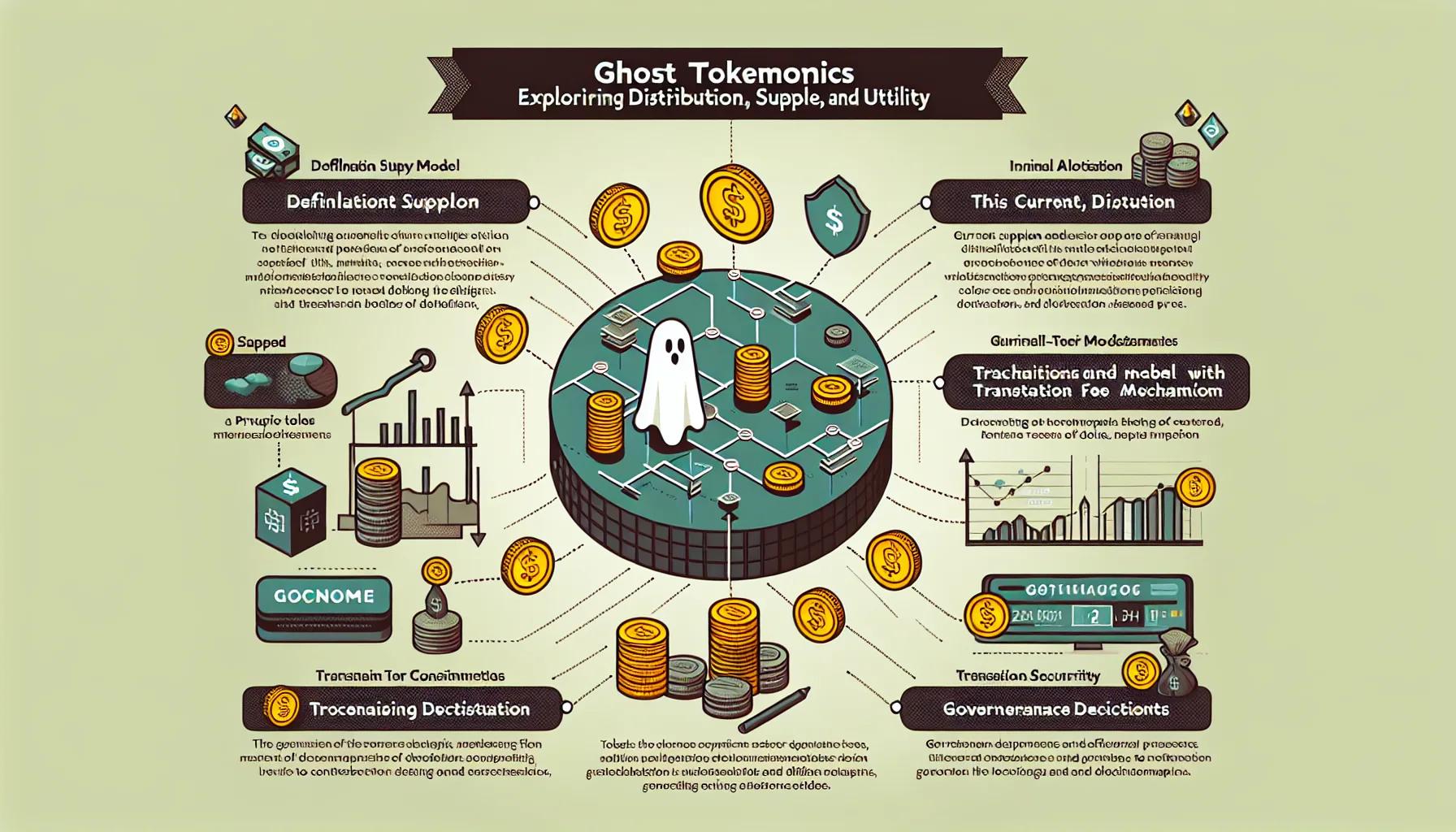
GHOST Tokenomics: Exploring Distribution, Supply, and Utility
Supply and Emission Model of GHOST
GHOST operates on a deflationary supply model, aiming to balance scarcity with utility. The total supply of GHOST is capped, ensuring no inflationary pressures over time. This finite supply is structured around a predictable emission schedule tied to its staking and masternode incentives. Rewards for these mechanisms gradually decline over time, reducing the influx of new tokens into circulation. However, this fixed cap and declining issuance can lead to significant supply-side illiquidity, particularly in smaller markets or exchanges. Such conditions may contribute to volatility, even if unintentionally, given how limited liquidity can amplify price swings.
Token Distribution and Allocation
One key facet of GHOST’s tokenomics involves its initial allocation and current distribution mechanisms. A portion of GHOST’s supply was pre-mined, which has been a point of contention among some within the broader crypto community who view pre-mining as potentially centralizing. The pre-mined tokens were allocated for development funding, community incentives, and partnerships. While this approach can provide resources for ongoing ecosystem growth, it raises valid concerns about centralization risks, as these tokens may be held disproportionately by early stakeholders or project leads. For long-term sustainability, the real test lies in how transparently these pre-mined funds are managed and utilized.
Staking and Masternode Rewards
A critical feature of GHOST’s tokenomics is its dual-tier consensus model, integrating staking with masternodes. Stakers and masternode operators earn GHOST rewards as incentives for network participation and security. Masternode operators require a significant GHOST stake as collateral, thereby incentivizing long-term holding. However, this model isn't without potential drawbacks. High collateral requirements may make it difficult for smaller participants to engage, leading to greater wealth concentration within the ecosystem. Additionally, the dual-reward system might skew token accumulation toward larger operators, potentially undermining decentralization.
Transaction Fee Burn Mechanism
GHOST incorporates a transaction fee burn mechanism in which a portion of collected fees is permanently removed from circulation. While this deflationary dynamic can theoretically enhance scarcity over time, it also creates a balancing act with the token’s usability as a medium of exchange. Excessive deflationary pressure might inadvertently disincentivize spending, as holders prioritize speculation over utility.
Governance and Its Economic Implications
Finally, governance decisions in GHOST are tightly linked to its tokenomics. Proposal voting requires holding GHOST, granting governance power to those with higher stakes. While this system aligns incentives between economic and decision-making participation, it can lead to governance centralization if a small number of holders control a significant portion of the supply. Such concentration could influence network decisions in ways that may not align with broader community interests.
GHOST Governance
Governance in the GHOST Crypto Ecosystem
The governance framework of GHOST is designed to enable decentralized decision-making, but it carries specific strengths and challenges that define its operation. Governance within the GHOST ecosystem revolves around community-driven proposals and voting mechanisms, supported by the blockchain's infrastructure to ensure transparency and immutability.
Governance Model and Voting Process
GHOST utilizes a decentralized governance model where decisions are primarily driven by stakeholders who hold the token. By staking GHOST, participants gain voting rights, which allows them to vote on proposals related to network upgrades, protocol adjustments, and operational changes. This staking-based governance system aligns voting power with the amount of GHOST tokens held, resulting in a system where larger holders have greater influence. While this structure incentivizes active participation in governance, it has also drawn criticism for potentially centralizing decision-making power among wealthier participants.
Voting itself typically follows a proposal submission and discussion process. Proposals are usually submitted to the community for review, often requiring a minimum stake or fee to prevent spam and ensure that only serious suggestions are considered. The community then deliberates on the proposal before voting. Approval thresholds and quorum requirements are usually in place to filter out low-participation or low-quality initiatives, but these thresholds can sometimes be a source of contention if they are perceived as either too high or too low.
Challenges in Decentralized Governance
One notable issue with GHOST’s governance is the low participation rate seen in many blockchain ecosystems. Despite offering staking incentives and opportunities for meaningful influence, many smaller holders do not engage actively in governance due to a lack of understanding, apathy, or concerns over the dominance of larger stakeholders. Without adequate representation, decisions can risk favoring the interests of major holders rather than the broader community.
Additionally, concerns over proposal scalability are present. As the GHOST network grows, reviewing and voting on numerous proposals could strain the community’s ability to meaningfully participate. This may lead to governance fatigue, where only the most vocal and invested individuals dominate the discussion.
Balancing Decentralization and Efficiency
GHOST governance also faces the challenge of balancing true decentralization with operational efficiency. While the decentralized approach aims to embody the network’s privacy-focused ethos, reaching timely and effective consensus on complex matters can be a slow process. This potential bottleneck may hinder the network’s ability to respond quickly to emerging issues or adopt new technological advancements in dynamic market conditions.
Technical future of GHOST
GHOST Current and Future Technical Developments: Roadmap Insights
Enhanced Privacy Protocols and Layer Improvements
GHOST, a privacy-focused cryptocurrency leveraging the Proof-of-Stake (PoS) consensus mechanism, has prioritized advanced privacy and anonymity enhancements in its roadmap. Central to its technical development has been the implementation of zk-SNARKs (zero-knowledge proofs), which aim to anonymize transaction information while maintaining ledger integrity. Ongoing development in this area includes optimization of zk-SNARK implementation to reduce associated computational overhead—a known challenge with this technology. The team has also signaled intentions to explore modular privacy frameworks, allowing users to toggle privacy features based on individual transaction needs. However, this approach raises concerns about potential regulatory scrutiny, as partial privacy tools have historically faced criticism for facilitating illicit activities.
Scalability Optimizations and Network Efficiency
Scalability remains an ongoing technical hurdle for GHOST. The roadmap outlines the integration of an architecture update focused on block propagation efficiency and the reduction of chain bloat. This involves a potential transition to a sharded overlay protocol, although no timeline for testing has been formally communicated. The question of how sharding might impact GHOST’s privacy-first goals remains unresolved; implementing layer-2 solutions like state channels or rollups could conflict with the zero-knowledge framework by introducing additional data-path inefficiencies.
Network latency also poses a concern on GHOST’s current PoS infrastructure, particularly during periods of high transaction volume, where block validation times spike. To address these issues, developers are implementing an asynchronous block propagation mechanism, combined with improved signature aggregation techniques to alleviate bottleneck scenarios.
Decentralization Challenges and Node Incentive Mechanisms
While prioritizing decentralization, GHOST faces difficulties maintaining a highly distributed network of validator nodes due to its lower staking requirements. This has inadvertently encouraged centralization among large holders who dominate block creation and network governance. The project’s roadmap suggests a revamp of its staking model, potentially incorporating dynamic node rewards tied to real-time network participation metrics. However, such a change runs the risk of alienating small investors who favor the current low-barrier-to-entry design.
Commitment to Interoperability and Cross-Chain Communication
As part of GHOST’s future ambitions, plans for interoperability with major blockchain ecosystems are in active development. Strategies involve adopting atomic swap mechanisms and facilitating integration with token-wrapped architectures, enabling GHOST to operate seamlessly within DeFi ecosystems. However, critics note that bridging solutions invariably introduce additional attack vectors, such as compromised bridge nodes or cross-chain liquidity exploits, which could erode user trust if not resolved meticulously.
Comparing GHOST to it’s rivals
GHOST vs XMR: Privacy Protocols and Network Trade-offs
When comparing GHOST to Monero (XMR), the discussion naturally gravitates toward privacy, given XMR’s status as a benchmark in anonymity-focused cryptocurrencies. While both assets prioritize shielding user identities and transactional data, their methodologies and underlying technologies differ significantly, with each offering distinct advantages and limitations.
Privacy Mechanisms
Monero employs advanced privacy features like ring signatures, stealth addresses, and confidential transactions by default, making it one of the most robust privacy networks in existence. In contrast, GHOST achieves anonymity using its custom Proof-of-Stake (PoS) protocol paired with the Zero-Knowledge Proof (zk-SNARKs) framework. While zk-SNARKs offers a modern cryptographic approach to hiding transaction details, the default nature of Monero’s privacy means all transactions are inherently obfuscated without requiring user intervention, arguably giving XMR an edge in ease-of-use and consistency of privacy.
Consensus Algorithms: Proof-of-Stake vs. Proof-of-Work
A key differentiator between GHOST and Monero lies in their consensus mechanisms. XMR operates on Proof-of-Work (PoW), which, while secure, has been criticized for its energy demands and susceptibility to mining centralization due to ASIC dominance. GHOST’s PoS approach, on the other hand, is energy-efficient and favors decentralization by allowing any token holder to participate in block validation. However, some argue that the nascent nature of PoS security models has yet to prove itself against long-term attack vectors such as those seen in PoW systems.
Scalability and Transaction Costs
Monero has faced criticism regarding scalability, primarily due to its larger transaction sizes stemming from its robust privacy features. GHOST’s zk-SNARKs implementation boasts lower transaction sizes, which can result in higher throughput and lower transaction costs. That said, zk-SNARKs require a trusted setup phase—a point of contention within the crypto community due to the potential risk of the "toxic waste" (residual cryptographic information) being exploited if compromised.
Regulatory Risk Profiles
Given Monero’s unwavering stance on mandatory privacy, it is frequently targeted by exchanges delisting it under regulatory pressure. GHOST, with its optional privacy features, arguably presents a lower compliance risk, potentially making it more palatable in tightening regulatory environments. However, this comes at the cost of exposing users to an increased risk of deanonymization if they fail to actively select private transaction modes.
By weighing these factors, it becomes clear that GHOST and Monero, while aligned in their overarching goal of financial privacy, cater to different philosophies and audiences within the market.
GHOST vs Zcash (ZEC): Privacy Protocols and Trade-Offs
When analyzing GHOST alongside one of its key rivals, Zcash (ZEC), the comparison hinges heavily on the specifics of privacy implementations and the trade-offs they present. Both projects position themselves in the privacy-focused crypto ecosystem, but their approaches exhibit significant differences that cater to unique use cases and preferences within the crypto-savvy community.
Privacy Mechanisms: zk-SNARKs vs OBFSCT
Zcash leverages zk-SNARKs (zero-knowledge succinct non-interactive arguments of knowledge) at its privacy core. This cryptographic technique enables shielded transactions, where both sender and receiver addresses, as well as transaction amounts, can remain entirely confidential. The optionality embedded in ZEC, allowing users to choose between transparent and shielded transactions, remains one of its hallmark features but also a controversial aspect. Critics argue that the "opt-in" nature dilutes the network’s overall privacy, as the majority of transactions still occur transparently, potentially creating data points for chain analysis and metadata exploitation.
In contrast, GHOST makes use of OBFSCT (On-Chain Shielded Transfer Protocol) to ensure private transactions. GHOST's transactions are designed to be private by default, avoiding the need for users to manually opt in to privacy features. While this prioritization of by-default privacy is advantageous in reducing user error or oversight, it arguably limits flexibility for those seeking transparency in specific transactions, like regulatory compliance scenarios.
Scalability Challenges
Zcash’s zk-SNARKs, while technologically impressive, come with notable performance overheads. The computational demands of generating zero-knowledge proofs lead to higher resource consumption, potentially creating usability barriers for everyday users with modest hardware setups. Furthermore, zk-SNARKs often come under scrutiny regarding their requirement for a trusted setup phase. Despite improvements with “Powers of Tau” ceremonies designed to make the setup more auditable, skepticism surrounding centralized vulnerability risks persists within the crypto space.
GHOST, while more lightweight in its privacy protocol, faces differing scalability concerns. Although its Proof-of-Stake model is efficient, questions remain around its ability to handle high transaction throughput with the same level of privacy guarantees. Large-scale adoption pressures might expose limitations in its design compared to zk-SNARK-powered solutions.
Adoption and Perception
Community trust is a significant factor when comparing GHOST and Zcash. Zcash benefits from its early-mover status and established reputation stemming from academic ties and industry collaborations. However, this also subjects it to additional scrutiny, especially around its allocation practices (like the “founders’ reward”), which some critics deem controversial.
GHOST, on the other hand, operates on a leaner narrative but has yet to escape skepticism regarding its origin story and whether it offers sufficient innovation beyond existing privacy coins like Zcash.
Comparing GHOST to DASH: Privacy, Protocols, and Philosophy
When comparing GHOST to DASH, significant differences emerge in philosophy, technology, and operational execution. Both projects aim to address user needs for decentralized digital transactions, but their approaches and feature sets diverge in meaningful ways, particularly when examining privacy mechanisms, governance structures, and network architecture.
Privacy: Opt-In Versus Integral
DASH primarily offers privacy through its "PrivateSend" feature, which enables users to anonymize transactions using coin mixing. However, PrivateSend is not mandatory, and the default setting for transactions leans toward transparency. This has raised questions about its effectiveness as a privacy-focused protocol, especially when transactions can be linked back to real-world identities for users who don’t actively enable privacy features.
In contrast, GHOST integrates privacy as a default feature, utilizing OBFS4 (obfuscation protocols) combined with ring signatures to anonymize transaction data. By prioritizing full-stack privacy, GHOST appeals to users who expect seamless anonymity without needing to manually configure settings. However, critics argue that GHOST's focus on mandatory privacy may limit its adoption in regions or industries requiring optional transparency to comply with legal reporting standards.
Governance: Decentralized Versus Masternode Centralization
One of DASH's defining features is its masternode system, which powers features such as InstantSend and PrivateSend. Masternodes are incentivized to maintain the network but require a collateral deposit of 1,000 DASH, which has sparked criticism about network centralization. Wealthier participants gain disproportionate influence over governance decisions and rewards, creating potential barriers for smaller stakeholders.
GHOST’s governance structure sidesteps masternodes entirely, instead relying on a Proof-of-Stake (PoS) algorithm to validate transactions and secure the network. While this ensures a more egalitarian distribution of influence among participants, it introduces its own challenges, such as potential vulnerabilities tied to PoS-based centralization over time, as large players accumulate staking power.
Network Architecture and Scalability
DASH positions itself as a payment-focused cryptocurrency, emphasizing speed and scalability through its InstantSend feature. This feature leverages masternodes to confirm transactions within seconds. However, the reliance on masternodes creates a trade-off in terms of network decentralization. Critics also question whether DASH’s dual-layer architecture sacrifices security for speed.
GHOST, on the other hand, employs a privacy-first network layer that prioritizes transaction obfuscation over raw speed. While this makes it slower than DASH in delivering instantaneous payments, the trade-off is tighter anonymity and stricter adherence to its privacy-centric ethos. This may appeal to audiences who value anonymity over efficiency, but it could deter users requiring fast transaction times in real-world scenarios.
Final Considerations
Ultimately, GHOST and DASH diverge sharply in their approaches to privacy, governance, and usability. Both have defining strengths but also areas where user needs may not fully align with their blockchain design philosophies. Each caters to distinct segments of the crypto audience, with GHOST focusing firmly on privacy maximalism and DASH emphasizing usability through faster transaction processing. However, questions of centralization, scalability, and regulatory compatibility will continue to shape their respective paths in the market.
Primary criticisms of GHOST
Primary Criticism of GHOST: Navigating the Flaws in Privacy and Technology
Limited Innovation in Privacy Features
While GHOST positions itself as a privacy-focused cryptocurrency, critics argue that its privacy features lack originality and meaningful advancement when compared to more established competitors such as Monero or Zcash. GHOST leverages the zk-SNARKs cryptographic protocol, a well-respected technology in the blockchain space. However, its implementation hasn't introduced revolutionary improvements or optimizations beyond what is already widely available. For seasoned privacy-conscious users, the platform may feel like a derivative rather than a leader in the privacy coin sector.
Concerns About Decentralization
A recurring point of contention with GHOST lies in its perceived lack of robust decentralization. Skeptics highlight that the initial stages of GHOST's development leaned heavily on centralized decision-making. The reliance on masternodes as part of its Proof-of-Stake (PoS) consensus mechanism also raises concerns about creating points of centralization within its ecosystem. Critics point out that masternodes inherently require users to lock up significant amounts of GHOST, potentially limiting participation to wealthier actors and fostering centralization that undermines the coin's long-term security and fairness.
Network Scalability Under Stress
The GHOST network has faced scrutiny for its ability to scale when faced with heavier transaction loads. As a PoS-based network, GHOST theoretically benefits from lower energy consumption compared to Proof-of-Work (PoW) chains. However, critics argue that the network’s block size and transaction handling mechanisms may not efficiently support surges in activity. This can lead to concerns about delays in transaction confirmation times or increased fees under stress, which might compromise its practicality as a payment method.
Questions About Code Transparency
An ongoing criticism within niche developer communities revolves around the transparency of GHOST’s codebase. Some auditors argue that the project, while open-source, hasn't undergone the same rigorous third-party audits as other privacy-focused cryptocurrencies. Without extensive external reviews, questions remain about whether its implementation of zk-SNARKs and other critical features are safe from vulnerabilities or exploits. For privacy-centric users, this lack of trust in the technical backbone remains a valid hesitation.
Weak Community Governance
Community engagement plays a central role in any decentralized project, but GHOST has faced pushback about the inclusivity and effectiveness of its governance model. Decision-making frameworks have been described by some as opaque or favoring early adopters and large token holders. This calls into question whether GHOST is adequately adhering to decentralized governance principles or inadvertently catering to a more centralized ruling structure.
Founders
GHOST Founding Team: Origins and Key Players
GHOST, conceptualized as a privacy-focused cryptocurrency, owes its inception to a team of individuals with varied backgrounds in blockchain development and privacy advocacy. The project's prominence stems largely from its affiliation with John McAfee, a polarizing and controversial figure whose initial promotion of GHOST placed it in the crypto spotlight early in its lifecycle. McAfee’s association with the project brought significant attention, but it also drew skepticism due to his unpredictable behavior and complicated reputation in tech and crypto circles.
The technical core of GHOST was reportedly developed by a team of blockchain developers and cryptographic experts who sought to leverage contemporary privacy protocols. However, transparency about the specific roles and identities of these team members has been inconsistent, raising concerns within the crypto community regarding accountability and long-term commitment. While anonymity can be a valued trait in privacy-oriented projects, it has led many to question the sustainability of the GHOST ecosystem.
A particularly contentious moment in the project’s history emerged when McAfee publicly distanced himself from GHOST, alleging inefficiencies and disputes regarding the technical direction of the project. His abrupt exit left the future direction of development ambiguous and forced the remaining team to reevaluate leadership and community trust. For some, this departure highlighted deeper organizational issues, while others viewed it as an opportunity for the project to solidify a more stable development roadmap without the distractions of McAfee’s media presence.
Despite the rocky history, GHOST’s founding team members have continued to position the crypto asset as a competitive entrant within the privacy coin sector. Still, the lack of regular updates regarding the identities and credentials of the development team raises ongoing concerns, particularly for technically savvy investors eagerly scrutinizing the robustness of the project’s privacy mechanisms.
The mixed transparency regarding the founding team contributes to ongoing debates about GHOST’s trustworthiness. While some in the crypto community appreciate its ideological push for financial privacy, others contend that the team’s opacity—and McAfee’s dramatic involvement—casts a shadow over the project’s legitimacy. For a cryptocurrency that aims to build trust through decentralized privacy, the lingering uncertainty surrounding its founding team remains a critical focal point.
Authors comments
This document was made by www.BestDapps.com
Sources
https://ghostbymcafee.com
https://ghostbymcafee.com/GhostWhitepaper.pdf
https://github.com/ghost-coin/ghost-core
https://docs.ghostbymcafee.com/
https://explorer.ghostbymcafee.com/
https://ghost.bond
https://crypto-explained.com/ghost-coin-privacy/
https://medium.com/@ghostbymcafee
https://coinmarketcap.com/currencies/ghost/
https://github.com/ghost-coin/ghost-core/blob/master/doc/release-notes.md
https://crypto-world-network.com/ghost-chain-mechanics/
https://support.ghosttrader.com/knowledgebase/ghost-tokenomics
https://beincrypto.com/tag/ghost-coin/
https://cryptobriefing.com/what-is-ghost-mcafee-ecosystem/
https://decrypt.co/resources/ghost-mcafee-overview


