History of ERN
The Origins and Evolution of ERN: A Deep Dive Into Its History
The ERN cryptocurrency, native to the Ethernity Chain ecosystem, emerged as a distinct addition to the blockchain landscape by focusing on the unique intersection of blockchain technology and digital collectibles. Its origins can be traced to an ambitious attempt to tokenize the world of exclusive non-fungible tokens (NFTs), leveraging both blockchain's decentralized ethos and the growing demand for authenticated digital art and memorabilia. However, this journey has not been without its challenges.
Originally launched to address gaps in NFT provenance and scarcity, ERN aimed to cement its platform as a bridge between artists, athletes, celebrities, and their audiences. Bringing high-profile partnerships to the ecosystem was central to its mission, but the early days of ERN's rollout weren't immune to skepticism. Critics raised concerns about the feasibility of heavily relying on celebrity endorsements to drive sustained adoption. There were also doubts about over-centralization, since its team played a leading role in the initial curation and partnerships, testing the limits of "decentralization" in a supposedly decentralized ecosystem.
Moreover, ERN’s tokenomics design played a major role in its initial adoption, with utility ranging from governance proposals to staking rewards and transaction fees on the Ethernity Chain platform. While this created a compelling use case for early supporters, questions over the inflation rate of ERN tokens and sustainable demand generation lingered in certain circles. Competing NFT protocols and marketplaces further highlighted the challenges ERN faced in carving out a differentiated niche in an increasingly crowded market of tokenized collectibles.
On the technical side, ERN's deployment on Ethereum gave it access to a robust network, but it also inherited challenges such as high gas fees and scalability hurdles during peak usage periods. While Layer 2 solutions and sidechain integrations were floated as possible mitigations, actual implementation took time, which frustrated some users who were eager for seamless minting and trading experiences.
Another key moment in ERN's formative history was its decision to embrace community-driven input through DAO-style governance mechanisms. This move, while aligning with the ethos of decentralization, sometimes led to fragmented priorities among token holders, especially when there were disagreements over platform developments. This tension underscored how balancing centralized efficiency with decentralized control remains an ongoing challenge in the token's evolutionary story.
ERN's history illustrates the trials of blending traditional celebrity-driven markets with blockchain's decentralized ideals. From skepticism over its hybrid approach to navigating technological barriers and token utility concerns, ERN's trajectory serves as a case study of both opportunity and friction in the rapidly evolving NFT ecosystem.
How ERN Works
How ERN Works: Mechanisms and Underlying Technology
Ethernity Chain (ERN) operates as a blockchain-powered platform designed to facilitate authenticated NFTs (non-fungible tokens). At its core, ERN leverages the Ethereum blockchain to mint and sell limited-edition digital assets while integrating both DeFi (decentralized finance) mechanics and social incentives to create a robust, interactive ecosystem. Here's an in-depth look at how ERN functions and some critical considerations surrounding its mechanics:
Smart Contract Infrastructure
The foundation of ERN lies in Ethereum's smart contract architecture. These contracts automate key processes involved in NFT creation, auctioning, and distribution. Through pre-programmed code, ERN ensures that transactions are transparent, immutable, and trustless. However, this reliance on Ethereum also inherits the challenges of network congestion and gas fees. When Ethereum usage spikes, minting or purchasing NFTs on ERN can become prohibitively expensive for users, particularly those seeking low-value assets.
Staking and Governance
ERN incorporates staking mechanisms, allowing token holders to lock their ERN tokens in exchange for rewards. These rewards often include benefits like governance rights, discounts on NFT purchases, or early access to drops. Governance via staking empowers the community to propose and vote on platform upgrades or partnerships. However, this model assumes token holders are well-informed and actively engaged, which isn’t always the case, often leaving governance decisions in the hands of a minority.
NFT Authentication and Licensing
A key selling point of ERN is its approach to NFT authentication. Collaborating with celebrities, brands, and artists, the platform curates 'authenticated' NFTs. These collectibles are marketed as officially licensed, providing a degree of legitimacy that counterfeits or unverified assets can't match. That said, this reliance on partnerships poses risks—any disputes or mismanagement in these collaborations could negatively impact the platform's credibility.
Token Utility Within the Ecosystem
ERN serves multiple utility roles within its ecosystem. It functions as the primary currency for purchasing NFTs, participating in auctions, and accessing exclusive content. Additionally, it is used for rewarding community engagements like promoting drops or completing tasks. While these utilities enhance the token's value proposition, the project still faces competition from other NFT and DeFi platforms offering similar or broader use cases.
Interplay with Gas Fees and Scalability
Given ERN's dependence on Ethereum, the platform grapples with Ethereum’s well-documented limitations in scalability. Although the Ethereum upgrade trajectory aims to mitigate these issues over time, current inefficiencies mean that transaction times and fees can impact ERN's user experience—particularly during high network traffic periods tied to popular NFT auctions.
By addressing these technical components, ERN attempts to balance innovation and functionality, though its full efficiency remains tightly coupled to the evolution of its underlying blockchain infrastructure.
Use Cases
Use Cases of ERN: Unlocking the Ecosystem of NFT-Powered Creative Collaboration
The ERN token (Ethernity Chain) brings a novel set of use cases within the NFT (non-fungible token) ecosystem, positioning itself as a utility token that integrates real-world assets, authenticated NFTs, and decentralized governance. While its applications target highly specific markets, its functionality and adoption potential remain subject to certain limitations and challenges.
Authenticated NFTs and Digital Ownership
One of the primary use cases for ERN lies in facilitating the purchase, staking, and creation of authenticated NFTs. Unlike generic NFTs, the authenticated nature of these assets provides an additional layer of credibility, appealing to collectors focused on verifiable scarcity and real-world ties. Artists, celebrities, and brands can mint verified NFTs—reducing risks of forgery or misrepresentation, issues that have plagued the NFT market. However, this reliance on partnership-driven exclusivity creates potential bottlenecks; the ecosystem’s success hinges on sustained collaboration with high-profile creators and commercial entities.
Staking Rewards and Access Privileges
ERN tokens allow users to access staking mechanisms, unlocking platform-specific rewards and value. This includes benefits like discounted NFT pricing, exclusive content, or priority access to limited-edition drops. While these features bolster user engagement, they may alienate segments of the crypto community if overly focused on premium features, potentially reinforcing a "pay-to-play" atmosphere within their ecosystem.
Community Governance and Decentralization Challenges
Another major application for ERN resides in decentralized decision-making. Token holders influence the platform’s governance process, voting on proposed upgrades, partnerships, and new collections. That said, this decentralized governance model is not without challenges. Concentrated holdings of ERN by whales or early backers can skew governance, undermining its democratizing intent and leaving smaller stakeholders with limited influence over critical decisions.
Real-World Integration via NFT Partnerships
ERN extends beyond blockchain into real-world integration, involving collaborations that tie NFTs to physical or experiential assets such as merchandise or event access. While this creates bridges between crypto-native technology and traditional markets, dependency on external partnerships introduces vulnerability. Delays, contractual disputes, or underwhelming collaborations could diminish perceived value.
Broader Ecosystem Considerations
While ERN’s use cases demonstrate innovative applications for utility tokens within niche creative markets, scalability and competitive differentiation remain ongoing questions. As the NFT ecosystem grows increasingly crowded, how ERN sustains long-term relevance amidst competing alternatives is a critical area of examination.
ERN Tokenomics
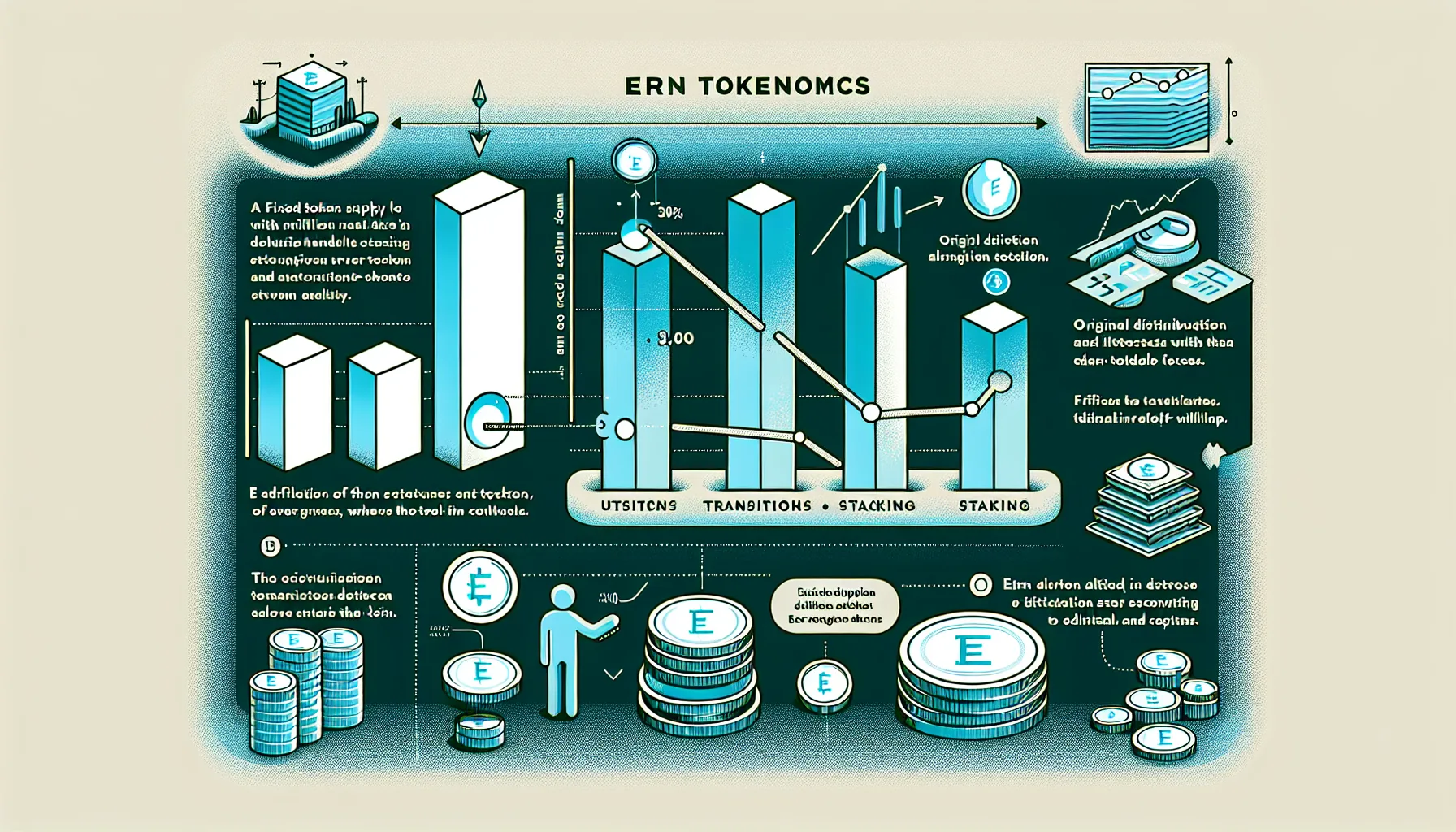
ERN Tokenomics: A Deep Dive into Supply, Utility, and Distribution
Fixed Supply and Deflationary Mechanisms
The ERN token operates on a fixed total supply model, capped at 30 million tokens. This hard cap is a fundamental characteristic influencing the tokenomics, as it fosters scarcity compared to inflationary models. However, the distribution structure and adoption dynamics heavily impact how this scarcity translates into market behavior. A deflationary component is also incorporated through token burns linked to platform activity, though critics argue that the burn schedules lack standardization and predictability, potentially complicating long-term valuation models for investors and users.
Utility-Centric Ecosystem Integration
ERN’s utility is rooted in its role within the ecosystem, notably for transactions, staking mechanisms, and exclusive access to digital collectibles and platform features. The staking functionality provides an additional layer of token locking, theoretically reducing circulating supply. Stakeholders who lock ERN gain rewards tied to ecosystem activity, but the ROI (return on investment) varies, raising questions about the long-term viability of incentives. Moreover, while the token's use in NFT-based transactions is central to its appeal, scalability concerns may arise as transaction volumes grow, potentially impacting usability and fees.
Initial Distribution and Allocation Metrics
The initial token distribution of ERN reflects common allocation strategies in blockchain projects, but some elements of its rollout have sparked debate. Roughly 30% of the total supply was allocated between private and public sales, which raised concerns about centralization risks given the disparity in token access during early stages. The team and advisory allocation, at approximately 20%, includes standard vesting schedules aimed at mitigating immediate sell-off risks, but questions about long-term token unlocking events persist in community discourse. Additionally, the ecosystem fund, representing another significant share, is structured to support development and partnerships, though details on its strategic use remain partially opaque.
Potential Issues in Circulating Supply Management
Circulating supply management is a contentious aspect of ERN’s tokenomics. While measures like staking and burns aim to reduce active supply, the mechanisms don't fully offset the periodic unlocking of tokens from vesting schedules, particularly in the early years. This dynamic introduces potential pressure points in supply-demand equilibrium, which could be amplified by limited liquidity on secondary markets. Furthermore, large token holders—potentially linked to early sales—could present risks of sudden market sell-offs, raising concerns about price stability even amidst increasing ecosystem activity.
Fee Structures and Interactions
Fees generated within the ERN ecosystem play a critical role in sustaining token dynamics, yet they also spark debate among users. Though the platform claims competitive rates, certain on-chain fees tied to NFT minting and marketplace functionalities have been criticized as disproportionately high during peak network activity. This issue introduces friction for smaller participants, which could challenge user adoption and retention over time.
ERN Governance
Governance Mechanisms of ERN: Decentralized Dynamics and Challenges
The governance structure of ERN operates within the broader DeFi ethos, emphasizing decentralization and community-driven decision-making. Key mechanisms underpinning ERN governance include token-holder voting, proposal submissions, and on-chain smart contract execution. However, the practical implementation of these ideals reveals both strengths and challenges that demand thorough analysis by stakeholders.
Token-Weighted Voting: Empowerment or Oligarchy?
ERN governance leverages a token-weighted voting system where ERN token holders exercise proportional voting power based on their holdings. While this aligns with DeFi's incentive model by rewarding contributors and stakeholders with direct influence, it inherently suffers from centralization risks. Large token holders or whales can amass disproportionate influence, effectively creating an oligarchic sway over governance decisions. This issue raises questions about whether ERN governance is genuinely equitable or prone to manipulation.
Governance Proposals: Accessibility and Expertise Gaps
Proposals within the ERN ecosystem are initiated by community members who meet minimal participation thresholds, reinforcing openness. This system facilitates user-driven evolution, including adjustments to protocol parameters, treasury allocation, or integrations. However, these thresholds, though well-intentioned, sometimes limit smaller stakeholders from engaging effectively. Moreover, the technical complexity involved in crafting impactful proposals can marginalize non-technical participants, potentially restricting governance diversity.
On-Chain Execution: Transparency vs. Bottlenecks
ERN's reliance on smart contracts for on-chain governance execution introduces enviable transparency and predictability compared to off-chain processes. Voting outcomes are automatically enforced without intermediary oversight, reducing human error or corruption. Still, on-chain execution faces scalability challenges during periods of network congestion, potentially delaying critical updates. These delays can frustrate users, especially during time-sensitive situations like responding to governance attacks or market conditions.
Passive Participation: A Silent Problem
Despite its decentralized aspirations, ERN governance is not immune to low voter participation—a common problem across token-based ecosystems. Many ERN holders exhibit passive behavior, often leaving voting power unused. This apathy can jeopardize governance legitimacy, as decisions are driven by a small active minority rather than the broader community. It underscores the need for more effective strategies to incentivize governance participation among retail holders.
Balancing Decentralization and Efficiency
ERN governance walks a fine line between decentralization and operational efficiency. While decentralization enhances trust and reduces power concentration, achieving swift, decisive actions in a volatile crypto environment can be challenging with a fully distributed governance model. This tension remains an ongoing area of exploration for the evolving ERN ecosystem.
Technical future of ERN
ERN Crypto Asset: Current and Future Technical Developments
The ERN (Ethernity) crypto project is actively evolving its technical stack to enhance utility, scalability, and ecosystem functionality. Below, we delve into specific innovations and upgrades to its architecture, smart contract infrastructure, and potential on-chain and off-chain integrations.
Layer-2 Scaling and Gas Optimization
One of the notable focal points in ERN’s roadmap is addressing Ethereum's scalability limitations. High transaction fees and network congestion remain pressing issues for projects operating on Ethereum. ERN is rumored to be exploring Layer-2 scaling solutions, such as zk-rollups or optimistic rollups, to reduce gas fees while maintaining security and decentralization. However, implementation specifics have not been disclosed, leaving some concerns over clarity in integration timelines and their eventual impact on user experience.
Enhanced NFT Smart Contract Protocols
A core component of the ERN ecosystem is its emphasis on non-fungible tokens (NFTs). The team has been working on enhancing smart contract protocols to allow for more dynamic features within NFTs, such as built-in royalty mechanisms, cross-platform composability, and real-time updates without compromising immutability. However, achieving cross-platform compatibility faces technical obstacles due to differing token standards and fragmented tooling across chains.
Decentralized Governance Transition
As ERN hints at transitioning to a more decentralized governance model, technical mechanisms like on-chain voting and DAO-like structures are in active development. The specifics regarding how voting power distribution will work—whether based purely on token holding, staking mechanisms, or other factors—remain under discussion. Critics argue that governance centralization from early stakeholders may persist without transparent token redistribution strategies.
Cross-Chain Compatibility
ERN is working to increase its interoperability by incorporating cross-chain bridges with blockchains such as Binance Smart Chain and potentially others like Solana or Polkadot. These bridges aim to facilitate seamless token and asset transfers between chains, helping to expand ERN's utility beyond Ethereum. However, these plans are not without risk, as cross-chain bridge protocols have been historically prone to security vulnerabilities and exploits.
Smart Wallet Features
There are mentions of ERN looking into integrating smart wallets with advanced transaction batching and account abstraction support. This could significantly streamline the user experience for interacting with complex NFT functionalities. Yet, widespread adoption of smart wallets has been hindered by limited compatibility with popular wallets and custodial solutions in the market, presenting technical barriers that must be addressed.
Developer Tools and SDK Advancements
ERN seeks to attract developers by releasing SDKs (software development kits) and APIs with modular integration options. These tools aim to simplify the creation of apps and platforms that use the ERN ecosystem, but adoption may hinge on clear documentation and community support, areas where other projects have faced struggles in retaining active developer networks.
Security Overhauls
Finally, ongoing security audits and infrastructure improvements are being delivered to protect against possible vulnerabilities in the ecosystem. The focus here includes mitigating risks around wallet exploits, token manipulation, and Layer-2 protocol-specific attacks. However, the transparency around audit results and bug-bounty structures is limited, which could be cause for concern among security-conscious users.
Comparing ERN to it’s rivals
ERN vs. SAND: An In-Depth Comparison of Utility and Ecosystem
ERN (Ethernity Chain) and SAND (The Sandbox) both occupy key niches in the NFT and metaverse sectors, but they serve distinctly different purposes and appeal to disparate user bases due to their core functionalities and ecosystems.
Focus on Premium NFTs vs. User-Generated Content
At its core, ERN is designed around the creation and trading of authenticated and curated NFTs, often tied to high-profile collaborations with celebrities, athletes, and artists. This specialization creates a luxury-market positioning for the asset, focusing on exclusivity and verified provenance. In contrast, SAND powers The Sandbox, a decentralized virtual world where the emphasis is on user-generated content (UGC). While SAND enables users to create, buy, and sell lands and assets within its metaverse, its strength lies in fostering creativity and community-owned virtual ecosystems. In this sense, SAND thrives on democratization, whereas ERN leans heavily into exclusivity.
Market Accessibility and Audience Scope
ERN’s high-profile partnerships may limit its appeal to a niche group of NFT enthusiasts and collectors, particularly those who prioritize authentication and scarcity. SAND, on the other hand, caters to a broader audience, including gamers, creators, and investors, who are drawn to its open-ended ecosystem and gamified meta-economy. The scale of SAND’s user engagement, driven by numerous partnerships and integrations with external projects, contributes to a more extensive appeal but also creates a potentially diluted user experience for those uninterested in gaming or UGC.
Ecosystem Complexity and Development Tools
A key differentiator lies in their ecosystem development pace and complexity. The Sandbox provides users with a robust suite of development tools, including VoxEdit, for asset creation, and Game Maker, for designing virtual experiences without coding skills. These tools are critical for empowering its user-base to actively contribute to the platform’s content and drive economic activity through SAND. Comparatively, ERN focuses less on user development tools and more on securing partnerships and creating high-value NFT drops, which can foster a slower pace of innovation and more centralized activity.
Scalability Challenges
Both platforms face unique scalability challenges. ERN’s value proposition hinges on its ability to consistently secure high-profile collaborations and maintain the exclusivity of its NFT offerings. Without a steady stream of new partnerships, there is a risk of stagnation. For SAND, the reliance on UGC requires significant resource allocation to ensure a seamless and scalable ecosystem as the number of creators and assets grows, which could lead to inefficiencies in its metaverse.
Token Utility and Use Cases
While both ERN and SAND share the foundational purpose of enabling economic transactions within their respective ecosystems, their token utilities differ sharply. ERN’s token is heavily tied to purchasing exclusive NFTs and staking for rewards, leaving it closely bound to the success of individual NFT drops. SAND’s token supports a wider array of functions such as governance voting, staking, and in-game purchases, which translates to a more diversified use case but also dilutes its immediate scarcity-driven premium appeal relative to ERN.
ERN vs. MANA: A Feature-by-Feature Breakdown
When comparing ERN (Ethernity Chain) to MANA (Decentraland), it’s essential to analyze how the two crypto assets approach their respective ecosystems, target audiences, and underlying utility structures. Both projects occupy distinct niches under the broad umbrella of blockchain-based virtual environments and digital asset tokenization, but their divergence in purpose and execution is noteworthy.
NFT Utility and Market Dynamics
ERN distinguishes itself primarily as an NFT-powered ecosystem focusing on authenticated collectibles, collaborations with prominent figures, and exclusive digital art. Its utility lies in curating rare, verifiable NFTs that often carry inherent cultural or celebrity-driven value. On the other side, MANA operates as the transactional backbone of Decentraland’s virtual world, facilitating payments for land, avatars, wearables, and other virtual goods within its metaverse.
From a utility perspective, MANA’s broad use case allows for higher versatility, while ERN’s narrower focus on authenticated collectibles makes it a niche asset. However, this specialization may alienate potential users outside its targeted demographic of NFT enthusiasts. MANA's integration into a wider, fully interactive metaverse provides it with broader adoption potential among those seeking more than just digital collectibles.
Community and Governance
MANA’s role extends into Decentraland’s decentralized governance model via its Decentralized Autonomous Organization (DAO). Holders of MANA have voting rights on key decisions affecting the development and direction of the platform. ERN, while offering staking opportunities for token holders, has yet to match MANA’s depth in decentralization and governance structures. This disparity emphasizes MANA’s maturity in empowering its community beyond holding and trading tokens.
Scalability and Network
One notable challenge for MANA is tied to Decentraland’s reliance on the Ethereum blockchain, which can limit transaction scalability and result in high gas fees during network congestion. ERN, similarly built on Ethereum, does not escape these limitations. However, ERN’s smaller transaction volume compared to MANA means that network congestion impacts its ecosystem to a slightly lesser extent.
Barriers to Entry
An issue to consider is accessibility. ERN’s premium NFT collaborations inherently carry a high-entry point for new users, as collectibles are often priced to reflect exclusivity and limited availability. MANA’s use cases, on the other hand, are more inclusive when compared to ERN, appealing to a diversity of users engaging in virtual economies, regardless of capital investment size.
By targeting different markets, MANA captures a broader audience through its expansive metaverse framework, while ERN focuses on exclusivity and cultural collaborations. Depending on user priorities, one might find scalability, governance, or inclusivity a stronger draw than the niche authenticity ERN provides.
ERN vs. TLM: A Focused Rivalry in the NFT Gaming Ecosystem
When comparing ERN (Ethernity) to TLM (Alien Worlds), the differences lie in their core use cases, tokenomics, and ecosystem design within the blockchain gaming and NFT spaces.
TLM is a utility token central to the Alien Worlds metaverse, a blockchain-based game that combines decentralized finance (DeFi) mechanics with collaborative community building. Players use TLM for staking, voting in Planetary DAOs, and acquiring in-game assets. In contrast, ERN focuses heavily on digital collectible NFTs with a celebrity and brand partnership emphasis, leveraging exclusivity and limited-edition items within the Ethernity ecosystem.
One of the notable distinctions between the two is TLM’s high reliance on gamification and its integration of mining mechanics. Players in Alien Worlds engage in mining TLM through interactive gameplay, which drives token distribution and incentivizes participation in the metaverse. This dynamic introduces a play-to-earn (P2E) model into the TLM economy but also opens potential issues of inflation. As more users mine TLM, token oversupply could dilute its value and utility over time, especially if growth in user activity stagnates. ERN, by comparison, leans more into scarcity-driven demand. With capped digital collectibles and a focus on authenticated content, ERN aims to sidestep the inflationary risks tied to gaming-based token minting.
Another critical comparison lies in interoperability. While TLM’s strategy strongly links its token use case to the Alien Worlds ecosystem, this reliance creates challenges for cross-platform value. The token primarily holds utility within its own gaming landscape. Conversely, Ethernity’s model positions its NFTs and ERN token for broader recognition, allowing for integration with external markets and increased liquidity avenues. This flexibility can appeal to NFT enthusiasts but also raises barriers for those seeking more streamlined in-game utility.
Community governance is another point of divergence. TLM allows holders to vote in Planetary DAOs, impacting decisions like planetary resource distribution and staking rewards. This decentralized governance model encourages user participation but can become sluggish or ineffective if voter turnout remains low or gridlocks occur due to misaligned incentives. ERN’s governance model, by contrast, emphasizes curated drops and community engagement via partnerships, leaving less room for direct decision-making by token holders.
However, TLM benefits from its accessibility and lower barriers to entry for casual crypto users exploring P2E mechanics. Ethernity’s steep focus on high-profile collaborations and limited-edition NFTs may alienate users without substantial capital, making ERN less accessible to smaller investors.
Primary criticisms of ERN
Primary Criticism of ERN: Key Concerns for the Crypto-Savvy
The ERN token, while gaining attention in the crypto space, has not escaped its share of scrutiny. Among the most discussed criticisms are concerns related to its utility, decentralization claims, and ecosystem sustainability, all of which warrant a closer look for those deeply embedded in the blockchain landscape.
Questionable Utility Beyond Niche Applications
A primary point of criticism surrounds ERN's utility. While the token may serve specific functions within its parent ecosystem, skepticism arises about its broader real-world applicability. Many critics argue that ERN's use cases are highly niche, appealing mainly to a very select subset of users. This limited applicability can restrict widespread adoption, which remains a cornerstone for long-term crypto success. Moreover, some question whether ERN is a solution in search of a problem, rather than addressing gaps in existing blockchain or traditional systems.
Centralization Concerns Despite Decentralized Claims
Despite being marketed as decentralized, there are ongoing concerns regarding the centralization of control within the ERN ecosystem. Some observers point out that a disproportionate portion of tokens appears to be concentrated among early investors, developers, or key stakeholders. This level of concentration may not align with the crypto community's broader ethos of decentralization, and it raises red flags about potential governance challenges. Such centralization could lead to unequal decision-making power, particularly if governance mechanisms remain poorly defined or inaccessible to token holders.
Economic Model and Inflationary Pressure
One of the recurring critiques of ERN is the sustainability of its tokenomics. Questions have been raised about how the token supply interacts with its current demand dynamics. Specifically, there is concern about whether the inflationary or deflationary pressures are balanced effectively to ensure long-term value preservation. Critics further highlight the risks of possible oversupply diluting value for existing holders, while some question whether the project’s incentives for participants are adequately aligned with ecosystem growth.
Slow Development and Partnership Challenges
Some critiques focus on ERN's development trajectory and external partnerships. Observers note that a slower-than-expected pace in delivering certain promised features or expansion into meaningful partnerships may hinder broader traction. For some, this raises doubts about the development team's execution capability and strategic vision. The lack of progress in securing integrations with notable blockchain infrastructure could amplify skepticism about ERN's ability to scale.
Community Governance Weaknesses
Even with mechanisms for token-holder participation, criticisms have emerged regarding the usability and transparency of ERN’s governance framework. Many in the crypto space expect decentralized projects to offer clear pathways for community-driven decision-making. However, in ERN’s case, some argue the governance structure feels opaque or overly controlled, limiting the power of the broader community while favoring select stakeholders.
With these challenges, ERN remains a contested asset in the ever-evolving blockchain ecosystem.
Founders
The Founding Team Behind ERN: Visionaries or a Cause for Concern?
The founding team behind ERN (Ethernity Chain) occupies a critical position in shaping the project’s identity and credibility. At its core, ERN is deeply tied to the expertise and vision of its creators, who aimed to tap into the intersection of blockchain technology, digital collectibles, and celebrity-driven social impact. However, like every crypto initiative, their approach and credentials merit closer scrutiny.
Ethernity Chain was brought to life by a team with notable figures from the blockchain and entertainment industries. The project’s founder, Nick Rose Ntertsas, has been a vocal advocate for blockchain’s ability to revolutionize high-value digital assets. His background indicates a focus on merging technology with cultural movements, particularly in using NFTs as a vehicle for mainstream adoption. However, critics often point out that his experience prior to the launch of Ethernity Chain, while significant in certain niches, may not have been deeply rooted in technical or financial blockchain infrastructures, raising questions about the technical depth underpinning ERN’s framework.
The team's broader composition combines professionals from technology development, marketing, and celebrity partnerships. This cross-disciplinary approach has allowed Ethernity Chain to secure some high-profile collaborations, particularly in the field of NFTs tied to renowned figures and brands. While this adds visibility and prestige to the project, it also raises issues about its long-term sustainability. Observers often wonder whether the backing of celebrities is truly substantive or mostly a branding play to capture hype in the NFT ecosystem. Without an emphasis on deeper technical advancements or proprietary blockchain innovation, some argue the team may run the risk of over-reliance on external partnerships.
One key concern among the crypto-savvy community revolves around the transparency of the team’s development roadmap. Ethernity Chain’s team has made public claims about their vision for charitable causes and blockchain democratization. However, strong emphasis on celebrity deals often overshadows these core mission points, potentially diluting the project’s crypto-native appeal. Additionally, criticisms have surfaced over the execution of milestones compared to the initial promises made during ERN’s early phases, prompting debate around whether the management team optimally allocates resources.
In evaluating ERN’s founding team, it’s important to weigh the balance between vision and execution. While the involvement of well-connected individuals has certainly placed Ethernity Chain in the spotlight, some sectors of the community remain cautious about whether this prominence translates into genuine innovation or merely marketability-driven hype.
Authors comments
This document was made by www.BestDapps.com
Sources
- https://www.erenmtoken.io/whitepaper
- https://www.erenmtoken.io/
- https://etherscan.io/token/0xbbc2ae13b23d715c30720f079fcd9b4a74093505
- https://medium.com/erenmtoken
- https://github.com/erenmtoken
- https://docs.erenmtoken.io/
- https://blog.erenmtoken.io/roadmap
- https://coinmarketcap.com/currencies/ethernity-chain/
- https://www.coingecko.com/en/coins/ethernity-chain
- https://cryptoslate.com/coins/ethernity-chain/
- https://defillama.com/protocol/ethernity
- https://www.binance.com/en/trade/ERN_USDT
- https://twitter.com/EthernityChain
- https://www.reddit.com/r/EthernityChain/
- https://blog.ethernity.io/
- https://discord.gg/ethernitychain
- https://www.linkedin.com/company/ethernity/
- https://www.crunchbase.com/organization/ethernity
- https://www.worldcoinindex.com/coin/ethernity
- https://www.tradingview.com/symbols/ERNUSDT/


