History of ENJ
The History of Enjin Coin (ENJ): Tracing Its Development in the Blockchain Ecosystem
Enjin Coin (ENJ) was launched in 2017 as part of Enjin's larger ecosystem, which dates back to 2009 with the establishment of Enjin Network, a gaming-focused community platform. The idea for ENJ emerged from the recognition of inefficiencies in gaming economies and digital ownership, particularly the lack of true ownership over virtual items within games. The conception of Enjin Coin leveraged the Ethereum blockchain to address these concerns, aiming to create a decentralized framework for tokenized assets in the gaming industry.
The ENJ token's history is intrinsically linked to its utility within the Enjin ecosystem. Its Initial Coin Offering (ICO) in 2017 was a significant milestone, raising approximately $18.9 million to fund its development. This ICO occurred during the height of the blockchain gold rush, capturing attention amid a boom in decentralized technologies. Unlike many ICO projects that failed to deliver, Enjin managed to progress beyond its funding phase, delivering tangible blockchain solutions.
A pivotal development in ENJ's timeline came with the launch of the Enjin Platform. This blockchain toolkit allowed developers to mint custom, asset-backed tokens, with ENJ serving as a reserve value. Every NFT or token created on the platform is infused with ENJ, granting it an inherent worth that can be reclaimed by melting the asset back into the native token. This innovative mechanism aimed to boost user trust in tokenized assets while addressing speculative concerns prevalent in NFT markets.
However, ENJ's history hasn’t been devoid of challenges. One criticism has been the project’s heavy dependence on Ethereum's ecosystem, leading to scalability and gas fee concerns—particularly during periods of network congestion. These issues have posed hurdles for ENJ adoption in large-scale, high-transaction gaming applications. Efforts to alleviate these bottlenecks included partnerships and integrations with Layer 2 scaling solutions and alternative blockchains, but the reliance on Ethereum's infrastructure has remained a point of contention within the community.
ENJ's adoption has historically been tied to the gaming sector's embrace of blockchain. While it has secured partnerships with notable gaming and technology companies, critics argue that its adoption has not reached a critical inflection point, partially due to the slow integration of blockchain into mainstream gaming sectors. This adoption barrier has sparked discussions about whether Enjin's vision aligns with the current trajectory of both blockchain and the gaming industry.
How ENJ Works
How ENJ Works: Powering Digital Ownership in the Enjin Ecosystem
At its core, ENJ (Enjin Coin) operates as an ERC-20 token built on the Ethereum blockchain, designed to provide a foundational backing for digital assets within the Enjin ecosystem. It bridges the gap between blockchain technology and gaming by introducing a novel way to create, manage, and trade tokenized virtual items. The mechanism revolves around ENJ’s ability to provide intrinsic value to digital assets, with each asset “minted” using ENJ tokens locked within it.
ENJ Token Minting Process
Developers can utilize the Enjin Platform to mint their own blockchain-based assets, such as in-game items, digital collectibles, or virtual currencies. During the minting process, a specific amount of ENJ is locked into the newly created item. This action not only assigns a tangible value to the item but also ties it directly to ENJ's scarcity, as the tokens used are removed from circulation—a mechanism designed to maintain ecosystem balance and enhance value retention.
Each minted asset exists as an ERC-1155 non-fungible or semi-fungible token, supporting both unique items and stackable, identical ones. These tokens include metadata and functionality that enable them to integrate seamlessly within games or projects. Should a user decide to liquidate the asset, it can be melted down to recover the locked ENJ, though this incurs network fees and is subject to real-time liquidity conditions.
Smart Contracts and Customizability
ENJ operates through a framework of robust Ethereum-based smart contracts. Developers using ENJ have significant flexibility to assign unique behaviors or attributes to their tokens, such as scarcity levels, utility integration within virtual environments, or cross-platform compatibility. However, the backend reliance on Ethereum introduces scalability limitations, particularly during periods of network congestion and high gas fees.
Marketplace and Trading Functionality
ENJ enables a decentralized asset economy, supporting peer-to-peer trading and transactions via the Enjin Wallet and marketplaces. However, while ENJ offers liquidity for virtual goods, its adoption largely depends on external factors such as game developer integration, player demand, and market perception. These dependencies can create barriers for widespread use, particularly in smaller or independent gaming projects with limited audiences.
Key Limitations
While ENJ-backed assets provide a tangible sense of ownership for users, the concept faces challenges surrounding mainstream adoption outside of gaming. Additionally, the variability of gas fees and Ethereum network speeds could impact seamless usability. There’s also the risk of over-collateralization: excessive token minting might inadvertently amplify liquidation pressures, undermining ecosystem stability during periods of market volatility. Furthermore, ENJ’s effectiveness is inherently centralized around the Enjin ecosystem, limiting its utility beyond partnered platforms or compatible systems.
Use Cases
ENJ Use Cases: Exploring Real-World Applications and Limitations
The Enjin ecosystem, powered by the ENJ token, is primarily designed to revolutionize digital ownership through blockchain-integrated platforms. Below is a deep dive into its most notable use cases, alongside the challenges and concerns associated with its implementation.
1. Tokenized In-Game Assets
ENJ is heavily utilized within the gaming sector for creating tokenized in-game assets. Developers can mint non-fungible tokens (NFTs) backed by ENJ, which provides intrinsic value to items such as unique skins, weapons, characters, or virtual real estate. Players benefit from actual ownership of these assets, as opposed to the traditional model where items remain tied to centralized game servers. However, challenges arise from interoperability limitations between games. While the Enjin ecosystem has pushed for multiverse items (NFTs usable across various games), adoption is slow, as developers may lack incentives to create compatibility with competing titles.
2. Digital Collectibles Marketplace
ENJ backs digital collectibles, ensuring value is embedded within the NFT itself. Collectors can tokenize artwork, memorabilia, or exclusive content using Enjin's platform. This use case democratizes ownership and reduces concerns over counterfeits, given the transparent nature of the blockchain. Yet, a common concern is liquidity. Selling ENJ-backed collectibles may depend on demand specific to Enjin's ecosystem, potentially limiting ROI compared to more liquid NFT platforms like Ethereum’s broader marketplace.
3. Loyalty and Rewards Programs
Brands and organizations leverage ENJ to create blockchain-based loyalty programs or rewards systems. Using Enjin's framework, businesses mint custom tokens that represent points or perks, which users can collect, trade, or hold. However, integrating such systems comes with friction, particularly for non-crypto-savvy adopters who face barriers navigating wallets, gas fees, and potential tax implications tied to holding blockchain assets.
4. Virtual Goods in the Metaverse
In the emerging metaverse economy, ENJ enables creators to sell virtual goods, such as land, avatars, or wearables. Its value backing provides credibility and security for purchases within decentralized virtual worlds. That said, Enjin’s competition in this space is fierce, with platforms like Decentraland and The Sandbox achieving higher brand recognition. This poses challenges for ENJ's metaverse adoption, particularly as developers and users may gravitate toward ecosystems with more established communities.
5. Certifiable Ownership for Real-World Assets
Another potential use case is tethering ENJ to real-world assets like tickets, certificates, or luxury items. Minting these as NFTs adds traceability, reducing fraud risks. However, scalability concerns become apparent. Handling enterprise-level demand means reliance on Enjin’s infrastructure, which may struggle with high-volume transactions when compared to blockchains with higher throughput and scalability solutions.
In summary, ENJ's use cases span diverse industries, but its adoption faces hurdles such as ecosystem lock-in, liquidity constraints, and scalability barriers.
ENJ Tokenomics
ENJ Tokenomics: Exploring the Mechanics of Supply and Utility
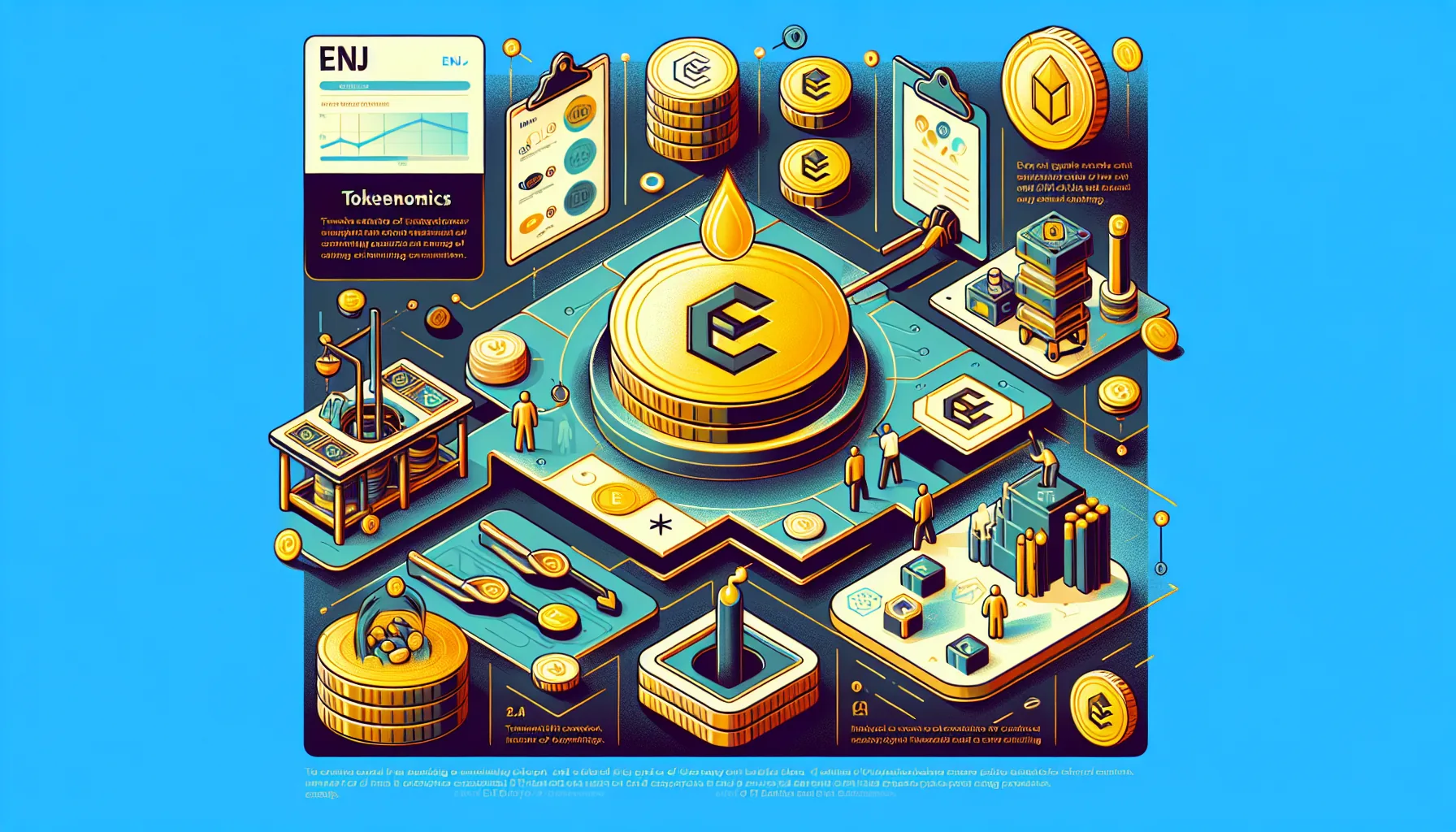
The tokenomics of Enjin Coin (ENJ) are intricately tied to its dual purpose as both a utility token and a core element of the broader Enjin ecosystem. As the backbone of a blockchain-based platform aimed at enabling virtual asset creation, ENJ features unique characteristics that govern its supply, demand, and functionality within its ecosystem.
Fixed Supply and Deflationary Mechanics
ENJ operates on a fixed total supply of 1 billion tokens, a critical element in driving scarcity and value preservation over time. A key differentiator in ENJ's design is its deflationary model, anchored by the ability to mint NFTs (non-fungible tokens). Every time an asset is minted on the Enjin platform, a proportional quantity of ENJ is locked into that asset as collateral. This process effectively removes ENJ tokens from circulation until the asset is melted (destroyed). While this mechanism may incentivize long-term holding and reduce circulating supply, critics have pointed out that it creates a barrier for those needing to reclaim liquidity quickly, particularly if token burning and melting processes are subject to inefficiencies or fees.
Utility Within the Ecosystem
ENJ primarily serves as a foundational layer for virtual asset creation and supports functionalities like in-game NFTs, digital collectibles, and virtual economies. Its demand is intrinsically tied to the platform adoption rate—more developers leveraging the Enjin ecosystem for game development or NFT minting generally means increased ENJ usage. However, the reliance on ecosystem growth also poses a risk in terms of token utility—should adoption stagnate, so might ENJ's role as a sought-after resource.
Moreover, minting NFTs requires users to determine an appropriate ENJ allocation, introducing the potential for speculative misuse of the token. While ENJ collateralization reinforces asset provenance and value backing, the absence of a universally enforced standard for allocation could create disparities in how effectively ENJ performs as a utility token across decentralized projects.
Staking and Governance Absence
Unlike other crypto assets that incorporate staking mechanisms or DAO-based governance models, ENJ lacks provisions for staking rewards or direct governance rights. Though this keeps its use-case narrowly focused, it also limits investor involvement in protocol-level decision-making. From a tokenomics perspective, this may deter holders seeking multipurpose functionality from the assets they invest in.
Challenges in Token Allocation
A further challenge lies in the token distribution. A significant portion of ENJ was allocated to early-stage fundraising and development activities, raising questions among some community members about centralization risks and the potential for disproportionate influence by early holders. Whether this allocation model will remain sustainable as the ecosystem scales is an open consideration for market participants.
By combining fixed scarcity with usage-driven demand, ENJ's tokenomics are geared toward niche functionality but are not without their complexities and points of critique.
ENJ Governance
Governance and ENJ: An In-Depth Analysis for Crypto Stakeholders
The governance model surrounding ENJ (Enjin Coin) stands out as a critical facet for understanding its broader ecosystem. Unlike many decentralized projects with formalized on-chain governance mechanisms, ENJ governance operates primarily through off-chain systems. This approach raises both potential benefits and concerns, particularly for those deeply involved in decentralized ecosystems.
Off-Chain Governance Structure
The core governance of ENJ is driven by the Enjin team, a centralized entity responsible for key decision-making processes. This structure allows for swift updates, feature rollouts, and ecosystem adjustments without lengthy deliberative processes. However, this centralized model places substantial power in the hands of a single authority. While this can be efficient for project direction, some question whether leaving governance decisions in the hands of a sole entity creates potential vulnerabilities or conflicts with the ethos of decentralization often championed in the crypto sector.
Lack of On-Chain Voting Mechanisms
Unlike crypto assets such as Ethereum or Polkadot, ENJ lacks a token-based voting system where holders can actively participate in governance decisions. This may lead to disengagement from the ENJ community as token holders have limited influence over the asset's roadmap or changes to its underlying protocol. While the Enjin team actively engages with its users via platforms such as Discord, Reddit, and Telegram, these channels are still far removed from the transparent and immutable systems provided by on-chain governance solutions.
Developer-Centric Approach
Governance decisions largely focus on enabling developers in the Enjin ecosystem. The team prioritizes expanding the functionality of the Enjin platform, its SDKs for blockchain gaming, and innovations like Efinity. While this developer-centric approach is aligned with fostering innovation, it could overshadow the voices of broader token holders or users outside of development circles. This prioritization risks alienating sections of the ENJ community who want a more participatory role in project governance.
Security Centralization Risks
With governance concentrated in one entity, the ENJ ecosystem faces heightened risks linked to central points of failure. This includes potential susceptibility to manipulation or breaches at the organizational level. While there are no publicly reported governance-related incidents compromising the Enjin ecosystem, the absence of a decentralized mechanism remains a point of contention for individuals or organizations seeking decentralized assurances in crypto projects.
Transparency Concerns
Although the Enjin team regularly provides updates on its progress, the lack of formalized governance standards can lead to a perception of opaqueness in the decision-making process. For crypto-savvy users who value transparency and accountability via immutable on-chain records, this approach may seem insufficient or outdated when compared to competitors embracing decentralized governance technologies.
Ultimately, ENJ’s governance framework reflects a balance between efficiency and control but leaves room for critique from decentralization purists.
Technical future of ENJ
Current and Future Technical Developments: ENJ Technical Roadmap
Enjin Coin (ENJ) has cemented its position as an infrastructure layer for blockchain gaming and NFT ecosystems, underpinned by continuous technical developments. A deep dive into its technical roadmap reveals both innovative advancements and critical challenges that influence its adoption among users and developers.
Focus on Efinity: Expanding the Ecosystem
One key technical development for ENJ is its integration with the cross-chain NFT platform, Efinity, built on Polkadot's parachain architecture. Efinity aims to alleviate Ethereum's scalability issues by offering faster transaction speeds and lower fees. Its design prioritizes multi-chain interoperability, enabling seamless NFT transfers across various blockchain protocols. This technical pivot enhances ENJ's utility as collateral for minting fungible and non-fungible tokens.
However, this multi-chain strategy introduces complexities. Different blockchain ecosystems have varying standards, and ensuring robust interoperability may slow down adoption or require significant updates to smart contracts. Additionally, Polkadot’s ecosystem is still maturing, and any delays in its development could impact integrations with Enjin technologies.
Advanced Smart Contract Capabilities
Enjin continues to refine its Ethereum smart contract framework, including support for the ERC-1155 standard. This technical protocol optimizes fungibility and non-fungibility within the same smart contract, reducing digital asset creation costs. Future releases plan to integrate advanced features like dynamic metadata updates, which enable NFTs to evolve based on user interactions or external conditions.
However, Ethereum's ongoing transition to Ethereum 2.0 and the deployment of sharding pose potential challenges. The ENJ ecosystem will require ongoing updates to keep pace with Ethereum's evolving infrastructure, including the transition from PoW to PoS and implementing rollup-based scaling solutions.
The Push Towards Decentralized Infrastructure
Another significant development involves Enjin’s decentralized compliance tools for NFT utility tokens. Their tech stack is shifting toward more decentralized governance models and non-custodial wallet enhancements. This move aligns with broader trends in Web3 token management but creates a technical trade-off between decentralization and user-friendly GUIs.
Further challenges include the high computational cost and latency issues often associated with decentralized, wallet-to-platform interactions. Such hurdles demand more efficient off-chain compute solutions or L2 scaling integrations.
Developer-Focused SDK Advancements
Ongoing upgrades to Enjin’s SDKs—catering primarily to game developers—include enhanced API documentation and expanded multi-platform toolkits for Unity, Unreal Engine, and JavaScript frameworks. These advancements reduce friction for onboarding developers into the blockchain sector.
Still, increasing SDK complexity requires extensive developer support resources, placing strain on Enjin's technical support infrastructure. Additionally, some competing blockchain ecosystems are developing more lightweight SDK solutions, which could challenge ENJ's appeal among indie developers.
Comparing ENJ to it’s rivals
Comparing ENJ to SAND: Key Differences in Utility and Ecosystem
Enjin Coin (ENJ) and The Sandbox (SAND) share overlapping visions within the blockchain gaming and metaverse sectors but diverge significantly in their approaches to asset tokenization, ecosystem design, and developer engagement. By understanding the contrasts between ENJ and SAND, we can better assess their unique value propositions and challenges within the crypto space.
Token Utility and Asset Collateralization
One of the most distinctive aspects of ENJ is its role as a foundational asset backing Enjin-powered NFTs. With ENJ, every NFT minted on the Enjin platform is infused directly with a verifiable amount of the token, providing immediate and intrinsic value to the asset. This approach ensures liquidity and interoperability, as these NFTs can be melted back into ENJ at any time. This model emphasizes utility-driven scarcity, where the supply of ENJ decreases as more NFTs are minted, aligning directly with user demand.
In contrast, SAND’s utility primarily revolves around transaction enablement and governance within The Sandbox metaverse. While SAND powers in-game economies and incentivizes user participation, it lacks ENJ’s direct asset backing mechanism. This creates a fundamental difference; where ENJ ties its value tightly to the assets within its ecosystem, SAND functions more as a spendable currency circulating within its virtual world. Critics have noted that this can make SAND more exposed to inflationary risks when user adoption slows, while ENJ’s deflationary aspects may offer better token economics in certain scenarios.
Developer Ecosystem and Integration
ENJ’s platform centers heavily on providing robust SDKs and tools for game developers to tokenize assets and integrate blockchain functionality seamlessly. Its focus on developer-first solutions, particularly through tools like JumpNet and the broader Enjin ecosystem, allows creators to deploy frictionless NFT solutions across multiple environments, including Ethereum scaling options. This positions ENJ as a cross-project integrator, making it appealing for developers seeking plug-and-play solutions.
SAND, on the other hand, is deeply rooted in The Sandbox’s closed metaverse, limiting flexibility for developers who may wish to bring assets or ideas outside the ecosystem. While The Sandbox’s voxel-based environment is highly interactive and visually compelling, its relatively enclosed ecosystem could discourage developers looking for cross-platform compatibility.
Challenges and Concerns
While ENJ’s strategy of tying value to NFTs provides sustainable tokenomics, it’s heavily reliant on the adoption of its minting model. If fewer developers or projects choose to mint assets within the Enjin ecosystem, ENJ’s utilization could stagnate. Similarly, SAND faces risks tied to the slowing growth of The Sandbox metaverse, which could curb demand for its token.
Ultimately, ENJ and SAND cater to different segments of the blockchain gaming and metaverse economies, but their structural differences present unique trade-offs regarding flexibility, scalability, and token use cases.
ENJ vs MANA: Comparing Use Cases and Ecosystem Strengths
When evaluating the strengths and weaknesses of Enjin Coin (ENJ) against Decentraland (MANA), the conversation naturally shifts toward their unique use cases, ecosystem structures, and developer incentives within the metaverse and NFT spaces. While both projects operate within the broader virtual asset and digital ownership sector, their approaches diverge significantly, carving out distinct niches.
Core Use Case: Gamification vs Real Estate-Centric Virtual World
ENJ positions itself as a foundational utility token for blockchain-based gaming and NFT creation. Its integration with Enjin's ecosystem, which includes tools like wallet services, NFT minting platforms, and marketplaces, focuses on empowering developers to inject blockchain utility into games. By contrast, MANA is the transactional currency of Decentraland, a fully decentralized virtual world where users can buy, build, and monetize parcels of land (virtual real estate). While Enjin seeks to bridge blockchain with gaming and gamified platforms, Decentraland leans heavily on the concept of user-owned metaverse economies.
This difference in focus creates unique audience segments. ENJ attracts gaming developers and creators looking for mass adoption of blockchain within interactive digital experiences. On the other hand, MANA remains more attractive to digital real estate enthusiasts, collectors, and virtual architects focused on long-term asset ownership within Decentraland.
NFT Ecosystems and Flexibility
ENJ’s NFT ecosystem centers on its tokenization model, the ability to bind ENJ into NFTs to create asset-backed utility. This ensures that every NFT minted on Enjin retains intrinsic value represented by the ENJ locked into it. MANA, while it indirectly supports NFTs through the sale or trading of Decentraland land NFTs, lacks the same underlying intrinsic value proposition. Enjin’s value-backing mechanic has created a holistic framework, but it is worth noting that it adds complexity and may deter developers unfamiliar with the minting process or hesitant to lock value in an NFT's creation.
However, Decentraland benefits from its early-mover advantage in the virtual world space, having established itself as one of the most visited decentralized metaverses. The flip side is that its focus remains highly concentrated on virtual land, which narrows the practical utility of MANA outside this application.
Scalability and Accessibility Challenges
While both projects aim for user adoption, MANA’s virtual-world-first approach has led to scalability challenges, particularly around user retention and the high costs of virtual real estate in Decentraland. Similarly, ENJ must contend with high competition in the gaming industry, and its reliance on developers to adopt its ecosystem creates potential hurdles for growth. However, its integration efforts through partnerships with prominent gaming companies help offset those challenges, even as it continues competing with simpler layer-2 NFT minting solutions.
Ultimately, the comparison highlights a philosophical split in purpose: gamified blockchain solutions versus virtual metaverse ownership.
ENJ vs. AXS: How Enjin Stacks Up Against Axie Infinity
When examining Enjin (ENJ) against Axie Infinity’s ecosystem, the primary point of contention lies in their diverging philosophies regarding utility, scalability, and user engagement within blockchain-driven gaming platforms.
Core Utility & Ecosystem Dynamics
ENJ is fundamentally designed as a utility token within the Enjin ecosystem to underpin digital ownership through its backing of non-fungible tokens (NFTs). Each NFT created on the Enjin platform is assigned a specific ENJ value, creating intrinsic scarcity and liquidity for digital items. Axie Infinity’s AXS, on the other hand, serves a governance-oriented role while fueling an economic loop tied closely to its Play-to-Earn (P2E) framework and its breeding mechanics for Axies—tradable NFT game characters.
A core differentiator is ENJ’s application in a broader array of blockchain gaming and metaverse projects, providing a toolkit that integrates ENJ-backed NFTs into virtually any gaming structure. In contrast, Axie Infinity’s utility revolves almost entirely around the Axie game itself. This localization offers AXS an advantage in fostering a tight-knit ecosystem but poses scalability challenges if demand for Axie-specific NFTs wanes or fails to expand into non-gaming applications.
Scalability and Sustainability Challenges
Axie Infinity’s P2E model has faced repeated criticism for its dependence on new user acquisition to sustain economic incentives for existing players. This pyramid-like structure raises sustainability concerns over the long term, particularly during bearish market cycles. ENJ avoids this pitfall by eliminating direct monetary rewards in its gaming integrations, focusing instead on increasing adoption by enabling developers to create compelling experiences with token-backed digital assets. However, ENJ’s broad applicability also means its traction depends on widespread adoption by third-party creators, leaving it more vulnerable to external interest in integrating Enjin’s platform.
Transaction Costs and Network Efficiency
Another consideration is network operations. Enjin, which now leverages Ethereum’s Layer 2 solutions like JumpNet and Efinity, mitigates scalability and gas fee concerns typically associated with Ethereum. Axie Infinity, meanwhile, operates on the Ronin sidechain, which offers its own low-cost transaction model. However, Ronin’s security incident in 2022, where it suffered one of the largest breaches in DeFi history, raised questions about the chain’s reliability. By comparison, Enjin’s multi-network approach diversifies its risk but might complicate user onboarding across different platforms.
Governance & Community Influence
AXS’s governance model empowers token holders with direct influence over game changes, which arguably engages its community more deeply. In contrast, ENJ’s focus is less on direct user governance and more on empowering developers to create assets, potentially limiting the sense of community influence.
In conclusion (avoided), this highlights key points of distinction worthy of dissecting in a broader context.
Primary criticisms of ENJ
Primary Criticism of ENJ: Challenges Facing the Enjin Ecosystem
Centralization Concerns within the Enjin Platform
A significant criticism of ENJ stems from its perceived level of centralization within the Enjin ecosystem. While blockchain-based projects are often lauded for their decentralized nature, Enjin’s infrastructure relies heavily on its proprietary network and core platform. Critics argue that this reliance could centralize power and decision-making within the organization, creating risks reminiscent of traditional ecosystems where gatekeeping can hinder flexibility and true decentralization. For crypto investors and builders who prioritize the ethos of blockchain—autonomy and immutability—this model may come across as flawed.
Limited Interoperability in Blockchain Gaming
ENJ markets itself primarily toward gaming ecosystems, enabling developers to tokenize in-game assets on the blockchain. However, the high level of customization required for each project has prompted concerns over its interoperability. Many blockchain developers have noted that assets created on Enjin’s platform often lack seamless portability between other popular gaming ecosystems or blockchain platforms. This limitation raises questions about its future role in a truly open metaverse, where interoperability will be vital for sustaining interconnected virtual economies.
Competition with Established Protocols
Another pointed critique of ENJ lies in its crowded segment within the blockchain space. The landscape of crypto-based gaming and NFT tokenization is increasingly competitive, with numerous protocols such as Immutable X and others offering distinct advantages, including lower fees and better scalability. While Enjin has focused on wielding its robust development tools and partnerships as strengths, critics argue that these advantages fade in comparison to ecosystems with broader adoption or streamlined on-chain mechanics. ENJ’s comparatively niche appeal might limit its growth, particularly as larger competitors dominate user bases and developer interest.
Native Token Value Dependency
ENJ’s utility token, ENJ, serves as the backbone for creating and maintaining fungible or non-fungible assets on the Enjin ecosystem. Nevertheless, this inherent dependence on ENJ’s token introduces issues tied to liquidity and speculative price movement. Developers and gamers alike have raised concerns regarding fluctuations in ENJ’s utility based on external factors, like market trends, that significantly affect its value, potentially disrupting project execution or gaming economies reliant on ENJ-based assets. Additionally, this dependency might disincentivize users from adopting the ecosystem, as volatility can hinder reliability for long-term planning.
High Entry Barriers for Non-Technical Users
Despite offering developer-friendly tools, critics highlight that Enjin remains less accessible for non-technical users or smaller indie developers who may struggle with onboarding complexity. The need for technical expertise to integrate blockchain mechanics with existing gaming frameworks can be a deterring factor. While these complexities are partially offset by the platform’s user documentation and SDKs, the disproportionately high cognitive overhead still raises accessibility concerns, especially for early-stage gaming studios or creators exploring tokenization for the first time.
Founders
The Founding Team Behind Enjin (ENJ)
Enjin Coin (ENJ), the cryptocurrency powering the Enjin ecosystem, was conceptualized and developed by a founding team with a distinct focus on blockchain-based gaming and digital asset management. The core leadership consists of two notable figures: Maxim Blagov and Witek Radomski. Their expertise and vision have played a central role in shaping Enjin's position within the blockchain space, but like any project, their track record also invites scrutiny from a critical perspective.
Maxim Blagov: A Creative Visionary with Limitations?
Maxim Blagov serves as the Co-Founder and CEO of Enjin. Blagov’s background lies predominantly in the realm of creative direction and project management, with over a decade of experience working at the intersection of technology and digital media before pivoting to blockchain. As CEO, he has been instrumental in formulating Enjin’s overarching vision of utilizing blockchain for gaming and asset tokenization. However, while his creative vision has helped Enjin carve out a niche in gaming applications, skeptics have questioned whether his focus on high-level initiatives could sometimes come at the expense of addressing operational challenges, especially amidst the highly technical demands of blockchain projects.
Blagov’s leadership style appears geared toward fostering innovation, but critics argue that such an approach may expose the project to potential gaps in execution, particularly when it comes to scaling or aggressively competing for mainstream adoption in an increasingly crowded crypto sector.
Witek Radomski: The Tech Brains, but Is It Holistic?
Witek Radomski, Enjin’s Co-Founder and Chief Technology Officer (CTO), is widely recognized as the technical backbone of the project. Radomski holds the distinct accomplishment of authoring the ERC-1155 token standard, which has become a significant innovation in the realm of NFTs, thanks to its flexibility and efficiency in managing fungible and non-fungible assets within a unified framework. This contribution has undoubtedly elevated Radomski’s status in the crypto world.
However, while ERC-1155 is undeniably impactful, critics have raised concerns about whether Radomski’s focus on technical advancements translates into sufficient attention toward strategic partnerships or broader ecosystem integration. For instance, Enjin has sometimes faced challenges in penetrating larger blockchain networks or communities beyond its core gaming audience. This has led some to question whether a stronger emphasis on external-facing initiatives could better complement Radomski’s technical contributions.
A Team Balancing Vision and Technical Depth, But with Trade-Offs
The founding duo of Blagov and Radomski reflects a blend of creative vision and technical acumen, which has allowed Enjin to establish itself as a pioneer in blockchain-based gaming. However, challenges persist, whether in scaling operational efficiency, solidifying industry-wide adoption, or competing beyond niche markets. Understanding the priorities and limitations of this founding team provides critical context to evaluate Enjin’s development trajectory realistically.
Authors comments
This document was made by www.BestDapps.com
Sources
- https://enjin.io/whitepaper
- https://github.com/enjin
- https://enjin.io/blog
- https://etherscan.io/token/0xf629cbd94d3791c9250152bd8dfbdf380e2a3b9c
- https://coinmarketcap.com/currencies/enjin-coin/
- https://enjin.io/efinity
- https://enjin.io/products
- https://developer.enjin.io/
- https://enj.in/
- https://medium.com/enjin/
- https://docs.enjin.io/
- https://enjin.io/marketplace
- https://dappradar.com/token/eth/0xf629cbd94d3791c9250152bd8dfbdf380e2a3b9c
- https://academy.binance.com/en/articles/what-is-enjin
- https://cryptoslate.com/coins/enjin-coin/
- https://blog.enjin.io/intro-to-enjin-and-blockchain-gaming-214382b0478f
- https://enjin.io/ecosystem
- https://github.com/enjin/enjin-wallet
- https://gov.enjin.io/
- https://twitter.com/enjin


