History of ELF
The Historical Evolution of AELF (ELF)
AELF (ELF) emerged as a blockchain project designed to tackle the scalability, customization, and interoperability challenges facing early blockchain architectures. Its origins can be traced to 2017, a time when the inefficiencies of first- and second-generation blockchains were becoming increasingly apparent. AELF sought to position itself as a next-generation platform, introducing a multi-chain framework and a Delegated Proof-of-Stake (DPoS) consensus mechanism as its foundation.
The project’s primary innovation lies in its architecture, which is built around a main chain and side chains. This design allows specific side chains to handle distinct tasks or industries, leaving the main chain as an operational hub. By focusing on task segregation, AELF claimed its approach could avoid the bottlenecks seen in monolithic blockchain systems like Ethereum, but critics have questioned the actual level of decentralization achieved by DPoS, citing concerns over the potential for validator collusion.
The AELF mainnet officially launched in late 2020 following an extensive testing and development phase. Prior to the mainnet release, the project conducted an Initial Coin Offering (ICO) in 2017, raising capital in the form of Ethereum to fund its initial development and build long-term partnerships. While the ICO was considered successful at the time, it also faced scrutiny regarding transparency, with critics questioning whether the funds were being efficiently deployed.
AELF's governance structure also caused debates within the crypto community. Its DPoS model limited the number of block producers (validators) to 17 initially, raising concerns over centralization risks. While proponents argue that this model enhances transaction speeds and efficiency, skepticism persists over whether the trade-off undermines the ethos of decentralization, a core principle of blockchain technology.
Over time, the project has attempted to address these critiques through proposals and updates aimed at refining governance processes and network security. Still, some developers and projects have opted not to build on AELF due to the learning curve required to adapt to its multi-chain ecosystem, slowing the pace of adoption relative to competitors.
AELF’s journey thus far reflects the broader tension between innovation and the practical hurdles of implementation. While its history is marked by ambitious goals and technical breakthroughs, it also highlights enduring challenges in achieving widespread adoption and striking an optimal balance between scalability, governance, and decentralization.
How ELF Works
How aelf (ELF) Works: A Modular, Multi-Chain Approach to Blockchain Scalability
aelf (ELF) distinguishes itself by delivering a modular and multi-chain architecture designed to tackle blockchain scalability and interoperability issues. At its core, aelf implements a unique "one main chain, multiple side chains" structure, which enables it to allocate different tasks and functionalities across dedicated side chains. This division of labor fosters parallel processing, optimizing performance and mitigating bottlenecks, especially for decentralized applications (dApps) requiring resource-intensive operations.
Instead of relying on a one-size-fits-all approach, aelf’s system design is entirely modular. This modularity allows developers to customize side chains for specific use cases by selecting tailored consensus models, governance mechanisms, and tokenomics. For example, one side chain can focus on high-speed transaction processing with minimal security trade-offs, while another prioritizes governance-heavy operations for a DAO or NFT marketplace. These choices empower developers to craft specialized chains without being limited by the constraints of the main chain.
The backbone of the ecosystem, the main chain, is responsible for overall governance and cross-chain communication. Utilizing an efficient Delegated Proof-of-Stake (DPoS) consensus mechanism, the main chain ensures rapid finality while maintaining decentralization through an elected set of nodes. The design prioritizes scalability over maximum decentralization, raising questions about potential susceptibility to governance manipulation or cartel-like structures among nodes. Developers relying on the security guarantees of the main chain should carefully evaluate such trade-offs.
A key functionality of aelf is its cross-chain communication protocol, which enables seamless interaction between the main chain and its side chains, as well as with external blockchains. By employing Merkle tree structures and indexing, this mechanism allows the secure transfer of data and assets across chains without the need for intermediaries. However, the complexity of implementing and maintaining such interoperability solutions can become a potential weak point, particularly for projects operating across highly fragmented ecosystems.
Another element of note is aelf’s economic model. The platform employs a native token, ELF, used for transaction fees, governance participation, and staking within the DPoS process. While this framework incentivizes active participation, the reliance on staking could inadvertently lead to centralization risks if wealthier stakeholders accumulate disproportionate influence over network decisions.
Lastly, while aelf’s architecture is highly customizable, its complexity could pose challenges for developers unfamiliar with its modular design. This may increase the time and resources needed to deploy projects compared to more straightforward blockchain platforms. Additionally, the onus is on project teams to secure and maintain individual side chains, which could lead to uneven security standards across the ecosystem.
Use Cases
Use Cases for AELF (ELF): Decentralized Cloud Computing and Interoperability
AELF (ELF) is positioned as a blockchain framework designed to solve key limitations of existing decentralized networks, with a particular focus on enterprise-grade use cases. Leveraging cross-chain interoperability and decentralized cloud infrastructure, AELF offers a platform catering to developers and businesses. Here's a closer look at its specific use cases:
1. Enterprise-Ready Customizable Blockchain Solutions
AELF enables enterprises to deploy dedicated sidechains tied to a mainchain. Each sidechain operates independently, allowing businesses to design blockchains tailored to their unique requirements. From supply chain management to financial services, companies can integrate bespoke consensus mechanisms and governance models.
However, the requirement for sidechain customization presents its own challenges. Enterprises may require substantial blockchain expertise to optimize their implementation, making the onboarding process resource-intensive. Additionally, the fragmentation of data across multiple sidechains could create synchronization concerns for businesses managing large-scale operations.
2. Cross-Chain Interoperability
One of AELF's core goals is to facilitate seamless interoperability between blockchains. Using a mainchain-sidechain architecture, AELF enables data transfer and smart contract interaction across ecosystems. This is particularly relevant for decentralized finance (DeFi) platforms and NFT markets, where multi-chain solutions are increasingly critical.
That said, interoperability is contingent on the security and operational stability of both the mainchain and the connected sidechains. Issues in one chain could potentially cascade across interconnected systems, raising questions about risk management in critical use cases.
3. Decentralized Cloud Computing for Scalable Applications
AELF focuses on decentralized cloud computing, offering high transaction throughput through parallel processing mechanisms. This makes it particularly appealing for dApps with high computational demands, including games, data analytics, and AI-driven services.
The platform's reliance on resource isolation between sidechains ensures that performance bottlenecks in one application won’t impact others. However, the staking model required for sidechain operation could deter smaller projects with limited budgets, as resources are distributed to holders of the ELF token rather than evenly across the ecosystem.
4. Tokenized Governance Models
Through ELF staking, users gain voting power over network upgrades and operational decisions, embodying decentralized governance. This use case is key for blockchain networks aiming to remain community-driven. AELF even allows governance at the sidechain level, giving developers flexibility to enforce context-specific rules.
However, token-based governance often leads to centralization concerns. Entities or individuals holding substantial ELF token reserves may exert disproportionate influence, creating potential governance imbalances.
5. Evolving Partnerships in Private and Public Sectors
AELF targets a diverse range of industries—including healthcare, gaming, logistics, and IoT—through its modular design. Its ability to integrate with varying business ecosystems theoretically broadens its market appeal.
Still, the adoption of AELF's technology hinges on its ability to overcome competition in the blockchain-as-a-service (BaaS) space. Enterprises evaluating AELF must weigh its benefits against more established platforms like Ethereum or Polkadot, where developer support and familiarity are often stronger.
ELF Tokenomics
Deep Dive into aelf (ELF) Tokenomics: Supply Mechanics & Distribution Model
ELF Token Supply Structure
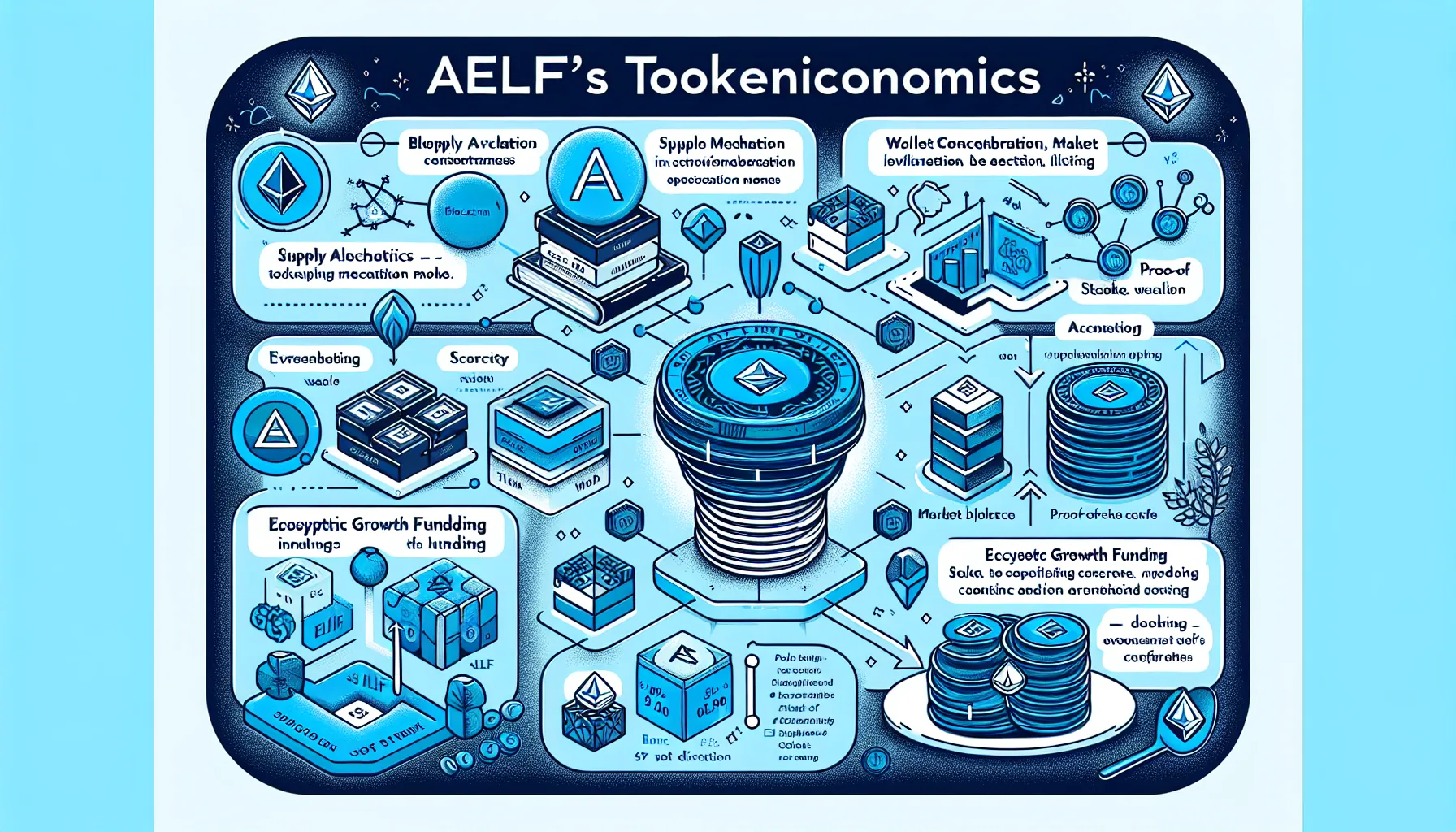
aelf’s native token, ELF, is central to the blockchain's ecosystem, designed to facilitate resource allocation, governance, and staking mechanisms. The total supply of ELF is capped, a deliberate choice to maintain scarcity and introduce predictable inflationary pressures over the long term. However, one notable complexity in its tokenomics is its two-tiered allocation model—initial token distribution versus ongoing staking rewards. This dual-structure introduces challenges when evaluating the long-term sustainability of aelf's reward system while balancing inflation control.
Initial Token Allocation & Concentration Risks
From its genesis, ELF tokens were allocated as follows: a significant share went to early investors (private sales), with allocations to the founding team, advisors, and ecosystem development. While this structure aligns with industry norms, the centralization of tokens held by insiders poses a risk of significant market influence. Wallet concentration analyses have periodically highlighted that a small group of addresses collectively holds a substantial percentage of circulating supply. For crypto-savvy investors, this raises concerns about potential price manipulation or governance capture, as the vested interests of large holders can outvote smaller decentralized stakeholders.
Staking and Governance Incentives
ELF relies on staking as its primary incentive for network participants. Stakers lock up their holdings to support the network's delegated proof-of-stake (DPoS) consensus mechanism while earning rewards in ELF through network fees. Although staking yields are attractive in the short term, they may amplify token dilution over time due to inflation-based distribution of rewards. Additionally, as a DPoS system, aelf operates with a defined number of block producer nodes, chosen via governance. While this increases scalability, critics argue it introduces semi-centralization risks by consolidating power in the hands of a small validator set—further exacerbated by the influence of whale accounts in governance decisions.
Ecosystem Growth Funding via Token Reserves
Aelf has also allocated a portion of its token supply for ongoing ecosystem development, including developer bounties, dApp incubations, and marketing initiatives. While this aligns with its goals to grow adoption, questions remain around transparency in fund utilization. Without standardized reporting, contributors and investors lack a clear view of how these reserves are deployed, which could hinder community trust in the system's integrity.
Burn vs Inflation Dynamics
Another interesting aspect of ELF's tokenomics involves its approach to balancing deflationary and inflationary forces. While inflation through staking rewards is intended to incentivize network participation, the absence of robust token burning mechanisms may lead to inflation outpacing demand at maturity. This creates potential vulnerabilities in maintaining long-term token value unless ecosystem activity consistently scales.
ELF Governance
Governance Model of aelf (ELF): A Modular Dual-Layer Approach
The governance framework of aelf (ELF) operates with a dual-layer structure, aligning with its modular blockchain architecture. Designed to optimize scalability and efficiency, aelf’s governance is implemented to ensure decentralized decision-making while maintaining operational effectiveness. However, the system is not without its complexities and potential challenges.
Delegated Proof-of-Stake (DPoS) Mechanism
At the core of aelf’s governance lies its Delegated Proof-of-Stake (DPoS) consensus mechanism. Token holders in the network stake their ELF tokens to vote for block producers (BPs), often referred to as “nodes,” who are responsible for validating transactions and maintaining network stability. This structure theoretically reinforces decentralization, as it places decision-making power in the hands of the broader community. However, like many DPoS systems, aelf is susceptible to centralization risks. Over time, voting power tends to consolidate among a smaller group of influential token holders or stakeholders, potentially undermining the decentralized spirit of the ecosystem.
Proposal System for Network Upgrades
aelf’s governance includes a formalized proposal system to manage protocol upgrades and other changes. Any approved proposal undergoes rigorous on-chain execution, minimizing the likelihood of off-chain disagreements or forks. While this mechanism ensures transparency and accountability, the barrier to participate in the proposal process can be prohibitively high for smaller stakeholders. This asymmetry in governance participation might deter engagement from less resourceful participants, inadvertently concentrating influence within the top-tier nodes or larger token holders.
Chain-Specific Governance
In line with its modular design, aelf also supports sidechain-specific governance frameworks. Each sidechain anchored to the aelf mainnet can operate under its own unique governance model, granting projects the flexibility to adopt structures that resonate with their use cases. While this modularity enhances adaptability within the ecosystem, it introduces governance fragmentation. Without robust coordination mechanisms, misaligned sidechain policies could present interoperability hurdles or even governance conflicts with the mainnet.
Stakeholder Incentives and Accountability
The incentive structure for voters, developers, and block producers is central to governance participation. Voters receive staking rewards, while block producers earn transaction and block rewards. However, aelf faces similar challenges to other DPoS systems: how to ensure that block producers remain accountable to the wider network and not just to their largest voting blocs. Additionally, voter apathy can disproportionately empower “whale” stakeholders, skewing governance outcomes toward those with substantial financial leverage.
Transparency and Decision-Making Challenges
Although aelf has made meaningful strides in creating an open governance ecosystem, transparency in the decision-making processes of block producers remains a persistent issue, as it does in comparable systems. Many BPs operate with limited disclosure about their intentions or decision-making rationale, leading to potential conflicts of interest or reduced trust among stakeholders.
By combining modularity and DPoS, aelf attempts to strike a balance between flexibility, functionality, and decentralization. Still, inherent trade-offs in its governance design necessitate ongoing effort to address concerns around centralization trends, stakeholder participation disparities, and decision-making transparency across the ecosystem.
Technical future of ELF
Current and Future Technical Developments for aelf (ELF)
aelf’s Modular Blockchain Architecture
A significant technical hallmark of aelf is its adoption of a modular blockchain architecture. The platform emphasizes parallel processing with a unique, node-cluster design, which enables smart contracts to operate independently. This design eliminates the bottlenecks common to single-chain networks by running multiple chains in parallel, optimizing transaction throughput and resource allocation. However, this complexity introduces challenges, particularly for developers who must navigate a non-standardized architecture compared to simpler blockchain networks. Without widespread tooling and frameworks that support aelf’s modular concept, adoption could face hurdles in the short to mid-term.
Cross-Chain Interoperability and Oracles Integration
aelf places a strong focus on interoperability, supporting seamless cross-chain communication through its built-in oracle system. Its Mainnet is designed to operate as the "Main Chain," while additional "Side Chains" can integrate with other blockchains to process specific business needs. While this approach supports scalability and flexibility, achieving true cross-chain operability at scale remains a technical challenge. Competing platforms like Cosmos and Polkadot are also pursuing similar goals, which adds competitive pressure to see if aelf can deliver on its promise with efficient tooling. Some developers have raised concerns about fragmented Side Chain management and the potential for side-chain-specific vulnerabilities or network isolation.
Customizable Smart Contracts Using a Resource Isolation Model
The blockchain uses a resource isolation model, allocating transactions and computational power based on fee tiers and bandwidth. This ensures high-priority tasks are executed without delay while less critical tasks are queued. aelf’s decision to prioritize customized smart contracts over standardized designs allows developers to craft more tailored solutions. However, the lack of "one-size-fits-all" tools could deter teams that are looking for rapid deployment solutions rather than highly specialized contract environments. Improving accessibility in this area might prove critical for accelerating developer engagement.
Focus on Decentralized Governance and Upgradable Codebase
aelf introduces a uniquely decentralized governance model where stakeholders vote on key blockchain parameters and updates, including upgrades to the system. Its design allows for a more agile approach to evolution, as its codebase can be upgraded without hard forking. While innovative, this mechanism inherently involves risks. Centralized pools of influence could potentially hijack governance, raising concerns among security-conscious users. Additionally, code upgrade mechanisms require bulletproof implementation to avoid exploitation. Addressing these concerns without sacrificing agility could be a key technical challenge moving forward.
Scalability Versus Complexity: The Road Ahead
The technical roadmap for aelf highlights a focus on scaling the network’s performance without compromising decentralization. However, balancing this with the complexity inherent in its architectural choices remains a question mark. As aelf expands its ecosystem of decentralized applications (dApps), creating a user-friendly development environment that rivals competitors while implementing robust security measures will be a defining factor for the network's long-term success.
Comparing ELF to it’s rivals
Comparing aelf (ELF) vs. Fantom (FTM): Key Differences in Blockchain Architecture and Use Cases
When contrasting aelf (ELF) to Fantom (FTM), a core distinction lies in their architectural foundations and the way they approach scalability, decentralization, and ecosystem design. While both aim to address blockchain scalability challenges, their methodologies diverge significantly.
Architecture and Scalability
aelf utilizes a modular blockchain architecture with a unique emphasis on sidechains. Its system is designed to process multiple transactions or smart contracts simultaneously by allocating specific workloads to individual sidechains. This results in a customizable and scalable ecosystem tailored to enterprise needs. Each sidechain is independently customizable, which allows aelf to address the diverse requirements of various industries without creating congestion in the main chain.
On the other hand, Fantom employs its DAG (Directed Acyclic Graph)-based Lachesis consensus mechanism. While DAG-based solutions like Fantom’s Lachesis achieve high throughput and low confirmation times, these benefits may come with tradeoffs in terms of decentralization depending on the level of validator distribution. Though aelf also faces scrutiny around decentralization due to its structure, its deliberate focus on permissioned sidechains stands out, creating limitations for use cases that specifically demand higher levels of trustlessness.
Developer and Ecosystem Support
aelf distinguishes itself with its multi-language development environment, optimizing accessibility for developers accustomed to mainstream programming languages like C#. This is strategically aimed at fostering broader adoption within traditional enterprise sectors. Fantom, conversely, prioritizes compatibility with Ethereum Virtual Machine (EVM) and tools like Solidity, carving out its dominance among DeFi projects seeking high-speed, Ethereum-compatible solutions. This EVM focus has enabled Fantom to capture considerable mindshare within the decentralized finance (DeFi) space.
A key issue for aelf revolves around the complexity of its sidechain ecosystem. Managing multiple customized sidechains can increase operational challenges and maintenance requirements for developers compared to Fantom’s more streamlined infrastructure. This could deter adoption among less experienced developers or those favoring simplicity.
Consensus Efficiency and Energy Impact
aelf’s Delegated Proof-of-Stake (DPoS) consensus relies on validator nodes, emphasizing speed and network efficiency. Critics, however, point to security and centralization concerns inherent in DPoS systems, particularly if validator participation becomes uneven. In contrast, Fantom's Lachesis, with its asynchronous Byzantine Fault Tolerance (aBFT), boasts higher resilience against network vulnerabilities — but some argue its implementation complexity creates barriers during network deployment.
Both aelf and Fantom bring unique innovations to scalability and consensus mechanisms, but the differences in their design philosophies shape how and where these networks thrive.
Comparing aelf (ELF) to NEAR Protocol (NEAR): A Layered Examination
When comparing aelf (ELF) to NEAR Protocol (NEAR), it’s essential to evaluate their respective design architectures, decentralization approaches, and developer ecosystems, given that both projects target scalability and smart contract deployment within the blockchain ecosystem.
Modular vs. Monolithic Design
aelf implements a modular, multi-chain architecture where individual sidechains cater to specific tasks or industries. This modularity allows the main chain to remain uncluttered, ensuring that transaction throughput scales effectively without one application interfering with another. NEAR, on the other hand, leverages a monolithic design with a focus on its sharding technology, known as Nightshade. Nightshade employs dynamic shards to increase scalability, ensuring a high level of efficiency for its single primary blockchain. While modularity provides aelf with flexibility, NEAR’s unified design avoids the complexities and cross-chain communication challenges that can arise in multi-chain systems.
However, a key issue in NEAR's Nightshade implementation is shard persistence. Each dynamic shard depends heavily on constant validator participation. This reliance can create vulnerabilities during periods of low validator activity—something that is less pronounced in aelf’s multi-chain approach, as tasks can be compartmentalized onto dedicated chains without affecting the network’s overall throughput.
Decentralization Trade-offs
Both aelf and NEAR Protocol address decentralization, but aelf’s Delegated Proof-of-Stake (DPoS) model has inherent centralization trade-offs. The limited number of validators in aelf ensures efficiency but at the cost of governance transparency and reduced participation opportunities for smaller network stakeholders. NEAR utilizes a Thresholded Proof-of-Stake (TPoS) consensus mechanism, designed to enhance validator participation through stake pooling. However, NEAR’s system has struggled with equitable distribution of validator rewards, leading to concerns about whale dominance, a limitation shared to some degree with aelf’s DPoS.
Developer-Focused Accessibility
NEAR offers significant developer-friendly tooling, such as its Rust and AssemblyScript support, in addition to its strong focus on user-facing wallet integration for dApps. This alleviates friction for builders entering the ecosystem. aelf, by contrast, prioritizes customizability and offers highly specialized SDKs for developers looking to leverage its multi-chain architecture. While this specialization can draw more enterprise-focused applications, it may create a steeper learning curve for developers unfamiliar with blockchain modularization.
Security Concerns and Final Considerations
A notable point of divergence arises in each protocol’s approach to security and uptime. NEAR’s reliance on dynamic sharding can introduce vulnerabilities if shards fail to synchronize efficiently, potentially leading to partial outages. aelf’s siloed sidechains mitigate this by localizing any potential failures within specific chains. However, the need for robust inter-chain communication layers in aelf can itself represent an attack surface, which NEAR avoids with its singular chain structure.
In summary, while both aelf and NEAR share goals of scalability and advancement in decentralization, the fundamental differences between their architectures, consensus mechanisms, and developer priorities reveal distinct strengths and challenges unique to each platform.
Comparing aelf (ELF) to Hedera Hashgraph (HBAR): Key Differences in Scalability and Governance
When evaluating aelf (ELF) alongside Hedera Hashgraph (HBAR), it becomes clear that while both projects aim to address blockchain inefficiencies, their foundational approaches diverge significantly, creating key distinctions in scalability, governance, and overall adoption strategies.
Consensus Mechanism and Scalability:
Hedera Hashgraph employs an entirely different architecture compared to aelf’s blockchain design. Hedera uses the Hashgraph consensus algorithm, which is asynchronous Byzantine Fault Tolerant (aBFT), allowing for high transaction throughput and fast finality. This contrasts starkly with aelf, which leverages a Delegated Proof-of-Stake (DPoS) mechanism combined with its innovative "Multi-Chain Parallel Processing" structure. While both projects emphasize scalability, Hedera’s data structure isn’t technically a blockchain but a Directed Acyclic Graph (DAG). This provides Hedera with some unique theoretical advantages in terms of transaction speed, though it introduces challenges in terms of decentralization perception and complexity. Meanwhile, aelf's multi-layered resource isolation via sidechains ensures scalability in a modular framework, though it can raise concerns over cross-chain communication efficiency and security.
Governance Comparison:
Hedera’s governance model is anchored in its Council, comprising up to 39 global, enterprise-level members. This Council is responsible for critical decisions, ranging from technical updates to network rules. The governance setup is explicitly designed to reduce centralization fears, but detractors argue that it creates a corporate-led environment that might not cater to the decentralized ethos many cryptocurrency enthusiasts seek. On the other hand, aelf’s DPoS system relies on elected nodes—dubbed as “BP Nodes”—to govern the ecosystem's operations. While theoretically more democratized than Hedera’s enterprise-centered governance model, the concentration of power among a limited number of block producers can lead to centralization concerns akin to Hedera’s setup. In essence, both projects tackle governance constraints differently but face scrutiny regarding their balance of decentralization and control.
Smart Contract Ecosystem:
Hedera sticks to a structure that supports Solidity-based smart contracts, familiar to developers working within the Ethereum ecosystem. However, its use of a unique consensus layer can create challenges for developers regarding portability and network complexity. aelf, in contrast, enables smart contract execution in C#, which enjoys broad enterprise adoption but limits its appeal for developers accustomed to Ethereum Virtual Machine (EVM)-centric ecosystems. This fragmentation can make integrations and migrations between aelf and other projects cumbersome.
Enterprise Adoption Focus:
Both aelf and Hedera heavily target enterprise adoption, but Hedera’s explicit alignment with multinational corporations places it in a somewhat traditional business space. aelf’s modular sidechain framework allows for bespoke enterprise solutions, though the learning curve for businesses new to blockchain can be steep. This divergence speaks to their broader adoption strategies: Hedera aiming to onboard through familiarity and institutional partnerships, while aelf focuses on performance-driven differentiation.
Challenges in Decentralization:
Both ecosystems face criticism over decentralization. While aelf’s DPoS system can result in oligopolistic tendencies among its block producers, Hedera’s permissioned Council model inherently places influence in the hands of large enterprises. This creates an ongoing tension in both ecosystems around how "decentralized" they can truly claim to be—an issue that savvy crypto users will continue to scrutinize closely.
In summary: both aelf and Hedera pursue scalability and enterprise adoption, but their distinct consensus mechanisms and governance models profoundly influence their development trajectories and challenges.
Primary criticisms of ELF
Primary Criticism of ELF: Key Challenges Facing the aelf Blockchain
The aelf (ELF) blockchain, while positioned as a scalable and customizable solution for decentralized applications (dApps), has not been without its share of criticisms. Despite its technical ambitions, several aspects of the protocol and its ecosystem have faced scrutiny from the crypto-savvy community. Below are some of the primary critiques that have emerged regarding ELF.
1. Centralization Concerns in Governance Structure
One of the most pointed criticisms of ELF relates to its Delegated Proof-of-Stake (DPoS) consensus mechanism. While DPoS offers scalability, skeptics argue it compromises decentralization, a foundational principle of blockchain systems. aelf's use of 17 main nodes for block validation has sparked accusations of granting excessive control to a small set of validators. This limited validator model raises questions about vulnerability to collusion or centralization risks, especially compared to other blockchain ecosystems with more distributed validator networks.
2. Potential Overcomplexity in Cross-Chain Operations
aelf’s focus on enabling cross-chain interoperability is often lauded as a core feature. However, critics suggest that its multi-layered sidechain structure, while innovative, introduces unnecessary complexity. Managing and maintaining distinct chains for different applications could potentially increase the barrier to entry for developers and lead to inefficiencies in performance if not implemented and scaled properly. This critique underscores concerns that the design may be over-optimizing for modularity at the expense of usability.
3. Adoption and Network Utilization Gaps
While the aelf team has emphasized building an enterprise-ready blockchain with high throughput capabilities, the ecosystem's adoption rates have lagged, particularly in terms of dApp development and network activity. Some critics argue that aelf's focus on offering a technical "general-purpose" blockchain may have diluted its ability to appeal to niche use cases or specialized markets. A network without sustained high usage risks becoming deflationary in utility.
4. Tokenomics and Long-Term Incentive Alignment
There are ongoing debates about ELF’s tokenomics model. Critics point to potential issues in aligning incentives for token holders and network participants, particularly as the platform matures. Concerns have been raised about inflation control mechanisms, staking rewards, and the broader distribution models, suggesting these might not adequately foster long-term engagement within the community.
5. Competition in the Layer-1 Blockchain Space
The rapid expansion of competing Layer-1 blockchains has also highlighted challenges for aelf in distinguishing itself. Critics note that many of its touted features, such as sidechain modularity and scalability, are becoming standard offerings in other projects. Without a significant differentiating factor or robust developer ecosystem, aelf risks being overshadowed by competitors with stronger ecosystems and more active communities.
Founders
Founding Team Behind aelf (ELF): Visionaries and Challenges
The founding team of aelf (ELF) is led by Ma Haobo, who plays a central role as the project's founder and CEO. Haobo brings substantial experience in blockchain technology and software architecture, having previously held leadership positions such as the CTO of GemPay and AllCoin. His technical expertise lays the groundwork for aelf’s ambition to provide a high-performance decentralized cloud computing platform. However, constructing a project as complex as aelf has not been without leadership and organizational hurdles.
The team has made deliberate efforts to assemble a multidisciplinary group with expertise spanning blockchain, distributed systems, cloud computing, and cryptography. This diversity is evident in the involvement of prominent advisors, such as blockchain veterans who are credited with steering the project's strategic direction. However, critics of the team point out a potential over-reliance on advisory contributions rather than consistent internal leadership. Questions have occasionally been raised about whether this structure supports long-term innovation or introduces bottlenecks in decision-making processes.
The founding team was early to identify some of the core scalability challenges in blockchain, aiming to solve them through innovative designs such as sidechain integration and a delegated proof-of-stake (DPoS) consensus mechanism. While these concepts underline their visionary intent, executing these ambitions has presented technical and practical difficulties. The complexity of the sidechain architecture has at times led skeptics to question the team’s ability to deliver a fully operational and user-friendly ecosystem, given the challenges of interoperability and governance within large-scale, multi-chain networks.
Another point of contention in the community has been the team's transparency regarding development progress and roadmap execution. While aelf made headlines with its approach to scalability and performance, the team has faced scrutiny over some perceived communication gaps between design aspirations and real-world delivery—an issue not uncommon in the crypto landscape. For some community members, these gaps have created skepticism about whether the founding team can consistently meet milestones in highly competitive sectors like blockchain platforms.
In addressing these challenges, the founding team of aelf has emphasized its long-term vision of building customizable sidechain frameworks and enabling seamless decentralized application scaling. However, critics argue that while the team’s technical approach is commendable, the real test lies in its ability to adapt leadership, maintain transparency, and consistently execute its vision in an ever-changing crypto environment.
Authors comments
This document was made by www.BestDapps.com
Sources
- https://aelf.io/
- https://aelf.io/whitepaper
- https://github.com/aelf/aelf
- https://aelf.io/economy-whitepaper
- https://github.com/aelf/aelf-core
- https://forum.aelf.io/
- https://explorer.aelf.io/
- https://docs.aelf.io/
- https://medium.com/aelfblockchain
- https://github.com/aelf/documentation
- https://twitter.com/aelf_official
- https://academy.binance.com/en/articles/what-is-aelf
- https://support.aelf.io/hc/en-us
- https://coinmarketcap.com/currencies/aelf/
- https://www.coingecko.com/en/coins/aelf
- https://www.linkedin.com/company/aelfblockchain/
- https://www.reddit.com/r/Aelf/
- https://techcommunity.microsoft.com/t5/azure-developer-community-blog/aelf-blockchain-and-azure/ba-p/2185020
- https://cryptoslate.com/coins/aelf/
- https://neironix.io/cryptocurrency/aelf