History of DOT
The History of Polkadot (DOT): From Vision to Launch and Beyond
Polkadot (DOT) was conceptualized as a next-generation blockchain platform, primarily focused on addressing interoperability and scalability issues that earlier blockchains like Bitcoin and Ethereum struggled with. The project was founded by Dr. Gavin Wood, a co-founder of Ethereum and the creator of the Ethereum Virtual Machine (EVM). Wood introduced Polkadot in 2016 via a whitepaper outlining a multi-chain architecture designed to facilitate seamless communication and data transfer between disparate blockchain networks.
The journey of Polkadot officially began with the formation of the Web3 Foundation, a nonprofit entity headquartered in Zug, Switzerland, tasked with funding and stewarding the project’s development. To accelerate progress, the development work was delegated to Parity Technologies, also co-founded by Wood. Despite its innovative vision, the early years were not without setbacks. A major incident occurred in 2017 during its initial coin offering (ICO). While the ICO successfully raised tens of millions of dollars, a significant portion of the funds was frozen due to a vulnerability in a Parity multi-sig wallet smart contract. This stalled operations temporarily and led to internal and external scrutiny of the security protocols employed by the project.
Despite these obstacles, Polkadot's first proof-of-concept governance system was released in 2018, followed by several testnets to fine-tune its network architecture. The most notable of these testnets, Kusama, launched in 2019. Kusama serves as a "canary network" for Polkadot, allowing developers and the community to experiment with the protocol’s features under live conditions. While Kusama is independent, it plays an integral role in testing Polkadot's core features and governance mechanisms.
Polkadot reached a key milestone in 2020 with the launch of its mainnet. Throughout this process, the deployment followed a phased approach: first enabling governance and staking, followed by the activation of parachains, their cornerstone multi-chain feature. Crucially, Polkadot introduced a novel consensus mechanism, Nominated Proof-of-Stake (NPoS), which was designed to ensure security and decentralization across its network of validators and nominators.
However, the project’s development history has not been without criticism. The complexity of its technology stack—specifically its parachain model—raises concerns around adoption, onboarding, and usability for smaller developers. Additionally, some within the crypto community have raised issues about centralization risks due to the influence of Web3 Foundation and Parity Technologies on governance decisions.
Polkadot’s history is a case study in ambition, setbacks, and innovation, offering valuable insights into how blockchain systems evolve under real-world pressures.
How DOT Works
How Polkadot (DOT) Works: Underlying Mechanics and Network Design
Polkadot’s (DOT) functionality is centered on its groundbreaking multichain architecture, which is designed to facilitate cross-chain interoperability and scalability. At its core, the Polkadot network consists of three key components: the Relay Chain, Parachains, and Bridges. Each is critical to how DOT achieves its functionality as a next-generation blockchain protocol.
The Relay Chain: The Heart of Polkadot
The Relay Chain is Polkadot’s central hub, providing the foundational layer of security, consensus, and communication across the network. It operates on Nominated Proof-of-Stake (NPoS), with validators selected by DOT holders (nominators) to secure the network and validate transactions. While NPoS is considered more energy-efficient than Proof-of-Work, it faces criticism for potential centralization risks, as the nomination process could concentrate power among wealthier participants or longstanding validators.
The Relay Chain itself is deliberately minimalistic—it manages the network's consensus and shared security but does not support smart contract functionality. This design allows Polkadot to avoid bloat and focus on governance and scalability. However, it also means developers must deploy functionality-heavy applications on parachains, which could deter traditional developers used to monolithic smart contract platforms like Ethereum.
Parachains: Customizable Blockchains for Use Cases
Parachains are independent, application-specific blockchains that connect to the Relay Chain. They run in parallel, leveraging Polkadot’s shared security model. Each parachain can have its own consensus rules, use case, or tokenomics, giving developers flexibility.
However, the inclusion of parachains comes with limitations. To connect to the Relay Chain, projects must acquire a parachain slot via an auction—an expensive and competitive process. This restricts access primarily to well-funded projects, raising concerns about inclusivity. Additionally, the rigid parachain slot limits (currently capped at a specific number) can impede expansion and delay new projects from joining the ecosystem.
Bridges: Connecting with External Blockchains
Bridges enable Polkadot to communicate with external networks like Ethereum or Bitcoin, allowing cross-chain asset transfers and data sharing. This interoperability is one of DOT’s primary value propositions, but operationalizing bridges is a challenging task. Trust assumptions, technical complexity, and vulnerabilities to exploits, such as flawed bridge contract code, are persistent concerns that have plagued the broader blockchain space.
Governance and On-Chain Upgrades
Polkadot employs an advanced governance model featuring referenda, a Council, and a technical committee. Upgrades and network changes occur on-chain without requiring hard forks. While this mechanism minimizes disruption, it relies heavily on active community participation. Low participation rates or governance capture by powerful stakeholders could undermine this model’s effectiveness.
Polkadot’s architecture is ambitious, but its complexity introduces challenges in onboarding users and developers, as well as technical risks tied to its multichain design. Continual optimization and strong community vigilance are necessary to maintain its promise of interoperability and scalability.
Use Cases
Use Cases of DOT: Unlocking Utility in the Polkadot Ecosystem
DOT, the native token of the Polkadot network, plays a pivotal role in powering the protocol's design and functionality. Developed as a multi-chain framework, Polkadot is designed to enable communication and interoperability between independent blockchains. While its modularity and scalability are core appeals, DOT serves as the critical utility token that supports several prominent use cases within the ecosystem. Below, we explore these utilities, while highlighting technical considerations and challenges tied to its implementation.
Governance and Decision-Making Authority
One of DOT’s primary use cases is its integration into the network's sophisticated governance mechanism. Token holders are granted the ability to propose, vote on, and ratify changes to Polkadot’s protocols. Unlike many blockchain networks with centralized decision-making or limited community input, Polkadot's governance follows an on-chain, decentralized model. However, while this technically fosters decentralization, it raises concerns around "voter apathy" and governance dominance by heavy-weight DOT holders, also called "whale governance." This can marginalize smaller participants and concentrate decision-making power.
Furthermore, the governance system implements adaptive mechanisms like council voting and referendum processes, but the technical complexity of engaging with these mechanisms often makes them less accessible to casual or non-technical token holders. For those unfamiliar with staking tools or governance voting platforms, participation can become prohibitively confusing.
Staking for Network Security
DOT supports Polkadot’s Nominated Proof-of-Stake (NPoS) consensus mechanism, ensuring network security through staking. Token holders can either become validators, participating directly in block generation, or nominate validators by delegating their DOT holdings. This staking rewards model incentivizes active participation and disincentivizes malicious behavior through slashing penalties.
However, token holders face challenges including illiquidity and staking lock-up periods, creating friction for those wanting to unstake and reallocate capital elsewhere. Additionally, the validator-nominator dynamic adds complexity, as nominators must carefully research validators for reliability and security to avoid accidental exposure to penalties.
Parachain Slot Auctions
A unique use case for DOT is its role in parachain slot auctions, which enable projects to secure parachain slots on the Polkadot relay chain. Projects bid with DOT during these auctions, with holders locking their tokens in support of preferred candidates via crowd loans. This lock-up mechanism drives significant DOT utilization and aligns incentives between token holders and specific parachain projects.
However, issues arise with accessibility for smaller DOT holders who may lack enough tokens to participate meaningfully. Additionally, the long-term lock-up periods required for crowd loan participation reduce liquidity, which can act as a barrier for some holders.
Interoperability Protocol Support
While interoperability between blockchains is Polkadot’s core innovation, DOT is essential in powering cross-chain message passing via XCMP (Cross-Chain Message Passing). DOT ensures smooth transactions and operations across parachains. But network congestion or technical malfunctions could theoretically disrupt message routing, limiting interoperability in critical scenarios.
Conclusion
DOT's use cases provide foundational utility within the Polkadot ecosystem. However, each of these use cases requires navigating trade-offs between accessibility, token liquidity, and the technical complexity of implementation. Its design highlights both the strengths and the challenges of integrating a utility token into a scalable multi-chain framework.
DOT Tokenomics
DOT Tokenomics: A Deep Dive into Supply, Utility, and Governance
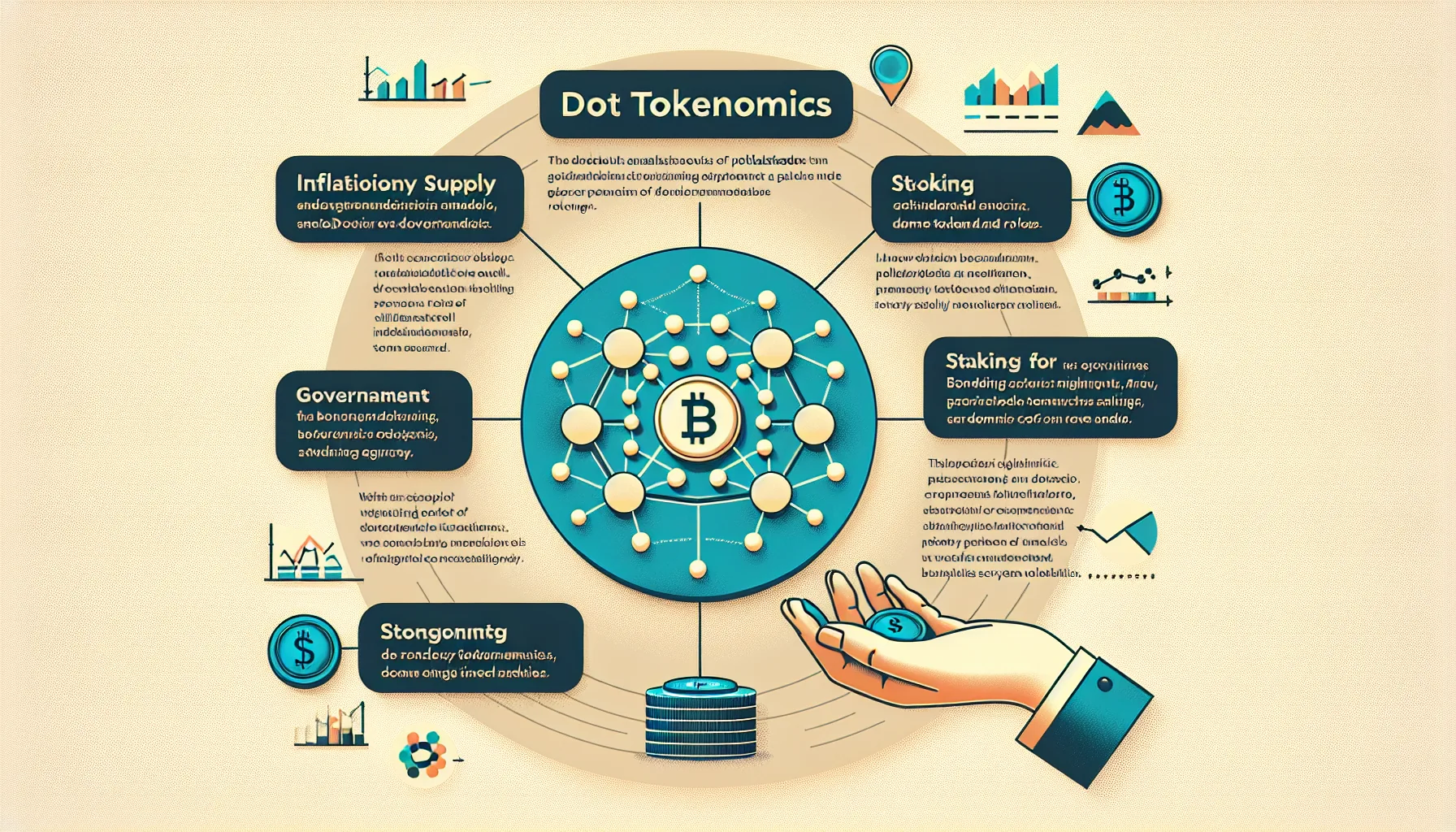
Polkadot's native token, DOT, operates as the economic engine of its ecosystem, blending multiple functionalities into a single asset. DOT serves three primary purposes: governance, staking, and bonding, each of which directly ties to the protocol's tokenomics design. However, understanding the tokenomics of DOT requires an examination of its inflationary supply model, allocation mechanisms, and the system's potential vulnerabilities.
Inflationary Supply Model and Token Distribution
Unlike Bitcoin's capped supply, DOT employs an inflationary model designed to incentivize network participation. The annual inflation rate is dynamic, targeting an approximate range of 10%, though this is subject to on-chain governance adjustments. Rewards generated by inflation primarily flow to validators and nominators staking their DOT, ensuring continuous interest in securing the network. That said, the inflationary mechanism may concern holders focused on maintaining long-term purchasing power, as dilution can occur without equivalent increases in staking rewards or utility-driven demand.
Token distribution remains another critical consideration. The initial network launch saw significant allocations to private investors and fundraising participants, as well as a locked proportion for treasury and ecosystem development. While this allocation strategy enables rapid development, it also concentrates early influence among certain participants, raising potential centralization concerns. Additionally, early vesting schedules and periodic allocations could lead to sell-side pressure, depending on market dynamics.
Application in Governance
DOT's governance utility sets Polkadot apart, as token holders directly influence protocol upgrades, monetary policies, and network fees. This participatory governance model is designed to be more decentralized compared to traditional development teams or foundation-driven projects. However, the reality of token-weighted voting raises concerns about "whale dominance," given the influence of large holders. Concentrated voting power could potentially lead to decisions that aren't optimal for the wider community. For well-meaning smaller holders, engaging in governance processes necessitates time and expertise, which may act as a barrier for broader participation.
Staking and Economic Security
DOT staking ensures the economic security of the Polkadot network. Validators and nominators bond their tokens to validate and secure parachains, receiving staking rewards in return. While staking yields encourage participation, it locks up liquidity for extended periods, rendering DOT holders exposed to opportunity costs during speculative or bearish market phases. Furthermore, the network’s reliance on high staking participation underscores potential fragility. If incentives are misaligned or staking participation drops significantly, the network's economic security could be compromised.
Bonding and Network Scalability
DOT's role in bonding is central to the scaling strategy of Polkadot's relay chain ecosystem. By bonding tokens, users help onboard new parachains. However, as parachain slots remain finite and highly competitive, the opportunity costs of bonding DOT increase, particularly in periods of high demand. This competition can concentrate parachain slots among well-funded projects while marginalizing smaller or community-driven efforts. Additionally, an over-reliance on bonding may introduce liquidity constraints for users, as bonded tokens cannot be freely traded.
These specific tokenomics characteristics reflect Polkadot's ambitious design but underscore the trade-offs inherent in balancing inflation, utility, and network dynamics within the crypto space.
DOT Governance
Understanding DOT’s Governance Model: Decentralization in Action
Polkadot’s native token, DOT, serves a pivotal role within its governance framework, designed to ensure the network remains decentralized and community-driven. Unlike traditional blockchain governance systems where decision-making is often limited to a core development team or miners, Polkadot prioritizes on-chain governance, directly empowering its stakeholders. This structure gives token holders substantial influence over the protocol’s evolution but also introduces certain operational complexities and risks.
DOT's Role in Governance
DOT holders can actively participate in the governance process by voting on proposals and referenda, ranging from network upgrades to various parameter adjustments. Polkadot employs a weighted voting system where the number of DOT tokens locked in a vote determines the weight of an individual’s decision. Proposals are submitted either by the Polkadot Council, a group responsible for representing the broader community, or by DOT holders themselves. If a proposal garners sufficient support, it is enacted autonomously without any third-party intermediaries.
The Polkadot Council and Technical Committee
Governance on Polkadot features two specialized components: the Council and the Technical Committee. The Council is a group of elected representatives responsible for advancing or rejecting proposals and ensuring that frivolous or malicious suggestions do not clog the system. Additionally, the Technical Committee, comprised of teams actively building on Polkadot, has the authority to fast-track critical proposals under certain conditions. While this layered structure adds robustness, critics argue that it could centralize decision-making around the Council and Technical Committee, thereby undermining the full decentralization ethos.
Challenges with On-Chain Voting
On-chain governance, while innovative, is not without its challenges. Voting power being tied to the amount of DOT held creates a system where wealthier participants have disproportionate influence. This could potentially skew decision-making toward the interests of whales or large entities, leaving smaller stakeholders with little say. Additionally, voter apathy remains a recurring issue; many token holders do not participate in governance, whether due to lack of incentive, knowledge gaps, or complex processes.
Potential Risks of Forkless Upgrades
One hallmark of Polkadot’s governance system is its support for forkless upgrades, achieved through the native governance mechanism. This approach reduces network disruption compared to hard forks but relies heavily on the assumption that stakeholders will consistently act in the network's best interest. If governance decisions are rushed or dominated by a select group, the protocol could face unintended repercussions.
In balancing decentralization with efficient decision-making, DOT’s governance model showcases innovation, though it still faces hurdles tied to voter participation and equitable representation.
Technical future of DOT
Technical Developments and Roadmap for Polkadot (DOT)
Polkadot (DOT) has emerged as a leading blockchain platform focused on interoperability and scalability, with a technical ecosystem built around its unique multi-chain architecture. At the heart of this architecture is the Relay Chain, which secures and coordinates a network of interconnected parachains. While the protocol has established itself as a highly versatile network, there are several ongoing and future technical developments that aim to bolster its capabilities and address existing challenges.
Key Current Technical Developments
One of the most notable upgrades revolves around improvements to parachain scalability and network efficiency. Polkadot's parachains are designed to operate in parallel, but limitations in block production rates and messaging capacity have been identified. Efforts are underway to optimize Cross-Consensus Messaging (XCM) to enhance communication between parachains. The current iteration of XCM works effectively, but scaling its throughput to match future demands remains an area of focus.
Polkadot is also advancing its asynchronous backing mechanism, a part of its broader effort to improve block finality times. This mechanism is expected to enable parachains to produce blocks more rapidly, reducing latency and enhancing transaction throughput across the network. However, implementing such changes remains a technically complex task, given the need to maintain seamless backward compatibility and security.
On the runtime side, the introduction of OpenGov (Governance version 2) has fundamentally changed how decisions are made within the network. While this decentralized governance framework fosters greater community involvement, critics have argued that its complexity could pose a barrier for adoption among less experienced token holders or parachain operators. Enhancing the user experience surrounding governance participation is an area Polkadot will need to address.
Future Technical Roadmap
Further down the roadmap, Polkadot developers are investigating solutions to expand its validator set. With the increasing number of parachains, the protocol's reliance on a limited number of validators for shared security has raised questions about scalability long-term. Efforts to introduce fractional staking arrangements and sharded validation are being explored to distribute security more effectively across the ecosystem.
Another critical area is the ongoing improvement of bridging solutions with other blockchain networks. While Polkadot's design already supports native interoperability, third-party bridges aiming to connect with external ecosystems (such as Ethereum) have faced technical challenges, particularly around security and trust assumptions. Future upgrades aim to make trust-minimized and permissionless cross-chain bridges more robust and seamless.
Lastly, Polkadot maintains a focus on supporting high-level developer tooling and WASM (WebAssembly) execution improvements for building parachains. While WASM provides substantial flexibility, creating a frictionless development experience remains a work in progress.
Challenges in Implementation and Scaling
While Polkadot’s vision of a decentralized, multi-chain future remains technically ambitious, its roadmap faces obstacles tied to both network complexity and developer adoption. As the ecosystem grows, balancing sophistication with accessibility will be a focal point for its continued evolution.
Comparing DOT to it’s rivals
Polkadot (DOT) vs. Cosmos (ATOM): A Deep-Dive Comparison
When comparing Polkadot (DOT) to Cosmos (ATOM), the spotlight falls on their similar goals: both aim to enable blockchain interoperability. However, the approaches they adopt are distinct, and understanding these differences highlights the unique characteristics and limitations of each.
Architecture and Interoperability Design
Polkadot's interoperability revolves around its Relay Chain. This central chain connects parachains—independent blockchains optimized for specific use cases—while maintaining shared security. The distinctive feature here is its pooled security model, where all parachains benefit from the Relay Chain's validator set. This simplifies the security burden for developers but increases competition for parachain slots, which are auctioned off in what can become a highly resource-intensive process.
Conversely, Cosmos employs the Inter-Blockchain Communication (IBC) protocol and allows blockchains within its ecosystem to maintain their sovereignty, including their own validator sets. While this independence provides flexibility, it requires developers to address their chain's security concerns, which can be a challenge for smaller projects with fewer resources to allocate to building robust infrastructure.
Scalability and Performance
Polkadot's parachain design promises significant scalability benefits since parallel processing of transactions is made possible via multiple parachains. However, this scalability is capped by the limited number of parachain slots, creating an inherent bottleneck. While upcoming upgrades such as parathreads aim to reduce this limitation, the system relies on competitive auctions for access, which can price out smaller projects.
In contrast, Cosmos focuses on fostering an ecosystem of independent chains but does not impose a strict limit on the number of blockchains that can interoperate via IBC. While this theoretically allows for seamless scaling, the approach also lacks a single, unified system for performance optimization, which can lead to inconsistencies in execution and cross-network coordination.
Governance and Development
Polkadot operates with an on-chain governance model. This enables DOT holders to vote directly on protocol upgrades, treasury allocations, and other network decisions. While this system ensures a high degree of transparency and decentralization, it can also lead to slower decision-making, particularly during contentious votes.
Cosmos, on the other hand, tends to empower individual chains with their own governance frameworks. While this allows for flexibility, the lack of a unified model may hinder coordinated decision-making across the ecosystem, undermining its broader interoperability goals.
Challenges in Adoption
While Polkadot’s design offers robust security and scalability features, its complexity can deter adoption. For one, the technical learning curve associated with developing parachains is steep, requiring advanced knowledge of frameworks like Substrate. Additionally, the auction system for parachain slots can become exclusionary for smaller projects.
Both ecosystems face the challenge of proving the necessity of interoperability in a fragmented blockchain landscape, but Polkadot's relatively centralized Relay Chain could prove a double-edged sword. Critics argue that this design creates a single point of failure, despite the mechanism's focus on providing unified security.
Polkadot (DOT) vs Cardano (ADA): A Deep Dive into Ecosystem Architecture and Governance
When comparing Polkadot (DOT) to Cardano (ADA), a clear point of differentiation lies in their core approaches to scalability, interoperability, and governance structures. Both have carved out unique niches within the blockchain landscape, but their execution strategies reveal areas where one excels over the other—and where challenges arise.
Ecosystem Development: Modular Versatility vs Layered Rigor
Polkadot’s architecture centers on its Relay Chain and modular parachains, emphasizing interoperability and a shared security model. This design allows different blockchains to operate simultaneously and communicate efficiently. Cardano, on the other hand, employs a layered architecture, separating its computational layer from its settlement layer. While this layered approach fosters system modularity and aims to boost security, it can also result in delays as each layer evolves independently, sometimes leading to bottlenecks in synchronicity.
Polkadot’s substrate framework accelerates blockchain development, enabling projects to deploy custom parachains tailored to specific use cases. In contrast, developers building on Cardano depend on its Haskell-based Plutus smart contract language—a powerful, mathematically-driven tool, but one that comes with a steep learning curve and restricted adoption within the broader development community.
Governance Frameworks: Flexible Upgrades vs Stiff Consensus
Polkadot’s governance model is designed for fast adaptability. Its on-chain governance mechanisms allow for continuous upgrades without hard forks—an element that aligns well with the fast-paced crypto development landscape. Cardano, in comparison, employs a more conservative governance model through its Ouroboros protocol and Voltaire phase for on-chain upgrades. While this slows decision-making, it minimizes risks associated with hastily implemented changes. However, such rigidity in governance may hinder Cardano in responding quickly to pressing ecosystem demands, particularly in periods of technological shift.
Adoption Hurdles: Accessibility and Developer Engagement
One area where Polkadot holds an edge over Cardano is in its emphasis on interoperability, which has made DOT a popular choice for cross-chain applications. Cardano, though celebrated for its rigorous academic approach and peer-reviewed protocols, has faced criticism for slower rollout of key functionalities and network upgrades. The delay in launching its smart contract capabilities, for instance, led to frustration among developers who opted for other platforms. While both projects face adoption challenges, Polkadot’s traction in connecting siloed blockchain ecosystems may position it as a more accessible option in certain contexts.
On the flip side, Cardano’s focus on formal verification and security creates a trade-off, appealing to developers seeking meticulously vetted solutions but alienating those who prioritize speed and flexibility over academic rigor.
In summary, Polkadot and Cardano share ambitions to redefine blockchain scalability and governance, yet their philosophical and technical divergences expose both strengths and vulnerabilities.
Polkadot (DOT) vs Solana (SOL): A Comparative Analysis
When comparing Polkadot (DOT) with Solana (SOL), it’s crucial to delve into the underlying technologies, use cases, and trade-offs between the two. While both projects aim to address scalability and interoperability issues plaguing the blockchain industry, they approach these challenges in fundamentally different ways.
Consensus Mechanisms: Proof-of-Stake With a Twist
Polkadot employs a Nominated Proof-of-Stake (NPoS) consensus mechanism that is tightly integrated with its parachain structure, prioritizing shared security and decentralization. By contrast, Solana utilizes a distinct Proof-of-History (PoH) mechanism layered within its Delegated Proof-of-Stake (DPoS) framework. Solana’s PoH enhances throughput by timestamping transactions, allowing blocks to be processed quickly and efficiently. However, this high-speed approach often comes at the cost of decentralization due to its reliance on beefy hardware requirements for validators, skewing participation toward more centralized entities.
Network Performance and Scalability
Solana is known for its high-performance blockchain, capable of processing thousands of transactions per second (TPS). Its throughput far outpaces Polkadot's current state, as DOT's architecture focuses on expanding scalability through parachains rather than emphasizing a single high-throughput chain. While Solana's transaction speeds are impressive, they introduce vulnerabilities like network outages and instability under high loads—a recurring criticism of its “speed-first” model. Polkadot, in comparison, opts for a modular approach where each parachain operates independently, preventing strain on the relay chain even during traffic surges.
Interoperability: Core Philosophies Diverge
At its core, Polkadot’s design revolves around interoperability. Through its relay chain and parachains, it enables specialized blockchains to communicate seamlessly, supporting multi-chain ecosystems. Conversely, interoperability on Solana is more restricted and relies predominantly on cross-chain bridges. Critics argue that bridges introduce potential attack vectors, as seen in past exploits within the broader crypto space. Polkadot mitigates this risk through its native architecture, although its cross-consensus messaging capabilities have broader limitations compared to Solana’s ecosystem integrations.
Ecosystem and Development Focus
Solana’s ecosystem is dense and focused heavily on decentralized finance (DeFi) and non-fungible tokens (NFTs). Its ecosystem growth has been fueled by rapid adoption among developers who value its low transaction costs and high throughput. Polkadot, on the other hand, appeals more to projects requiring bespoke blockchain architectures, such as enterprise solutions or niche applications. While both aim to attract developers, Solana’s approach often favors immediacy, whereas Polkadot’s deliberate rollout of parachain slots and customizability fosters a more methodical development trajectory.
Challenges of Architecture
Polkadot’s shared security model is lauded for its robustness, but onboarding parachains is time-intensive, and its architecture can feel overly complex to developers seeking a straightforward deployment. Solana’s network, though more accessible in certain respects, faces criticism for prioritizing speed over resilience, amplifying centralization risks and raising questions about long-term sustainability.
By focusing on fundamentally different priorities—speed versus reliability—DOT and SOL provide contrasting value propositions to the crypto space, making their rivalry emblematic of the broader trade-offs shaping blockchain innovation.
Primary criticisms of DOT
Primary Criticism of DOT: Key Challenges Facing Polkadot's Token
The Polkadot ecosystem has gained significant attention in the blockchain space, yet its native token, DOT, is not without its share of criticism. While the network’s core ambition of enabling interoperability across blockchains is commendable, there are ongoing concerns regarding the functionality, governance, and technical complexities associated with DOT.
Complexity of Staking and Reward Mechanisms
One of the most prominent criticisms revolves around Polkadot's staking system. While staking is essential for maintaining network security, many argue that DOT’s staking process is intricate and not user-friendly. For retail investors or less-savvy crypto participants, understanding and effectively participating in staking remains daunting. The ecosystem's lack of simplified tools to guide users through validator selection, nomination mechanics, and reward optimization adds to this challenge. Moreover, the unbonding period for staked DOT—where tokens are locked and inaccessible—makes staking less appealing for those seeking flexibility in their investment strategies.
Overhyped Decentralization Claims
Another area of concern lies in the true decentralization of Polkadot and its governance structure. While the network positions itself as community-driven, critics point out that decision-making disproportionately favors token holders with larger stakes. For example, those controlling significant amounts of DOT can exert outsized influence over governance proposals, creating potential centralization risks. This "economic weight bias" in governance decisions can alienate smaller investors and undermine the ethos of decentralization touted by blockchain projects.
Parachain Slot Auction Accessibility
Polkadot’s innovative parachain slot auction system—used to determine which projects gain access to the network—is another contentious topic. Despite its design to foster competition and innovation, critics argue the mechanism inherently favors well-funded projects, leaving smaller teams at a disadvantage. This creates a dynamic where parachain slots tend to end up in the hands of projects backed by large token holders or venture capital, raising concerns over the inclusiveness and long-term diversity of the ecosystem.
Inflationary Supply Dynamics
DOT’s inflationary model is also a point of skepticism. As the token’s supply increases to support staking rewards and ecosystem growth, some worry this approach may dilute value over time. While Polkadot promises a controlled annual inflation rate, participants have raised questions about whether this inflation will exert downward pressure on price, particularly if demand for DOT does not match the increasing supply.
Lack of Clarity in Use Case Evolution
Lastly, there are nagging concerns regarding the evolution of DOT’s utility as the network matures. Beyond staking, governance, and parachain auctions, many question the depth and relevance of DOT’s use cases. The lack of diversification in token utility could pose risks to the sustained growth and adoption of Polkadot’s broader ecosystem, especially as competitors innovate with similar multi-chain interoperability solutions.
Founders
The Founding Team Behind DOT: A Deep Dive into Polkadot's Leadership
Polkadot (DOT), a multi-chain blockchain protocol designed to enable the interoperability of various blockchains, owes much of its vision and technical architecture to a renowned and accomplished founding team. At the core of Polkadot's development is Parity Technologies, a key infrastructure development firm in the blockchain ecosystem, co-founded by Dr. Gavin Wood and Jutta Steiner. Their involvement in DOT’s creation has been both a strength and a point of contention in some circles.
Dr. Gavin Wood: Visionary, Technologist, and Controversial Leader
Dr. Gavin Wood, Polkadot's co-founder and the primary architect of the project, is one of the most recognized names in blockchain technology. Known for being a co-founder of Ethereum and the creator of the Solidity programming language, Wood brought significant credibility and technical expertise to Polkadot when it launched. He developed the concept of the relay chain and implemented the Substrate framework, two foundational components of the Polkadot ecosystem.
However, Wood's leadership has not been without criticism. His intense focus on technical perfection and broad philosophical ideas surrounding decentralization have occasionally been critiqued as impractical by those advocating for faster execution and mainstream adoption. Additionally, his highly centralized influence within the early stages of Polkadot’s development raised concerns among some in the community about how well the project aligns with principles of decentralization.
Jutta Steiner: Security Specialist Turned Blockchain Advocate
Jutta Steiner, Parity Technologies' other co-founder, brought crucial expertise in cryptographic security to the Polkadot project. Steiner, previously the Chief of Security at Ethereum, has been instrumental in establishing best practices for code security and audits. However, Parity’s involvement in high-profile mishaps, such as the controversial Parity wallet bug in 2017 (prior to Polkadot’s launch), has cast a shadow over her track record for some in the space. While not directly related to DOT, such events left a mark on community trust.
Web3 Foundation: A Centralized Hub for Decentralization
Alongside Parity Technologies, the Web3 Foundation, also co-founded by Wood, has been a key driver in funding and promoting Polkadot. Critics argue that the Web3 Foundation’s concentrated control over early token allocation and network governance stands in contrast to Polkadot's stated goal of fostering decentralization. Proponents, on the other hand, argue that such oversight was necessary to bootstrap the complex ecosystem.
Polkadot's leadership team has undeniably brought groundbreaking innovation to the blockchain space. At the same time, questions about centralization, execution speed, and decision-making processes remain topics of intense debate among those immersed in the crypto space.
Authors comments
This document was made by www.BestDapps.com
Sources
- https://polkadot.network/whitepaper/
- https://polkadot.network/blog/
- https://github.com/paritytech/polkadot
- https://github.com/paritytech/substrate
- https://wiki.polkadot.network/
- https://medium.com/polkadot-network
- https://docs.substrate.io/
- https://polkadot.network/ecosystem/
- https://parity.io/technology/polkadot/
- https://polkadot.subscan.io/
- https://polkadot.js.org/
- https://kusama.network/
- https://polkadot.network/parachains/
- https://www.w3f.tech/
- https://messari.io/asset/polkadot
- https://cryptoslate.com/coins/polkadot/
- https://coinmarketcap.com/currencies/polkadot-new/
- https://decrypt.co/resources/what-is-polkadot-guide
- https://www.coingecko.com/en/coins/polkadot
- https://research.binance.com/en/projects/polkadot