History of DCRN
The History of DCRN: Origins, Forks, and Key Events
DCRN (Decred Next) emerged as a result of a contentious fork within the Decred (DCR) ecosystem. The split was driven by disagreements over governance, mining incentives, and control over treasury funds. Unlike Decred, which transitioned to a hybrid PoW/PoS model emphasizing stakeholder governance, DCRN sought to address what some saw as centralization issues in the Decred community.
The Fork and Its Motivations
The primary catalyst for DCRN’s creation was Decred’s shift in block reward distribution. Decred’s developers restructured the reward split to allocate a larger proportion to PoS stakeholders at the expense of PoW miners. Critics argued this marginalized miners and reduced the security contributions made by Proof-of-Work. This decision, along with broader governance disputes, led to the hard fork that birthed DCRN, which retained an older reward model and prioritized miner incentives.
Beyond mining economics, DCRN proponents pointed to governance concerns within Decred. They argued that Decred’s Politeia system, originally designed for decentralized treasury management, had become dominated by specific stakeholder groups, limiting true open participation. By forking, DCRN sought to preserve what its supporters saw as a more balanced governance structure.
Initial Adoption and Network Stability
Following the split, DCRN faced challenges in securing widespread network adoption. Exchange listings were slower than expected, impacting liquidity. Additionally, maintaining hash rate security proved difficult, as much of the original Decred mining power remained with DCR. In the months after the fork, concerns were raised over whether DCRN could sustain a viable network given its smaller size and lower economic incentives compared to its predecessor.
Despite these hurdles, the project maintained a following of miners and early adopters who supported its principles. Developers worked to keep the protocol aligned with desired modifications while still retaining core Decred functionalities, including its hybrid PoW/PoS system.
Governance and Development Trajectory
One major issue with DCRN’s governance model was whether it could avoid the same centralization concerns that had led to the fork in the first place. The project’s decision to maintain a different block reward split did not fully address deeper questions about long-term governance participation. Additionally, DCRN’s treasury management system, while initially aiming for more openness, faced scrutiny over potential influence from large stakeholders.
While DCRN retained the technological base of Decred, its divergence in economic incentives and governance structure defined the project’s early history. The long-term effects of this split raised ongoing questions about sustainability, miner participation, and community-driven decision-making.
How DCRN Works
How DCRN Works: Consensus, Governance, and Incentives
DCRN operates as a hybrid Proof-of-Work (PoW) and Proof-of-Stake (PoS) blockchain, combining miner-driven security with stakeholder-driven governance. The PoW component relies on miners who validate transactions and secure the network, while PoS allows token holders to vote on proposals and participate in consensus. This design aims to mitigate centralization risks typically associated with pure PoW or PoS systems. However, the balance between miners and stakeholders can sometimes lead to governance conflicts, particularly when economic incentives create misalignment between the two groups.
Proof-of-Work and Mining
Miners in DCRN use computational power to solve cryptographic puzzles, validate transactions, and extend the blockchain. Block rewards are distributed between PoW miners, PoS stakeholders, and the treasury. Unlike purely PoW-based networks, where miners dictate chain security and transaction validation entirely, DCRN limits their influence by ensuring that stakeholders have a direct role in governance. This structure helps prevent miner-dominated decision-making but also reduces miner rewards compared to pure PoW chains, which could impact long-term miner participation.
Proof-of-Stake and Governance
Stakeholders acquire voting power by locking DCRN tokens in exchange for tickets, which are randomly selected to validate blocks and propose rule changes. This process distributes governance power across active participants instead of concentrating authority among core developers or large mining pools. Ticket voting enables protocol upgrades without hard forks, reducing the likelihood of contentious chain splits. However, the ticketing mechanism introduces capital inefficiency, as locked funds remain inaccessible for extended periods, discouraging some participants from engaging in staking.
On-Chain Treasury and Development Funding
A portion of block rewards is allocated to a decentralized treasury that funds network improvements and development initiatives. Proposals for fund allocation are reviewed and voted on by stakeholders, ensuring ongoing infrastructure support. While this governance structure prevents centralized financial control, it introduces potential inefficiencies, such as sluggish decision-making or the concentration of voting power among early adopters and large stakeholders. Uneven voter participation may also delay critical upgrades or limit ecosystem growth.
Challenges and Trade-Offs
DCRN’s hybrid model aims to balance security and decentralization, but trade-offs exist. The reliance on both PoW and PoS means miners and stakeholders must coexist with sometimes conflicting economic incentives. Staking participation requires locking funds, reducing liquidity for token holders. Governance decisions depend on active voting, which can lead to slow proposal execution if participation rates are low. Furthermore, treasury-funded development depends on sustained user engagement, meaning periods of inactivity or decreased network usage could impact long-term innovation.
Use Cases
Use Cases of DCRN
Decentralized Governance and Staking
DCRN is designed to enable decentralized governance through a hybrid consensus mechanism, combining Proof of Work (PoW) and Proof of Stake (PoS). This system allows stakeholders to participate in decision-making through voting while simultaneously securing the network. However, the governance model's effectiveness depends on stakeholder engagement, and low participation could lead to power centralization among a smaller group of users.
On-Chain Treasury System
A key use case of DCRN is funding ecosystem development through an on-chain treasury. A portion of block rewards is allocated to a fund used for network development, which is governed via stakeholder voting. While this model ensures continuous funding, it introduces challenges related to governance transparency and efficiency, as misallocation of funds or governance stagnation could hinder long-term growth.
Peer-to-Peer Transactions
DCRN facilitates decentralized and censorship-resistant peer-to-peer transactions. With an emphasis on security and scalability, it is positioned as a medium for financial transfers without intermediaries. However, network congestion and transaction fees can impact the efficiency of transfers depending on demand and miner participation.
Smart Contracts and dApps
DCRN supports smart contracts and decentralized applications (dApps), enabling developers to build on the network. This expands possibilities for DeFi platforms, NFT marketplaces, and automated financial agreements. However, competition from well-established smart contract platforms may limit adoption, and security vulnerabilities in contract execution remain a risk.
Privacy and Security Features
Security is a major emphasis in DCRN’s architecture, with cryptographic measures enhancing transactional privacy. While this strengthens user anonymity, it may also attract scrutiny from regulatory bodies concerned about illicit financial activity. Additionally, privacy-oriented transactions can face challenges related to compliance and usability.
Cross-Chain Interoperability
DCRN is exploring cross-chain interoperability to enhance its utility beyond its native network, allowing seamless value transfer between different blockchain ecosystems. However, interoperability solutions often introduce added complexity and security risks, particularly in bridge infrastructure, which has been a target for exploits in multiple networks.
Sustainability Through Hybrid Consensus
The hybrid PoW/PoS consensus mechanism balances decentralization, security, and efficiency. Miners secure the network via PoW, while PoS stakeholders contribute to governance and consensus. However, hybrid models demand more network coordination, and disagreements between PoW miners and PoS voters could result in governance conflicts.
DCRN Tokenomics
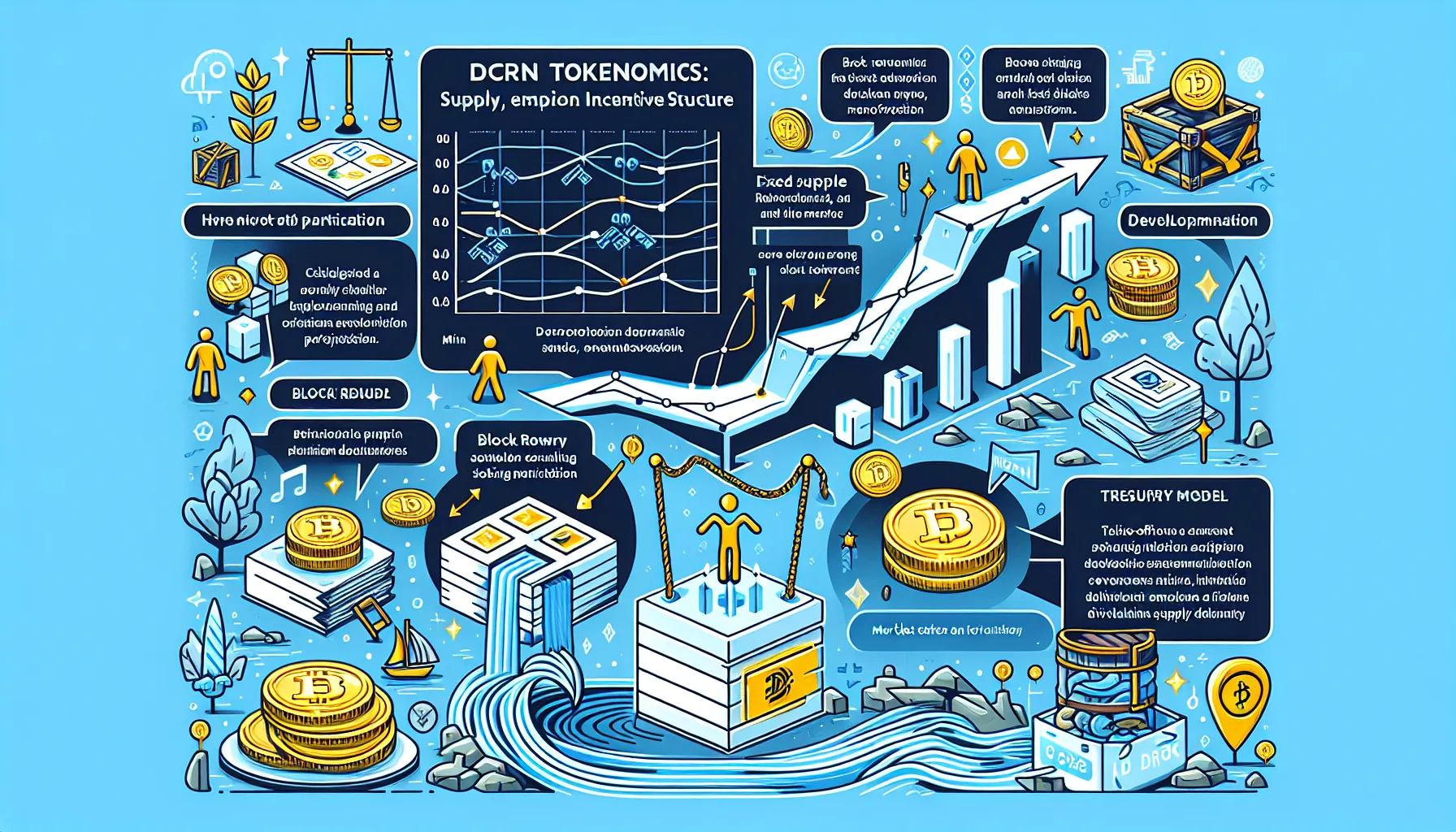
DCRN Tokenomics: Supply, Emission, and Incentive Structures
Fixed Supply and Emission Model
DCRN follows a structured emission schedule with a capped total supply, ensuring a predictable long-term inflation rate. Block rewards are subject to periodic reductions, following a pre-defined decaying schedule. This programmed decrease in coin issuance impacts miner incentives, network security, and overall liquidity in secondary markets.
Block Reward Distribution
The network distributes block rewards among key participants, including miners, stakeholders, and governance mechanisms. A significant portion is allocated to proof-of-work (PoW) miners, while a separate portion incentivizes those participating in the proof-of-stake (PoS) component. This dual approach maintains chain security while allowing stakeholders to exert governance influence.
While this distribution mechanism aligns miner incentives with network security, reliance on PoW introduces concerns regarding long-term sustainability, especially as block subsidies decrease. Over time, transaction fees must compensate for lower block rewards, which could impact miner participation if on-chain activity does not increase proportionally.
Staking Incentives and Governance Participation
Holders can engage in staking to earn a share of rewards while securing the network. This staking mechanism also grants governance rights, allowing stakeholders to participate in protocol-level decision-making processes. The requirement to lock tokens for governance voting impacts circulating supply, influencing market dynamics and overall liquidity.
However, the staking yield fluctuates based on network participation rates, meaning rewards are not static. High staking participation reduces per-staker returns while reinforcing network security, whereas lower participation increases yield but may leave the network more vulnerable to governance manipulation or security risks.
Treasury Model and Development Fund
A portion of block rewards is directed into a treasury, used for ongoing protocol development, ecosystem growth, and operational costs. Treasury-controlled funds are subject to governance decisions, typically requiring stakeholder approval for spending proposals.
While this mechanism ensures continuous funding for development, governance disputes or inefficiencies in fund allocation could impact the network’s long-term viability. If treasury funds accumulate without efficient utilization, or if governance becomes contentious, decision-making gridlock may slow down expected advancements.
Market Liquidity and Circulating Supply Dynamics
The interplay between mining issuance, staking, and treasury funding directly affects DCRN’s circulating supply. A high percentage of tokens locked in staking or controlled by the treasury reduces immediate market availability, potentially influencing price stability or volatility. Conversely, large sell-offs from miners or treasury expenditures could introduce downward pressure on the token’s value if not met with adequate buy-side support.
Liquidity concerns can arise if staking rewards are too attractive relative to transaction-based incentives, leading to lower transactional volume and reduced exchange liquidity. This creates a scenario where demand for liquid tokens may outpace freely available supply.
DCRN Governance
DCRN Governance: Decentralization, Voting, and Challenges
DCRN employs an on-chain governance model that allows stakeholders to participate in decision-making, shaping protocol upgrades and network direction. Governance is primarily executed through a hybrid consensus mechanism that merges Proof of Work (PoW) with Proof of Stake (PoS), ensuring both miners and stakeholders have a say in the network’s evolution.
Stakeholder Voting and Proposal System
DCRN governance is structured around a ticket-based voting system, where stakeholders lock DCRN tokens to acquire tickets. These tickets grant voting rights on various proposals concerning protocol changes, network upgrades, and funding requests. This mechanism aims to mitigate governance centralization by requiring active participation from economic stakeholders rather than relying solely on miners.
The proposal system is built on an off-chain and on-chain hybrid approach. Off-chain discussions typically occur in a public forum before proposals move to a formalized, on-chain voting phase. Each ticket casts a single vote, and proposals are accepted or rejected based on predefined participation and approval thresholds.
Miner Influence and Governance Trade-offs
Despite the stake-based governance model, miners in DCRN maintain influence due to the hybrid PoW/PoS structure. While they cannot directly vote on proposals, their role in block production introduces a level of control over which transactions are included in blocks. This dynamic means that governance in DCRN must balance stakeholder influence with miner incentives, potentially creating conflicts when governance decisions negatively impact mining profitability.
Governance Challenges and Centralization Risks
One of the primary challenges in DCRN governance is the voter participation rate. Since users must lock tokens to participate, lower liquidity or uncertainty around governance proposals can lead to reduced engagement. Apathy among token holders can result in decision-making being disproportionately influenced by a smaller group of active participants.
Another concern is how governance proposals are introduced and the risk of centralization within proposal discussions. While voting itself is open to stakeholders, the direction of governance discussions is often dominated by early adopters, core developers, or well-funded entities capable of rallying votes. This can lead to decisions that primarily benefit specific parties rather than the broader network.
The reliance on a hybrid model also introduces potential friction between PoS voters and PoW miners, particularly when governance decisions impact block rewards, transaction fees, or consensus mechanics. Addressing these misalignments remains an ongoing difficulty within DCRN’s governance framework.
Technical future of DCRN
DCRN Technical Developments and Roadmap
Ongoing Enhancements to Consensus Mechanism
DCRN developers continue refining the network’s hybrid PoW/PoS consensus model, aiming to optimize security and decentralization. Recent technical discussions have centered around improving staking efficiency and reducing potential vulnerabilities in validator selection. Some proposals suggest modifying ticket selection algorithms to further deter manipulative behaviors. However, implementing such changes requires careful testing to avoid unintended centralization risks.
Smart Contract Integration and Layer-2 Expansion
Efforts are underway to extend DCRN’s smart contract capabilities, with a focus on improving interoperability with existing DeFi ecosystems. Key developments include enhancements to scripting languages and virtual machine efficiency to support more complex contracts. While progress has been steady, challenges remain in ensuring seamless execution while maintaining low transaction costs.
Layer-2 scaling solutions are also under active research, with rollups and state channels being primary candidates for further exploration. Discussions continue regarding the trade-offs between security, decentralization, and performance, particularly concerning data availability and network congestion.
Privacy and Security Improvements
Security remains a focal point, and developers have been investigating cryptographic enhancements to improve transaction privacy. Various implementations of confidential transactions and zero-knowledge proofs have been proposed, though the primary challenge lies in maintaining scalability while integrating these features. Issues with computational overhead persist, and further optimizations are required before broad deployment.
In response to past security concerns, additional protocol hardening measures are being tested, including improvements to peer-to-peer encryption and DDoS resistance mechanisms. These enhancements are expected to mitigate risks of network-level attacks and unauthorized chain reorganizations.
Governance System Modifications
Decentralized governance remains a complex issue, with debates surrounding voting mechanisms and transparency. Recent proposals suggest adjustments to treasury allocation structures to better incentivize long-term development while preventing centralization of funding control. However, resistance exists from stakeholders who favor the current system, citing concerns over potential governance manipulation.
Efforts to improve the efficiency of proposal submission and funding distribution continue. Developers are exploring on-chain identity verification mechanisms to prevent sybil attacks while maintaining pseudonymity. Achieving this balance remains an unresolved challenge.
Long-Term Development Focus
The DCRN roadmap emphasizes long-term sustainability, but uncertainties exist regarding ecosystem adoption and developer participation. While core development progresses, maintaining a robust contributor base is an ongoing concern. Future efforts include fostering a stronger developer community and improving platform accessibility without compromising decentralization principles.
Comparing DCRN to it’s rivals
DCRN vs. DCR: Key Differences and Competitive Analysis
Decentralized Credit Network (DCRN) and Decred (DCR) share a common ancestry but have diverged in critical ways that impact governance, security, and long-term sustainability. While both projects incorporate hybrid Proof-of-Work (PoW) and Proof-of-Stake (PoS) consensus mechanisms, their implementation and community dynamics create distinct differences.
Governance and Decision-Making Differences
DCR relies heavily on its Politeia proposal system, allowing stakeholders to vote on network upgrades and treasury expenditure. While this system provides a high degree of decentralization, critics argue that dominant voting power tends to concentrate among large stakeholders, leading to governance inertia on controversial upgrades.
DCRN, on the other hand, emerged as a fork aiming to address concerns surrounding rigid governance structures. By offering a different voting mechanism, DCRN seeks to create a more adaptable decision-making process, though questions remain about whether it can effectively balance stakeholder influence without introducing centralization risks.
Mining and Network Security
Both DCR and DCRN utilize a hybrid consensus model, combining PoW mining with PoS validation to reduce the influence of ASIC miners and prevent 51% attacks. However, DCR has had broader miner adoption, resulting in a more mature and battle-tested security model.
DCRN, being a newer fork, lacks the same level of miner commitment and depth in hashrate distribution. A lower hashrate concentration can make it more susceptible to network attacks, especially if mining participation remains fragmented or controlled by a small subset of actors. This is a critical security consideration for users transacting or staking within the ecosystem.
Development Funding and Treasury Model
DCR operates under a self-funding model, where a portion of block rewards is allocated to the project’s treasury. This has allowed sustained development without reliance on external venture capital. However, some community members have criticized the slow pace of innovation and reluctance to implement sweeping technical changes.
DCRN inherits a similar funding structure but faces challenges in attracting new developers and fostering adoption within a space already crowded with competing blockchain ecosystems. Without sustained treasury funding and continuous developer incentives, there’s a risk that DCRN could struggle to maintain momentum over time.
Network Adoption and Liquidity Considerations
DCR benefits from deeper exchange integrations and a more established trading presence. Liquidity across multiple trading platforms provides ease of access for traders and users looking to stake or participate in governance.
DCRN, being a fork, faces hurdles in achieving the same level of liquidity and exchange support. Without significant incentives for market makers or broader exchange adoption, its accessibility remains a barrier for new participants entering the ecosystem.
DCRN vs. ETC: Comparing Network Security, Governance, and Development
Consensus Mechanism and Security Trade-Offs
DCRN and Ethereum Classic (ETC) both utilize proof-of-work (PoW) as their consensus mechanism, but their approaches to network security differ significantly. ETC has faced multiple 51% attacks in the past due to its lower hashrate compared to Ethereum before the merge. This vulnerability has raised concerns about its ability to maintain trustless security in the long term. DCRN, on the other hand, incorporates a hybrid PoW/PoS system, which aims to mitigate the risks of PoW-exclusive chains by requiring both miners and stakeholders to participate in network validation. This dual-layer approach makes coordinated attacks significantly more costly, though it also introduces additional layers of complexity in governance.
Governance Structure and On-Chain Decision-Making
ETC adheres to a "code is law" philosophy, emphasizing immutability and minimizing on-chain governance interventions. While this ensures that the chain remains true to its principles, it also makes governance slow and resistant to changes—even when adjustments could serve the long-term health of the network. In contrast, DCRN integrates an on-chain governance system where stakeholders can vote on proposals and protocol changes. This allows for more structured decision-making and adaptability, though it could also result in governance centralization if a small group of major stakeholders accumulates disproportionate voting power.
Smart Contract Capabilities and Ecosystem Growth
ETC maintains compatibility with Ethereum’s EVM, allowing smart contracts and dApps to function on its network. However, despite this compatibility, its ecosystem remains relatively underdeveloped compared to Ethereum, with limited developer activity and lower adoption levels. The network's security concerns have also contributed to skepticism among potential dApp developers who prioritize long-term network resilience. DCRN, while not as focused on smart contract execution, directs its development efforts toward improving hybrid consensus efficiency and sustainable blockchain funding. This trade-off means that while DCRN may not directly compete in the smart contract space, its governance and funding model could result in a more consistently maintained network over time.
Mining Economics and Incentive Design
ETC benefits from a well-established mining infrastructure, especially after Ethereum's transition to proof-of-stake, which led to an influx of displaced miners. However, its long-term mining incentives remain a point of debate, as ongoing security demands require a sufficient hashrate commitment. DCRN’s hybrid model creates a different set of incentives, balancing PoW rewards with PoS validation, which impacts how miners engage with the network. While this diversification can enhance security, it also affects miner participation by splitting rewards among different consensus participants, potentially leading to lower direct rewards for miners compared to pure PoW chains like ETC.
DCRN vs. ZEC: Comparing Privacy and Governance Approaches
When evaluating DCRN against ZEC, the most notable contrast lies in their approach to privacy and governance. While both networks focus on decentralization and security, their technological implementations and community governance models diverge significantly.
Privacy Mechanisms: Optional vs. Default
ZEC is built around privacy, utilizing zk-SNARKs to enable shielded transactions. While Zcash allows users to choose between transparent and shielded addresses, its adoption of privacy has historically been hindered by inconsistent usage—many transactions still occur on transparent addresses, diminishing the overall anonymity set.
DCRN, on the other hand, does not implement privacy at the protocol level. Instead, users seeking anonymity must rely on secondary tools or external privacy solutions. This distinction makes ZEC more appealing for those prioritizing built-in privacy but also raises concerns about regulatory scrutiny, given increasing restrictions on privacy-focused assets.
Governance and Decision-Making
DCRN adopts a hybrid Proof-of-Work (PoW) and Proof-of-Stake (PoS) model, granting stakeholders direct governance participation. This structure enables on-chain voting and treasury funding mechanisms that allow the community to influence protocol development and resource allocation.
ZEC relies on the Electric Coin Company (ECC) and the Zcash Foundation for major governance decisions. While community members can participate in discussions, substantial power remains centralized in key organizations, particularly through the Zcash Development Fund. The lack of direct, protocol-level governance has led to periodic disputes over funding allocations and the direction of protocol upgrades.
Inflation and Sustainability
Both networks distribute block rewards, but their long-term economic models differ. ZEC implements a tail emission, ensuring a continued reward past the original emission schedule. However, its funding model diverts a percentage of block rewards to developers and the foundation, potentially creating conflicts of interest between stakeholders and miners.
DCRN follows a structure where network funding is allocated through on-chain proposals, reducing reliance on centralized foundations. This may appeal to those skeptical of development teams holding prolonged financial control.
ASIC Resistance and Mining Considerations
ZEC operates on the Equihash algorithm, which, despite initial ASIC resistance, has seen significant ASIC dominance in mining. This has led to concerns about mining centralization within specific entities.
DCRN, being a fork with modified governance but retaining PoW elements, also faces questions about mining centralization. However, its governance model aims to mitigate some of the influence large miners have over the network’s future direction.
Primary criticisms of DCRN
Primary Criticism of DCRN
Contentious Chain Split and Governance Concerns
One of the primary criticisms of DCRN revolves around its origins as a chain split from Decred (DCR). Forks are common in crypto, but DCRN's split was particularly contentious due to disagreements over governance and treasury control. The decision-making process around the fork has led some to question its legitimacy, arguing that it reflects deep-seated fractures within the original Decred community rather than a well-structured technical evolution. This governance skepticism has resulted in concerns about long-term stability and decision-making within the DCRN ecosystem.
Security Trade-offs After the Fork
DCRN inherited much of the technology stack from Decred, including its hybrid Proof-of-Work (PoW) and Proof-of-Stake (PoS) consensus model. However, critics argue that the fork has negatively impacted network security. With a smaller overall hashrate and fewer staking participants after the split, DCRN may be more vulnerable to various blockchain security risks, including potential attacks or manipulations. Lower staking engagement also weakens the PoS component, which is central to governance and network decentralization.
Reduced Developer and Ecosystem Support
A major criticism of DCRN is the relative lack of developer activity compared to its predecessor. Though some contributors transitioned to DCRN, the split created fragmentation within the developer community. This has led to concerns about the sustainability of protocol updates, security patches, and new feature rollouts. A smaller developer base can also slow down innovation and make network improvements more challenging. Additionally, ecosystem support—such as third-party integrations, exchange listings, and DeFi applications—has been slower to grow compared to other blockchain projects with stronger community backing.
Market and Liquidity Limitations
Another recurring issue tied to DCRN is its liquidity and accessibility. Since it emerged from a contentious split, exchange support has been inconsistent, affecting trading volume and usability. Limited liquidity can result in greater price slippage and make it harder for participants to enter and exit positions efficiently. Lower market participation also impacts staking incentives, reducing the appeal for both miners and PoS voters who contribute to the network’s security and governance.
Uncertain Economic Incentives
DCRN’s tokenomics have been a subject of scrutiny, particularly surrounding long-term incentives for validators, miners, and the broader community. Some critics argue that post-fork economic policies have not been stress-tested enough to ensure sustainable rewards distribution. If incentives are misaligned or unattractive, this could weaken network participation over time, exacerbating security concerns and reducing the motivation for continued development and governance engagement.
Founders
The Founding Team Behind DCRN
DCRN (Decred-Next) was initiated by a faction of developers and community members who diverged from the original Decred (DCR) ecosystem. This split was driven by ideological and technical disagreements, particularly relating to governance and proof-of-work participation. The founding team comprises former Decred contributors, developers, and supporters who sought an alternative direction distinct from the course taken by the Decred project.
Origins and Background of the Core Developers
The primary contributors to DCRN have backgrounds in blockchain development, consensus mechanisms, and cryptographic security. While some of the team members previously worked on the original Decred project, others were recruited from the broader blockchain space to expand expertise. Many had prior experience with open-source governance models and decentralized treasury management.
A key distinction in DCRN's founding group is their stance on mining decentralization. Unlike the original Decred team, which shifted towards stronger PoS control, the DCRN founders aimed to maintain a more balanced engagement between Proof-of-Work (PoW) miners and Proof-of-Stake (PoS) participants. This ideological focus shaped much of the early development efforts.
Anonymity and Transparency Concerns
One challenge with analyzing the DCRN founding team is the partial anonymity of some contributors. While certain developers and organizers have been vocal in online forums and development channels, others prefer to operate behind pseudonyms. This has led to concerns about transparency, particularly when it comes to decision-making authority and long-term project stewardship.
In the cryptocurrency space, pseudonymous development is not uncommon, but it often raises questions about trust and accountability. Without publicly verifiable leadership, investors and users must rely on active code contributions and community engagement to gauge the project's direction.
Governance and Decision-Making Structure
Unlike fully centralized crypto teams, DCRN's founders embraced a hybrid governance model. Early governance decisions were influenced by the founding contributors, but mechanisms were put in place to gradually distribute decision-making power to the community. However, skepticism remains regarding how much influence the original team continues to hold, particularly in funding allocations and protocol upgrades.
DCRN also inherited a treasury system similar to Decred’s, allowing for ongoing project funding. The founding team initially managed key allocations, but the transition to more decentralized control has been a topic of ongoing debate within the community. Disagreements over proposal approvals and the distribution of funds have sparked friction between the founding developers and newer participants.
Controversies and Schisms
As with many forked projects, the DCRN founding team has been at the center of numerous debates. Critics argue that some early decisions lacked community consensus or were motivated by personal disagreements within the Decred ecosystem. In some cases, these disputes have resulted in developers leaving the project, causing concerns about contributor retention.
While the development team continues to push updates and maintain the network, questions remain regarding long-term leadership and how governance will evolve beyond the initial group of founders.
Authors comments
This document was made by www.BestDapps.com
Sources
- Official Website
- Whitepaper
- GitHub Repository
- Explorer
- Official Forum
- Medium Blog
- Discord Community
- Twitter (X) Official
- Telegram Group
- CoinMarketCap Listing
- CoinGecko Listing
- Roadmap
- Technical Documentation
- Mining Guide
- Consensus Mechanism Overview
- DeFi Integration Plans
- Governance Model
- Tokenomics Breakdown
- Security Model


