History of DCR
The History of Decred (DCR): A Governance-Focused Blockchain Evolution
Decred (DCR) originated in 2016 as a novel attempt to address and rectify governance challenges observed in earlier blockchain projects, especially Bitcoin (BTC). The project emerged from a dissatisfaction with centralized decision-making and developer influence in Bitcoin's ecosystem, particularly surrounding the contentious scalability debates of the mid-2010s. The creators of Decred envisioned a self-governing cryptocurrency that balanced power dynamics between miners, developers, and users.
The origins of Decred can be traced back to an open-source software company, Company 0 (C0), led by Jake Yocom-Piatt. Drawing on their work contributing to Bitcoin’s codebase, C0 sought to establish a blockchain that effectively integrated a hybrid Proof-of-Work (PoW) and Proof-of-Stake (PoS) consensus mechanism. This innovative approach was designed to align incentives between stakeholders and ensure a more decentralized governance framework. Notably, the PoS system—as implemented by Decred—allowed stakeholders to lock their DCR in exchange for voting rights, giving users significant influence over network upgrades and policy decisions.
Decred's development was bootstrapped without an Initial Coin Offering (ICO), opting instead for a transparent pre-mine of 8% of the total 21 million tokens. Half of the pre-mine was distributed to developers to reward their contributions, while the other half was airdropped to early adopters to ensure decentralized token distribution. While the pre-mine strategy fostered transparency, it also drew criticism from segments of the crypto community, who questioned whether it truly prevented centralized accumulation of influence.
The platform quickly distinguished itself by introducing the Politeia proposal system in 2018, which centralized its commitment to on-chain governance. Politeia enabled DCR holders to submit, discuss, and vote on proposals for network changes and treasury spending. However, concerns have arisen regarding voter participation rates. Some critics argue that significant portions of the staked DCR often do not engage actively in governance, potentially undermining the project's democratic aspirations.
Decred’s governance structure extends further, as 10% of all block rewards are allocated to a treasury for funding development and community initiatives. While this model has enabled sustainable funding without external reliance, questions remain about treasury management transparency and whether funds are always utilized optimally.
Decred’s history is thus one of ambition and experimentation, rooted in a desire to create a truly autonomous cryptocurrency. Nevertheless, its unique approach has not been immune to challenges, especially around questions of voter participation and governance efficiencies.
How DCR Works
How Decred (DCR) Works: Governance, Hybrid Consensus, and Unique Design Elements
Decred (DCR) is a unique crypto asset built around a hybrid consensus model that integrates proof-of-work (PoW) and proof-of-stake (PoS) mechanisms. This design is aimed at fostering decentralized governance, network security, and fair decision-making within its ecosystem. Here’s a closer breakdown of how its components interact and operate:
Hybrid Consensus Mechanism
Decred’s hybrid consensus combines PoW and PoS to address dominance by any single party within its network. Miners (PoW participants) validate transactions and secure the blockchain, while stakeholders (PoS participants) validate blocks and influence governance decisions. Stakeholders achieve their influence by locking up DCR to purchase “tickets,” which are then randomly selected to vote on network matters or block approvals.
By linking block validation to stakeholder votes, Decred mitigates risks of miner centralization—a common issue in pure PoW blockchains—and ensures that both short-term validators (miners) and long-term investors (stakeholders) have cooperative yet distributed control over the protocol’s future.
However, this dual-layer mechanism can introduce complexity. Synchronizing incentives between miners and stakeholders is challenging and requires continued adoption to avoid governance gridlock or uneven representation in decision-making.
On-Chain Governance
One of Decred’s standout features is its governance model, conducted through its Politeia platform. Politeia enables stakeholders to propose, discuss, and vote on network changes or treasury spending. This system ensures that decisions surrounding development or resource allocation are transparent and stakeholder-driven.
While empowering, the on-chain governance model comes with trade-offs. It relies heavily on active participation from stakeholders, which can lead to decision fatigue and voter apathy. If large ticket holders dominate votes, smaller participants may feel disenfranchised, potentially replicating inequalities found in traditional governance systems.
Self-Funding Treasury
Decred allocates 10% of each block reward to a decentralized treasury, ensuring a sustainable funding model for ongoing improvements. These funds are controlled via stakeholder votes through Politeia. This mechanism eliminates reliance on external funding or developer grants but can become controversial if disagreements arise over fund allocation.
Issues with Scaling and Interoperability
Though Decred emphasizes decentralization and security, its approach to scalability can lag behind other ecosystems. Solutions like Lightning Network integration aim to address this, but adoption has been uneven. Additionally, while Decred supports atomic swaps to enable interoperability between blockchains, further efforts are needed for seamless integration with DeFi ecosystems, which remain highly fragmented.
In sum, Decred operates through a fine balance of stakeholder contributions and decentralized systems, but its design introduces trade-offs in complexity, scalability, and participation dynamics.
Use Cases
Decred (DCR) Use Cases: Governance, Payments, and Layered Utility
Decred (DCR) stands out in the crypto ecosystem with its versatile use cases, underpinned by a hybrid proof-of-work (PoW) and proof-of-stake (PoS) consensus mechanism. Built with decentralization and community empowerment at its core, DCR is designed to address inefficiencies in traditional governance models and facilitate self-sustaining blockchain operations. However, despite its architectural advantages, limitations in adoption and interoperability may hinder its broader utility.
On-Chain Governance and Decision-Making
One of DCR’s most prominent use cases is its advanced on-chain governance system. Through its Politeia platform, DCR token holders actively participate in proposals, voting, and decision-making processes for network upgrades and funding allocations. This direct involvement ensures that network development aligns with community interests, minimizing risks seen in centralized blockchain governance. However, ensuring sustained voter participation requires ongoing incentives, and disengagement from stakeholders could lead to stagnation in governance outcomes. Additionally, the technical barrier to entry for new participants may limit broader involvement.
Medium of Exchange and Payments
DCR is positioned as a decentralized medium of exchange with fast transaction finality, thanks to its layered consensus model. This dual-consensus mechanism not only bolsters the security of transactions but also reduces the risk of network attacks. Payments settled in DCR are intended to be efficient and equitable for global transfers, as higher scalability and decentralization reduce dependence on intermediary financial institutions. However, significant hurdles remain, such as limited merchant adoption and lower visibility relative to competing assets in the payments niche. As a result, DCR’s payment utility may face challenges scaling beyond crypto-native users.
Hybrid Layer Models and Innovative Staking Economy
Decred’s hybrid consensus offers multi-functional utility. Long-term holders can leverage DCR in its PoS mechanism to lock up tokens, validate transactions, and participate in governance while earning staking rewards. The combination of staking participation and network governance creates layered utility, encouraging cyclical engagement from token holders. Nonetheless, the staking mechanism may inadvertently lead to an over-concentration of influence among whale participants. Such concentration risks creating a feedback loop that could undermine the system's intended decentralization.
Funding Open-Source Initiatives
DCR’s 10% treasury allocation ensures sustainable funding for development and network initiatives without over-reliance on external resources. While this approach strengthens resilience against centralization risks, inefficiencies in proposal execution or misallocation of funds could inhibit the network’s ability to prioritize critical upgrades or burgeoning use cases.
Decred’s use cases provide significant potential for self-sustaining network dynamics through its governance structure and payment mechanics. However, realizing these capabilities will depend on tackling challenges like adoption barriers, voter participation, and economic concentration within its governance model.
DCR Tokenomics
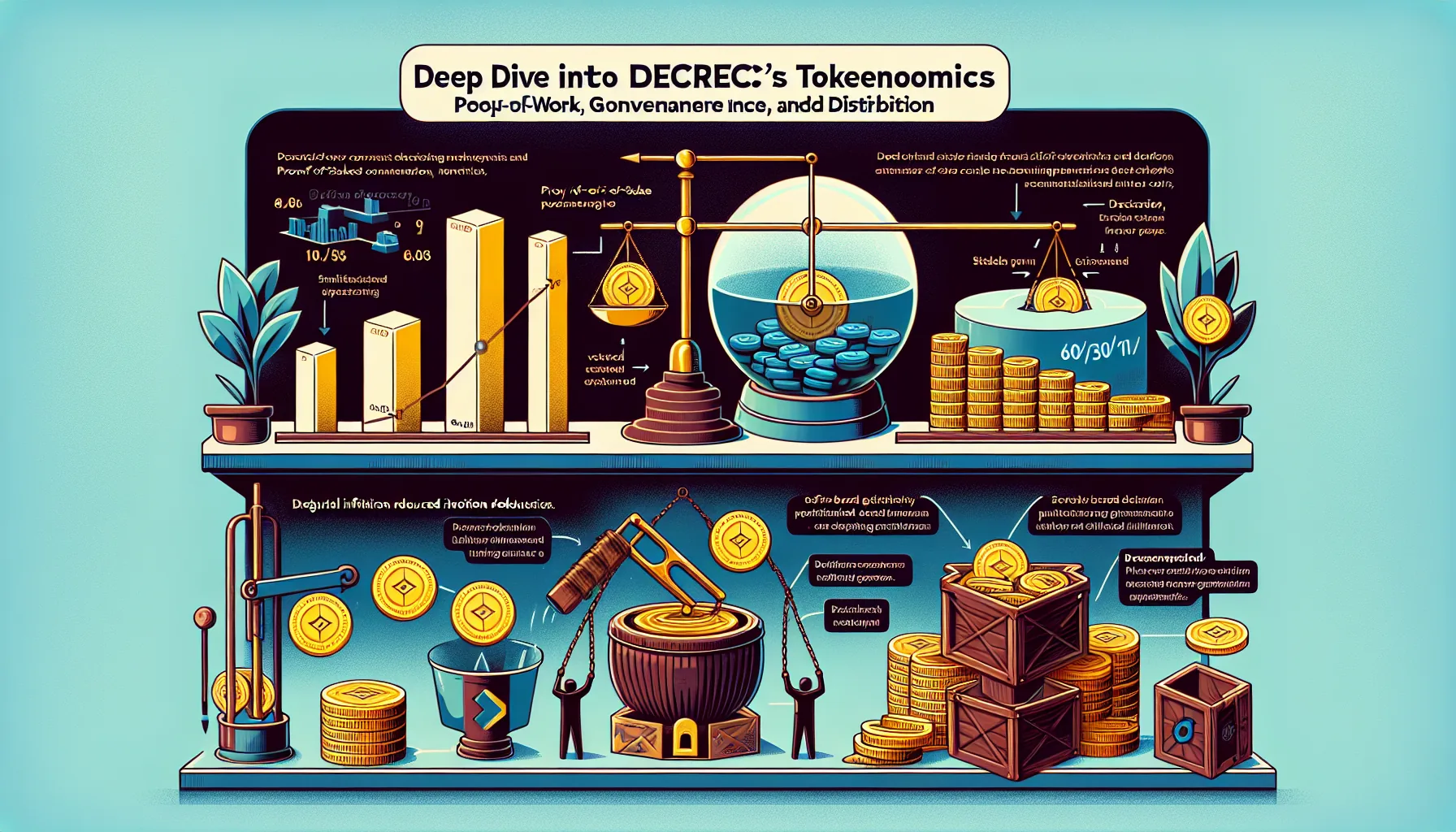
Deep Dive into Decred (DCR) Tokenomics: Supply, Governance, and Distribution
Decred (DCR) implements a hybrid Proof-of-Work (PoW) and Proof-of-Stake (PoS) consensus mechanism, which directly influences its tokenomics by integrating miners, stakers, and the development team into its reward distribution model. The allocation of newly minted DCR is pivotal to understanding its tokenomics: 60% is directed to PoW miners, 30% to PoS stakers, and 10% to the project’s treasury. This structured split ensures that all key stakeholders are incentivized but comes with unique implications.
Fixed Max Supply and Inflation
DCR has a capped maximum supply of 21 million coins, aligning with a deflationary monetary policy similar to Bitcoin. However, DCR differs in its block subsidy reduction mechanism. Instead of fixed halving events, the block reward undergoes a continuous and gradual reduction by a factor of 100/101 approximately every 12 months. This slow tapering of inflation is designed to counter the disincentives associated with sharp halving shocks but raises questions about its efficacy in maintaining long-term miner profitability.
Governance Through Ticket Staking
A cornerstone of DCR tokenomics is its ticket-based staking system. Users participate in governance by locking DCR to purchase tickets, which are placed into a lottery for voting on proposed changes and fund allocation from the treasury. The ticket price dynamically adjusts according to supply and demand, which can lead to accessibility challenges during periods of high network activity. While this model enhances decentralization and community input, the capital-intensive nature of repeated ticket purchases may discourage smaller holders from participating meaningfully.
Treasury-Funded Development
The self-funding treasury bolstered by the 10% block reward allocation is a distinguishing feature of Decred’s tokenomics. Unlike projects dependent on external funding, this mechanism aims to ensure sustainable development. However, the centralized control over treasury spending by a relatively small voting population of ticket holders raises concerns about potential plutocracy in decision-making. The reliance on DCR holders with significant resources may impact the diversity of perspectives in governance.
Liquidity and Distribution Issues
Despite its innovative model, liquidity can be a concern for DCR due to its hybrid consensus requiring staking to maintain network security. A significant percentage of the circulating supply remains locked in staking, reducing the availability of DCR for trading and potentially contributing to bouts of illiquidity. Additionally, early adopters and developers who accumulated DCR in the project's initial phases may hold concentrated stakes, which could influence market dynamics and governance outcomes over time.
Decred’s tokenomics design balances rewards, governance, and funding mechanisms while presenting challenges in adoption and participation equity. Understanding these nuances is crucial for assessing DCR’s role within the broader crypto ecosystem.
DCR Governance
Governance in Decred (DCR): A Deep Dive into On-Chain Decision-Making
Decred (DCR) stands out in the blockchain space due to its hybrid model of governance. Combining Proof-of-Work (PoW) and Proof-of-Stake (PoS), Decred uses a system designed to balance miner influence with stakeholder power. This governance structure is a central feature of the project, offering unique advantages—yet it also comes with its own set of complexities and potential limitations.
Ticket-Based Voting System
At the core of Decred's on-chain governance is its "ticket" system. Stakeholders lock their DCR to purchase tickets, which are randomly selected to vote on network proposals and to validate mined blocks. This ticket structure is intended to ensure fairness, as all participants, regardless of initial DCR holdings, have an opportunity to engage in decision-making. However, the ticket price, which adjusts dynamically, can inadvertently create a barrier to entry for smaller stakeholders. As the protocol grows, this dynamic may centralize governance, as fewer participants can afford consistent ticket purchases.
Politeia: A Proposal Platform
Politeia, Decred’s off-chain, public proposal system, further adds dimensions to governance. It allows community members to submit, discuss, and vote on funding proposals for ecosystem development. While decentralized and transparent, Politeia has faced criticism regarding participation. Larger and more organized stakeholders often dominate discussions, potentially discouraging individual contributors or less influential voices. Additionally, the accessibility of Politeia is still dependent on users being familiar with its technical nuances, leaving less savvy participants at a disadvantage.
Stakeholder Prioritization Over Miners
Decred’s hybrid PoW/PoS model lends considerable weight to stakeholders in governance decisions, counterbalancing miner influence. Though designed to prevent miner centralization and attacks, this model has raised concerns about whether it could marginalize the operational role of miners entirely. As more participants lean toward staking instead of mining, PoW’s contribution to securing the network might weaken over time, which could pose risks unless carefully managed.
Enforced Consensus Rule Changes
Unlike many other blockchains, Decred mandates stakeholder approval for every consensus rule change. This minimizes the likelihood of controversial hard forks but introduces friction in adapting to rapidly evolving blockchain challenges. Some critics argue that this mechanism could slow down innovation, as achieving majority buy-in may require significant time and resource commitments from developers and community advocates.
Security vs. Accessibility
While the governance mechanism is highly secure and resistant to hostile takeovers, it unintentionally leans toward higher participation costs for meaningful input. Long-term implications for inclusivity and decentralization remain key areas of discussion within the community.
Technical future of DCR
Decred (DCR): Current and Future Technical Developments
Decred (DCR) is a hybrid proof-of-work (PoW) and proof-of-stake (PoS) cryptocurrency that has consistently evolved its technical framework to address scalability, governance, and decentralization challenges. The project maintains a strong focus on self-sovereignty and sustainable development, with several advancements and updates shaping its technical trajectory.
Enhanced Privacy Features Through CoinShuffle++
Decred has implemented the CoinShuffle++ protocol to enable privacy-focused transactions. This decentralized mixing approach is integrated into the consensus mechanism, allowing users to enhance the anonymity of their funds without relying on external tools or service providers. However, the privacy layer has faced criticism for requiring manual interaction and lacking the same degree of automation or seamless integration seen in protocols like Monero’s ring signatures or Zcash’s zk-SNARKs.
Development of Decentralized Treasury
One of Decred's standout features is its decentralized treasury system, which is funded through a portion of block rewards and controlled exclusively by stakeholders via on-chain voting. Updates to ensure transparency and prevent misuse of treasury funds are a constant focus. Future developments aim to improve treasury governance efficiency, but challenges persist, such as maintaining voter engagement and avoiding centralization in decision-making.
Lightning Network Integration
To address scalability, Decred has been working toward implementing the Lightning Network for instant, low-cost, and off-chain transactions. While its hybrid consensus adds complexity to Lightning Network adoption compared to PoW-exclusive networks like Bitcoin, Decred developers are making progress by tailoring the system to integrate smoothly into its existing architecture. However, broader adoption of this layer-2 solution may depend on the community's willingness to transition to and use such technology.
Stakeholder-Directed Consensus Changes
Decred's Politeia governance system has been instrumental in enabling stakeholders to propose, discuss, and vote on protocol changes. Politeia has seen iterative refinements to boost usability and security while reducing spam. Nonetheless, governance remains a challenge. Coordinating large-scale upgrades, such as potential changes to the hybrid consensus structure, often takes time, as it requires significant community agreement and technical implementation effort.
On-Chain Decentralized Exchange Development
Decred is actively developing its own decentralized exchange (DEX), DCRDEX, to facilitate trustless trading between cryptocurrencies. It eliminates intermediaries and prioritizes user sovereignty over funds. While DCRDEX offers critical advantages like no trading fees and atomic swaps, the user base remains comparatively limited, which could hinder its long-term adoption and scalability as a competitive trading platform.
Future Roadmap Ambitions
Future technical developments for Decred revolve around improving staking participation through enhanced PoS tooling, refining the hybrid consensus model, and potentially exploring interoperability with external blockchain ecosystems. However, technical complexity and a relatively smaller developer community compared to larger projects could pose scalability and resource challenges in achieving these goals.
Comparing DCR to it’s rivals
Comparing Decred (DCR) to Monero (XMR): A Deep Dive into Governance and Privacy
When evaluating Decred (DCR) against Monero (XMR), the contrast largely revolves around governance structures and privacy-centric features, two critical aspects for decentralized networks. Both projects target distinct niches within the blockchain landscape, yet their design decisions offer insights into their competitive positioning.
Governance: On-Chain vs. Off-Chain Decision-Making
Decred’s primary differentiator is its innovative on-chain governance system, anchored by a hybrid Proof-of-Work (PoW) and Proof-of-Stake (PoS) consensus mechanism. Stakeholders actively participate in decision-making via the Politeia proposal system, ensuring transparency and mitigating centralized control. This setup aims to prevent dominant mining pools or single entities from overtaking the network’s future development. However, some critics argue that this system remains vulnerable to voter apathy, as a significant percentage of stakeholders consistently abstain from voting, potentially skewing governance outcomes.
In contrast, Monero maintains an off-chain governance approach—largely informal and reliant on community consensus and core development teams. While this offers Monero flexibility and adaptability, the lack of formalized decision-making processes can sometimes lead to slower updates and disputes over project direction. For those seeking a structured governance framework, Decred has an edge here, but for others, Monero’s decentralized ethos may feel more aligned with Bitcoin’s original vision of community-driven decision-making.
Privacy: Optional vs. Default
Privacy is another defining divergence. Monero is synonymous with privacy, leveraging advanced cryptographic techniques like ring signatures, stealth addresses, and confidential transactions to ensure every transaction is untraceable and unlinked by default. For privacy maximalists, this default approach provides a consistent shield against blockchain analysis but has also invited regulatory scrutiny in some jurisdictions.
Decred, on the other hand, incorporates privacy as an optional feature built on CoinShuffle++—a solution that mixes transactions to obscure their origins and destinations. Unlike Monero, which embeds privacy at its core, Decred’s privacy model allows users to toggle between transparent and private transactions. While this flexibility can appeal to users who prefer an opt-in system, it leaves Decred at a disadvantage when measured against Monero’s hardened privacy guarantees. Additionally, Decred’s optional privacy implementation raises the question of whether its mixed-use case could make it less resilient against adversarial analysis over time.
Network Philosophy
Finally, it’s worth noting the philosophical split between systems like Decred, which emphasize self-funding (treasury-backed development) and formal governance, versus Monero, which thrives on its community-oriented, privacy-first goals. This foundational difference shapes not only their technical implementations but also their respective user bases.
Decred (DCR) vs Dash (DASH): A Technical and Governance Comparison
When comparing Decred (DCR) to Dash (DASH), one of the most striking points of divergence lies in their approaches to governance and incentivization. Both projects aim to improve upon Bitcoin’s foundational framework, but their methods are fundamentally different, influencing how upgrades are implemented and how community participation is driven.
Governance: On-Chain vs Masternodes
Decred employs a hybrid Proof-of-Work (PoW) and Proof-of-Stake (PoS) consensus mechanism with on-chain governance at its core. Stakeholders vote directly on proposals and consensus changes, ensuring that decisions are transparent and decentralized. This system provides an immutable record of governance activity and avoids the centralization risks that arise when decision-making power is limited to a specific subset of participants.
Dash, in contrast, uses a two-tier network. While anyone can mine Dash or run a full node, its governance is primarily driven by its masternode system. Only masternode operators—those who hold and lock 1,000 DASH—can vote on budget proposals and network decisions. While this design promotes efficiency and incentivizes masternode operators with a share of block rewards, it has drawn criticism for leaning towards wealth centralization. Those with sufficient capital to operate masternodes effectively hold most of the decision-making power, which could alienate smaller holders and limit broader community engagement in governance matters.
Privacy Features: Limited Scope
Unlike DCR, which focuses heavily on governance and scalability, Dash integrates optional privacy features through its PrivateSend functionality. PrivateSend is a coin-mixing service that obfuscates transaction details, enhancing privacy but not achieving the same level of anonymity as other privacy-focused competitors. Users must trust masternodes to process these transactions, which introduces an additional layer of reliance on a subset of the network. Critics have pointed out that this may be less secure compared to fully decentralized privacy solutions. Decred does not currently offer native privacy features, making this a point of differentiation depending on user needs.
Incentives and Decentralization
Another critical difference is how block rewards are distributed. Dash divides rewards among miners, masternode operators, and its treasury fund. While this incentivizes multiple layers of participation, it also concentrates rewards in the hands of masternode operators. Decred’s design splits block rewards among PoW miners, PoS stakeholders, and a treasury fund, with a greater emphasis on ensuring equal representation for stakeholders who participate in governance. This balance may better align incentives across the board but introduces added complexity in maintaining hybrid consensus.
Network Centralization Challenges
A contentious aspect of Dash’s architecture is its reliance on masternodes. Critics argue that the high collateral requirement creates an economic barrier that consolidates decision-making among wealthier participants, potentially resulting in governance decisions that benefit masternode operators at the expense of everyday users. In comparison, Decred’s focus on stakeholder voting enables broader participation, but the ticket-based PoS mechanism still requires users to lock a portion of their holdings, which could be a deterrent for smaller players.
Comparing Decred (DCR) to Zcash (ZEC): Privacy and Governance in Focus
When analyzing Decred (DCR) in the context of Zcash (ZEC), one of the most critical aspects to evaluate is their differing approaches to privacy and governance—two areas where they diverge significantly, catering to distinct user preferences and use cases within the crypto landscape.
Privacy Mechanisms: Opt-In vs. Default
Zcash, as a privacy-focused cryptocurrency, emphasizes optional privacy through its use of zero-knowledge proofs (zk-SNARKs). This cryptographic method allows users to conduct shielded transactions, hiding both the details of the sender, receiver, and transaction amount. The flexibility of Zcash's “opt-in” privacy can be seen as both a strength and a drawback. On the one hand, it allows users to choose between transparent or shielded transactions, making it easier to interact with regulated exchanges and maintain compliance. However, the default transparency of transactions has been a point of criticism within privacy-centric circles, as it leads to relatively low adoption of shielded transactions in practice, undercutting Zcash's purported privacy benefits.
Decred, on the other hand, does not use zk-SNARKs but incorporates privacy as an integrated feature through its implementation of CoinShuffle++, an improvement on the CoinJoin protocol. While CoinShuffle++ ensures a level of transactional privacy by obscuring inputs and outputs, it is inherently less robust than Zcash's zk-SNARKs in terms of cryptographic guarantees. This trade-off places Decred in a middle ground, offering some privacy benefits without making it the platform’s primary focus.
Governance and Community Decision-Making
Decred’s standout feature lies in its hybrid Proof-of-Work/Proof-of-Stake (PoW/PoS) governance system, which enables token holders to participate directly in voting on protocol changes. This setup fosters long-term alignment between network participants and ensures that development remains community-driven. Decred’s decentralized treasury further enhances this model by funding projects approved via stakeholder consensus.
In contrast, Zcash’s governance incorporates a more centralized structure due to its reliance on the Electric Coin Company (ECC) and the Zcash Foundation. While recent governance frameworks, such as the establishment of the Major Grants Review Committee, signal efforts toward increased decentralization, the Zcash ecosystem remains heavily influenced by these central entities. Critics argue that this degree of centralization poses risks to the network, particularly in scenarios where there may be competing interests or diverging priorities.
Operational Factors
While Zcash relies on zk-SNARKs for privacy, the cryptographic complexity of this technology leads to higher computational requirements. This issue often translates into usability challenges for non-technical users, particularly in creating shielded transactions. Decred’s approach, while less privacy-focused, does not impose such significant technical burdens on its user base, contributing to easier adoption but at the expense of comprehensive privacy guarantees.
Key differences between the two extend to their mining ecosystems as well. Decred’s PoW/PoS hybrid model helps mitigate centralization by disincentivizing miner dominance. Zcash, operating solely on Proof-of-Work (PoW), risks susceptibility to the same mining centralization concerns that affect other PoW chains.
In summary, while Zcash and Decred both aim to address critical issues within the blockchain space, they do so with contrasting priorities. The trade-offs between their approaches to privacy, governance, and usability highlight how differently the two projects align with user values and technical preferences.
Primary criticisms of DCR
Primary Criticisms of Decred (DCR)
Governance Power Concentration
One recurring criticism of Decred (DCR) stems from its hybrid Proof-of-Work (PoW) and Proof-of-Stake (PoS) consensus model, which is designed to balance miner and stakeholder input. However, skeptics argue that this approach may inadvertently centralize governance power in the hands of large stakeholders. In its PoS system, voting rights are tied to ticket ownership, meaning that users with significant DCR holdings and ticket purchasing capabilities ultimately wield greater influence over decision-making. For smaller participants or those priced out of acquiring large numbers of tickets, the model can feel exclusionary, leading to debates about whether Decred's governance is truly as decentralized as it claims.
Barriers to Participation
Another point of contention relates to the practical barriers for entry into Decred’s staking process. The ticket-based PoS design, which requires users to lock DCR as collateral to participate in governance and earn staking rewards, can disadvantage those with limited capital. Ticket prices, which are determined algorithmically, can fluctuate widely and make participation cost-prohibitive for smaller investors. Additionally, the need for technical know-how to navigate staking wallets and manage tickets further narrows accessibility, potentially alienating a portion of the crypto community who might otherwise contribute to the ecosystem.
Concerns Around Politeia and Proposal Vetting
Decred’s Politeia platform, intended to facilitate decentralized governance and funding proposals, has not been immune to criticism either. Detractors argue that Politeia’s design, while innovative, still relies heavily on subjective human judgment during the proposal vetting process. Questions have been raised about whether proposals can be unfairly dismissed or whether the system inadvertently introduces gatekeeping dynamics. Adding to this is the challenge of ensuring that funded projects truly deliver long-term value to the network, as there is no mechanism to guarantee accountability beyond community oversight.
Miner and Stakeholder Incentive Alignment
A broader criticism revolves around the alignment between Decred’s hybrid PoW and PoS incentive structures. By design, the block reward is split between miners, stakers, and the treasury. Opponents of this structure argue that dividing the reward dilutes miners’ incentive to secure the network, particularly since staking offers substantially higher economic returns in practice. This has led to concerns that the PoW component of the network could become less secure over time if miners lose motivation, potentially exposing Decred to vulnerabilities.
Low Transaction Throughput
While Decred excels in incorporating advanced features like on-chain governance and atomic swaps, critics often highlight its relatively low transaction throughput. Despite scalability efforts, such as the integration of the Lightning Network, the base layer performance is still seen as lagging when compared to other high-throughput blockchains. This reduced scalability can make Decred less appealing for use cases that demand high-speed transactions, such as micro-payments or high-frequency trading, further limiting its adoption beyond niche use cases.
Founders
The Founding Team Behind Decred (DCR)
Decred (DCR) was developed with a focus on building a truly decentralized cryptocurrency, both in its governance model and its community-driven approach. The project was officially launched in 2016 by a team led by the company behind its development, Company 0 (C0). The primary figure associated with Decred’s inception is Jake Yocom-Piatt, a prominent developer and open-source advocate with extensive experience in cryptocurrencies. Yocom-Piatt’s early contributions to the Bitcoin space, including work on btcsuite—a popular Bitcoin implementation in Go—laid important groundwork for Decred’s own technical infrastructure.
Another key contributor to Decred's development was Marco Peereboom, a technologist with a strong background in security, software engineering, and scalable system design. Peereboom was instrumental in developing the core architecture of Decred and its focus on implementing a hybrid Proof-of-Work (PoW) and Proof-of-Stake (PoS) consensus mechanism. His expertise in cryptography and system design gave the project its robust security foundation.
A unique aspect of Decred’s founding team was its deliberate decision to eschew traditional venture capital funding and initial coin offerings (ICOs), which sets it apart from many other blockchain projects. Instead, Decred allocated a small premine of 8% of its total supply, distributed between funding development efforts and compensating its early contributors. This decision attracted some criticism within the crypto community, as premines are often viewed skeptically due to potential centralization risks. However, the founding team defended their approach by emphasizing the absence of external interference or investor-driven decision-making during the early stages of the project.
Decred’s emphasis on decentralization is apparent in its deliberate transition of developmental oversight from Company 0 to the project’s stakeholder community. While this was a natural evolution in line with Decred’s ethos, some critics have argued that Company 0 had an outsized influence during the project's formative period. This raises questions for some skeptics about whether true decentralization was fully intact at the outset. Additionally, like many crypto projects, some observers have debated whether there was an over-reliance on a handful of individuals in the early years, raising concerns about key-person risk in Decred’s initial phase.
While the founding team’s strong technical background and transparent approach have provided a solid foundation for Decred, navigating perceptions of early centralization and ensuring leadership turnover remain ongoing challenges for the project’s image.
Authors comments
This document was made by www.BestDapps.com
Sources
- https://decred.org/
- https://docs.decred.org/research/overview/
- https://decred.org/research/
- https://github.com/decred/dcrd
- https://docs.decred.org/governance/politeia/
- https://decred.org/white-paper/
- https://docs.decred.org/research/consensus-overview/
- https://github.com/decred/dcrdocs
- https://blockcommons.red/papers/decred_yellowpaper.pdf
- https://docs.decred.org/how-it-works/overview/
- https://github.com/decred/politeia
- https://docs.decred.org/getting-started/what-is-decred/
- https://explorer.dcrdata.org/
- https://github.com/decred/dcrwallet
- https://medium.com/@decred
- https://decred.org/research-resources/
- https://stake.decred.org/
- https://github.com/decred/decrediton
- https://docs.decred.org/deployment-guide/
- https://dcrcompass.com/