History of DASH
The History of Dash: From XCoin to Digital Cash
Dash was launched on January 18, 2014, by Evan Duffield under the original name XCoin (XCO). It was quickly rebranded to Darkcoin within its first month, emphasizing privacy-focused features that differentiated it from Bitcoin. However, concerns over its association with darknet markets led to another rebranding in 2015, when it became Dash, a blend of "Digital Cash."
Instamine Controversy and Early Challenges
Within Dash's first 48 hours, approximately 1.9 million DASH—roughly 10% of the total supply—were mined due to a difficulty adjustment bug. While some viewed this as an accident, critics speculated whether it was an intentional instamine. The project opted not to reset the chain, instead allowing early adopters to retain their coins. This incident remains a controversial part of Dash’s history, with detractors citing it as evidence of unfair initial distribution.
Masternodes and the Two-Tier Network
One of Dash’s most significant innovations was the introduction of the masternode system in 2014. Unlike Bitcoin’s purely miner-based validation, Dash implemented a two-tier network, where masternodes handle services like InstantSend, CoinJoin (formerly PrivateSend), and governance. Users needed 1,000 DASH to operate a masternode, which led to a concentrated group of network participants wielding governance power.
DAO and Self-Funded Development
Dash pioneered one of the first Decentralized Autonomous Organizations (DAOs) by allocating a portion of its block rewards to fund protocol development. This mechanism allowed Dash’s ecosystem to sustain itself without relying on external donations or ICO fundraising, a model later adopted by other projects. However, critics argue that the treasury system often funds projects with limited ROI and that decision-making power is still concentrated among masternode holders.
Regulatory Issues and Declining Adoption
Due to its history with privacy-enhancing features, Dash has faced regulatory scrutiny in certain jurisdictions. Although DashCore Group has publicly distanced itself from the "privacy coin" label, some exchanges have delisted Dash, citing compliance concerns. Meanwhile, its adoption as digital cash saw early success in regions like Venezuela, but merchant usage and network activity have struggled to maintain long-term growth against competitors and changing market dynamics.
Evolution and Technical Upgrades
Dash has continued technical development, including long-living masternode quorums (LLMQs) and ongoing improvements to its layer-2 solution Dash Platform. However, despite its early innovations, Dash has faced increasing competition from more scalable and feature-rich blockchain networks, leading to debates within the community about its future direction.
How DASH Works
How Dash Works: Masternodes, PrivateSend, and InstantSend
Dash operates on a hybrid architecture that combines traditional proof-of-work (PoW) mining with a second-layer network of masternodes. This structure enables key features such as PrivateSend, InstantSend, and the Dash governance system.
Masternodes: A Second Layer Network
Unlike Bitcoin, which relies solely on miners for transaction validation and network security, Dash introduces masternodes. These are specialized full nodes that require a collateral of 1,000 DASH to operate. In return, masternodes receive a portion of block rewards and provide additional network functions.
Masternodes enable Dash’s InstantSend and PrivateSend features while also facilitating its governance model. However, this system creates centralization concerns, as running a masternode requires significant financial investment, limiting participation to wealthier users. Additionally, the requirement to lock up 1,000 DASH reduces liquidity.
PrivateSend: Coin Mixing for Enhanced Privacy
PrivateSend is Dash’s privacy feature, which operates using CoinJoin to mix transactions. This process obscures transaction history by combining multiple users’ funds before broadcasting transactions to the network. While this improves fungibility, it does not provide the same level of privacy as zero-knowledge proofs or ring signatures used by other privacy-focused cryptocurrencies.
PrivateSend requires masternodes to facilitate mixing sessions, introducing potential centralization risks. While masternodes do not have direct visibility into transaction details, external analysis could de-anonymize users, particularly with insufficient mixing rounds. Some exchanges have also flagged Dash due to this feature, limiting its accessibility in certain jurisdictions.
InstantSend: Fast Transactions with Masternode Verification
InstantSend utilizes masternodes to lock transaction inputs, preventing double-spending before miners confirm transactions on the blockchain. This allows transactions to be considered final in seconds rather than waiting for multiple confirmations in a traditional PoW system.
While InstantSend significantly improves transaction speed, it relies on masternodes to validate and lock funds, introducing trust assumptions not present in purely PoW-based systems. If masternodes were to act maliciously, they could theoretically disrupt the effectiveness of InstantSend.
Governance and Funding Model
Dash employs a decentralized autonomous organization (DAO) where masternodes vote on budget proposals. A percentage of block rewards funds community projects, development, and marketing efforts. However, this model concentrates decision-making power among masternode holders, leading to concerns about governance centralization and potential conflicts of interest.
Use Cases
Use Cases of DASH: Payments, Privacy, and Governance
Instant and Low-Cost Transactions
DASH is widely used as a payment solution due to its InstantSend feature, which enables rapid transaction confirmations. Unlike Bitcoin, where blocks are mined roughly every 10 minutes, DASH leverages its masternode network to lock inputs and ensure transactions are finalized within seconds. This makes DASH particularly suitable for point-of-sale purchases, online transactions, and remittance services.
Another advantage is its relatively low transaction fees compared to other blockchain networks. While network congestion can cause fees to rise, DASH’s structure generally keeps costs predictable and competitive, which has made it attractive for merchants, especially in regions with limited access to traditional banking services.
Privacy Transactions with CoinJoin
DASH offers an optional privacy feature known as CoinJoin. This built-in functionality allows users to mix their transactions with others, making it harder to trace the origin and destination of funds. Unlike Monero’s default privacy or Zcash’s shielded transactions, DASH’s CoinJoin is opt-in, which means users must manually engage in the mixing process.
However, it is not a foolproof privacy solution. Since CoinJoin operates at the software level rather than the protocol level, chain analysis firms and regulators have explored methods to track DASH transactions regardless. This has resulted in some exchanges delisting or restricting DASH due to concerns over compliance with Anti-Money Laundering (AML) regulations.
Decentralized Governance and Treasury System
DASH is one of the few blockchain networks with a decentralized autonomous organization (DAO). A portion of the block reward funds a treasury that supports ecosystem development. DASH masternode operators vote on budget proposals, allowing for a structured approach to funding technical improvements, marketing initiatives, and business partnerships.
While this system provides sustainability, it has faced governance challenges. Masternodes require a significant stake in DASH to participate, creating concerns about centralization since wealthier entities can exert greater influence over proposals. Additionally, abandoned or inefficient projects funded by the treasury system have raised questions about the efficiency of the governance model.
DASH in the Broader Crypto Ecosystem
DASH’s use as digital cash has led to adoption in both legal and gray-market economies. Some jurisdictions have embraced it for everyday transactions, while others have scrutinized its privacy features or restricted access due to regulatory concerns. As a result, despite its technical advantages, DASH faces both adoption opportunities and limitations depending on geographic and regulatory environments.
DASH Tokenomics
DASH Tokenomics: Supply, Emission, and Incentive Structure
Fixed Supply and Inflation Mechanism
DASH has a hard-capped total supply of 18.9 million coins, utilizing a gradual emission model to manage inflation. The protocol reduces block rewards by 7.14% every 210,240 blocks (~every year), creating a predictable supply schedule. Unlike Bitcoin's hard-coded halving every four years, this smoother reduction prevents abrupt supply shocks.
Block Rewards and Distribution
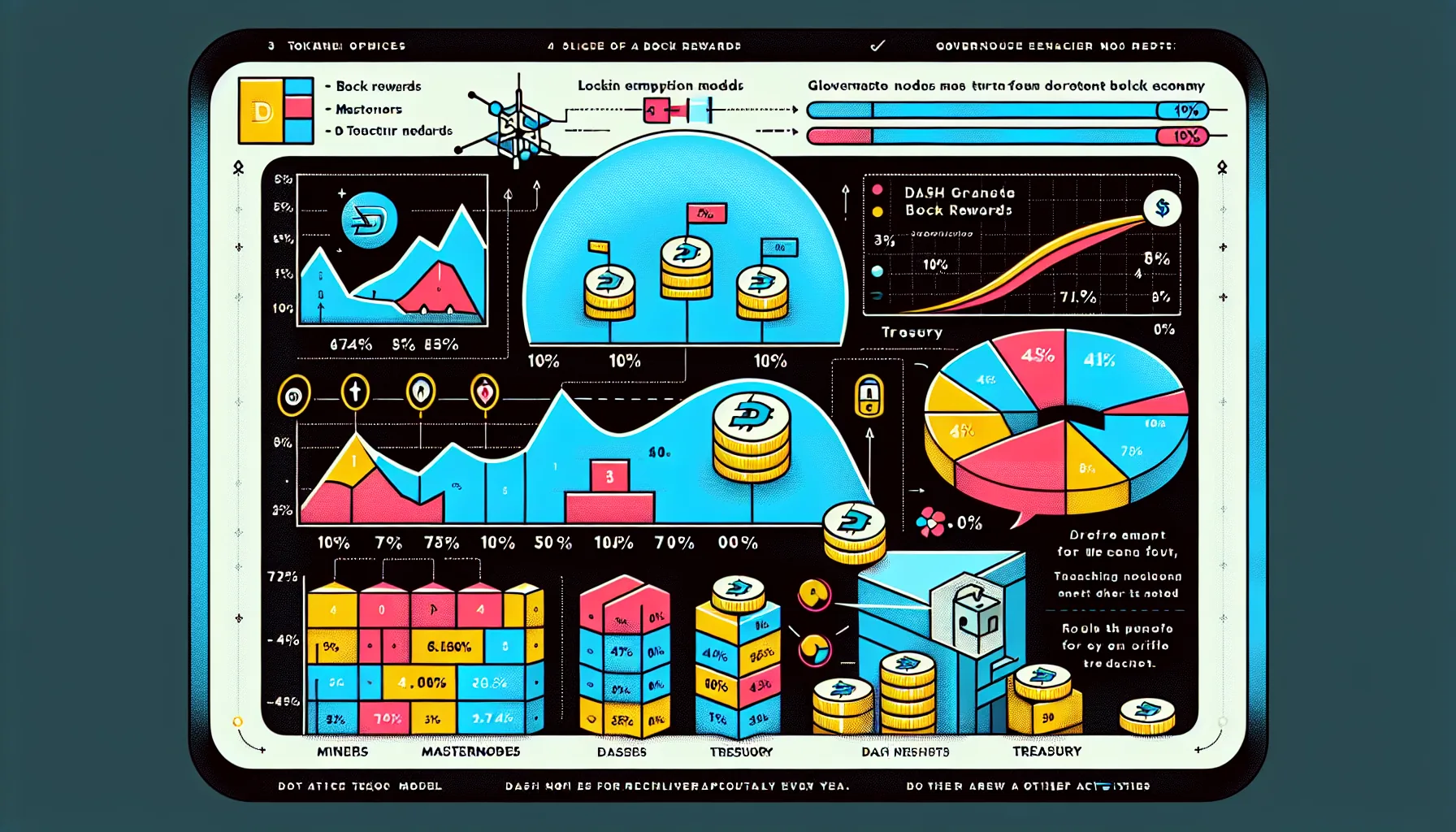
Each block reward is distributed among three stakeholders:
- Miners (45%) – Secure the network through Proof of Work (PoW), using the X11 hashing algorithm.
- Masternodes (45%) – Provide services such as InstantSend, CoinJoin, and governance decisions.
- Treasury (10%) – Funds development and ecosystem growth, based on governance votes.
Unlike most PoW-based networks, DASH relies less on pure mining incentives. Instead, its masternode system locks supply in collateralized nodes, reducing active circulation and increasing scarcity. However, this structure has led to centralization concerns, as maintaining a masternode requires 1,000 DASH, which can be a high barrier to entry.
Masternode Economics and Yield
Masternode operators receive a share of block rewards in exchange for providing network stability and key services. The return on investment (ROI) for running a masternode fluctuates based on:
- Total masternode count – More nodes dilute individual rewards.
- Block reward reductions – Lower emissions affect long-term profitability.
- Price volatility – Although not the main factor in tokenomics, price affects the real-world yield of rewards.
Since masternodes require DASH collateral, the system theoretically restricts available circulating supply. However, various services allow shared masternodes, reducing the economic barrier but increasing centralization risks.
Governance Funding and Treasury Model
The 10% treasury allocation funds development, marketing, and ecosystem improvements through a decentralized autonomous organization (DAO). Proposals are submitted and voted on by masternodes, with approved allocations distributed every superblock. This mechanism ensures ongoing funding for network improvements but has been criticized for favoring large stakeholders, as smaller holders lack direct influence.
Circulating Supply vs. Locked Supply
A significant portion of DASH remains locked in masternodes, affecting liquidity and trading dynamics. While this structure provides network security and service reliability, it also decreases on-chain transaction activity compared to other cryptocurrencies with a more fluid supply model.
Additionally, merchant adoption strategies and private transaction features like CoinJoin further impact supply dynamics, as users may lock or mix DASH for privacy, delaying its re-entry into circulating supply.
DASH Governance
Dash Governance: A Decentralized Decision-Making Model
Dash employs a decentralized governance model through a Decentralized Autonomous Organization (DAO), enabling network participants to influence protocol development and funding decisions. Unlike traditional blockchain governance that relies solely on miners or stakeholders, Dash leverages its Masternode system, which plays a critical role in decision-making.
Masternodes and Proposal Voting
To operate a Masternode, participants must hold and lock a set amount of DASH as collateral. This staking mechanism ensures that those involved in governance have a vested interest in the network’s long-term viability. These Masternodes are responsible for voting on budget proposals and protocol upgrades, determining how treasury funds are allocated.
Any participant can submit a proposal for funding, which typically involves network improvements, marketing, or infrastructure enhancements. Masternodes then vote on these proposals, and those meeting the required quorum with a majority of "yes" votes receive funding from the Dash Treasury, which is funded through a portion of block rewards.
Funding Allocations and Treasury Model
Dash's self-funding mechanism sets it apart from many other crypto projects that rely on external fundraising. The Dash Treasury receives a percentage of the block rewards, enabling continued development and ecosystem growth without dependence on external investors. However, while this model fosters autonomy, it also introduces risks such as inefficient fund allocation if the community fails to prioritize high-impact initiatives.
Since Masternode operators are economically vested actors, there is a risk of centralized influence, where large-scale Masternode operators may dominate governance decisions. This concern is heightened by the high entry barrier to operating a Masternode, potentially limiting broader community participation.
Challenges and Governance Controversies
While Dash's governance system is designed to be efficient and decentralized, it is not without criticism. The concentration of Masternodes among a limited number of operators can lead to potential centralization risks. Additionally, proposal approvals are not always aligned with the broader network consensus, leading to contentious funding decisions that may not reflect the entire community's interests.
Another challenge is low voter participation, as not all Masternodes actively engage in decision-making. This can result in a small subset of Masternodes shaping the network's direction, which may not always be in line with decentralization principles.
Dash's governance model remains one of the most structured DAO frameworks in the cryptocurrency space, but its effectiveness heavily depends on active Masternode participation and responsible treasury management.
Technical future of DASH
Dash Technical Developments and Future Roadmap
Evolution of ChainLock and InstantSend Mechanisms
Dash continues to refine its ChainLock technology, which enhances network security against 51% attacks by leveraging long-living masternode quorums (LLMQs). Enhancements to ChainLocks seek to reduce false positives and improve efficiency in block finalization. Similarly, InstantSend—Dash’s transaction-locking mechanism—is undergoing optimizations to further lower confirmation latency while addressing scalability concerns that emerge with increased network usage.
Dash Platform and Decentralized API (DAPI)
Dash Platform is positioning itself as a core component of future adoption. It integrates decentralized data storage and a service layer via Dash Drive, which enables users and developers to store and query application data on-chain. The core component facilitating this is the Decentralized API (DAPI), allowing external applications to interact with the Dash network without requiring direct blockchain synchronization. A primary challenge remains optimizing data retrieval and maintaining efficiency in a permissionless environment.
Evolution of DashPay and Wallet Enhancements
DashPay, a decentralized username-based payment solution, is receiving upgrades aimed at improving user experience and reducing reliance on alphanumeric wallet addresses. The implementation of human-readable usernames through blockchain identity handling adds usability but also requires additional consensus mechanisms to ensure security. Compatibility across third-party wallets and non-native integrations remains a complex issue.
Masternode Network Enhancements
Masternodes serve as the backbone for Dash’s governance and layer-two processing functions. Refinements in masternode consensus algorithms focus on efficiency improvements and reducing collateral requirements without weakening sybil attack resistance. Upcoming governance updates aim to enhance treasury fund allocation and voting mechanisms, yet balancing decentralization with governance effectiveness remains a key challenge.
Layer-Two Scaling and Privacy Enhancements
Dash’s PrivateSend mechanic is being reevaluated for improved throughput and privacy guarantees, potentially integrating newer cryptographic techniques like zero-knowledge proofs to refine transaction obfuscation. A major tradeoff in these enhancements is ensuring robustness while maintaining reasonable fees. Parallel to privacy-focused developments, proposals for off-chain scaling solutions, such as payment channels or optimized LLMQ-based transactions, are also under exploration.
Ongoing Security and Network Stability Challenges
The focus on masternodes as a core network component introduces concerns around centralization risks, with a significant portion of masternodes operated within concentrated hosting environments. Additionally, maintaining high uptime without introducing excessive hardware demands requires continuous refinement in node incentivization structures.
Development Roadmap and Potential Bottlenecks
With ongoing work on Dash Platform and the gradual shift towards a decentralized application ecosystem, testing and deployment delays remain a recurring challenge. Ensuring backward compatibility while introducing new functionality, particularly within governance upgrades, continues to be a significant hurdle. The long-term success of these technical advancements depends on both community adoption and external infrastructure readiness.
Comparing DASH to it’s rivals
Dash vs Monero: Privacy, Speed, and Adoption
When comparing Dash (DASH) to Monero (XMR), the core distinction lies in their approach to privacy and transaction efficiency. Both coins aim to improve upon Bitcoin’s (BTC) limitations, but they do so with different priorities and trade-offs.
Privacy: Optional vs Default Anonymity
Dash employs PrivateSend, a CoinJoin-based methodology that mixes transactions to obscure sender and receiver details. However, it remains an optional feature, meaning not all transactions on the Dash network are private. This gives users flexibility but also creates traceability concerns for non-mixed transactions. Analytics firms can often track Dash transactions when PrivateSend is not enabled.
Monero, by contrast, enforces default privacy via RingCT, stealth addresses, and ring signatures. Every transaction is automatically obfuscated, preventing blockchain analysis from revealing amounts or participant addresses. This makes XMR a stronger choice for those prioritizing full anonymity. However, it also raises regulatory concerns, with exchanges frequently delisting Monero due to compliance risks, something Dash largely avoids by offering optional privacy.
Transaction Speed and Fees
Dash utilizes its InstantSend feature, which allows for near-instant finality by leveraging its masternode network. The masternodes verify transactions quickly, reducing confirmation times compared to traditional Proof-of-Work (PoW) consensus. This gives Dash a transactional speed advantage over Monero, where transactions typically require multiple confirmations due to its privacy features.
XMR transactions, due to the cryptographic techniques used for obscuring transaction details, generally require more computational resources. This not only impacts confirmation times but can also lead to higher transaction fees compared to Dash. This efficiency difference makes Dash more attractive for everyday payments, while Monero is preferred for those prioritizing privacy above all else.
Network and Adoption Challenges
Monero’s focus on privacy has led to broad usage within privacy-centric communities, but it also faces regulatory scrutiny. Government agencies and exchanges have imposed restrictions, leading to liquidity and accessibility issues. Dash, while not immune to regulatory concerns, has navigated this space more effectively by marketing itself as a payments-focused cryptocurrency rather than purely a privacy coin.
Dash also benefits from its unique two-tier network, where masternodes handle governance and enable advanced features like InstantSend and ChainLocks. However, reliance on masternodes introduces centralization concerns, as a subset of the network holds significant control over governance and upgrades. Monero, being fully decentralized without masternodes or a structured governance system, avoids this issue but at the expense of efficiency.
Dash vs. Litecoin: A Detailed Comparison
Dash (DASH) and Litecoin (LTC) are both well-established crypto assets that improve upon Bitcoin’s original framework, but they take different approaches in doing so. While both offer fast and cost-effective transactions compared to Bitcoin, their architectures, privacy implementations, and governance models set them apart.
Speed and Transaction Costs
Both Dash and Litecoin aim to provide faster transactions than Bitcoin, but they achieve this differently. Litecoin uses a modified version of Bitcoin’s Proof-of-Work (PoW) consensus with shorter block times of 2.5 minutes, making transactions roughly four times faster than Bitcoin. Dash, on the other hand, benefits from its InstantSend feature, allowing transactions to be confirmed in seconds by leveraging its masternode network. Litecoin has no comparable masternode system, which means its transactions rely solely on network miners for validation.
In terms of transaction fees, both assets typically maintain low costs. Litecoin’s fees fluctuate with network activity but generally remain competitive. Dash’s fee structure is also low, especially when InstantSend is enabled, but users must rely on masternodes for instant confirmations.
Privacy Features
While neither Dash nor Litecoin can be classified as a full privacy coin, Dash offers optional privacy features through PrivateSend, which mixes transactions via coinjoin. The effectiveness of PrivateSend has been debated, as it does not provide the same level of anonymity as more advanced privacy-focused assets. Litecoin originally lacked any privacy features but later introduced MimbleWimble Extension Blocks (MWEB) to improve fungibility and privacy. Unlike Dash’s coin-mixing model, MWEB enables confidential transactions without revealing amounts or addresses publicly. However, MWEB adoption remains limited due to centralization risks associated with opt-in privacy and lack of widespread support among exchanges and wallets.
Governance and Development
Dash and Litecoin also differ significantly in governance and funding. Dash operates on a decentralized autonomous organization (DAO) model, where a portion of block rewards funds development and community initiatives through masternode voting. Litecoin lacks an on-chain governance mechanism and instead relies on donations, volunteer efforts, and the Litecoin Foundation for development funding. This means Dash has a formalized process for continuous funding, while Litecoin's development progress is more dependent on external support and interest from contributors.
Network Evolution and Adoption
Litecoin and Dash have seen varying degrees of adoption for payments and merchant services. Litecoin benefits from its reputation as a Bitcoin alternative with broad exchange support and liquidity. Dash, with a strong focus on real-world payments, has gained traction in regions with high demand for digital cash alternatives, thanks to InstantSend and low fees. However, both networks have faced challenges in maintaining consistent adoption growth, particularly as newer Layer 2 scaling solutions emerge.
Dash vs. Bitcoin Cash: Privacy, Speed, and Adoption
When comparing Dash to Bitcoin Cash (BCH), key differences emerge in areas like privacy, transaction speed, and network adoption. Both networks aim to serve as a more efficient alternative to Bitcoin (BTC) for everyday transactions, but their approaches differ significantly.
Privacy: Optional vs. Transparent by Default
Dash provides optional privacy features through PrivateSend, which leverages a CoinJoin-based mixing mechanism. This allows users to obscure transaction histories, though it is not as robust as some dedicated privacy coins. In contrast, Bitcoin Cash relies entirely on transparent transactions recorded on a public ledger, without built-in privacy mechanisms. While BCH users can utilize external mixing services, this introduces reliance on third-party solutions, making privacy less seamless than Dash’s integrated approach.
Transaction Speed: InstantSend vs. Larger Blocks
Dash's InstantSend feature significantly enhances transaction finality by locking inputs at the network layer before block confirmation. This allows near-instant transactions, making Dash more attractive for real-world payments where speed is essential. While Bitcoin Cash does not have an equivalent mechanism, it compensates with significantly larger block sizes, reducing congestion and allowing more transactions per block. However, larger blocks do not eliminate the need for confirmations, which can make BCH transactions slower than Dash’s InstantSend in time-sensitive scenarios.
Governance and Development Funding
Dash operates on a treasury-funded governance model that allocates a portion of each block reward to fund network improvements, marketing, and development. Masternode operators vote on budget proposals, ensuring an ongoing stream of funding without relying on donations or corporate sponsorships.
Bitcoin Cash, in contrast, lacks a built-in treasury system. Development is funded through independent entities, donations, or miner tax proposals, which have been contentious in the community. This decentralized nature can lead to innovation, but it has also contributed to factional disputes and hard forks within the BCH ecosystem.
Merchant Adoption and Usability
Both networks push for real-world adoption, but their strategies differ. Dash has focused on targeted merchant adoption programs, particularly in regions with unstable currencies. Meanwhile, BCH often positions itself as "Bitcoin as Satoshi intended," appealing to users who prioritize low fees and on-chain scaling without secondary layers.
While both networks aim to improve transactional efficiency, their design choices lead to distinct trade-offs in privacy, speed, governance, and adoption strategy.
Primary criticisms of DASH
Primary Criticism of DASH
Concerns Over PrivateSend and Regulatory Scrutiny
DASH has long marketed itself as a privacy-focused cryptocurrency due to its PrivateSend feature. However, critics argue that its privacy capabilities are not as strong as those of other privacy-focused coins. PrivateSend is essentially a CoinJoin implementation, which offers some level of transaction obfuscation but does not provide cryptographic guarantees like those found in Monero or Zcash. This has led to criticism that DASH is not truly a "privacy coin" but rather a rebranded Bitcoin fork with optional obfuscation. Additionally, some exchanges have delisted DASH alongside other privacy coins due to regulatory uncertainty surrounding enhanced anonymity features.
Centralization and Masternode Governance
DASH employs a masternode system for governance and network operations, but this model has been criticized for centralization risks. Running a masternode requires holding a substantial amount of DASH, which some argue creates wealth concentration and governance dominated by early adopters or well-funded entities. Because masternodes play a critical role in approving proposals and managing treasury funds, concerns exist that a small group of stakeholders can exert disproportionate influence over network decisions, making the system vulnerable to centralization pressures.
Instamine Controversy
One of the most persistent criticisms of DASH is its instamine controversy at launch. Within the first 48 hours, a significant portion of the total DASH supply was mined due to a supply code bug. Developers later adjusted the coin issuance model, but the initial distribution remains a point of contention. Critics argue that this early concentration of coins provided a select group of individuals with an unfair advantage, leading to long-term concerns over wealth distribution and decentralization. While supporters argue that the issue was resolved early in DASH’s history, detractors believe the instamine tainted the project’s credibility.
Declining Merchant Adoption and Network Activity
Despite its original vision as a payments-focused cryptocurrency, DASH has seen fluctuating adoption levels. While some merchants and payment processors have integrated DASH, broader adoption has been inconsistent. Transaction volume and real-world usage have had periods of decline, leading skeptics to question the long-term viability of DASH as a global payments solution. Critics argue that other blockchain networks, particularly those with stablecoin integrations or faster finality, have surpassed DASH in practical usability.
Competitive Displacement by Newer Technologies
DASH initially gained traction as a faster and privacy-enhanced alternative to Bitcoin, but newer cryptocurrencies with more advanced scalability and privacy features have emerged. Layer-2 solutions, zero-knowledge proofs, and other innovations have diminished DASH’s competitive edge. The lack of major protocol overhauls in comparison to competitors has led some to argue that DASH’s technology stack is outdated, limiting its ability to remain at the forefront of the cryptocurrency landscape.
Founders
Dash Founding Team: Key Figures Behind the Project
Dash was created by Evan Duffield in 2014 as a privacy-focused alternative to Bitcoin. Initially launched as "XCoin" before briefly rebranding to "Darkcoin" and finally settling on "Dash" (short for "Digital Cash"), the project aimed to improve Bitcoin’s speed and privacy shortcomings. Duffield, a software developer with a background in finance and artificial intelligence, developed Dash’s core features, including its masternode system and PrivateSend functionality.
Evan Duffield: Visionary or Centralized Figure?
Duffield’s role in Dash’s early days was instrumental, but it also raised concerns about centralization. He personally funded the project in its infancy and played a significant role in engineering its core protocol. One of the more controversial aspects of Dash’s launch was its "instamine" issue, where a large portion of the total supply was mined within the first 48 hours. Some in the crypto community criticized this as an unfair distribution, while Duffield attributed it to a bug in the mining code.
Though he eventually stepped down from day-to-day involvement, Duffield remained associated with Dash Core Group, a key entity overseeing Dash’s development. His departure did not entirely erase concerns over early centralization, as Dash retained a governance structure that relied on a relatively small set of masternodes.
Dash Core Group and Governance Dynamics
Post-Duffield, Dash Core Group (DCG) became the primary development body. DCG operates somewhat differently than decentralized open-source communities like Bitcoin, as it receives funding directly from Dash’s treasury system. This hybrid approach gives Dash an evolving governance model but has led to debates about whether it limits true decentralization.
Ryan Taylor, a former Morgan Stanley analyst, took leadership of Dash Core Group after Duffield, bringing a more corporate structure to the development team. Taylor’s tenure saw a stronger push for merchant adoption and network scalability but also internal conflicts over decision-making processes. Over time, key figures have exited DCG, sometimes amid disputes over funding and governance.
Developer Retention and Community Challenges
Dash's founding team helped establish technical innovations, but retaining developers has been an ongoing challenge. Unlike fully decentralized projects that rely on voluntary contributions, Dash’s contractor-based funding model has experienced periods of funding shortages, affecting development continuity. As key contributors have rotated in and out, it has sometimes raised questions about long-term stability.
Dash’s governance framework, designed to prevent external influence, has instead led to concentrated decision-making among masternodes, which often hold large amounts of DASH. While this structure ensures direction and funding, it has also occasionally caused conflicts between stakeholders, with disagreements over the project’s priorities and treasury allocations.
Authors comments
This document was made by www.BestDapps.com
Sources
- https://www.dash.org/whitepaper/
- https://github.com/dashpay/dash
- https://docs.dash.org/en/stable/
- https://www.dash.org/downloads/
- https://github.com/dashpay/docs
- https://www.dashcentral.org/
- https://blockchair.com/dash
- https://explorer.dash.org/insight/
- https://github.com/dashpay/dips
- https://www.dash.org/dip/
- https://www.dash.org/governance/
- https://www.dashnexus.org/
- https://www.dash.org/roadmap/
- https://chainz.cryptoid.info/dash/
- https://www.dash.org/masternodes/
- https://www.dash.org/evolution/
- https://mnowatch.org/
- https://bitinfocharts.com/dash/
- https://www.dash.org/forum/
- https://www.dash.org/security/