History of DAI
The History of DAI: Evolution of a Stablecoin
DAI, a decentralized stablecoin pegged to the US dollar, was introduced by MakerDAO, a pioneering decentralized autonomous organization, in an effort to address the limitations of volatility common in other cryptocurrencies. Its development began in earnest in 2015, with the goal of creating an asset backed by on-chain collateral and governed transparently by a decentralized community. This was a groundbreaking shift away from centralized stablecoins, which depend on trust in third-party custodians.
The protocol officially launched on the Ethereum blockchain in December 2017, introducing what is now referred to as Single-Collateral DAI (SCD). At the time, ETH was the sole form of collateral users could lock into Maker Vaults to generate DAI. While innovative, this early iteration of DAI had its limitations. By relying on ETH exclusively, the system was vulnerable to severe drawdowns in value during periods of market volatility, leading to concerns of under-collateralization during major price corrections.
Acknowledging these challenges, MakerDAO transitioned to a more robust system in November 2019 with the release of Multi-Collateral DAI (MCD). This upgrade introduced the ability for DAI to be collateralized with multiple types of assets, starting with BAT and eventually expanding to other tokens such as USDC, LINK, and WBTC. Importantly, MCD also introduced the DAI Savings Rate (DSR), a mechanism allowing holders to earn interest by locking their DAI holdings directly in the protocol.
Despite its advancements, the journey of DAI hasn’t been devoid of issues. The use of centralized collateral like USDC has occasionally sparked debate within the crypto community. Critics argue that reliance on centralized tokens introduces regulatory and censorship risks, calling into question the "decentralized" nature of DAI. This concern became particularly pronounced during critical moments where MakerDAO governance decisions leaned on centralized solutions to stabilize DAI’s peg under extreme market conditions.
Additionally, the ethical and operational complexities of MakerDAO’s governance model have carried their own challenges. Voting participation rates among MKR token holders, who collectively oversee the protocol, have frequently been low. Allegations of governance capture by large stakeholders have posed risks to the long-term resilience and decentralization of the protocol.
While DAI’s history is one of repeated innovation, it also underscores the inherently complex compromises required to sustain a widely-adopted stablecoin that adheres to the principles of decentralization.
How DAI Works
How DAI Works: The Mechanics of a Decentralized Stablecoin
DAI is a decentralized stablecoin that operates through the MakerDAO protocol on the Ethereum blockchain. Unlike traditional fiat-backed stablecoins, DAI is pegged to the value of 1 USD but achieves this stability through overcollateralized crypto assets, primarily Ethereum (ETH) and other tokens approved by the MakerDAO community. Here’s a breakdown of how DAI functions under the hood:
Collateralized Debt Positions (CDPs) and Vaults
The creation of DAI begins with a mechanism called Maker Vaults, previously known as Collateralized Debt Positions (CDPs). Users can lock up collateral, such as ETH or other supported tokens, in smart contracts within the MakerDAO system. In return, they can mint DAI at a collateralization ratio higher than 100%—usually set at a minimum of 150% or more, depending on the token. This overcollateralization ensures that even during periods of market volatility, the value of the collateral exceeds the value of the DAI issued.
For example, if you lock $1,500 worth of ETH into a Maker Vault, you might mint up to 1,000 DAI. If the value of the collateral falls below the required ratio, the system automatically liquidates the position to maintain stability and protect the protocol.
Stability Through Target Rate Feedback Mechanism
DAI maintains its peg to the USD through a combination of algorithmic adjustments and market incentives. The MakerDAO system utilizes a Target Rate Feedback Mechanism (TRFM) that adjusts the supply and demand of DAI. Additionally, the protocol allows users to burn DAI in exchange for unlocking their collateral, effectively reducing the circulating supply.
The system also incorporates a "Stability Fee," which functions as an interest rate users pay when they mint DAI. This fee is adjusted according to market conditions and serves as a tool to calibrate the supply of DAI, incentivizing or discouraging its creation to stabilize the peg.
Challenges and Risks in the System
Despite its innovative design, several challenges persist. Market liquidity and collateral volatility remain significant risks. In extreme scenarios, such as a drastic drop in ETH price, liquidations may cause cascading effects, potentially destabilizing the DAI peg. Additionally, the system's dependency on centralized oracles for price feeds creates a single point of failure, although steps have been taken to decentralize these oracles.
Multi-Collateral DAI and Governance
Since its initial inception as a single-collateral stablecoin backed only by ETH, the MakerDAO community has transitioned to a multi-collateral model, allowing assets like USDC and wrapped BTC (WBTC) to serve as collateral. While this expands the utility of DAI, reliance on centralized assets like USDC introduces an element of counterparty risk, potentially undermining the protocol’s decentralization ethos.
DAI’s governance is fully decentralized, with MKR token holders voting on key parameters such as collateral types, risk models, and stability fees. This level of governance offers flexibility but can create bottlenecks if decision-making is slow or contentious.
Use Cases
Use Cases of DAI: Unlocking Value in Decentralized Finance (DeFi)
1. Stable Medium of Exchange in DeFi
DAI functions as a decentralized stablecoin, providing a consistent medium of exchange across various decentralized finance (DeFi) protocols. Unlike fiat-backed stablecoins that rely on centralized entities to maintain reserves, DAI's stability is algorithmically maintained through overcollateralized crypto assets held in MakerDAO’s protocol. This decentralized approach appeals to users who prioritize censorship resistance and transparency. However, the dependency on collateral assets—often volatile cryptocurrencies like ETH—raises risks. In extreme market downturns, liquidation events can challenge the peg stability.
2. Collateral for Lending and Borrowing
In decentralized lending platforms, DAI is frequently used as both an asset to borrow and collateral to secure loans. For example, users may deposit ETH or other supported crypto assets to generate DAI through Maker Vaults, or they may lend DAI on platforms such as Aave or Compound to earn yield. This functionality supports liquidity within the DeFi ecosystem, but there are risks tied to smart contract vulnerabilities and liquidation mechanisms during volatile market conditions. Borrowers must also contend with high overcollateralization requirements, which may limit accessibility for users with smaller portfolios.
3. Cross-Border Payments and Remittances
DAI enables seamless cross-border transactions without reliance on traditional financial intermediaries. It offers stable value compared to volatile cryptocurrencies, which makes it appealing for global remittance use cases. However, the speed and cost of transferring DAI largely depend on the efficiency of the underlying blockchain network (e.g., Ethereum or Layer 2 solutions). Network congestion or high gas fees may undermine its attractiveness for smaller transactions.
4. Savings and Yield Generation
DAI-powered savings dApps, such as MakerDAO’s DSR (DAI Savings Rate), allow users to earn interest simply by holding and depositing DAI. DeFi protocols often integrate DAI into automated yield strategies, compounding returns through lending and liquidity provision. While these opportunities can offer attractive returns, users face risks associated with impermanent loss, rug pulls, or governance mismanagement that could compromise the value of their holdings.
5. Unit of Account in DeFi Ecosystems
Many DeFi platforms use DAI as a standard unit of account to denominate lending, borrowing, trading, and yield strategies. This consistency helps reduce the complexity of tracking profits and losses, particularly in multi-asset portfolios. However, maintaining DAI's dollar peg during periods of collateral instability or insufficient liquidity can present challenges, potentially impacting user confidence in its reliability as a stable unit of account.
6. Integration in Layer 2 and Multi-Chain Solutions
DAI's presence is expanding across Layer 2 networks (e.g., Arbitrum and Optimism) and multi-chain ecosystems, increasing its utility and reducing transaction costs. These integrations enhance scalability, but fragmentation across chains introduces challenges in liquidity synchronization and bridging mechanics. Users must remain vigilant about bridge risks, including potential exploits or delays.
DAI Tokenomics
DAI Tokenomics: A Deep Dive into Its Mechanisms and Challenges
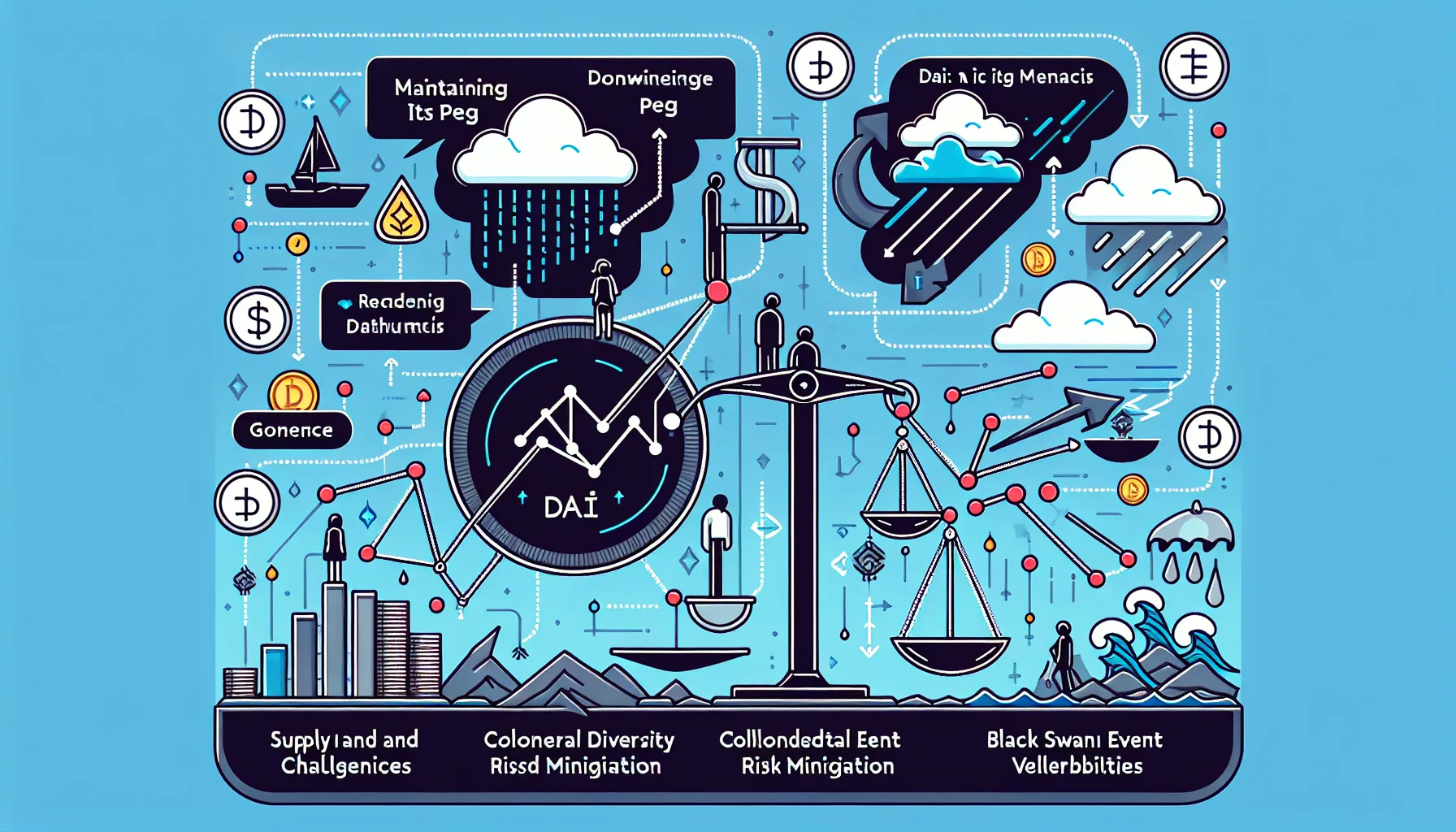
1. How DAI Maintains Its Peg
DAI operates as a decentralized, collateral-backed stablecoin, aiming to maintain a 1:1 peg with the U.S. dollar. This peg is primarily governed by MakerDAO's smart contracts and the collateralization process. Unlike algorithmic stablecoins that rely solely on supply-demand dynamics, DAI uses over-collateralization of volatile crypto assets like ETH or wETH. Users lock collateral in Maker Vaults, creating DAI while ensuring systemic backing. The Collateralization Ratio (typically above 150%) is crucial, as it cushions against crypto price volatility. However, the model is not foolproof; rapid price crashes can trigger liquidations, leading to inefficiencies or market imbalances in extreme scenarios.
2. The Role of MKR and Governance
DAI issuance and stability rely heavily on MakerDAO governance, with MKR token holders responsible for setting parameters like stability fees, collateral types, and risk metrics. MKR tokens are burned when stability fees are paid, connecting DAI's performance to MKR's tokenomics. While this decentralized governance system enables adaptability, it has raised concerns about participation centralization. A small group of entities often dominates governance votes, contradicting the ideals of wide decentralization. Additionally, the complex economic design can deter less sophisticated participants from engaging actively.
3. Collateral Diversity and Risk Mitigation
Initially backed entirely by ETH, DAI expanded to accept multiple types of collateral, including USDC and WBTC, to enhance capital efficiency and reduce reliance on ETH's price stability. However, this diversification introduces centralization risks, as USDC, a centrally issued asset, accounted for a significant portion of collateral. USDC issuers have the power to freeze assets, potentially compromising the decentralized ethos of DAI. This hybrid collateral model has generated ongoing debates about whether DAI can truly be considered a decentralized stablecoin.
4. Supply and Demand Dynamics
The circulating supply of DAI fluctuates based on user demand for decentralized borrowing. Stability fees, which function as interest rates, incentivize or discourage borrowing as needed. For example, higher stability fees reduce DAI issuance to maintain its peg, while lower fees encourage borrowing and increase supply. However, this mechanism encounters limitations during extreme market conditions or during sudden shifts in collateral value, potentially destabilizing the peg.
5. Black Swan Event Vulnerabilities
Though robust in design, DAI's tokenomics remain vulnerable to extreme black swan events. A simultaneous sharp decline in collateral asset values combined with liquidity thinning could overwhelm the Maker Protocol, preventing sufficient liquidations to uphold collateral ratios. Furthermore, high gas fees during network congestion can delay liquidations, heightening systemic risk.
DAI Governance
Governance Mechanisms of DAI: Decentralized Yet Imperfect
The governance of DAI, a decentralized stablecoin issued by MakerDAO, operates via a decentralized autonomous organization (DAO). Its governance is facilitated primarily through MKR token holders, who have the power to propose, discuss, and vote on key protocol changes. This structure ensures DAI remains collateralized, stable, and responsive to market dynamics. However, this governance model is not without its complexities and vulnerabilities.
Voting Power Concentration
Despite being decentralized in structure, the actual distribution of governance power can lean heavily toward MKR whales. Large token holders have disproportionately significant influence over the outcome of governance proposals, leading to concerns about potential centralization within decision-making processes. This dynamic raises risks of governance capture, where decisions could prioritize individual interests over the broader MakerDAO ecosystem or DAI's long-term stability.
Proposal Process and Risk Management
To maintain stability for DAI, MakerDAO leverages its governance system to modify crucial parameters, such as collateral types, stability fees, and debt ceilings. While these decisions are meant to be optimized for risk management, the proposal and voting process are often criticized as overly technical and inaccessible for the average MKR holder. This limits participation and creates reliance on a smaller set of technically skilled community members or MakerDAO core units, which may inadvertently lead to centralization of expertise and influence.
Collateral Onboarding and Its Governance Risks
One critical aspect of MakerDAO's governance involves collateral onboarding. The ability to introduce new collateral types allows flexibility and growth for DAI's ecosystem but introduces governance risks tied to decisions about asset quality and regulation. Allowing less resilient or overly centralized assets into the system could undermine DAI’s decentralized nature or expose it to regulatory scrutiny, a point of contention among MKR holders with differing risk appetites.
Fee Adjustments and Potential Governance Bottlenecks
Adjusting stability fees and other parameters to maintain the peg can also be a source of contention. While fee changes serve as a vital tool for controlling supply and demand, the need for timely governance decisions during times of market stress creates potential bottlenecks. Delayed or contentious decision-making can jeopardize DAI’s stability, especially during market turbulence.
Governance Audits and Security
With increasing scrutiny of DeFi protocols, MakerDAO governance occasionally faces critiques related to the security of its voting infrastructure. Exploits or manipulation of governance processes could destabilize DAI or lead to unintended, cascading consequences across the protocol. While measures like governance delay mechanisms are meant to mitigate risks, they cannot eliminate all vulnerabilities inherent in decentralized governance.
Technical future of DAI
Current and Future Technical Developments of DAI: Exploring the Roadmap
The Evolution of Maker Protocol and Multi-Collateral DAI
One of the most notable technical milestones for DAI was the transition from Single-Collateral DAI (now referred to as SAI) to Multi-Collateral DAI (MCD). This major upgrade expanded the collateral types that can back DAI, introducing a modular system for onboarding assets. Supporting diverse collateral types—ranging from ETH to tokenized real-world assets—has enhanced the protocol's resilience but also introduced complexities in collateral risk management. The MakerDAO community has faced challenges in determining collateral governance parameters like Debt Ceilings, Stability Fees, and Risk Premiums, which require active coordination and rapid adjustments during volatile market conditions.
The Maker Protocol continues to refine collateral onboarding processes to ensure both security and scalability. Smart contract upgrades are ongoing to mitigate over-collateralization risks while maintaining system transparency. One key enhancement involves optimizing the liquidation mechanism through auction redesigns, which aim to reduce inefficiencies during collateral sell-offs and prevent slippage.
Integration of Layer-2 Scaling Solutions
In an effort to minimize Ethereum gas fees and enhance transaction throughput, MakerDAO has been integrating Layer-2 scaling solutions. Optimistic Rollups and zkRollup frameworks are under exploration to expand DAI’s use cases beyond the confines of Ethereum Mainnet while retaining interoperability. Current developments are focused on bridging trusted execution with Layer-2 rollups without exposing the system to cross-chain risks, a persistent challenge for DeFi protocols that rely on multi-environment operations.
Real-World Asset (RWA) Collateral Integration
Expanding collateral options to include Real-World Assets (RWAs) has been a recent focal point. This approach connects decentralized lending with traditional financial structures, creating unique challenges around trust assumptions and legal enforceability of loans. While this integration has opened up new avenues for liquidity generation, it also introduces potential vulnerabilities, such as centralized counterparty dependencies and the need for clear legal frameworks. These technical and jurisdictional hurdles remain contentious topics within the MakerDAO governance ecosystem.
Decentralization vs. Governance Risks
As Maker scales, it continues to explore ways to decentralize DAI’s governance mechanisms further. However, the reliance on Maker Governance Token (MKR) holders to make decisions raises concerns around governance centralization, voter participation rates, and susceptibility to governance attacks. Enhancements to tooling for on-chain voting, such as smart contract auditing of governance proposals, are a work in progress to address these risks.
Autonomous Systems and AI Integration
Another long-term technical exploration is the integration of autonomous AI models to manage risk parameters dynamically. While still conceptual, these decentralized intelligence systems aim to reduce human decision-making bottlenecks. However, this opens questions around algorithmic bias, code fail-safes, and the challenge of building completely trustless AI solutions.
DAI’s roadmap reflects a protocol pushing technical boundaries but also grappling with complex issues that come with scaling decentralized ecosystems. It remains to be seen how these initiatives will play out in practice amid the challenges of a rapidly evolving DeFi landscape.
Comparing DAI to it’s rivals
Comparing DAI to USDC: Decentralization vs. Centralization in Stablecoins
When analyzing DAI against USDC, the starkest difference lies in their core design philosophies—decentralization versus centralization. DAI, issued by MakerDAO, is a decentralized, crypto-collateralized stablecoin, while USDC is a fully collateralized, fiat-backed stablecoin issued and controlled by Circle and Coinbase. This fundamental divergence significantly impacts their operational mechanisms, trust structures, and use cases.
Collateral Structure and Risk Exposure
DAI is overcollateralized by various crypto assets, primarily Ethereum. This mechanism introduces certain risks, such as potential instability during significant market volatility when collateral values can plunge. To mitigate this, MakerDAO relies on automated liquidation systems, forcing collateral sales if the collateralization ratio dips below a threshold. While it ensures DAI's peg under extreme conditions, it may cause cascading liquidations, exacerbating market shocks.
USDC, in contrast, is collateralized exclusively by fiat reserves and short-term U.S. Treasuries held in audited accounts by regulated financial institutions. This model provides stability but comes with the caveat of requiring users to trust centralized custodians. Any potential mismanagement of reserves or regulatory pressure on these central entities could jeopardize USDC’s reliability.
Regulatory Implications
USDC's heavy alignment with regulatory bodies offers both a strength and a limitation. Its compliance with strict U.S. financial regulations makes it appealing to institutions and entities seeking reliable stablecoin settlement. However, this centralized compliance structure exposes USDC to legal and regulatory uncertainties. Governments could impose restrictions, blacklists, or even halt transactions.
DAI, while more resistant to censorship and regulatory influence due to its decentralized nature, isn't entirely immune. Its growing reliance on real-world assets (RWAs), such as U.S. Treasuries held via intermediaries, compromises its earlier reputation as a purely crypto-native asset. Critics argue this dependency dilutes DAI’s resilience to external pressures compared to its earlier years.
Censorship Resistance and Account Freeze Risks
USDC is inherently more susceptible to censorship. Through private key control, Circle can blacklist wallet addresses, effectively freezing USDC balances. This feature caters to legal compliance but clashes with crypto’s ethos of permissionless value transfer. DAI, being decentralized, values greater censorship resistance. However, its reliance on collateral types like USDC within its reserves (via PSM) raises questions about indirect exposure to these centralization risks.
Liquidity and Integration
USDC benefits from predictable pricing and extensive fiat on/off-ramp support, making it the stablecoin of choice for many centralized platforms. Although DAI enjoys wide integration within DeFi ecosystems, users sometimes criticize its stability mechanisms during extreme market conditions. Moreover, USDC’s role as a collateral asset within DAI's system creates an ironic co-dependence, blurring the lines between these "rival" stablecoins.
Comparing DAI to USDT: Key Differences and Considerations
When comparing DAI to its rival USDT (Tether), it’s critical to examine their differing mechanisms, transparency, and adoption in the crypto space. While both are classified as stablecoins and aim to provide price stability, their designs and underlying philosophies set them apart.
Decentralized vs. Centralized Backing
DAI is a decentralized stablecoin issued by the MakerDAO protocol and collateralized through on-chain assets like Ethereum and wETH. In contrast, USDT operates as a centralized asset and is issued by Tether Limited. USDT’s value is backed by a mix of traditional financial assets, including cash reserves, treasury bills, and other commercial papers. This centralized backing model requires users to trust Tether Limited to maintain sufficient reserves to support its circulating supply.
The trust issue surrounding USDT has historically sparked debate. Due to its centralized accounting structure, USDT has faced criticism over the sufficiency and transparency of its reserves. While Tether has improved transparency in recent years with attestations from third-party firms, the lack of full, public audits still raises red flags within certain sectors of the crypto community.
By contrast, DAI relies on publicly verifiable on-chain collateral, where users can inspect the reserves backing the token at any moment. This removes the need for third-party trust, although volatility in the collateral markets (e.g., rapid Ethereum price drops) presents its own set of risks for maintaining DAI’s peg and collateralization levels.
Use Cases and Adoption
USDT has historically outpaced DAI in market penetration. It is one of the most widely traded stablecoins, with deep liquidity across nearly every major exchange and blockchain. Its widespread adoption makes it highly convenient for traders looking for a stable trading pair for cryptocurrencies. However, its dominance has also called attention to centralization risks and potential over-reliance on a single entity to maintain market integrity.
DAI appeals to a different user base. It is particularly attractive to DeFi enthusiasts who value decentralization and are often reluctant to use centralized stablecoins. However, DAI’s reliance on overcollateralization can limit its scalability compared to USDT, which can mint tokens efficiently on demand based on its centralized reserve model.
Regulatory Scrutiny
USDT faces persistent scrutiny from regulators, particularly concerning its reserves and compliance practices. Though these inquiries have not toppled its dominance, they add a layer of uncertainty for institutional adoption. DAI, while not facing the same centralized issues, has its own risks as regulatory heat mounts against DeFi protocols, potentially targeting MakerDAO and its governance mechanisms.
Comparing DAI to TUSD: A Stablecoin Analysis for Crypto Enthusiasts
When examining DAI and TUSD, distinct differences emerge in their design, operational models, and adoption. While both aim for price stability and serve as tools for trading, decentralized finance (DeFi), and managing volatility within the crypto ecosystem, their underlying mechanics set them apart.
Collateral Models at the Core
DAI is famously decentralized, minted through overcollateralized debt positions on the MakerDAO platform, using a basket of crypto assets like ETH and others. TUSD, by contrast, is fully collateralized by fiat currency held in traditional financial systems. Each TUSD token is backed 1:1 with U.S. dollars held in escrow accounts managed by regulated trust companies. As a result, TUSD relies heavily on transparent audits and compliance with financial institutions to maintain trust, a centralized approach that inherently diverges from DAI’s algorithmically managed, decentralized construct.
However, this centralization in TUSD can pose a risk some crypto users aim to avoid. Dependence on regulated entities introduces exposure to jurisdictional constraints, censorship, and possible operational bottlenecks tied to the traditional financial ecosystem. DAI, on the other hand, carries risks of its own—namely, the reliance on volatile cryptocurrencies as collateral, requiring overcollateralization to safeguard the peg at $1.
Adoption and Use Cases
On-chain activity for DAI and TUSD also presents a notable contrast. DAI’s deep integration into DeFi protocols fuels its utility for borrowing, lending, and yield farming. TUSD, while functional in DeFi, often sees a larger portion of its use concentrated within centralized exchanges and for direct fiat on-and-off ramps. The more conservative TUSD user base may thus use the token primarily as a means for transferring funds rather than tapping into DeFi’s advanced capabilities.
Decentralization vs. Trust
TUSD markets itself on transparency, leveraging real-time audits that theoretically provide users with up-to-date confidence that reserves match circulating supply. However, skeptics argue that trust-based assurance is still inferior to the trustless design of DAI. Centralized transparency is only as reliable as the financial institutions and auditors behind it.
That said, DAI’s decentralized framework has its own challenges. In volatile markets, liquidations of collateral can threaten its stability. Additionally, its gradual reliance on USDC and other fiat-backed stablecoins as collateral has been criticized for undermining its decentralization ethos—a criticism less relevant to TUSD given its fully centralized nature.
By evaluating DAI against TUSD, users face a philosophical dichotomy: decentralization vs. centralized transparency. Each appeals to distinct demands in the growing stablecoin sector.
Primary criticisms of DAI
Primary Criticism of DAI: Fragility in Decentralization and Stability Mechanisms
The Perceived Centralization Risks
Despite being marketed as a decentralized stablecoin, a common criticism of DAI lies in its reliance on centralized collateral assets, particularly USDC. Users argue that the heavy inclusion of fiat-pegged, centralized stablecoins in the collateral pool undermines DAI’s decentralization claims. USDC, for example, is subject to regulatory controls, with potential risks of freezing funds or forced compliance with government actions. Such reliance exposes DAI to the very centralized financial intermediaries it claims to bypass, leading many to question its ability to remain a truly trustless and censorship-resistant asset in the long term.
Over-Collateralization Challenges
DAI’s stability mechanism requires users to over-collateralize their debt positions. While this ensures the system's solvency, critics view it as inefficient capital allocation. Locking up assets worth significantly more than the DAI minted can be a barrier to entry for smaller or capital-constrained participants. This economic model has faced scrutiny for being relatively inaccessible compared to traditional financial systems or competing stablecoins, which may not require users to lock up excessive capital.
Black Swan Event Vulnerabilities
DAI’s mechanics make it vulnerable to extreme market conditions, often called "black swan events." During sharp downturns, significant price crashes in collateral assets like Ethereum can trigger mass liquidations. While the system utilizes auctions to manage these situations, inefficiencies or delays can lead to under-collateralization, challenging DAI’s peg. Critics highlight past events where stability faced pressure due to precipitous sell-offs, underscoring risks in its design when the market experiences systemic stress.
Governance Centralization Concerns
MakerDAO, the entity responsible for DAI issuance, operates under a decentralized governance model. However, critics argue that its governance remains susceptible to centralization risks. A small number of large MKR token holders can potentially influence governance decisions disproportionately, creating risks of plutocracy. Additionally, slow or contested governance decision-making during critical moments could delay essential protocol adjustments, further exacerbating risks in volatile environments.
Limited Scalability Due to Collateral Dependency
DAI’s reliance on over-collateralized assets also introduces scalability challenges. To mint more DAI, additional collateral needs to enter the system, which directly ties its growth to market demand for specific assets. Critics suggest this requirement imposes a ceiling on DAI’s scalability, especially as it competes against algorithmic stablecoins or fiat-backed tokens that do not face such constraints.
Regulatory Risks for Underlying Assets
Another significant concern ties into DAI’s exposure to regulatory risks due to the inclusion of centralized stablecoins and tokenized real-world assets (RWAs) as collateral. Changing regulatory landscapes could result in unforeseen restrictions, erode trust, or alter the utility of these assets, potentially threatening DAI’s stability and broader functionality.
Founders
The Founding Team Behind DAI: Innovators and Controversies
DAI, an algorithmically stabilized decentralized stablecoin, is the flagship product of MakerDAO—a platform that has changed the very fabric of decentralized finance (DeFi). At the heart of its development is the founding team, a group of innovators who laid the foundation for one of crypto’s most widely adopted stablecoins. However, like other initiatives in the fast-moving world of crypto, the team’s journey has not been without its complexities and challenges.
Rune Christensen: The Visionary Driving MakerDAO's Creation
Rune Christensen, the Danish entrepreneur who co-founded MakerDAO, has often been described as the driving force behind DAI's emergence. Christensen's vision for a decentralized stablecoin was fueled by his understanding of the shortcomings of centralized financial systems as well as the inherent volatility of cryptocurrencies. Under his leadership, MakerDAO introduced the innovative system of collateralized debt positions (CDPs), now referred to as Maker Vaults, to mint DAI. While Christensen's leadership has been a key factor in the project’s success, his strong influence has drawn some criticism from the community, with concerns voiced about MakerDAO becoming too centralized in its governance structure around a core group of early contributors.
The Challenges in Early Development
The project initially started in 2015 with a small collective of developers, primarily funded through a series of private token sales. Despite the strengths of its vision, MakerDAO faced skepticism during its early days. The idea of a fully collateralized stablecoin backed entirely by smart contracts raised questions about its scalability and resistance to black swan events. In hindsight, these challenges underscored the obstacles inherent in building trust in a permissionless system, especially when early contributors had to balance transparency with operational security.
Departure of Core Contributors
One notable element in MakerDAO's history involves the departure of several early key contributors as the project scaled. Some left voluntarily, while others were pushed out due to internal disagreements over the project's direction and governance. This turnover exposed occasional tensions in the project's culture, particularly regarding collaboration practices and decision-making processes. Such departures arguably diluted the founding team's composition over time, further fueling concerns about its ability to uphold decentralization principles as MakerDAO grew more institutionalized.
Broadening the Talent Pool
With MakerDAO’s transition into newer governance models, including its push toward "MetaDAOs," the founding team’s influence has lessened as the ecosystem takes on a more decentralized structure. While this evolution aligns with MakerDAO's ethos, critics argue that the dilution of the founding team's direct involvement may lead to challenges in maintaining the same level of cohesive innovation present in its initial phase.
Authors comments
This document was made by www.BestDapps.com
Sources
- https://makerdao.com/en/whitepaper
- https://github.com/makerdao/dai
- https://docs.makerdao.com/smart-contracts
- https://dai.stablecoin.science/
- https://www.makerburn.com/
- https://blog.makerdao.com/
- https://community-development.makerdao.network/glossary/
- https://dai.descipher.io/
- https://vote.makerdao.com/
- https://defipulse.com/defi-list/dai
- https://data.makerdao.network/
- https://etherscan.io/token/0x6b175474e89094c44da98b954eedeac495271d0f
- https://makerdao.com/en/the-maker-protocol-zero-to-one-guide
- https://debank.com/projects/makerdao
- https://makerdao.forum/
- https://makerdao.world/en/what-is-maker-dao/
- https://cryptobriefing.com/stablecoin-guide-dai/
- https://www.dune.com/hagaetc/makerdao
- https://www.coingecko.com/en/coins/dai
- https://makerdao-mips.makerdao.network/