History of DAGX
The Origins and Evolution of DAGX: A Deep Dive into Its History
The history of DAGX is deeply intertwined with the evolution of blockchain innovation, particularly focusing on Directed Acyclic Graph (DAG) technology. Unlike the linear and sequential blockchains that dominate the cryptocurrency space, DAGX was conceived to address the scalability and transaction throughput challenges faced by traditional blockchains.
DAGX was first introduced as a solution to inefficiencies in existing distributed ledger technologies (DLTs). Its whitepaper outlined a vision that diverged from Proof-of-Work (PoW) and Proof-of-Stake (PoS) protocols, instead emphasizing a DAG-based structure to create a more resource-efficient and scalable transaction ecosystem. Early iterations of the DAGX protocol faced technical skepticism. Critics questioned whether such a structure could deliver the same level of security and decentralization as established blockchains.
Initial testing and development of the DAGX network highlighted some challenges. Early adopters reported synchronization issues between network nodes when transaction volume spiked. Additionally, concerns arose regarding the complexity of implementing consensus mechanisms on a DAG architecture without introducing points of vulnerability. This led to a sequence of updates and revisions to the protocol, guided heavily by community feedback and early-node operators.
Another critical milestone in DAGX’s development was transitioning from an experimental framework to mainnet deployment. The mainnet launch wasn’t without setbacks; network delays and stalled transactions hampered initial confidence. These issues not only shed light on the inherent risks of pioneering new technology but also underscored the importance of stress-testing DAG-based systems before adoption.
Further history reveals that DAGX underwent several governance transformations. Its initial governance model, centered on a relatively small group of decision-makers, was met with resistance from the wider crypto community, which demanded increased decentralization. To address these concerns, DAGX later adopted a more community-driven focus, integrating decentralized governance frameworks.
Criticism also surrounded the tokenomics of DAGX in its early days. Despite promising zero transaction fees due to its network architecture, questions around token distribution and early whale dominance led to accusations of centralization. This prompted measures to balance the tokenomics and incentivize broader participation, but the impact of these adjustments remains a contentious topic.
Over time, incremental improvements and community engagement have shaped the trajectory of DAGX. Its history, however, is marked by persistent debates within the crypto space about the long-term viability of its unique technological approach, particularly in terms of security trade-offs compared with traditional blockchain systems.
How DAGX Works
How DAGX Works: A Technical Breakdown of Its Directed Acyclic Graph Architecture
DAGX operates on a Directed Acyclic Graph (DAG) architecture, distinguishing it from traditional blockchain-based cryptocurrencies. Unlike blockchains, which use sequentially ordered blocks to validate and store transactions, DAGX organizes transactions as independent nodes in a graph. These nodes are connected via directed edges, forming a network structure that avoids cycles. This design inherently eliminates the need for mining, reduces network congestion, and ensures scalability.
Transaction Validation Model
In the DAGX framework, every new transaction must validate a set number of previous transactions before it can be considered valid. This approach distributes the job of validation across network participants, removing the dependence on miners or validators seen in traditional Proof-of-Work (PoW) or Proof-of-Stake (PoS) networks. This decentralized model theoretically enhances efficiency but requires a robust mechanism to prevent fraudulent or low-quality transactions within the graph.
The validation process depends heavily on network incentives. Nodes in the DAGX architecture are rewarded for their active role in verifying transactions, which helps maintain integrity while eliminating energy-intensive mining. However, this design raises questions about the potential for network fragmentation, where low adoption can result in transaction bottlenecks or under-validated transactions.
Fee-Less Transactions: How It’s Made Possible
DAGX leverages its architecture to achieve near-zero transaction fees. Without the need for miners earning block rewards, the system accumulates minimal operational costs. Fee-less transactions make DAGX attractive for micro-payments and IoT-related use cases, but questions remain regarding sustainability. In a low-activity network, incentivizing validators without fees could be challenging, potentially compromising transaction reliability.
Scalability Advantages and Bottlenecks
DAGX’s structure is inherently scalable, as increasing transaction throughput directly contributes to the network's capacity. Due to its design, there is no theoretical upper limit on the number of transactions the network can process. However, this scalability comes with trade-offs. High levels of parallel verification introduce synchronization issues and can lead to temporary inconsistencies, particularly during periods of rapid transaction growth.
Security Implications of the DAG Model
While DAGX avoids the centralization risks associated with PoW or PoS chains, its reliance on node-based validation raises unique security challenges. A partially populated DAG network could be susceptible to double-spending attacks or Sybil attacks if insufficient nodes are active. DAGX mitigates this risk using reputation metrics, but these systems are not foolproof and remain a target for exploitation.
This balance between decentralization, scalability, and security remains an ongoing challenge for DAG-based systems, and DAGX is no exception.
Use Cases
Exploring DAGX Use Cases: Practical Applications and Limitations
DAGX leverages its Directed Acyclic Graph (DAG) infrastructure to address challenges traditionally faced by blockchain systems, enabling unique use cases. Below, we examine its specific applications and the associated challenges that come with its adoption.
Scalability-Centric Transactions
DAGX is tailored towards environments requiring high transaction throughput with minimal latency. Its scalable architecture—by eliminating block-based constraints—makes it suitable for microtransactions and environments with high user demands, such as IoT (Internet of Things) ecosystems or decentralized payment systems. However, while DAG's structure optimizes for speed, questions around long-term security remain, particularly as smaller transaction volumes can theoretically lead to weakened network validation.
High-Frequency Trading and DeFi Integrations
Given its near-instantaneous settlement capability, DAGX is finding a niche within high-frequency trading platforms and decentralized finance (DeFi) operations. The lack of mining for transaction validation reduces confirmation times, a significant advantage in volatile trading conditions. Yet, integration challenges exist when bridging DAGX to ecosystems traditionally rooted in blockchain protocols. Middleware solutions often generate complexity and additional fees, potentially negating its low-cost appeal.
Data Integrity for Supply Chain Management
The DAG structure of DAGX is well-suited for recording and validating vast, interconnected data points. This makes it effective for tracking supply chain activities, ensuring data immutability in complex logistics networks. Enterprises can utilize DAGX for real-time auditing of goods, eliminating dependence on centralized intermediaries. However, interoperability hurdles with legacy systems and other blockchains often limit the adoption rate for mid-size businesses, which may opt for more universally supported solutions.
Machine-to-Machine (M2M) Economy
DAGX's no-miner verification model aligns with the vision of a seamless machine-to-machine economy. Devices can transact autonomously with minimal overhead, facilitating use cases like autonomous vehicle toll payments or AI-driven contract execution. However, the relative immaturity of M2M protocols raises questions about whether DAGX can dominate this space without better-defined standards and broader developer support.
Potential Bottlenecks in Adoption
While DAGX's architecture offers robust potential across decentralized systems, its unique reliance on DAG mechanics introduces complexities for developers accustomed to traditional blockchain tools. The limited availability of development frameworks and lack of robust ecosystem support can deter institutional interest. Furthermore, network performance heavily depends on continuous transaction activity; periods of low activity could weaken network resilience, skewing its effectiveness for mission-critical applications.
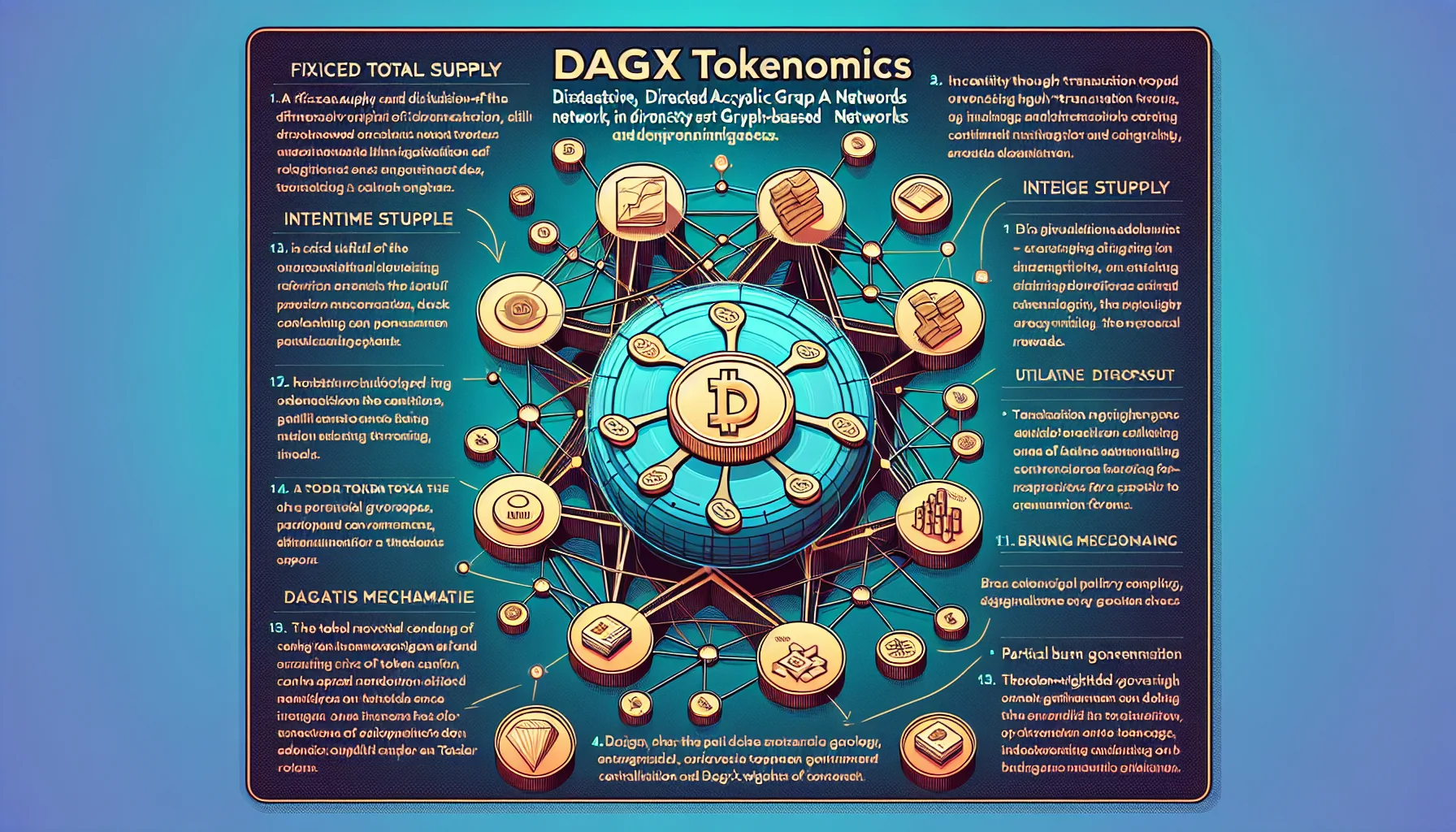
DAGX Tokenomics
Tokenomics of DAGX: A Deep Dive into the Mechanics
The tokenomics of DAGX is centered on its unique utility within a Directed Acyclic Graph (DAG)-based network architecture. Unlike traditional blockchain tokens that rely on mining or staking rewards, DAGX employs a dynamic fee structure and utility-driven model designed to incentivize both network efficiency and adoption. However, the design brings both innovative solutions and potential challenges.
Token Supply and Distribution
DAGX operates with a fixed total supply, which was fully minted at genesis. A significant allocation was reserved for early contributors, ecosystem development, and a staking-reward mechanism. While this fixed supply guarantees no inflationary effects, critics have raised concerns about concentrated token distribution. Early backers holding a substantial share could lead to centralization risks, particularly during low liquidity phases. Without transparent mechanisms to ensure equitable redistribution over time, this remains a contentious issue for long-term sustainability.
Incentive Structures and Fee Dynamics
The network’s transaction fees are directly tied to the DAG architecture’s processing bandwidth. Instead of block confirmation rewards, validators are incentivized via transaction throughput. While this lowers the barriers to entry for new validators, it could present scalability challenges under high-demand conditions. Furthermore, the fee structures are not deflationary by default, which some community members see as a missed opportunity to promote scarcity-driven value appreciation.
Utility-Driven Mechanisms
DAGX tokens serve a multifaceted role within the ecosystem, including network validation, governance participation, and transaction enablement. Staking allows token holders to secure the network while earning rewards proportional to their staked amounts and contribution levels. However, critics have pointed out that staking rewards disproportionately favor whale accounts with large holdings, making meaningful participation challenging for smaller entities. Additionally, the staking lock-up periods might deter engagement from users seeking higher liquidity.
Governance Implications
DAGX implements a token-weighted governance model, where voting power is correlated with token holdings. While this encourages active participation in network decisions, the system inherently runs the risk of plutocracy. Larger stakeholders can wield disproportionate influence on protocol updates, fee adjustments, or safeguard measures. Decentralized governance is a key promise of cryptocurrency, but DAGX must strike a balance to avoid alienating smaller participants.
Burn Mechanism and Sustainability
Although DAGX incorporates partial burns from transaction fees as a pseudo-deflationary mechanism, the burn rates are relatively low and may not offset potential increases in circulating supply due to unlocking schedules or market redistribution. This could soften long-term scarcity effects, which some argue limits exponential token value growth—a critical factor for investor sentiment in the crypto space.
DAGX Governance
Governance in DAGX: A Closer Look at Decentralized Decision-Making
The governance structure of DAGX is intricately designed to strike a balance between decentralization and effective decision-making, yet it faces a mix of strengths and potential challenges in execution. DAGX leverages a hybrid model, combining on-chain governance mechanisms with off-chain deliberations to ensure transparency and community inclusivity. Token holders play a central role in proposing, debating, and voting on protocol changes, but the distribution of voting power raises questions about potential centralization risks and systemic vulnerabilities.
Token-Weighted Voting: Participation and Power Distribution
One of the primary mechanisms for DAGX governance is token-weighted voting. This approach gives every DAGX token holder a voice in decision-making, proportional to their stake. While this incentivizes active participation from major stakeholders, it also brings concerns about power centralization. Large token holders—possibly institutions or early adopters—may exert disproportionate influence, overshadowing smaller participants and limiting the diversity of perspectives in governance.
Moreover, the reliance on token staking for voting power introduces challenges related to economic accessibility. Smaller holders may feel disenfranchised if their financial contributions yield minimal influence. This could, over time, disincentivize active participation, reducing the community's engagement in governance proposals.
Proposal Process: Transparency and Challenges
DAGX governance proposals go through a structured, multi-phase process. Proposals are typically submitted via a predefined interface, where they must meet certain thresholds (e.g., a specific amount of staked tokens) to advance to the voting stage. This ensures that only carefully considered ideas make it to the decision phase. However, some critics argue that such thresholds may unintentionally filter out innovative or grassroots initiatives, favoring proposals backed by whales or entities with resources to rally support.
The transparent nature of proposal submission and voting is a positive, as it allows every stakeholder to track and audit decisions on-chain. Still, transparency doesn't inherently solve the challenges around voter apathy—a recurring issue with most governance models. Participation rates in DAGX governance votes fluctuate, potentially leaving important decisions in the hands of a small subset of highly motivated actors.
Off-Chain Elements: Community Deliberation and Informal Power
In addition to on-chain voting, off-chain discussion forums and developer meetings play a crucial role in shaping the direction of DAGX governance. While this dual-layered approach adds depth to decision-making, it introduces risks of informal power dynamics. Well-connected individuals or groups may wield outsized influence in these less-transparent environments, undermining the principle of equal community representation.
The combination of on-chain and off-chain mechanisms makes the DAGX governance framework robust yet imperfect, leaving room for further iteration to address the outlined challenges.
Technical future of DAGX
Current and Future Technical Developments of DAGX: A Deep Dive into the Evolution of Its Infrastructure
The DAGX ecosystem continues to evolve, leveraging innovative technologies to address scalability, efficiency, and interoperability challenges. As a Directed Acyclic Graph (DAG)-based protocol, DAGX offers a fundamentally different architecture from traditional blockchain networks. However, its technical roadmap is not without hurdles and areas requiring further refinement.
Current Technical Landscape
DAGX is centered around its DAG structure, which enables parallel transaction processing, theoretically bypassing the bottlenecks associated with blockchain block-by-block architectures. This approach results in increased scalability, as transaction validation grows alongside network activity. However, the reliance on such a structure introduces complexities related to transaction ordering and consensus.
The DAGX protocol currently employs a consensus mechanism optimized for rapid verifications, but community discussions have highlighted concerns regarding potential vulnerabilities to network attacks, such as Sybil attacks and collusion among validators. While mechanisms such as staking tiers and reputation-based systems have been partially implemented to mitigate these risks, critics argue that these solutions remain susceptible to manipulation in less decentralized settings.
Another noteworthy aspect of DAGX is its transaction fee model, which is tied directly to transaction throughput. While low fees have been a key selling point, sudden surges in traffic reveal inefficiencies in how the network dynamically redistributes validation loads among nodes, leading to intermittent delays.
Future Developments and Technological Upgrades
DAGX’s roadmap outlines several ambitious upgrades targeted at both protocol-level improvements and ecosystem development. A major focus is the planned rollout of enhanced consensus algorithms that integrate additional layers of randomness to safeguard against malicious validator behavior. This enhancement aims to strike a balance between decentralization and efficiency.
Interoperability remains a critical focus area for the DAGX team. There are ongoing efforts to develop native bridges to other blockchain ecosystems, allowing DAGX to facilitate token exchanges and cross-chain smart contract executions without relying on centralized intermediaries. However, interoperability introduces new attack vectors, such as bridge exploits, which require robust testing before broad implementation.
The team is also exploring ways to expand DAGX’s support for decentralized applications (dApps). Preliminary developer documentation reveals plans to enhance compatibility with existing programming languages and provide modular toolkits for building applications directly within the DAG framework. However, the absence of a widely adopted standard for DAG-based dApp development poses a barrier that will need addressing to attract long-term developer interest.
Finally, network upgrades incorporating zero-knowledge proofs (ZKPs) are on the horizon, aligning with industry trends toward privacy-preserving features. Yet, the integration of ZKPs in a DAG structure remains largely experimental, and scalability concerns tied to computational overhead may slow adoption significantly.
The path forward for DAGX is technically ambitious, though significant challenges persist. The balance between innovation and robust, secure implementation will ultimately determine its viability in the evolving crypto landscape.
Comparing DAGX to it’s rivals
Comparing DAGX to XYZ: Key Differentiators in the Crypto Ecosystem
When evaluating DAGX against its competitor XYZ, it’s essential to examine the distinct architectural and functional disparities between these two crypto assets. Both strive to address scalability and speed challenges, but their approaches expose key differences that appeal to divergent blockchain use cases.
Consensus Mechanism: Directed Acyclic Graph vs. Traditional Blockchain
DAGX employs a Directed Acyclic Graph (DAG) structure, eliminating the need for miners by allowing transactions to confirm one another. This unique consensus enables theoretically unlimited scalability, provided sufficient network activity supports it. In contrast, XYZ relies on a conventional proof-of-stake (PoS) model, where validators secure the network by staking tokens. While PoS is energy-efficient compared to proof-of-work alternatives, it doesn’t quite match the transaction finality speed DAGX can achieve under optimal conditions. However, DAGX’s dependence on high transaction throughput for network security introduces a potential weakness in periods of low activity, something XYZ’s validator-based model is less susceptible to.
Network Security and Decentralization
Although DAGX boasts high throughput and rapid confirmations, it faces criticism regarding decentralization and security. Its DAG structure can struggle with resistance to certain types of attacks, such as parasite chains or spamming. XYZ, despite potential bottlenecks in processing times due to its fixed validator set, benefits from a mature and robust approach to handling bad actors. DAGX’s reliance on a growing network to ensure its resilience means that, at a smaller scale, its security model is not as battle-tested as XYZ’s PoS consensus.
Smart Contract Capabilities
Another point of comparison lies in smart contract functionality. DAGX integrates lightweight scripting for efficiency, but this approach limits the complexity of decentralized applications (dApps) it can support. XYZ, with its robust virtual machine infrastructure, provides a more flexible environment for developers building advanced dApps, giving it an edge in markets requiring sophisticated programmable logic.
Adoption and Integration
A practical focus for both projects is interoperability with other blockchain ecosystems. DAGX’s DAG framework allows for rapid data sharing across networks, which is beneficial for IoT and microtransaction use cases. Conversely, XYZ has focused heavily on building partnerships with established DeFi protocols, making it a preferred choice for developers targeting liquidity and yield-generation applications. DAGX’s focus on niche industries could position it as specialized, but XYZ’s broader adoption gives it a competitive mass-market edge.
By critically assessing the nuances in architecture and use cases, it becomes clear that the tradeoffs between DAGX and XYZ heavily depend on the specific demands of the user or developer engaging with the network.
DAGX vs. NODL: A Deep Dive into Structural and Utility Differences
When analyzing DAGX in comparison to NODL, one of the most notable distinctions centers around the architecture and prioritization of network scalability. While both crypto assets operate within high-throughput blockchain ecosystems, their fundamental design philosophies diverge significantly, leading to variations in utility and operational focus.
Network Architecture: Divergence in Consensus and Security Models
NODL leverages a proof-of-availability coupled with graph state synchronization, emphasizing lightweight integration for devices and IoT implementation. This approach streamlines usability in edge-computing environments but comes with trade-offs in terms of heightened reliance on gateways for off-chain task validation. On the other hand, DAGX's direct acyclic graph (DAG) model optimizes for concurrent transaction processing by eliminating the need for traditional block-based constraints. However, some critics argue that while DAGX excels in raw throughput, its susceptibility to network splits or fork scenarios under adverse conditions reveals vulnerabilities that NODL circumvents with its centralized fallback protocols.
Cost Dynamics: Transaction Fees and Scalability
Another key operational distinction lies in transaction cost management. DAGX prides itself on a no-fee structure for network transactions, relying heavily on staking requirements to sustain validator engagement. NODL, however, implements a hybrid micro-fee system tied to bandwidth consumption, making it potentially more predictable for enterprise usage but less appealing to small-scale, high-frequency microtransactions. Users who prioritize absolute cost-efficiency may gravitate towards DAGX, while those seeking scalability tailored to metric-based throughput might find NODL better calibrated.
Developer Ecosystem: Barriers and Adoption Rates
Both assets offer developer toolkits, yet the emphasis differs substantially. NODL's API-heavy development framework is tailored predominantly for IoT integrations, which can complicate onboarding for developers inexperienced in sensor-based systems. Meanwhile, DAGX takes a generic programming approach, aimed at scalable DApp development. However, the lack of standardized guidelines in DAGX’s developer documentation has drawn some criticism. Without formalized best practices, newcomers often face integration hurdles, somewhat narrowing DAGX’s adoption curve for non-specialized industries compared to NODL.
Decentralization vs. Centralization Concerns
A recurring criticism of NODL is its reliance on semi-centralized validators for enhanced speed, raising questions over long-term protocol trustlessness. DAGX, while technically more decentralized in structure, faces challenges with node distribution, often clustering around regions with extensive infrastructure access. These nuances highlight a philosophical divide: NODL optimizes for convenience and targeted scalability, whereas DAGX leans into a purist interpretation of decentralization at the cost of occasional operational inefficiencies.
By focusing heavily on IoT and real-time synchronization, NODL carves out a unique niche but also exposes potential disparities in adaptability to general-purpose blockchain applications. Conversely, DAGX’s DAG framework and fee-less model serve as its core differentiating factors. Each approach carries inherent strengths and weaknesses, significantly impacting their respective user bases and adoption pathways.
DAGX vs. VXRM: A Technical Comparison for Smart Crypto Investors
When analyzing DAGX in direct comparison to VXRM, the complexities of both assets' underlying architectures come into play. VXRM has garnered a reputation for its robust focus on decentralized finance (DeFi) interoperability, leveraging its proprietary cross-chain bridging technology. While DAGX also focuses on scalability and efficient transaction throughput via its Directed Acyclic Graph (DAG) structure, the two assets serve distinct niches when scaled against user adoption and ecosystem functionality.
VXRM’s standout feature lies in its multi-layer architecture, particularly its emphasis on seamless integration within cross-chain ecosystems. This allows VXRM to interact with a wide variety of blockchain networks, including those lacking native interoperability. DAGX, however, prioritizes an alternative approach by offering high-speed, fee-minimal peer-to-peer transactions, which may appear limited when compared to VXRM’s broader DeFi integrations. While DAGX’s strategic focus caters to microtransactions and data-heavy applications, VXRM’s technical complexity seeks to unlock broader possibilities in decentralized finance markets.
On the governance front, VXRM’s reliance on node incentivization through a proof-of-stake (PoS) mechanism has received both praise and criticism. While this mechanism incentivizes holders to actively participate, it can also lead to concerns surrounding potential centralization due to the high capital cost required to operate validator nodes. DAGX mitigates similar concerns with its distributed network model, avoiding over-reliance on a staking system, but at the cost of lacking the same economic incentives for deep engagement.
A critical area of differentiation comes down to developer accessibility. Developers often cite VXRM’s tooling and documentation as superior, providing a broader range of software development kits (SDKs) and modular frameworks to leverage third-party blockchain integrations. In contrast, critics argue DAGX’s framework can be narrower in scope, favoring simplicity, but occasionally sidelining developers whose projects require greater flexibility.
One ongoing challenge for VXRM, however, lies in its significant network latency during high-volume DeFi market phases. Users report occasional slowdowns during periods of network congestion, something the DAGX protocol, optimized for lightweight transactions, largely avoids. That said, DAGX’s comparative lack of emphasis on multi-chain compatibility could leave it less competitive in markets prioritizing inter-connectivity between blockchains.
For investors and developers seeking to optimize for scalability without sacrificing broader ecosystem participation, the specific strengths and limitations of each protocol demand careful scrutiny. Each project continues to develop distinct strategies, which shapes the trajectory of their market positioning.
Primary criticisms of DAGX
Primary Criticism of DAGX: Scalability vs. Network Complexity
One of the primary criticisms of DAGX revolves around its scalability trade-offs and the increasing complexity of its network infrastructure as it grows. Unlike traditional blockchain architectures, DAGX employs a Directed Acyclic Graph (DAG) structure, which, while touted for its high throughput and scalability, can introduce significant challenges as the network matures.
The first issue stems from transaction verification bottlenecks. While DAG structures are designed to enable multiple transactions to be processed simultaneously without a strict linear sequence, the network’s requirement for nodes to validate multiple prior transactions can lead to inefficiencies. As transaction volume scales, the number of interdependencies grows, potentially creating validation delays and requiring significantly more computing resources for nodes. These bottlenecks contradict the promise of DAGX’s scalability, raising concerns about whether its performance benefits can be sustained in a larger, more active network.
Another criticism centers on security vulnerabilities tied to node governance. DAGX's consensus mechanism requires a level of trust among network participants to confirm transactions in a decentralized manner. Critics argue that as the number of nodes in the network expands, maintaining transparency and accountability becomes increasingly difficult. This potential weakness in governance could expose the network to attacks such as fraudulent transaction approvals or collusion among a subset of validators, especially in cases where the network lacks robust mechanisms to incentivize good behavior and punish malicious actors.
The third key point of contention is network partitioning risk. Critics highlight that DAG-based cryptocurrencies like DAGX are particularly vulnerable to partitioning attacks. In scenarios where the network is split into disconnected regions—whether due to malicious intent or network outages—DAGX’s reliance on a non-linear, consensus-driven transaction structure can create inconsistencies in ledger states. These inconsistencies demand rigorous reconciliation efforts, which increase operational complexity and require proactive mitigation mechanisms to prevent extended downtime or data loss.
Furthermore, latency variance across different network environments raises concerns about user experience and accessibility. While DAGX aims to offer high transaction speeds, differences in global node participation and network conditions can result in unpredictable transaction confirmation times. This undermines the network’s reliability and may deter adoption among users and developers who prioritize consistent performance.
Lastly, DAGX’s onboarding challenges for developers warrant attention. As a relatively niche data structure within the broader cryptocurrency space, DAG-based systems are less familiar to many blockchain developers. The steep learning curve for integrating with the protocol or building dApps atop DAGX can slow ecosystem growth, ultimately counteracting its potential as a competitive crypto asset. These developer hurdles also limit third-party audits, leaving DAGX to face long-term scrutiny over its implementation and security guarantees.
Founders
The Founding Team Behind DAGX: Visionaries and Challenges
The origins of DAGX lie in the work of a multifaceted founding team composed of blockchain pioneers, infrastructure developers, and systems architects with extensive expertise in distributed ledger technology (DLT). Unlike traditional blockchain projects that often stem from single-individual leadership or high-profile founders, DAGX was crafted by a collective with a strong technical focus. This collaborative structure aimed to prioritize technical innovation over the cult of personality often seen in the crypto space. However, this dynamic has come with both strengths and challenges.
Core Technical Architects
At its foundation, DAGX was led by two core technical architects with extensive experience in high-performance computing, decentralized infrastructure, and asynchronous systems. The team’s strong emphasis on Directed Acyclic Graph (DAG) technology allowed DAGX to diverge from the bottlenecks of traditional blockchain design. These engineers focused on scalability and transaction finality, solving the latency issues often plaguing proof-of-work (PoW) and proof-of-stake (PoS) models. However, critiques from the community have noted that the team's heavy technical focus sometimes resulted in less emphasis on user experience and adoption strategies during earlier development stages.
Lack of a Public Figurehead
One distinguishing feature of DAGX is the absence of a singular public-facing founder. While this deliberate choice supports the project’s ethos of decentralized credibility, it has also made branding and community engagement more challenging. Many crypto enthusiasts, particularly retail investors, often look for a charismatic leader to rally behind, and this anonymity has arguably dampened DAGX’s visibility in an increasingly competitive DLT ecosystem.
Governance and Decision-Making Nuances
Internally, the DAGX team operates through a quasi-consensus model for project governance, mirroring the decentralized ideals of its core technology. While this approach aligns philosophically with the crypto ethos, it has raised questions about decision-making efficiency. Critics have pointed out delays in protocol updates and slower responses to external opportunities, which some attribute to the team's inherently democratic—but occasionally cumbersome—governance structure.
Early Scalability Risks
Reflection on DAGX’s developmental timeline further illustrates how choosing technical precision over speed exposed vulnerabilities in its earlier iterations. The founding team’s emphasis on innovating beyond blockchain encountered obstacles such as poorly optimized initial smart contract frameworks and a lack of detailed documentation for developers. Although these issues have been progressively addressed, they highlighted a tension between pushing ambitious technical boundaries and delivering a fully polished product early on.
The founding team of DAGX represents a departure from the traditional leadership narratives dominating the crypto industry. While their collaborative structure enabled technical advancements in DAG technology, it has also introduced unique hurdles affecting branding, governance, and ecosystem growth.
Authors comments
This document was made by www.BestDapps.com
Sources
- https://dagx.network/whitepaper
- https://dagx.network/yellowpaper
- https://dagx.network/
- https://medium.com/dagx
- https://github.com/DAGX-Foundation/dagx-core
- https://dagx.network/tokenomics
- https://forum.dagx.network/
- https://docs.dagx.network/
- https://explorer.dagx.network/
- https://dagx.network/roadmap
- https://coinmarketcap.com/currencies/dagx/
- https://messari.io/asset/dagx
- https://cryptoslate.com/coins/dagx/
- https://dagx.foundation/foundation-overview
- https://community.dagx.network/
- https://twitter.com/dagxofficial
- https://www.reddit.com/r/DAGX/
- https://dagx.medium.com/
- https://partners.dagx.network/
- https://developer.dagx.network/


