History of DAG
The History of DAG: Evolution Through Innovation and Challenges
The inception of Directed Acyclic Graph (DAG) as a distinct class of crypto-related technology stems directly from attempts to address the inefficiencies inherent in traditional blockchain systems. While blockchain technology—exemplified by Bitcoin—revolutionized the way transactions are recorded and verified, early innovators in the space recognized several bottlenecks related to scalability, transaction throughput, and energy consumption.
DAG's crypto history is rooted in theoretical computer science, with its conceptual groundwork going back decades. However, its adaptation for distributed ledger technology began gaining traction in the mid-2010s. Unlike blockchains, which process transactions sequentially in blocks, DAG structures allow transactions to verify each other asynchronously, creating a network that can theoretically scale more efficiently. This architecture opened the door for new possibilities in the cryptographic space, especially for applications demanding high throughput and low latency.
One of the earliest crypto projects to implement DAG structures was IOTA, which introduced the "Tangle." Released in 2015, the project's goal was to create a scalable system for the Internet of Things (IoT). While IOTA's launch generated substantial buzz, the project struggled with technical issues, including network vulnerabilities and centralization concerns, that led to various periods of skepticism within the crypto community.
The adoption of DAG expanded over the following years, with several other networks exploring the model to differentiate themselves from traditional Proof-of-Work and Proof-of-Stake framework limitations. Among these projects was Constellation, which focused on integrating DAG technology with big data use cases, such as artificial intelligence and government data processing. However, DAG's alternative consensus mechanisms often drew criticism for their experimental nature, and detractors pointed out that DAG-based networks occasionally sacrificed decentralization for improved performance.
Complexity is another historical hurdle for DAG-based systems. Many crypto-savvy users, including developers and miners familiar with standard blockchain conventions, faced a steep learning curve in understanding how DAG operates. This limited mainstream adoption in its early stages and led some to label DAG-based networks as niche solutions rather than blockchain competitors.
Despite significant potential, DAG technology’s history is punctuated by periods of uncertainty, including questions surrounding security, implementation, and ecosystem development. As an evolutionary offshoot of blockchain concepts, DAG has carved its own space but continues to contend with skepticism and practical challenges in proving its resilience and reliability.
How DAG Works
How DAG Crypto Assets Work: A Technical Deep Dive
DAG (Directed Acyclic Graph) is a structural framework that redefines how transactions are validated and stored in certain crypto assets. Unlike traditional blockchain architectures that operate linearly with blocks of transactions appended sequentially, DAG leverages a graph-based structure where each transaction is interlinked in a web-like form. This eliminates the "block." Instead, the focus shifts to individual transactions validating one another.
Transaction Validation Through Direct Links
In a DAG network, transactions serve the dual purpose of being both records and validators. When a user submits a new transaction, the transaction itself validates a set number of prior transactions to be added to the ledger. This process often requires proof of verification or a lightweight computational step depending on the DAG consensus mechanism. For instance, some DAG-based systems include a type of Proof-of-Work for spam-resistance, although it is typically far less resource-intensive than traditional mining.
Parallelization and High Throughput
One of the standout advantages of the DAG structure is the ability to process transactions in parallel. Because there are no predefined "blocks," transactions can be confirmed concurrently, contributing to faster processing speeds and scalability—particularly useful in environments with high transaction volumes. However, this parallel validation mechanism can introduce complexities regarding proper transaction ordering, which some argue increases the risk of conflicts or inconsistencies.
Consensus Without Mining
Most DAG systems do not rely on the traditional mining process seen in Proof-of-Work blockchains. Instead, consensus mechanisms are achieved via other innovative methodologies. These may include recursive weighted voting systems, hierarchical reputation proofs, or even edge computation techniques. While this approach is energy-efficient and removes the cost-intensive nature of mining, it can also lead to centralization risks in smaller networks—especially if validation roles are concentrated among a limited number of participants.
Potential Vulnerabilities in DAG Systems
Despite advantages in scalability and speed, DAG-based networks face unique challenges. A notable issue is security against double-spending attacks in networks with low activity. Without a steady flow of transactions to maintain consistent validation, networks may face reduced integrity or even temporary halts. Additionally, the absence of block structures makes it harder to implement time-based milestones for reorganization or rollback in case of network errors or attacks.
Storage Considerations
Another technical consideration tied to DAGs revolves around ledger storage. Growth in transaction volume directly correlates to an expansion in the size of the ledger, potentially leading to heavy storage demands over time. Although DAG projects often claim lightweight operation, the practical architecture may ultimately require nodes with significant storage and bandwidth capabilities to efficiently participate long-term.
Use Cases
Use Cases of the DAG-Based Crypto Asset
A Directed Acyclic Graph (DAG) blockchain architecture introduces a novel approach to distributed ledger technology, enabling a variety of unique use cases that diverge from traditional blockchain systems. Its distinguishing feature—parallel transaction validation without a centralized chain of blocks—positions DAG crypto assets for certain applications that prioritize scalability, speed, and efficiency.
High-Throughput Payment Networks
DAG-based crypto assets are often utilized in high-throughput payment networks, where traditional blockchains may face limitations. By eliminating the block mining process and enabling near-instantaneous confirmation, DAG systems can process transactions simultaneously, accommodating a higher number of transactions per second (TPS). This makes DAG particularly suitable for micropayments, IoT (Internet of Things) ecosystems, and machine-to-machine payments, where frequent, low-value transactions are common. However, scaling such networks with high TPS sometimes risks lower levels of decentralization, as higher throughput often relies on specific network nodes having greater importance.
Supply Chain Management
The scalability and efficiency of DAG frameworks can benefit supply chain management, where transparency and secure data handling are critical. Crypto assets utilizing DAG can be integrated into systems tracking product provenance, verifying data between parties, and reducing inefficiencies in multi-party transactions. However, critics argue that certain implementations could centralize data recording if enterprises consolidate node control, which may undermine the original principles of decentralization.
Identity Verification and Data Integrity
DAG architectures are being explored for identity verification services and securing digital records. The tamper-proof and immutable structure of the ledger is leveraged to securely store identifiers and sensitive personal data. Identity providers and institutions can utilize DAG to quickly authenticate without reliance on third-party verifiers. Still, larger-scale adoption remains a challenge, as standards in data privacy compliance—especially in regions with stringent regulations—may not align with the open nature of some DAG networks.
Energy-Efficient Consensus Protocols
Unlike traditional blockchains that generally rely on Proof-of-Work, some DAG crypto assets emphasize energy efficiency by utilizing consensus systems like Proof-of-Stake or consensus via transaction validation by nodes. This feature makes DAG-based assets appealing for eco-conscious industries or regions with limited energy resources. However, questions around the long-term security and robustness of these alternative mechanisms remain, particularly in networks with smaller user bases where attack vectors may arise from low participation.
Smart Contracts and Decentralized Applications (dApps)
Emerging DAG implementations are expanding functionality to support smart contracts and dApps. The potential for low-latency execution could make these networks a competitive platform for applications requiring high-speed transactions. However, the relatively new incorporation of these features into DAG structures introduces potential for vulnerabilities, both in terms of code stability and the ability to scale with smart contract demands.
DAG Tokenomics
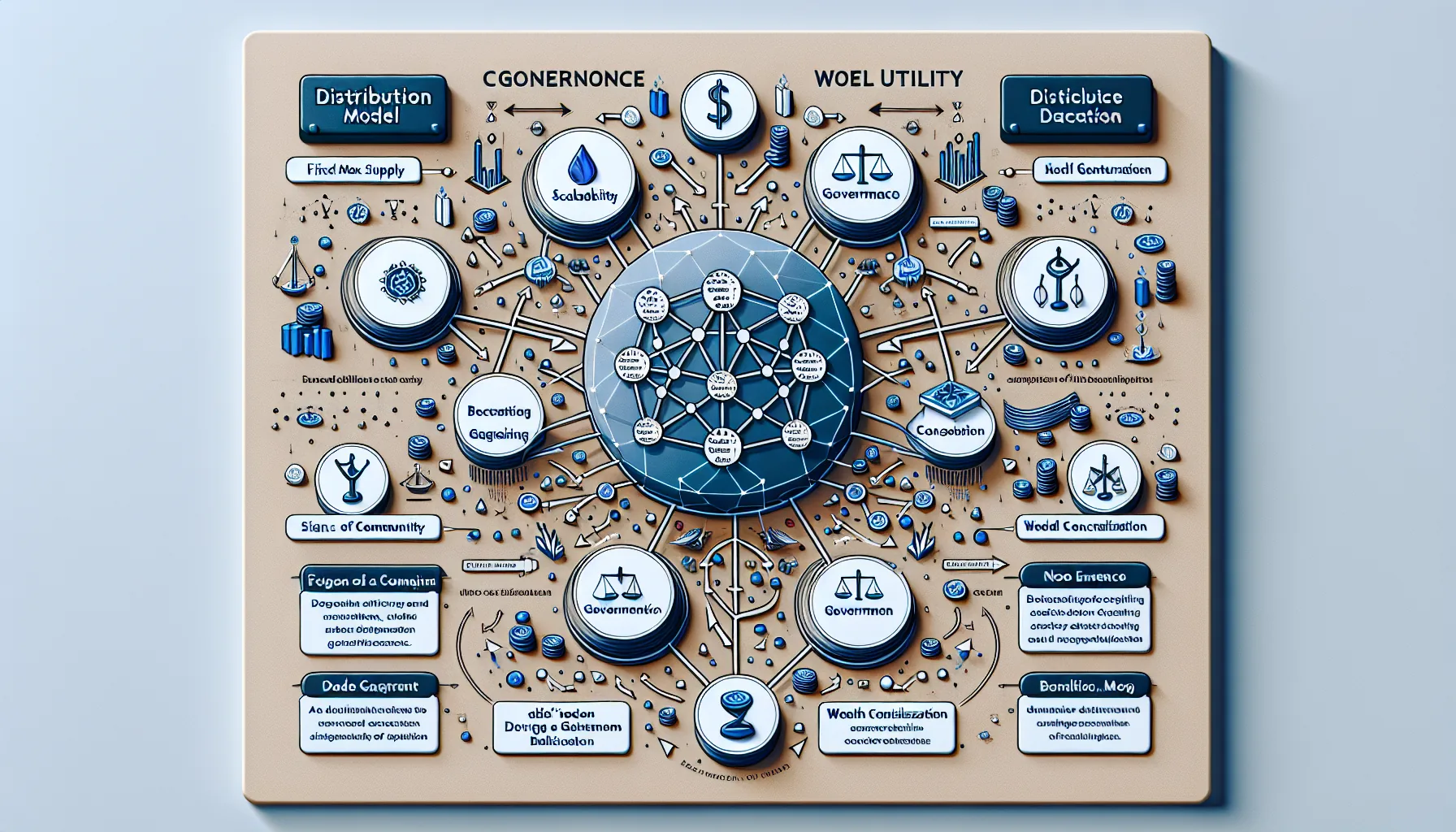
Unpacking the Tokenomics of DAG: Key Metrics and Mechanics
The tokenomics of Directed Acyclic Graph (DAG) networks, specifically Constellation's $DAG token, provide a unique yet intricate framework that merges scalability, governance, and utility. As a native asset within Constellation's Hypergraph ecosystem, understanding DAG's tokenomics requires an in-depth look into its distribution, use cases, and economic dynamics, along with potential challenges or limitations.
Supply and Distribution Model
At the core of DAG is its fixed max supply design, which aims to maintain scarcity while balancing ecosystem growth. The initial token allocation leaned toward rewarding early adopters, node operators, and participants in ecosystem development. Supply distribution includes categories such as team reserves, partner initiatives, and allocations for staking rewards. While this approach fosters network decentralization, concerns about the transparency of initial token dispersal and its long-term impact on governance equity remain active talking points.
Utility-Driven Design
DAG is central to powering Constellation’s Hypergraph Network, acting as fuel for processing data, executing transactions, and achieving consensus within its Proof of Reputable Observation (PRO) protocol. Beyond simple transactional utility, DAG enables seamless interaction with Layer 0 state channels, allowing enterprises to tokenize data streams for multidimensional use cases. However, this reliance on a single utility model linked to enterprise adoption raises questions about its adaptability if enterprise usage growth stagnates or if competitors offer greater flexibility.
Staking and Node Incentives
The economic design includes staking mechanisms whereby node operators secure the network and earn DAG rewards based on throughput and reputation metrics. This reward model encourages high-performance nodes while discouraging bad actors, aligning with the decentralized ethos. Nonetheless, the staking model introduces concerns about wealth centralization as larger stakeholders may dominate node creation, potentially limiting network inclusivity.
Governance and Ecosystem Control
Unlike traditional tokens, DAG emphasizes governance via its consensus model, where node reputation links directly to influence. While this incentivizes active participation and alignment with network health, it could lead to governance biases where influential nodes and participants disproportionately sway decisions. Additionally, the absence of granular token-holder voting beyond node operators may deter smaller community members from engaging more broadly in ecosystem decisions.
Inflationary vs. Deflationary Dynamics
DAG’s fixed supply model positions it more as a deflationary asset over the long term. While this scarcity could heighten its attractiveness during bull periods, it may also limit flexibility during bear cycles, particularly when it comes to incentivizing new participants. Moreover, transaction fees—partially burned within the ecosystem—contribute to deflationary pressure but may also raise concerns about fee predictability and affordability in high-demand scenarios.
Challenges to Monitor
Despite its innovative framework, DAG’s tokenomics face potential hurdles including dependency on enterprise adoption, governance equity issues revolving around staking imbalances, and the challenge of maintaining incentive structures for all participants. As with all crypto ecosystems, sustainable development hinges on balancing decentralization and scalability without disenfranchising smaller stakeholders.
DAG Governance
Governance in DAG: Understanding Decision-Making Within the Network
DAG (Directed Acyclic Graph) crypto assets introduce nuanced governance structures that differentiate them from traditional blockchain-based cryptocurrencies. Effective governance is crucial due to the technical complexities of DAG systems, but challenges exist that can impact decentralization, upgrade processes, and community alignment.
Decentralization Challenges in Governance
While decentralization is a core principle of cryptocurrency governance, DAG networks may face unique obstacles in achieving it. Governance in many DAG-based systems often relies on a form of weighted participation—where token holdings or staked amounts influence decision-making power. This creates an imbalance, as large stakeholders may dominate the voting process, reducing the ability of smaller participants to impact decisions. Such centralization risks may conflict with the ethos of decentralized ecosystems, potentially undermining trust among participants.
Additionally, governance models in DAG-based networks might not yet be as mature as those in more established blockchain projects. This can lead to uncertainties in navigating contentious upgrades or resolving disputes.
Protocol Upgrades and Decision-Making Complexity
Another key consideration in DAG governance is its dependency on the foundational structure of the protocol itself. Unlike linear blockchains, DAG topology introduces non-sequential data confirmation processes, which can complicate governance decisions regarding upgrades or changes. Altering a DAG protocol might require significant technical considerations to ensure backward compatibility or consensus across nodes, especially when the participation of specific validators or coordinators is critical to network operation. Missteps in governance could result in stalled upgrades, forks, or inefficiencies in the network.
Community Involvement: Transparency and Accessibility
Maintaining transparency and accessibility in DAG governance is vital but not universally achieved. Many DAG-based crypto projects rely on developer-led initiatives for protocol changes, leading to questions about whether community participation is sufficiently prioritized. In some cases, proposals and discussions around governance occur in limited forums or through opaque processes, making it challenging for the broader crypto community to engage effectively.
Moreover, a lack of standardized frameworks for governance in DAG systems has led to diverse implementations. While this flexibility allows innovation, it can also create fragmentation within the ecosystem. Disjointed governance practices across different DAG projects make it harder for developers, stakeholders, and token holders to align on best practices.
Governance in DAG networks remains a work in progress, with notable trade-offs between decentralization, decision-making efficiency, and community involvement.
Technical future of DAG
Technical Developments and Roadmap of DAG-Based Crypto Assets
The technical evolution of Directed Acyclic Graph (DAG)-based crypto assets has focused on scaling solutions, decentralized security mechanisms, and interoperability. Unlike blockchain architectures, which rely on sequential blocks, DAG structures offer parallel transaction validation, reducing latency and improving throughput. As technical development progresses, multiple innovations and challenges define the current state and potential future of DAG-based systems.
Scalability and Consensus Optimizations
One of the most prominent efforts in DAG development is refining consensus mechanisms. Traditional DAG platforms often use variants of probabilistic consensus or reputation-based systems, but these can face challenges with bottlenecks during high transaction loads. Current advancements target dynamic staking models and more robust node validation protocols to counter vulnerabilities like parasite chain attacks. Research into hybrid consensus methods—blending DAG's speed with blockchain-style security—is gaining traction, although practical implementation remains complex.
Smart Contract Functionality Integration
DAG-based networks historically struggled with implementing smart contracts at a level comparable to blockchain platforms like Ethereum. This limitation stems from the non-linear nature of DAG structures, which complicates isolated state management. Current roadmaps highlight active development of scalable VM environments and layer-2 frameworks to enable Turing-complete smart contract functionality. While promising, progress in this area has been slower than predicted, primarily due to the additional computational overhead introduced by these solutions.
Interoperability Progress
Interoperability is another key focus for DAG ecosystems. Given that DAG-based assets occupy a niche in the broader crypto landscape, achieving compatibility with other blockchains and networks is critical. Developments such as atomic swaps and cross-chain bridges aim to enhance connectivity, though they are still in early testing phases on most platforms. Furthermore, some DAG projects are exploring inter-DAG communication protocols to extend ecosystem synergy. However, these efforts bring new risks, including potential attack vectors introduced by bridging mechanisms.
Challenges with Network Decentralization
Despite the technical promise of DAGs, decentralization remains a contentious issue. Many DAG networks rely on foundational nodes or governance councils for initial network security and facilitation. Although roadmaps emphasize progressive decentralization, these structures often persist longer than anticipated, leading to concerns about centralization risks. The tradeoff between efficiency and decentralization is a recurring debate within the development of DAG ecosystems.
Future Areas of Research and Testing
Future developments are expected to target distributed AI algorithms, IoT integration, and enhanced privacy layers, particularly zero-knowledge proofs. However, integrating these features into existing DAG architectures remains rife with technical hurdles, such as maintaining performance while scaling complexity. The balance between innovation and network stability will play a significant role in shaping the evolution of DAG-based crypto assets.
Comparing DAG to it’s rivals
DAG vs HBAR: A Technical Comparison of Hashgraph and Directed Acyclic Graph Frameworks
When comparing DAG-based crypto assets like Constellation (DAG) to Hedera’s Hashgraph framework (HBAR), both systems aim to solve similar scalability and efficiency challenges while operating on radically different underlying technologies. The distinctions between these two networks are not trivial, as they highlight key philosophical and technical divergences within the distributed ledger ecosystem.
Consensus Approaches and Architecture
The defining difference lies in the consensus mechanisms and the architecture behind them. DAG operates on a Directed Acyclic Graph structure where transactions themselves validate other transactions. This allows for asynchronous processing, meaning transactions can propagate the network without needing a linear chronological chain. In contrast, Hedera’s Hashgraph employs a gossip-about-gossip protocol combined with virtual voting to achieve consensus. Hashgraph’s methodology emphasizes deterministic finality with Byzantine Fault Tolerance (BFT), providing highly predictable results.
While Hashgraph’s virtual voting achieves consensus with extreme efficiency, its reliance on a permissioned model raises concerns about decentralization. The HBAR network is governed by a council of pre-selected organizations, creating a semi-centralized structure. By comparison, DAG’s architecture is more open in nature, offering a permissionless environment, yet this can also lead to concerns about network security in the event of a poorly optimized incentive structure that allows potential spam attacks.
Scalability and Performance
Hashgraph is widely regarded as one of the fastest distributed ledger technologies, boasting high throughput and low energy usage. However, scalability in Hedera is somewhat limited by its governance structure. Transaction processing on HBAR is bound by network nodes controlled by council members, creating a bottleneck of centralized decision-making. Conversely, the DAG architecture is designed to scale dynamically as more nodes and users join. Each transaction is processed in parallel, theoretically leading to infinite scalability—though this has yet to be fully tested under high-stress scenarios.
Tokenomics and Utility Considerations
Another critical aspect of comparison is tokenomics and usage. HBAR focuses heavily on enterprise adoption, enabling use cases like supply chain management, identity verification, and decentralized advertising platforms, often catering to large-scale corporate clients. Meanwhile, DAG’s tokenomics focus is centered on enabling interoperability for data validation across systems, targeting industries reliant on secure data transmission. Both ecosystems face challenges with adoption, but DAG’s emphasis on interoperability positions it differently compared to HBAR’s corporate-driven trajectory.
Security Models
HBAR emphasizes security through its asynchronous Byzantine Fault Tolerance (aBFT), claiming resilience even against malicious actors. Meanwhile, DAG leverages a more probabilistic security model, relying on the cumulative weight of transactions to determine the trustworthiness of individual actions. This difference in security paradigms often leads to debates over the more practical approach, particularly for critical applications requiring near-infallible verification standards.
In conclusion, comparing DAG and HBAR reveals two distinct approaches to achieving scalability and efficiency within distributed ledger technology, each with its own tradeoffs between decentralization, security, and scalability.
DAG vs FTM: Comparative Analysis of Directed Acyclic Graph Technology in Crypto
When comparing DAG to Fantom (FTM), there are notable similarities and differences in their core technologies, scalability approaches, and use cases, stemming largely from their unique implementations of distributed ledger technology.
Consensus Mechanisms: Directed Acyclic Graph vs. Lachesis Protocol
DAG employs a Directed Acyclic Graph structure to handle transactions, eliminating blocks entirely and allowing for asynchronous, parallel transaction validation. This approach is highly efficient for high-throughput, low-latency use cases. FTM, on the other hand, relies on Lachesis, a custom variant of the asynchronous Byzantine Fault Tolerant (aBFT) consensus model. Lachesis allows Fantom to achieve fast finality and high scalability while maintaining network security. However, it still structures its ledger in block architecture, contrasting with the blockless nature of DAG’s design.
One potential weakness in DAG’s approach lies in its reputation system for validation, which some argue could introduce nuances of centralization if a small set of nodes gain disproportionate influence over others. In contrast, Fantom's Lachesis promotes validator decentralization through staking incentives, although concerns about potential validator collusion persist.
Throughput and Network Scalability
Both DAG and FTM are designed to excel in environments demanding high throughput, but their performance characteristics are shaped by their differing architectures. DAG’s blockless structure, theoretically, can achieve near-infinite scalability as more users and devices contribute validations. Yet, this level of scalability is highly dependent on consistent participation and the proper selection of reputable nodes, which could present bottlenecks under certain conditions.
Fantom, by using a more traditional layered blockchain system tailored with DAG-inspired elements to simplify transaction processes, offers competitive throughput speeds with confirmation times often under 1 second. However, Fantom’s scalability is contingent on the performance of individual subnets, called Opera chains, in its ecosystem. This can become a constraint if the network grows rapidly or the ecosystem fragments between siloed applications.
Smart Contract Support
A major distinction lies in the support for smart contracts. Fantom natively supports the Ethereum Virtual Machine (EVM), making it fully compatible with Ethereum-based dApps and tooling. This has bolstered FTM’s developer adoption and ecosystem growth. DAG, while capable of facilitating smart contract functionality via its ecosystem, has not achieved the same level of interoperability or adoption in the broader Web3 development community. This could limit its traction among developers in the short to medium term, relative to Fantom's clear EVM compatibility advantage.
Security Trade-Offs
Fantom’s Lachesis increases confidence in transaction finality even under Byzantine conditions, theoretically making it less prone to attacks. DAG, while innovative, relies heavily on the accuracy and reputation of its validating nodes. Any failure in this selection process could expose vulnerabilities, making trust mechanisms a potential weak point compared to Lachesis’s more formally defined consensus.
In conclusion, the architectural differences between DAG and Fantom result in trade-offs across scalability, decentralization, and developer adoption. For users choosing between the two, understanding these distinctions is critical to aligning the technology with their specific needs.
DAG vs ALGO: A Technical Comparison of Distributed Ledger Designs
When comparing DAG (Directed Acyclic Graph) to ALGO (Algorand), the key differences lie in their underlying design philosophies, consensus mechanisms, scalability approaches, and trade-offs in decentralization. Both projects aim to address significant challenges in the blockchain space but implement strikingly different methodologies.
Consensus Mechanism: PoW-Free Approaches Diverge
DAG's architecture eliminates traditional blocks and relies on a graph-based structure where transactions directly validate one another. This eliminates block times and could theoretically enable infinite scaling as network activity increases. In contrast, Algorand employs a Pure Proof of Stake (PPoS) consensus protocol, where validators are selected randomly and secretly to produce blocks and participate in consensus. While Algorand’s approach ensures fast finality and robust security under adversarial conditions, DAG’s model emphasizes parallelization, which may introduce challenges for maintaining consistent global state as network complexity grows.
Scalability Trade-Offs
Algorand boasts a high throughput, achieving thousands of transactions per second (TPS) and near-instant finality. This is partly due to its efficient consensus mechanism but also a function of its traditional blockchain model, which simplifies state management. DAG, on the other hand, scales horizontally, with TPS increasing as the number of users and transactions grow. However, this scalability can complicate network stability and synchronization, as reaching consensus across a sprawling and dynamic graph structure presents computational challenges. Disparate nodes in a DAG-based model may interpret the network differently, especially during high activity periods or under adversarial conditions, which could lead to temporary inconsistencies.
Decentralization Considerations
Decentralization is a nuanced topic between these two systems. Algorand claims a high level of decentralization given its randomized validator selection, but questions have been raised regarding the distribution of its token supply and its governance system, which may give disproportionate influence to early adopters or foundation-backed stakeholders. DAG-based networks tend to distribute validation responsibility more fluidly, as every participant can validate transactions. However, this model also introduces the risk of higher centralization around dominant nodes that process a significant portion of traffic, potentially creating bottlenecks or vulnerabilities.
Smart Contract Functionality
Support for advanced smart contracts is a noteworthy difference. Algorand offers well-developed Layer 1 smart contract capabilities and supports NFTs and DeFi applications. DAG architectures typically do not natively support complex smart contracts on the same level due to the structure’s focus on transaction throughput rather than programmability. For projects aiming to build decentralized applications, this distinction underscores a major consideration when choosing between the ecosystems.
By highlighting these technical distinctions, it’s clear that the two systems cater to different use cases and bring unique trade-offs to the table in tackling blockchain’s trilemma of scalability, decentralization, and security.
Primary criticisms of DAG
Primary Criticism of Directed Acyclic Graph (DAG) Crypto Assets
Directed Acyclic Graph (DAG)-based crypto assets have garnered attention for their scalability and unique structure. However, despite the technological advantages often associated with DAGs, they are not without criticism. Below are some of the primary concerns raised by the crypto-savvy community regarding these assets.
Lack of Decentralization in Practice
While DAG structures promise decentralization, many critics argue that this benefit isn't fully realized in practice. DAG-based networks often rely on a limited number of validator or coordinator nodes during initial phases or to mitigate certain attack vectors. This setup can create a perception, or even a reality, of centralization. Such centralization contrasts with the core ethos of blockchain technology, where trustless, permissionless systems are paramount.
Challenges in Security
DAG systems face industry scrutiny regarding their security assumptions. Unlike proof-of-work (PoW) or proof-of-stake (PoS) blockchains, DAG implementations typically lack robust economic mechanisms to prevent Sybil attacks or double-spending. Instead, they often rely on trust-based reputation systems or centralized checkpoints, which may introduce exploitable vulnerabilities or require subjective arbitration by network stakeholders.
Maturity and Adoption Concerns
Despite their technical appeal, DAG-based crypto assets remain underdeveloped compared to traditional blockchain networks. Critics highlight that the infrastructure, developer tools, and third-party integrations often lag significantly. The ecosystem surrounding DAG assets typically lacks the established support seen with more mature networks like Ethereum or Bitcoin, which restricts their adoption cycle significantly.
Complex Consensus Mechanisms
DAG's consensus models can be conceptually obscure, even to those well-versed in blockchain technology. Concepts such as tip selection algorithms or reputation-based consensus mechanisms are often poorly documented or lack transparency. This complexity can deter developers, investors, and regulators, creating hurdles for widespread adoption.
Undefined Standards and Fragmentation
With no universally accepted standards for implementation, DAG ecosystems are prone to fragmentation. Each project tends to adapt DAG mechanics to suit its specific use case, further complicating interoperability between platforms. This issue limits cross-project collaboration and isolates DAG-based assets within their individual silos.
Increased Attack Surface
The novel structure of DAGs introduces new attack vectors distinct from traditional chains, including vulnerabilities in topology configurations or tip selection algorithms. Critics warn that these potential exploits have not been fully stress-tested in real-world situations at scale. Skeptics argue that these systems might falter under high activity or malicious intent.
Through examining these criticisms, it becomes evident that while DAGs offer innovative solutions to long-standing blockchain limitations, they also present their own unique challenges.
Founders
The Founding Team Behind DAG: Key Figures and Insights
The founding team of a crypto project often plays a critical role in its trajectory, and the Constellation Network project — powered by its DAG token and technology — is no exception. With a governance structure rooted in a decentralized ethos, the personnel at the core of DAG's creation and development reflect a blend of experience in technology, cryptography, and entrepreneurship. However, like any crypto initiative, the background and decisions of the founders leave room for scrutiny.
The primary names associated with DAG's inception include Benjamin Jorgensen, Wyatt Meldman-Floch, and Mathias Goldmann, among others. Each has brought a distinct expertise to the project. Jorgensen, as CEO, has often positioned himself as the face of Constellation Network, highlighting the technical underpinnings of its Directed Acyclic Graph (DAG)-based architecture in various forums and discussions. A serial entrepreneur, Jorgensen’s roots in blockchain trace back to his interest in tackling data integrity – a challenge he believes existing blockchain solutions fail to address effectively.
Wyatt Meldman-Floch, the project’s Chief Technical Officer, has been instrumental in shaping Constellation Network’s technical foundation. Coming from a background in database systems, distributed ledger technology, and machine learning, Meldman-Floch is often credited with spearheading the application of DAG-based designs to improve scalability and throughput — core tenets of the network. His claims of creating a highly modular protocol have garnered attention, though doubts remain among some crypto enthusiasts about the implementation challenges inherent to DAG technology.
Mathias Goldmann, serving as COO, has positioned himself as a key figure in the network’s operational strategy. His previous corporate experience, combined with a focus on compliance, reflects the team’s intent to create a bridge between cutting-edge blockchain solutions and enterprise-level usability. However, skeptics argue that coupling decentralization with enterprise adoption poses risks to the protocol’s neutrality over time.
Several in the crypto space have raised valid critiques about the concentration of influence among the founding members in the project's early stages. While the team’s backgrounds underscore technical proficiency and strategic focus, questions linger surrounding the transparency of development milestones and the pace of open-source adoption within the ecosystem. For a project that touts decentralization as a core principle, reliance on a comparatively small founding team has been a point of contention.
Moreover, critics have pointed to the team's communication as sometimes esoteric, making it difficult for even savvy participants to assess key developments in real-time. This opacity has led to debates about whether the founding team’s goals fully align with the community’s expectations for an open and trustless network.
Authors comments
This document was made by www.BestDapps.com
Sources
- https://constellationnetwork.io
- https://github.com/Constellation-Labs/constellation
- https://constellationnetwork.io/whitepaper.pdf
- https://medium.com/constellationlabs
- https://www.coingecko.com/en/coins/constellation-labs
- https://coinmarketcap.com/currencies/constellation/
- https://docs.constellationnetwork.io/
- https://twitter.com/Conste11ation
- https://www.reddit.com/r/Constellation/
- https://explorer.constellationnetwork.io/
- https://dag.global/
- https://www.youtube.com/c/ConstellationLabs
- https://www.kucoin.com/trade/DAG-BTC
- https://beincrypto.com/learn/what-is-dag/
- https://cryptoslate.com/coins/constellation-labs/
- https://icodrops.com/constellation/
- https://techcrunch.com/2018/06/07/constellation-labs/
- https://www.coinbureau.com/education/what-is-dag-constellation/
- https://medium.com/constellationlabs/state-channels-101-building-scalable-distributed-data-systems-on-dag-36a3db598ff9
- https://www.block123.com/en/token/dag/


