History of CSPR
The History of CSPR: From Conception to Mainnet Launch
CSPR, the native token of the Casper Network, has its roots in solving scalability and usability challenges within the blockchain ecosystem. The project's journey began with the creation of CasperLabs in 2018, co-founded by a team of experienced developers and researchers, including prominent figures like Medha Parlikar and Dr. Daniel Kane. The core ambition was to build a blockchain network that offered enterprise-grade features without sacrificing decentralization or security.
The Casper protocol itself is based on a modified version of the Correct-by-Construction (CBC) Proof-of-Stake (PoS) consensus mechanism proposed by Ethereum Foundation researcher Vlad Zamfir. Initially, the CBC concept faced complexities in formalizing its principles into a fully functional system. CasperLabs worked extensively to create a robust implementation of CBC PoS, choosing to focus on developer-friendly tooling and enterprise adoption.
In early 2021, after years of research and development, CasperLabs facilitated the Casper Network’s testnet, allowing developers and validators to experiment with its consensus model. One notable aspect of this process was the network's emphasis on upgradability and flexibility to accommodate future technical advancements, a feature often missing in earlier-generation blockchains. However, this focus brought criticism from some in the crypto community, who argued that such malleability could undermine decentralization if not carefully managed.
Casper Network achieved its mainnet launch in March 2021, supported by Initial Coin Offering (ICO) and private funding rounds conducted on platforms such as CoinList. The ICO was pivotal in distributing CSPR tokens to a broader audience, though it encountered some controversy. Critics pointed to the high allocation to early investors and the limited availability of tokens for public buyers, raising concerns about wealth centralization within the ecosystem.
Post-launch, the Casper Network's technical roadmap continued to identify itself as enterprise-focused. However, this positioning led to debates about whether the project leaned too heavily on centralized partnerships, thus potentially alienating the broader crypto community. While the network gained traction from organizations seeking customizable blockchain solutions, its adoption among individual developers and DeFi enthusiasts progressed more slowly than anticipated.
Additionally, Casper faced challenges with competition. As other Layer 1 blockchain projects emphasized composability, decentralized governance, and incentive structures, Casper encountered obstacles in maintaining its unique value proposition. This underscored the difficulty of standing out in a crowded market saturated with innovative platforms vying for developer attention.
CSPR's historical trajectory highlights a project deeply rooted in research and enterprise-grade applications, but not without contention over its design priorities and tokenomics. Its history is a reflection of the broader struggles faced by blockchain projects attempting to balance innovation with community adoption and institutional-friendly features.
How CSPR Works
How CSPR Works: The Technical Functionality Behind Casper Network's Native Token
The CSPR token functions as the native cryptocurrency of the Casper Network, a proof-of-stake (PoS) blockchain designed to address scalability, usability, and security. At its core, CSPR operates as the economic layer of the Casper Network, facilitating consensus mechanisms, incentivizing validator participation, and enabling on-chain governance—all while integrating features like upgradeable smart contracts and WebAssembly (Wasm) compatibility for developers.
Consensus Mechanism and Validator Incentives
CSPR plays a critical role in Casper’s Highway Protocol, a fork of the Correct-by-Construction (CBC) Casper consensus model. Validators are responsible for securing the network, confirming transactions, and proposing new blocks in exchange for CSPR rewards distributed via staking mechanisms. Token holders can participate in the network as delegators, staking their CSPR by delegating tokens to validators in exchange for a portion of the rewards. However, the staking model requires careful participation; validators or delegators associated with misbehavior—such as double-signing or downtime—face penalties, including reduced staking rewards or slashing.
While PoS reduces energy consumption compared to proof-of-work (PoW) systems, its model relies heavily on CSPR’s distribution and staking architecture to ensure decentralization. Concerns remain over the impact of token concentration: a small number of participants controlling a disproportionately large share of staked CSPR can potentially limit the decentralization and security of the network.
Gas Payments, Smart Contracts, and Network Utility
CSPR also functions as the utility token for executing transactions and deploying smart contracts. Users pay CSPR as “gas fees” to utilize the network, incentivizing validators to include their operations in newly proposed blocks. One key feature of Casper is its implementation of predictable gas fees, aimed at mitigating extreme fluctuations in cost during network congestion. However, as with any blockchain, fee structures may face scalability challenges under heavy transactional loads.
For developers, the Casper Network offers tools such as upgradeable smart contracts and contracts written in Wasm, giving flexibility for building decentralized applications. Nevertheless, this innovation comes with its own set of hurdles. While the upgradeable contract model fosters adaptability, critics argue that it introduces possible attack vectors since contract owners retain modification privileges post-deployment.
On-Chain Governance
Casper’s governance mechanisms are heavily reliant on CSPR for decision-making. Network participants, particularly validators, influence protocol development, updates, and feature roll-outs through voting systems. However, this governance model assumes active community engagement, and disproportionate participation by large stakeholders could potentially skew decision-making in their favor.
Use Cases
CSPR Use Cases: Unlocking the Potential of Casper Network
Casper Network, powered by its native token CSPR, is designed to address key bottlenecks in blockchain adoption by enterprises and developers. Below is an exploration of its use cases, delving into both strengths and challenges.
1. Enterprise-Grade Smart Contracts
CSPR plays a critical role in facilitating the deployment and execution of smart contracts on the Casper Network. The platform’s support for upgradable smart contracts appeals to enterprises, enabling flexibility in adapting to changing business needs without requiring a complete redeployment. This eliminates some traditional limitations of blockchain immutability when it comes to iterative development.
Challenges: While the upgradability feature is a major innovation, it also raises concerns about centralization risks. Enterprises controlling upgrades could potentially compromise trustlessness if mechanisms for community oversight are insufficient.
2. Decentralized Identity Management
Casper's infrastructure enables the development of decentralized identity (DID) solutions that leverage CSPR for transaction fees and governance. These systems aim to give individuals control over their personal data while maintaining transparency and security. Unlike traditional identity management systems, DIDs built on Casper are interoperable and scalable, making them attractive to large organizations managing user access and authentication.
Challenges: Adoption of decentralized identity remains nascent, and Casper faces stiff competition from established blockchain projects already offering such solutions. Furthermore, convincing enterprises to overhaul their existing identity management systems presents significant friction.
3. Tokenization of Real-World Assets
Casper Network supports the creation and management of tokenized assets, including real estate, intellectual property, and supply chain components. CSPR is utilized to pay for minting, transferring, and integrating asset-backed tokens into dApps. The network’s predictable gas fees reduce uncertainty, a key factor for asset issuers.
Challenges: Although the technical capability exists, real-world implementation requires legal and regulatory frameworks that vary significantly across jurisdictions. The network’s ability to scale such solutions depends heavily on third-party integration and compliance.
4. Enterprise Data Management
Casper enables organizations to store and manage sensitive data securely on the blockchain, with CSPR used to pay for storage-related transactions. For industries like healthcare and finance, the ability to achieve both privacy and transparency using the network’s cryptographic techniques is highly attractive.
Challenges: Blockchain-based data storage is still costlier and slower compared to traditional cloud solutions. Enterprises considering Casper must weigh these trade-offs against their specific requirements for security and censorship resistance.
5. Staking and Network Security
CSPR is instrumental in Casper’s Proof-of-Stake (PoS) consensus mechanism, where token holders can stake their assets to secure the network and participate in governance. Staking provides an additional income stream for participants while ensuring the blockchain remains decentralized and resilient.
Challenges: Staking requires maintaining active validator nodes, which could lead to centralization if control becomes concentrated among entities with significant infrastructure capabilities. In addition, smaller token holders may face barriers to participating meaningfully in governance.
By addressing enterprise challenges while leveraging CSPR’s role as an essential infrastructure layer, Casper Network is positioning itself as a blockchain optimized for real-world use cases. However, unlocking mass adoption depends not only on the uniqueness of its features but also on overcoming limitations tied to scalability, trust, and external stakeholder buy-in.
CSPR Tokenomics
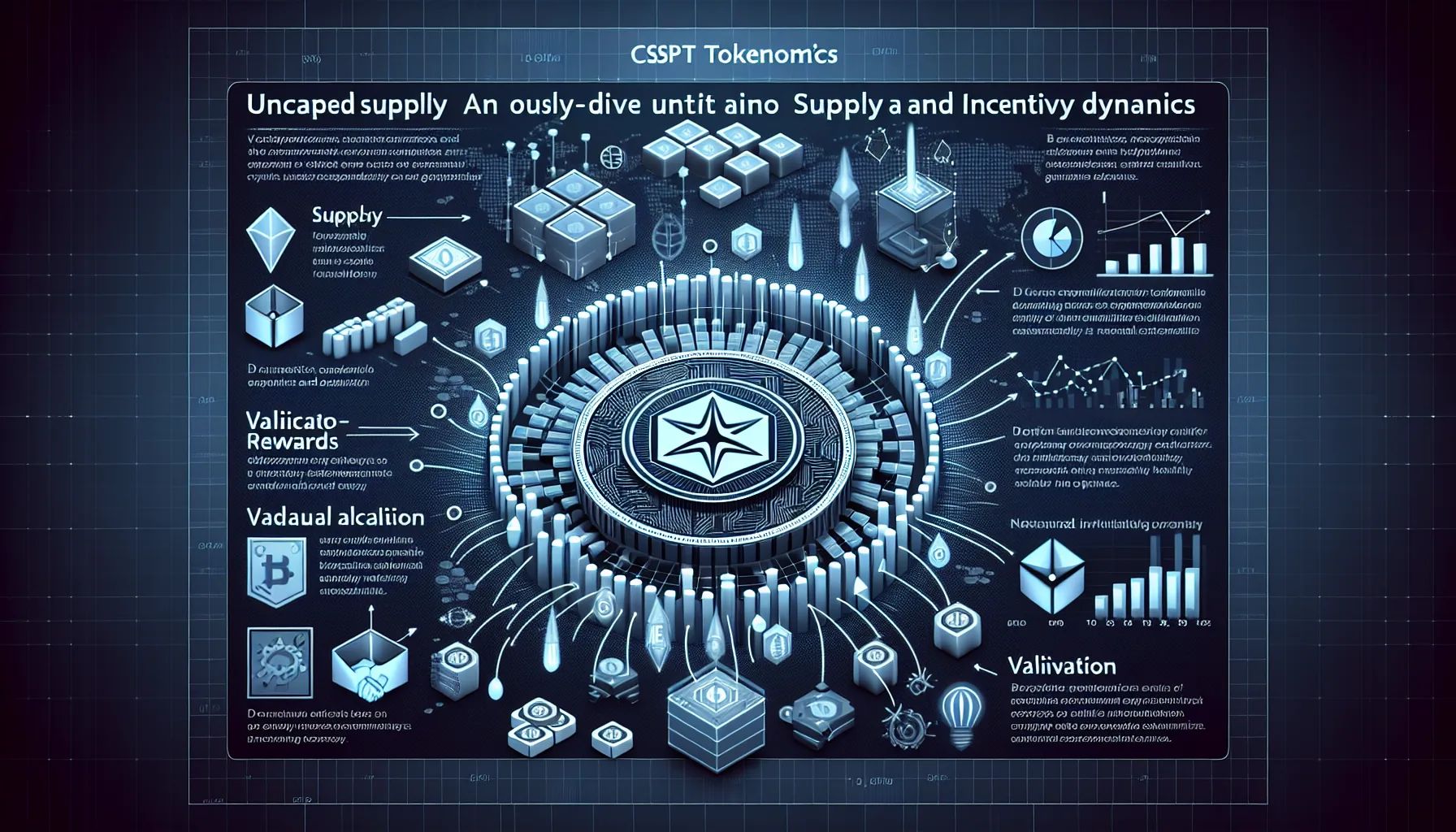
CSPR Tokenomics: A Deep Dive into Supply and Incentive Dynamics
The tokenomics of CSPR, the native cryptocurrency of the Casper Network, is shaped by its unique approach to issuance, allocation, and overall network economics. Designed to support a scalable, proof-of-stake (PoS) blockchain, CSPR's structure aims to balance long-term decentralization with incentivization for participants. However, certain aspects of its design present challenges that warrant scrutiny.
Supply Mechanism and Inflation Model
CSPR operates with an uncapped supply, opting for an inflationary model designed to continuously reward validators and support the security of the network. The annual inflation rate is currently set at a fixed percentage, which introduces predictability in reward distribution while maintaining incentives for network validators and delegators. While this mechanism provides ongoing rewards, it necessitates a consistent demand growth to offset inflationary pressure. Without sufficient ecosystem adoption or transactional utility, the inflation model risks diluting the value of existing tokens over time.
Initial Allocation and Distribution Concerns
The distribution of CSPR during its initial token sale and network launch garnered attention due to a relatively high allocation to early backers and the founding team. A significant portion of the total supply was allocated to developers, validators, and ecosystem participants, a strategy aimed at jumpstarting adoption and incentivizing early contributions. Critics, however, point to potential centralization risks arising from this structure. Concentrated holdings among a small group could pose governance challenges, especially in a PoS system where influence correlates with token control.
Staking Rewards and Participation
CSPR holders can delegate their tokens to validators to earn staking rewards, a critical component of the network's PoS model. The reward structure is designed to encourage widespread token staking, thereby enhancing network security. However, staking participation rates and the distribution of validators play a crucial role in determining how effectively the network remains decentralized. A scenario where a limited number of validators dominate staking could undermine the network's resilience and democratic governance, especially in light of the aforementioned allocation concerns.
Token Utility and Ecosystem Development
CSPR's primary utility lies in network fees, staking, and participation in governance. The emphasis on creating a developer-friendly infrastructure aims to fuel demand for the token through decentralized applications and enterprise use cases. Nevertheless, the pace of ecosystem development is critical for sustaining token demand. Without significant growth in on-chain activity, the inflationary supply model may exacerbate market challenges, highlighting the need for a robust and expanding ecosystem.
Conclusion: Key Considerations in the Tokenomics of CSPR
CSPR's tokenomics reflect a carefully thought-out model for incentivizing participation and ensuring network security. However, it's essential to monitor the effects of inflation, initial distribution, and staking centralization on long-term network health and economic sustainability.
CSPR Governance
Governance Mechanisms in the Casper (CSPR) Network
The governance model of Casper (CSPR) is designed to support a decentralized and inclusive approach while prioritizing scalability and security. As a blockchain platform built on the Casper CBC (Correct-by-Construction) consensus protocol, governance decisions are deeply intertwined with the protocol's design, its validator network, and how protocol changes are proposed and adopted. However, like other proof-of-stake (PoS) networks, there are notable strengths and challenges inherent to its governance framework.
On-Chain Governance and Validator Responsibilities
In the Casper ecosystem, validator nodes play a central role in governance. Validator selection is carried out through staking: network participants delegate their CSPR tokens to validators, effectively granting them voting power. These validators are responsible for maintaining the network’s security, validating transactions, and reaching consensus on-chain. Governance rights, therefore, are closely tied to the distribution of staked tokens, which creates a structure where decision-making influence corresponds to economic participation.
While this incentivizes validators to act in the network's best interest, the inevitable centralization risks exist. If large token holders or staking pools dominate the validator set, governance decisions may skew toward their preferences, reducing inclusivity and threatening decentralization. The Casper Network actively monitors such risks but has yet to fully mitigate them.
Proposal Submission and Upgrade Implementation
Casper takes an upgrade-friendly approach, which allows the network to evolve without requiring disruptive hard forks. Proposed protocol changes and upgrades are often discussed off-chain before being submitted for formal voting by validators. This blend of off-chain deliberation and on-chain decision-making ensures flexibility but has potential drawbacks in transparency and engagement. Some critics argue that relying heavily on validator participation in governance may reduce the direct involvement of smaller token holders and community members.
Additionally, while the network’s governance mechanisms are less prone to stagnation compared to rigidly structured models, they require continuous education and communication with stakeholders. Misaligned incentives or lack of understanding from participants could result in a fragmented decision-making process or slower adoption of crucial upgrades.
Governance Transparency and Community Involvement
While validators are pivotal, the broader Casper community does not yet have robust mechanisms for direct governance input. Unlike some governance token systems that encourage grassroots participation, Casper’s structure leans towards a top-heavy model. Efforts to increase transparency and foster broader dialogue within the community remain a work in progress. Realizing inclusive governance will likely require additional tooling, such as decentralized identity systems or accessible voting platforms, to empower token holders of all scales.
Technical future of CSPR
Current and Future Technical Developments of CSPR: An In-Depth Analysis
Casper Network (CSPR) has garnered attention in the blockchain space for its unique approach to scalability, security, and developer-friendly architecture. At the core of its technology lies its innovative consensus algorithm: Correct-by-Construction (CBC) Casper, a research-driven Proof-of-Stake (PoS) mechanism. This section dives into the network’s current technical progression and its proposed roadmap, highlighting advancements as well as potential challenges.
Current Technical Features and Upgrades
One of the standout features of CSPR is its enterprise-grade WebAssembly (WASM) contract environment. The use of WASM improves the chain’s interoperability with mainstream programming languages like Rust or AssemblyScript, making it more accessible for developers to deploy and audit smart contracts. Additionally, the recently implemented protocol-level changes enhance gas efficiency, targeting an improved developer and user experience. The “Highway Protocol,” a moving part of CBC Casper, has also been optimized to enable flexible finality thresholds, allowing network participants to adjust security and performance parameters on the fly.
Another notable development is Casper’s designed support for upgradable smart contracts. While forward-looking and beneficial for long-lived applications, this feature introduces complexity for developers who must account for version control and test around potential upgrade-induced contract conflicts. Despite these challenges, Casper is solidifying its reputation as a blockchain geared toward real-world enterprise adoption.
Future Technical Roadmap
Casper's roadmap places a strong emphasis on future-proofing the network while scaling to accommodate demand. Two significant upgrades loom on the horizon: the implementation of shard-aware execution technology and tighter integrations with zero-knowledge proof (ZKP) systems. Sharding is critical for improving transaction throughput by distributing the computation and storage burden across multiple segments of the network. Early-stage sharding prototypes have shown promise, but questions remain around ensuring cross-shard communication without compromising performance or breaking atomicity.
Moreover, the team has signaled its intent to integrate ZKPs to bolster privacy and off-chain computational capabilities. ZKPs introduce potential efficiencies, yet they also pose a formidable developmental challenge due to their computational intensity and intricate cryptographic dependencies.
Challenges and Considerations
While Casper Network’s modular framework offers notable adaptability, it faces competition in interoperability and developer tooling from larger ecosystems like Ethereum and Polkadot. Specific concerns also exist around validator centralization. Despite being PoS-driven, there is a risk of validator dominance by a few entities, potentially undermining the network's decentralized ethos.
In summary, Casper’s technical developments and roadmap bring innovation and complexity alike, positioning it uniquely in the evolving blockchain landscape. Carefully orchestrating these developments will be the key to navigating its technical trajectory.
Comparing CSPR to it’s rivals
Comparing CSPR to ATOM: Key Differences in Layer-1 Design and Consensus
When assessing Casper (CSPR) against Cosmos (ATOM), two core differentiators surface: design philosophy and consensus mechanisms. Both are Layer-1 protocols, but their approach to scalability, decentralization, and developer engagement diverges significantly.
Scalability and Technical Architecture
Casper utilizes its Highway Protocol, an innovative consensus mechanism based on the Casper Correct-by-Construction (CBC) framework. Its primary focus is on energy efficiency and flexibility while providing security assurances akin to traditional proof-of-stake systems. This design emphasizes incremental upgrades to the network, offering enhanced flexibility to adjust slashing parameters or other governance rules over time. Additionally, CSPR emphasizes a weighted key management system, making it developer-friendly for enterprise-grade dApps.
In contrast, ATOM relies on the Tendermint consensus engine alongside the broader Cosmos SDK for its modular development. Tendermint prioritizes simplicity and speed, offering robust performance but at the potential expense of higher hardware requirements for node operators. Furthermore, while Cosmos boasts the Inter-Blockchain Communication (IBC) protocol to enable interoperability, Casper sticks to its single-layer focus with future possibilities for scaling solutions such as layer-2 integrations or cross-chain bridges.
While Tendermint's simplicity has allowed Cosmos to foster fast adoption, critics argue that its modular approach may risk fragmentation across the ecosystem. Casper’s design, by focusing solely on Layer-1 functionality, counters this issue but lacks Cosmos' native interoperability solutions, which are crucial for broader use cases like DeFi or cross-chain NFT marketplaces.
Token Utility and Ecosystem Funding
ATOM plays a crucial role in securing the Cosmos Hub and managing governance, but its tokenomics model has often been criticized for lacking hard caps, potentially creating long-term inflationary pressures. Casper’s CSPR, on the other hand, incorporates a more predictable linear issuance model. This choice appeals to those prioritizing fiscal predictability for staking rewards and token distribution. Yet, it can also be perceived as overly conservative, which might slow ecosystem growth when attracting developers or investors.
While Cosmos has seen rapid adoption due to aggressive marketing and ecosystem funding, CSPR has taken a more measured approach, focusing largely on developer-led growth without the same level of community-driven hype or diversity in dApps. However, this more conservative strategy is a double-edged sword—strong foundations can lead to long-term stability, but they may also hinder Casper’s ability to create innovative projects at the scale seen in Cosmos’ thriving ecosystem.
Onboarding Challenges and Developer Usability
One area where Casper excels is its implementation of upgradable smart contracts and weighted keys, which cater largely to enterprise applications by simplifying maintenance around contracts post-deployment. In contrast, Cosmos developers must manually integrate similar functionality into dApps, relying on individual module configurations to handle comparable needs.
That said, ATOM’s ecosystem has a lower barrier to entry for everyday developers, as the Cosmos SDK is tailored for modular organizational structures. Casper's heavy focus on correctness might present an overly steep learning curve for independent developers, particularly those looking for out-of-the-box solutions with minimal friction. Additionally, while Casper’s enterprise alignment offers long-term potential, it risks alienating smaller contributors who might find the enterprise-first focus restrictive compared to Cosmos' more inclusive developer tooling.
Ultimately, the divide between Casper and Cosmos (ATOM) is philosophical: Casper targets precision and long-term flexibility, while Cosmos champions modularity and interoperability. This split often shapes where developers and projects choose to build, with each approach having distinct trade-offs that merit close attention.
Comparing CSPR to DOT: Key Differences in Ecosystem and Design
When evaluating CSPR (Casper) against DOT (Polkadot), it’s essential to understand the fundamental architectural and operational divergences that set the two apart. While both aim to address scalability, interoperability, and blockchain innovation, their approaches and ecosystems differ significantly.
Consensus Mechanisms: CBC-Casper vs. Nominated Proof-of-Stake (NPoS)
CSPR is built on the CBC-Casper specification, a forward-looking proof-of-stake (PoS) consensus model known for its flexibility and eventual consistency. This infrastructure allows for upgrades without hard forks and is designed to support enterprise adoption. DOT, on the other hand, leverages a Nominated Proof-of-Stake (NPoS) model, where nominators back validators they trust with their tokens to secure the network. While NPoS provides strong economic incentives for decentralization, critics often point out that larger stakeholders can accumulate disproportionate influence in the nomination process, potentially leading to centralization risks.
Interoperability: Polkadot’s Parachains vs. Casper's Smart Contracts
Polkadot's core innovation lies in its parachain model, which enables multiple layer-1 blockchains to coexist and communicate. This inherently positions DOT as an interoperability powerhouse, but the parachain model requires substantial development effort, funding, and expertise, making it difficult for smaller projects to integrate. CSPR, in contrast, focuses primarily on customizable smart contracts with predictable gas fees, appealing directly to enterprises prioritizing scalable dApps over cross-chain operability. While CSPR’s lack of robust interoperability frameworks like Polkadot’s could limit its appeal to DeFi projects, its enterprise-first orientation could be seen as a feature rather than a flaw for certain use cases.
Governance: On-Chain Advancements vs. Simplicity
Governance represents another critical divide. Polkadot offers a sophisticated on-chain governance model, where stakeholders vote on proposals to upgrade or change the network’s direction. Every aspect of Polkadot can be modified through decentralized input. However, critics argue that the system’s complexity burdens participants with the need for constant engagement to ensure governance decisions truly reflect decentralized consensus. In contrast, CSPR opts for a simpler governance model that prioritizes sustainability over ongoing voter involvement, though this has raised concerns regarding slower adaptation to rapidly evolving user demands.
Developer Accessibility
Polkadot’s Substrate framework is a double-edged sword for developers. It provides unparalleled flexibility for creating custom blockchains but comes with steep learning curves. Casper’s WebAssembly (Wasm) support offers a more familiar environment for developers accustomed to traditional programming languages. Yet, this focus on accessibility may underserve projects seeking highly customized blockchain solutions that Polkadot’s Substrate can facilitate.
In summary, while both networks focus on innovation, the architectural and ecosystem trade-offs between CSPR and DOT speak to distinct priorities within their respective target markets.
Comparing CSPR and NEAR: A Detailed Analysis of Key Differentiators
Casper (CSPR) and NEAR Protocol (NEAR) represent two distinct approaches within the blockchain ecosystem, particularly in the way they tackle scalability, developer accessibility, and use-case flexibility. While both aim to provide next-generation solutions tailored for enterprise adoption and dApp (decentralized application) development, their technological foundations and ecosystem strategies exhibit stark contrasts.
Consensus Mechanism: Optimizing for Speed and Security
CSPR relies on the Casper CBC (Correct by Construction) proof-of-stake consensus mechanism, which emphasizes network security and scalability while balancing finality and decentralization. NEAR, on the other hand, operates using the Doomslug variant of proof-of-stake alongside the Nightshade sharding mechanism. While both platforms lean into PoS for energy efficiency, NEAR’s use of dynamic sharding stands out as a direct scalability enabler. It segments state and transaction processing across smaller and parallel workloads, theoretically enabling near-linear scalability.
However, NEAR’s sharding approach introduces potential complexities—such as synchronizing across shards and latency issues under high congestion—that may impact certain dApps requiring instant cross-shard communication. Casper sacrifices such advanced scalability methods for simpler architecture but also avoids some of these multi-shard synchronization headaches.
Developer Usability and Accessibility
NEAR prioritizes a developer-friendly experience, providing SDKs in common programming languages like JavaScript and frameworks like Rust. Moreover, NEAR boasts innovations such as “human-readable accounts,” which replace traditional cryptographic addresses with easier-to-use aliases. For developers unfamiliar with blockchain, this significantly lowers the entry barrier.
Casper, conversely, takes a more enterprise-oriented focus with features like upgradeable smart contracts and predictable gas fees. However, this design choice can create obstacles for newer developers accustomed to Ethereum-style programming paradigms, as Casper’s WebAssembly (Wasm)-based smart contract language may require a steeper initial learning curve.
Tokenomics and Incentive Structures
CSPR’s inflationary model is tied closely to its staking dynamics, providing steady rewards for validators and delegators while maintaining an emphasis on long-term ecosystem sustainability. NEAR operates under a deflationary or capped-supply tokenomics model, which burns transaction fees—offsetting inflation pressures but potentially limiting long-term validator rewards as transaction volume grows. This presents a fundamental ideological divergence in how each network incentivizes participation and growth.
Critics have pointed out that NEAR’s burn model, while attractive on paper, might yield uncertain outcomes for system security if token rewards drop drastically over time. Meanwhile, Casper’s inflationary model provides clearer incentivization but at the cost of diluting token supply, which some argue could cause community friction in the absence of substantial value creation.
Ecosystem and Adoption
NEAR’s emphasis on onboarding Web2 users with developer-friendly tools has allowed it to cultivate an ecosystem with a broad range of dApps spanning DeFi, gaming, and NFTs. On the other hand, CSPR’s deliberate targeting of enterprise-grade applications has resulted in a more niche focus, with fewer retail consumer-facing projects and slower ecosystem adoption growth visible to the wider public.
This divergence raises a critical question: is Casper’s enterprise-oriented strategy creating an adoption bottleneck? While NEAR aggressively builds an expansive grassroots user base, Casper’s relatively constrained adoption funnel could limit its long-term competitiveness in open blockchain use cases.
In summary, while both CSPR and NEAR have distinct strengths, their approaches highlight key philosophical and technical differences that can either amplify or hinder developer adoption, scalability, and token utility, depending on specific use-case demands.
Primary criticisms of CSPR
Primary Criticism of CSPR: Challenges Facing the Casper Network
Casper (CSPR), the native token of the Casper Network, has garnered attention for its enterprise-focused blockchain solutions and its adoption of a Proof-of-Stake (PoS) protocol. However, despite its promising technical approach, the project has not been immune to criticism. Below, we examine some of the primary critiques of CSPR, specifically concerning its ecosystem, adoption, and tokenomics.
1. Limited Ecosystem Development
One of the most notable criticisms of CSPR stems from the perceived lack of a robust decentralized ecosystem. While the Casper Network positions itself as developer-friendly, its ecosystem has struggled to achieve significant traction compared to competitors like Ethereum, Solana, or Avalanche. This is visible in the relatively low number of decentralized applications (dApps) deployed on the network and a scarcity of high-profile partnerships specifically leveraging CSPR for decentralized finance (DeFi), gaming, or non-fungible tokens (NFTs). Critics point out that without more substantial ecosystem growth, Casper’s utility could remain confined to isolated use cases, limiting its scalability and adoption.
2. Centralization Concerns
Although the Casper Network markets itself as decentralized, concerns have been raised around the concentration of validators and governance structures that could centralize decision-making power within a limited group of stakeholders. Critics argue this could undermine the fundamental principles of decentralization, particularly as a significant portion of validators and staked tokens appear tied to early backers or institutional nodes. This raises questions regarding network resilience and the fairness of governance decisions, especially as the project scales.
3. Critics of the Tokenomics Model
CSPR’s tokenomics model has not escaped scrutiny, with complaints focused on its inflationary design and token allocation. The unlocking schedules for early investors and team allocations have been described as overly aggressive by some community members, contributing to potential sell-pressure dynamics. Furthermore, the inflationary supply mechanism, while justified as necessary for sustaining staking rewards, has led to apprehension over long-term price stability and real-world utility of the token. Critics argue that excessive inflation can dilute value for long-term token holders, particularly if network activity fails to grow proportionately to absorb the increased supply.
4. Barrier to Enterprise Adoption
While Casper aims to be enterprise-ready, it faces criticism over the actual hurdles in driving widespread adoption among corporations. Many blockchain platforms, not limited to Casper, encounter difficulties aligning their infrastructure with the compliance, scalability, and integration requirements of large organizations. In Casper’s case, its value proposition may be hindered by a lack of technical differentiation that would universally appeal to enterprises already considering alternatives like Hyperledger or permissioned versions of Ethereum.
5. Market Perception and Competition
In the broader blockchain market, Casper often struggles with differentiation due to the highly saturated layer-1 ecosystem. Critics note that its marketing and educational outreach fail to clearly articulate unique value versus generalized claims of being “scalable, secure, and decentralized.” This lack of distinct branding leaves CSPR competing directly with larger ecosystems that already have a stronger foothold in both the crypto and enterprise realms.
While these criticisms do not negate the potential of the Casper Network, they represent significant hurdles that require resolution to strengthen its position within the highly competitive blockchain industry.
Founders
The Founding Team Behind CSPR: Leadership and Vision
The CSPR cryptocurrency, which powers the Casper Network, was born from the collective efforts of a seasoned and technically proficient founding team. At its core lies a leadership group that has aimed to address the well-documented limitations of blockchain technology, such as scalability, security, and accessibility for enterprise adoption. While the team’s expertise is notable, there are key dynamics worth exploring when considering the influence of its founders on the direction of the project.
Medha Parlikar: An Experienced Technical Architect
Medha Parlikar is the co-founder and CTO of the Casper Network. With decades of experience in software product delivery, Parlikar has a background in guiding complex systems to scale. Prior to Casper, she worked in diverse industries, including cloud-scale SaaS platforms. Her technical leadership has positioned her as a foundational voice in Casper’s development, driving use cases tailored toward enterprise solutions. However, some detractors within the crypto space criticize this enterprise-first mentality as being potentially at odds with the decentralized ethos of blockchain technology.
Dr. Daniel Kane: Cryptographic and Mathematical Expertise
Another major contributor to CSPR's creation is Dr. Daniel Kane, who is often referenced for his deep understanding of cryptography and formal verification. Kane’s focus on security and rigor has contributed to Casper’s positioning as a protocol with strong academic underpinnings. While this lends credibility, there is an argument to be made that the heavy academic approach might slow iterative improvements or make the network less agile in responding to rapidly shifting crypto market conditions. His involvement comes across as both a strength and a potential bottleneck.
RChain and CasperLabs: Controversial Roots
The project’s initial inspiration originated from Casper CBC, a protocol formally discussed in Ethereum’s community as part of its transition to proof-of-stake. Many of the core contributors previously had ties with the RChain Cooperative, a now-controversial blockchain initiative that faced operational and financial issues. Casper coalesced into its present form under CasperLabs, a for-profit organization created to develop and promote the protocol. Critics have pointed to the centralized undertakings of CasperLabs as misaligned with the decentralized ideals the network intends to achieve.
Balancing Vision with Execution
While the founding team has demonstrated deliberate and methodical development cycles, questions remain regarding the extent of Casper’s decentralization given its beginnings as a commercially incubated project. For crypto-savvy users, these dynamics present both a technical leadership advantage and a philosophical trade-off worth close consideration.
Authors comments
This document was made by www.BestDapps.com
Sources
- https://casper.network
- https://github.com/casper-network/ceps
- https://github.com/casper-network/casper-node
- https://casper.network/whitepaper
- https://casper.network/yellowpaper
- https://github.com/casper-network/CasperLabs
- https://explorer.caspernetwork.io
- https://docs.casperlabs.io
- https://casper.community
- https://medium.com/casperlabs
- https://casperassociation.io
- https://www.coindesk.com/price/casper/
- https://coinmarketcap.com/currencies/casper/
- https://www.cryptocompare.com/coins/cspr/overview
- https://staking.casperdash.io
- https://casperarmy.org
- https://casperhacks.com
- https://caspertutorials.com
- https://caspscan.io
- https://casper.live


