History of CRPT
CRPT Token History: Development, Challenges, and Milestones
Crypterium (CRPT) launched as part of the Crypterium ecosystem, a project aimed at bridging traditional finance with crypto transactions. The project gained attention during its initial coin offering (ICO), which took place in late 2017 and attracted significant investor interest. The ICO structure allocated CRPT tokens as a utility component, primarily designed for transaction fee payments within the Crypterium platform.
Early Adoption and Ecosystem Integration
Following the token generation event, Crypterium focused on building an integrated financial ecosystem where CRPT served as the core transaction token. The concept involved automatic gas fees burned with every transaction in the Crypterium app, creating a deflationary mechanism. Initial adoption was driven by partnerships and the promise of a seamless crypto-to-fiat payment infrastructure. However, real-world usage and merchant adoption presented challenges, slowing growth despite strong marketing efforts.
Regulatory and Market Hurdles
As with many projects launched during the ICO boom, Crypterium faced evolving regulatory scrutiny. Compliance concerns related to crypto payments required adjustments in strategy, influencing how CRPT could be utilized outside of the platform. Additionally, competition from both centralized financial services and decentralized finance (DeFi) alternatives pressured adoption rates.
The broader crypto market cycles also impacted CRPT’s performance. During bullish periods, transaction volumes increased, but during downturns, lower activity reduced token burn rates. This dynamic affected the long-term sustainability of the planned deflationary model.
Expansion, Rebranding, and Strategic Shifts
Over time, Crypterium underwent several strategic shifts to drive utility for CRPT holders. New products and services were introduced, including partnerships with traditional financial institutions and crypto card solutions. However, adoption remained a key challenge as the crypto payment sector grew increasingly competitive. The project expanded its focus beyond retail crypto payments, exploring enterprise-level solutions and decentralized applications.
Additionally, discussions around governance and token utility adjustments emerged, with some community members advocating for more flexible integration within DeFi ecosystems rather than being confined to Crypterium’s platform. These discussions highlighted the ongoing challenge of balancing platform control with broader ecosystem adoption.
Persistent Utility Questions and Market Perception
Despite technical developments, CRPT’s market perception has remained tied to the success and adoption of the Crypterium ecosystem. While the token retains its core function, scalability concerns and evolving payment infrastructure solutions continue to shape its trajectory. The long-term viability of CRPT’s deflationary model and real-world adoption remains a key point of discussion within the crypto community.
How CRPT Works
How CRPT Works: Transaction Mechanics and Fueling Crypto Payments
Gas Fees and the Role of CRPT in Payments
CRPT is the native token used within the Crypterium ecosystem, primarily designed to facilitate crypto-to-fiat transactions. Whenever a user makes a payment through Crypterium’s infrastructure, the system uses CRPT to cover network fees automatically. This ensures that users can pay in various cryptocurrencies without manually managing gas fees.
Each transaction triggers an automatic fee-burning mechanism, permanently reducing the total token supply. This deflationary aspect increases CRPT's scarcity over time but also introduces concerns about long-term usability if token availability becomes constrained.
Smart Contract Execution and Fee Automation
Crypterium processes transactions via smart contracts that interact in real-time with payment providers. When a user initiates a payment, the system converts the selected cryptocurrency into fiat before reaching the merchant. Behind the scenes, an equivalent amount of CRPT is deducted and burned as a transaction processing fee.
The automation simplifies crypto payments but relies on Crypterium’s ability to maintain liquidity and execute timely conversions. Any delays in processing could result in unfavorable exchange rates or failed transactions, which are risks inherent to the model.
CRPT Token Mechanics Within the Ecosystem
Beyond transaction fees, CRPT is used for staking incentives, rewards, and potentially governance functions. However, its utility is tightly integrated into Crypterium’s services, meaning its demand is directly affected by platform adoption. If usage declines, so does the necessity for CRPT transactions, which could impact liquidity and market activity.
Additionally, the token’s automated burning mechanism theoretically benefits supply dynamics but reduces circulation over time. While this scarcity model can create long-term value appreciation, it also raises concerns about sustainability if fewer tokens remain available for ongoing payments.
Limitations and Centralization Factors
Despite leveraging blockchain technology, CRPT's dependency on Crypterium’s infrastructure introduces elements of centralization. The platform acts as an intermediary for processing payments, meaning users must trust its operations, liquidity management, and fee structures.
Another limitation is the reliance on CRPT for fee payments. Users with insufficient CRPT balance might face transaction failures or be subject to forced conversions from other assets. This can create barriers to usability, particularly if token availability becomes an issue due to burning mechanics or restricted exchange listings.
Overall, CRPT’s design aims to simplify crypto payments but remains contingent on Crypterium’s stability, adoption rates, and the long-term effects of its deflationary token model.
Use Cases
CRPT Use Cases: Fueling Crypto Payments and Smart Transactions
Transaction Processing in the Crypterium Ecosystem
CRPT plays a core role in processing crypto payments within the Crypterium ecosystem. Every transaction executed using the Crypterium app incurs a fee, which is automatically paid in CRPT and then burned. This mechanism ensures a continuous demand for the token while reducing its circulating supply over time. However, a major consideration is the reliance on Crypterium’s infrastructure—users must trust that the ecosystem remains sustainable and continues to grow, or else the token’s utility could be undermined.
Automated Gas Fees for Seamless Crypto Payments
One of CRPT’s main utilities is covering network fees on behalf of users in transactions processed through Crypterium. Rather than requiring users to hold multiple cryptocurrencies for gas fees, CRPT is burned to settle these costs. This approach simplifies transactions, making them more user-friendly. However, since the gas fees must be ultimately covered in fiat or native blockchain currencies, the system requires continuous liquidity and volume, presenting a potential risk if adoption slows.
Support for Crypto Debit Card Transactions
CRPT plays a role in Crypterium’s crypto-to-fiat card solutions, which allow users to make purchases at traditional merchants using cryptocurrency. The token is used within the system to facilitate transaction processing. While this enhances crypto spendability, it also introduces dependency: if merchants or payment providers restrict Crypterium’s payment system, CRPT’s utility could be affected. Additionally, regulatory shifts impacting crypto debit and credit solutions may also pose long-term challenges.
Loyalty Incentives and Staking Integrations
CRPT has been positioned as a potential asset in staking and reward mechanisms. Crypterium has explored initiatives where users can stake CRPT for discounted fees or benefits within the ecosystem. While these incentives can drive engagement, maintaining sustainable rewards without excessive inflation remains a key challenge. If benefits are too limited, adoption may stagnate; if too generous, sustainability issues arise.
Regulatory and Ecosystem Dependency Risks
Despite its clear use cases, CRPT’s primary dependencies on Crypterium’s platform and regulatory landscapes raise concerns. A shift in compliance requirements or changing business models from Crypterium could influence CRPT’s usability. Additionally, the burning mechanism relies on transaction volume, meaning that lower ecosystem activity could dampen the token’s core utility over time.
CRPT Tokenomics
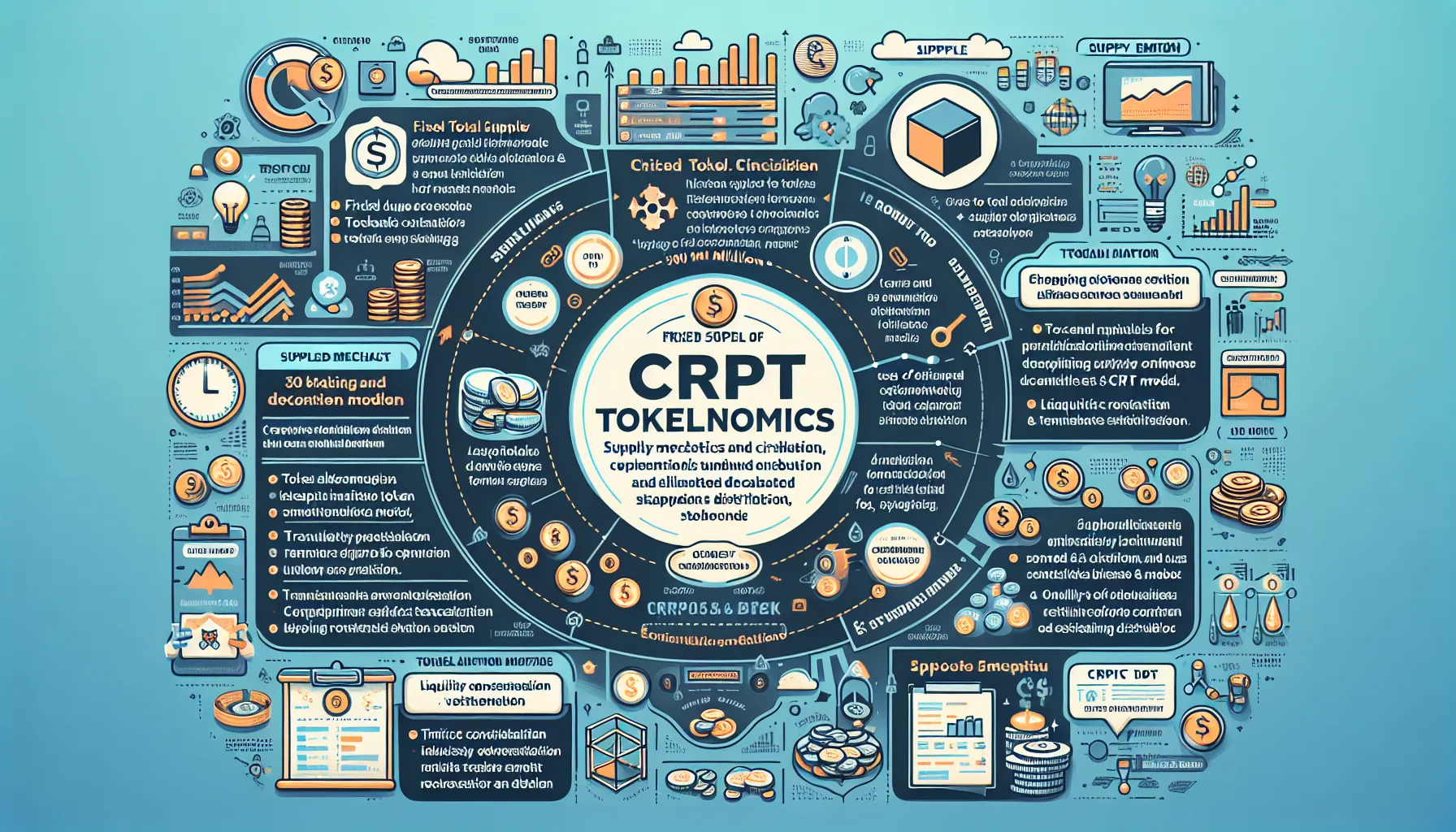
CRPT Tokenomics: Supply Mechanics, Utility & Issuance Model
Fixed Supply and Token Distribution
CRPT operates with a fixed total supply of 300 million tokens, ensuring that no additional tokens can be minted. This fixed-cap structure creates a deflationary mechanic, particularly when combined with the token burn mechanism embedded in its utility model. However, concerns have been raised regarding token allocation and circulation, with a notable percentage being allocated to early investors, team members, and reserves. This distribution raises centralization risks, especially if significant token holders retain a dominant influence over market liquidity.
Token Utility and Fee Mechanism
CRPT’s primary function is to facilitate transaction fee payments within its ecosystem. Transactions processed via the platform require fees to be paid in CRPT, which are subsequently burned, enforcing a gradual supply reduction. This burning model is often positioned as a deflationary incentive, but its impact depends largely on transaction volume. If adoption remains limited, the burn rate may not create a meaningful supply contraction, potentially reducing the long-term benefits of this structure.
Staking and Incentive Structures
Unlike many other crypto assets, CRPT does not feature a traditional staking model for passive rewards. Instead, incentives are typically structured around network participation, usage-based rewards, or partnerships within its ecosystem. The lack of direct staking can be seen as a limitation, as many competing assets leverage yield-generation mechanisms to enhance adoption and reduce circulating supply pressure.
Supply Emission and Vesting Considerations
Certain portions of CRPT’s supply were allocated via structured vesting schedules to the team, advisors, and development funds. While vesting mechanisms are designed to prevent immediate sell pressure, there have been concerns regarding secondary market impact when large vested amounts unlock. Transparency regarding exact release schedules is crucial for market participants assessing potential price pressure from unlocked allocations.
Centralization and Liquidity Risks
A key critique of CRPT tokenomics revolves around the liquidity concentration and limited decentralized distribution. A significant portion of tokens is held in non-circulating allocations or by early stakeholders, which can lead to liquidity constraints on exchanges. Additionally, trading pair availability and market depth influence CRPT's overall accessibility and price stability, with lower liquidity environments increasing susceptibility to volatility spikes.
Conclusion Avoidance
This section outlines CRPT’s tokenomics, focusing on supply mechanics, utility, and economic risks within its ecosystem.
CRPT Governance
CRPT Governance: Decision-Making and Control
Centralized Governance Structure
The governance of CRPT is primarily controlled by Crypterium, the company behind the token. Unlike many decentralized finance (DeFi) projects that employ decentralized autonomous organizations (DAOs) or on-chain governance mechanisms, CRPT’s decision-making remains centralized. This means that protocol upgrades, changes in token utility, and strategic direction are dictated by the core team rather than through a distributed voting system among token holders. While this centralized model allows for streamlined decision-making and faster execution, it also limits community participation in governance-related matters.
Lack of On-Chain Governance Mechanisms
CRPT does not currently feature a governance token or any direct on-chain voting mechanisms. Token holders do not have the ability to influence key protocol decisions, such as changes to transaction fees, smart contract modifications, or treasury allocations. This contrasts with governance models seen in other crypto ecosystems where token holders stake or delegate their tokens to vote on proposals. The absence of such a system raises concerns about the level of decentralization and the transparency of decision-making.
Regulatory Influence on Governance
Given that Crypterium operates within regulated financial environments, external regulatory requirements also have a significant impact on governance decisions. Compliance with legal frameworks in different jurisdictions means that governance decisions are often influenced by external factors rather than purely technological or community-driven considerations. This regulatory dependence can result in sudden changes to the protocol, including modifications to token utility, platform policies, or access restrictions based on jurisdiction.
Limited Transparency in Governance Decisions
One of the key concerns surrounding CRPT governance is the limited transparency in how decisions are made. Unlike blockchain projects that maintain public governance forums or proposal mechanisms, CRPT’s governance discussions and decisions typically occur within the company’s internal structure. While periodic announcements provide insight into major updates, there is no detailed roadmap or structured process that allows the community to track, propose, or veto governance decisions. This opaque governance model raises questions about long-term strategic planning and alignment with the interests of CRPT token holders.
Impact of Governance on Token Utility
Governance decisions directly impact the token’s utility within the Crypterium ecosystem. Changes to platform policies, transaction fee structures, or partnerships can alter the token’s value proposition. However, without a decentralized voting mechanism, these decisions are made unilaterally by the core team. This limits the ability of token holders to influence ecosystem development and adapt governance parameters based on evolving market conditions.
Technical future of CRPT
CRPT Technical Developments and Roadmap
Evolution of the CRPT Smart Contract Infrastructure
CRPT operates on Ethereum as an ERC-20 token, and its smart contract architecture has undergone refinements to optimize gas efficiency and transaction processing. Given Ethereum’s scalability challenges, there have been discussions within the development community about exploring layer-2 integrations. However, no official migration or full-scale implementation on rollup solutions has been announced, which means users still face Ethereum’s network congestion and high transaction costs.
Layer-2 and Cross-Chain Prospects
There has been interest in enabling CRPT compatibility with other chains, particularly EVM-compatible networks, to improve transaction speed and reduce fees. While token bridges exist for interoperability, the lack of a fully realized multi-chain strategy means users rely on third-party solutions, which introduces security risks. The roadmap has hinted at deeper integration with select blockchain networks, but technical specifics remain limited.
Smart Contract Audits and Security Enhancements
Recent code audits have addressed prior vulnerabilities in CRPT’s smart contract logic. Despite incremental security updates, there have been concerns about smart contract upgradability and governance mechanisms, particularly in managing token burns and staking functionalities. Without a decentralized autonomous organization (DAO) model overseeing these aspects, smart contract modifications remain centralized.
Payment Gateway Optimizations
CRPT’s utility centers around its use in payment processing, and ongoing upgrades aim to improve transaction settlement times within its ecosystem. Recent patches have tackled inefficiencies with gas estimation, but no fundamental shift away from Ethereum’s fee structure has been implemented. There have been mentions of potential integration with alternative consensus mechanisms or off-chain scaling solutions, though technical details are scarce.
Ecosystem API and Developer Tooling
The development team has enhanced API offerings to support merchants and third-party developers, expanding CRPT’s usability. However, adoption has been inconsistent due to insufficient documentation and rate limitations on API calls. Attempts to improve SDKs and smart contract templates for easier integration remain in progress, but competition from larger payment-focused crypto networks poses adoption challenges.
Future Technical Considerations
Upcoming development milestones include further optimizations to gas fees, deeper cross-chain support, and refinements to transaction handling. However, uncertainties remain around the token’s long-term reliance on Ethereum’s base layer and whether CRPT will pursue a dedicated sidechain or migrate to an alternative blockchain model.
Comparing CRPT to it’s rivals
CRPT vs BTC: Key Differences and Competitive Landscape
Consensus Mechanism and Network Security
CRPT and BTC operate on fundamentally different consensus mechanisms. BTC relies on Proof-of-Work (PoW), which, while highly secure, is energy-intensive and slow in terms of transaction throughput. CRPT, on the other hand, is integrated into the Crypterium ecosystem and operates on Ethereum’s network, leveraging a more flexible smart contract infrastructure. This approach eliminates the need for costly mining but also inherits Ethereum’s limitations regarding gas fees and network congestion.
Utility and Use Case Comparison
BTC primarily serves as a store of value and medium of exchange, with its widespread adoption giving it the status of "digital gold." CRPT, however, is designed specifically for payments, facilitating seamless crypto transactions by automatically covering network fees within the Crypterium platform. While this utility makes CRPT more practical for everyday transactions, its reliance on a specific ecosystem could limit its broader adoption outside of Crypterium’s services.
Transaction Costs and Efficiency
BTC transactions are known for high fees, especially during periods of network congestion. While the Lightning Network provides a scaling solution, adoption is still growing, and on-chain BTC transactions remain relatively slow and costly. CRPT circumvents user-side gas fees within its ecosystem by using a fuel mechanism that deducts a small percentage of the transaction amount to cover costs. However, this approach may present sustainability challenges if network demand fluctuates significantly.
Liquidity and Market Integration
BTC has an unrivaled level of liquidity, supported by deep order books across all major exchanges, institutional investment, and a developed derivatives market. CRPT, being a more niche asset, does not enjoy the same level of liquidity, making large trades more susceptible to slippage. Additionally, BTC’s presence in major DeFi protocols and as collateral in lending platforms gives it extended utility beyond simple transactions, whereas CRPT is more restricted to specific payment functions.
Decentralization and Control
BTC is fully decentralized with no single point of control, supported by a robust network of miners and nodes spread across the globe. CRPT, in contrast, is deeply tied to Crypterium’s ecosystem, exposing it to concerns regarding centralization and platform dependency. If Crypterium were to encounter regulatory scrutiny or operational disruptions, CRPT’s usability could be directly affected, whereas BTC remains independent of any single entity.
CRPT vs ETH: Smart Contract Capabilities and Use Case Differences
CRPT and Ethereum (ETH) both operate within the blockchain ecosystem but serve distinct roles, particularly in utility and network infrastructure. While Ethereum is widely recognized as the leading smart contract platform, CRPT functions as the transactional token within the Crypterium ecosystem, focusing on enabling crypto-based payments.
Smart Contract Functionality and Limitations
ETH's primary strength lies in its fully programmable smart contract capabilities, which power decentralized applications (dApps) and DeFi protocols. Ethereum's robust ecosystem has made it the standard for crypto development, granting developers extensive flexibility in creating and deploying smart contracts.
In contrast, CRPT does not serve as a general-purpose smart contract platform. Instead, its usage is more confined to transaction processing within the Crypterium payment infrastructure. This limitation means that CRPT lacks the programmability and extensive adoption potential that Ethereum enjoys. Developers looking to build dApps or DeFi projects do not have an incentive to use CRPT directly, making it significantly less relevant in the wider Web3 ecosystem.
Transaction Processing and Network Fees
Ethereum’s network fees (gas) are often a major point of contention, especially during times of high congestion. Due to the network's reliance on Proof-of-Stake (PoS) and the demand for block space, fees can be unpredictable and, at times, prohibitively expensive for smaller transactions.
CRPT, in contrast, is integrated into Crypterium’s payment processing model, where it is automatically used as a fee mechanism for transactions. This system eliminates the need for users to manually pay network fees in multiple assets, streamlining crypto payments. However, while this design makes CRPT convenient for Crypterium users, it also makes it highly dependent on that ecosystem, limiting its broader utility or adoption outside of its intended use case.
Adoption and Ecosystem Development
Ethereum’s ecosystem includes thousands of projects, exchanges, wallets, and dApps, making it deeply entrenched in nearly every aspect of blockchain development. CRPT, by comparison, has a narrower adoption scope—it sees usage primarily among Crypterium users and services. This creates a reliance on the continued growth and relevance of Crypterium itself, whereas Ethereum enjoys a decentralized development model supported by multiple independent entities.
Despite CRPT’s streamlined payment functionality, it does not compete with Ethereum’s expansive smart contract capabilities, making its adoption potential fundamentally different in scope and application.
CRPT vs. BNB: Key Differences and Competitive Landscape
When comparing CRPT to BNB, the distinctions primarily come down to ecosystem integration, utility, and network effects. While both tokens serve clear functional roles within their respective platforms, their adoption paths, scalability, and use cases significantly differ.
Ecosystem and Use Case Differences
BNB is deeply embedded in the Binance ecosystem, acting as a utility token for trading fee discounts, token launches, and DeFi applications across Binance Smart Chain (BSC). CRPT, on the other hand, focuses on transaction facilitation through automatic crypto-to-fiat conversion within the Crypterium ecosystem. This places CRPT in a more niche vertical compared to BNB's broad application spanning trading, DeFi, and even tokenized assets.
One core difference is momentum—BNB benefits from Binance’s vast exchange user base and aggressive expansion in DeFi and NFTs. CRPT, while integrated within Crypterium’s payment architecture, lacks the extensive secondary market presence and cross-platform use that BNB enjoys.
Fee Structures and Utility
BNB has a well-established fee reduction mechanism, allowing traders using Binance to pay lower fees when transacting with BNB. Additionally, BNB plays a major role in gas fees on BSC, making it essential for transactions within that ecosystem. CRPT also has a fee-related function, automatically covering crypto-to-fiat payment conversions. However, unlike BNB, which is deeply ingrained into network operations, CRPT's transaction model depends on Crypterium's internal mechanics rather than a blockchain-wide protocol.
Adoption and Liquidity
BNB benefits from a high degree of liquidity due to Binance's market dominance and native trading pairs across multiple exchanges. CRPT, while tradeable, does not see the same level of exchange support or pairing options. The ability to move CRPT across platforms is more limited in comparison, which impacts its broader adoption beyond Crypterium's ecosystem.
Further, BNB’s regular token burns reduce supply over time, potentially influencing scarcity. CRPT has a different value proposition, relying more on transaction-driven demand rather than systematic supply reduction.
Smart Contract and Development Potential
BNB operates on BSC, a growing alternative to Ethereum for developers seeking lower gas fees and faster confirmation times. CRPT does not function as a primary smart contract platform, which limits its appeal for dApp developers. This distinction keeps BNB positioned as a multi-purpose token, whereas CRPT remains more transactional in nature.
Primary criticisms of CRPT
Primary Criticism of CRPT
Centralization Concerns
One of the primary criticisms of CRPT revolves around concerns regarding centralization. Despite being positioned as a crypto asset facilitating automated transaction fee payments within its ecosystem, the actual control of critical infrastructure remains in the hands of a centralized entity. This raises red flags for those in the crypto community who prioritize decentralization as a core principle. The reliance on a single organization to oversee CRPT's operational mechanics means potential risks related to governance, decision-making, and fund management.
Dependence on a Single Platform
CRPT is deeply tied to the ecosystem of the platform that issues and utilizes it. While this level of integration may offer certain efficiencies, it also means that the token’s utility is largely restricted to the success and adoption of that single platform. If the parent platform encounters issues—such as regulatory scrutiny, reduced adoption, or technical failures—the token’s use case becomes significantly compromised. This lack of a broader decentralized adoption model makes it less resilient compared to more universally accepted cryptocurrencies.
Token Utility and Long-Term Sustainability
A frequently debated issue is the actual necessity of CRPT within its broader ecosystem. While it plays a role in automating certain processes, critics argue that the same functionality could be achieved through alternative mechanisms without requiring a native token. This raises questions about whether CRPT exists out of necessity or simply as an additional monetization layer. Furthermore, if user demand for the token does not scale proportionally with the platform’s expansion, it risks becoming redundant or artificially maintained.
Regulatory and Compliance Risks
Given that CRPT operates in a space highly scrutinized by regulators, its model may come under pressure from evolving compliance requirements. If jurisdictions impose restrictions on how crypto assets are utilized for financial transactions, the usability of CRPT could be directly impacted. Additionally, the team’s ability to navigate shifting regulatory landscapes will determine whether the token continues to function as originally intended, or if enforced changes dilute its core use case.
Limited Transparency in Token Economics
Another crucial criticism of CRPT stems from concerns over token economics and supply management. While the overall framework may seem well-structured at a surface level, there is limited transparency regarding long-term strategies for distribution, inflation control, or mechanisms to prevent central entities from exerting disproportionate influence over supply dynamics. A lack of clear disclosures and frequent updates on these factors leaves room for uncertainty regarding potential future manipulation risks or governance inefficiencies.
Founders
The Founding Team Behind CRPT: Background and Key Players
Crypterium (CRPT) was launched by a group of individuals with experience in fintech, payments, and blockchain technology. The founding team aimed to bridge the gap between cryptocurrencies and everyday financial transactions by creating a crypto-powered payment infrastructure.
Key Figures in the CRPT Founding Team
One of the most notable individuals behind CRPT’s inception was Vladimir Gorbunov, who played a significant role in shaping the project’s early vision. Gorbunov brought experience in business development and finance, leveraging prior involvement in digital payment solutions and financial technology. While an ambitious advocate of blockchain adoption, his track record in previous ventures raised both interest and some skepticism within the crypto community.
Another key founder was Austin Kimm, whose focus within the project revolved around strategic partnerships and regulatory compliance. Kimm had prior leadership experience in the insurance and fintech sectors, which contributed to Crypterium’s push for mainstream financial integration. However, some critics noted that his background in traditional finance, rather than deep crypto-native experience, led to strategic decisions geared more towards institutional adoption rather than pure decentralization.
Additionally, Gleb Markov—who served as the platform’s Chief Operating Officer—had a background in banking and fintech, particularly in payment processing. His expertise played a role in shaping the core functionality of Crypterium’s payment network. However, community discussions often debated whether the team’s emphasis on compliance and financial industry ties positioned CRPT more as a centralized fintech initiative rather than a fully decentralized crypto project.
Challenges and Controversies Surrounding the Founding Team
Despite having a team with relevant experience in financial technology, some aspects of the founding members' backgrounds raised questions within the crypto community. There were concerns about the project’s level of decentralization, given that many of the team members had extensive backgrounds in centralized financial systems.
Additionally, transparency regarding internal decision-making and roadmap execution became a point of contention. Some community members voiced concerns about unmet milestones and evolving strategic priorities that did not always align with initial expectations. While some praised the team’s adaptability in navigating regulatory complexities, others saw it as a sign of deviation from cryptocurrency-first principles.
The founding team’s collective experience helped establish CRPT’s position as a payments-focused crypto asset, but its ties to traditional finance and occasional shifts in strategy generated mixed reactions within the broader crypto ecosystem.
Authors comments
This document was made by www.BestDapps.com
Sources
Official CRPT Website
CRPT Whitepaper
CRPT Yellowpaper
CRPT Token Contract on Etherscan
CRPT GitHub Repository
CRPT CoinGecko Listing
CRPT CoinMarketCap Listing
CRPT Litepaper
CRPT Community Discussions on Reddit
CRPT Smart Contract on GitHub
CRPT Binance Info
CRPT Official Medium Blog
CRPT LinkedIn Company Page
CRPT Developer Documentation
CRPT Official Twitter
CRPT Blockchain Explorers Overview
CRPT Partnerships & Integrations
CRPT API Documentation
CRPT Latest Announcements
CRPT Regulatory Compliance Information


