History of CKB
The History of CKB and Nervos Network
CKB, the native token of the Nervos Network, was introduced to solve blockchain scalability and interoperability challenges. Nervos was conceived as a layered architecture, with its Layer 1 Common Knowledge Base (CKB) designed to provide secure and decentralized storage of crypto assets, smart contracts, and other on-chain data.
Development and Early Adoption
The Nervos project was initiated by a team of experienced blockchain developers and researchers. It aimed to address fundamental limitations of existing blockchains, particularly state bloat and on-chain resource inefficiencies. The Nervos CKB mainnet launched after a period of extensive testing and development. This launch established the foundational layer that allows developers to build Layer 2 solutions and applications on top of it.
A distinguishing factor in CKB’s early development was its focus on the "store of assets" concept rather than just being another smart contract platform. The blockchain uses a novel economic model where users must hold CKB to store data on-chain, creating a built-in incentive for optimizing usage over time. While this mechanism was designed to align long-term network sustainability, it also presented a learning curve for developers and users unfamiliar with this state-based economic model.
Token Issuance and Mining
CKB was initially distributed through a token sale and mining rewards, using a hybrid inflation model. The issuance design includes a base issuance, which follows a Bitcoin-like halving schedule, and a secondary issuance meant to sustain network security and incentivize long-term development. This dual-layer issuance model has sparked debates regarding its long-term economic impact, with some critics questioning the necessity of continuous issuance beyond the base layer.
Mining on Nervos CKB is secured via Proof of Work (PoW), making it distinct in a space where many new projects lean toward Proof of Stake (PoS) alternatives. The use of PoW ensures decentralization and security but also comes with the typical concerns of energy consumption and miner concentration risks.
Challenges and Evolution
Despite its unique approach, Nervos has faced obstacles in adoption and developer traction. The complexity of CKB’s cell model, which differs significantly from Ethereum’s account-based system, has required developers to take a different approach when building dApps. This has resulted in a slower rate of ecosystem expansion compared to more familiar smart contract platforms.
Strategic integrations, cross-chain developments, and Layer 2 innovations have been ongoing attempts to enhance CKB's utility. However, competition from high-performance chains and evolving blockchain regulatory landscapes continue to influence its trajectory.
How CKB Works
How CKB Works: The Technical Mechanics Behind Nervos' Layer 1
CKB, the native token of the Nervos Common Knowledge Base (CKB), operates on a unique Layer 1 blockchain designed for secure and flexible smart contract execution. Unlike account-based models used by Ethereum, CKB employs a UTXO-like system called “Cells,” which enables off-chain computation and state management.
The Cell Model: UTXO Concept with Smart Contract Flexibility
CKB's Cell model is structurally similar to Bitcoin’s UTXO model but extended for smart contract execution. Each Cell contains user-defined data, capacity (denoted in CKB), and associated scripts that govern its validity. Cells are immutable once created, but new Cells can be generated through transactions that consume and produce them. This architecture allows for parallel execution and greater composability than account-based models, reducing state bloat and improving blockchain efficiency.
Cells enable off-chain computation and rollup-like structures without modifying Layer 1 integrity. However, this model introduces complexity for developers transitioning from EVM-based chains, as designing smart contracts requires a different paradigm of state management.
Economic Model: State Rent for Blockchain Sustainability
CKB uses an economic model called "state rent" to address the common issue of blockchain state growth. Unlike blockchains where storage is free after deployment, CKB charges in proportion to the space a user occupies on-chain. Users lock CKB to store data, with the locked amount recoverable upon deletion.
While this approach prevents uncontrolled state expansion, it can be an adoption barrier for applications needing persistent on-chain storage. Developers must optimize storage usage to minimize costs, which contrasts with blockchains that externalize costs onto validators instead of users.
RISC-V Virtual Machine: A Flexible Execution Environment
CKB's smart contract execution is powered by the RISC-V virtual machine (CKB-VM), allowing developers to write smart contracts in multiple programming languages instead of being restricted to Solidity or WASM-based environments. This approach enhances interoperability and fosters diverse tooling support.
However, RISC-V's low-level nature increases development complexity compared to EVM chains. Developers need to manage execution environments with a deeper understanding of binary compatibility, making it less accessible for teams without prior experience in low-level programming.
Consensus Mechanism: NC-Max for Security and Scalability
CKB employs NC-Max, an enhanced Nakamoto consensus variant designed to optimize block propagation and mitigate miner selfishness. By dynamically adjusting block production based on network conditions, NC-Max improves throughput without sacrificing security.
Despite these improvements, CKB's Layer 1 does not inherently support high transaction throughput. Instead, it relies on off-chain scaling solutions and Layer 2 networks. Applications demanding high-frequency transactions must integrate with Nervos’ Layer 2 ecosystem or risk facing performance constraints at the base layer.
Use Cases
Nervos CKB Use Cases: On-Chain Storage, DeFi, and Cross-Chain Interoperability
On-Chain Storage and Stateful Assets
CKB is designed to function as a store of value blockchain where users can store assets, identities, and smart contract states directly on-chain. Unlike many blockchains that rely on ephemeral state storage, CKB's cell model enables persistent, programmable storage. This makes it a strong candidate for applications requiring long-term data availability, such as decentralized identity (DID) frameworks and NFTs with fully on-chain metadata. However, storage space on CKB is linked to token ownership, requiring users to hold CKB to maintain data availability. This introduces a cost factor that may limit large-scale adoption unless storage efficiency solutions are implemented.
DeFi and Layer 2 Scalability
CKB supports DeFi applications via smart contracts built using its unique UTXO-based cell model, which differs from account-based models like Ethereum. This results in improved parallel transaction execution and fewer congestion issues. Layer 2 protocols, such as rollups and sidechains, leverage CKB as a secure base layer while enabling higher transaction throughput. However, DeFi adoption on CKB is still limited compared to larger ecosystems, and liquidity fragmentation remains a challenge. Bridging assets from Ethereum and Binance Smart Chain has mitigated this issue to some extent, but cross-chain dependencies introduce additional security risks.
Cross-Chain Interoperability with Force Bridge
CKB's interoperability framework, Force Bridge, facilitates asset movement between Nervos and major blockchain networks without requiring trust in third-party custodians. By supporting direct token transfers between ecosystems, Force Bridge reduces reliance on wrapped assets and centralized bridging solutions. However, like all interoperability protocols, it is exposed to smart contract vulnerabilities and potential attack vectors. Given past exploits on other cross-chain bridges, security remains a key consideration for users interacting with CKB via Force Bridge.
DA Layer for Modular Blockchain Architectures
CKB's structure allows it to function as a data availability (DA) layer for modular blockchain designs. With increasing adoption of execution layers that offload consensus and DA to separate chains, CKB presents an alternative to solutions like Celestia. Its programmability and persistent storage model give developers flexibility when designing rollups or custom execution layers. The trade-off is that CKB’s DA capacity is closely tied to tokenomics, meaning scalability and cost considerations may arise as demand increases.
Enterprise and Government Applications
The programmability of CKB allows for private or permissioned deployments catering to enterprises and government entities. Use cases include document authentication, verifiable credentials, and asset tokenization. These implementations can benefit from CKB’s stateful model, but adoption within regulated industries often faces challenges related to compliance, privacy concerns, and the integration of blockchain solutions with existing legacy systems.
CKB Tokenomics
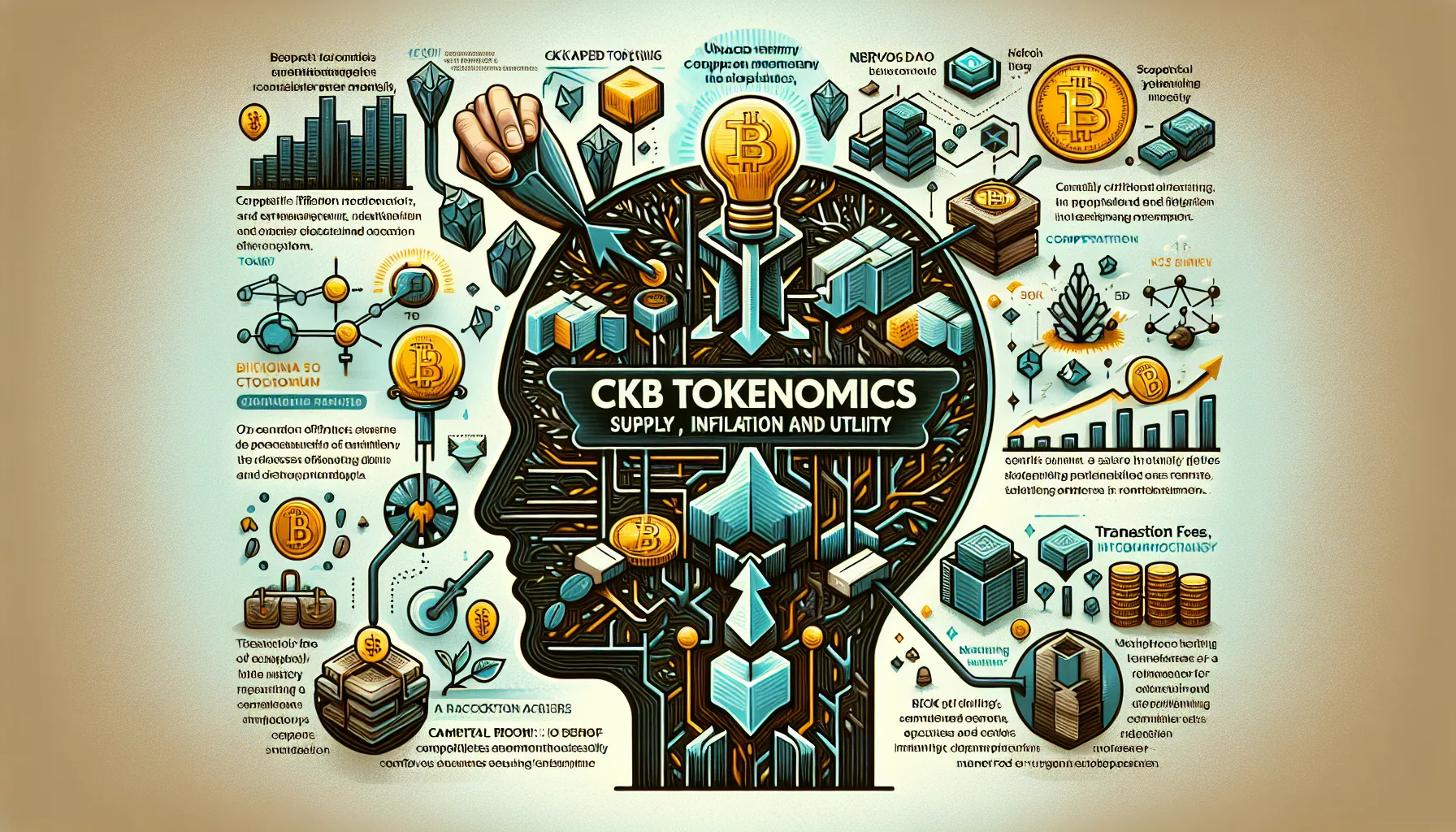
CKB Tokenomics: Supply, Inflation, and Utility
Total Supply and Issuance Model
CKB operates with an uncapped issuance model, designed to balance network security and long-term sustainability. The base issuance follows a predictable schedule, utilizing the Bitcoin-inspired halving mechanism. Every four years, the issuance per block decreases by half, reducing the rate at which new CKB enters circulation.
In addition to base issuance, the Nervos DAO adds a secondary issuance mechanism. Users who deposit CKB into the DAO effectively remove tokens from active circulation, mitigating inflationary pressures. However, this model introduces trade-offs, as locked tokens cannot be utilized for other on-chain activities, impacting liquidity.
Inflation and Economic Trade-Offs
CKB has an inflationary component due to continuous issuance. While controlled, this feature ensures ongoing incentives for miners securing the network. The effective inflation rate depends on how many tokens remain staked in the Nervos DAO versus those actively circulating. The more CKB locked in the DAO, the lower the effective circulating supply growth.
A key concern is how the market perceives ongoing issuance. If demand does not scale alongside inflation, downward price pressures may occur. Additionally, as block rewards diminish over time, transaction fees must increase to sustain network security—a challenge seen in other UTXO-based models.
Utility and Network Resource Model
CKB represents the foundational layer of Nervos' "store of value" design, functioning as state storage within the network. Users must hold and lock CKB to occupy on-chain space, creating inherent demand. However, the balance between affordability and security remains a critical consideration.
The Cell model allows for unique UX advantages, but practical adoption is necessary for sustainable demand. If dApp usage remains low, storage costs alone may not generate sufficient economic activity to offset inflationary pressures. Meanwhile, layer-2 scaling solutions, while promising, could reduce direct demand for CKB depending on the fee structure dynamics.
Governance and Economic Adjustability
CKB lacks on-chain governance for direct monetary policy adjustments, placing trust in the foundational economic design. While this stability prevents arbitrary changes, it also limits flexibility in responding to unforeseen economic challenges. Future network developments and ecosystem growth will directly influence whether the current tokenomics model can sustain long-term adoption.
Potential Risks and Challenges
The balance between inflation, network adoption, and security incentives remains a key concern. If user demand does not keep pace with issuance, or if alternative economic models (such as staking-based or rent-based solutions) prove superior, CKB may face competitive pressures. Additionally, long-term network sustainability depends on transaction fee growth, a factor often difficult to predict in emerging blockchain ecosystems.
CKB Governance
CKB Governance: On-Chain and Off-Chain Decision Making
Governance within the Nervos Network and its native token, CKB, is structured through a combination of on-chain mechanisms and off-chain coordination. Unlike some fully decentralized autonomous organizations (DAOs), Nervos does not rely solely on direct token-holder voting for protocol upgrades or economic parameter adjustments. Instead, governance involves a mix of developer proposals, community discussion, and implicit consensus among node operators and miners.
Off-Chain Governance: Developer and Community Influence
A significant portion of CKB’s governance occurs off-chain, driven by core developers, contributors, and an active community. The Nervos Foundation, alongside key developers, holds a central role in initiating protocol changes. Proposals for upgrades or modifications typically emerge from research discussions, with formal proposals shared in public forums like GitHub or community-driven governance discussions.
While this structure allows for flexibility and expert-driven decision-making, it also presents centralization risks. Without a binding on-chain governance model, decisions may lean towards those with greater influence in the development process rather than purely token-weighted voting. This raises concerns over decentralization, as governance power is effectively distributed among core contributors rather than all CKB holders.
Hard Forks and Network Upgrades
Changes to the CKB protocol typically require hard forks, meaning active coordination among node operators and miners is essential. This process contrasts with networks where governance is enforced on-chain via token-holder voting or smart contract execution. In practice, consensus is formed through community discussion, core team recommendations, and eventual adoption by miners and full nodes.
This method ensures that only widely accepted protocol changes are implemented, but it also slows decision-making and presents challenges in contentious scenarios. Without an automated upgrade mechanism, disagreements within the community or development team could result in network splits or delays in needed improvements.
The Role of Miners in Governance
CKB employs a Nakamoto-style Proof-of-Work (PoW) consensus, giving miners influence over governance decisions through block validation and network security. Since miners must upgrade their software to adopt protocol changes, they act as a gatekeeper for new modifications. This creates a governance dynamic where economic incentives influence miner participation in upgrades, potentially leading to centralization if a few large mining entities dominate hash power.
The reliance on miner consensus means that governance proposals must align with economic incentives to be successfully implemented. While this reinforces network security and stability, it can also hinder rapid iteration or controversial upgrades if miners oppose them.
Technical future of CKB
Nervos CKB: Technical Roadmap and Ongoing Development
Layer 2 Scaling and Rollup Advancements
Nervos CKB continues to focus on Layer 2 scaling solutions, with significant efforts directed at enhancing rollups. Multiple teams are working on zk-Rollups and optimistic rollups to improve transaction throughput while maintaining security through the Layer 1 base. These developments are aimed at improving scalability without compromising CKB's core principles of maximal decentralization and security. However, challenges remain, particularly in optimizing smart contract compatibility and minimizing rollup costs.
CKB-VM Enhancements and RISC-V Efficiency
CKB's virtual machine, built on RISC-V, is undergoing optimizations to improve its efficiency for smart contract execution. Developers are working on refining static analysis tooling, enhancing execution performance, and reducing the cost of on-chain computation. A major hurdle is balancing performance improvements while maintaining the flexibility that distinguishes CKB-VM from traditional Ethereum-based environments. Some updates aim to improve compatibility with existing blockchain tooling to lower barriers for developers migrating from other ecosystems.
Cross-Chain Interoperability with Force Bridge
Force Bridge remains a critical component of Nervos CKB’s interoperability strategy. While the bridge enables asset transfers between CKB and other major chains like Ethereum and Binance Smart Chain, reliability and security concerns are ongoing issues. Developers are actively enhancing the bridge to support additional networks and improve decentralization. However, the complexity of multi-chain asset transfers introduces potential vulnerabilities that require constant monitoring.
UX and Dev Tooling Improvements
Developer tooling remains a key focus, with ongoing refinements to frameworks such as Lumos for dApp development and Capsule for smart contracts. Efforts are being made to streamline onboarding for new builders, but challenges persist in documentation and ecosystem maturity. Compared to more established smart contract platforms, CKB still faces a learning curve that deters some developers.
Storage Layer Innovations and State Rent Implementation
CKB's unique state model introduces storage challenges, particularly around long-term state growth. To address this, developers are exploring state rent mechanisms that require users to pay for storing data on-chain. While this could incentivize efficient state usage, it also raises concerns regarding UX complexity and potential friction for users unfamiliar with such models.
Future Outlook on Governance and Protocol Upgrades
Decentralized governance discussions around protocol upgrades continue to be a crucial aspect of CKB’s evolution. While governance mechanisms are in place, decision-making processes remain complex, and reaching community consensus on major upgrades is an iterative challenge. Future proposals may involve adjustments to economic incentives and Layer 1 optimizations to support sustainable network growth.
Comparing CKB to it’s rivals
CKB vs. ICP: A Technical and Architectural Comparison
Consensus Mechanism and Scalability
CKB utilizes the Proof-of-Work (PoW) consensus mechanism, ensuring high security and robustness but at the cost of energy consumption. Its unique approach—separating state storage from computation—allows for sustainable scalability. By employing the Cell Model, CKB enables flexible scripting without predefined virtual machines, offering developers the freedom to create custom execution environments.
In contrast, ICP operates on a novel Threshold Relay consensus combined with Chain Key cryptography. This system is designed for speed and efficiency, minimizing latency while offering near-instant finality. However, ICP’s reliance on a more complex consensus model introduces potential network centralization concerns, as node operations are tightly controlled by the Network Nervous System (NNS).
Smart Contract Flexibility
CKB provides developers with unparalleled flexibility via its Cell Model, which supports multiple scripting languages without requiring a native virtual machine. This lays the groundwork for universally compatible smart contracts, as developers can leverage off-chain computation while maintaining data integrity on-chain. However, this also means that developers must handle certain execution aspects manually, increasing the complexity of development.
ICP, on the other hand, integrates WebAssembly (WASM) as its primary execution environment, allowing developers to build applications using languages like Rust and Motoko. This makes development more accessible but inherently restricts flexibility compared to CKB’s agnostic approach. Despite ICP’s seamless smart contract execution, the reliance on WASM also introduces potential security attack vectors, particularly around determinism and sandboxing.
Data Availability and Storage Model
CKB’s architecture prioritizes state verification over computational speed. Its method of storing on-chain data as live cells ensures strong availability without requiring continuous smart contract execution. However, this results in higher storage costs over time as more state data remains permanently accessible on-chain.
ICP’s design achieves dynamic scaling of smart contract storage through canisters—its unique computational units. Canisters automatically manage state persistence and are designed to operate with minimal friction. While this allows ICP to store large amounts of data efficiently, the proprietary canister system adds a fundamental dependency on ICP’s operational framework, creating a walled-garden effect that may hinder interoperability with other blockchain ecosystems.
Governance and Network Control
CKB employs a more decentralized governance model, with control distributed among miners and node operators. While this sacrifices certain efficiency gains, it reinforces censorship resistance.
ICP, governed by the NNS, allows token holders to participate in decentralized decision-making, but the system's hierarchical structure enables certain entities to exert significant influence. This governance design can lead to concerns about centralization and potential intervention in network operations.
Comparing CKB to Filecoin (FIL): Storage vs. State Rent
When evaluating CKB against Filecoin (FIL), the fundamental difference lies in their core function—CKB focuses on state rent and decentralized computation, while FIL is a decentralized storage network. Although both projects address blockchain scalability in different ways, their underlying mechanisms and economic models create distinct advantages and limitations.
Economic Model: State Rent vs. Storage Market
CKB introduces a unique "state rent" model, where users must hold CKBytes to allocate on-chain storage. This ensures that blockchain growth remains sustainable, preventing excessive bloat. In contrast, Filecoin operates on a decentralized marketplace where storage providers compete for client data, earning FIL based on supply and demand dynamics. While this incentivizes storage availability, FIL's dependency on continuous demand for storage services can introduce economic instability, particularly during fluctuations in usage.
One key issue with Filecoin's model is collateral requirements for storage providers. Miners must stake significant FIL to participate, leading to potential liquidity issues and capital inefficiencies. This is not a concern for CKB, where there is no collateralized consensus mechanism—resource allocation is determined by ownership of CKBytes, rather than external economic factors like FIL’s staking requirements.
Security Trade-offs and Decentralization
Filecoin relies on cryptographic proofs such as Proof-of-Replication (PoRep) and Proof-of-Spacetime (PoSt) to verify stored data without requiring constant re-uploading. While this ensures provable storage integrity, it adds computational overhead, and failed proofs can lead to slashing penalties for storage providers. These penalties, combined with costly hardware requirements, can centralize power among well-capitalized entities, reducing true network decentralization.
CKB, by contrast, secures its network using the NC-Max consensus algorithm, an evolution of Nakamoto Consensus. Because it does not require specialized computing resources to prove storage efficiency, operational barriers to participation are lower. This makes validator participation more accessible, strengthening decentralization without relying on slashing mechanisms.
Smart Contract Support and Composability
While Filecoin does support smart contract execution through integrations such as the FVM (Filecoin Virtual Machine), its native environment was not initially designed for advanced programmability. CKB, with its Cell Model, offers a more flexible data structure that enables parallel execution and smart contract composability without predefined constraints. This differentiation allows for broader use cases beyond simple storage incentivization, including off-chain data availability and verifiable state transitions.
However, Filecoin benefits from a stronger alignment with existing IPFS infrastructure, making it more widely adopted in decentralized storage solutions. The question remains whether CKB’s state rent model can achieve similar adoption in broader Web3 applications, or if Filecoin's storage-first approach will maintain an advantage in practical use.
CKB vs. AR: A Deep Dive into Architectural Differences
When comparing CKB to AR, the most immediate distinction arises in their fundamental design philosophies. CKB employs a state-based model with its unique Cell model, enabling programmability without the need for smart contracts in the traditional sense. In contrast, AR utilizes a blockweave structure, which functions more like a permanent storage ledger than a traditional blockchain.
Storage Model vs. Generalized State Verification
AR’s core proposition lies in its permanent data storage approach, where users pay once to store content indefinitely. This is fundamentally different from CKB’s economic model, which is built around state verification rather than file permanence. While AR ensures file persistence through its endowment structure, CKB optimizes for flexibility, allowing developers to create adaptable and evolving applications.
This difference introduces trade-offs. AR’s model makes it well-suited for archival data storage but limits its composability for complex decentralized applications (dApps). CKB, by maintaining a verification-focused design, enables more generalized use cases but does not offer a built-in guarantee of permanent data storage.
Consensus Mechanism and Network Efficiency
Another major distinction lies in consensus mechanisms. AR uses a modified version of Proof-of-Work (PoW) called “Succinct Proofs of Random Access” (SPoRA), which is designed to incentivize miners to store full historical data. This ensures content is available over time but comes with challenges related to miner incentives and long-term sustainability.
CKB, on the other hand, follows a more conventional Nakamoto-style PoW approach that optimizes for security and decentralization. The use of PoW in both networks ensures robustness but also raises questions about efficiency and scalability in the long run, as both face inherent limitations typical of PoW-based architectures.
Developer Ecosystem and Smart Contract Functionality
CKB provides native programmability through its Cell model, allowing for stateful applications without introducing complex smart contract logic. This creates a unique development environment where assets and states can be manipulated off-chain while still maintaining on-chain verifiability.
In contrast, AR relies more on Layer 2 solutions and external frameworks for smart contract execution, such as SmartWeave. This approach reduces on-chain computation costs but introduces delayed finality and potential validation concerns, as smart contract execution is handled by clients rather than miners.
Scalability and Bottlenecks
Both networks have scalability limitations. AR’s network faces long-term sustainability concerns due to its reliance on storage incentivization, while CKB's UTXO-inspired model can pose challenges when managing large-scale on-chain applications.
Primary criticisms of CKB
Primary Criticism of CKB
Inflation Concerns and Tokenomics Scrutiny
One of the most persistent criticisms of CKB revolves around its inflationary model. Nervos Network employs a dual-layer tokenomics structure, featuring CKBytes (CKB) as the native asset. However, the issuance model includes both a fixed supply allocation and a secondary issuance mechanism. The latter, designed to incentivize miners and maintain network security, leads to continuous inflation, which some argue dilutes long-term value for holders who are not staking or otherwise engaged in yield-generating activities.
For investors focused on scarcity-driven valuation models, such as Bitcoin’s hard cap, CKB's perpetual issuance raises concerns about sustained price pressure over time. While Nervos partially counters this with mechanisms like the DAO that allows users to offset dilution, critics argue that participation in these systems adds complexity and friction for casual holders.
Adoption and Ecosystem Development Challenges
Despite its ambitious goals of interoperability and Layer 1 flexibility, CKB has struggled with widespread adoption. The network's architecture is designed to support many mainstream blockchain functionalities, but its ecosystem remains comparatively underdeveloped relative to larger smart contract platforms. Smart contract execution on CKB requires developers to work within the UTXO-based model, which can pose a learning curve for those accustomed to Ethereum’s account-based approach. This friction has contributed to slower adoption among decentralized application (dApp) developers.
Additionally, while Nervos promotes cross-chain interoperability via its solutions like Godwoken, the reality remains that Ethereum Virtual Machine (EVM)-compatible chains dominate developer activity. Without deeper integrations or a stronger developer incentive model, building lasting network effects remains a challenge.
Centralization and Governance Concerns
Another point of critique stems from governance and potential centralization risks. A significant portion of CKB supply was pre-mined and allocated to investors, the team, and ecosystem development. While such allocations are common in crypto projects, skeptics argue that this concentration of tokens in a limited number of hands could lead to governance risks and potential network influence that is not entirely decentralized.
Mining power distribution also comes into question. While CKB operates on a proof-of-work (PoW) consensus mechanism using the Eaglesong algorithm, there have been concerns over mining centralization, particularly with the advent of ASIC miners. Any network that relies heavily on a few mining pools can face security risks, including potential 51% attacks or undue influence over block production.
Complexity in Layer 1 Usability
Nervos' design philosophy emphasizes modularity and security, but this complexity has also been a barrier to mainstream accessibility. The Common Knowledge Base (CKB) model introduces a unique approach to asset storage and smart contract execution, but for many users and developers, the learning curve remains steep compared to more straightforward networks like Ethereum or Solana. Tools, wallets, and onboarding tutorials are improving, but the broader crypto community often favors ease of use, which can hinder CKB adoption.
Competitive Landscape Pressures
The blockchain space is highly competitive, with various Layer 1 and Layer 2 solutions continuously evolving. CKB operates in a niche emphasizing interoperability and sustainability, but it competes against ecosystems with significantly larger developer communities, deeper liquidity, and established traction. Without significant breakthroughs in adoption, integration, or killer applications, Nervos risks being overshadowed by more dominant smart contract-capable chains.
Founders
Founding Team Behind CKB: Background, Experience, and Challenges
The Nervos Network, which powers the CKB (Common Knowledge Base) crypto asset, was founded by a group of blockchain veterans with expertise in distributed systems, cryptography, and protocol engineering. Key figures include Jan Xie, a former Ethereum core developer, who played a significant role in Nervos’ cryptographic design and economic model. His background in blockchain consensus mechanisms and virtual machine architecture strongly influenced CKB’s development.
Other founding members bring experience from academia and major tech firms, which helped shape CKB’s layered blockchain approach. The team’s expertise is evident in Nervos’ technical whitepapers and early development roadmaps, which emphasize modular architecture and protocol-level flexibility. Despite this experience, some critics have pointed to the team’s lack of extensive experience in large-scale, production-ready ecosystems, particularly in contrast to founding teams behind other L1 projects with deeper enterprise and institutional backing.
Funding and early project support came from major crypto investors and venture capital firms, allowing the team to focus on long-term development. However, some concerns have been raised about the distribution of tokens among early backers and the core team, with questions about long-term decentralization and incentive alignment. Transparency regarding leadership decision-making has also been a point of discussion within the community, especially when it comes to governance updates and protocol upgrades.
The Nervos team has been active in blockchain research, contributing to interoperability and cryptographic advancements. However, outreach efforts to attract developers to the ecosystem have faced challenges, particularly in onboarding smart contract developers from Ethereum or other EVM-compatible networks. While the team has worked on tooling and compatibility layers, adoption friction remains a critical issue.
The founding team’s commitment to building a sustainable blockchain architecture is clear, but the execution and adoption hurdles continue to shape Nervos' trajectory. Their emphasis on a dual-layer structure with a UTXO-based model differentiates them from many competitors but also requires a steep learning curve for developers accustomed to account-based systems. Balancing innovation with usability remains an ongoing challenge for the team as they refine CKB’s framework.
Authors comments
This document was made by www.BestDapps.com
Sources
- https://github.com/nervosnetwork/rfcs
- https://github.com/nervosnetwork/ckb/blob/develop/docs/whitepaper.md
- https://github.com/nervosnetwork/ckb/blob/develop/docs/yellowpaper.md
- https://docs.nervos.org/
- https://explorer.nervos.org/
- https://ckb.tools/
- https://xangle.io/project/NervosNetwork/profile
- https://research.binance.com/en/projects/nervos-network
- https://decrypt.co/resources/nervos-network
- https://medium.com/nervosnetwork
- https://github.com/nervosnetwork/ckb
- https://github.com/nervosnetwork/lumos
- https://talk.nervos.org/
- https://nervos.org/
- https://coinmarketcap.com/currencies/nervos-network/
- https://www.coingecko.com/en/coins/nervos-network
- https://messari.io/asset/nervos-network
- https://blog.nervos.org/
- https://github.com/nervosnetwork/force-bridge
- https://github.com/nervosnetwork/godwoken


