History of BURST
The History of BURST: A Pioneering Step in Blockchain Storage
BURST, first introduced in 2014, emerged as one of the earliest blockchain projects to integrate a Proof of Capacity (PoC) consensus mechanism. This unique system distinguished BURST from other cryptocurrencies that relied on energy-intensive Proof of Work (PoW). Instead of continuous computational hashing, BURST leveraged unused hard drive space, carving a niche in an emerging landscape where energy efficiency was becoming increasingly important. However, the road to recognition and adoption for BURST has been far from seamless.
Originally launched on the NXT blockchain platform, BURST’s early development aimed to capitalize on decentralization and self-sufficiency. The asset attracted attention with its innovative technologies, including “Smart Contracts” and its hallmark feature, the autonomous transaction system known as Atomic Cross-Chain Transactions. BURST was also the first crypto asset to deploy Turing-complete smart contracts on a decentralized blockchain, an achievement often overshadowed by the later emergence of Ethereum’s similar functionality.
Later in 2015, BURST gained notoriety for hosting the first ever decentralized crowdfunding initiative (commonly referred to as an Initial Coin Offering, or ICO), which served as a precursor to the ICO boom of subsequent years. Despite these achievements, development stagnated after its initial fanfare. A lack of formalized team structure and minimal marketing efforts contributed to a relatively small community, isolating it from the mainstream appeal achieved by other projects.
BURST faced further challenges due to its reliance on hard disk mining, a concept novel to many but also technically challenging to implement and maintain. Setup complexities and slow mining rewards dissuaded all but the most dedicated enthusiasts. Additionally, criticisms of centralization emerged, with skeptics pointing to the limited number of miners controlling significant storage portions within the network.
By 2016, BURST development changed hands, shifting from its anonymous founder to the BURST community itself, under a decentralized governance structure. While this improved transparency, it also presented organizational challenges, slowing developmental progress. The project endured code vulnerabilities and intermittent network optimization failures that dampened potential adoption.
These challenges have defined a storied and turbulent history for BURST. The crypto asset has juggled a dual identity as both an innovator in blockchain technology and a symbol of the difficulties of sustaining community-driven blockchains. Its trajectory reveals the complexities of competing in a rapidly evolving tech environment, burdened by competition and infrastructure constraints.
How BURST Works
How Burstcoin Works: A Technical Breakdown of Proof-of-Capacity Blockchain
Burstcoin (BURST) operates on a unique consensus mechanism known as Proof of Capacity (PoC), setting it apart from traditional Proof of Work (PoW) or Proof of Stake (PoS) systems. PoC leverages unused hard drive space for mining, providing a more energy-efficient alternative to computationally heavy mechanisms like PoW.
Plotting: Initial Setup for Mining
Burst mining begins with a one-time process called plotting, where miners allocate hard drive space to generate data files known as plots. Each plot consists of consecutive cryptographic hashes (scoops), created using the Shabal-256 algorithm. The process is computationally intensive at the start but only needs to be performed once per allocated space, meaning there’s no ongoing computational cost after the plots are created.
One important consideration is that plotting requires substantial write throughput, which can be a barrier for users without high-performance hardware. A mechanical HDD can suffice, but the process is significantly faster on SSDs or NVMe drives. This initial step may deter users seeking low entry barriers, as plotting can take hours or days depending on allocated space.
Mining: Using Disk Space to Secure the Network
Unlike PoW, where miners solve complex mathematical problems, Burst utilizes the pre-computed plots. Every mining round, the network issues a challenge, and miners scan their plots to find the best matching “nonce.” Each nonce corresponds to a deadline, which determines the time interval the miner must wait before mining the next block. The miner with the shortest deadline wins the round and adds a new block to the blockchain.
This process consumes very little energy since the hard drive’s read operations are far more efficient than intensive GPU or CPU calculations. However, mining performance directly correlates with available disk space. Miners with larger storage capacity inherently have an advantage over smaller participants, leading to concerns about centralization as professional miners dominate with multi-petabyte setups.
Smart Contract Integration and Scalability Challenges
Burst also distinguishes itself by supporting Turing-complete smart contracts directly on-chain, eliminating the need for additional virtual machines. This allows for decentralized applications (DApps) without the complexity of external computation layers. However, the native implementation of smart contracts introduces scalability challenges. The blockchain grows quickly, requiring larger storage over time, which exacerbates resource demands from miners and full nodes.
While its framework aims for decentralization, the reliance on storage infrastructure could lead to inequalities similar to those seen in PoW systems. Centralized mining pools are another potential issue as they play a significant role in Burst’s mining ecosystem, which some critics argue dilutes the purported advantages of a decentralized network.
Use Cases
Use Cases of Burstcoin: Decentralized Applications Beyond Mining
Burstcoin is a blockchain-based crypto asset with unique attributes that foster diverse use cases, particularly focusing on energy efficiency, decentralized storage, and smart contract execution. Below, we delve into its most notable applications and their implications for the crypto-savvy audience.
1. Energy-Efficient Mining and Proof-of-Capacity
Burstcoin is renowned for its use of the Proof-of-Capacity (PoC) consensus mechanism. Unlike Bitcoin’s energy-intensive Proof-of-Work (PoW), PoC leverages unused hard drive space for mining, offering a more sustainable alternative. This mining approach appeals to users with limited hardware budgets or those looking to contribute to network security without excessive energy demands. However, while energy savings and decentralization are significant advantages, the system is limited by a growing reliance on larger storage farms, raising concerns about potential centralization risks similar to mining pools in PoW systems.
2. Decentralized File Storage
Burstcoin supports decentralized file storage through use-case-specific applications like Burst Drives, where users can store and share encrypted files on the blockchain. The integration of data-layer file storage adds another dimension to its utility, complementing its monetary role. By relying on blockchain-based storage, users benefit from censorship-resistance and data redundancy. However, the trade-off comes in the form of slower data retrieval speeds and higher storage costs compared to traditional cloud solutions, making scalability and usability significant challenges for large-scale adoption.
3. Smart Contract Functionality and Automated Transactions
Burstcoin incorporates Turing-complete smart contracts directly on its blockchain, akin to Ethereum but implemented differently. These contracts enable applications like trustless escrow, crowdfunding, and automated royalty payments. Of particular note are “Atomic Cross-Chain Transactions” (ACCTs), enabling trustless swaps with other cryptocurrencies—one of the earliest implementations of this feature in the crypto space. Despite this innovation, the limited throughput and computational constraints of the network may hinder scaling more complex contracts, leaving simpler implementations as the most feasible in the near term.
4. Crowdfunding and Asset Tokenization
Through its built-in marketplace and asset exchange, Burstcoin provides tools for tokenizing assets and raising funds. This functionality allows users to launch initial token offerings (ITOs) or fractionalize ownership of projects without requiring third-party platforms. While its decentralized asset exchange bolsters functional flexibility, competition from larger, more liquid blockchains dampens adoption. Additionally, user accessibility is limited by a less intuitive UX compared to major peers, adding friction for non-technical participants.
5. Lottery-Style Applications
Burstcoin’s ability to generate verifiable random numbers makes it suitable for lottery and gaming applications—all done without requiring a centralized operator. These decentralized lottery applications reinforce its versatility but face regulatory and jurisdictional scrutiny in many regions, which may deter broader adoption.
Burstcoin’s feature set demonstrates strong potential in multiple decentralized use cases, but challenges related to usability, scalability, and growing competition remain pivotal factors for its ecosystem.
BURST Tokenomics
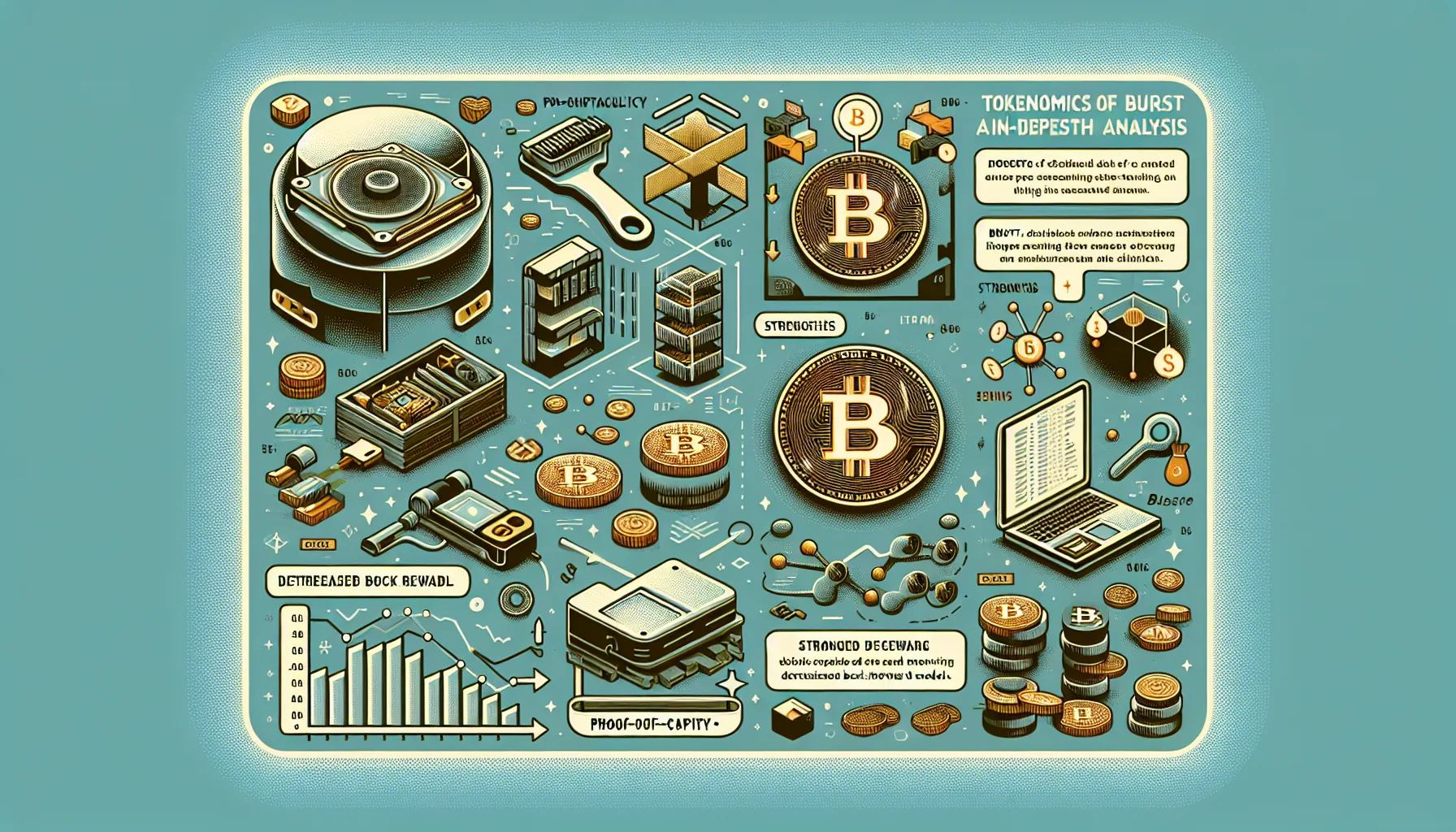
Tokenomics of BURST: An In-Depth Analysis
BURST operates on a distinct blockchain architecture that sets it apart from many other cryptocurrencies. Central to its tokenomics is its consensus mechanism, Proof-of-Capacity (PoC). Unlike Proof-of-Work (PoW) or Proof-of-Stake (PoS), BURST relies on participants allocating unused hard drive space to validate transactions. While this approach has gained attention for being energy-efficient, it raises key tokenomic considerations.
Supply Cap and Block Emission
BURST has a fixed maximum supply of 2,158,812,800 coins. The network uses a decreasing block reward model, which means miners receive progressively smaller rewards as time elapses. This emission model resembles Bitcoin’s halving, but rather than discrete halving events, BURST block rewards decrease incrementally with every block. This mechanism was designed to gradually increase scarcity, but some argue that the slow reduction in rewards could discourage miners in the absence of strong transaction fee-based incentives.
Transaction Fee Model
BURST employs a flat transaction fee model, where all transactions typically incur a base fee of 0.00735 BURST. While this simplicity appeals to some users, it also draws criticism, especially during periods of network congestion. Since fees don’t scale dynamically with demand, it may lead to inefficient use of block space or delays if transaction volumes rise sharply.
Fostered Decentralization vs. Hardware Inefficiency
The PoC mechanism theoretically democratizes mining by relying on hard drive capacity rather than expensive GPUs or ASICs. This lowers barriers to entry compared to PoW-based systems. However, critics point out that large-scale miners still have a distinct advantage, as they can afford to deploy vast arrays of hard drives. This has sparked debates about whether BURST achieves meaningful decentralization or if it merely shifts mining centralization to a different resource class.
Token Distribution and Pre-Mine Absence
BURST launched without the typical pre-mine or ICO phases seen in many blockchain projects, which initially lent it credibility. However, this also meant the early adoption distribution skewed towards initial miners with ample storage capacity. Over time, this distribution asymmetry has been scrutinized, as it concentrates a significant portion of BURST supply in the hands of early participants.
Layered Incentive System
BURST’s use of the Asset Exchange and Smart Contracts adds complexity to its tokenomics. While these features create additional utility for the token, they are underutilized when compared to ecosystems like Ethereum. This mismatch between BURST’s technical potential and economic activity underscores a broader challenge in driving network adoption.
BURST’s tokenomics reflect an innovative approach with a circular balance of strengths and hurdles. From its unique Proof-of-Capacity mechanism to its supply model and decentralized aspirations, its economic structure offers much to analyze in the ever-evolving crypto landscape.
BURST Governance
BURST Governance: A Deep Dive into Decentralization and Challenges
BURST, a blockchain-based platform leveraging Proof-of-Capacity (PoC), operates with a unique governance structure that emphasizes community-driven consensus and decentralization. Unlike many crypto ecosystems that rely heavily on centralized decision-making bodies or foundation-led governance models, BURST’s governance is largely rooted in its distributed network and the involvement of its miners, node operators, and developers. However, this decentralized model comes with its share of strengths and challenges.
Community-Driven Decision Making
BURST’s governance is steered by its participatory community. Decisions regarding improvements, updates, and network modifications often emerge through open discussions among stakeholders, particularly on community forums, Discord channels, and other shared platforms. In principle, this democratic model ensures that no single entity can dominate the future direction of the protocol. Governance proposals are often subject to community-wide scrutiny, fostering transparency. However, this model can sometimes lead to prolonged debates without achieving consensus, potentially delaying critical upgrades.
Lack of Formal On-Chain Governance
Unlike some modern blockchain projects with formalized on-chain governance systems, BURST does not currently leverage token-based voting or binding decentralized autonomous organization (DAO) structures. While this avoids issues tied to plutocracy—where token-rich entities dominate voting outcomes—it also means BURST lacks a codified mechanism for enacting decisions. This reliance on informal processes can introduce inefficiencies, particularly when coordinating across a globally distributed network of participants.
Miner Influence and Its Impacts
BURST’s Proof-of-Capacity mechanism introduces an interesting dynamic in governance. Miners play a crucial role in maintaining the network's integrity and security, but their influence could raise concerns regarding governance centralization. Miners with significant storage capacity may exert outsized control over the network’s operations, potentially skewing decision-making processes to align with their incentives. Balancing miner influence with the interests of developers, users, and smaller stakeholders remains a topic of active conversation.
Developer Contributions and Funding Challenges
BURST’s open-source nature means that its development relies on voluntary contributions from a core team and community developers. While this fosters innovation and inclusivity, it comes with funding limitations. Unlike projects with treasuries funded through token allocation or transaction fees, BURST’s ecosystem often depends on ad-hoc donations and community fundraising. This can slow progress on crucial upgrades, leaving governance decisions vulnerable to resource constraints.
Transparency vs. Fragmentation
While BURST prides itself on transparency, the lack of a centralized governing entity can sometimes fragment decision-making. The diversity of opinions within the community, while a hallmark of decentralized systems, can hinder cohesive direction, especially in contentious scenarios. This fragmentation may result in parallel development efforts or, worse, forks, though BURST has so far avoided significant splits in its ecosystem.
These dynamics reflect both the promise and complexities of decentralized governance within the BURST network.
Technical future of BURST
Current and Future Technical Developments of BURST Network
PoC+ Consensus: Advancing Energy Efficiency and Decentralization
BURST stands out with its Proof-of-Capacity Plus (PoC+) consensus mechanism. Incorporating storage-based mining ensures energy-efficient operations while maintaining decentralization. Current developments include optimizing storage utilization through adaptive plotting techniques, which aim to reduce disk space redundancy associated with the mining process. However, challenges remain in addressing potential centralization risks tied to the expanding use of enterprise-grade storage hardware, which gives larger operators an undeniable advantage.
Smart Contract Infrastructure and Functional Constraints
BURST employs Automated Transactions (AT), a precursor to modern smart contracts. While innovative at its inception, the current AT system exhibits limitations, particularly in its restricted scripting language and lack of modern programmability features. Development on enabling Turing-complete capabilities and interoperability with leading blockchain networks is in active exploration, yet these upgrades face delays due to the aging technical foundation of the AT framework, needing community-driven or external developer input for implementation.
Dymaxion and Scalable Layer 2 Protocol Plans
The Dymaxion layer—BURST's proposal for a scalable Layer 2 protocol—promises off-chain transaction processing and lightning-fast execution. Future releases highlight potential utilization of payment channels and parallel blockchains to enhance throughput while simultaneously reducing congestion on the main chain. Despite its promise, progress has been uneven, hindered by limited funding and manpower in the development team. For such features to reach fruition, continuous community support and external partnerships will likely be essential.
Cross-Chain Functionality and Atomic Swaps
Efforts to expand BURST into the broader blockchain ecosystem are evident in its work on atomic swap capabilities. This addition would allow trustless exchange of BURST with other cryptocurrencies, improving liquidity and interoperability. Yet, implementation requires overcoming challenges in aligning diverse blockchain standards and designing a seamless user experience for cross-chain transactions.
On-Chain Storage Optimization
BURST’s reliance on large-scale storage makes addressing data pruning a priority. Current proposals aim to incorporate zero-knowledge proofs to reduce on-chain data bloat while preserving transparency. However, integrating cutting-edge cryptographic techniques poses significant technical hurdles, including maintaining compatibility with the existing PoC+ protocol and ensuring backward compatibility with older mining setups.
Community-Led Development Roadblocks
While BURST remains driven by a dedicated community, the decentralized nature of its development introduces inefficiencies. Fragmented team alignment, slow feature rollouts, and reliance on volunteer developers are recurring challenges. Without a formalized funding structure, adopting cutting-edge innovations may continue to progress slower than competitors in the blockchain space.
Comparing BURST to it’s rivals
Comparing BURST to XCH: Decentralized Storage and Consensus Approaches
When comparing BURST to XCH (Chia Network), key technical and operational differences emerge around their consensus mechanisms, energy efficiency, and approaches to decentralized storage. Both projects aim to innovate in different ways within the blockchain and decentralized storage space, but their methodologies and ecosystems diverge significantly.
Consensus Mechanisms: Proof of Capacity vs. Proof of Space and Time
BURST’s foundation lies in its Proof of Capacity (PoC) consensus algorithm, which allows users to mine coins using pre-plotted hard drive space. By storing cryptographic plots on disk, BURST lowers barriers to entry for individuals interested in mining, fostering greater decentralization. The energy cost of mining is reduced, as the system relies on a drive's idle storage and requires minimal ongoing computational power beyond the initial plotting phase.
XCH employs Proof of Space and Time, a related but distinct consensus mechanism. While XCH also utilizes storage space for its Proof of Space component, it requires an additional Proof of Time mechanism to enhance blockchain security and synchronize blocks. This dual-layered consensus introduces added complexity but claims to prevent issues like grinding attacks that some argue could theoretically impact PoC systems like BURST’s. However, critics of XCH often point out that its Proof of Time validator nodes introduce centralization risk, creating a mixed perception of its decentralization goals when compared to BURST.
Economic and Accessibility Factors
BURST excels in offering practical accessibility due to its relatively lightweight plotting requirements and compatibility with common storage devices. This accessibility allows for engagement at a small scale, appealing to users with existing hard drive capacity who want to involve themselves in blockchain infrastructure without major upfront costs.
In contrast, XCH’s system prioritizes large storage participation, driving significant enthusiasm from enterprise-level operations and professional scale farmers. However, this focus has led to critiques of its ecosystem being skewed toward resource-heavy participants, and there have been environmental concerns about the rapid degradation of consumer-grade SSDs and hard drives due to the intense write requirements of XCH's plotting mechanism.
Storage Use Cases and Ecosystem Integration
One distinguishing factor for BURST is its native support for decentralized storage solutions directly within its ecosystem. For example, features like the BURST Asset Exchange and its ability to enable smart contracts on-chain provide a multi-functional layer beyond simple storage of data. XCH, while aiming to innovate in green blockchain practices, has not prioritized native decentralized data storage in its current roadmap, focusing instead on financial transactions and token issuance.
BURST’s long-standing tenure in the market also grants it a historical advantage in forging a resilient community, while XCH's comparatively newer ecosystem is still undergoing development to address scalability challenges and adoption constraints. Feedback loops in both communities highlight important contrasts in user priorities and emergent challenges.
Comparing BURST vs SC: A Unique Approach to Decentralized Storage
When assessing BURST against SC, the comparison hinges on their distinct implementations of decentralized storage and blockchain integration. Both cryptocurrencies aim to disrupt traditional storage architectures, but the paths they’ve taken to achieve scalability, efficiency, and adoption vary considerably.
Consensus Mechanisms: PoC Meets PoW
BURST employs Proof-of-Capacity (PoC), an eco-friendly alternative that uses hard drive storage to secure its blockchain. SC, on the other hand, utilizes Proof-of-Work (PoW), a more energy-intensive mechanism despite its longevity in blockchain ecosystems. SC’s architectural reliance on PoW raises questions about its scalability and environmental impact, especially during periods of high usage. BURST’s PoC system provides a stark contrast by emphasizing sustainability, though it may come at the cost of slightly less fine-tuned cryptographic security compared to SC's established PoW base.
Storage Offering: Generalized vs. Specialized
On the storage front, SC has taken a specialized approach, building an ecosystem narrowly focused on competitive cloud storage alternatives. SC’s native platform allows users to rent out unused disk space as part of a broader decentralized network, meaning its primary goal is tightly aligned with storage use cases. BURST, by contrast, is more generalized—it integrates storage not only as a utility within its ecosystem but as an extension of its broader blockchain design. While this makes BURST more adaptable for users looking for a hybrid model, it could dilute its competitiveness in pure-play storage segments where SC has specialized toolsets and developer APIs.
Usability and Ecosystem Factors
SC introduces a complex fee structure that links its token, Siacoin, directly to the cost of storage. This mechanism creates predictability for storage providers but introduces adoption friction for non-technical users unfamiliar with its staking and leasing requirements. BURST’s ecosystem, while less specialized, simplifies on-ramps for users by integrating storage features within its multi-purpose blockchain, which may appeal to those seeking ease of use. Yet, critics argue that BURST’s generalist adaptability could hinder long-term innovation where SC focuses its attention.
Network Decentralization and Mining Dynamics
BURST's reliance on hard drives allows a wider set of participants to mine, promoting decentralization. In contrast, SC’s PoW approach often incentivizes GPU or ASIC-based mining, which can lead to greater centralization over time. The tradeoff here involves network security; SC benefits from its concentrated hash power, while BURST prizes inclusion at scale.
By comparing BURST and SC, it becomes clear that both projects prioritize decentralized storage. However, their ideological and technical differences present end users with distinct tradeoffs.
Burst vs Storj: Decentralized Storage Heavyweights Compared
When evaluating Burst against Storj in the realm of decentralized storage solutions, it is critical to analyze both their technical infrastructure and usability. While both projects aim to revolutionize data storage through blockchain technology, their methodologies differ significantly, shaping their unique advantages and shortcomings.
Architecture and Mechanism
Storj leverages a system built around its Tardigrade platform, which focuses on secure and high-performing object storage through a distributed network of nodes. The architecture relies on erasure coding for optimal redundancy, breaking user-uploaded files into segments and distributing them across the network. Burst, on the other hand, employs its unique Proof of Capacity (PoC) consensus mechanism, which uses pre-mined disk space as collateral for securing the network.
This fundamental distinction creates trade-offs: Storj’s erasure coding ensures high availability and performance when retrieving data, with little latency. By contrast, Burst’s PoC is tailored more toward energy efficiency and decentralized file transactions but doesn’t directly match Storj’s specialized focus on enterprise-level data storage.
Token Utility and Incentives
Storj utilizes the STORJ token to compensate node operators who rent out unused storage space and bandwidth, making its economic model tightly interwoven with actual usage cases. Payments are determined by data retrieval frequency, storage capacity provided, and uptime reliability. Burst, by comparison, uses BURST tokens to facilitate its broader blockchain ecosystem, which extends beyond storage into smart contracts and decentralized applications (dApps). Due to this versatility, the storage aspect of Burst is less economically prioritized compared to Storj, meaning that incentives on Storj tend to favor storage-specific participants more directly.
Scalability and Accessibility
Storj has positioned itself to accommodate enterprise use cases, offering a polished developer toolkit, S3 integration, and cross-platform compatibility, which cater heavily to businesses transitioning from centralized solutions. Burst’s community-driven development, while innovative, doesn’t currently present the same degree of enterprise-oriented features. Furthermore, some users have noted challenges in leveraging Burst for large-scale data applications, given the relative complexity of its ecosystem setup.
Network Challenges and Decentralization
Storj emphasizes a global decentralized node system, yet critics argue its model introduces partial centralization, as developers maintain oversight of the Tardigrade platform. Burst, by nature of its blockchain consensus mechanism, adopts a more grassroots-level decentralization approach, though scalability can suffer as a result under network stress.
Ultimately, while Storj has refined itself as a storage-first blockchain solution geared toward heavy practical use cases, Burst’s multifaceted approach to utility may sometimes dilute its focus within the storage niche. This comparison highlights areas of divergence where Storj excels but also exposes potential vulnerabilities in centralization and reliance on enterprise adoption.
Primary criticisms of BURST
Primary Criticism of BURST: Key Challenges Facing the Blockchain
Limited Development Activity and Ecosystem Growth
One of the primary criticisms surrounding the BURST blockchain is its sluggish development pace and limited ecosystem growth compared to its competitors. While BURST initially gained attention for its innovative Proof-of-Capacity (PoC) consensus mechanism, the lack of consistent and highly visible development updates has led to concerns about the project's ability to keep pace with the rapidly evolving crypto space. Critics argue that the stagnation in developer contributions and the slow release of new features may jeopardize its relevance in a market driven by innovation.
Scalability Concerns in High-Usage Scenarios
Despite BURST’s efficiency in using hard-drive space for mining over energy-intensive methods like Proof-of-Work (PoW), its scalability has been questioned. As the blockchain grows, the size of stored data and the bandwidth requirements for operating nodes increase significantly. Critics highlight these operational concerns, asserting that such demands may hinder the network’s ability to scale effectively under heavy usage or long-term adoption. This issue raises red flags for users expecting BURST to compete with blockchains focusing on high scalability and seamless performance.
Lack of Robust Smart Contract Functionality
Although BURST supports basic smart contracts and decentralized applications (dApps) through its Automated Transactions (AT) functionality, many argue that it falls short of offering the robust, developer-friendly environments seen in leading ecosystems like Ethereum or Solana. The limited scope of BURST’s smart contract capabilities can deter developers from building on the platform, stifling the expansion of its ecosystem. BURST critics have often pointed out that failing to innovate on this front could lead to a long-term disadvantage in a crypto industry increasingly reliant on complex dApps and DeFi protocols.
Mining Centralization Risks
While BURST’s Proof-of-Capacity mechanism is designed to be more decentralized than traditional Proof-of-Work systems, some critics argue that it still faces centralization challenges. Over time, larger storage providers or mining pools with substantial hard-drive capacity have the potential to dominate mining rewards, undermining the decentralization that BURST aims to achieve. This criticism of mining centralization raises questions about whether BURST’s consensus mechanism can truly deliver on its promise of equitable participation.
Awareness and Adoption Gaps
Another key issue critiqued by the community is the limited awareness and adoption of BURST among both crypto-savvy users and the broader public. Despite being one of the early blockchains to adopt a more energy-efficient consensus mechanism, its market penetration remains minimal. Critics attribute this not only to development shortcomings but also to weak marketing and community efforts, which have failed to position BURST prominently against well-established and newer competitors.
Founders
The Founding Team Behind BURST: Origins and Insights
BURST, launched in 2014, is widely recognized as one of the earliest blockchain projects to implement proof-of-capacity (PoC) as its consensus mechanism. However, its founding team remains something of a mystery in crypto circles, a fact that has both intrigued and frustrated the community over the years. While decentralized ideals underpin the BURST project, questions around its initially anonymous and fragmented development have occasionally created challenges regarding trust and transparency.
The original creator of BURST remains unknown, having gone by the pseudonym “Burstcoin” in crypto forums. This lack of identity parallels the pseudonymous nature of Bitcoin's Satoshi Nakamoto, but unlike Bitcoin’s ecosystem, which gained traction through a well-documented community of contributors, BURST's early days were marked by limited communication and scarce documentation. The pseudonymous nature of the creator has left few, if any, breadcrumbs about the vision or future goalposts beyond the foundational blockchain code itself.
After its release, BURST’s development shifted into the hands of several voluntary community developers. Notably, a group called PoC Consortium emerged in 2017 as one of the more cohesive forces driving technical upgrades. While the consortium injected a wave of innovation into BURST—introducing features like smart contracts, atomic cross-chain transactions, and improvements to the PoC mechanism—the loosely organized nature of the group raised concerns about governance. With no official leadership or funding structure, progress has often been uneven, depending largely on the voluntary contribution of passionate contributors.
One issue that has plagued BURST lies in consistent talent retention. Over the years, skilled developers have come and gone, sometimes leaving unfinished upgrades or gaps in communication. The lack of a clear or formalized roadmap has led to pauses in development activity, further compounding some doubts about the project’s longevity. This fragmentation at the organizational level has sparked debates within the crypto-savvy community about the sustainability of projects without centralized teams or well-defined leadership structures.
In conclusion, the founding and development of BURST showcase both the promise and the growing pains of decentralized blockchain projects. While its origins were rooted in anonymity, its evolution has relied heavily on voluntary contributions, which, while innovative at times, have exposed vulnerabilities in consistency and long-term planning.
Authors comments
This document was made by www.BestDapps.com
Sources
- https://www.burst-apps-team.org/whitepaper
- https://github.com/PoC-Consortium/burstcoin
- https://burstcoin.org/
- https://explorer.burstcoin.network/
- https://www.burstcoin.info/
- https://bitcointalk.org/index.php?topic=731923.0
- https://www.burstwiki.org/wiki/Main_Page
- https://github.com/burst-apps-team/burstcoin
- https://medium.com/@Burstcoin
- https://coinmarketcap.com/currencies/burst/
- https://burstcoin.foundation/
- https://burstcoin.ist/
- https://discord.com/invite/burstcoin
- https://www.youtube.com/c/BurstCoin
- https://github.com/PoC-Consortium/nxt-wallet
- https://www.reddit.com/r/burstcoin/
- https://stakingrewards.com/earn/burstcoin/
- https://burstfaq.com/
- https://miningpool.fun/en/coin/burst/
- https://www.researchgate.net/publication/343183883_Burstcoin_Proof_of_Capacity


