History of BNB
The History of BNB: From Utility Token to Ecosystem Staple
BNB (Binance Coin) originated as an ERC-20 token on the Ethereum blockchain in July 2017, launched via an Initial Coin Offering (ICO) by Binance, one of the largest cryptocurrency exchanges globally. Its initial supply was capped at 200 million tokens, and the ICO price was set at $0.10 per token. The ICO raised $15 million, positioning BNB as a funding mechanism for building Binance's exchange infrastructure.
The primary utility of BNB at inception was to offer discounted trading fees on Binance’s platform, providing early adopters with a tangible incentive to use the exchange. The discount structure, decreasing annually over four years, created an initial utility-driven demand. However, this limited scope raised concerns about BNB’s sustainability as a long-term asset. Critics at the time questioned whether a token primarily tied to trading discounts could maintain its value in the face of declining incentives.
In early 2019, Binance initiated the transition of BNB from Ethereum to Binance Chain, its proprietary blockchain. This migration not only marked a shift in technology but also redefined BNB's role within the Binance ecosystem. The token evolved into the native asset of Binance Chain, enabling transaction fees, voting in decentralized governance, and powering essential dApps. However, this shift intensified discussions around centralization, as Binance Chain operated under a delegated Byzantine Fault Tolerance (dBFT) consensus model controlled by validators allied with Binance, sparking frequent critiques about its lack of decentralization.
Burn mechanics have been a central feature of BNB’s history. Binance introduced scheduled quarterly token burns, funded by 20% of the exchange's quarterly profits. This deflationary mechanism reduces the circulating supply, aiming to improve scarcity over time. In 2021, the system was upgraded to an auto-burn mechanism, decoupling burn rates from exchange performance. While this bolstered transparency, some have argued that linking burns to supply-demand ratios might artificially influence market dynamics.
BNB’s history is not without controversies. The token’s centralized origins, coupled with Binance’s dominance in its ecosystem, have drawn scrutiny. Critics highlight potential conflicts of interest, including its use in Binance Smart Chain (BSC) projects, which drew allegations of prioritizing Binance-linked tokens over competitors. Additionally, regulatory headwinds against Binance in several jurisdictions repeatedly raised questions about BNB's dependency on the exchange's operational health.
BNB's trajectory from a discount utility token to a key facilitator of a broader ecosystem underscores a dynamic evolution, but it also reflects the challenges of balancing utility, decentralization, and regulatory scrutiny.
How BNB Works
How BNB Works: Mechanics and Functionality
Binance Coin (BNB) operates as a multi-faceted utility token that powers the Binance ecosystem, including the Binance Smart Chain (BSC) and Binance Chain. Its design is centered on enabling transactions, reducing fees, participating in governance, and powering decentralized applications (dApps). Here’s an in-depth breakdown of its functionality:
Native Utility Across Binance Ecosystem
BNB serves as the native currency for transaction fees on Binance’s centralized exchange (CEX) and its blockchain networks. Users who opt to pay for trading fees on the Binance exchange using BNB receive discounts, an incentive mechanism that has tied the token closely to Binance services. The Binance Smart Chain (a key platform for DeFi, NFTs, and token issuance) uses BNB as gas to cover transaction fees, similar to how Ethereum uses ETH.
BNB’s utility extends beyond payment, acting as collateral for futures trading on Binance and as a staking asset in various protocols built within its ecosystem. Being deeply integrated into every aspect of Binance operations means that BNB has broad utility, but also heavy reliance on the centralized entity behind it.
Token Burn Mechanism
BNB employs a token burn mechanism to systematically reduce supply. Initially implemented via quarterly buy-backs funded by Binance's profits, this method transitioned to an auto-burn formula in 2021. The auto-burn process adjusts the burn rate according to BNB’s price and on-chain activity, ensuring scalability independent of Binance's profitability.
While the burn mechanism theoretically drives scarcity, this feature introduces questions about decentralization. The auto-burn system is still controlled and triggered by Binance, which contrasts with fully autonomous, code-based burning mechanisms seen in other protocols.
Role in Decentralized Applications
BNB plays an essential role as the utility token of the BSC, supporting smart contracts, staking, and liquidity incentives. However, the BSC architecture has raised criticism for its degree of decentralization. The network relies on a set number of validators (21 at the time of writing), many of which have perceived ties to Binance, leading to concerns about centralization risks. Despite this, the BSC has gained significant traction due to low transaction costs and fast speeds compared to Ethereum.
Potential Security and Dependence Challenges
While BNB’s integration with the Binance ecosystem drives demand, it also ties the token’s performance and adoption to the company’s reputation and the long-term viability of its platforms. This centrality may pose risks related to regulatory scrutiny or operational issues within Binance and its blockchains. Critics also caution that the token’s dual use as a utility and speculative asset can lead to a misalignment of incentives for developers and users, potentially impacting its sustainability.
Use Cases
BNB Use Cases: Beyond Trading and Speculation
1. Transaction Fees on Binance Exchange
One of BNB's most prominent use cases is its role in lowering transaction fees on the Binance ecosystem. Users who opt to pay trading fees with BNB receive discounted rates, which incentivizes holding and utilizing the token. However, it's worth noting that this discount decreases over time, which has led to concerns about the long-term appeal of BNB for active traders once the incentives diminish further.
2. Utility in Binance Smart Chain (BSC)
BNB functions as the native token for Binance Smart Chain (BSC), where it is primarily used to pay gas fees for transactions and smart contract execution. This positions it as a pivotal asset for projects built on BSC. However, criticisms arise around the centralization of BSC, as it uses a limited validator set managed closely by Binance, which may concern those seeking fully decentralized ecosystems. Additionally, high network congestion during peak activity has occasionally driven up gas fees, which contradicts the narrative of BSC being a low-cost alternative to Ethereum.
3. Token Burn Mechanism
BNB employs a token burn mechanism to reduce supply over time, with burns funded by Binance's profits. While this deflationary aspect helps maintain scarcity and provides value to holders, it also raises questions about regulatory scrutiny of buybacks and burns, which some jurisdictions may interpret as mechanisms to influence token prices.
4. Participation in Binance Launchpad and Staking
BNB is often required for participation in initial token sales hosted through Binance Launchpad, giving holders early access to new projects. It is also utilized in staking for various rewards, including earning tokens from newer projects. While attractive, access to these benefits can create exclusivity, locking smaller investors out of opportunities due to insufficient BNB holdings.
5. Payment Integration and E-Commerce
BNB has been integrated into a growing number of payment systems and e-commerce platforms, allowing users to pay for goods and services. Despite these expansions, adoption is still limited compared to major payment networks, and BNB transactions might not be the most practical currency option due to volatility or lack of global merchant acceptance.
6. Liquidity Provision in DeFi Applications
Through its integration with DeFi protocols on BSC, BNB can be used in liquidity pools, lending platforms, and yield farms. Yet, the reliance on BSC’s ecosystem ties BNB’s DeFi utility to the performance and perception of the chain, which faces competition from more decentralized networks.
BNB Tokenomics
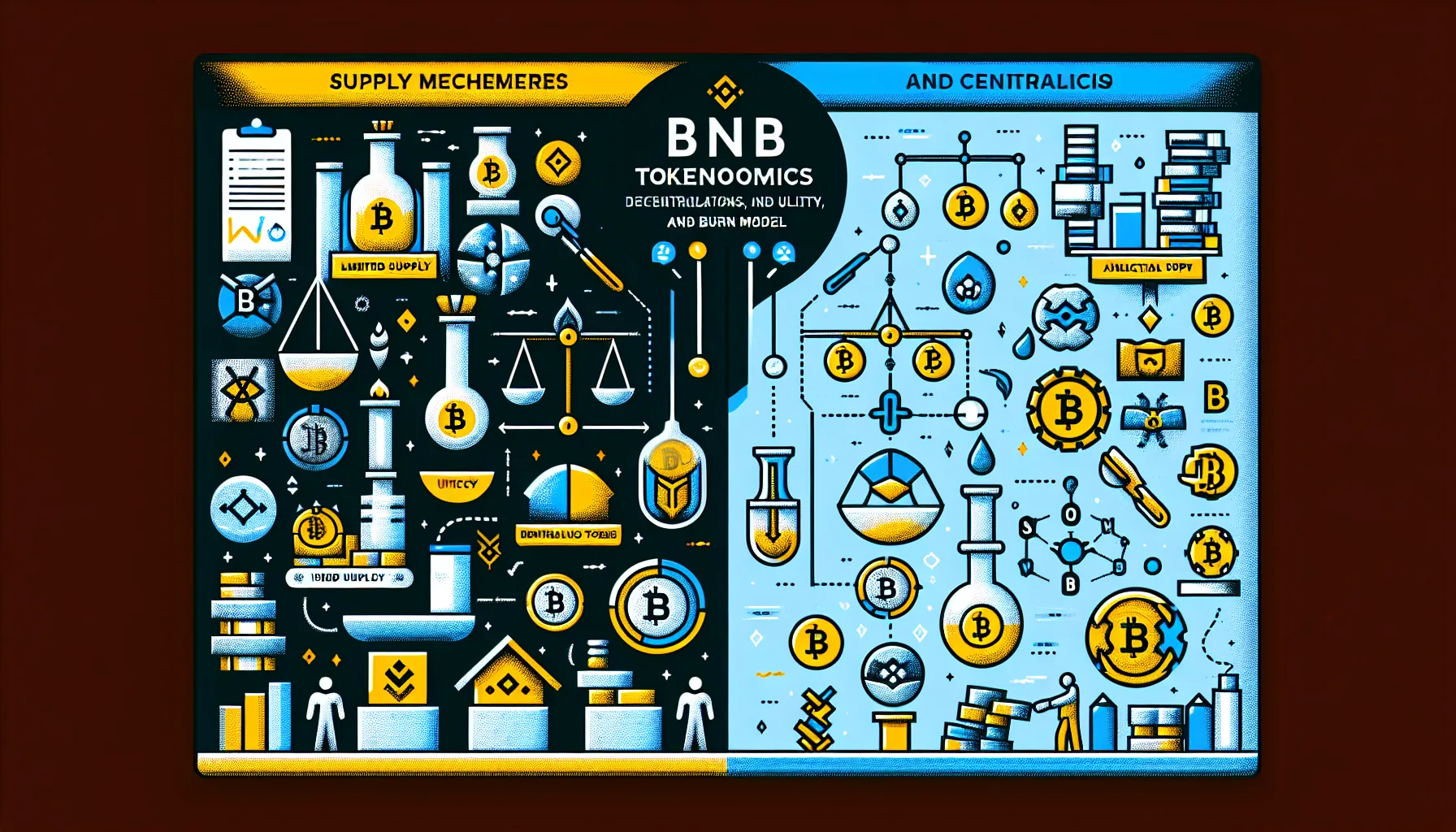
Analyzing BNB Tokenomics: Supply Mechanisms, Utility, and Burn Model
BNB (formerly Binance Coin) operates on a multifaceted tokenomics structure that plays a pivotal role in its ecosystem's long-term sustainability and functionality. Key aspects such as total supply, utility applications, burn mechanisms, and distribution dynamics define BNB's economic framework. This section delves into these specifics and highlights both its strengths and potential challenges.
Fixed Supply and Distribution Dynamics
BNB launched with a maximum supply of 200 million tokens, but this cap has been gradually reduced due to systematic token burns. Initially distributed through an ICO in 2017, BNB's allocation followed a conventional model: 40% reserved for Binance's founding team, 10% for angel investors, and 50% sold to the public. This early-stage allocation has raised questions about potential centralization risks, as Binance retains significant influence over BNB’s development and use cases. Such centralized control poses scrutiny in an era where decentralization is an expected norm.
Utility Across Ecosystem Layers
BNB’s key value proposition lies in its expansive utility. It operates as the native gas token for the BNB Chain ecosystem, encompassing the Binance Smart Chain (BSC) and Binance Beacon Chain. It is used to pay transaction fees, participate in governance proposals, and even access staking opportunities. Additionally, BNB offers fee discounts on the Binance exchange, creating demand from traders seeking cost savings. However, heavy reliance on Binance’s ecosystem ties BNB’s utility to the adoption of its centralized and semi-decentralized infrastructure, which may not align with the philosophies of certain crypto purists.
Deflationary Burn Mechanism
BNB employs a dual burn strategy: quarterly burns and real-time BEP-95 burns. The quarterly burn process removes a proportion of BNB's circulating supply until it reaches 100 million tokens (50% of the original supply). Separately, the BEP-95 mechanism—introduced post-BSC upgrade—burns a portion of on-chain fees in real-time, further accelerating deflationary pressure. While these efforts reduce supply and theoretically benefit token holders through scarcity, critics argue that sustained burns can disproportionately benefit early investors while limiting the token's broader distribution and adoption.
Economic Risks and Scalability Challenges
Despite its robust tokenomics, BNB faces unique risks. Heavy reliance on Binance’s leadership and operations introduces counterparty risk, and centralized control may discourage institutional participation in decentralized finance (DeFi) ecosystems. Furthermore, while deflationary mechanisms incentivize long-term holding, they could curtail utility if tokens become excessively scarce or expensive to use in everyday applications. The intrinsic connection between the token’s demand and Binance's global operations adds another layer of systemic risk.
BNB’s tokenomics operate within a carefully constructed framework designed to balance utility, scarcity, and sustainability. However, challenges surrounding centralization, reliance on Binance’s ecosystem, and the long-term impacts of its burn strategy warrant scrutiny from an analytical perspective.
BNB Governance
BNB Governance: Understanding the Framework and Challenges
BNB token governance serves as a significant component in the decision-making process within the Binance ecosystem. Unlike some decentralized protocols that often rely heavily on community-driven voting mechanisms, BNB’s governance model takes a more centralized approach, reflecting the hybrid nature of Binance’s infrastructure. This paradigm raises unique considerations and potential friction points for the crypto-savvy audience analyzing its alignment with decentralization ethos.
Centralized Oversight by Binance
A critical aspect of BNB governance is its centralized oversight. Binance, as the leading entity behind the ecosystem, plays an outsized role in key decisions related to upgrades, Binance Smart Chain (BSC) developments, and BNB tokenomics. For example, major protocol updates or emission schedule changes are often dictated through Binance’s internal decisions, bypassing the distributed governance frameworks seen in platforms like Ethereum or Polkadot. This concentrated control allows for streamlined development, but it can be seen as a point of contention for advocates who prioritize decentralized governance.
Binance Smart Chain Validators and Governance Power
The Binance Smart Chain operates on a delegated Proof-of-Stake (dPoS) consensus mechanism, where a limited set of validators are responsible for network security and governance execution. These validators are selected based on their ability to stake BNB and attract delegator votes. However, the validator set—while designed to enhance scalability—is significantly smaller than that of other networks, which may lead to concerns over centralization of voting power. Many of these validators are speculated to have strong ties to Binance itself, further amplifying questions about impartial decision-making.
Absence of Direct Token Holder Proposals
Unlike governance models that empower token holders to directly propose and vote on protocol changes, BNB governance lacks a robust mechanism that incorporates community input at the proposal level. While users can delegate BNB to validators or participate in staking, their ability to influence fundamental changes to the ecosystem is minimal beyond these roles. This could deter users seeking an active voice in governance processes and may alienate those who view participation as essential to the blockchain’s democratization.
Challenges in Transparency
Another notable critique of BNB governance is transparency. Because Binance retains significant control and operates without the same degree of network-wide disclosure as some decentralized projects, governance decisions may seem opaque to external participants. There is limited documentation or on-chain mechanisms to publicly track how decisions are formulated or assigned. This contrasts sharply with the transparent decision-making processes employed by DAOs in competing ecosystems.
BNB governance represents a hybrid structure that facilitates effective decision-making but highlights ongoing debates over decentralization, validator influence, and ecosystem inclusion.
Technical future of BNB
BNB's Current and Future Technical Developments: A Deep Dive Into Its Evolving Ecosystem
Binance Smart Chain (BSC) Upgrades and Scalability Innovations
BNB serves as the native token of Binance Smart Chain (BSC), an evolving layer-1 blockchain known for its low fees and high transaction throughput. One of the major ongoing developments focuses on improving BSC's scalability through advancements in consensus mechanisms. BSC currently employs a Proof-of-Staked Authority (PoSA) model, but scalability concerns remain, particularly during periods of heightened network congestion—a challenge consistently raised by developers and users alike.
Efforts are underway to enhance validator efficiency, with plans to increase the maximum validator count from 21 to diversify decision-making power and strengthen network resilience. Upcoming updates may also introduce dynamic gas pricing models to handle fluctuating network activity more effectively. However, concerns about centralization persist, as PoSA's small validator set raises questions about the robustness of decentralization efforts compared to fully permissionless chains.
BNB Greenfield: Decentralized Storage Ambitions
A key focus of BNB’s technical roadmap lies in the BNB Greenfield project, aimed at building a decentralized data storage infrastructure. Greenfield aspires to challenge traditional centralized storage providers by leveraging smart contract integrations and enabling users to monetize their data ownership. This initiative could have significant implications for decentralized app (dApp) ecosystems, particularly in NFT marketplaces and content-driven platforms.
However, critiques of Greenfield often center around its potential market adoption hurdles and whether its performance can match centralized incumbents like AWS or Google Cloud. Furthermore, interoperability between BNB Smart Chain, Greenfield, and other blockchain layers remains a technical hurdle requiring robust tooling and cross-chain bridges.
zkBNB and Zero-Knowledge Proof Expansion
Another forward-looking development is zkBNB, which integrates zero-knowledge (ZK) proof technology for scalable and privacy-preserving transactions. zkBNB seeks to offload transaction data processing from the main chain, potentially increasing BSC’s throughput while maintaining the integrity of on-chain settlements. Initial iterations of zkBNB target high-performance use cases like gaming and DeFi applications.
Despite its potential, the challenges tied to developing zkBNB are non-trivial. Implementing ZK proofs at scale remains computationally intensive, and questions remain about the trade-offs between ZK implementation costs and the expected performance benefits. Additionally, adoption might face resistance from certain dApp developers who could perceive zkBNB tooling as overly complex.
Governance Evolution and Cross-Chain Interoperability
A critical yet understated focus in BNB's roadmap is its evolving governance model coupled with interoperability. With the rise of multi-chain ecosystems, Binance has signaled an interest in stronger cross-chain integrations via security improvements to its Binance Bridge solutions. However, as witnessed in notable bridge-related exploits in the broader crypto ecosystem, ensuring the security of cross-chain transfers presents significant implementation risks.
There is also ongoing experimentation with decentralized governance frameworks to allow BSC participants to have greater influence over protocol-level decisions. While these changes aim to align with community priorities, skepticism remains around whether such measures are purely performative or capable of genuinely decentralizing governance within a Binance-driven ecosystem.
Comparing BNB to it’s rivals
BNB vs ETH: Key Differences and Competitive Analysis
When comparing Binance Coin (BNB) with Ethereum (ETH), the discussion often revolves around the technical architecture, ecosystem development, and use cases of these two crypto assets. While both serve integral roles in their respective ecosystems, they exhibit notable differences in areas such as consensus mechanisms, transaction efficiency, and potential bottlenecks.
Consensus Mechanism and Scalability
BNB operates on the Binance Smart Chain (BSC), which uses a Proof of Staked Authority (PoSA) consensus mechanism. This hybrid approach combines aspects of both Proof of Stake (PoS) and Proof of Authority (PoA). The result is faster block times and lower transaction costs. In contrast, Ethereum transitioned to Proof of Stake (PoS) with the Ethereum 2.0 upgrade, abandoning its previous Proof of Work (PoW) model. However, Ethereum continues to face challenges with scalability and transaction throughput, even with technologies like rollups and sharding being introduced to mitigate these issues.
BSC's PoSA model inherently sacrifices decentralization for speed, with a limited number of validators (21 active at a time). In comparison, Ethereum boasts a much larger and more decentralized validator set. For crypto users prioritizing decentralization and network security, this trade-off presents a significant drawback for BSC when competing against Ethereum.
Transaction Costs and Speed
BNB stands out for its low transaction fees, averaging fractions of a cent. This has made BSC particularly attractive for decentralized applications (dApps) requiring high-frequency transactions and gaming projects. Meanwhile, Ethereum's network, though equipped with more advanced tools for decentralized finance (DeFi) and institutional use cases, has long been plagued by high gas fees during periods of congestion. Even with the adoption of layer-2 solutions on Ethereum, the cost advantage of BSC remains compelling for developers and users seeking affordability.
However, critics of BSC argue that its low fees can facilitate spam transactions, leading to blockchain bloat. Additionally, Ethereum's fee model (EIP-1559) improves fee predictability and includes a deflationary component, which has long-term implications for tokenomics that BNB does not replicate.
Ecosystem and Development
Ethereum's ecosystem is far more expansive, with thousands of dApps and the lion’s share of total value locked (TVL) in DeFi protocols. Ethereum's open-source nature and developer-centric ethos have fostered a robust ecosystem. By contrast, BSC's ecosystem is largely centralized, with Binance playing an outsized role in guiding its growth. While this centralization enables quicker decision-making and ecosystem updates, it raises concerns about censorship and long-term decentralization.
The disparity in developer communities between the two blockchains is also significant. Ethereum boasts one of the largest and most innovative groups of developers globally, constantly introducing new standards like ERC-20, ERC-721, and ERC-1155. In comparison, BNB and BSC lack the same cultural and technical influence, often being labeled as a more centralized alternative focused on replicating Ethereum’s functionality rather than pioneering foundational innovations.
Regulatory Factors
Regulatory scrutiny has become a prominent issue for centralized entities like Binance, which directly impacts BNB and its ecosystem. Ethereum—despite some concerns over securities classification—has a decentralized structure that arguably minimizes the risks of single-point failures or regulatory crackdowns. The centralized nature of BSC and Binance's influence raise questions about the long-term sustainability of its competitive positioning, particularly in jurisdictions with stringent crypto regulations.
BNB vs SOL: A Closer Look at the Differences
When comparing BNB (Binance Coin) to SOL (Solana), the discussion inevitably converges on their architectural designs, use cases, and community adoption, offering crypto-savvy investors distinct considerations. Both projects are integral to their respective ecosystems, but they take radically different approaches to achieving scalability, decentralization, and utility.
Network Performance and Scalability
BNB operates primarily within the Binance Smart Chain (BSC), leveraging its Proof-of-Staked-Authority (PoSA) consensus mechanism. While this hybrid model offers fast block times and a high transaction throughput, it sacrifices a degree of decentralization due to its limited number of validators. In contrast, Solana employs a unique Proof-of-History (PoH) system combined with Proof-of-Stake (PoS), delivering unmatched speed — with theoretical scalability up to 65,000 transactions per second (TPS). However, Solana's frequent network outages and challenges in maintaining operational stability highlight a potential fragility in its architecture. BNB's network may not achieve Solana's TPS claims, but it benefits from a more predictable uptime, which traders and developers often prioritize.
Developer Ecosystem and Smart Contracts
BNB Smart Chain has achieved significant traction among developers due to minimal gas fees and EVM (Ethereum Virtual Machine) compatibility. This compatibility lowers the barrier to entry for projects migrating from Ethereum, and the ecosystem boasts a large array of decentralized applications (dApps), especially in DeFi and NFTs. SOL, on the other hand, excels in fostering innovative use cases, prioritizing performance-driven applications such as high-frequency trading platforms and gaming dApps. However, Solana's development environment can be less accessible for teams familiar with Solidity, as programs are primarily built using Rust, which has a steeper learning curve. This can slow down the onboarding of new projects compared to BNB's more accessible framework.
Token Utility and Ecosystem Reliance
BNB is deeply integrated into Binance's exchange, providing a distinct edge in terms of utility for trading fee discounts, token launches, and other ecosystem incentives. Conversely, SOL's primary utility revolves around staking and transaction fees on Solana’s network. While this positions SOL as a backbone for its ecosystem, it lacks the broader exchange-related use cases that BNB enjoys.
Centralization Concerns
Decentralization remains a contentious topic for both. While Solana’s validator set is larger than that of Binance Smart Chain, critics argue that SOL's network is still highly concentrated, as the majority of tokens are held by insiders and initial investors. Similarly, BNB’s validator set is relatively centralized, dominated by Binance-affiliated nodes, which raises governance concerns.
Both assets cater to different niches, with BNB emphasizing ecosystem synergy and Solana pushing the boundaries of network speed. Understanding these distinctions can help define their roles within your broader crypto strategy.
BNB vs. AVAX: A Detailed Comparison of Ecosystem Strengths and Trade-Offs
When comparing BNB and Avalanche’s native token, AVAX, notable distinctions emerge in their approach to scalability, decentralization, and ecosystem growth. These differences are rooted in their unique technical frameworks and strategic priorities, giving each a distinct edge based on specific use cases.
Consensus Mechanisms: BNB Smart Chain vs. Avalanche Consensus
BNB operates on the Binance Smart Chain (BSC), which uses a Proof-of-Staked-Authority (PoSA) consensus model. This hybrid mechanism optimizes for transaction speed and low cost but is often criticized for reduced decentralization due to its reliance on a limited number of validators. AVAX, on the other hand, leverages Avalanche’s revolutionary Snowman consensus protocol. Its leaderless design allows for thousands of validators to confirm transactions while maintaining consensus efficiency. This provides AVAX with a higher level of decentralization and security compared to BNB but can result in slightly slower finality in certain conditions.
Transaction Costs and Speed
BNB has gained traction largely because of its ultra-low fees and consistently fast transaction throughput. The network was specifically built with cost efficiency in mind, which has made it attractive for retail users and smaller-scale transactions. Meanwhile, Avalanche offers near-instant transaction finality and competitive fees thanks to its unique multi-chain structure consisting of the X-Chain, C-Chain, and P-Chain. Still, in congested situations, AVAX fees can spike higher than BNB’s, especially during periods of peak demand for DeFi applications on Avalanche.
Developer Ecosystem and Infrastructure
Avalanche’s subnets provide developers the flexibility to create custom blockchain environments, which is a compelling feature for projects requiring bespoke validation rules or governance structures. This modularity gives AVAX a technical edge in supporting highly specialized dApps. BNB, although lacking this level of customizability, benefits from a more streamlined and developer-friendly architecture. Building on BSC often entails less complexity, making it appealing to less experienced projects or those prioritizing speed-to-market over fine-tuned capabilities.
Scalability and Network Congestion
BNB Smart Chain’s scalability is achieved at the cost of a higher degree of centralization. This has raised concerns among crypto purists but offers practical advantages in throughput and cost predictability. Avalanche’s subnets and parallel execution engines also deliver strong scalability but introduce higher levels of complexity for both end-users and developers. This aspect can sometimes create friction in onboarding and usability when compared to the simplicity of BSC.
Security and Decentralization Trade-Offs
One of the primary critiques of BNB is its reliance on Binance as an overarching entity. This perception of centralization not only raises regulatory questions but may also deter enterprises seeking blockchain solutions free from over-reliance on a single actor. By contrast, Avalanche’s decentralized validator set and academic consensus foundations make it well-suited to those prioritizing trustless systems. However, AVAX’s larger attack surface, due to its multi-chain architecture, could theoretically pose additional security challenges.
This side-by-side comparison underscores fundamental differences between the two ecosystems, shaped by how BNB and AVAX approach network design and user priorities. Their trade-offs in decentralization, cost efficiency, and developer customization have made them prominent but distinct players in the evolving crypto landscape.
Primary criticisms of BNB
Primary Criticism of BNB: Key Issues Surrounding Binance’s Native Token
Centralization Concerns
One of the most significant criticisms of BNB revolves around its level of centralization. Despite being marketed as a utility token for the Binance ecosystem, many argue that its governance and supply are heavily controlled by Binance itself. The Binance team conducted the initial token distribution via an ICO in 2017, and a substantial portion of the supply remains linked to the company and its associated wallets. Critics claim this concentrated ownership gives Binance substantial power to influence the token’s market dynamics, raising concerns about transparency and trust within the ecosystem.
Additionally, Binance Chain, where BNB operates, has faced scrutiny for being less decentralized than other blockchain networks. Validators on the Binance Smart Chain (BSC) are limited in number, making it easier for Binance to exert influence over network governance. This perceived lack of decentralization undermines one of the core principles of cryptocurrency: ensuring that no single entity holds disproportionate power.
Regulatory Risks
Regulatory risks have also been identified as a key issue for BNB. As Binance continues to expand globally, it faces mounting scrutiny from regulators in various jurisdictions. Given that BNB plays a central role in Binance’s operations—being used for trading fee discounts, launchpad participation, and more—it is seen as closely intertwined with the company's overall business. Some critics argue that its utility and close link to Binance's business model could make it susceptible to being classified as a security by regulatory agencies. This classification could have far-reaching implications, including the possibility of compliance restrictions or enforcement actions that could impact users of the token.
Token Burn and Market Manipulation Allegations
BNB’s periodic token burn events, designed to reduce supply and potentially increase scarcity, have also been criticized. While token burns are promoted as a mechanism to reward holders, detractors argue that these practices are not transparent enough. Since Binance itself decides on the burn amount based on company profits and activity metrics, skeptics believe this could be exploited to manipulate perceptions of demand or to artificially inflate market sentiment. Without comprehensive third-party audits or more accountability, such activities raise questions about the long-term trustworthiness of the tokenomics model.
Limited Use Beyond the Ecosystem
While BNB boasts several utilities within the Binance ecosystem, critics often highlight that its adoption outside of Binance's platforms remains relatively constrained. Although some partnerships have enabled limited usage of BNB for payments or DeFi protocols, its dependability on Binance’s infrastructure is seen as a significant weakness. Should Binance face operational disruptions or negative regulatory outcomes, this dependency could undermine the token’s relevance and utility.
These criticisms, while not exhaustive, point to complex challenges faced by BNB in maintaining its reputation and trust within the crypto community.
Founders
BNB Founding Team: Key Figures Behind the Binance Ecosystem
The founding team behind BNB (Binance Coin) is intrinsically linked with Binance, one of the largest cryptocurrency exchanges globally. Binance launched BNB in 2017 as part of its ICO, with its leadership team playing a pivotal role in shaping the coin’s purpose and adoption within the ecosystem. However, the team’s journey has not been without complexity or criticism, which crypto-savvy readers should carefully consider.
Changpeng Zhao (CZ): The Face of Binance
Changpeng Zhao, widely known as CZ, is the co-founder and CEO of Binance. With a computer science background and extensive experience in financial tech, including stints at Blockchain.com and OKCoin, CZ brought significant technical expertise to the creation of Binance and BNB. Regarded as a highly visible figure in the crypto space, his leadership has been a key driver behind Binance’s rapid ascent. However, CZ has faced regulatory scrutiny in numerous jurisdictions worldwide. Critics argue that Binance’s sometimes opaque operational structure could be a reflection of leadership choices made early in its development.
While CZ has been commended for his hands-on approach and engagement with the crypto community, skeptics have pointed out the risks of over-reliance on his personal leadership, including potential vulnerabilities tied to regulatory pressures or unforeseen controversies.
He Yi: Steering Strategy and Marketing
He Yi, Binance’s other co-founder and its Chief Marketing Officer (CMO), has been instrumental in shaping the company’s global presence. With a background in communications and a previous role as co-founder of OKCoin, He Yi leveraged her expertise to position Binance as a dominant player in the crypto market. Her focus on building community trust around the Binance brand played a significant role in increasing BNB’s adoption.
However, some critics question the long-term sustainability of Binance’s aggressive growth strategy, which she helped architect. This rapid expansion has sometimes resulted in regulatory clashes and a perception that the company prioritizes growth over compliance. Such concerns also inevitably reflect on the executives behind Binance, including He Yi.
Anonymous Contributors and Decentralization Questions
While CZ and He Yi are the prominent faces associated with the founding of Binance and BNB, much of the initial development involved anonymous contributors. For a crypto asset that promotes itself as integral to a decentralized ecosystem, this raises questions about transparency and centralization at the leadership level. Critics argue that the company displays a centralized operational ethos despite touting decentralization as a core principle, which runs counter to broader cryptocurrency ideals.
Authors comments
This document was made by www.BestDapps.com
Sources
- https://bnbchain.org/en/whitepaper/
- https://github.com/bnb-chain/whitepaper
- https://academy.binance.com/en/articles/an-in-depth-look-at-binance-coin-bnb
- https://coinmarketcap.com/currencies/bnb/
- https://etherscan.io/token/0xB8c77482e45f1F44dE1745F52C74426C631bdd52
- https://www.binance.com/en/bnb
- https://research.binance.com/en/projects/binance-coin
- https://docs.bnbchain.org/
- https://www.coingecko.com/en/coins/binancecoin
- https://cryptoslate.com/coins/binance-coin/
- https://defillama.com/chain/Binance
- https://consensys.net/token-explorer/binance-coin-bnb/
- https://www.stakingrewards.com/earn/binance-coin/
- https://messari.io/asset/bnb
- https://api.binance.com/
- https://www.gemini.com/cryptopedia/binance-coin-bnb
- https://docs.binance.org/smart-chain/index.html
- https://medium.com/@binance
- https://crypto.ro/en/binance-coin-bnb-explained/#tokenomics