History of BLZ
The History of BLZ: Evolution of the Bluzelle Ecosystem
Bluzelle, the blockchain network behind the BLZ token, was launched with a clear focus on solving data storage challenges in the decentralized ecosystem. Its origins trace back to its founders’ vision of creating a decentralized database solution that caters to dApps, enabling high data integrity, security, and scalability. Initially envisioned during the blockchain boom, Bluzelle began its journey by addressing one of the fundamental limitations of existing networks: the reliability and cost-efficiency of data storage.
The project first gained significant attention during its highly-publicized Initial Coin Offering (ICO), which funded the development of the network. The ICO, conducted at the peak of the blockchain fundraising frenzy, highlighted Bluzelle’s unique value proposition: a decentralized database as a service (DBaaS) for developers. During this time, the BLZ token was minted and distributed as the core means of accessing the Bluzelle infrastructure and incentivizing network usage. However, the ICO funding model came with its set of challenges, leaving the project with steep expectations from its backers and the broader blockchain community.
Bluzelle’s early years saw extensive development and testing of its decentralized database, positioning the project as a natural fit for dApp developers needing secure and distributed storage. However, scaling the network’s user base and adoption posed challenges in a competitive space where other blockchain storage solutions, notably IPFS and Filecoin, were already vying for market dominance. Moreover, critiques emerged around Bluzelle’s initial emphasis on Ethereum as its platform of choice, particularly regarding Ethereum’s scalability issues and congestion during high-traffic periods.
In response to these challenges, Bluzelle shifted focus to interoperability and upgraded its platform to integrate with more robust ecosystems, such as Cosmos. This transition allowed the network to leverage Tendermint’s consensus mechanism and improved scalability, significantly enhancing the performance of its decentralized storage solution. However, the migration also posed risks, as refocusing and repositioning the project within a different ecosystem required re-educating its user base and partners.
As the platform matured, Bluzelle expanded its use case beyond decentralized storage, incorporating capabilities such as data oracles and NFT-oriented products. This diversification aimed to capitalize on broader blockchain trends while showcasing the versatility of its technology. While this evolution showcased adaptability, some critics argued that pivoting into multiple segments diluted Bluzelle’s original vision and stretched its resources thin.
BLZ’s historical trajectory underscores the challenges of navigating the rapidly-evolving blockchain landscape while addressing initial scalability, adoption, and competitive pressures.
How BLZ Works
How BLZ Works: Decentralized File Sharing and Data Security
BLZ, the native utility token of the Bluzelle network, powers a decentralized storage protocol specifically designed to cater to the demands of Web3 applications. At its core, the mechanism driving BLZ revolves around providing a censorship-resistant, secure, and high-performance environment for data storage and retrieval. This section delves into the underlying infrastructure and operational mechanics that define BLZ.
Decentralized Database Network
Bluzelle operates as a distributed network of nodes, each contributing storage and computing resources to form decentralized storage clusters. These nodes maintain redundancy through a replication model, ensuring data durability even in the event of node outages or network splits. The database structure adheres to principles of sharding, breaking data into smaller fragments and distributing them across the nodes. This ensures scalability as the demand for storage grows while also minimizing latency during data queries.
Proof-of-Storage and Token Economics
BLZ incentivizes participants through its Proof-of-Storage model. Storage providers commit their disk space and are rewarded with BLZ tokens in exchange for their contributions to the network. However, this rewards mechanism also comes with challenges. For example, network validators need to maintain high system performance to meet the storage and reliability standards set by the protocol. Misaligned incentives could lead to underperformance if storage resources are distributed with insufficient uptime or inadequate quality guarantees.
Governance and Network Decentralization
Bluzelle integrates a governance structure powered by BLZ, allowing token holders to vote on critical protocol upgrades and network changes. While this approach fosters decentralization, it can also introduce governance challenges. For instance, token whales could potentially dominate decision-making processes, skewing the network direction in favor of parties that hold significant BLZ reserves.
Content Access and File Retrieval
Through its use of a Distributed Hash Table (DHT) architecture, the Bluzelle network ensures efficient file retrieval by assigning unique cryptographic hashes to stored data. Users interact with this system through APIs, which are interoperable with common blockchain ecosystems, making BLZ especially attractive to dApp developers. However, the reliance on DHT can lead to data latency issues in edge cases where network congestion or poor node performance occurs.
Security Measures and Stakes
Security in Bluzelle is reinforced through staking mechanisms. Nodes are required to lock BLZ tokens as collateral, which can be slashed in the event of misbehavior. While this slashing mechanism protects against malicious activities, it also imposes significant entry barriers for potential validators, as they must acquire and stake a substantial amount of BLZ to participate in the network.
BLZ's architecture is a finely-tuned system that balances decentralization, scalability, and security, though it is not without its trade-offs. Data redundancy and cryptographic security come at the cost of potential throughput bottlenecks, and governance design remains an ongoing experiment in balancing power among stakeholders.
Use Cases
BLZ Crypto Asset Use Cases: Decentralized Data Delivery and Beyond
The BLZ (Bluzelle) crypto asset is primarily designed to power its decentralized storage and database network. It is an essential component within a robust infrastructure aimed at addressing specific challenges tied to the storage, distribution, and security of data in decentralized applications (dApps). Below, we unpack some of the prominent use cases of BLZ and the potential caveats attached to them.
1. Decentralized Data Storage for dApps
One of the core use cases of BLZ lies in its role as a medium for accessing storage and database services within the Bluzelle ecosystem. The platform positions itself as a decentralized alternative to centralized cloud storage, enabling developers to store critical pieces of dApp data in a way that ensures redundancy, immutability, and security. This fills a critical need for projects leveraging blockchain infrastructure, where even minor data loss or corruption can disrupt smart contract functionality.
However, as with any decentralized storage solution, the reliability of the network depends heavily on the distributed nature of its validator nodes. Questions remain around network robustness when usage scales significantly or during periods of low validator participation. Additionally, onboarding developers in a competitive ecosystem dominated by centralized giants like AWS and Google Cloud poses challenges.
2. Content Delivery Network (CDN) for Decentralized Media
BLZ also powers Bluzelle's decentralized content delivery network, which aims to facilitate efficient data sharing for media and content-heavy applications. By leveraging a swarm architecture, Bluzelle routes data through its network faster than centralized counterparts—at least in theory—while avoiding single points of failure.
Yet, latency concerns in cross-border data delivery could hinder its appeal. Geographic distribution of validator nodes is crucial, as an unevenly distributed network could disproportionately benefit some regions while underperforming in others, potentially reducing adoption for global dApps.
3. Network Staking Incentives
BLZ tokens enable a staking mechanism where participants can earn rewards by securing the network and maintaining storage nodes. This incentivization model is vital for ensuring the health of the ecosystem by providing decentralized infrastructure.
However, staking models can often lead to centralization risks if a small number of participants accumulate a disproportionate amount of BLZ. This could undermine the network's decentralization ethos.
4. Data Security and Privacy
Finally, BLZ plays a significant role in enabling encrypted storage and data transactions. The use of blockchain tech ensures that no single entity has control, making data theft or unauthorized changes highly unlikely.
Still, real-world privacy concerns arise when regulators demand compliance in certain jurisdictions. It's unclear how Bluzelle navigates these conflicts without compromising its decentralized vision.
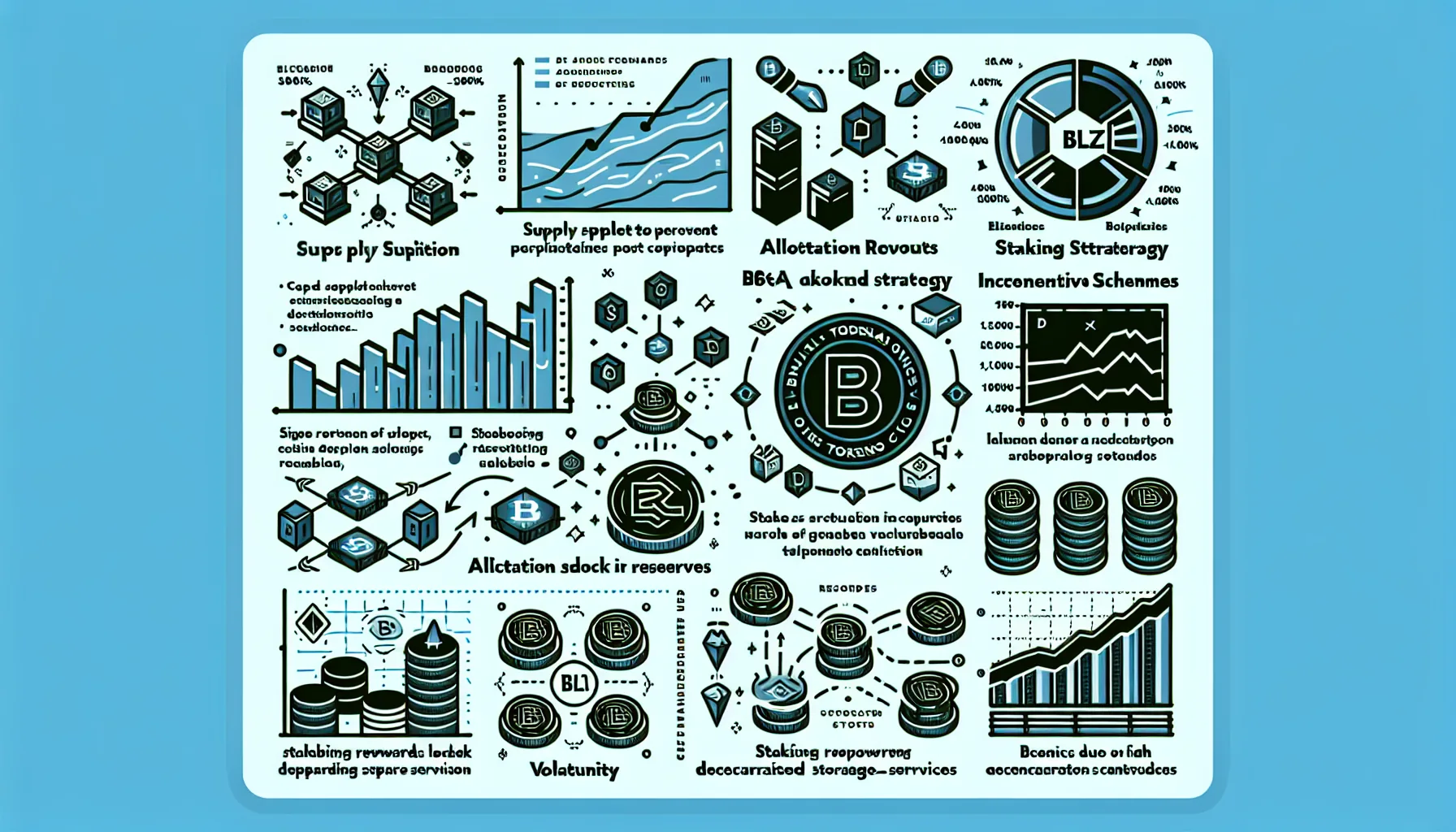
BLZ Tokenomics
Tokenomics of BLZ: An In-Depth Analysis
The tokenomics of BLZ, the native utility token for the Bluzelle ecosystem, provide crucial insights into the asset's economic design and functional utility. By understanding its supply dynamics, allocation strategy, and incentive mechanisms, crypto-savvy users can better assess its role within the broader decentralized space.
Circulating and Total Supply Dynamics
BLZ’s tokenomics largely hinge on its fixed total supply, which is designed to prevent inflation over time. The capped supply ensures scarcity, a common feature in many crypto assets aimed at fostering long-term value retention. However, as with any token, understanding the circulating supply versus the total supply is critical. A significant percentage of BLZ tokens are locked in staking protocols and ecosystem reserves. This creates a scenario where the "true" circulating supply may be lower than anticipated. While this can reduce sell pressure, it may also lead to liquidity concerns, especially for larger traders or institutions.
Allocation Strategy and Distribution
The initial BLZ token allocation was designed to service various ecosystem needs, including developer incentives, operational reserves, liquidity provision, and the community. While such diversification is a positive in theory, some concerns have been raised regarding transparency in distribution. For instance, the exact timing and structure of token unlocks have not been consistently communicated, leading to potential uncertainty for token holders.
Additionally, token allocation heavily favors early contributors and ecosystem development—features that may give an outsized advantage to insiders, raising questions about fair distribution of governance power. Over time, such power asymmetry may create obstacles to decentralization, particularly if large stakeholders exert undue influence over decision-making or network changes.
Incentivization and Staking
A core pillar of BLZ tokenomics lies in its staking model. Token holders can stake BLZ to secure the network and earn rewards, creating a dual utility of financial incentives and network participation. These staking rewards are not inflationary, as they are distributed from pre-allocated reserves. While this structure benefits stakers, there are risks to consider: high staking participation may reduce liquidity on exchanges, amplifying price volatility and creating barriers to entry for new participants.
Furthermore, depending on user participation rates, staking yields may diminish over time as more participants join the pool. This raises valid questions about the long-term sustainability of staking as a driver of value for BLZ holders.
Burn Mechanisms and Utility
BLZ does not currently implement a token burn mechanism, which is a divergence from the approach seen in deflationary tokens. While this avoids reducing the supply artificially, it does leave the question of token demand unaddressed. The utility of BLZ primarily revolves around powering decentralized storage services on the Bluzelle network. However, adoption challenges in competing against established Web3 storage solutions may directly affect token demand over the long term.
BLZ Governance
Exploring Governance in BLZ: Decentralization and Potential Limitations
The governance structure of BLZ (Bluzelle) plays a critical role in shaping the platform's evolution and decision-making processes. Built on a decentralized framework, BLZ prioritizes community involvement and seeks to distribute authority across its token holders. This aligns with the broader ethos of blockchain ecosystems, but like any governance model, it has its nuances, strengths, and weaknesses.
Token Holder Influence: Stake-Based Voting
BLZ's governance leverages a stake-based voting mechanism, where BLZ token holders participate in determining key decisions. The more tokens one holds, the greater their influence over governance proposals. This model, while effective in decentralizing power, naturally introduces challenges. For instance, large token holders or whales can disproportionately tip the scales on votes, potentially sidelining smaller community members. This common issue in stake-based governance highlights an existing tension between decentralization and equity in decision-making.
Proposal System and Community Engagement
The BLZ governance process hinges on community-driven proposals. Token holders can submit ideas or updates for consideration, covering anything from protocol upgrades to fee structure adjustments. While this open proposal model encourages broad participation, its success depends heavily on the level of engagement within the ecosystem. A lack of diverse participation can weaken the decision-making process, leading to echo chambers dominated by a minority of participants. It is essential for any decentralized governance system, including BLZ, to foster active participation from a wide array of stakeholders to ensure that decisions reflect the ecosystem's broader interests.
Governance Token Utility and Incentive Misalignment
One critical aspect of BLZ's governance framework lies in the economic design of its token. While the governance utility incentivizes holders to participate in decision-making, the underlying assumption is that token holders always act in the ecosystem's best interests. In practice, self-interested decisions or short-term profit motives could result in governance outcomes that do not align with the platform's long-term health. This creates an inherent risk of conflicts between governance decisions and the sustainable growth of the network.
Transparency and Execution Risks
The transparency of voting outcomes and the implementation of governance decisions remain core concerns for BLZ governance. Although decisions reached through the voting process are typically binding, ensuring their timely and accurate execution requires robust operational mechanisms. Any gaps in this process can erode trust within the community, undermining the effectiveness of decentralized governance.
In summary, while BLZ's governance framework reflects a commitment to decentralization and community empowerment, challenges such as influence centralization, engagement limitations, and execution risks demand constant attention.
Technical future of BLZ
BLZ Crypto Asset: Current and Future Technical Developments and Roadmap
BLZ's Decentralized Edge: Advancing Data Delivery with Akash and Filecoin Integrations
BLZ (Bluzelle) continues to focus its technical innovations on decentralized data storage and retrieval, leveraging its distributed database system. A key development is its ongoing integration with decentralized compute and storage networks such as Akash and Filecoin. These integrations aim to address scaling and latency issues by hosting BLZ nodes closer to the edge, enhancing performance for dApp developers who rely on Bluzelle to access critical datasets. While this development is promising in increasing network reliability, one concern is the relatively slow adoption rate of these third-party solutions. Their performance relies on external ecosystems, which introduces dependencies that could affect network uptime in case of isolated downtime incidents.
The Evolution of the Bluzelle R2 Protocol
The Bluzelle R2 protocol, its primary database model, is undergoing upgrades to optimize write efficiencies for enterprise-grade use cases. R2's migration to a Byzantine Fault Tolerant (BFT) consensus algorithm enhances security against network disruptions while maintaining transaction finality under adverse conditions. However, transitioning to full BFT consensus could increase block-processing times during peak activity periods. This tradeoff between decentralization and throughput remains an area of concern for projects exploring Bluzelle within DeFi platforms requiring high-speed transactions.
Gaming-Focused Features and Gas Fee Optimization
Bluzelle has identified blockchain-based gaming as a broader application for its technology. Developments such as file serialization improvements directly benefit game developers by reducing storage footprints for NFTs (non-fungible tokens) and other game assets. Meanwhile, BLZ is working on gas fee reduction mechanisms through zk-rollup adoption to minimize friction for its gaming-focused user base. Although zk-rollups present scalable benefits, their maturity and full compatibility with Bluzelle's multi-chain architecture are still in experimental stages. These ongoing evaluations may introduce delays in wider rollup implementations.
Challenges in Multi-Chain Expansions
While BLZ supports major chains including Cosmos and Ethereum, efforts to expand its compatibility to BNB Chain and Polkadot have encountered technical bottlenecks. These include hindrances with cross-chain data synchronization and interoperability standards. The development team has hinted at adopting an IBC-compatible messaging layer to resolve such issues, but this introduces new complexities in network governance and trust-layer audits.
Upcoming Roadmap Milestones
The technical roadmap emphasizes three priority areas: completing the shift to full BFT protocols, publishing an SDK for seamless dApp integration, and deploying its incentivized staking mechanism. While these updates could advance Bluzelle's utility for developers and node operators, challenges remain in balancing rapid deployment timelines with security and decentralization objectives.
Comparing BLZ to it’s rivals
BLZ vs. ZIL: A Deep Dive Into Key Differences
When analyzing BLZ (Bluzelle) alongside one of its primary competitors, ZIL (Zilliqa), both projects bring unique strengths and tradeoffs to the decentralized ecosystem, though they operate in distinct niches that occasionally overlap. While BLZ focuses heavily on decentralized data storage and file integrity through its optimized decentralized database solutions, ZIL has carved out prominence in the space by pushing forward high-throughput smart contract execution driven by its use of sharding technology.
Blockchain Architecture: Specialized vs. Generalized
Zilliqa's architecture operates on a high-throughput Layer-1 blockchain optimized for handling dApps requiring large-scale processing power. ZIL is highly generalized, supporting a diverse range of use cases from DeFi to NFTs. By contrast, BLZ specializes in decentralized data management, employing file storage that prioritizes speed, data availability, and multi-cloud redundancy for dApps needing secure backend storage. This specialization often makes BLZ more appealing for enterprise-level data use cases, while ZIL’s broader scope caters more to decentralized computation and smart contract environments.
Technology Comparison: Sharding vs. Storage Nodes
ZIL stands out for pioneering sharding as a scaling solution, enabling it to process thousands of transactions per second. This scalability ensures minimal latencies during high network activity. However, due to its focus on transaction processing, ZIL doesn't directly address decentralized data storage – leaving a gap in its ecosystem that BLZ seeks to fill. Bluzelle’s use of clustered storage nodes decentralizes database services, offering low-latency and tamper-resistant data retrieval.
Ecosystem Integration
BLZ’s connection to the Cosmos ecosystem provides interoperability advantages, allowing seamless cross-network data management and storage solutions. ZIL, on the other hand, positions itself as a standalone ecosystem with its own smart contract language, Scilla, which enhances transactional efficiency but adds a steeper learning curve for developers unfamiliar with ZIL-specific tooling.
Strategic Limitations
One challenge for BLZ is its niche focus; while powerful, its decentralized data solutions may not attract as wide a developer base compared to ZIL's multi-vertical ecosystem. Conversely, ZIL's aggressive focus on scalability has faced criticism for introducing complexity that some developers avoid, particularly when working with its ecosystem-specific coding structures. Moreover, ZIL’s framework lacks a native decentralized data layer, meaning projects requiring multi-use solutions must look to additional tools or integrations.
Both projects occupy complementary yet competitive niches, with differences in technical focus offering developers unique trade-offs depending on their project needs.
BLZ vs. ICX: Evaluating Network Strength and Use-Case Divergence
When comparing BLZ (Bluzelle) to ICX (Icon), the two projects reveal distinct approaches to blockchain utilities and network goals that cater to different segments within the decentralized ecosystem. A clear examination of these distinctions provides vital insights for those evaluating both networks.
Interoperability vs. Specialized Focus
ICX positions itself as a 'blockchain of blockchains,’ emphasizing interoperability through its proprietary Blockchain Transmission Protocol (BTP). This allows ICX to connect various blockchains in a seamless, scalable manner. By contrast, BLZ operates within a more focused niche, carving out a decentralized data storage and management system geared towards safeguarding Web3 applications. ICX’s broader mandate may attract developers requiring cross-chain compatibility, while BLZ's specialized approach appeals specifically to dApp developers who prioritize decentralized data integrity.
Decentralization Paradigm
One significant difference lies in how decentralization is implemented. ICX relies on its Delegated Proof-of-Stake (DPoS) consensus mechanism, where validators (or ‘P-Reps’) take on a pivotal role in network governance and transaction processing. While this adds efficiency and scalability, critics argue that DPoS models can introduce centralization risks, as power consolidates among larger stakeholders. BLZ, leveraging its unique Proof-of-Storage paradigm in conjunction with Tendermint-based Proof-of-Stake (PoS), targets decentralization more directly within its data storage architecture, ensuring anyone can participate and rent out unused storage capacity. However, critics of BLZ note concerns of fragmentation, as adoption hinges on attracting robust demand for its data-storage utility.
Real-World Application and Adoption
ICX's ambition for interoperability has led to partnerships within enterprise and public-sector environments, especially in South Korea, where it has been adopted for government-backed blockchain projects. This gives ICX strong enterprise-facing credentials but also means it is heavily tied to the success of regional adoption rather than achieving broader global reach. In contrast, BLZ’s appeal lies in decentralized architecture, which primarily benefits the Web3 and DeFi space. While this offers significant growth potential, challenges exist around fostering sufficient awareness and involvement from mainstream projects to prevent BLZ from being perceived as a niche utility.
Developer Community and Ecosystem Maturity
ICX provides a mature, developer-friendly ecosystem, offering robust tools like ICON SDKs and APIs that support widespread dApp creation and cross-chain connectivity. However, the ecosystem's reliance on its ICON blockchain limits modular adoption in the multi-chain future. On the other hand, BLZ’s streamlined focus enables targeted innovation in decentralized storage solutions, albeit with a smaller active developer base. This disparity underscores ICX's broader appeal with a more extensive development framework versus BLZ’s high specialization but narrower scope.
Examining BLZ against ICX reveals compelling contrasts and trade-offs, catering to different priorities within the blockchain ecosystem. Whether focusing on cross-chain interoperability or specialized decentralized storage will shape user adoption and network evolution remains to be seen.
BLZ vs. ELF: A Detailed Comparison of Ecosystem and Use Cases
In the competitive landscape of blockchain protocols and crypto assets, BLZ (Bluzelle) and ELF (aelf) cater to fundamentally different niches, but both aim to address scalability and efficiency challenges in decentralized systems. These differing priorities create points of comparison worth exploring, especially when considering how developers and enterprises allocate resources within the blockchain ecosystem.
Network Architecture and Scalability Solutions
BLZ leverages a decentralized database solution designed to empower dApps by providing secure, reliable data storage. Its value proposition revolves around decentralized data integrity and performance-driven solutions for applications requiring frequent, scalable storage. Conversely, ELF offers a multi-chain architecture aimed at tackling computational bottlenecks in blockchains. Aelf achieves scalability through built-in sidechains, allowing for the segmentation of specific tasks or applications to prevent mainchain congestion.
While BLZ emphasizes data storage, ELF’s strength lies in its robust computing and resource segregation model. However, ELF's architecture introduces complexity, as developers must design applications with both mainchain and sidechain compatibility in mind. This added layer can delay development timelines and poses potential interoperability pain points between sidechains—an issue BLZ avoids due to its singular focus on database management.
Adoption and Developer Ecosystem
A notable stark contrast lies in how these platforms appeal to their respective developer communities. Bluzelle's primary users tend to be dApps within verticals like gaming, DeFi, and NFT ecosystems, where fast, secure database operations are paramount. ELF attracts enterprise-level projects seeking to leverage its modular blockchain layer and customizable governance frameworks. However, it’s worth noting that ELF’s adoption rates among smaller developers have been slower, potentially due to its higher entry barriers when compared to Bluzelle’s plug-and-play database API offering.
The complexity of managing sidechains in ELF’s ecosystem could deter independent developers or smaller-scale projects. On the other hand, BLZ is less flexible in its scope, given that its database solution is strictly tailored to dApp-specific storage needs and doesn't extend into the broader enterprise-grade use case sphere.
Token Utility and Staking Mechanics
Both BLZ and ELF emphasize token-based ecosystems, but their staking mechanics differ significantly. ELF uses its token to govern mainchain-sidechain relationships and allocate computational resources. While effective for resource management, this method introduces governance challenges as high-stake holders could theoretically centralize decision-making. By contrast, BLZ's staking dynamics are more straightforward, incentivizing network participants to provide storage and maintain integrity. However, this single-purpose approach to token utility may limit BLZ’s versatility when compared to ELF’s multi-use model.
Potential challenges with ELF's model include concerns about overwhelming complexity for developers and governance risks tied to token supply dynamics. Meanwhile, BLZ's simplicity comes at the cost of being highly specialized, leaving less room for broader market capture.
Primary criticisms of BLZ
Criticisms and Challenges Facing BLZ: A Deep Dive into Its Network and Adoption
Centralization Concerns within the BLZ Ecosystem
Despite positioning itself as a decentralized solution for data storage and sharing, BLZ has faced recurring concerns over centralization. Critics have pointed out that a significant portion of its network functionality—especially the operation of Storage Nodes—relies on a relatively small group of participants. This has raised questions about whether the platform can truly claim to be fully decentralized. Furthermore, a lack of transparency regarding node selection criteria and any potential role of the Bluzelle development team in overseeing or influencing node operations has fueled speculation that the project might lean toward a permissioned network model rather than a purely decentralized one.
Limited Developer Adoption
One of the primary goals of the BLZ project is to serve as a data storage layer for decentralized applications (dApps). However, BLZ has struggled to gain traction among developers in an increasingly competitive blockchain ecosystem. Platforms like Filecoin and Arweave dominate the decentralized storage space, benefiting from larger ecosystems and broader compatibility with well-established developer tools. While Bluzelle offers unique features like its compatibility with Tendermint and Cosmos SDK, critics argue that these advantages have not yet translated into widespread use or real-world applications. The lack of significant partnerships with major blockchain projects has only deepened skepticism about the network’s ability to attract sustained interest from developers.
Network Scalability and Efficiency
Another recurring issue lies in questions about the scalability of the BLZ network. While theoretically designed to achieve high throughput, there is limited proof of its real-world performance at scale. Critics have highlighted the risks of bottlenecks arising as more participants engage with its data storage solutions simultaneously. Additionally, while the platform's staking mechanism incentivizes contributions to the ecosystem, some have observed potential limitations in its long-term sustainability, particularly as larger-scale usage could place higher demands on underlying infrastructure. These concerns suggest that BLZ may not yet be optimized for handling enterprise-grade data storage.
Token Utility and Economic Model Doubts
The BLZ token is central to the ecosystem, serving as a mechanism for payments, staking, and rewards. However, questions have arisen about whether the token’s utility adequately aligns with fostering continuous demand. Critics argue that the token primarily supports speculative trading activity rather than serving a functional, indispensable role within the network. Moreover, the absence of detailed data on how token velocity and circular supply impact the ecosystem’s balance has led to doubts about the sustainability of the project's economic model in the face of market fluctuations.
Founders
Founding Team Behind BLZ: A Deep Dive into the Builders of Bluzelle
The founding team of BLZ, the native token of the Bluzelle blockchain ecosystem, is a group of experienced technologists and entrepreneurs with a relatively unique mix of backgrounds spanning enterprise technology, decentralized solutions, and creative innovation. However, like every project in the highly competitive and scrutinized crypto space, their expertise and approach have been points of both admiration and criticism.
Pavel Bains – Co-Founder and CEO
Pavel Bains, a recognizable figure in both the blockchain and tech industries, co-founded Bluzelle with a vision to address data storage inefficiencies within decentralized ecosystems. Before entering blockchain, Bains made a name for himself in digital media and technology startups, notably working with gaming companies like Disney and Microsoft. This background has informed his understanding of scalable systems but has also drawn skepticism from crypto purists, who sometimes question whether traditional tech experience inevitably translates into decentralization excellence. Additionally, observers have occasionally critiqued his media-friendly approach as being at odds with the ethos of anonymity and decentralization some blockchain advocates champion.
Neeraj Murarka – Co-Founder and CTO
Neeraj Murarka, the technical architect behind Bluzelle's infrastructure, is an engineer with over two decades of experience across sectors like telecommunications, hardware design, and cybersecurity. His technical pedigree includes stints at large enterprises such as Hewlett-Packard and IBM, which lends credibility to his ability to construct robust systems for large-scale data use. Nonetheless, the same enterprise-heavy emphasis has led some to question whether his enterprise solutions mindset aligns tightly enough with blockchain-native scalability needs, particularly given the dynamic demands of DeFi and Web3 applications.
Team Structure and Coordination Challenges
The core team is notable for maintaining a relatively small and focused development structure rather than sprawling organizational layers. While this leanness allows for agility, detractors often mention that it raises concerns about whether the team can effectively scale efforts beyond the project's current scope. Critics point out a key challenge: balancing the technical complexities of blockchain infrastructure while simultaneously pursuing partnerships and integrations across multiple decentralized verticals such as gaming, DeFi, and NFTs.
Further, the team has faced criticism for appearing at times too centralized in their decision-making processes. Despite decentralization being a central tenet of the crypto ethos, some community members have voiced concern about the lack of transparent governance practices, especially during early developmental phases.
The dynamics of the Bluzelle founding team reflect a nuanced balance of technical strength, entrepreneurial drive, and industry expertise, with no shortage of challenges that come with navigating the blockchain ecosystem.
Authors comments
This document was made by www.BestDapps.com
Sources
- https://bluzelle.com/
- https://www.bluzelle.com/whitepaper
- https://github.com/bluzelle/bluzelle-db
- https://medium.com/bluzelle
- https://coinmarketcap.com/currencies/bluzelle/
- https://www.coingecko.com/en/coins/bluzelle
- https://docs.bluzelle.com/
- https://etherscan.io/token/0x5732046a883704404f284ce41ffadd5b007fd668
- https://twitter.com/BluzelleHQ
- https://www.youtube.com/c/BluzelleOfficial
- https://bluzelle-network-explorer.netlify.app/
- https://bluzelle.com/blog/
- https://www.linkedin.com/company/bluzelle-networks/
- https://messari.io/asset/bluzelle
- https://academy.binance.com/en/articles/what-is-bluzelle-blz
- https://docs.cosmos.network/v0.42/modules/
- https://www.stakingrewards.com/earn/bluzelle/


