History of BEL
The History of BEL Crypto Asset: Tracing Its Origins and Evolution
BEL, the native token of the Bella Protocol, has a noteworthy origin story that reflects both the ingenuity and challenges commonly observed in the blockchain ecosystem. Bella Protocol was developed by ARPA Network, a well-regarded team in the crypto space known for its focus on privacy-preserving computation solutions. The decision to create the Bella Protocol and launch its BEL token was rooted in the goal of addressing inefficiencies in the decentralized finance (DeFi) ecosystem—specifically, user experience and accessibility barriers.
The project gained attention early on due to backing from Binance Launchpool, an initiative by Binance that allows users to farm new tokens through staking. BEL's introduction via Launchpool in September 2020 sparked interest because of its straightforward token distribution model. The initial farming activity involved staking Binance Coin (BNB), Binance USD (BUSD), or ARPA tokens, ensuring early integration with the Binance community. While the Launchpool collaboration provided significant visibility, it also raised concerns about potential centralization due to the reliance on Binance's ecosystem.
From day one, BEL has been positioned as an integral component to Bella Protocol’s suite of DeFi products, which include tools like simplified yield farming and automated staking platforms. The Bella ecosystem was designed to streamline complex DeFi functionalities into user-friendly interfaces, with the BEL token serving governance and incentivization purposes. However, critics argue that while promising simplicity, the project has faced perpetual competition from larger, more established DeFi players offering similar solutions.
A key point in BEL’s historical timeline is its tokenomics structure. Of the initial supply, 50% was designated for community allocation purposes, with 26% distributed to ecosystem incentives and another 6% issued to staking rewards. Roughly 20% went to the development team and project advisors, which sparked debates within crypto circles regarding whether this allocation lacked decentralization. The relatively high percentage earmarked for insiders has drawn criticism as potentially hindering community-driven governance.
Another debated milestone in BEL’s history was its rapid listing on major exchanges, attributed to early ties with Binance. While this afforded BEL significant liquidity and accessibility, skeptics argue that the reliance on centralized exchanges ran contrary to the decentralized ethos the project aimed to champion.
In retrospect, BEL's journey reflects both the advantages of leveraging established platforms for rapid growth and the scrutiny such dependence invites. The token’s historical trajectory remains a case study in balancing innovation, adoption strategies, and the principles of decentralization.
How BEL Works
How BEL Works: A Deep Dive into Bella Protocol's Mechanics
Bella Protocol (BEL) operates as a decentralized ecosystem aimed at simplifying and improving the user experience in the world of decentralized finance (DeFi). At its core, BEL is the native governance token of this ecosystem, supporting user participation, staking, and incentivization mechanisms. To understand how BEL works, it's critical to explore its role within the protocol and its integration across various DeFi components.
Staking and Governance
The BEL token plays a fundamental role in governance. Token holders can stake BEL to participate in decision-making processes, such as protocol upgrades or fee adjustments. Conducted through on-chain voting, this governance model enables decentralized control over the protocol. However, a key issue lies in the potential centralization of voting power, as users or institutions with significant holdings may disproportionately influence outcomes. This concern underscores the importance of inclusive participation to maintain decentralization.
Fee Optimization and Rewards Distribution
Bella Protocol’s ecosystem is designed to optimize gas fees and reward users within the DeFi space. BEL tokens are utilized to fund fee subsidies in certain yield farming products. This feature helps lower the barriers to entry for new users by addressing the high gas costs often associated with DeFi protocols. That said, while this optimization is advantageous during periods of network congestion, its sustainability over the long term is worth noting, particularly if reward distributions become increasingly dependent on external funding or token inflation.
Integration with Smart Pools
Bella's smart pool feature leverages BEL tokens to enhance automated asset management. Users can contribute assets to these pools and, in return, gain exposure to diversified returns across integrated DeFi protocols. BEL tokens often act as governance and incentive tools within these smart pools, ensuring optimal performance and liquidity. However, reliance on external platforms introduces risks such as smart contract vulnerabilities or integration issues. Users need to be diligent about risks introduced through cross-protocol dependencies.
Tokenomics and Inflationary Dynamics
The emission schedule of BEL features fixed supply mechanics intended to manage inflationary pressures. While this design creates scarcity over time, it also imposes liquidity challenges, particularly for newer participants. This can translate to issues with token accessibility for users who may want to engage in governance or participate in staking pools. Additionally, as with many governance-focused tokens, another concern is the speculative demand that may overshadow its intended utility-driven function.
Security Considerations
As a DeFi protocol, Bella inherits risks commonly associated with smart contract execution. While the protocol has undergone audits, no system is entirely immune to exploits. The centralized components of the protocol, such as its custodian mechanisms used for some service layers, may also introduce concerns around trust and counter-party risks, which crypto-native users often seek to avoid.
Understanding how BEL operates requires navigating its dual role as both a utility and governance token, as well as assessing the reliability of its underlying systems—a balance that remains critical to the protocol's adoption and functionality.
Use Cases
Exploring the Use Cases of BEL Token: Real-World Applications and Limitations
The BEL token, at the core of the Bella Protocol ecosystem, is designed to power a range of functionalities, targeting DeFi users looking for streamlined access to yield optimization tools and financial services. At its heart, the utility of BEL extends across governance, fee reductions, and staking rewards — all tied intricately to the protocol's operations. However, delving deeper into these use cases sheds light on both its strengths and potential weaknesses.
Governance and Decision-Making
BEL serves as the governance token for Bella Protocol, enabling holders to participate in the decision-making processes of the ecosystem. Token holders can put forward proposals or vote on critical platform developments, such as new integrations, product upgrades, or changes in reward structures. However, as with many governance tokens, the participation rate can often be skewed, with whales (large holders) having disproportionate influence. This centralization risk is something the protocol grapples with, as it could lead to decisions that do not necessarily align with the interests of smaller stakeholders or the broader community.
Fee Reductions and Cost Optimization
One of the more direct use cases of BEL is its role in reducing fees for users engaging with Bella Protocol’s financial services, such as automated yield optimization products. By holding or staking BEL, users can gain access to discounted fees or additional premium features. This utility is particularly appealing to active DeFi participants seeking cost-efficiency in their transactions. However, it’s worth noting that such benefits are contingent on the adoption and usage of Bella Protocol’s services. If the protocol struggles to maintain or grow its user base, the fee-reduction use case of BEL could lose relevance over time.
Staking and Rewards Generation
BEL can be staked within the Bella ecosystem, enabling users to earn rewards over time. This staking mechanism incentivizes long-term holding, contributing to ecosystem stability while rewarding participants. Staking yields may vary depending on the protocol’s performance and reward distribution mechanisms. While appealing, this use case may face challenges in keeping up with competitive APYs offered by other DeFi platforms. Additionally, staking often requires locking up tokens for a specific duration, limiting liquidity for users who may need their funds more quickly.
A Niche in Cross-Platform Integration
Bella Protocol has positioned itself as a facilitator for simplifying DeFi access, and BEL's potential as a cross-platform utility token is still an area with untapped possibilities. While the token today is largely tied to Bella's internal ecosystem, its long-term relevance could hinge on whether it gains traction beyond its native platform. Any stagnation in integrations could limit BEL’s broader functionality. At the same time, overexpanding its use case might dilute its value proposition, creating a double-edged sword scenario.
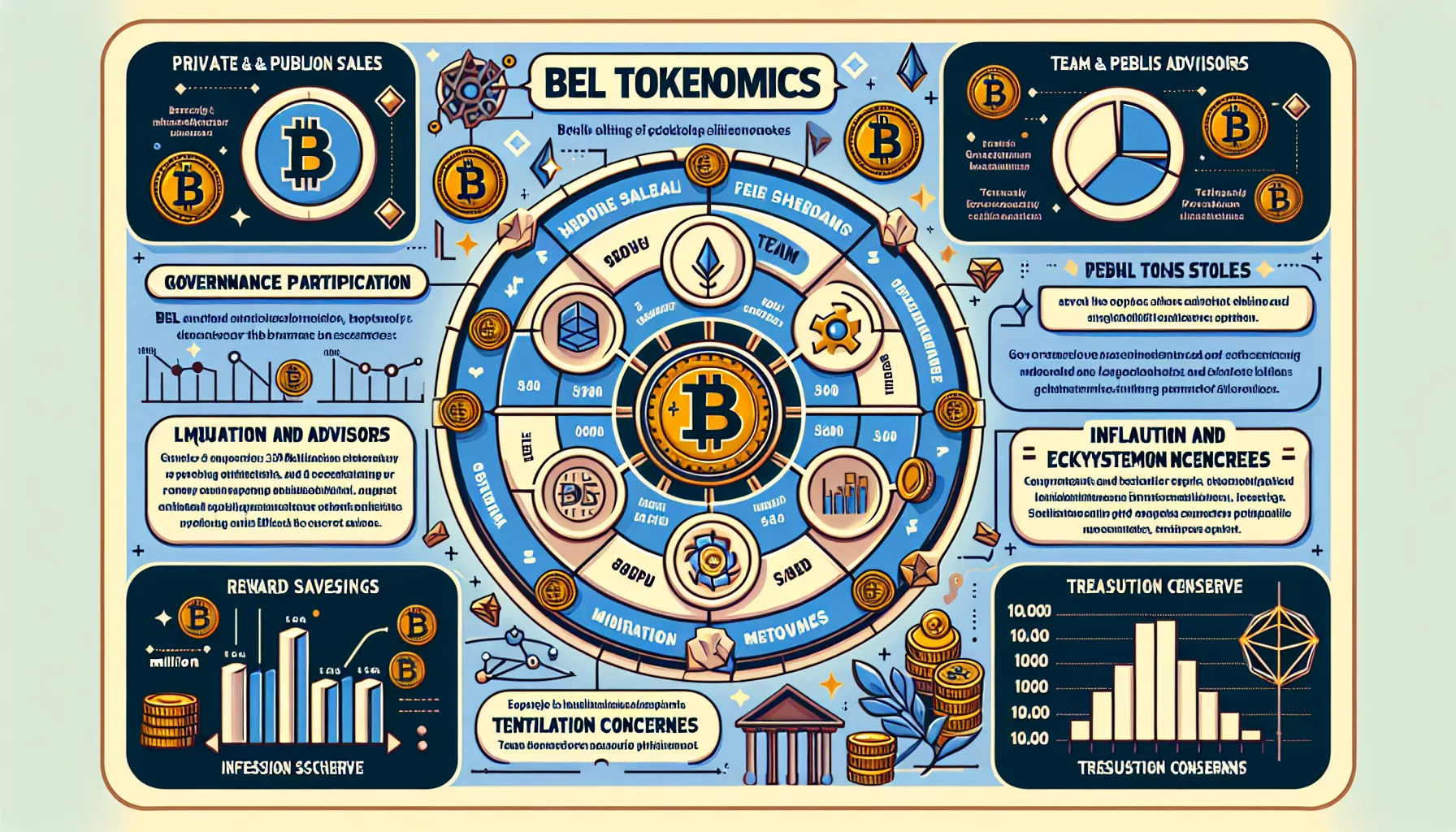
BEL Tokenomics
BEL Tokenomics: Unpacking the Mechanics of Bella Protocol
Bella Protocol’s native token, BEL, operates at the heart of its ecosystem, empowering a range of decentralized financial services. A deep dive into BEL’s tokenomics lays bare its distribution model, utility structure, and mechanisms driving value within the platform. While the project emphasizes efficiency and user-centric services, certain aspects of its tokenomic framework may require scrutiny.
Token Supply and Distribution Breakdown
BEL operates with a capped maximum supply of 100 million tokens. The allocation structure provides insight into how value is distributed across stakeholders:
- Private and Public Token Sales: A significant portion of tokens was distributed via early funding rounds, with approximately 6% allocated to public sales and 23% to private investors. While this was necessary for initial fundraising, the relatively high allocation to early backers may raise concerns about concentrated holdings.
- Team and Advisors: 20% of the supply is allocated to the team and advisors, with a multi-year vesting schedule in place. This structure is intended to incentivize long-term commitment but could introduce potential sell-pressure risk once the tokens fully vest.
- Liquidity Mining and Ecosystem Incentives: 40% of the token supply is reserved for incentivizing ecosystem participants. This allocation supports user engagement through rewards but introduces inflationary pressure over time.
- Treasury and Reserve: 10% of BEL tokens serve as a reserve for strategic use within the Bella Protocol ecosystem. Transparent use of these funds remains critical to sustain trust in governance and long-term development.
BEL Token Utility
The BEL token plays a central role in the utility infrastructure of Bella Protocol:
- Governance Participation: BEL holders can participate in decision-making processes for protocol upgrades and improvements. However, governance power may be skewed in favor of early adopters due to the distribution model.
- Fee Savings: Token holders benefit from reduced service fees on Bella Protocol's DeFi products. While this incentivizes token ownership, the scope of fee reduction may limit appeal to larger holders rather than small-scale users.
- Reward Mechanisms: BEL is distributed as a reward in mining and staking initiatives. Although this fosters user engagement, the long-term sustainability of rewards could face challenges if token value erodes.
Inflation and Emission Schedule
A large portion of BEL’s supply is issued through liquidity and staking incentives. While necessary to bootstrap activity, this emission model dilutes token scarcity over time. Careful monitoring of inflationary impact remains essential, particularly as the ecosystem matures and shifts away from heavy reliance on incentives.
Centralization Concerns
The vesting structure and large allocations to insiders and private investors introduce potential risks related to token centralization. A more equitable distribution might better mitigate long-term concerns about concentrated decision-making power and market manipulation.
In summary, BEL's tokenomics design balances incentivization and utility but leaves room for potential refinements around decentralization and inflation control. Understanding these nuances is key for crypto-savvy participants engaging with the Bella Protocol ecosystem.
BEL Governance
Bel Governance: Structure, Voting Mechanisms, and Limitations
BEL, the native token of the Bella Protocol, plays a pivotal role within its decentralized governance framework. Governance is integral to the protocol, as it allows the community to influence critical decisions, including upgrades, parameter adjustments, and fund allocation from the protocol’s treasury. However, while decentralized governance offers transparency and user empowerment, it isn’t without its complexities and potential weaknesses.
Governance Model and Stakeholder Participation
Bella Protocol employs a token-weighted governance model, where holders of BEL tokens can propose and vote on governance decisions. This structure aligns voting power with token holdings, meaning those with larger stakes wield more influence. Token holders are required to stake BEL to participate in governance discussions and votes, creating incentives for long-term commitment to the project.
While this model ensures aligned incentives between active stakeholders and the protocol’s long-term success, it also raises concerns about potential centralization of power. As is common with token-weighted voting systems, individuals or entities with significant BEL holdings can disproportionately shape outcomes. This creates the risk of governance decisions favoring whales or institutional participants over smaller, decentralized community contributors, potentially undermining the spirit of grassroots participation.
Proposal Submission Process
The governance framework enables BEL holders to submit proposals via an established set of rules. Participants typically need to meet a minimum threshold of BEL staked to propose changes. Proposals span a wide range of topics, from liquidity mining reward adjustments to contract functionality upgrades. Proposals first undergo a discussion period, fostering dialogue between the community and prospective proposers, before advancing into voting.
However, the high staking requirements for submitting proposals could deter smaller participants from bringing innovative ideas to the table. This barrier might inadvertently suppress diversity of input, constraining the breadth of the ecosystem’s evolution and favoring well-capitalized contributors.
Voting Dynamics
Voting within the Bella Protocol governance is conducted on-chain, ensuring transparency and immutability. Most protocols implement quorum and majority thresholds for a proposal to pass, and Bella Protocol follows a similar structure. Still, low voter turnout is a common pain point across decentralized governance systems. Active participation in BEL governance can suffer due to voter apathy or lack of incentive, leaving critical decisions in the hands of a small subset of users.
Additionally, off-chain discussions in forums and social media may play an influential role in shaping on-chain outcomes. While this enables robust debates, it also introduces concerns regarding informal lobbying and decision-making opacity, particularly for users disengaged from off-chain channels.
In addressing these challenges, Bella Protocol governance exemplifies both the strengths and limitations of token-weighted voting systems. Improving inclusivity and participation will be a key consideration for its development over time.
Technical future of BEL
BEL (Bella Protocol): Current and Future Technical Developments and Technical Roadmap
The Bella Protocol (BEL) continues to evolve within the DeFi ecosystem, leveraging its focus on simplifying user access to decentralized financial services. At its core, BEL operates as a suite of products designed to streamline interactions with DeFi through aggregation, yield farming, and optimization tools. However, the protocol's technical roadmap and planned developments illuminate both its potential and challenges.
Current Technical Landscape
Bella Flex Savings v2 remains one of the central elements of the BEL ecosystem, focusing on providing automated yield optimization for users. Recent updates have emphasized efficiency improvements in gas fee management, ensuring a reduction in barriers to entry for smaller participants. Furthermore, Bella Protocol integrates with multiple liquidity providers and yield-generating platforms, enhancing interoperability across DeFi ecosystems. Notably, the engineering team has also improved the compatibility of smart contracts with Layer-2 scalability solutions, reflecting the broader push toward faster and more cost-effective transactions.
Despite these advancements, BEL is not without its technical limitations. For example, the reliance on Ethereum’s Layer-1 network still poses challenges during periods of congestion. While its integration of Layer-2 solutions addresses this partially, adoption rates of these scaling technologies among users remain inconsistent. Additionally, transparency in smart contract audits is open to questioning, as the public has noted insufficient clarity on the timing and scope of certain security assessments.
Future Technical Developments
The technical roadmap for BEL emphasizes three major areas for further innovation: multi-chain interoperability, enhanced automation features, and the launch of more sophisticated tools for comprehensive DeFi management.
-
Multi-Chain Support: As the DeFi sector continues to diversify, cross-chain compatibility remains pivotal for BEL. Upcoming development efforts aim to integrate with blockchains beyond Ethereum, such as Solana, Avalanche, or the Binance Smart Chain. While progress in this direction is promising, implementing such integrations often requires high development complexity and risks introducing vulnerabilities.
-
Improved Automation and AI-Driven Features: Bella Protocol aims to build on its automated yield optimization, with plans to incorporate AI-driven strategies for portfolio allocation and decision-making. However, these enhancements rely heavily on data quality and could lead to overreliance on non-transparent algorithms, raising governance concerns for users.
-
Advanced DeFi Management Tools: A key focus of the roadmap includes creating a unified dashboard for users to seamlessly manage portfolios across various DeFi products and chains. Although this is highly anticipated, delivering a streamlined user experience across disparate ecosystems is technically challenging.
Challenges in Execution
Execution risks loom over the ambitious roadmap, particularly in navigating technical trade-offs between security, scalability, and decentralization. While BEL's push toward multi-chain and AI-driven solutions demonstrates forward-thinking, the complexity of these initiatives underscores the need for thorough testing and clear community governance frameworks to avoid fragmentation or protocol risks in the future.
Comparing BEL to it’s rivals
BEL vs. PHA: How Do These Crypto Assets Stack Up?
When comparing BEL (Bella Protocol) with PHA (Phala Network), the unique characteristics and use cases of these crypto assets reveal distinct approaches to the blockchain landscape. Both projects aim to innovate within the decentralized space, but their focus areas diverge significantly, leading to differences in utility, adoption, and underlying technology.
Core Focus: DeFi vs. Privacy Computing
BEL is deeply entrenched in the DeFi (Decentralized Finance) ecosystem, offering a suite of products like yield optimization, staking rewards, and streamlined financial tools. In contrast, PHA is built around privacy-preserving cloud computing, leveraging its blockchain-based infrastructure to provide secure execution of applications. While BEL targets simplifying and enhancing DeFi access, PHA is serving a niche demand in data confidentiality for Web3 services.
For crypto users, the divergence in focus translates directly into application. BEL caters primarily to traders and investors seeking seamless financial tools, while PHA's offerings are geared toward developers and enterprises needing secure, scalable computation.
Blockchain Architecture and Technical Approach
BEL operates primarily on Ethereum, emphasizing its compatibility with widely adopted DeFi protocols, though this means it shares Ethereum's known limitations such as high gas fees and network congestion. PHA, in contrast, uses Substrate, integrating with the Polkadot ecosystem for scalability and interoperability. While Polkadot's ecosystem allows PHA to implement rapid cross-chain transfers and low transaction fees, this dependence means developers need familiarity with Polkadot-specific tooling, which could slow adoption compared to Ethereum's vast existing user base.
Adoption Challenges and Trade-offs
A clear advantage for BEL is its accessible and straightforward DeFi integrations, supported by a focus on user-friendly interfaces. However, this simplicity can leave advanced traders or developers, who require granular control over financial operations, seeking alternatives. PHA, while powerful in its privacy computation focus, struggles with the challenge of educating the broader ecosystem on the benefits of privacy-enhancing protocols—a utility that may not yet resonate widely with enterprises that are still exploring blockchain technology.
Token Utility and Ecosystem Growth
The utility of BEL's token centers on its DeFi applications, including staking and rewards mechanisms that appeal to liquidity providers. PHA’s token, on the other hand, is more integral to its core network operations, such as securing confidential computation tasks. This makes PHA’s token usage highly specialized, whereas BEL offers a broader appeal across a growing DeFi user base. However, PHA’s focus on specialized use cases could limit its user traction, as general crypto participants may not see an immediate need for privacy computation protocols.
Security and Decentralization Considerations
BEL relies on Ethereum's existing security infrastructure. While that ensures robustness, it also makes BEL inherently subject to Ethereum’s vulnerabilities, such as smart contract exploits. Conversely, PHA emphasizes security through its privacy-oriented network, but this requires trust in the technical soundness of its novel cryptographic models, which are still relatively untested at scale.
For users deciding between the two, the trade-offs hinge on priorities: DeFi utility and ease of use (BEL) versus privacy-driven infrastructure for decentralized applications (PHA).
BEL vs. LIT: Examining the Differences in Decentralized Identity and Token Utility
In the realm of blockchain projects addressing decentralized identity and access control, Bella Protocol (BEL) and Litentry (LIT) target overlapping niches but with divergent approaches and scopes. Each project brings unique strengths and a set of challenges, making the comparison particularly relevant to investors and developers tracking the evolution of decentralized identity solutions.
Technology Focus & Design Philosophy
BEL primarily focuses on simplifying user access to DeFi through its suite of products, such as smart aggregation tools and yield optimization strategies. Its ecosystem is designed to abstract complexity for users while maintaining decentralization. In contrast, Litentry centers its efforts on decentralized identity (DID) aggregation and credential management, carving a niche in building infrastructure for cross-chain identity verification.
Litentry's use of the Substrate framework offers inherent advantages in cross-chain compatibility within the Polkadot ecosystem. This approach facilitates identity resolution across multiple blockchains, providing critical infrastructure for applications requiring seamless interoperability. BEL, on the other hand, does not prioritize DID as a central focus of its ecosystem, limiting its specific utility in identity verification contexts compared to LIT.
Token Utility & Governance
LIT, the native token of Litentry, primarily serves governance, staking, and identity-related operations within its ecosystem. Its utility is tightly linked to incentivizing validators and providing secure computation for identity aggregation mechanisms. BEL, in contrast, emphasizes governance over its DeFi offerings, including fee sharing and staking to access improved financial products. While both tokens play governance roles, the contrast lies in application focus—BEL’s utility is more applicable to financial products, while LIT’s utility leans heavily into identity services.
Challenges in Adoption
Both projects face adoption hurdles, but the challenges differ. Litentry’s success is closely tied to the Polkadot ecosystem's growth and adoption of decentralized identity in real-world use cases, which remains a niche market. While Litentry’s DID solution is technologically robust, its dependence on partnership integrations can slow adoption. On the other hand, BEL’s hurdles lie in differentiating itself in a crowded DeFi ecosystem and sustaining user interest amid fierce competition from other protocols offering similar services.
By comparing BEL and LIT, it’s clear that while they share some overlapping goals in decentralization, their distinct focuses position them as competitors in specific but diverging areas of the blockchain landscape. This division creates room for both projects to develop unique market niches, but direct comparisons highlight significant scope and utility distinctions.
Comparing Bella Protocol (BEL) to Automata Network (ATA): A Detailed Examination
When examining Bella Protocol (BEL) alongside a competitor like Automata Network (ATA), the distinctions in functionality, focus, and ecosystem impact provide insight into how these two crypto assets differ in their approach to decentralized blockchain solutions.
Core Focus and Use Case Analysis
Bella Protocol positions itself as a one-stop DeFi platform, focusing on user experience optimization and gas fee efficiency through its suite of automated tools. Automata Network, by contrast, emphasizes middleware privacy infrastructure for decentralized applications. ATA's flagship contributions, such as anonymous voting via its Witness framework and on-chain privacy through the Oblivious RAM protocol, differentiate it by catering to a privacy-first audience. While BEL prioritizes lowering entry barriers for decentralized finance participants, ATA tackles the pressing concern of enabling verifiable and private interactions on blockchain networks.
Ecosystem Synergies and Limitations
A key advantage for Bella Protocol lies in its tight integration with the Ethereum network to deploy yield optimization strategies, often leveraging partnerships within DeFi to deliver competitive services. ATA, while expanding across multiple blockchains, sometimes struggles with balancing general utility and maintaining exceptional functionality for each supported chain. Automata's focus on privacy means that its infrastructure often appeals to niche developers rather than a broader user base, which might limit the traction of its adoption versus BEL’s more intuitively market-ready solutions.
Token Utility Divergence
The BEL token is primarily utilized for governance, staking rewards, and fee reductions across the Bella Protocol ecosystem. Its straightforward model is designed to attract users into DeFi, ensuring usability for non-specialists. On the other hand, the ATA token has a more specialized role, functioning as a utility token within Automata's privacy middleware, with applications in operations such as computational tasks that protect sensitive data. While ATA's use case may appear more nuanced, it also risks alienating investors or users who are not directly involved in privacy-centric projects, limiting its utility outside its niche.
Challenges with Adoption and Competition
Although both BEL and ATA face stiff competition from larger projects in their respective areas, Automata Network's privacy-centric angle is still battling against slow adoption. The DeFi space, where BEL operates, may be saturated, but BEL benefits from a clearer alignment with the growing demand for cost-efficient yield solutions. Comparatively, ATA faces the issue of demonstrating its relevance in ecosystems where competing privacy solutions, such as ZK-Rollups or other Layer-2 privacy enhancements, are gaining traction.
Development Transparency and Audience Appeal
Finally, when it comes to developer transparency, Bella Protocol maintains a focus on user-driven advancements, simplifying the DeFi learning curve, which creates a tangible narrative for broader crypto adoption. Automata Network, conversely, often targets developers directly, which can result in a steeper entry point for non-technical stakeholders. This stark difference in communication channels and project positioning may result in challenges for ATA in appealing to a wider audience outside its core developer community.
Primary criticisms of BEL
Primary Criticism of BEL: Challenges Facing Bella Protocol
Concerns Over Centralization in Governance
A recurring criticism of BEL, the native token of the Bella Protocol, centers on its governance structure. While Bella Protocol positions itself as a decentralized finance (DeFi) project, critics argue that the decision-making process remains disproportionately influenced by core team members and early investors. This centralization raises concerns about potential conflicts of interest and the reliability of governance proposals aligning with the broader community’s best interests. For a project in the DeFi space, where decentralization is a core ideological tenet, this issue is viewed as a significant drawback.
Limited Ecosystem Development
Another point of contention lies in the relatively slow ecosystem growth around Bella Protocol. While the project boasts DeFi solutions such as staking, automated yield generation, and lending, critics argue that innovation has lagged behind competitors in the same sector. The lack of a robust and diverse ecosystem has led to concerns about long-term user engagement and its ability to remain competitive in an ever-evolving DeFi market. BEL’s utility outside of staking rewards and governance is also questioned, potentially limiting its appeal to a broader demographic.
Liquidity and Exchange Accessibility
BEL's critics frequently highlight liquidity issues and limited accessibility across decentralized exchanges (DEXs). Although the token is available on several major platforms, users report liquidity constraints on smaller exchanges and specific trading pairs, which can lead to higher slippage and reduced efficiency in conducting trades. This limits the seamless user experience, particularly for smaller traders who may already face prohibitive gas fees in certain blockchain environments.
Inflation Model and Tokenomics Uncertainty
The inflationary tokenomics of BEL are another source of critique. While inflation is intended to incentivize early adopters and liquidity providers, it inevitably raises concerns about long-term value dilution. Critics question whether the issuance structure perpetuates selling pressure, particularly as staking rewards are distributed. This issue is compounded by the perception that BEL’s economic model lacks clear mechanisms to drive sustainable demand, especially outside of its utility within Bella Protocol’s existing offerings.
User Interface and Usability Challenges
Though Bella Protocol promotes itself as a user-friendly DeFi solution, some users have expressed frustration with the platform’s interface and performance. Reports of unintuitive design, occasional backend failures, and insufficient documentation have led to a perception that the platform may not cater effectively to its intended audience. While the protocol aims to simplify DeFi participation, these shortcomings dilute confidence in the overall experience.
Founders
Founding Team Behind BEL: Leadership Driving Bella Protocol
The Bella Protocol (BEL) was developed by the ARPA team, a group widely recognized within the blockchain industry for their technical expertise and achievements in the realm of privacy-preserving computation. ARPA, formerly known for its secure Multi-Party Computation (MPC) technology, was established with the mission of creating solutions that make blockchain applications more scalable and user-friendly. This expertise in privacy and scalability provided a foundation for Bella Protocol's creation, which aims to simplify decentralized finance (DeFi) through a suite of tools and services.
Key Figures and Leadership
The key figure behind Bella Protocol is Felix Xu, the Co-Founder and CEO. Felix brings a background in investment and technology, having previously worked in traditional finance and venture capital. His overarching vision for Bella Protocol revolves around addressing the complex user experience challenges in DeFi and enabling broader participation in decentralized ecosystems. However, critics have occasionally pointed out that Xu's expertise, while notable, is largely business-oriented; skeptics argue that more technical experience at the leadership level might strengthen the project's focus on innovation.
Meanwhile, Bella Protocol also benefits from the technical acumen of Co-Founder Yemu Xu (no direct relation to Felix Xu). Yemu brings experience in cryptography and blockchain development, contributing to the protocol's architecture, particularly its automated features and emphasis on optimizing transaction efficiency. Although praised by many, detractors have commented that the leadership team does not possess the well-known profiles of figures behind other DeFi projects, potentially impacting institutional investor confidence.
Technical Team and Community Engagement
ARPA's core engineers were instrumental in the development of Bella Protocol, leveraging their deep understanding of cryptographic principles such as zero-knowledge proofs and secure computation. Despite their technical background, some in the crypto community have questioned whether their expertise in privacy-focused projects translates seamlessly into DeFi development. Additionally, while the team has expressed their commitment to fostering transparency and collaboration with the crypto community, critics have occasionally highlighted a perceived lack of extensive public engagement.
The founding team’s decision to launch Bella Protocol through Binance Launchpool in 2020 reflects their strategic awareness, but it has also led to concerns about centralization and concentrated token distribution. This has sparked debate about whether Bella Protocol’s origins conflict with the decentralized ethos of the blockchain space.
Authors comments
This document was made by www.BestDapps.com
Sources
- https://www.belledao.org/whitepaper
- https://github.com/BellaProtocol
- https://medium.com/bellaofficial
- https://www.coingecko.com/en/coins/bella-protocol
- https://coinmarketcap.com/currencies/bella-protocol/
- https://docs.belledao.org/
- https://etherscan.io/token/0xa91ac63d040deb1b7a5e4d4134ad23eb0ba07e14
- https://www.binance.com/en/buy-sell/BEL
- https://defillama.com/protocol/bella
- https://www.stakingrewards.com/earn/bella-protocol/
- https://twitter.com/BellaProtocol
- https://reddit.com/r/BellaProtocol/
- https://forum.belledao.org/
- https://cryptoslate.com/coins/bella-protocol/
- https://www.gemini.com/prices/bella-protocol
- https://messari.io/asset/bella-protocol
- https://www.block123.com/en/nav/498331204129.htm
- https://dappradar.com/binance-smart-chain/defi/bella-protocol
- https://cryptobriefing.com/tag/bella-protocol/
- https://www.tokeninsight.com/en/coins/bella-protocol


