History of BAND
The History of BAND: From Concept to Implementation
BAND Protocol, a cross-chain data oracle platform, embarked on its journey in 2017, during the peak of decentralized application development interest. Initially built on Ethereum, BAND Protocol aimed to solve a critical issue in the blockchain ecosystem: the reliable provision of off-chain data to smart contracts. The necessity for a decentralized oracle framework grew out of the inherent limitations of blockchains, which by design are isolated from external data sources. BAND sought to address these limitations by building a protocol that could deliver secure, verifiable, and cross-chain accessible data feeds.
In 2019, the BAND Protocol team conducted its initial coin offering (ICO) via Binance Launchpad. The ICO attracted substantial attention, partially due to its ambitious goal of tackling one of the blockchain industry's most challenging problems. Following the ICO, the project launched its first iteration on the Ethereum network. However, scaling challenges and high gas fees in Ethereum’s ecosystem during this period exposed vulnerabilities in BAND’s implementation, particularly as oracle usage demands increased.
Recognizing these constraints, the BAND team pivoted. In 2020, they transitioned BAND Protocol to Cosmos SDK. This shift represented a significant turning point in its history. By leveraging the Cosmos network, which focuses on interoperability and scalability, BAND Protocol was able to operate as its own independent blockchain. This move not only improved transaction throughput and cost efficiency but also positioned BAND as a more viable competitor to other established oracle solutions.
A notable feature in BAND's updated architecture was the introduction of its delegated proof-of-stake (dPoS) consensus mechanism. Validators on the BAND Chain began taking a central role in securing the oracle processes and providing data verification. However, some observers have flagged centralization risks as an area of concern, as the reliance on a limited number of network validators could, in theory, present vulnerabilities in governance and security.
Despite improvements, BAND's journey has not been without controversy. Delays in network upgrades and questions regarding token allocation transparency have occasionally cast a shadow over the project. Furthermore, critics have cited the competitive landscape of data oracles, with Chainlink dominating market share, as a persistent challenge for BAND in gaining broader adoption.
The evolution of BAND Protocol reflects a mix of innovation, adaptation, and challenges as it continues striving to provide decentralized, reliable oracle solutions to the blockchain ecosystem.
How BAND Works
How BAND Protocol Works: Powering Decentralized Data Oracles
BAND Protocol is a decentralized cross-chain oracle system designed to bring real-world data to smart contracts across various blockchain ecosystems. Its architecture centers around enabling efficient, scalable, and secure data feeds by incentivizing validators to aggregate and verify data. Understanding how BAND Protocol operates requires analyzing its core components and mechanisms.
Data Request and Oracle Selection
At its core, BAND Protocol functions as a bridge between smart contracts and off-chain information. The process begins when a smart contract makes a specific data request. Instead of relying on centralized entities, BAND Protocol allows multiple data providers (oracles) to compete to fulfill these requests. The protocol’s unique oracle selection mechanism enables developers to customize their data requirements by specifying parameters such as the number of validators, data sources, and aggregation methods.
The BAND Blockchain
Unlike some oracle protocols that operate off-chain, BAND Protocol implements its own native blockchain, powered by the Tendermint consensus algorithm. This independent chain offers advantages such as fast block finality and compatibility with various blockchain platforms. This cross-chain operability is facilitated through BAND Standard Dataset—a framework that allows Band to interact seamlessly with multiple smart contract environments, including Ethereum, Binance Smart Chain, and others.
Validators and the Staking Mechanism
Validators play a central role in BAND's infrastructure by collecting and verifying data from external sources. To participate, they are required to stake BAND tokens, aligning incentives for accurate data delivery. Misbehavior, such as submitting incorrect or manipulated data, can result in slashing penalties, where the validator loses a portion of their staked tokens. However, critics have raised concerns about the concentration of BAND token ownership, which could potentially centralize validator power and compromise the system's decentralization goals.
Data Aggregation and Finalization
After multiple validators submit data, BAND Protocol implements an aggregation mechanism to standardize the results. This multi-sourcing approach reduces reliance on any single provider and mitigates the risks of data manipulation or inaccuracies. Once data is finalized, it is posted on-chain, allowing the requesting smart contract to access the verified information. While this process enhances trust and reliability, there are trade-offs in terms of latency—particularly for time-sensitive applications, as the multi-step process can introduce delays.
Cross-Chain Data Access via IBC
A standout feature of BAND Protocol is its integration with the Inter-Blockchain Communication (IBC) protocol, which allows for seamless data sharing across different chains. This interoperability design is a strength; however, it also adds complexity to the system. Security concerns arise when interacting across multiple blockchains, particularly in ensuring that trust assumptions remain consistent and secure throughout cross-chain interactions.
Challenges of Scalability and Competition
While BAND Protocol emphasizes scalability through its blockchain design, critics point out potential bottlenecks as the network grows. Competing projects with similar functionalities, such as Chainlink, further intensify the race for adoption among developers. This competitive landscape places constant pressure on BAND Protocol to differentiate its offerings and achieve wide-scale integration within decentralized applications.
Use Cases
BAND Protocol Use Cases: Exploring Decentralized Data Aggregation
BAND Protocol is designed to address a critical concern in the blockchain ecosystem: the reliable integration of off-chain data into decentralized applications (dApps). By functioning as a decentralized oracle network, BAND provides a bridge that supplies blockchains with external data in a secure and scalable manner, enabling use cases across multiple industries. Here, we explore its primary applications and the associated considerations.
1. DeFi and Price Feeds
A key use case for BAND lies in Decentralized Finance (DeFi). DeFi applications often require accurate and real-time price feeds for assets such as cryptocurrencies or commodities. BAND Protocol provides this service by sourcing data from multiple APIs and aggregating it through decentralized mechanisms, mitigating risks of manipulation. While BAND claims to be highly secure, concerns remain about whether its smaller validator network could make it more susceptible to targeted attacks compared to more established oracle providers. Additionally, as DeFi platforms expand datasets, questions about latency and scalability arise, particularly during periods of network congestion.
2. Blockchain Gaming
Blockchain-based games and NFTs often depend on external data, such as random number generation (RNG) for determining in-game outcomes or metadata updates for dynamic NFTs. BAND's decentralized oracle infrastructure offers a potential solution for injecting randomness or handling game logic dependent on real-world triggers. However, ensuring fairness and preventing data tampering is only as strong as the security of the oracle architecture itself. In competitive environments like gaming, the trustworthiness of the oracle layer becomes a potential attack vector if not rigorously decentralized.
3. Supply Chain and Logistics
BAND enables smart contracts to integrate real-world information, such as supply chain updates or environmental conditions during product transit. For example, a smart contract could release payment upon verifying shipment delivery through external GPS coordinates aggregated by BAND. That said, integrating off-chain IoT devices adds an additional layer of complexity and potential vulnerability to the system, magnifying risks surrounding data authenticity and dispute resolution mechanisms.
4. Prediction Markets
Prediction markets depend heavily on accurate external data to settle outcomes, such as sports results, election data, or financial indices. BAND can theoretically deliver reliable datasets for these applications. However, oracle networks incorporating edge-case scenarios or highly subjective outcomes still face challenges, as the aggregated final data might not account for contentious or disputed results.
Overall, BAND Protocol positions itself as a versatile solution for decentralized data needs. However, its utility hinges on the robustness of its validator network, as well as its resilience against potential attack scenarios.
BAND Tokenomics
BAND Tokenomics: A Deep Dive into Its Economic Design
Total Supply and Initial Distribution
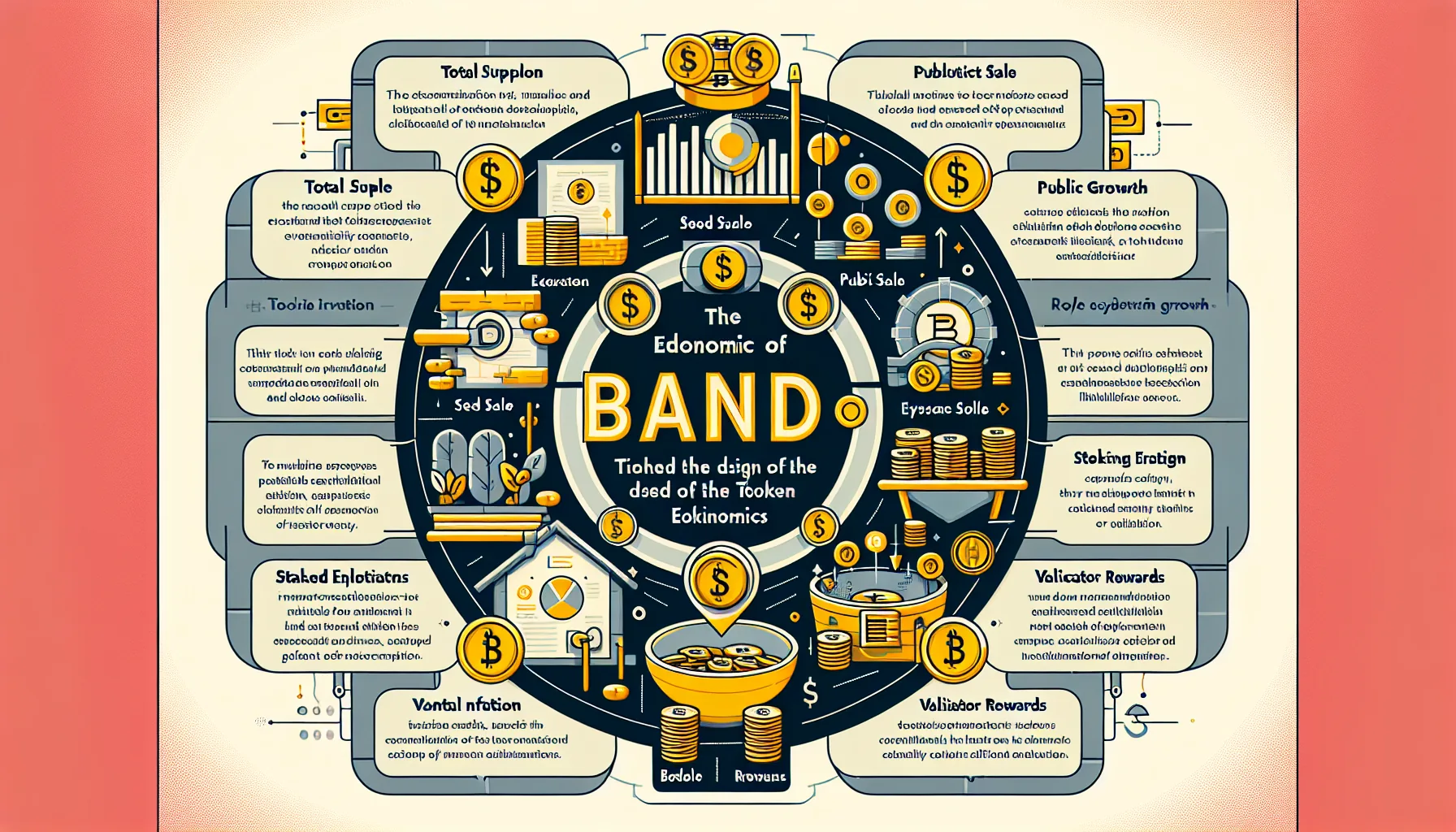
BAND operates with a capped total supply of 100 million tokens, a design choice aimed at promoting scarcity and long-term value. The initial token distribution allocated 27.37% toward a private sale, 5% to a seed sale, and 12.37% to a public sale, ensuring early-stage funding and diverse token holder participation. However, the allocation also includes 25% earmarked for ecosystem growth and partnerships, which is a common practice but could raise questions about potential centralization risks if these tokens are deployed in an opaque manner.
Reward Mechanism and Staking Economics
BAND follows an inflationary issuance model to reward stakers and validators that participate in the network. The annual inflation rate is dynamic, ranging between 7% and 20%, with adjustments based on the portion of tokens actively staked. This mechanism incentivizes higher staking participation, targeting an ideal staking ratio of approximately 66%. While this design supports network security, the inflationary structure may lead to token dilution for non-staking token holders—a concern for those unwilling or unable to lock their BAND holdings.
Validators are rewarded for securing the network and facilitating Oracle operations, while delegators share a portion of the reward in exchange for staking their tokens through validators. However, it's worth noting that validators set their own commission rates, creating competitive dynamics that can favor larger players in the network, possibly undermining decentralization.
Ecosystem Development Fund and Allocation Transparency Issues
A significant portion of BAND tokens is allocated toward ecosystem incentives and development, theoretically ensuring long-term project sustainability. However, questions around allocation transparency remain. Without public clarity on how these funds are deployed—whether toward partnerships, marketing, or integrations—token holders may find it difficult to gauge if these allocations are being effectively utilized. Lack of updates on ecosystem fund usage could lead to skepticism within the crypto-savvy community, especially when compared to more transparent projects.
Liquidity and Exchange Distribution
BAND benefits from its listing on multiple decentralized and centralized exchanges, promoting liquidity and accessibility. That said, significant liquidity held within a small number of exchanges can pose a risk of centralized price manipulation. Furthermore, the concentration of BAND tokens on major platforms may expose the project to potential risks if exchange-based liquidity were to face regulatory scrutiny or technical disruptions.
Token Utility and Potential Limitations
BAND tokens serve multiple roles within the ecosystem: staking, governance, and transaction fees related to Oracle data queries. The multi-role utility reinforces the token's importance within the network. However, its reliance on adoption by external platforms requiring Oracle services could present long-term dependency risks. If Oracle demand stagnates or shifts toward alternative projects, BAND's demand dynamics and tokenomics could face stress.
BAND Governance
BAND Protocol Governance: Decentralized Decision-Making Framework
BAND Protocol operates with a governance framework designed to give token holders significant influence over the protocol's evolution, aligning incentives across its ecosystem. Core governance revolves around BAND token staking and voting, which directly informs the protocol's operational and developmental trajectory. However, like many crypto projects, its governance framework is not without challenges.
On-Chain Governance Mechanism
The primary method for governing BAND Protocol exists on-chain. Token holders can propose and vote on changes, including updates to the oracle system, network parameters, and upgrades to the protocol itself. Any significant protocol change typically requires a governance proposal to be formally submitted, followed by a staking-weighted vote by token holders.
BAND token staking plays a prominent role in governance, with each token representing proportional voting power. Stakers and delegators (those who delegate their stakes to validators) are incentivized to actively participate, as their stake helps secure the network and is subject to slashing penalties for dishonest behavior. However, this dual role of BAND tokens — functioning as a governance mechanism and as an economic security layer — introduces complexities. For one, stakers may prioritize incentives tied to short-term token value rather than governance decisions aimed at long-term protocol growth.
Delegated Voting and Validator Influence
Delegators often trust validators to vote on their behalf. While this delegation model can increase participation rates, it creates potential centralization risks. Highly influential validators with significant voting power may sway governance outcomes, reducing the decentralized ethos of the protocol. Over time, this could lead to governance capture, where concentrated voting power prevents diverse opinions from influencing critical decisions.
Challenges with Participation and Inclusivity
One challenge facing BAND's governance system is the engagement disparity among token holders. Governance participation typically skews towards larger stakeholders, as smaller token holders may feel their voting power does not significantly influence outcomes. This dynamic can inadvertently marginalize governance voices from smaller token holders, limiting the diversity of perspectives in decision-making.
Proposal Process and Adoption Friction
Submitting proposals to BAND's on-chain governance requires technical expertise and a deep understanding of the protocol. This threshold could discourage community members from participating unless they are technically inclined. Moreover, achieving consensus on major changes often involves overcoming coordination hurdles among a globally distributed base of stakeholders.
Overall, while BAND Protocol’s governance framework is a critical component of its decentralized infrastructure, it highlights common trade-offs in DeFi governance, including centralization risks, participation disparities, and execution friction. Further refinements to engage token holders and balance power dynamics will likely remain an ongoing area of focus.
Technical future of BAND
BAND Protocol: Current and Future Technical Developments and Roadmap
BAND’s Cross-Chain Oracle Infrastructure Advancements
BAND Protocol continues to refine its scalable cross-chain oracle solution, which remains its core technical offering. The protocol leverages the Tendermint-based BandChain to provide secure, decentralized, and efficient data feeds across multiple blockchains. One of the critical areas of development is the optimization of inter-blockchain communication (IBC), which allows BandChain to interface seamlessly with multiple Layer 1 and Layer 2 blockchain ecosystems. These improvements aim to reduce latency and gas costs for data delivery, ultimately ensuring faster response times for real-time applications like DeFi and gaming.
However, the current implementation of IBC is not without challenges. BandChain relies on external bridges for certain blockchain interactions, which could present vulnerabilities or compromise decentralization. Developing truly trustless and efficient bridges remains a significant technical hurdle, and ongoing work is required to eliminate these dependencies.
Data Provider Enhancements and Decentralization
Improving the robustness and diversity of data sources feeding into the Band oracle ecosystem is another focus. BAND has introduced mechanisms to make onboarding data providers easier and incentivizes honest behavior through its slashing mechanism. While these mechanisms are theoretically sound, there have been industry concerns regarding the level of decentralization among data providers within the network. A concentration of providers could expose the protocol to risks such as collusion or localized outages.
Future updates are expected to emphasize further decentralization, potentially through open participation models or additional staking incentives for smaller providers. There is also ongoing work to make BandChain’s validator software more efficient, reducing the hardware demands for running a node and thereby broadening access to contributors.
Smart Contract Upgrades and WASM Integration
Another technical development to note is the forthcoming integration of WebAssembly (WASM) within BandChain’s smart contract framework. WASM will enhance the flexibility and efficiency of custom script execution, enabling more complex operations to be processed directly on-chain. This expansion of functionality could be critical as decentralized applications demand more intricate data verification and transformation capabilities. While WASM adoption could significantly enhance utility, it also increases the complexity of the codebase, which may introduce new attack surfaces requiring comprehensive auditing.
Usability and Developer Tooling
To attract more developers, BAND has been focusing on creating robust SDKs and APIs that simplify oracle integration for both new and existing blockchain projects. While this is a positive step, many developers still report a steep learning curve with BandChain’s tools compared to competing solutions. Improving the documentation and developer resources will need to remain a priority to ensure sustainable adoption across the broader ecosystem.
Comparing BAND to it’s rivals
BAND vs LINK: A Detailed Comparison of Decentralized Oracle Protocols
When comparing BAND Protocol to LINK (Chainlink), two leaders in the decentralized oracle space, there are both overlapping capabilities and significant differences in their architecture, network design, and operational focus. Both projects cater to the critical need for securely bridging real-world data with blockchain ecosystems, but their methodologies create nuanced distinctions that shape their adoption.
Network Architecture & Consensus Mechanism
BAND Protocol utilizes the Cosmos SDK, enabling it to operate as an independent blockchain powered by a Delegated Proof-of-Stake (DPoS) consensus mechanism. This design facilitates faster transaction processing and lower fees due to its high throughput compared to Ethereum-based solutions. LINK, on the other hand, relies exclusively on Ethereum’s base layer and its Proof-of-Stake (PoS) upgrade for network security, tethering it to higher gas fees and occasional network congestion.
While BAND’s self-contained chain allows for fine-tuned scalability, some critics argue that LINK’s reliance on Ethereum strengthens its ecosystem by benefiting from Ethereum’s security and massive developer community. BAND’s isolated design—although interoperable with other blockchains—may require additional effort to attract integrations and trust from developers unfamiliar with the Cosmos ecosystem.
Data Aggregation Approach
The two protocols differ substantially when it comes to data aggregation. BAND aggregates data off-chain and submits the results as a single signed value to its blockchain, reducing on-chain overhead but relying on its validators for trustworthiness. LINK, in contrast, focuses heavily on decentralized data retrieval at the node level, where multiple nodes independently provide data and come to a consensus before submitting it on-chain.
The distinction here raises questions for developers weighing decentralization against efficiency. BAND’s approach may appeal to use cases requiring lower costs and faster data availability, but it can invite skepticism regarding reduced transparency and validator reliability, particularly in critical applications like DeFi. Alternatively, LINK’s emphasis on fully decentralized data aggregation bolsters trust but comes at the expense of higher costs and slower operation.
Ecosystem & Adoption
LINK boasts a long-standing presence in the oracle space, with a vast array of integrations across DeFi, NFTs, and traditional enterprises. BAND, though quickly growing in adoption and partnerships, remains comparatively niche. The larger LINK ecosystem gives it a competitive advantage, as developers may prefer the network effect and tooling support available. However, BAND’s expanding connections with blockchains outside Ethereum demonstrate its focus on flexibility and multi-chain compatibility.
Security Considerations
Both protocols prioritize security, but BAND’s smaller market penetration and validator pool could raise concerns about susceptibility to attacks when compared to LINK’s larger and more battle-tested infrastructure. While BAND’s Cosmos-based DPoS system enhances performance, LINK's Ethereum-based reputation system instills confidence in the long-term reliability of its oracles.
Comparing BAND to DIA: Decoding the Differences in Oracles
When evaluating BAND and DIA as players within the blockchain oracle niche, it's evident that both aim to address the critical need for decentralized, accurate, and tamper-proof data feeds. However, their structural approaches and focus areas present notable differences, revealing inherent strengths and limitations on each side.
Protocol Architecture and Design
BAND Protocol, built on the Cosmos SDK, leverages interoperability as a core offering. This architecture enables BAND to provide cross-chain data feeds across a wide range of blockchain ecosystems. DIA, on the other hand, operates on Ethereum and emphasizes transparency in data sourcing and processing. DIA allows for open-source data aggregation, with the community contributing to how data is sourced, validated, and distributed.
While BAND’s use of Cosmos provides speed and flexibility to interact with multiple chains, it also faces challenges in maintaining deep integration with Ethereum, where a large portion of decentralized applications (dApps) reside. DIA's Ethereum-first strategy benefits projects within the Ethereum ecosystem but creates limitations when scaling to non-EVM chains, placing it at a disadvantage in terms of cross-chain interoperability.
Data Sourcing and Validation
A major differentiator between BAND and DIA lies in their approach to data sourcing. BAND uses a decentralized network of validators to pull and aggregate data from APIs and other web sources, which is then delivered to its users. DIA takes a more participatory approach, allowing users to directly contribute data and audit its accuracy through community-driven oracles.
This model gives DIA a unique edge in terms of transparency but simultaneously introduces risks of incomplete or slow response times in scenarios requiring rapid data updates. BAND, with its validator-centric method, is designed to prioritize performance over transparency. However, centralizing data collation among validators has raised questions about the agency of these validators and potential vector points for manipulation.
Niche Focus and Use Cases
DIA markets itself as a platform targeting the long tail of DeFi projects, concentrating on creating unique data pairs that aren’t typically covered by other oracles. BAND typically pursues wider-use cases, targeting enterprises and large-scale adoption in mass-market applications. This strategic difference poses an inherent tradeoff: DIA’s specialization makes it attractive for niche projects, but its scalability into broader markets remains a key concern. BAND’s generalized approach ensures adaptability but risks spreading resources too thin by attempting to satisfy high-demand enterprise-class use cases and lighter, smaller dApps simultaneously.
The discrepancies in ambition, execution, and focus between BAND and DIA illustrate how the oracle space, though highly competitive, is not a one-size-fits-all solution.
Comparing BAND to API3: Decentralized Oracles and Key Differences
In the decentralized oracle space, both BAND and API3 aim to address the critical challenge of providing secure and reliable off-chain data to on-chain applications. However, their approaches to achieving this goal differ significantly, with noteworthy trade-offs in terms of architecture, decentralization, and community involvement.
API3’s First-Party Oracle Approach
One of API3’s defining characteristics is its reliance on first-party oracles, where data providers themselves operate oracle nodes. This model eliminates intermediaries, theoretically reducing attack surfaces and increasing data reliability. Compared to BAND’s decentralized oracle network, which aggregates data from multiple third-party providers, API3’s architecture introduces the advantage of a direct line between data providers and smart contracts. This can result in lower latency and potentially fewer opportunities for data manipulation, though it does place a larger emphasis on the trust and reputation of the data providers themselves.
Governance Variances
API3 implements a DAO model (Decentralized Autonomous Organization) for governance, with its API3 token holders directly participating in decision-making processes. While BAND has implemented decentralized governance to an extent, critics could argue that API3’s pure DAO structure provides a more direct form of stakeholder involvement. On the flip side, BAND’s governance model allows for faster decision-making, which may be better suited for responding to critical issues or scaling challenges in a fast-evolving ecosystem.
Data Coverage and Network Size
API3’s emphasis on first-party oracles could limit its breadth of data offerings. By relying on a more curated set of data providers, its network size is smaller when compared to BAND’s integration of third-party data sources. BAND’s broader reach into diverse external services might offer a key advantage for projects requiring comprehensive data coverage, whereas API3's model could excel in applications that prioritize data authenticity over sheer variety.
Security Considerations
While BAND’s decentralized model disperses risk across multiple sources, API3’s reliance on first-party data introduces a different security profile. If a trusted data provider is compromised, the impact on API3-integrated dApps could be severe. Similarly, API3’s use of off-chain cryptographic proofs (via its Airnode technology) adds another layer of operational complexity, raising potential questions about implementation risk and long-term sustainability.
Interoperability & Ecosystem Integration
Both platforms emphasize multi-chain compatibility, but BAND may have an upper hand in terms of seamless integrations with various blockchain networks, partially due to its longer-standing market presence. API3’s focus on first-party data may limit its adaptability to some existing DeFi protocols that are built around aggregated oracle solutions.
By weighing these structural and ideological differences, developers and stakeholders can better assess which oracle protocol aligns with their specific use case, considering the distinct trade-offs each entails.
Primary criticisms of BAND
Primary Criticism of BAND: Unpacking the Limitations of the Oracle Solution
BAND Protocol, despite its innovative approach to decentralized data oracles, is not without its share of criticisms. While the project has garnered attention for its cross-chain compatibility and scalability, several concerns persist within the crypto community regarding its design philosophy, technical robustness, and governance.
Centralization Concerns in Validator Set
One of the most frequently raised criticisms of BAND lies in its validator ecosystem. Although the protocol operates on a delegated proof-of-stake (DPoS) mechanism to secure its network, the relatively small number of active validators raises questions about potential centralization. Critics argue that a concentrated validator set may increase the risk of collusion or undue influence from large token delegations, potentially undermining the decentralization that is foundational to the operation of a trusted oracle.
Additionally, as BAND positions itself as an alternative to Ethereum-based oracles like Chainlink, questions have been raised about the barriers to entry for staking and becoming a validator. The high staking requirements could disincentivize broader participation, leaving much of the network’s security and accuracy reliant on a limited number of actors.
Security Trade-offs in Cross-Chain Integrations
BAND's core value proposition is its interoperability, enabling seamless oracle services across multiple blockchain ecosystems. While this is a compelling feature, critics highlight the potential security vulnerabilities that arise from these cross-chain integrations. The interconnected nature of the system could expose BAND to risks stemming from vulnerabilities or exploits in the chains it interacts with. For instance, if a partnered blockchain suffers a security breach, the secondary impact on BAND’s oracle data integrity cannot be ignored, potentially leading to cascading failures in its network.
Limited Adoption Relative to Competitors
Another criticism is BAND's adoption rate compared to leading oracle networks like Chainlink. While BAND markets itself as an efficient, cost-effective alternative, its ecosystem has struggled to match the size and diversity of competitors’ developer and project networks. Some argue that this slow adoption has resulted in less real-world data usage and testing, which could weaken its overall reliability when deployed in high-stakes decentralized finance (DeFi) scenarios.
Governance Challenges and Token Distribution
BAND Protocol's governance structure has also come under scrutiny. A significant portion of its initial token supply was allocated to early investors and institutional backers. Critics point out that this distribution model might lead to governance disproportionately favoring a small group of stakeholders, leaving smaller token holders with minimal influence over protocol upgrades and development decisions. This imbalance could discourage community participation and create long-term centralization risks in decision-making.
Data Validation Transparency
Finally, concerns have been raised about BAND's transparency in its data validation process. While decentralization is a core promise of BAND, some critics claim that the system’s data verification mechanisms lack sufficient clarity, potentially making it difficult for users to independently assess the quality of the oracle data being provided. This perceived opacity could harm BAND's perceived trustworthiness, particularly when deployed in sensitive financial or data-driven applications.
Founders
Deep Dive into BAND: The Founding Team Behind the Protocol
BAND Protocol, a cross-chain data oracle solution, was established with a clear vision to bridge reliable, real-world data to blockchain ecosystems. At its core, the success and challenges of the project can be traced back to its founding team, whose expertise and execution strategy have played a pivotal role in shaping the protocol's trajectory.
The BAND Protocol team was co-founded by Soros Darapanich, Paul Chonpimai, and Soravis Srinawakoon, with the latter serving as the CEO and most prominent figurehead. Srinawakoon, before his foray into blockchain, held a degree in computer science from Stanford University and initially worked as a management consultant at Boston Consulting Group (BCG). His blend of academic credentials and corporate experience allowed him to tackle product design, growth strategy, and initial partnership outreach. However, skeptics have pointed out his relatively limited exposure to large-scale decentralized systems prior to BAND, calling into question whether his skill set perfectly matched the demands of building a robust public blockchain solution.
Paul Chonpimai, an alumni of top-tier academic programs in Asia, focuses on BAND Protocol’s product engineering. He is recognized for his deep technical knowledge in distributed systems, which has contributed significantly to BAND’s infrastructure. However, as the protocol scaled, some observers have questioned the team's ability to transition from prototype development to handling increasingly complex use cases across a diverse array of blockchain platforms. Critics often cite the challenges associated with meeting demand from enterprise-level users while ensuring consistent updates, suggesting operational bottlenecks within the technical leadership.
Soros Darapanich, responsible for overseeing the financial and operational framework, complements the team with his strong analytical background. While the foundational elements of BAND’s tokenomics model and early funding strategy were viewed as successful, some dissenters argue that the ecosystem’s reliance on staking incentives could lead to longer-term token distribution concerns and inflationary pressures. Whether these token-related factors are a result of leadership decisions or external variables remains a topic of community debate.
BAND Protocol’s founding team is notable for its strong regional ties to Southeast Asia, serving as a double-edged sword. On one hand, their understanding of the regional market provided them unique entry points and partnerships early on. On the other, it has prompted questions about whether the team’s influence extends effectively to Western markets, which are critical for global blockchain scalability and adoption.
Authors comments
This document was made by www.BestDapps.com
Sources
https://bandprotocol.com/whitepaper.pdf
https://github.com/bandprotocol
https://docs.bandchain.org/technical-specifications/overview.html
https://medium.com/bandprotocol
https://bandprotocol.com
https://blog.bandprotocol.com/band-protocol-v2-ecosystem-integration-updates-2023-341a48cd67f9
https://explorer.bandchain.org
https://forum.bandprotocol.com
https://docs.bandchain.org/
https://twitter.com/BandProtocol
https://www.coingecko.com/en/coins/band-protocol
https://defiprime.com/band
https://docs.oracle.bandchain.org/introduction.html
https://www.binance.com/en/buy-sell/BAND
https://messari.io/asset/band-protocol/profile
https://stakingrewards.com/earn/band-protocol/
https://research.binance.com/en/projects/band-protocol
https://info.uniswap.org/#/tokens/0xba11d3d6c2068deae24099e8b211cf4577aeba39
https://etherscan.io/token/0xba11d3d6c2068deae24099e8b211cf4577aeba39
https://cryptoslate.com/coins/band-protocol/


