History of AR
The History of Arweave (AR): Revolutionizing Data Storage with Blockchain
Arweave (AR), the crypto asset underpinning the Arweave protocol, emerged alongside the nascent wave of Web3 projects aiming to disrupt traditional data storage systems. Its history is deeply tied to the development of a decentralized, permanent data storage network using an innovative blockchain-inspired technology known as blockweave. Conceptualized as a solution to the inefficiencies of ephemeral data availability and centralized control, Arweave’s development journey sets it apart from many blockchain projects.
The origins of Arweave can be traced to its foundational problem statement: how to create a permanent, low-cost storage ledger in a decentralized environment. Unlike many blockchain protocols that primarily focused on financial transactions or computation, Arweave aimed to address the fundamental need for immutable data storage at scale. This vision led to the introduction of its “permaweb” concept, a collectively owned and maintained repository of data with high reliability and censorship resistance.
Arweave's blockweave innovation played a critical role in its early development. Unlike traditional blockchains, Arweave optimizes storage by linking each new block to a randomly chosen set of previous blocks, incentivizing miners to maintain access to historical data to earn rewards. While this mechanism solved many of the scalability challenges, it also brought up new concerns about consensus efficiency, particularly as the network grew. The practical implications of this structure remain a topic of debate within the crypto community.
One key event in Arweave's history was its move away from Proof-of-Work (PoW) towards an approach described as Proof-of-Access (PoA). This development aligned with its mission of storage versus raw computational power, but questions arose about long-term sustainability and whether incentives could consistently attract robust miner participation. Potential vulnerabilities were also raised during its early adoption phase, particularly around the risks of malicious uploads to its seemingly immutable permaweb.
The tokenomics of AR have remained a central discussion point in its history. AR’s finite supply and its integration into the ecosystem as a utility token for storage payments created both advantages and challenges. While it enabled predictable cost structures and long-term planning for users, critics have questioned AR's ability to sustain its value in a marketplace dependent on consistent utility demand and network activity.
Arweave's history reflects a trajectory filled with innovation, ambition, and technical challenges, providing the foundation for its particular role within the broader Web3 ecosystem.
How AR Works
How Arweave (AR) Works: Permanent Decentralized Data Storage on the Permaweb
Arweave (AR) is a blockchain-like protocol designed for the permanent storage of data in a decentralized manner. Its foundation lies in the innovative blockweave architecture, which differentiates it from traditional blockchain systems. Unlike conventional blockchains that require storing all historical data, Arweave utilizes a Proof of Access (PoA) consensus mechanism that combines traditional Proof of Work (PoW) with data recall requirements. This ensures that miners not only validate transactions but also provide demonstrable access to previously stored data.
At the core of Arweave’s functionality is the concept of the Permaweb, a decentralized storage layer that allows files, web pages, and applications to be stored permanently, with users accessing them through standard web browsers. The cost to upload data is calculated upfront and relies on a unique pricing algorithm. This algorithm factors in AR token economics and the expected future yield of a storage endowment, ensuring perpetual storage for a fixed one-time fee.
Blockweave and Data Recall
Arweave's blockweave structure revolutionizes the traditional blockchain model. Each new block requires miners to access a randomly selected previous block, ensuring continual accessibility to older data. This efficient design reduces the full replication burden and incentivizes distributed storage of data across the network. However, this approach does raise concerns about incomplete storage distribution or network participants selectively storing specific parts of the dataset for convenience.
Proof of Access vs. Proof of Work
Arweave’s PoA mechanism improves long-term efficiency by shifting part of the verification process to include data retrievability. This inherently reduces the storage redundancy seen in systems like IPFS while stabilizing costs. However, over-reliance on economic incentives to ensure sufficient decentralization could pose risks if token economics falter or miners lose interest in maintaining long-term historical data, potentially impacting the protocol’s accessibility guarantees.
Storage Endowment and Sustainability
Data uploaders pay a one-time fee in AR tokens, enabling permanent storage backed by a "storage endowment." These funds are algorithmically managed to support storage indefinitely based on interest earned from the AR ecosystem. This model creates a self-sustaining economy but assumes that token demand and the endowment's returns will remain viable under all circumstances. Should external market factors disrupt this equilibrium, doubts may arise over the system’s permanence.
Challenges with Scalability
Arweave's high storage requirements and bandwidth usage as the system scales may become a bottleneck. While the protocol addresses some concerns through selective recall, the cumulative cost of storing growing datasets could restrict participation to entities with high resources, leading to potential centralization risks.
Use Cases
Use Cases of AR: Enhancing Decentralized Storage and Beyond
Arweave's native token, AR, serves as a pivotal component within the Arweave ecosystem, designed specifically for decentralized permanent storage. While its primary use case is clear, the utility of AR expands into various applications and functional dynamics. Nonetheless, like any crypto asset, its application faces certain limitations and ongoing challenges.
1. Payment for Permanent Storage
The most prominent use of AR lies in facilitating payments on the Arweave network. Users pay AR tokens to store data permanently, leveraging Arweave’s innovative “Pay Once, Store Forever” model. This process ensures that a single transaction covers the indefinite hosting of data, supported by a network of incentivized miners. However, one challenge within this use case lies in accurately estimating storage costs upfront. Despite Arweave’s claims of providing sustainable pricing via its endowment model, critics argue that fluctuating token prices and long-term scalability could impact user affordability.
2. Incentivizing Miners and Network Stability
Miners require AR tokens as rewards for contributing storage space and maintaining network security. Arweave employs a storage-endowment mechanism that blends upfront payments with profit from the interest generated on those payments over time. While this system is theoretically sustainable, its reliance on real-world funding rates and network-wide adoption raises concerns if interest models deviate from expectations, or if miner engagement fluctuates due to external market pressures.
3. Enabling Decentralized Applications (dApps)
AR tokens are frequently used within decentralized applications built atop Arweave. The network’s “permaweb” offers developers the ability to create dApps requiring permanent and immutable data records, such as archives, NFTs, decentralized blogs, and DAOs. However, a significant limitation arises from the high entry costs required for permanent data storage compared to ephemeral blockchain-based alternatives. For early-stage projects with limited budgets, this may hinder widespread adoption.
4. Facilitating Data Integrity and Immutable Records
Particularly attractive for use cases like document verification, legal records, and historical archives, AR enables immutable, decentralized data custody. This is especially relevant for censorship-resistant applications. Still, concerns about data permanence intensify regarding malicious or illegal content hosted indefinitely. The nature of storing “forever,” while unique, introduces ethical and legal challenges that remain unresolved, particularly across jurisdictions with strict data policies.
5. Governance Potential
Although not fully realized yet, discussions around AR potentially playing a role in governance mechanisms have surfaced. Token holders could theoretically influence protocol upgrades or community-driven initiatives. However, details on such implementations remain sparse, leaving users uncertain about governance utility or incentives.
While AR demonstrates significant practical use cases in decentralized storage and beyond, the token’s long-term application and utility remain tethered to its ability to overcome economic, ethical, and regulatory hurdles.
AR Tokenomics
AR Tokenomics: In-Depth Analysis of Supply Structure and Economic Dynamics
Arweave’s native token, AR, serves as the backbone of its decentralized storage ecosystem, underpinning network operations through nuanced tokenomics that crypto veterans must fully grasp. At its core, the tokenomics of AR is designed to balance supply scarcity with long-term network incentives, while tackling unique challenges inherent to permanent data storage.
Fixed Supply Model and Distribution
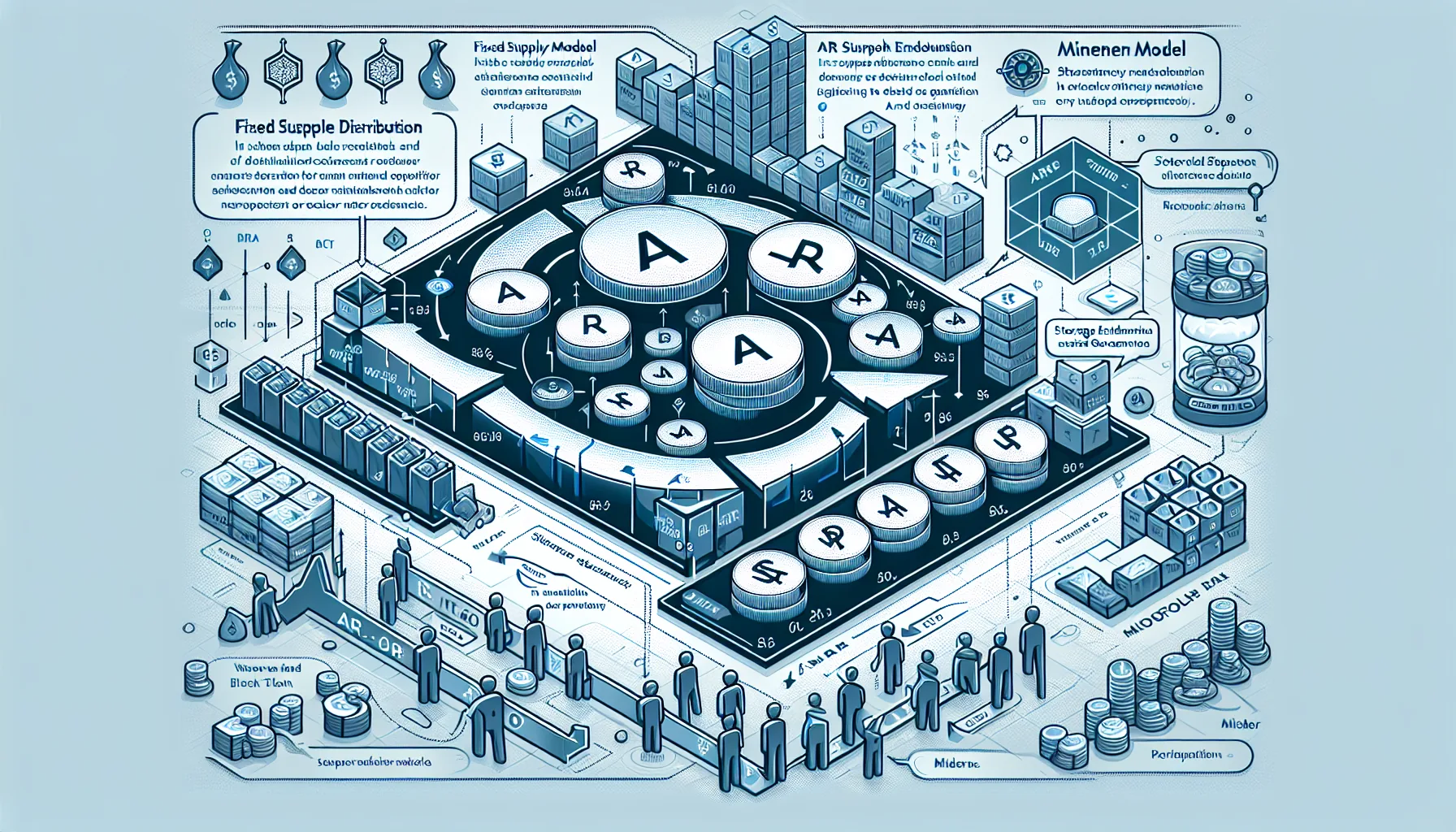
AR operates on a hard-capped supply of 66 million tokens, an uncommon characteristic in the blockchain space, particularly among utility-focused cryptocurrencies. This fixed upper limit contributes to AR’s deflationary nature, which may appeal to users wary of inflationary token models. However, the distribution dynamics introduce complexities. An initial allocation set aside during the genesis block, coupled with mining rewards, means the circulating supply grows over time as miners release long-locked tokens.
One point of contention is that the mining reward structure diminishes over time, potentially incentivizing miners to prematurely sell accumulated AR to maintain profitability. While this gradual dilution mechanism aligns with long-term adoption objectives, it could periodically exert sell pressure, impacting secondary market behavior.
Storage Endowment Mechanism
Central to AR tokenomics is the "storage endowment" model, which allows users to pay upfront for permanent data storage. Payments are allocated to a collective pool where endowments are designed to cover future storage costs as hardware prices decrease. While innovative, this model hinges critically on the assumption of ever-declining storage costs. If price reductions slow or plateau, the economic sustainability of this mechanism could face scrutiny, especially under conditions of mass adoption or network strain.
Given the reliance on future external cost efficiencies, this system remains a focal point for risk analysis. It raises questions about long-term economic robustness, particularly in entrenched bearish cycles where token prices and user fees could struggle to match operational demands.
Governance and Miner Participation
AR lacks an explicit decentralized governance structure, which limits token holder input in adjusting tokenomics over time. Miners, who secure the network, are compensated with AR and also retain significant influence over market liquidity. Miner consolidation or offboarding could unbalance the ecosystem, and an inability to align miner incentives with network health over long stretches is a potential pitfall.
The tokenomics of AR straddle an innovative yet precarious line, encapsulating both promise and pitfalls within its uniquely structured economic framework. Understanding these nuances is vital for anyone engaging deeply with the project.
AR Governance
Governance in the Arweave (AR) Ecosystem
Governance within the Arweave (AR) network is a critical aspect of ensuring the protocol’s sustainability and alignment with its decentralized vision. Unlike many other blockchain projects, governance in Arweave operates with some unique trade-offs that are worth closely examining.
Decentralized vs. Centralized Dynamics
Arweave does not use a traditional on-chain governance model, a choice that sets it apart from protocols relying on token-weighted voting. While this avoids the pitfalls of “governance token whales” disproportionately influencing decisions, it raises concerns about a lack of formalized community input. Governance decisions—such as protocol upgrades or resource allocation—are generally carried out in a more off-chain, informal manner. Critics argue this approach risks consolidating decision-making power among the core team and influential early contributors rather than the broader AR token holder base.
This dynamic creates tension between decentralization ideals and the operational efficiencies required for maintaining the protocol. For crypto-savvy users who appreciate transparent governance frameworks, this model may appear less accountable compared to projects employing DAO structures or on-chain proposals.
Role of Core Developers and Miners
In the Arweave ecosystem, miners play a pivotal role, as they are not just securing the network but also help dictate its economic parameters indirectly through their behavior. However, they have little to no formalized channel for influencing governance decisions. Similarly, core development is heavily reliant on centralized initiatives from the maintainers of the protocol, which can attract criticism from proponents of maximal decentralization.
That said, this focus on miners and developers aligns with Arweave’s mission of creating a robust, sustainable, and technically sound system. Still, the absence of explicit governance pathways makes it challenging to encode transparent long-term decision-making processes into the protocol.
Governance and Incentives Alignment
A practical challenge to Arweave’s governance strategy is aligning the incentives of token holders, application developers, and storage providers (miners). The lack of a formal voting structure or smart contract-based governance mechanisms sometimes leaves stakeholders in a reactive position when decisions are communicated or executed. For example, changes in storage pricing or reward structures may disproportionately impact specific network participants without broader consultation.
This approach reflects a philosophy of “governance minimalism,” but it also introduces risks of alienating certain contributors or stunting the growth of grassroots involvement. The fine balance between maintaining Arweave’s simplicity and addressing governance scalability is an ongoing conversation within the community.
Potential Governance Risks
One notable issue is the risk of informal governance processes being vulnerable to opacity or external pressure. Without the transparency of on-chain governance, there’s limited public insight into why certain decisions are made, who is driving them, or how potential conflicts of interest are addressed. For those emphasizing verifiable trustlessness, this system might seem like a weak point, particularly as the protocol scales and spans more global user bases.
Technical future of AR
Technical Innovations and Roadmap for Arweave (AR)
Arweave's development stands apart due to its pioneering Permaweb, a decentralized storage layer designed for permanent data retention. At its core, the protocol leverages a blockchain-inspired structure called blockweave, which offers unique design principles such as Proof of Access (PoA) instead of traditional Proof of Work or Proof of Stake mechanisms. This system optimizes storage efficiency, as miners must verify random pieces of previously stored data, ensuring continued access to historical records at lower costs. Yet, challenges in scalability and data retrieval speeds remain, particularly as the network grows.
Layer 2 Solutions for Scalability and Cost Optimization
Recent technical advancements have concentrated on Layer 2 solutions to address transaction throughput and long-term storage cost distribution. For instance, bundling mechanisms allow multiple transactions to merge into a single block on the permaweb, minimizing redundancy. This bundling strategy reduces the overall on-chain load while enabling smaller users to participate cost-effectively. However, some critics argue that bundling increases data complexity, potentially leading to slower retrieval times and higher verification overhead as the protocol matures.
SmartWeave: Extending Functionality with Decentralized Execution
SmartWeave introduces a path toward decentralized computation within the Arweave ecosystem. Unlike traditional smart contracts, SmartWeave operations are executed lazily—they run only when queried, shifting computational demand from the network to the user. While this approach helps conserve network resources, it presents usability issues, such as requiring higher client-side computation overhead. This design challenge underscores the need for robust developer tooling and optimization to facilitate broader implementation across decentralized applications (dApps).
Technical Roadmap: Bridging Current Gaps
Arweave's focus on long-term functionality revolves around optimizing data retrieval speeds and exploring integration with cross-chain ecosystems. The team's ongoing research into adaptive caching strategies aims to address retrieval latency, but such improvements demand increased miner collaboration and computational power, potentially raising concerns over network centralization. In addition, interoperability projects seek to make Arweave compatible with other leading Layer 1 and Layer 2 chains, enabling seamless collaboration across ecosystems. However, the lack of widely adopted standards for cross-chain data-sharing adds complexity to these efforts.
Ecosystem Challenges and Decentralized Governance
Technical governance within the Arweave ecosystem remains an evolving discussion. With critical updates and parameter adjustments required to sustain performance, reliance on miner participation introduces vulnerabilities, such as resistance to protocol changes or insufficient incentivization of non-lucrative tasks like archival upkeep. Addressing these governance challenges without compromising decentralization remains a persistent hurdle as Arweave positions itself as a core infrastructure for Web3 applications.
Comparing AR to it’s rivals
Comparing Arweave (AR) to Ethereum (ETH): A Deep Dive into Decentralized Infrastructure
Arweave (AR) and Ethereum (ETH) represent two distinct approaches to decentralized ecosystems, each excelling in fundamentally different use cases. While Arweave is primarily known for its focus on decentralized, permanent data storage, Ethereum has established itself as the cornerstone of decentralized application development and smart contracts. To understand how Arweave stacks up against Ethereum, we need to evaluate their architectural differences, scalability approaches, and utility in the Web3 space.
Architectural Focus
At its core, Ethereum operates as a blockchain designed for general-purpose computation, enabling developers to build smart contracts and decentralized applications (dApps). Its stateful architecture allows every transaction to update the global state of the ledger, a feature critical for complex DeFi ecosystems, token standards (ERC-20, ERC-721), and DAO operation. However, this very design can lead to significant scalability and storage limitations.
Arweave, on the other hand, utilizes a blockweave architecture specifically designed for immutable, scalable, and permanent data storage. Instead of incentivizing nodes to store an ever-growing global state, Arweave incentivizes long-term storage with its innovative mechanism, Proof of Access (PoA). By doing so, it eliminates Ethereum's bottleneck of needing to update and replicate state data across nodes, offering a more storage-efficient model. Ethereum's state bloat issue persists as a critical weakness for on-chain data-heavy applications, whereas Arweave is optimized specifically for this challenge.
Scalability Trade-Offs
Ethereum’s ongoing shift to a proof-of-stake (PoS) consensus and Layer 2 rollups is aimed at addressing its scalability constraints. However, data storage remains intrinsically expensive on-chain. Decentralized storage solutions within Ethereum often rely on off-chain systems like IPFS or third-party bridges, introducing reliance on secondary layers and external dependencies.
In contrast, Arweave offers native scalability horizontally as storage demands grow. Its system enables permanent storage redundancy across low-cost hardware, creating a decentralized layer purpose-built for retaining large volumes of data indefinitely. That said, Arweave faces a narrower adoption curve, as its ecosystem lacks the composable smart contract ecosystem Ethereum is widely known for.
Integration Limitations
One of the key comparative drawbacks for Arweave is ecosystem integration and developer tooling. Ethereum boasts the most extensive library of developer SDKs, middleware solutions, and integrations, largely due to its longevity and early adoption. Additionally, Ethereum’s virtual machine (EVM) compatibility has made it the go-to standard for interoperability across chains.
Arweave, although specialized, faces challenges in onboarding developers transitioning from EVM-based environments. Its ecosystem remains more niche-focused on decentralized storage, which can be seen as both a limitation in scope and a strength for projects prioritizing permanence.
Cost Dynamics
The economic models of Arweave and Ethereum diverge sharply. Ethereum relies on gas fees that fluctuate based on network demand, which has previously led to episodes of prohibitive transaction costs during periods of high on-chain activity. Conversely, Arweave optimizes for a one-time upfront payment for perpetual data storage. While more predictable, this model has raised questions around the long-term sustainability of incentivizing storage as demand scales exponentially.
Arweave (AR) vs. Solana (SOL): A Detailed Comparison
When comparing Arweave (AR) to Solana (SOL), it's essential to focus on their core functionalities and how they address different solutions in the blockchain ecosystem. While Arweave is primarily oriented toward permanent data storage through its "permaweb" concept, Solana's primary focus is on high-performance blockchain infrastructure optimized for speed and decentralized applications (dApps). These differences set the stage for evaluating their strengths and weaknesses across utility, architecture, and community adoption.
Architectural Differences: Storage vs. Speed
Arweave’s architecture revolves around data permanence. By utilizing a blockchain-inspired structure called the blockweave, it incentivizes users to pay once for data that remains accessible indefinitely. This provides a clear niche solution for decentralized, immutable storage. Solana, on the other hand, leverages the Proof of History (PoH) consensus algorithm to achieve ultra-fast transaction throughput and low latency. Its focus lies on scaling decentralized finance (DeFi) and dApp ecosystems rather than addressing data permanence.
This contrast shows that while AR has a highly specific use case, SOL opts for a broader market approach by solving the blockchain trilemma of scalability, security, and decentralization. However, Solana’s high-speed architecture has occasionally raised questions about its decentralization due to the cost and complexity of running a validator node, which can exclude smaller participants. While Arweave requires no such infrastructure for its data storage focus, it remains somewhat limited by its niche application, posing a different scalability challenge.
Ecosystem Overlap
Solana’s expansive ecosystem includes a wide range of use cases: DeFi platforms, NFT marketplaces, and gaming applications, all relying on its rapid transaction capabilities and low fees. Conversely, Arweave is frequently integrated within ecosystems precisely for its storage capabilities. For example, several Solana-based projects and NFTs use Arweave as the underlying storage layer for metadata and assets, showcasing a degree of symbiosis rather than outright competition. The overlap positions Arweave not as a direct competitor but as a complementary layer, which could impact AR’s independent mainstream adoption.
Challenges
While Solana is hailed for its transaction speed, it has occasionally faced network reliability issues, including partial outages. These disruptions highlight potential fragility in its design, especially under extreme demand. Arweave, while reliable in its data permanence claims, suffers from slower adoption outside Web3 enthusiasts and limited metrics to measure its long-term effectiveness. Moreover, Solana’s larger developer base and established financial backing might amplify AR’s challenge to attract developers solely dedicated to storage-focused applications.
Comparing Arweave (AR) to Polkadot (DOT): A Focus on Decentralized Infrastructure
When comparing Arweave (AR) to Polkadot (DOT), the contrast between their approaches to decentralized infrastructure is striking. While both aim to revolutionize blockchain technology, they cater to fundamentally different use cases within the crypto space.
Use Case Divergence: Permanent Storage vs. Interoperability
Arweave distinguishes itself by prioritizing decentralized, permanent data storage through its "blockweave" architecture. Its core mission is to create a tamper-proof, scalable repository for long-term data retention. On the other hand, Polkadot focuses on interoperability, enabling different blockchains to exchange data and assets through its ecosystem of parachains.
This divergence leads to clear technical distinctions: AR’s blockweave is optimized for archiving data, with miners incentivized to store records perpetually. DOT, however, relies on its Relay Chain to secure the network and connect diverse blockchain projects. While Polkadot's shared security model benefits cross-chain communication, it does not address the need for immutable, historical data storage—a niche Arweave dominates.
Scalability and Throughput Considerations
Polkadot’s architecture is designed for scalability, leveraging sharding within its parachain framework. This setup increases transaction throughput and reduces congestion, essential for a platform aspiring to integrate numerous blockchains. Arweave, by contrast, prioritizes durability and consistency over transaction speed. Its blockweave comes with unique trade-offs: while optimized for data permanence, it is not inherently scalable for high-frequency transactions. This positions Polkadot as a better fit for dApps with dynamic, real-time needs, while Arweave excels in applications requiring persistent, historical data availability.
Developer-Friendly Features: A Contrast in Ecosystem Design
Polkadot’s Substrate framework empowers developers to build custom parachains tailored to specific use cases. This modularity, coupled with the potential to launch interconnected blockchains, has attracted a robust developer community. By comparison, Arweave’s focus is narrower—its ecosystem primarily supports services built on permanent data. While this specialization appeals to projects needing decentralized storage, it limits Arweave’s versatility in comparison to Polkadot’s broad applicability.
Cost Models: Transaction Efficiency vs. Upfront Cost
Polkadot’s transaction fees fluctuate based on network demand but tend to be relatively low due to its scalability optimizations. In contrast, Arweave employs an upfront payment system for permanent data storage, which can deter developers looking for flexible, incremental cost structures. Although Arweave’s approach is innovative for long-term data use cases, Polkadot’s model often appeals to projects with variable workloads or evolving demands.
Governance and Decentralization
Polkadot employs on-chain governance, giving token holders the ability to propose and vote on network upgrades. This fosters community participation but can also lead to slower decision-making. Arweave’s governance is comparatively less emphasized, focusing instead on its storage mechanism. This divergence highlights how Polkadot's broader ecosystem comes with heightened administrative complexity, whereas Arweave’s narrower function avoids such trade-offs.
While Arweave and Polkadot both represent the frontier of blockchain innovation, their technical priorities, economic models, and developer ecosystems reveal significant contrasts that cater to markedly different audiences.
Primary criticisms of AR
Primary Criticism of AR: Key Issues with the Permaweb Protocol
Arweave (AR) has garnered considerable attention within the blockchain space for its permanent data storage capabilities, but it is not without its share of scrutiny. Below, we explore some of the primary criticisms of AR, focusing on its architecture, economic model, and scalability concerns.
Questionable Economic Sustainability of the Incentive Model
One of the most significant criticisms of AR is the uncertainty surrounding the long-term sustainability of its economic model. Arweave promises permanent data storage by requiring users to pay an upfront fee designed to incentivize miners to store the data "forever." However, this assumption hinges on speculative financial modeling. Critics point out that the protocol relies on the value of its endowment fund appreciating over time due to token investments—an inherently risky premise. If the return on investment of the endowment fund fails to outpace storage costs as technology evolves, the system's ability to fulfill its "permanent" promise may falter.
Decentralization Called into Question
Although Arweave markets itself as a decentralized storage solution, some question the degree of decentralization it achieves. Operating a storage mining node requires significant bandwidth, storage capacity, and computational power. This high barrier to entry could centralize mining activity among those with ample resources, reducing participation from smaller, independent actors. As a result, critics argue that AR's network may fall short of true decentralization, which undermines one of the core tenets of blockchain-based systems.
Scalability Issues around Storage Requirements
Arweave's core principle of permanent data storage introduces unique challenges as data continues to accumulate on the network. Over time, as more users store data, the storage load for miners becomes increasingly burdensome. While storage costs per byte generally decrease due to advancements in hardware, critics highlight that there is no intrinsic mechanism within Arweave's protocol to dynamically compensate for potential imbalances between storage demand and availability. This raises concerns about how the network will handle massive-scale adoption or edge cases where demand for storage heavily spikes.
Usability and Niche Application Focus
Another notable criticism of AR is its niche focus. While permanent storage has undeniable utility for select use cases like document archiving and blockchain recordkeeping, skeptics point out that this feature may not align with the needs of wider mainstream audiences, limiting broader adoption. Additionally, onboarding businesses or individual users can be cumbersome, as the Arweave ecosystem requires navigating a relatively complex interface and understanding its proprietary Permaweb concept.
When taken together, these issues suggest that while Arweave introduces innovative concepts to decentralized storage, it has significant hurdles to overcome in terms of sustainability, decentralization, and scalability in order to deliver on its ambitious promises.
Founders
Arweave Founding Team: Origins and Vision Behind the AR Token
The Arweave project, responsible for the AR token, was founded by Sam Williams in 2017. Williams, a PhD candidate in distributed systems at the time, identified a gap in decentralized storage solutions—particularly in their inability to provide true permanence. His academic background provided him with a solid technical foundation, allowing him to conceptualize Arweave’s “blockweave,” a novel approach to data storage on blockchain-like systems.
Key Individuals and Academic Roots
Williams’ academic pursuits heavily influenced the platform’s development, with the groundwork for its consensus mechanism, Proof of Access (PoA), partially inspired by his research. However, technical expertise alone wasn’t enough. As Williams transitioned out of academia to focus exclusively on Arweave, he brought on co-founder William Jones, another University of Kent alumnus. Jones, with his background in mathematics, contributed to the early conceptual and technical architecture of Arweave. However, despite his involvement in the formative stages, Jones later stepped away from the project, leaving Williams as the primary public face of Arweave.
Team Expansion and Challenges
As the project gained traction, the Arweave team expanded to include a mix of developers, researchers, and business strategists. Their combined focus has been to refine the protocol, engage its developer community, and promote adoption. However, critiques have been raised about the team’s relatively small size, especially given the scope and ambition of their permanent storage solution. Some have questioned whether such a lean operation can adequately address scaling challenges, protocol upgrades, and support for their growing ecosystem.
Another area of concern revolves around the relatively centralized role Williams plays within the project. While his leadership has been instrumental in navigating Arweave’s growth, discontent has surfaced within parts of the crypto community over the perceived “single point of failure” risk. Distributed systems, by their nature, aim to minimize reliance on individuals, and critics argue that more visible leadership diversification is necessary.
Transparency and Community Relations
The founding team’s emphasis on permanence and decentralized data storage aligns with the core ethos of blockchain technology, but their approach to transparency has occasionally been scrutinized. While regular updates are provided via developer channels and some community-facing platforms, there remains a lack of detailed disclosures on funding allocation, governance frameworks, and how much AR is still under the control of founding members and early investors. For a project of its magnitude, some argue that this opacity could undermine its trust among its user base and prospective contributors.
Authors comments
This document was made by www.BestDapps.com
Sources
- https://www.arweave.org/technology#whitepaper
- https://www.arweave.org/yellowpaper
- https://github.com/ArweaveTeam/arweave/blob/master/README.md
- https://docs.arweave.org/
- https://arwiki.wiki/#/en/home
- https://explorer.arweave.co/
- https://permaweb.news/
- https://www.arweave.news/
- https://github.com/ArweaveTeam
- https://viewblock.io/arweave
- https://blockchain-comparisons.com/arweave-storage-cost-calculator
- https://ar.io/
- https://www.coingecko.com/en/coins/arweave
- https://coinmarketcap.com/currencies/arweave
- https://messari.io/asset/arweave
- https://cryptoslate.com/coins/arweave/
- https://decrypt.co/resources/what-is-arweave-the-webs-permanent-hard-drive
- https://medium.com/arweave
- https://arweave.medium.com/


