History of ALGO
ALGO: A Brief History of Algorand's Origins and Development
Algorand, launched in 2019, was founded by Silvio Micali, a renowned cryptographer and MIT professor who won the Turing Award for his contributions to cryptographic principles. Its development was rooted in addressing what Micali identified as fundamental limitations in blockchain technology: scalability, decentralization, and security—the so-called blockchain trilemma. From the outset, Algorand set out to achieve these goals through its unique Pure Proof-of-Stake (PPoS) consensus mechanism, which differentiates it from traditional Proof-of-Work (PoW) networks.
The genesis of Algorand stood apart because of its focus on engineering a system where participation in block creation is random, secret, and verifiable—minimizing the risks of centralization and malicious node domination. ALGO, the native token of the platform, was designed to play a central role in this ecosystem, serving not only as a staking and governance token but also as a necessary component for transaction fees and network operation.
One of the more controversial aspects of Algorand's story has been its initial token distribution process. The project underwent a Dutch auction model to sell ALGO tokens to early adopters, aiming for fair market-driven price discovery. However, the distribution mechanics—and specifically the overhang of unsold tokens—attracted criticism from some in the crypto community for creating unnecessary sell pressure and centralization concerns. The foundation's decision to retain a large allocation of tokens also sparked early conversations about transparency and decentralization, issues that continue to be debated.
Another notable milestone in Algorand's history was the rapid development of its Layer 1 architecture, which integrates smart contract capabilities, atomic swaps, and asset issuance directly into the base protocol. By avoiding Layer 2 dependencies at the outset, Algorand positioned itself as a highly efficient network capable of sub-4 second transaction finality and robust throughput. Still, critics have pointed out that the aggressive on-chain development might sacrifice some trade-offs on decentralization, an aspect scrutinized by competing blockchain ecosystems.
Governance has also been a critical part of Algorand's evolution. Initially organized through centralized leadership by the Algorand Foundation, over time, governance mechanisms were introduced that allowed ALGO holders to propose and vote on key protocol changes. This democratization of control has not always been smooth, with certain decisions—such as changes to foundation-controlled token release schedules—prompting debate within the community.
Algorand’s focus on academic rigor and innovation remains central to its identity, and its early choices continue to shape perceptions of its ecosystem within the broader digital asset landscape.
How ALGO Works
How Algorand (ALGO) Works: A Deep Dive into Its Blockchain Mechanisms
Algorand operates on a unique proof-of-stake (PoS) consensus model, specifically a variation called Pure Proof of Stake (PPoS). Unlike traditional PoS mechanisms that often rely on staking thresholds to determine validators, Algorand democratizes this process by allowing every token holder to participate in block validation. Key to its design is its cryptographic sortition process—a random yet verifiable selection mechanism that determines which users will propose and validate blocks. This ensures both decentralization and fairness, as no single entity consistently exerts disproportionate influence over the protocol.
At the core of Algorand's architecture is the Byzantine Agreement protocol, which ensures consensus even in environments with malicious or unreliable participants. Blocks are finalized in a single voting round, offering near-instant finality. This eliminates the need for forks, a problem commonly faced by traditional blockchain architectures, ensuring that Algorand-based transactions are confirmed swiftly and irreversibly.
Block Time Efficiency and Scalability
Algorand's architecture boasts remarkably low block times—under five seconds per block processing—while maintaining high throughput. The chain achieves this scalability without compromising decentralization or security. However, it's important to note that while the asynchronous finality is highly effective in normal network conditions, extreme network partitions or adversarial activities could still theoretically threaten performance.
Layer-1 Features and Smart Contract Functionality
One of Algorand’s standout characteristics is the integration of advanced features directly on its Layer 1 protocol. These include Algorand Standard Assets (ASAs), atomic transfers, and smart contract execution powered by Algorand's unique Transaction Execution Approval Language (TEAL). The inclusion of these functionalities at the base layer enhances transaction efficiency but creates potential limitations compared to more general-purpose Layer-2 solutions. For example, TEAL's design is deliberately restricted to ensure speed and security, but it may impose constraints for developers accustomed to more flexible smart contract languages like Solidity.
Decentralization and Governance Challenges
While PPoS theoretically ensures broad decentralization, the reality often skews towards concentration among wallets with significant ALGO holdings, potentially centralizing validation power. Furthermore, Algorand’s governance model requires active participation, but the turnout for governance proposals has historically been limited. This raises questions about the long-term sustainability of true decentralization within the ecosystem.
Environmental Impact: Pros and Cons
Algorand’s low energy consumption is frequently cited as a benefit of its PPoS model. The chain’s design inherently avoids the resource-intensive computations required by proof-of-work blockchains. Nevertheless, scalability concerns arise in terms of storage and historical data growth, as the ever-growing blockchain size could impose burdens on individual node operators over time.
Use Cases
Exploring ALGO’s Use Cases: Leveraging the Algorand Blockchain
The ALGO token powers a diverse range of use cases within the Algorand blockchain, a high-performance, Layer-1 network designed for scalability and efficiency. Below is a breakdown of notable applications and implementations, along with some associated challenges.
Decentralized Finance (DeFi) Ecosystem on Algorand
ALGO serves as a fundamental medium for facilitating DeFi operations, including liquidity pools, decentralized exchanges (DEXs), and yield-farming protocols within the Algorand ecosystem. Its design enables near-instantaneous transaction finality at low cost, making it attractive for users and developers in cash-flow-intensive DeFi processes. However, the adoption rate of Algorand's DeFi applications remains a bottleneck compared to platforms like Ethereum and Solana, which enjoy broader liquidity and user bases. This disparity creates concerns around network effects, which are vital for DeFi sustainability.
Enterprise-Grade Applications
Algorand’s protocol, known for its Pure Proof-of-Stake (PPoS) consensus mechanism, has been positioned to support enterprise-level use cases, such as supply chain management, tokenized asset issuance, and digital payments. Organizations leverage ALGO to pay for network transaction fees or as a staking mechanism in enterprise-specific applications. Still, some enterprises express hesitation due to limited wallet integrations and concerns about the perceived centralization of decision-making within Algorand’s governance structure.
Governance Participation
ALGO holders can participate in Algorand’s decentralized governance, where they vote on protocol updates and project funding proposals in exchange for staking rewards. While this fosters community involvement, criticism arises regarding the accessibility and fairness of these processes. Large token holders often dominate votes, raising questions about the true decentralized nature of decision-making on the network.
Non-Fungible Tokens (NFTs) and Creators
The low-cost and fast transaction capabilities of the Algorand blockchain make it a viable option for NFT creation and marketplace development. Artists and developers have the ability to mint NFTs and execute smart contracts seamlessly. However, competition from more established NFT ecosystems like Ethereum and Polygon overshadows Algorand’s efforts in securing a prominent position in this sector. This limits ALGO’s penetration in broader NFT marketplaces.
Cross-Border Payments
ALGO is increasingly used in cross-border payment frameworks, leveraging Algorand’s low latency and high throughput for instantaneous value transfer. However, the lack of partnerships with prominent financial institutions keeps its reach modest compared to blockchain networks with established financial industry collaborations like Ripple (XRP).
Tokenized Assets and Algorand Standard Assets (ASA)
The Algorand Standard Assets (ASA) framework allows for the tokenization of assets ranging from equities and bonds to stablecoins. ALGO is used to handle transactions for these digital assets, empowering developers to launch complex financial instruments on-chain. Despite its technical robustness, the awareness and accessibility of ASA functionality remain low in the broader market, restricting widespread developer adoption.
In terms of utility, ALGO shows remarkable flexibility across varied use cases, but noticeable challenges related to adoption, network effects, and ecosystem maturity persist. These issues will likely influence its trajectory within key crypto sectors.
ALGO Tokenomics
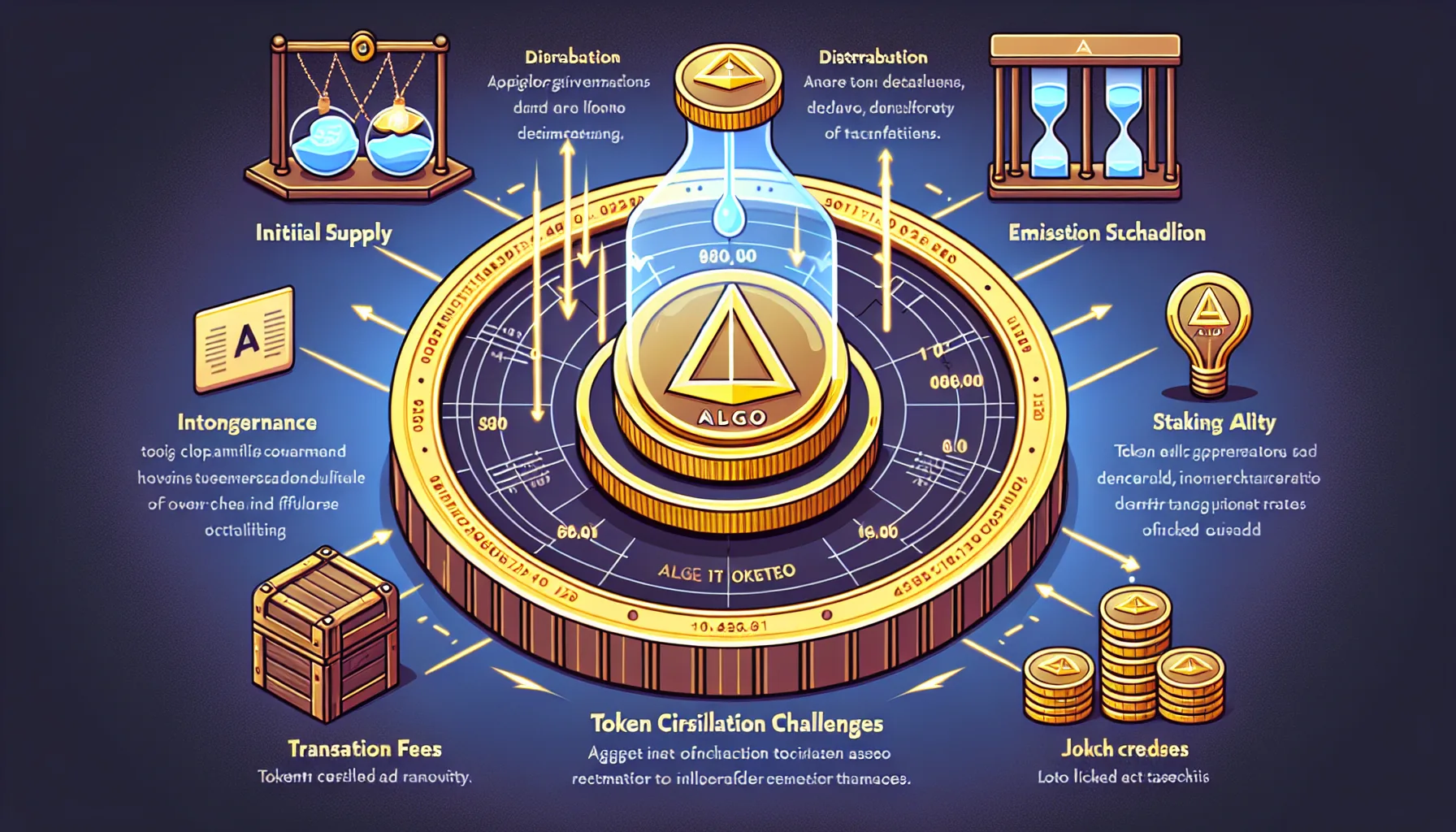
ALGO Tokenomics: Understanding the Dynamics of Algorand's Native Asset
The tokenomics of ALGO, the native cryptocurrency of the Algorand blockchain, center around decentralization, staking incentives, and a deflationary emission model. However, the structure and distribution mechanisms present both opportunities and challenges for users and the broader ecosystem.
Initial Supply and Distribution
ALGO launched with a total cap of 10 billion tokens programmed to be distributed over a period of years. While pre-mined supply models allow for an early and transparent allocation plan, they can also lead to concerns around centralization if significant amounts remain in the hands of early investors, founding teams, or Algorand Inc. itself. A notable portion of ALGO's supply is held by the Algorand Foundation for ecosystem development, grant programs, and governance rewards. These holdings raise questions about the pace of token release and potential sell pressure during certain periods.
Emission Schedule
Algorand employs a deflationary token release schedule designed to reduce new issuance over time. This emission model rewards participation in the protocol's Pure Proof of Stake (PPoS) consensus mechanism. Early adopters and stakers benefitted most from higher initial rewards, but the diminishing issuance rate over time poses long-term questions about how the system will maintain high levels of engagement once the incentives thin out.
Governance and Staking Rewards
ALGO token holders can participate in on-chain governance and receive rewards for doing so. Governance staking requires users to lock their tokens for a fixed period, during which they’re rewarded with additional ALGOs. This approach encourages active participation and lends weight to decentralized decision-making. However, it presents opportunity costs for token holders unable or unwilling to lock their assets for extended periods. Moreover, high staking yields often favor large-scale holders, inadvertently contributing to wealth concentration.
Transaction Fees and Utility
ALGO serves as the fundamental utility token for network transactions and smart contract deployment. Low transaction fees––made possible by Algorand’s efficient consensus––enhance its appeal as a utility token. That said, the emphasis on ultra-low fees may limit the potential for fee-based scarcity mechanisms and could create challenges for long-term token value accrual.
Token Circulation Challenges
One criticism often directed at ALGO's tokenomics is the disparity between its circulating supply and its total supply. As of various periods, a large quantity of ALGOs remains locked in reserve accounts or vested for future distribution. While this structured release ensures gradual decentralization, it can also result in market sell-offs when large unlocks occur, impacting demand dynamics.
ALGO’s tokenomics reflect a deliberate effort to balance decentralization, utility, and adoption, but its long-term sustainability remains closely tied to its ability to address these underlying complexities.
ALGO Governance
ALGO Governance: Mechanisms, Challenges, and Opportunities
Algorand’s governance framework is designed to empower ALGO token holders by giving them direct influence over the protocol’s evolution. This decentralized governance model operates through periodic governance periods, where participants commit tokens, propose changes, and vote on key network updates. However, while innovative, Algorand's governance setup presents critical strengths and notable challenges.
Decentralized Decision-Making via Governance Periods
Algorand implements a unique governance structure driven by community participation. ALGO holders can commit their tokens to specific governance periods, which typically last several months. This commitment ensures that only participants with "skin in the game" influence key decisions. During these periods, proposed changes to the protocol or network parameters are introduced, and holders have the opportunity to vote on them. Such a setup decentralizes decision-making authority, theoretically reducing the influence of centralized entities or developers. However, there is an ongoing debate over the weight and practicality of token-based voting, as it inherently favors wealthier participants with larger token holdings.
Incentives for Participation
One of the primary mechanisms used to encourage participation is rewards for governance activity. ALGO participants who vote and meet their commitment requirements are often rewarded with additional tokens or governance incentives proportional to their contributions. While this creates a strong financial incentive to participate, it raises concerns about whether governance is being driven by individuals who are genuinely invested in the protocol's long-term growth or by those motivated purely by short-term gains.
Additionally, the financial barrier to entry for smaller token holders can sometimes discourage participation in meaningful governance. This could lead to a concentration of power, where only a minority of large stakeholders influence the protocol’s direction.
Transparency and Accountability in Decision-Making
Algorand’s governance model prioritizes transparency by publishing proposals and voting results for community review. However, one recurring issue revolves around the clarity and accessibility of proposal documentation. For a system reliant on broad participation, the governance process can sometimes be seen as overly technical, alienating a portion of the community less familiar with the intricacies of blockchain technology.
Furthermore, there have been instances of low overall voter turnout in governance periods, suggesting that the platform may need to explore additional ways to engage its community and increase active participation. Without such measures, there's a risk of decision-making being dominated by a disproportionately small subset of the community.
Balancing Stability and Innovation
Governance decisions naturally shape the future trajectory of Algorand. However, they also introduce unpredictability, as participants may prioritize short-term network stability or self-serving measures over long-term innovation. This tension between competing priorities remains an ongoing challenge for Algorand’s decentralized governance model, creating potential risks for the alignment of interests across different network stakeholders.
Technical future of ALGO
Current and Future Technical Developments in ALGO's Ecosystem
Advancements in Core Protocol Development
Algorand’s layer-1 blockchain continues to evolve with significant focus on scalability, throughput, and decentralization. The recent implementation of state proofs enhances the protocol's interoperability, allowing ALGO to integrate seamlessly with other blockchains without compromising security. Unlike traditional bridges, state proofs reduce reliance on trusted intermediaries, tackling common vulnerabilities linked to cross-chain interactions. However, critics argue that while state proofs are a step forward, their adoption across external systems is still limited, presenting a bottleneck for broader utility.
Another significant development lies in the upgrading of Algorand’s consensus algorithm, Pure Proof of Stake (PPoS). The ongoing optimization targets reduced latency and energy consumption, solidifying ALGO’s position as one of the greenest blockchain networks. Still, scalability comparisons with competing blockchains like Solana have fueled debates. Some developers remain skeptical about whether future protocol refinements will fully address transaction batching under high-load scenarios.
Smart Contract Features and Improvements
Algorand’s support for Algorand Smart Contracts (ASCs) leverages TEAL (Transaction Execution Approval Language) for lightweight on-chain functionalities. Recent updates have prioritized enhancing the Virtual Machine (AVM) for more complex DeFi and NFT use cases. Enhanced Layer-1 atomic transaction capabilities allow dApps to improve composability, which is crucial for multi-step financial processes. However, feedback from some in the developer community points to a steeper learning curve for TEAL compared to Solidity, potentially hindering onboarding for Ethereum-native projects.
Technical Roadmap Highlights
Algorand’s technical roadmap reflects priorities such as further quantum-resistant cryptographic enhancements. While post-quantum cryptography has gained attention across blockchain platforms, Algorand’s research into these cryptographic methods showcases forward-looking commitment. Yet critics caution that practical implementation timelines remain unclear, potentially lagging behind advancing threat capabilities.
Another core focus of the roadmap is broader adoption of Co-Chains – private, permissioned implementations of Algorand’s blockchain. These are marketed as ideal for enterprises that require high performance and configurable privacy. Although Co-Chains provide a flexible option for institutional users, the lack of widespread adoption by high-profile organizations raises industry concerns about penetration into the enterprise market.
Concerns on Decentralization
The Algorand protocol distributes validator roles to all token holders, democratizing participation. However, questions remain about validator concentration and whether large stakeholders weaken the degree of practical decentralization. This issue is particularly relevant for long-term ecosystem governance and security assumptions.
Final Technical Observations
As Algorand continues to release upgrades, challenges related to developer uptake, interoperability, and resource allocation remain critical. Innovating on multiple fronts while maintaining simplicity and usability for end-users might strain the pace of seamless technical progression.
Comparing ALGO to it’s rivals
ALGO vs SOL: A Comparative Breakdown
When evaluating ALGO and Solana (SOL) as blockchain ecosystems, the technical foundations, scalability claims, and developer uptake paint two distinct pictures. Both projects aim to dominate the high-performance blockchain space, but their approaches diverge significantly.
Algorand leverages Pure Proof-of-Stake (PPoS), a consensus mechanism designed to ensure high security, decentralization, and energy efficiency. Unlike Solana's Proof-of-History combined with Proof-of-Stake (PoH-PoS) approach, Algorand avoids relying on leader-based block production. SOL’s PoH introduces a cryptographic timestamping technique that boosts transaction speeds but has drawn criticism for its potential centralization risks, as the high-performing hardware requirements favor larger, more resource-heavy participants. In contrast, Algorand’s design theoretically allows for more equitable participation in consensus.
From a performance angle, Solana’s claim of processing tens of thousands of transactions per second (TPS) dwarfs Algorand’s current throughput. However, Algorand’s focus on deterministic finality, where blocks are finalized in seconds with no forking, ensures consistency and avoids the double spend or transaction reversal risks commonly associated with high-speed systems under specific stress tests. Solana’s reliance on PoH has, at times, resulted in severe network outages and performance degradation during periods of high demand, raising concerns about its robustness under pressure. Algorand, on the other hand, has so far maintained uptime while scaling gradually, but critics argue that its TPS performance seems understated for a blockchain aiming to be a global settlement layer.
Developer ecosystems also mark a point of differentiation. Solana boasts strong developer interest, partly due to its high throughput and the appeal of building dApps on a lightning-fast blockchain. That said, frequent network instability has prompted some developers to voice dissatisfaction. In contrast, Algorand has focused on building a stable and secure platform, but it has faced challenges in capturing comparable levels of hype or developer community size. The adoption of programming frameworks like TEAL (Transaction Execution Approval Language) for Algorand smart contracts has been lauded for security but criticized for being less developer-friendly than Rust, which is used for Solana programming.
Ultimately, ALGO and SOL represent two opposing philosophies: one prioritizing stability, energy efficiency, and gradual iteration, while the other focuses on pushing performance boundaries, sometimes at the expense of decentralization and resilience. The trade-offs between the two often hinge on specific use-case priorities, leaving room for nuanced evaluation.
ALGO vs. ADA: A Comparative Analysis of Blockchain Ecosystems
When comparing ALGO (Algorand) to ADA (Cardano), it's evident that the two networks address similar pain points in the blockchain space—namely scalability, energy efficiency, and decentralized functionality—while employing vastly different approaches in their technical design and development strategies.
Consensus Mechanisms: Pure Proof-of-Stake vs. Liquid Proof-of-Stake
ALGO leverages Pure Proof-of-Stake (PPoS), a cutting-edge consensus mechanism aimed at achieving high transaction speed with low finality times. This design ensures that block production and validation are more evenly distributed amongst participants, emphasizing fairness and decentralization. ADA, on the other hand, utilizes Ouroboros, a Liquid Proof-of-Stake (LPoS) model. Ouroboros relies on delegation and staking pools, which introduces inherent centralization risks, as wealthier participants or larger entities may dominate staking pools, consolidating influence over block validation. Conversely, ALGO's randomized block proposer selection minimizes the concentration of power, which some argue gives it a structural decentralization advantage.
Development Philosophies: Research-Driven vs. Iterative Deployment
Cardano is notorious for its academic and research-heavy development philosophy, pushing system upgrades only after rigorous peer-reviewed processes. This ensures robust, well-vetted improvements, but it often hampers development speed and responsiveness to emerging trends. In comparison, Algorand adopts an iterative and agile development cycle, introducing regular upgrades to enhance network performance and developer tooling without significant delays. While ADA's method might appeal to enterprises focused on network robustness, some developers and users may perceive it as slow-moving compared to ALGO's more flexible model.
Smart Contract Ecosystems: Plutus vs. TEAL
Smart contract execution is another key battleground. ADA relies on Plutus, a language rooted in Haskell, which emphasizes high levels of code correctness but steepens the learning curve for developers unfamiliar with functional programming paradigms. ALGO's TEAL (Transaction Execution Approval Language) adopts a more minimalist and purpose-built scripting language designed for speed and simplicity, though critics argue it lacks the versatility of more complex smart contract systems. As a result, while Algorand’s smart contracts suit high-throughput use cases like decentralized finance (DeFi) and tokenization, Cardano's architecture may be better suited for highly complex applications that benefit from formal verification.
Network Adoption and Decentralization Dynamics
While both ALGO and ADA prioritize decentralization, ALGO's pure proof-of-stake mechanism ensures every token holder has an equal chance to participate in consensus. ADA's delegation model sees a small subset of operators controlling a large percentage of the network due to staking pool dynamics, raising questions about true decentralization. However, Cardano's reliance on delegation can simplify user participation, potentially fostering broader adoption among non-technical stakeholders at the expense of consolidating power.
Closing Thoughts
This section underscores the contrasting choices made by ALGO and ADA in their approach to blockchain innovation. Both networks excel in addressing critical blockchain challenges, though trade-offs in speed, usability, and ideology differentiate their ecosystems.
Comparing ALGO to DOT: A Technical Perspective
When comparing Algorand (ALGO) to Polkadot (DOT), the conversation gravitates toward their fundamentally different approaches to scalability, interoperability, and governance within the blockchain ecosystem. Both are Layer 1 blockchains, but the technological frameworks they employ reflect divergent philosophies in tackling the scalability trilemma.
Consensus Mechanism: Pure Proof-of-Stake vs. Nominated Proof-of-Stake
Algorand operates on a Pure Proof-of-Stake (PPoS) mechanism, which employs randomized selection to ensure high throughput and low latency while minimizing energy consumption. This design inherently avoids forking, providing finality within seconds. Polkadot, on the other hand, leverages Nominated Proof-of-Stake (NPoS), a variation of delegated consensus where nominators select validators to secure the network. While NPoS emphasizes decentralization in validator selection, critics argue it suffers from potential oligopolistic tendencies, as dominant validators may consolidate power over time.
Interoperability: Silos vs. Relay Chains
Polkadot’s chief innovation centers around its relay chain architecture and the ability to support multiple parachains, each tailored for specific use cases. This modular design allows for cross-chain communication and facilitates interoperability among networks. Algorand, in contrast, focuses less on facilitating multi-chain ecosystems and more on offering an all-in-one blockchain with an emphasis on speed and frictionless execution. Although Algorand has made strides toward interoperability through initiatives like cross-chain bridges and partnerships, it lacks the native, fully integrated, and scalable multi-chain structure of Polkadot.
Developer Ecosystems: Generalist vs. Specialized
Algorand prides itself on being accessible for developers building decentralized applications (dApps) with plug-and-play simplicity via its SDKs and developer tools. However, the developer community size and ecosystem depth are arguably smaller compared to Polkadot. With Polkadot's Substrate framework, projects can build custom blockchains and deploy them as parachains, offering unparalleled flexibility that attracts more specialized use cases. The tradeoff is the complexity and higher technical barrier to entry, which could deter developers without substantial resources or expertise.
Governance Models: On-Chain Differences
Both ALGO and DOT use on-chain governance, but with distinct implementations. Polkadot features a more intricate governance system that includes a Council, a Technical Committee, and token-holder referendums, which some view as overly complex. Algorand, although utilizing simpler governance mechanisms, has faced criticism for relatively low voter turnout, raising questions about whether decentralization is being meaningfully achieved in its decision-making processes.
Scalability and Performance
From a performance standpoint, Algorand excels with its consistent block times and lower transaction fees, making it an appealing choice for high-frequency applications. However, Polkadot’s parachain auctions and relay chain throughput theoretically enable greater network-wide scalability, albeit at the expense of potentially congesting the core relay chain during peak usage.
By examining the distinct characteristics of ALGO and DOT, it is evident that each network caters to different niches within the blockchain landscape, with tradeoffs in decentralization, usability, and scalability defining their divergent paths.
Primary criticisms of ALGO
Primary Criticism of ALGO: Key Issues Hindering Adoption and Growth
Algorithmic blockchain projects like Algorand (ALGO) have garnered attention for their innovative consensus mechanisms and scalability solutions, but ALGO has not been immune to criticism. Despite its technical advancements, the ecosystem faces substantial challenges that cloud its potential in the eyes of many within the crypto community.
1. Centralization Concerns in Governance and Staking
One of the most prominent criticisms of ALGO lies in its governance and staking model. While Algorand’s Pure Proof-of-Stake (PPoS) is touted as a democratized system, detractors argue that significant centralization exists in practice. A disproportionate amount of ALGOs are held in wallets tied to early investors, foundational actors, or large validators. This imbalance raises concerns about how decentralized governance decisions truly are. Critics emphasize that token distribution impacts who gets to participate in the governance process, questioning whether small holders have meaningful influence.
2. High Token Emission Rates and Dilution
Algorand’s tokenomics are another recurring critique, especially regarding its aggressive emission schedule. The allocation to early supporters, rewards for node operators, and ecosystem funding mechanisms have led to substantial inflationary pressure on the native token. While inflationary incentives may encourage staking and ecosystem growth, many argue that this diminishes the token's appeal for long-term holders. Consequently, the high rate of token dilution has led to debates about the protocol’s sustainability and whether the economic model favors insiders over retail participants.
3. Limited Developer Ecosystem and DApp Adoption
Algorand positions itself as a blockchain optimized for decentralized applications (DApps), yet its ecosystem growth has been slower compared to competitors like Ethereum or Solana. Skeptics point to lower developer activity and fewer high-profile DApp launches on Algorand as evidence of its struggles to gain traction among developers. Critics suggest this may stem from a lack of robust development tools, ecosystem incentives, or community engagement, which are critical to expanding a blockchain's network effects.
4. Questions Around Real-World Use Cases
Despite positioning itself as an enterprise-grade blockchain, there is ongoing debate about Algorand’s ability to attract meaningful real-world adoption. Critics question whether its unique selling points, such as fast transaction finality and low fees, are enough to set it apart in an increasingly crowded market. Skeptical voices argue that competing blockchains with established networks are addressing similar issues more effectively, leaving Algorand struggling to define a competitive edge.
5. Perceived Over-Reliance on Marketing
Another point of contention is the perception that Algorand relies heavily on marketing efforts rather than organic ecosystem growth. High-budget sponsorship deals and public relations campaigns have caught the attention of crypto enthusiasts, but many view this approach as prioritizing hype over substance. For many critics, this raises questions about whether the protocol can deliver on its promises or if it risks becoming a project focused more on optics than utility.
Founders
Founding Team Behind Algorand: Expertise and Controversies
The Algorand blockchain was founded by Silvio Micali, a renowned cryptographer and Turing Award winner, whose academic and professional credentials are deeply rooted in cryptographic research. Micali, a professor at the Massachusetts Institute of Technology (MIT), is celebrated for his contributions to fields like zero-knowledge proofs, verifiable randomness functions, and other foundational blockchain technologies. His leadership has lent Algorand an air of credibility among crypto insiders, particularly those drawn to projects with strong academic underpinnings.
Joining Micali at Algorand are several key figures with high-profile experience in fields such as finance, software development, and business strategy. Notable among these is Steve Kokinos, who previously co-founded and served as CEO for Fuze, a cloud communications company. Kokinos has brought a sharp focus to scaling Algorand's adoption across enterprises, attempting to bridge traditional finance with blockchain technology. Another prominent figure is W. Sean Ford, Algorand’s COO, whose resume includes senior leadership roles at pioneering technology companies like LogMeIn. His expertise in operational scaling and marketing has played a significant role in Algorand's early ecosystem growth.
However, despite the founding team’s strong technical and managerial credentials, there have been criticisms. Some in the crypto community have questioned the alignment between the team's centralized decision-making and the broader ethos of decentralization that blockchain technologies often aim to achieve. These concerns stem largely from Algorand’s governance structure in its initial phases, where the team maintained considerable control over the protocol's direction—an issue that hasn’t sat well with advocates of fully decentralized networks.
Another point of contention revolves around the tokenomics model and distribution mechanisms designed by the team. Critics argue that the allocation of early token supplies heavily favored insiders—team members, investors, and foundation-controlled wallets. This has inevitably raised concerns about the true level of decentralization within the Algorand ecosystem and whether those distribution choices could lead to potential conflicts of interest.
It’s also worth noting that despite Micali's academic brilliance, some detractors in the technical community believe that being an expert in theoretical cryptography doesn’t necessarily translate to executing flawless blockchain implementations. This skepticism occasionally clouds the perception of Algorand, particularly among developers who champion competing Layer 1 solutions.
While the expertise of the founding team is undeniably advanced and critical to Algorand’s genesis, these controversies highlight ongoing debates about governance, decentralization, and execution that persist within the community.
Authors comments
This document was made by www.BestDapps.com
Sources
- https://www.algorand.foundation/algorand-whitepaper
- https://developer.algorand.org/docs/
- https://algorand.foundation/yellow-paper
- https://www.algorand.com/technology
- https://developer.algorand.org/whitepapers/
- https://www.algorand.foundation/sustainability
- https://algorand.foundation/consensus
- https://developer.algorand.org/tutorials/
- https://medium.com/algorand
- https://tokenomics.algorand.foundation/
- https://github.com/algorand/go-algorand
- https://explorer.algorand.foundation/
- https://developer.algorand.org/articles/
- https://www.algorand.com/resources/blog
- https://www.algorand.foundation/research
- https://algorand.foundation/news
- https://algorand.foundation/ecosystem
- https://www.algorand.com/wallet
- https://docs.algorand.com/


