History of ADA
The History of Cardano (ADA): A Journey Through Development and Challenges
Cardano (ADA) is a blockchain platform that was first conceptualized in 2015 by Charles Hoskinson, a co-founder of Ethereum. The project was engineered with a strong emphasis on a peer-reviewed academic approach. Officially launched in September 2017, Cardano introduced itself as a third-generation blockchain, aspiring to address the scalability, interoperability, and sustainability issues that plagued earlier networks like Bitcoin and Ethereum.
Cardano's development is spearheaded by three primary organizations: IOHK (Input Output Hong Kong), the Cardano Foundation, and EMURGO. IOHK, led by Hoskinson, is responsible for most of the platform's research and technical architecture. The Cardano Foundation focuses on community oversight, governance, and regulation, while EMURGO drives business adoption and commercial partnerships for the ecosystem. This trifurcated governance structure, while innovative in concept, has drawn criticism for its complexity and occasionally unclear decision-making processes.
The platform's development was divided into distinct phases, termed "eras," which are named after prominent individuals from history. Cardano debuted with the "Byron Era," introducing its foundational blockchain framework and the ADA cryptocurrency. However, this initial phase was criticized for its use of a federated network structure, which relied on IOHK-controlled nodes, raising concerns about decentralization.
The subsequent "Shelley Era," launched in mid-2020, marked Cardano's transition to a more decentralized system. Shelley introduced staking functionality through Ouroboros, Cardano's proof-of-stake (PoS) consensus algorithm, which is touted as being energy-efficient and mathematically secure. However, early decentralization efforts weren't without challenges, as smaller staking pools struggled to compete with larger ones, raising questions about economic centralization within its PoS model.
Cardano's focus on lengthy research timelines and incremental rollouts has been lauded for its rigor, but it also attracted skepticism for perceived delays compared to more agile blockchain projects. Critics argue that its "research-first" ethos could hinder its ability to adapt quickly in a fast-moving industry, with some pointing to the extended gap between Shelley and the launch of the "Goguen Era." Goguen introduced smart contract capabilities, a critical feature necessary to compete with ecosystems like Ethereum. The delays leading up to this release resulted in Cardano being seen by some as lagging behind in decentralized application (dApp) development and adoption.
The iterative history of Cardano reflects its ambition to create a robust blockchain through methodical execution, yet it underscores the inherent tension between academic rigor and market-driven speed.
How ADA Works
How Cardano's ADA Works: A Detailed Insight
Cardano's ADA operates as the native cryptocurrency of the Cardano blockchain, facilitating core functionalities such as staking, transaction fees, and governance. The foundation of ADA lies in Cardano's unique dual-layer architecture: the Cardano Settlement Layer (CSL) and the Cardano Computation Layer (CCL). This design separates coin transfers from the execution of smart contracts, aiming to optimize scalability, flexibility, and security.
Proof-of-Stake and ADA's Role in Consensus
ADA is integral to Cardano's Ouroboros Proof-of-Stake (PoS) consensus mechanism, which relies on ADA delegation and staking for network security. Rather than the energy-intensive mining required by Proof-of-Work systems, ADA holders can delegate their coins to staking pools or run their own pool to validate transactions. This delegation system balances decentralization and accessibility, enabling even small-scale participants to contribute to consensus.
However, Cardano's staking model faces challenges, such as concerns over staking pool centralization. Large pools dominate the network, potentially leading to an imbalance in power. While mechanisms like saturation limits were introduced to incentivize smaller pools, the issue of decentralization remains pertinent as the network evolves.
ADA and Smart Contracts
Smart contracts executed on Cardano require ADA to cover transaction fees and operational costs. Cardano's smart contract platform, Plutus, is based on Haskell, a functional programming language that emphasizes formal verification. While this provides high guarantees for security and correctness, it presents a steep learning curve for developers unfamiliar with functional programming. This limitation can slow adoption in a space dominated by Solidity-based smart contracts like Ethereum's.
Additionally, ADA transactions and smart contracts rely on deterministic execution to ensure predictable outcomes. While this enhances transparency and reduces unexpected results, it can make certain applications, such as dynamic or highly complex computations, less practical compared to blockchains optimized for such use cases.
Tokenomics and ADA Usage
ADA’s fixed supply of 45 billion coins underpins its scarcity-driven value proposition, with newly minted ADA distributed as staking rewards. This incentivizes network participation while maintaining a predictable reward structure. However, concerns have been raised regarding the long-term sustainability of this model, as staking rewards diminish over time, shifting reliance to transaction fees. Whether transaction volume can adequately replace staking rewards remains a subject of debate within the Cardano community.
Finally, ADA plays a key role in governance, enabling token holders to vote on protocol updates and funding proposals via the on-chain treasury system. While this decentralizes decision-making, questions remain about voter participation levels and the influence of whales in shaping Cardano's future.
Use Cases
Use Cases of ADA: Exploring the Functional Role of Cardano’s Native Asset
ADA, the native cryptocurrency of the Cardano blockchain, plays a critical role in enabling a broad spectrum of potential use cases within its ecosystem. These use cases go beyond simple value transfer and focus on powering a range of utility-based functionalities that distinguish ADA from other digital assets. However, these applications also face some inherent challenges, which are worth considering.
1. Transaction Fees and Network Utility
ADA serves as the primary token for paying transaction fees on the Cardano blockchain. Every interaction with the network, such as transferring tokens, deploying smart contracts, or interacting with dApps, requires ADA to cover computing costs. This ensures the integrity of the network by mitigating spam attacks and subsidizing validator rewards. However, as the network grows and activity scales, concerns about transaction fee predictability and cost-efficiency remain for users and developers. Additionally, while transaction fees are currently lower compared to some competing blockchains, sustained congestion could alter this dynamic.
2. Staking and Proof-of-Stake Consensus
One of ADA’s most prominent use cases is staking, which underpins Cardano's Ouroboros Proof-of-Stake protocol. Token holders can delegate their ADA to stake pools or operate their own pools, directly contributing to network security and decentralization while earning rewards. While Cardano prides itself on incentivizing decentralized participation, centralization risks still exist if a small number of large stake pools gather a disproportionate amount of ADA delegations. Moreover, managing long-term staking rewards sustainability requires careful adjustments to the protocol’s economic parameters.
3. Smart Contract Execution and dApps
ADA facilitates operations involving Plutus-based smart contracts and decentralized applications (dApps) on the Cardano network. This utility makes it an essential asset for developers building on the platform, as ADA must often be integrated into dApp systems for transaction execution. However, Cardano’s relatively recent smart contract rollout has, at times, been criticized for slower adoption compared to other protocols, which impacts ADA’s role in this sector. Potential bottlenecks in tooling and developer support, though improving, could also affect seamless implementation.
4. Governance Participation
ADA aims to empower holders with the ability to participate in on-chain governance decisions once Cardano’s Voltaire era is fully realized. This aligns ADA with efforts to decentralize not just network operation but also protocol evolution. However, governance models involving token-weighted voting can raise challenges around the disproportionate influence of large holders, a factor ADA holders will need to navigate as governance features mature.
ADA’s use cases highlight its versatility, but these practical applications are also accompanied by challenges tied to scalability, adoption, and governance mechanisms that continue to evolve with the ecosystem.
ADA Tokenomics
ADA Tokenomics: A Deep Dive into Supply Dynamics and Distribution
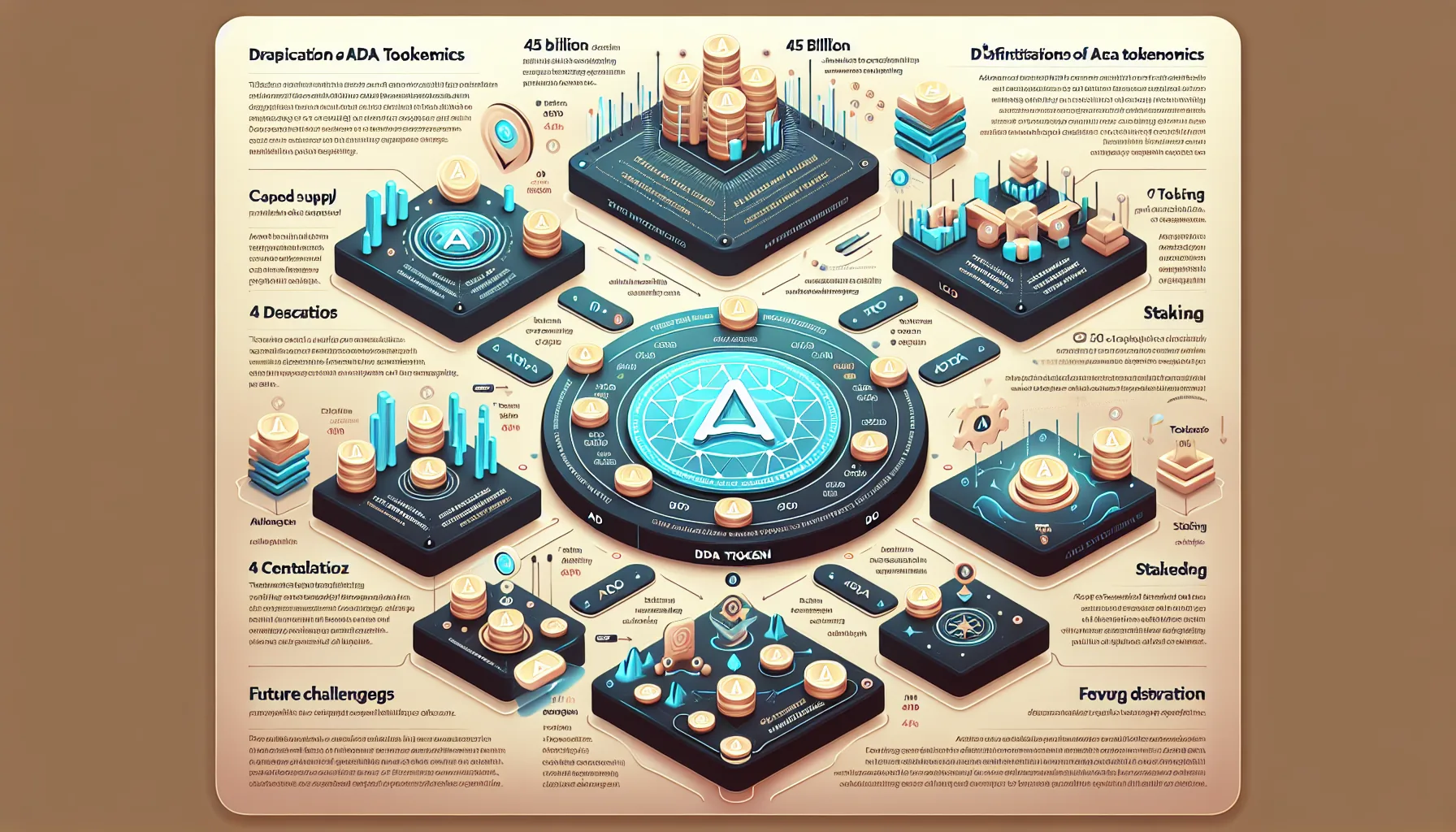
Cardano’s native cryptocurrency, ADA, operates within a meticulously designed tokenomics model that balances fixed supply constraints with an incentivized distribution mechanism. With a maximum supply cap of 45 billion ADA, the finite nature of the token establishes scarcity intended to drive value over time. Of this maximum supply, approximately 31 billion ADA tokens are currently in circulation, leaving a significant portion reserved for system incentives and strategic allocations.
Initial Distribution
ADA’s initial token distribution was a point of contention for some observers. During its Initial Coin Offering (ICO) conducted between 2015 and 2017, approximately 25.9 billion tokens were minted. Notably, 57.6% of these tokens were allocated to ICO participants, while 11.5% were reserved for the three foundational entities driving Cardano’s development—Input Output Global (IOG), the Cardano Foundation, and Emurgo. Critics have raised concerns about the centralization risk posed by the significant holdings retained by these entities, though proponents argue that these allocations are necessary to fund ongoing network development and expansion efforts.
Staking and Incentive Mechanism
ADA’s staking framework is a critical aspect of its tokenomics model, designed to secure the network via a Proof of Stake (PoS) consensus mechanism. ADA holders can delegate their tokens to staking pools or operate their own pools to earn rewards, which are funded from a mix of reserved ADA supply and transaction fees. This dual-source incentive model provides rewards not only to validators but also to delegators, creating a financially inclusive and decentralized staking ecosystem. However, critics have noted that larger pools may attract a disproportionate share of delegations, raising concerns about potential centralization within the staking ecosystem.
Transaction Costs and Deflationary Pressure
Transaction fees on the Cardano network are another central element of ADA's economic model. A portion of these fees is burned, introducing deflationary pressure. While this mechanism theoretically benefits long-term holders, the relatively modest fee structure compared to other blockchains has led some to question whether the burning rate is sufficient to have a meaningful impact on token scarcity.
Future Distribution Challenges
One potential challenge for ADA's tokenomics is the eventual depletion of the reserve fund, which is currently the primary source of staking rewards. As the reserve diminishes over the coming decades, staking rewards will increasingly rely on transaction fees. Whether transaction volumes—and thus fees—will scale to adequately replace the reserve remains an open question, posing uncertainty for long-term participant incentives.
Tokenomics plays a foundational role in ADA’s ecosystem, balancing ambitious goals of decentralization and inclusivity with the technical and economic realities of maintaining a sustainable network.
ADA Governance
Governance in ADA: Decentralized Oversight and Ongoing Challenges
Cardano’s governance model, particularly as it pertains to ADA, centers on decentralization and community-driven decision-making. At the core of this approach is the use of its on-chain governance framework, which empowers ADA holders to actively participate in shaping the future of the network. Unlike many other blockchain projects, Cardano has opted for a structured governance system. While innovative, it also comes with inherent complexities and unresolved issues that demand careful consideration.
A foundational component of ADA's governance is the Catalyst Project, Cardano's funding mechanism for community proposals and development initiatives. ADA holders can stake their tokens to vote on various proposals, allocating resources from a treasury funded by transaction fees. This creates a highly participatory system that ensures the ecosystem evolves according to its community's needs. However, the effectiveness of Catalyst has been questioned due to voter apathy; despite its accessibility, a significant portion of ADA holders have historically abstained from participating, leaving critical decisions to a smaller, motivated subset of stakeholders. This introduces risks of centralization, as power can concentrate in the hands of those who consistently engage.
Another element in Cardano’s governance strategy is its reliance on a multi-phase roadmap to transition to a fully decentralized model. While phases like Voltaire aim to provide a sustainable governance structure, critics point out that the roadmap's pace and complexity may hinder timely adoption of impactful changes. Moreover, the ideal of decentralization sometimes conflicts with real-world execution, such as when socially influential groups or entities wield disproportionate sway in governance-related decisions.
A key advantage of ADA’s governance system is its inherent adaptability. Decisions and updates can be codified and enforced via Cardano Improvement Proposals (CIPs), ensuring the network evolves without contentious forks. But this comes at the cost of requiring continuous community education and engagement, which can be hard to scale as the network grows. Additionally, concerns linger about whether the mechanisms sufficiently incentivize diverse and long-term participation, especially as newer users join the ecosystem.
In summary, the governance of ADA highlights both the promise and challenges of decentralized decision-making. While it prioritizes community involvement and safeguards against unnecessary fragmentation, it is not without its flaws, including voter disengagement and potential imbalances in influence among stakeholders. These dynamics make ADA’s governance a fascinating space for crypto-savvy individuals to monitor and potentially engage with.
Technical future of ADA
Technical Developments and Roadmap for ADA: Innovations and Challenges
Cardano (ADA), a third-generation blockchain platform, continues to evolve through ongoing technical developments, driven by its methodical, research-driven approach. The platform, built on the Ouroboros proof-of-stake consensus mechanism, emphasizes scalability, interoperability, and sustainability. However, its roadmap reveals both advances and persistent obstacles as it moves forward.
Recent and Upcoming Protocol Enhancements
One pivotal technical development for Cardano is the continual improvement of its Plutus smart contract platform, which was introduced during the Alonzo upgrade. Enhancements to Plutus aim to expand functionality for decentralized applications (dApps), increase script processing efficiency, and lower transaction fees. Developers have raised concerns about the platform's constrained execution units, which have occasionally led to slower adoption by dApp builders. Current efforts focus on optimizing resource allocation and refining memory usage to address these limitations.
Additionally, Hydra, a Layer 2 scaling solution, is a key focus for Cardano's roadmap. Hydra channels aim to enable the network to handle millions of transactions per second by offloading computations from the main chain. While promising, the significant complexity of Hydra's implementation has slowed down its deployment. Developers are tackling issues such as channel state finality and network synchronization to ensure robust functionality at scale.
Interoperability and Sidechains
The launch and expansion of sidechain protocols remain critical for Cardano's technical strategy. The EVM-compatible sidechain and the recent emphasis on cross-chain bridges underscore the platform's move toward fostering multi-chain interoperability. Despite these initiatives, achieving seamless interoperability has proven to be a challenge, particularly in terms of maintaining security during cross-chain transactions. Issues such as potential vulnerabilities in bridge mechanisms and the lack of widespread adoption pose ongoing risks.
Governance Upgrades
The Cardano team also has significant plans surrounding Voltaire, the governance phase of its development cycle. The introduction of a decentralized treasury and on-chain voting mechanisms aims to transition the network into a leaderless, self-governing ecosystem. However, governance presents its own set of challenges. Critics argue that low voter turnout and a steep learning curve for participants may hinder the success of governance proposals. Addressing these participation barriers is an ongoing area of focus.
Addressing Persisting Scalability Challenges
While Cardano emphasizes scalability in its design, network congestion has occasionally surfaced during high-demand periods due to limited throughput and reliance on layered solutions. As the ecosystem grows, ensuring consistent performance while maintaining decentralization remains a top technical priority. Upcoming roadmap iterations are expected to further address these bottlenecks and focus extensively on enhancing network efficiency.
Comparing ADA to it’s rivals
ADA vs. ETH: A Detailed Comparison of Blockchain Architecture and Use Cases
When comparing ADA and ETH, the differences in their underlying architectures and technological frameworks stand out. Cardano (ADA) and Ethereum (ETH) both aim to provide blockchain ecosystems for decentralized applications (dApps) and smart contracts. However, their approaches to scalability, governance, and development lifecycle reveal notable distinctions.
Consensus Mechanism and Scalability
ADA and ETH differ fundamentally in their consensus mechanisms. Cardano relies on Ouroboros, a proof-of-stake (PoS) protocol that prioritizes energy efficiency and theoretical security. Ouroboros is designed to provide scalability without significantly compromising decentralization. By dividing time into epochs and slots, it achieves a modular approach to block validation.
ETH, after transitioning from proof-of-work (PoW) to proof-of-stake via Ethereum 2.0, now uses the Casper protocol. While ETH has successfully moved to PoS, its legacy architecture creates challenges in maintaining efficiency under heavy network loads. Cardano's PoS protocol was, from its inception, built around formal methods, which aim to reduce systemic errors through rigorous academic validation.
Despite this, Ethereum's Layer 2 solutions, such as rollups, have brought scalability enhancements that address its historical issues with congestion. ADA, by comparison, has faced criticism for slow implementation timelines related to its scaling solutions, such as Hydra—a protocol still requiring broader adoption and deployment.
Smart Contracts and Development Environment
One of Ethereum's strongest advantages lies in its smart contract ecosystem, dominated by Solidity, a programming language with widespread developer adoption. Ethereum Virtual Machine (EVM) compatibility has become the standard for interoperability, allowing developers to migrate dApps easily across EVM-enabled blockchains.
This contrasts sharply with Cardano's use of Plutus, a programming language based on Haskell. Plutus emphasizes safety and precision, catering to mathematically inclined developers. However, this niche focus has contributed to lower developer uptake compared to Ethereum, where the barrier to entry is lower due to Solidity's simplicity and access to extensive documentation.
Governance and Upgrades
ADA's governance framework follows a community-driven model through Project Catalyst, which gives ADA holders direct input into funding new projects and proposing technical changes. ETH, in contrast, relies on a mix of centralized decision-making by the Ethereum Foundation and input from its developer community. This relative centralization has sometimes allowed ETH to implement upgrades more efficiently—but it has also raised questions about decentralization.
Conclusion for Comparison
Key trade-offs between ADA and ETH stem largely from Ethereum’s dominance as a first-mover versus Cardano's rigorous, academic development ethos. Both exhibit distinct strengths and weaknesses depending on the specific requirements of use cases.
ADA vs DOT: A Detailed Comparison of Technical Frameworks and Ecosystem Strengths
When comparing ADA (Cardano) to DOT (Polkadot), the discussion centers on two distinct approaches to blockchain scalability, interoperability, and governance. While both projects aim to resolve the challenges of fragmented blockchain ecosystems, their methodologies and underlying architectures showcase noticeable differences.
Consensus Mechanisms: Ouroboros vs Nominated Proof-of-Stake (NPoS)
ADA operates on Ouroboros, a proof-of-stake (PoS) protocol designed for energy efficiency and formal verification. Polkadot, on the other hand, employs Nominated Proof-of-Stake (NPoS), which optimizes network security by allowing token holders (nominators) to back validators they trust. One strength of Polkadot’s NPoS approach lies in its multi-level consensus system, enabling faster block speeds and a more flexible governance model. However, ADA's Ouroboros provides a rigorously peer-reviewed foundation, which some argue heightens security and reliability at the cost of slower adaptability to real-world deployment needs.
Interoperability: Parachains vs. Hydra Scaling
Polkadot is widely known for its parachain architecture, enabling different blockchains to operate in parallel and share information securely through the Relay Chain. This modularity allows developers to craft purpose-specific blockchains while benefiting from Polkadot’s shared security. ADA, in contrast, takes a different stance on scalability through Hydra, a layer-2 solution built on its proof-of-stake foundation. While Hydra promises to handle an enormous volume of transactions per second, critics highlight that it lacks the same level of native, cross-chain interoperability Polkadot's parachains afford. This contrast shows Polkadot excelling in multi-chain operability, while ADA continues to refine its focus on direct throughput enhancements.
Governance Models: On-Chain vs. Off-Chain Dynamics
In terms of governance, both platforms lean heavily on decentralization, but Polkadot’s on-chain governance system is relatively faster in real-world amendments. Cardano employs a more cautious governance framework, relying on its Catalyst voting system and prioritizing extended community engagement in protocol updates. While Cardano's approach may lead to more deliberate decision-making, Polkadot's governance is often seen as more dynamic but prone to faster (potentially riskier) shifts.
Development Ecosystems: Haskell vs. Substrate
ADA emphasizes a functional programming paradigm through Haskell, focusing on code correctness and reducing vulnerabilities. In comparison, Polkadot thrives on its Substrate framework, which allows developers to create customized blockchains more rapidly. Substrate’s flexibility is a strong draw for developers, whereas ADA's stricter development model has been criticized for its slower pace of innovation and smart contract deployment.
ADA and DOT, while sharing similar high-level objectives, diverge considerably in execution, leading to significant trade-offs for developers, businesses, and users engaging with their ecosystems.
ADA vs SOL: A Detailed Comparison of Blockchain Capabilities
When examining ADA (Cardano) and SOL (Solana), the differences in design philosophy, scalability mechanisms, and network decentralization highlight two distinct approaches to blockchain technology. These distinctions are pivotal for understanding each asset's technical architecture and practical applications.
Consensus Mechanisms and Decentralization
Cardano's Ouroboros protocol is a scientifically-backed proof-of-stake (PoS) mechanism prioritizing peer-reviewed research and energy efficiency. Conversely, Solana employs a unique proof-of-history (PoH) mechanism combined with proof-of-stake. While PoH enables Solana to process high volumes of transactions quickly, it introduces concerns about centralization.
In Solana’s setup, the network relies heavily on Validator nodes, which require substantial hardware resources to participate. This creates a barrier to entry for smaller validators, potentially concentrating control among a limited number of participants. Cardano, with lower hardware requirements for its stake pools, focuses on broader participation and decentralization, though this emphasis sometimes comes at the expense of transaction speed.
Scalability and Speed
One of Solana’s defining features is its ability to achieve remarkable throughput—tens of thousands of transactions per second (TPS). Its architecture favors ultra-fast transaction processing and an emphasis on real-time data synchronization. However, this high-performance capability has caused network outages during periods of excessive load, as seen in several instances of failed consensus in Solana's young history.
Cardano, on the other hand, emphasizes a methodical roll-out of scalability through its Hydra layer-2 solutions that aim to improve transaction throughput without compromising stability. Though Cardano's current transactions per second may lag behind Solana, the emphasis on gradual, secure scaling avoids some trade-offs that come with Solana’s high TPS model.
Smart Contract Implementation
Solana’s smart contract platform leverages Rust-based programming, which attracts developers seeking performance optimization. However, the learning curve for Rust is steeper compared to Cardano’s Plutus framework, which is based on Haskell. Cardano’s approach appeals to developers prioritizing formal verification and functional programming principles.
Critically, Solana’s monolithic architecture—where consensus, execution, and data availability occur on a single layer—introduces the risk of bottlenecks during periods of high demand. Cardano’s more modular approach aims to separate these processes, which may lead to greater long-term resilience.
Network Reliability and Resilience
While Solana’s speed is undeniable, its network stability has been called into question, with downtime events disrupting usability. Cardano, by contrast, has maintained an uptime of nearly 100%, showcasing the reliability of its deliberate development roadmap.
These contrasting strengths and weaknesses highlight the trade-offs between performance and decentralization in competing blockchain ecosystems, and the varying philosophical approaches behind their growth strategies.
Primary criticisms of ADA
Primary Criticism of ADA: Challenges Facing Cardano’s Blockchain Ecosystem
Cardano (ADA) is often lauded for its methodical approach to blockchain development and its commitment to peer-reviewed research. However, despite its ambitious roadmap, the project has not been immune to criticism. Several pain points highlight fundamental concerns within the crypto community, especially among those with a deep understanding of blockchain technology and real-world adoption challenges.
Slow Development Pace
One of the most frequently voiced criticisms of ADA is its slow development timeline. Cardano’s reliance on a peer-reviewed research model means that updates and features undergo rigorous academic scrutiny before being implemented. While this ensures a high standard of quality, it has also delayed critical advancements. For example, Cardano took years to roll out smart contract functionality, setting it behind competitors like Ethereum and Solana, which were already entrenched in the decentralized finance (DeFi) and NFT spaces. This methodical approach has led many crypto veterans to question whether Cardano's pace is sustainable in an industry driven by rapid innovation.
Smart Contract Limitations
Introduced with the Alonzo upgrade, Cardano’s smart contract functionality was meant to rival that of Ethereum. However, its adoption has faced hurdles due to Plutus, Cardano’s proprietary programming framework. Developers have criticized Plutus for being overly complex compared to widely adopted languages like Solidity. This complexity, compounded by documentation gaps and a relatively small developer community, has led to slower dApp development on Cardano. The result has been a noticeable lack of highly-used applications in its ecosystem, underscoring concerns about whether the blockchain can attract and sustain innovative projects.
Scalability and Network Throughput
Despite Cardano’s emphasis on scalability, there have been persistent questions about its real-world performance as usage scales. The Ouroboros proof-of-stake (PoS) consensus mechanism, while energy-efficient, has yet to demonstrate its capacity to handle widespread adoption effectively. Critics point to the network’s relatively low current activity levels and question whether its solutions, like Hydra, will fully address potential bottlenecks once demand surges.
Centralization and Governance Concerns
Cardano markets itself as a decentralized ecosystem, but skeptics argue that the Cardano Foundation, IOHK (Input Output Hong Kong), and Emurgo wield significant influence over development decisions. Additionally, while the community-driven Project Catalyst is an intriguing governance initiative, some view it as insufficiently representative of the broader ADA holder base. This perception of centralization clashes with the principles of blockchain decentralization, raising eyebrows in the crypto community.
Lack of Real-World Adoption
Another prominent criticism of ADA is the limited evidence of impactful real-world use cases. While Cardano frequently announces partnerships, especially in developing nations, these initiatives often lack tangible follow-through or meaningful metrics to assess their success. Without clear and actionable adoption milestones, skepticism surrounding Cardano's real-world impact continues to grow.
Founders
The Founding Team Behind ADA: Key Players and Controversies
Understanding the origins of a cryptocurrency often requires a deep dive into the people behind it. ADA, the native token of the Cardano blockchain, is no exception. The founding team is a focal point of discussion within the cryptocurrency ecosystem, both as a source of credibility and as a point of contention.
Charles Hoskinson: Visionary or Polarizing Figure?
At the nucleus of ADA’s creation is Charles Hoskinson, one of the co-founders of Ethereum and later the driving force behind Cardano. His background in mathematics and his hands-on experience from Ethereum gave him unique insight into blockchain technology. Hoskinson’s vision for Cardano was clear: to create a third-generation blockchain that balances scalability, interoperability, and sustainability. However, his persona has been divisive within the crypto community.
Critics argue that Hoskinson’s managerial style leans toward centralization—ironic for a blockchain that touts decentralization as its core ethos. Moreover, his brash and sometimes controversial statements on social media platforms have sparked debates about professionalism and communication within the space. While these issues haven’t derailed Cardano’s development, they have influenced public perception.
Input Output Global (IOG): A Leading Force
Input Output Global (formerly IOHK), the blockchain research and development firm founded by Hoskinson and Jeremy Wood, has been the cornerstone of ADA’s technical development. The team at IOG focuses on academic rigor, partnering with universities and prioritizing peer-reviewed research to inform Cardano’s technology stack.
While these efforts have earned praise for their thoroughness, critics claim the process is overly bureaucratic, often resulting in delayed deployment of critical features. Milestones within Cardano’s development cycle, like the Shelley and Goguen upgrades, faced delays that frustrated the community, even as IOG emphasized the need for precision over speed.
Issues of Decentralization in Founding Structure
A notable concern about ADA’s founding team is the fragmented organization of entities involved in the project. Cardano’s ecosystem consists of three main groups: IOG, the Cardano Foundation, and Emurgo. While this tripartite structure was designed to decentralize governance, critics argue it has, at times, led to misaligned priorities and communication breakdowns.
For instance, early tensions between the Cardano Foundation and IOG created public uncertainty about the project’s direction. Although those issues have largely subsided, they raised questions about whether fragmented leadership can effectively steer a project of this magnitude.
Thus, while the ADA founding team boasts credentials and ambition, it is not without its share of scrutiny and challenges.
Authors comments
This document was made by www.BestDapps.com
Sources
https://cardano.org/
https://github.com/input-output-hk/cardano-sl
https://hydra.family/~input-output-hk/cardano-ledger-specs/
https://docs.cardano.org/
https://github.com/cardano-foundation
https://medium.com/@InputOutputHK
https://explorer.cardano.org/
https://cardano-ledger.readthedocs.io/
https://whitepaper.io/document/582/cardano-whitepaper
https://iohk.io/en/research/library/
https://emurgo.io/en
https://www.cardanoassets.com/
https://github.com/input-output-hk/plutus
https://github.com/input-output-hk/hydra
https://cardanoupdates.com/
https://roadmap.cardano.org/en/
https://cips.cardano.org/
https://forum.cardano.org/
https://staking.cardano.org/
https://testnets.cardano.org/


