History of ADA
A Deep Dive into the History of Cardano (ADA)
Cardano (ADA), the brainchild of Ethereum co-founder Charles Hoskinson, made its debut in the cryptocurrency space in 2017. Developed by IOHK (Input Output Hong Kong), Cardano set itself apart early with its methodical, research-driven approach. Unlike many blockchain projects which launched with minimal foundation, Cardano emphasized peer-reviewed research and academic rigor as the backbone of its development process, touting itself as a "third-generation blockchain."
The project began with the release of the Byron phase, named after the poet Lord Byron. During this phase, Cardano launched its native token, ADA, and introduced the Daedalus wallet, aimed at providing users with a secure, full-node solution. However, early critics noted that Byron lacked many of the functionalities required for decentralization. Most notably, blockchain participants were unable to stake ADA or host their own nodes, as the blockchain followed a federated model controlled largely by IOHK, Emurgo, and the Cardano Foundation.
In 2020, Cardano transitioned to its second major phase of development, Shelley. This phase marked a significant step toward decentralization, with the introduction of staking and delegation capabilities. Staking ADA became a cornerstone of Cardano's design, leveraging its proprietary Ouroboros proof-of-stake (PoS) protocol. While the staking mechanism was celebrated for its energy efficiency compared to proof-of-work systems, its rollout was not without criticism. Some argued that the initial distribution of stake pools remained heavily centralized, given a number of pools were clustered under a few operators.
The execution delays between Byron and Shelley also cast doubt on Cardano’s ability to meet developer timelines. Many in the crypto community saw the project as overly academic, with a perception that focus on theoretical frameworks hindered practical implementation. These delays, combined with Cardano's slower pace compared to other blockchain ecosystems, became a recurring critique within discussions about the asset’s history.
Despite this, Cardano’s phased, multi-era roadmap—comprising Byron, Shelley, Goguen, Basho, and Voltaire—remains central to its narrative. Subsequent phases address smart contract deployment, scalability, and governance, though each is subject to both anticipation and scrutiny. Historical developments such as Cardano’s Hesitance in joining the DeFi boom or its delayed entry into smart contracts highlight its cautious execution.
How ADA Works
How Cardano's ADA Works: A Deep Dive into Its Mechanisms
Cardano's native cryptocurrency, ADA, operates within a layered blockchain architecture designed to optimize scalability, security, and functionality. At its core, ADA's functionality is tightly integrated with Cardano’s proof-of-stake (PoS) consensus mechanism, Ouroboros, which differentiates it from traditional proof-of-work (PoW) models by reducing energy consumption and enhancing network efficiency. However, while the system offers innovative solutions, it is not without complexity and challenges.
Delegation and Staking in ADA
ADA plays a pivotal role in Cardano's staking ecosystem. Token holders are incentivized to participate in network validation through delegation or by running their own stake pool. Ouroboros randomly selects slot leaders from a pool of staked participants for block validation, ensuring security through randomness while maintaining a decentralized network structure. The system's effectiveness hinges on active participation, but smaller stakeholders often face disadvantages, as large pools can dominate rewards. This has led to concerns over potential centralization.
Smart Contracts and Layered Design
ADA powers transactions and acts as the fuel for executing smart contracts on Cardano. Unlike traditional monolithic blockchain platforms, Cardano employs a layered design. The Cardano Settlement Layer (CSL) handles ADA transfers, while the Cardano Computation Layer (CCL) is dedicated to executing scripts and smart contracts. This separation allows for modular updates and increased scalability. However, the two-layer structure raises concerns about complexities in compatibility and cross-layer communication, particularly as the ecosystem grows.
Native Tokens and Interoperability
ADA also enables the minting and management of native tokens on the network, a process that does not rely on additional smart contracts, as seen in Ethereum-based ERC-20 tokens. This design reduces fees and network congestion risks. Yet, the ecosystem's ability to attract widespread adoption for its native tokens remains uncertain, especially in comparison to more established competitors.
Incentive Structures and Governance Issues
ADA contributes to Cardano’s governance framework by allowing holders to vote on proposed changes and improvements to the protocol. While this promotes decentralization, participation in governance processes has been criticized for being skewed towards larger stakeholders, reducing inclusivity. This dynamic can potentially disincentivize smaller holders from engaging actively, raising questions about whether the system achieves true decentralization in decision-making.
ADA’s mechanisms showcase technical innovation but are accompanied by operational complexities and governance challenges that require ongoing refinement for sustainable growth.
Use Cases
Use Cases of ADA: Applications and Real-World Utility
1. Staking and Network Validation
ADA serves as the native cryptocurrency of the Cardano blockchain and plays a critical role in its Proof of Stake (PoS) consensus mechanism, known as Ouroboros. ADA holders can delegate their tokens to staking pools or operate their own pools to validate transactions and secure the network. Unlike Proof of Work systems, ADA staking is energy-efficient, offering participants an opportunity to earn rewards without the hardware-intensive requirements of mining. However, some critics argue that centralization risks exist, as large staking pools can dominate the network, potentially undermining decentralization.
2. Smart Contracts and dApp Development
With the introduction of Cardano’s smart contract functionality via the Alonzo hard fork, ADA became instrumental for developers building decentralized applications (dApps). From DeFi protocols to NFT projects, ADA is used as the primary transaction currency to interact with smart contracts. That said, Cardano’s platform has faced scrutiny for its slower adoption compared to competing networks like Ethereum and Solana. Developers occasionally report challenges with Plutus, Cardano’s proprietary smart contract programming language, which is viewed as less accessible than more established tools such as Solidity.
3. Governance Participation
ADA holders play a significant role in Cardano’s on-chain governance model. Through voting mechanisms, participants use their tokens to influence the direction of the network, including protocol upgrades and treasury allocations. This democratic approach empowers the community but can lead to slower decision-making processes when compared to centralized alternatives. Additionally, critics question whether adequate incentives exist for all token holders to actively participate in governance, potentially leaving decisions to a smaller subset of the community.
4. Cross-Border Transactions and Payments
ADA is frequently utilized for peer-to-peer transactions and cross-border payments. Its relatively low fees and quick settlement times make it appealing for transferring value compared to some legacy cryptocurrencies. However, real-world adoption for retail payments remains limited, partly due to the limited number of merchants accepting ADA directly, as well as broader regulatory and adoption hurdles facing cryptocurrencies as a whole.
5. Tokenization and Asset Management
The Cardano blockchain supports custom token creation via native tokens, leveraging ADA for operational fees. Projects have utilized this capability for launching fungible and non-fungible tokens without requiring smart contracts, thus reducing complexity and transaction costs. Despite this innovation, Cardano’s ecosystem of tokenized assets lags behind competitors, with relatively few high-profile projects driving adoption. Critics suggest that interoperability limitations with other blockchains may be slowing growth in this space.
ADA Tokenomics
ADA Tokenomics: An In-Depth Examination
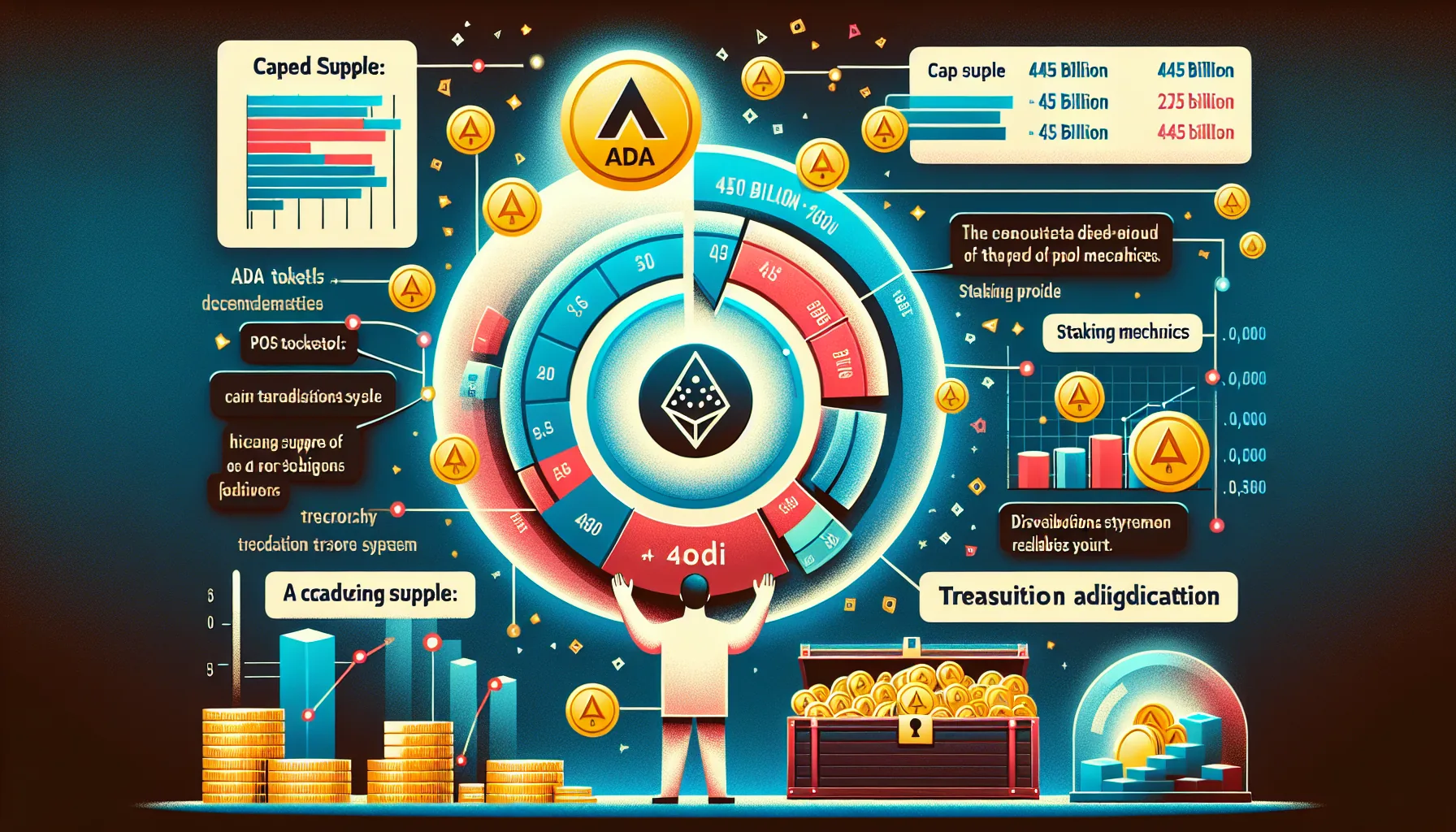
The tokenomics of ADA, the native cryptocurrency of the Cardano blockchain, is defined by a combination of capped supply, staking mechanics, and distribution strategies. With a maximum supply of 45 billion ADA, its design follows a deflationary model aiming to balance scarcity with accessibility. However, understanding the nuances of ADA’s tokenomics reveals both its strengths and potential criticisms.
Fixed Supply and Distribution Allocation
Out of the 45 billion ADA that will ever exist, approximately 31 billion are already in circulation. A significant portion of the initial ADA supply was distributed via an initial coin offering (ICO) in 2015-2017, targeting primarily Japanese investors. This concentrated geographical participation has raised concerns among the crypto community about unequal initial distribution and its potential implications for decentralization.
The remaining ADA tokens were allocated to the team, the Cardano Foundation, and other entities to fund the ecosystem's ongoing development and operations. Critics have pointed to this allocation structure as a centralization risk, as early stakeholders hold significant influence over the network.
Staking and Delegation Dynamics
Cardano’s proof-of-stake (PoS) mechanism influences ADA’s utility and distribution through staking. ADA holders can delegate their tokens to stake pools to secure the network and earn rewards. Notably, rewards are designed to diminish over time, encouraging early adoption but potentially disincentivizing long-term participation as block rewards decrease.
The staking model uses a saturation point formula to avoid over-concentration in large pools. However, in practice, some critics argue that the system has not fully prevented power from consolidating within a small number of large, well-run pools. Additionally, the fixed cost parameter for running a pool has sparked debates regarding fairness, as it may disadvantage smaller operators and contribute to centralization tendencies.
Reserve System and Treasury Allocation
To ensure sustainable network growth, Cardano incorporates a treasury system funded by transaction fees and a portion of staking rewards. These funds are allocated to support projects and proposals within the ecosystem. While this is an innovative approach to decentralized development funding, concerns arise regarding the governance mechanisms determining fund allocation. Critics argue that the decision-making process might reflect disproportionate influence from large stakeholders, undermining true decentralized governance.
Inflation vs. Deflation Dynamics
ADA’s deflationary model is designed to encourage scarcity over time. However, some have raised questions about whether this structure could limit its utility as a medium of exchange in favor of incentivizing speculation. As block rewards decline and transaction fees become a primary incentive for validators, the network's ability to maintain decentralization and security without high fees remains an ongoing area of analysis.
By examining ADA’s tokenomics, it becomes evident that while its system boasts innovation, it also faces challenges in maintaining decentralization, fairness, and long-term sustainability.
ADA Governance
Understanding ADA Governance: Decentralization and On-Chain Decision Making
Cardano's governance system, a critical component for the sustainability of its native cryptocurrency ADA, prioritizes decentralization and community-led decision-making through an evolving framework. Governed by a combination of on-chain processes and stakeholder voting, ADA relies heavily on its proof-of-stake (PoS) protocol, Ouroboros, to ensure inclusivity and accountability. However, the governance structure, while ambitious, faces known challenges that continue to shape its development.
Voltaire Era and Treasury System
ADA’s governance framework is structured to enable self-sufficiency through what is referred to as the Voltaire phase of Cardano development. This phase introduces a treasury system designed to fund ecosystem projects via transaction fees and inflationary rewards. Stakeholders vote on how treasury funds are allocated using their ADA holdings as a measure of voting power. Such treasury mechanisms aim to reduce dependency on external funding, empowering the community to sustain development through internal mechanisms. However, one issue lies in the potential for centralization in governance power. Large ADA holders wield disproportionate influence, raising questions about governance equity and fairness.
Catalyst as a Governance Innovation
One of ADA's standout governance initiatives is Project Catalyst, an experimental vehicle for decentralized innovation. Catalyst enables ADA holders to propose, debate, and vote on development projects for Cardano’s ecosystem. While this provides a platform for grassroots involvement, criticisms include low stakeholder participation rates, which dilute the democratic ideals of the system. Additionally, the complexity of proposal evaluation and the technical knowledge required to participate can alienate less-experienced users, leaving critical decisions to an already-informed minority.
Smart Contract Governance Limitations
ADA governance must also contend with the growing use of smart contracts within its ecosystem. While smart contracts introduce powerful programmable transactions, their governance ties are indirect. Unlike platforms specifically designed for DAO (Decentralized Autonomous Organization) frameworks, ADA’s governance network operates somewhat externally to smart contract activity. This can present issues when on-chain ecosystems grow more complex, as disputes or upgrades may not always align seamlessly with overarching governance decisions.
Scalability Concerns with Expansion
As ADA scales, concerns about its governance structure's long-term sustainability remain valid. Ensuring that governance mechanisms can handle the influx of new users without sacrificing decentralization continues to challenge developers. Voting latency, accessibility, and the risk of voter apathy could diminish the effectiveness of governance in a larger network.
ADA's governance model is unique but not without its trade-offs.
Technical future of ADA
Current and Future Technical Developments in Cardano (ADA)
Cardano (ADA) stands out in the blockchain ecosystem due to its structured, peer-reviewed approach to technical innovation. This focus has produced some notable advancements, but the platform also faces critical challenges that influence its path forward. Below is an analysis of Cardano’s current technical state and its future development roadmap.
The Evolving Plutus Smart Contract Platform
One of Cardano's most significant technical strides is the Plutus smart contract platform, which uses the functional programming language Haskell. Plutus offers a high degree of code auditability and security, making it appealing for developers requiring robustness in their decentralized applications (dApps). However, the platform has faced issues around complexity. Developers have noted that the learning curve for Plutus is steep compared to other smart contract ecosystems like Ethereum’s Solidity. As part of its technical roadmap, Cardano plans to lower entry barriers by introducing more accessible tools and expanding its developer documentation. Whether this will attract broader adoption remains to be seen, especially as competitors continue to mature their own ecosystems.
Scaling with Hydra Protocols
A core focus for Cardano is scalability, particularly through the Hydra Layer 2 protocol. Hydra utilizes isomorphic state channel technology, enabling transactions to occur off-chain without compromising Cardano’s security guarantees. With each Hydra "head" capable of processing parallel transactions, the protocol theoretically scales linearly as the network grows. While promising, Hydra is still in a development phase, and its real-world application has yet to undergo vigorous testing under high-throughput conditions. The success of Hydra will be pivotal for Cardano’s ability to support large-scale enterprise use cases and decentralized finance (DeFi) platforms.
Continued Development of Ouroboros
Cardano’s Ouroboros consensus mechanism, a proof-of-stake (PoS) algorithm, underwent ongoing iterations to enhance efficiency and security. Future enhancements in Ouroboros aim to address latency and reduce the time to finality for transactions. However, while Ouroboros continues to lead as one of the most theoretically advanced PoS frameworks, critics argue that its practical implementation occasionally lags behind its theoretical ambition, highlighting a need for constant refinement in production environments.
Interoperability and Sidechains
Interoperability has become increasingly central to Cardano’s roadmap. A planned introduction of sidechains will allow ADA to connect more seamlessly with other blockchain networks. This could foster broader adoption but raises concerns about additional security risks and complexities associated with maintaining cross-chain functionalities.
Cardano continues to evolve, driving innovation while addressing obstacles that could hinder its broader adoption and technical efficiency. Its success in meeting these challenges will define its role in the blockchain ecosystem moving forward.
Comparing ADA to it’s rivals
ADA vs. ETH: A Detailed Comparison of Blockchain Architecture and Functionality
When comparing ADA (Cardano) and ETH (Ethereum), the most notable distinction lies in their respective approaches to blockchain development and scalability. While both projects utilize proof-of-stake (PoS) consensus mechanisms, their implementations and architectures diverge significantly, leading to unique strengths and challenges for each network.
Consensus Mechanism and Development Philosophy
Ethereum has undergone a transformative shift from proof-of-work (PoW) to PoS with Ethereum 2.0, marking a critical evolution in its journey. The transition underlines Ethereum’s adaptability, but it also came with complexities surrounding the merge process and a historically energy-intensive legacy. ADA, on the other hand, implemented PoS from its inception through the Ouroboros protocol, a rigorously peer-reviewed and mathematically formalized system. This meticulous academic approach is often praised for security and transparency; however, critics argue that the heavy focus on research has slowed the pace of real-world adoption and upgrades compared to Ethereum's iterative "move fast and fix later" strategy.
Smart Contracts: Plutus vs. Solidity
ADA’s smart contract framework, Plutus, and Ethereum’s Solidity present another key point of comparison. Plutus is based on Haskell, a functional programming language known for math-centric precision and robustness. While this adds rigor to Cardano’s ecosystem, it has also limited developer participation due to Haskell’s steeper learning curve and smaller community. Ethereum’s Solidity is more widely known and widely adopted, resulting in a vast ecosystem of tools, libraries, and decentralized applications (dApps). As of now, Ethereum significantly outpaces Cardano in active developers and deployed dApps, adding to its network effect.
Scalability and Layering
Cardano primarily focuses on scalability through its layered architecture, where the computation layer (for smart contracts) is segregated from the settlement layer (for transactions). Theoretically, this design choice minimizes bottlenecks and enhances efficiency. Ethereum, while not inherently layered, relies on roll-ups and sidechains to offload processing-intensive operations from the mainnet. However, Ethereum still struggles with congestion during peak usage, leading to high gas fees—a criticism ADA has largely sidestepped thanks to its scalability-first design.
Decentralization and Governance
ADA incorporates on-chain governance through its Voltaire era plans, allowing ADA holders to vote on protocol decisions via treasury mechanisms. Ethereum's governance, in contrast, operates off-chain through forums and proposals driven by its core developers and miners turned validators. While Cardano’s model is presented as more decentralized and community-driven, it is still relatively untested in high-stakes scenarios compared to Ethereum's established but arguably less democratic approach.
Final Thoughts on Adoption Barriers
Though ADA boasts an architecturally elegant system, Ethereum’s first-mover advantage and sheer dominance in DeFi, NFT marketplaces, and gaming dApps cannot be ignored. Cardano’s deliberate pace of development and less extensive adoption remain challenges as it competes with Ethereum in a rapidly evolving market. Developers and users often weigh Ethereum’s proven ecosystem against Cardano’s promise of stability and scalability, leading to varied preferences depending on individual priorities.
Comparing ADA to SOL: A Technical Perspective on Competing Layer-1 Blockchains
Cardano (ADA) and Solana (SOL) are often compared in the context of decentralized application platforms, as both operate as layer-1 blockchains with the goal of enabling scalable, secure, and energy-efficient environments for smart contracts and decentralized finance (DeFi). However, their design philosophies, consensus mechanisms, and technical structures present key differences that industry participants should consider.
Consensus Mechanism and Network Performance
Cardano relies on a Proof-of-Stake (PoS) protocol called Ouroboros, which emphasizes provable security grounded in formal academic research. This approach has helped Cardano position itself as a blockchain that prioritizes methodical development and long-term scalability. Solana, on the other hand, employs a hybrid system integrating Proof of History (PoH) with Proof of Stake (PoS). PoH adds a verifiable passage of time between transactions, which allows Solana to achieve impressive throughput — reportedly up to 65,000 transactions per second (TPS) without relying on traditional sharding techniques.
While Solana’s emphasis on speed has garnered attention, critics point out that its high throughput trades off decentralization. A Solana validator requires significant hardware specifications, rendering the entry barrier relatively high and concentrating validation power in fewer nodes. This contrasts with Cardano’s lower technical requirements for staking pools, which supports a larger participant base in its network security.
Developer Ecosystems and Smart Contract Design
Solana’s development is optimized for high-performance decentralized applications, but this requires developers to use the Rust or C programming languages. These are technically efficient but have a steeper learning curve compared to Cardano’s integration of Haskell and Plutus for smart contract development. Cardano’s development stack is designed with an emphasis on functional programming, which aligns with its philosophy of mathematical precision and formal verification. However, Plutus itself is relatively niche, which can limit developer adoption compared to the broader popularity of Rust.
Additionally, Solana's Network Programming Interface (NPI) has occasionally faced scrutiny for vulnerability exploits due to its focus on high execution speed. Cardano’s slower and more deliberate approach to rolling out smart contracts — though seen as lagging in execution — minimizes exposure to similar security risks.
Stability and Network Downtime
Another key distinction between the two networks lies in stability. Solana has faced several high-profile network outages caused by surges in transaction volume or validator synchronization issues, which have raised questions about its reliability under heavy load. In contrast, Cardano’s slower pace of throughput has ensured a track record of stability, though critics argue this comes at the cost of real-world usability for applications requiring high-speed transactions.
While both networks aim to solve the blockchain scalability trilemma, Solana’s trade-offs lean heavily in favor of speed, sometimes at the expense of decentralization and consistent uptime, factors that crypto-savvy users may weigh carefully when assessing Cardano's competitive position.
Comparing Cardano (ADA) to Polkadot (DOT): A Layer-1 Analysis
When comparing Cardano (ADA) to Polkadot (DOT), the conversation often centers around their contrasting approaches to scalability, governance, and developer ecosystems. While both projects aim to address the challenges of interoperability and scalability in blockchain architecture, their design philosophies and technical implementations diverge significantly.
Consensus Mechanisms: Ouroboros vs. Nominated Proof-of-Stake (NPoS)
Cardano uses Ouroboros, a proof-of-stake (PoS) mechanism that emphasizes formal verification and academic rigor. This protocol's reliance on peer-reviewed research positions Cardano as a blockchain focused on provable security. In contrast, Polkadot implements Nominated Proof-of-Stake (NPoS), which combines staking and elections to secure the network. NPoS incentivizes nominators to back reliable validators, an approach that has been noted for promoting decentralization more dynamically than ADA’s staking pools, which are sometimes criticized for centralization risks due to the influence of large entities within the ecosystem.
Interoperability: Sidechains vs. Parachains
Polkadot’s defining feature is its parachain model, which enables specialized blockchains to operate in parallel and communicate with each other seamlessly through the Relay Chain. This architecture is optimized for interoperability and cross-chain functionality. While Cardano has recently adopted sidechains to enhance interoperability, its implementation is comparatively newer and lacks the established ecosystem of applications seen with Polkadot’s parachains. Additionally, Polkadot’s bridge system has demonstrated more robust capabilities in connecting external networks, giving it a head start in the multi-chain paradigm.
Governance Frameworks: Technical Audit vs. Rapid Adaptability
Cardano's governance leans heavily on its Catalyst system for funding proposals paired with Plutus-based smart contract improvements. While this ensures that changes undergo rigorous scrutiny, it often results in slower adaptation to market demands. Polkadot, meanwhile, offers an on-chain governance structure that allows stakeholders to propose, vote on, and implement upgrades in a matter of days. Critics of Cardano argue that its conservatism stifles experimentation, whereas skeptics of Polkadot highlight that faster governance updates come with the inherent danger of hastily implemented or controversial changes.
Developer Ecosystem: Haskell vs. Substrate
Cardano’s use of Haskell for Plutus-based smart contracts emphasizes precision but creates a steeper learning curve for developers entering the ecosystem. Polkadot’s Substrate framework, by contrast, has gained traction for its flexibility and modularity, enabling developers to build custom blockchains more efficiently. Some argue that Cardano's overly academic focus alienates everyday developers, while Polkadot’s broader tools attract more immediate experimentation.
Scalability Challenges Persist
Both platforms face ongoing scalability challenges. Cardano’s Hydra layer-2 solution is still under active development, while Polkadot’s Relay Chain has finite slots for parachains, creating competition that may limit smaller projects. Thus, neither system has delivered a fully scalable solution, leaving room for criticism and further innovation.
In summary, Cardano and Polkadot approach similar problems with strikingly different solutions, each with distinct trade-offs for developers, users, and enterprises.
Primary criticisms of ADA
Primary Criticism of ADA: Barriers to Adoption and Development Challenges
Cardano's native cryptocurrency, ADA, has garnered significant attention within the blockchain ecosystem, but it hasn't been immune to criticism. Among the primary concerns is the platform's relatively slow pace of development, which critics argue undermines its potential scalability and utility in the competitive landscape of decentralized systems.
One major issue frequently mentioned is Cardano’s reliance on its scientific, peer-reviewed approach to blockchain development. While this method aims to ensure a rigorously built and well-vetted infrastructure, it has been criticized for delaying key milestones and features. For instance, the extended timeline for smart contract capability following the Alonzo upgrade raised concerns among stakeholders that Cardano might lag behind competitors like Ethereum or Solana, which have already gained significant traction in decentralized finance (DeFi) and NFT ecosystems. Critics argue that the meticulous process often results in stagnation, leaving the project vulnerable to being outpaced by faster-moving competitors.
Another point of contention is ADA's ecosystem adoption. Although Cardano champions itself as a high-performance platform, its actual level of adoption within the broader crypto community has been called into question. Despite boasting robust design principles and exciting theoretical potential, some detractors state that the lack of major decentralized applications (dApps) or a thriving ecosystem is a sign that Cardano has struggled to attract developers and projects when compared to other blockchains. This imbalance between potential and execution continues to foster skepticism among vocal segments of the crypto community.
Moreover, ADA's unique consensus mechanism, Ouroboros, presents its own set of challenges. Though Ouroboros is promoted as a more energy-efficient proof-of-stake (PoS) protocol, critics highlight its complexity as a potential barrier to widespread understanding and application. For a blockchain protocol that emphasizes scalability and accessibility, the intricate nature of Cardano’s underlying framework could deter adoption from less technically proficient developers and users.
Finally, centralization concerns have been raised as an ongoing risk. While Cardano advocates for decentralization, some detractors suggest that the ecosystem remains overly dependent on its founding entity, Input Output Global (formerly IOHK). This reliance has led to debates about whether Cardano has truly achieved a decentralized structure or if its governance model inadvertently creates a bottleneck for decision-making.
These critical aspects underscore the challenges ADA faces as it seeks to solidify its position in an increasingly crowded and rapidly evolving blockchain sector.
Founders
The Founding Team Behind Cardano (ADA): Visionaries and Controversies
Cardano (ADA), a blockchain network known for its unique academic approach and layered architecture, was co-founded by Charles Hoskinson, with significant contributions from other notable figures in the crypto and blockchain ecosystem. The founding team set out to address the scalability, interoperability, and sustainability challenges plaguing earlier blockchain projects like Bitcoin and Ethereum. However, like all founding stories in crypto, Cardano's leadership has not been without its criticisms and complexities.
Charles Hoskinson: The Polarizing Visionary
Charles Hoskinson, one of Ethereum's original co-founders, plays a central role in Cardano’s creation. Often recognized for his charismatic leadership and philosophical approach to blockchain technology, Hoskinson has become the face of Cardano. As the CEO of Input Output Global (IOG), the research and development company largely responsible for Cardano’s initial design and continuous updates, his influence on ADA’s trajectory is undeniable.
Hoskinson’s academic-driven narrative—claiming the protocol is rooted in peer-reviewed research and industry collaboration—has garnered both admiration and skepticism. Critics have raised concerns about the speed of development under his leadership, citing the deliberate research-heavy approach as overly slow in a rapidly evolving crypto sector. Additionally, some crypto insiders have questioned Hoskinson’s leadership style, describing it as overly controlling, which has led to occasional tensions with the broader Cardano community.
Jeremy Wood: The Quiet Strategist
Jeremy Wood, another pivotal figure in Cardano, co-founded IOG alongside Hoskinson. While not as public-facing as Hoskinson, Wood’s contributions have been instrumental, particularly on the business strategy and operational sides of the project. His behind-the-scenes work has helped shape the company’s direction and maintain a focus on long-term development. However, Wood’s lower profile compared to Hoskinson has led to many outside the community being less aware of his role, resulting in a perceived lack of transparency about decision-making processes within IOG.
Decentralized Governance or Leadership Bottleneck?
One point of contention regarding Cardano’s founding team is the perceived centralization of decision-making within IOG and its leadership. While Cardano’s roadmap includes plans for more decentralized governance structures (such as Project Catalyst and Voltaire), critics argue the founding team’s ongoing dominance limits the network’s current decentralization. Crypto-savvy observers often point out the contradiction in a blockchain promoting decentralization while being heavily influenced by its founding personalities.
The founding team of ADA undeniably brought unique qualifications and a high-level vision to the project, but this centralization of leadership remains a debated aspect of its ecosystem.
Authors comments
This document was made by www.BestDapps.com
Sources
https://www.cardano.org/
https://docs.cardano.org/
https://cardano.org/discover-cardano/
https://github.com/cardano-foundation
https://github.com/input-output-hk
https://docs.cardano.org/core-concepts/cardano-design
https://docs.cardano.org/cardano-basics/what-is-ada
https://hydra.family/
https://research.cardano.org/
https://plutus.iohk.io/
https://marlowe.iohk.io/
https://atala.io/
https://docs.cardano.org/core-concepts/cardano-smart-contracts
https://www.cardanocube.io/
https://github.com/input-output-hk/ouroboros-network
https://github.com/input-output-hk/cardano-wallet
https://github.com/input-output-hk/cardano-node
https://medium.com/cardanorss
https://cardanoupdates.com/
https://emurgo.io/